CALIFORNIA EGG PRODUCTION UP – Prices Down From XMAS Rush
USDA says California’s egg production during October totaled 375 million, up 20 million from September production and down 43 million from October 2013. The average number of layers during the month totaled 15.6 million,down 0.2 million from last month, and down 11 percent from October 2014. Eggs per 100 layers during the month were 2,408, compared to 2,251 a month earlier and 2,394 in October 2013.
Looking to the latest numbers the website Egg-Cite notes that an “unprecedented run-up in prices through mid-December predictably softened during the past week. The two largest sizes were down by 12 percent in price and Mediums by 9 percent.
Higher prices did not dampen XMAS sales that were up 13% for the week ending December 19.
“California compliant” eggs were shipped to the state at a considerable premium over Midwest commodity prices and no shortage is expected as the new law on hen comfort goes into effect tomorrow.
More Psyllids In Tulare County – Near Kingsburg
Tulare County Ag Commissioner Marilyn Kinoshita says “we had 3 adult psyllids show up on one trap on Avenue 400 near Kingsburg. The delimitation area will include a portion of Fresno County. CDFA will survey the area and arrange treatments of residential properties.”
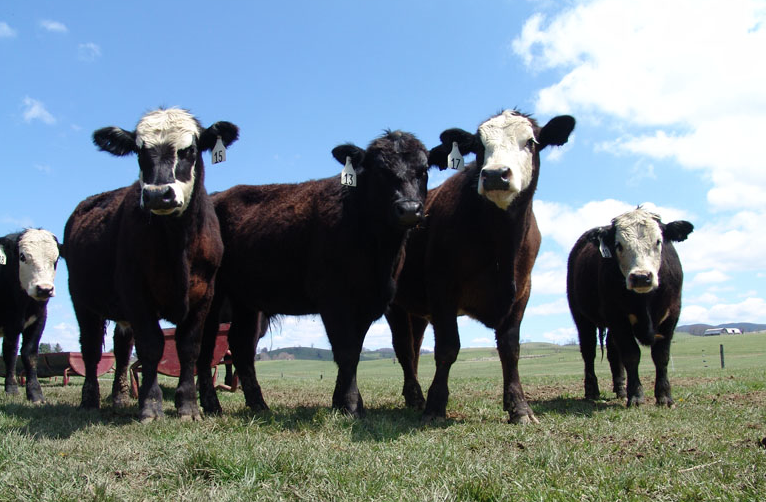
USDA says California and the US is eating a lot less red meat. The finding appears to be based on both supply and demand in 2014.
California’s production of red meat plunged during November 2014 totaled 107.0 million pounds, 11 percent lower than the previous month and 22 percent lower than November 2013.
US MEAT PRODUCTION DOWN FROM LAST YEAR
Commercial red meat production for the United State s totaled 3.76 billion pounds in November, down 9 percent from the 4.12 billion pounds produced in November 2013.
Beef production, at 1.85 billion pounds, was 10 per cent below the previous year.
Veal production totaled 6.5 million pounds, 29 percent below November a year ago. Calf slaughter totaled 35,900 head, down 41 percent from November 2013.
Pork production totaled 1.89 billion pounds, down 7 percent from the previous year. Hog slaughter totaled 8.81 million head, down 9 percent from November 2013.
Lamb and mutton production, at 11.5 million pounds, was down 3 percent from November 2013. Sheep slaughter totaled 173,600 head, 6 percent below last year.
In a move aimed at reducing risk to Delta smelt and potentially avoiding more severe water supply impacts later, operators of the State Water Project and Central Valley Project will proactively reduce pumping in the Delta over the next several days.
According to a Dec. 15 announcement, combined pumping levels for both projects will decrease from about 11,000 cubic feet per second (CFS) to roughly 7,000 CFS by Tuesday, Dec. 16.
The curtailment, which comes as modest storms are expected to increase runoff, is designed to avoid drawing turbid storm runoff toward the pumps in the south Delta that supply 25 million Californians and 3 million acres of irrigation farmland with all or part of their water.
“The turbidity generated by this first set of big storms is very high and presents a significant risk of creating a turbidity bridge in the central and south Delta,” the announcement said. “Creating an expansive turbidity plume into the central Delta may make future management of smelt distribution difficult. The turbidity generated as these first big storms of the season churn streambeds and sweep away debris may draw smelt closer to the water project pumps in the south Delta. By curbing pumping levels now, water project operators hope to avoid a situation that would lead to a marked increase in entrainment of either Delta or longfin smelt at the pumping plants and force a longer, more drastic cutback of pumping.”
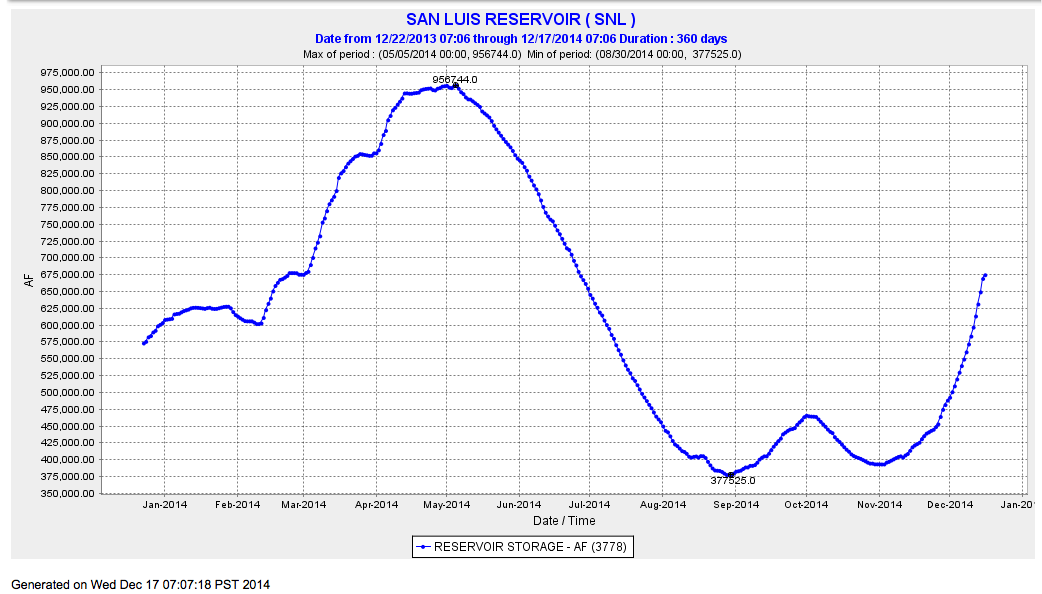
San Luis Reservoir south of the Delta is suppled strictly by pumping water south of the outflow to the Pacific to be used by California water users later in the year. The reservoir had been draining since May of 2014 from nearly 1 million acre ft down to 377,000. With the recent storms some 300,000 additional acre ft has been pumped into the lake mostly since the first of December. Now that flow will be reduce.But regulators say avoiding impacts on the fish will pay off later.
The curtailment, which could result in tens of thousands of acre-feet of water going uncaptured over the next several days, may allow water project operators to avoid the loss of hundreds of thousands of acre-feet of water supply later in the winter.
The Department of Water Resources and the U.S. Bureau of Reclamation, which operate the SWP and the CVP respectively, are coordinating Delta operations closely with federal and state wildlife agencies.
In December 2012, a plume of turbidity that extended into the central Delta led to severe pumping curtailments in order to avoid harm to smelt. As a result, hundreds of thousands of acre-feet of water were not moved into reservoir storage. Conditions quickly turned severely dry. In 2013, urban and agricultural water districts that depend upon the SWP and CVP got a small fraction of the supplies for which they contract.
Officials will continue to monitor turbidity levels in the Delta and the movement of Delta and longfin smelt, and will adjust pumping levels accordingly.
Colony Energy Partners Tulare LLC will receive a $5 million grant from the California Energy Commission to build a digester for processing waste. The digester will produce 2.8 million diesel gallon equivalents of biogas each year, displacing an equal amount of diesel fuel used by trucks in the San Joaquin Valley. Colony expects to start construction near the Tulare WWT plant in the next few months.
Almonds Have Big Pay Day
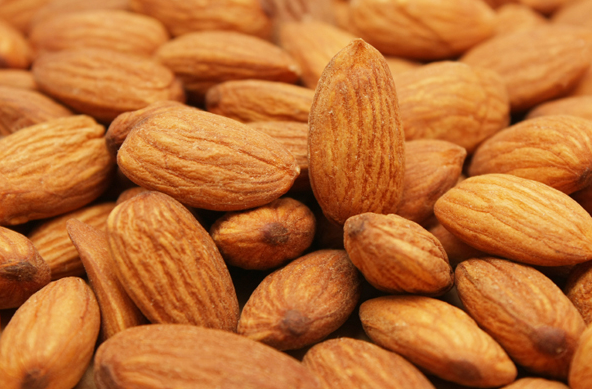
Almond production generates more than 100,000 California jobs and adds $11 billion dollars to the state’s economy, according to a study issued this month. The report from the University of California Agricultural Issues Center says almonds account for nearly one-quarter of the state’s agricultural exports. The study tracked the economic impact of almonds at every stage of production, from growing through hulling, shelling, handling and manufacturing.
Farm Bureau Honors Shirley Kirkpatrick
Decades of service to California farmers and ranchers led to awards for two people at the California Farm Bureau Federation Annual Meeting this week in Garden Grove including a Tulare County woman. Longtime Tulare County Farm Bureau staff member and agricultural advocate Shirley Kirkpatrick was honored with the Lifetime Service Award.
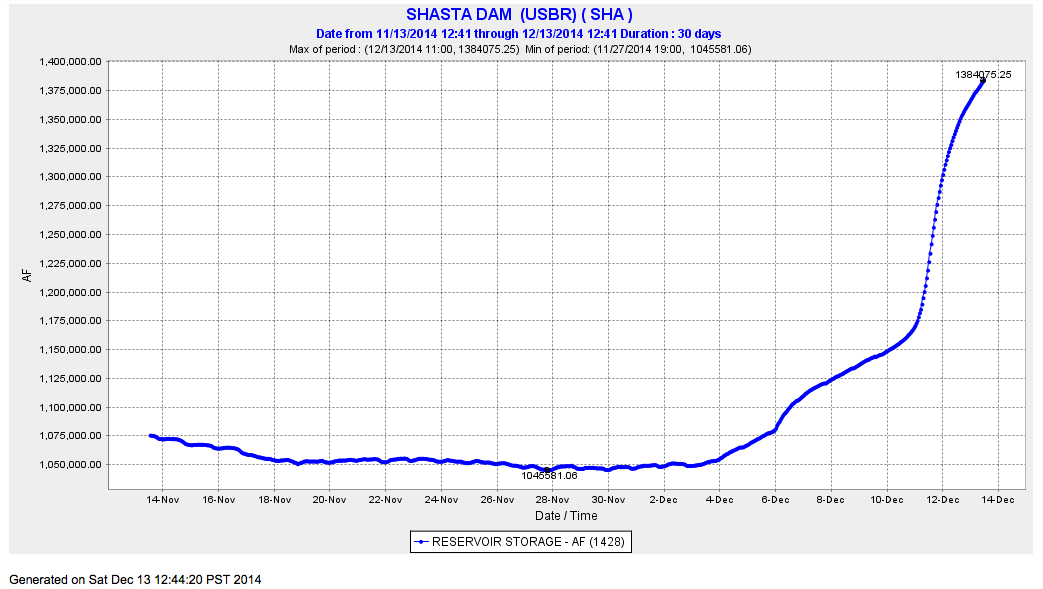
Filler Up: Reservoir level jumps by 38% in a few days – click to enlarge
There is no more important water reservoir in California than Shasta that feeds the mighty Sacramento River. That’s why water users including in Tulare County should be cheering today as this weeks storm helped add over 380,000 acre ft of water (by Sat AM) to the dam taking total storage from about 1 million acre ft to 1.38 million in a little over a week.Buckets of rain totaling 10 inches fell over two days this week through Friday morning taking this year’s rain gauge to 28 inches as of December 11. For all of last water year the dam received under 35 inches of precip. If Shasta does not have enough water, like last year, Friant districts here have to save their water above Fresno for the Exchange Contractors leaving us at “zero allocation.”
Some parts of California are likely to get wet every day over the next 10 days as a train of storms will deliver what Accuweather calls “drenching rain” into Northern California through the middle of December..
“The weather pattern through the middle of the month has the potential to bring 6-12 inches of rain from northern California to western Washington state and yards of snow to the high country of the northern Sierra Nevada and Cascades.
The cumulative amount of rain and snow could impact the drought in a positive way with time.”
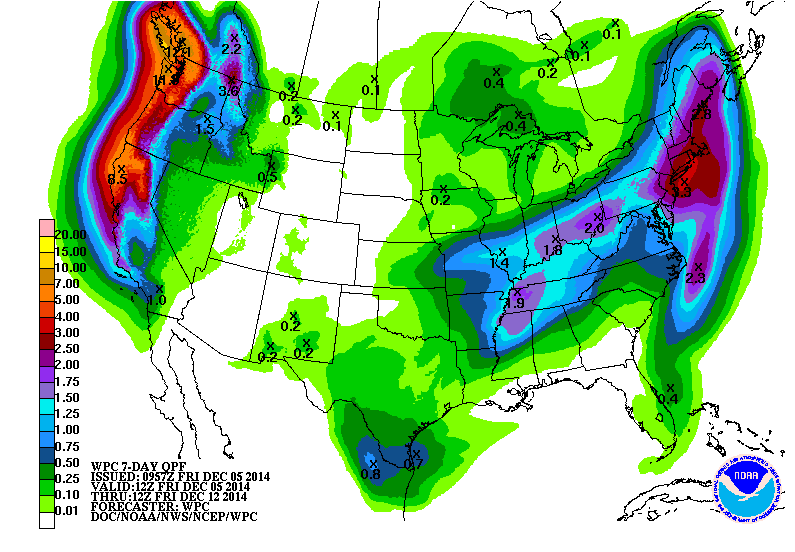
7 day NOAA precipitation forecast – Click to enlarge
This last weeks series of storms helped northern California and southern California get a soaking but middle California got only a moderate to small amount of rain and ski resorts in the Central Sierra were disappointed with the warm temps that caused precip to fall as rain up to 8000 ft.
China Peak’s website said it all.”Unfortunately the snow level through most of the wettest part of this storm was very high, well above all the resorts in California, including China Peak, even though we have one of the highest base and peak elevations in the state.
As of this morning, snow is expected late next week, December 11-12, decent amount, cold, followed by cold.”
Water watchers like the state’s farmers will be cheered by the fact that for the next 10 days, the city of Redding near Shasta Reservoir has better than a 50% chance of rain every day (Accuweather) as a wet pattern helps fill this key storage unit as well as provide a wet blanket over most of Northern California.
Rainfall at Shasta Dam stands at about 13 inches as of today, well ahead of the past year’s anemic pace for this date. The lake has been drawn down over the past two fall months and only now appears to be heading higher every day in the past week as finally more water pours in than is going out. If the reservoir shows a 19 inch rainfall total by mid-December (adding about 6 inches) that would be more than half the amount of rain that fell all water year in 2013/14 totaling 33 inches.The average annual rainfall at the dam is around 65 inches – about double last years numbers.
Shasta reservoir has plenty of room to fill with water storage just over 1 million acre ft today.The dam holds 4.5 million acre ft.
With this next round of storms ”much less rain and high country snow are likely to fall farther south in California, there will be a few rounds of needed moisture.”say Accuweather.
“The storm from this past Tuesday and Wednesday was only the beginning of a pattern that will deliver moisture in the form of rain and high-country snow to the West Coast.
Much more rain on a gradual basis is needed to alleviate the extreme to exceptional drought conditions extending back several years, centered on California.”
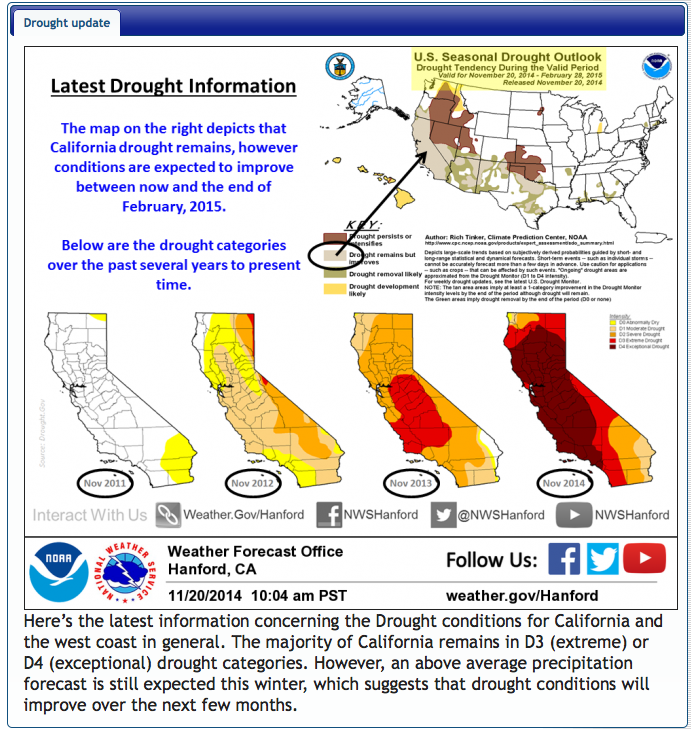
NWS Hanford has published this latest Seasonal Drought Outlook that predicts conditions to improve by March of next year with above average precipitation over the next few months.
There are a few signs already when you look at rainfall totals so far at 2 key state reservoirs compared totals the same time last year.
At Shasta Reservoir they have received about 9 inches ( Noon Saturday) so far this water year compared to just 2 inches this time a year ago. At Lake Oroville they have received about 5 inches compared to 2 this time a year ago.
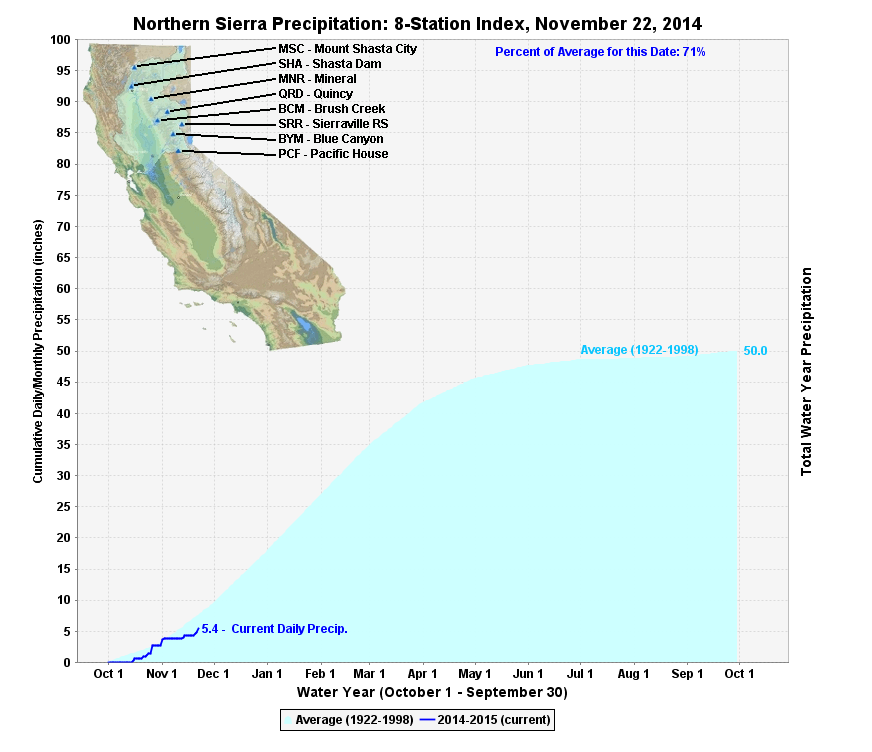
Here is the latest CDWR Northern Calif. Index compared to an average year showing totals just under average.
While this key part of the state is better off than last year at this time that does not help refill these most important reservoirs like Shasta yet as more is going out than coming in even though it should build by now.
Bottom line – keep it coming.
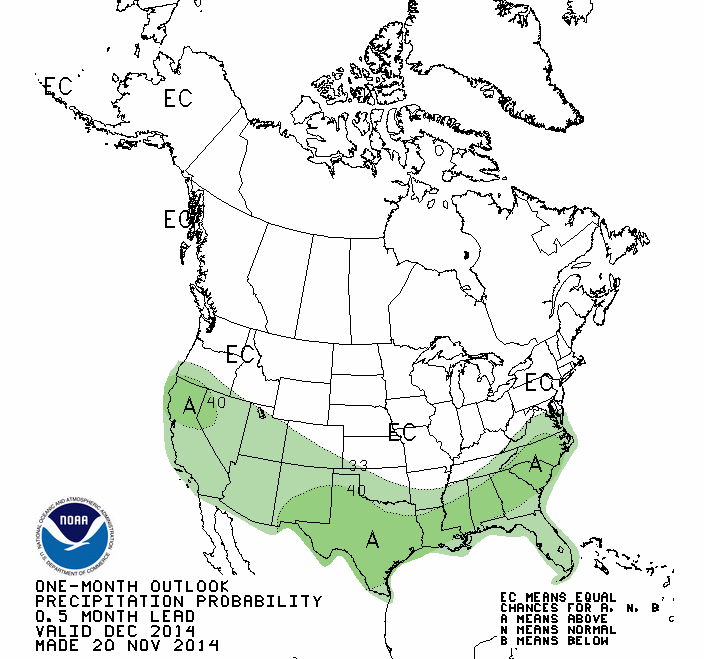
Here is the December outlook according to the Climate Prediction Center.
After meeting with President Obama this week,United Farm Workers president Arturo Rodriguez issued a statement detailing part of what Obama is set to announce late Thursday.
“We were pleased to learn from the President today that at least 250,000 farm workers (and at least 125,000 California farm workers) will be eligible for deportation relief under his executive action,” said Arturo Rodriguez, the president of United Farm Workers (UFW), in a statement Wednesday.
“The president committed to working with UFW to do everything possible to make sure that every farm worker who qualifies for the program gets enrolled, and we are prepared to work with him and Congress to finish the job by passing legislation that fully addresses this issue once and for all.”
Today’s meeting follows a mock Thanksgiving feast in front of the White House, in which farm workers from across the country presented an array of food items harvested and processed by immigrant workers.
Washington GOP leaders may be incensed that President Barack Obama plans to issue an executive order in the next few days that could allow up to 5 million undocumented residents to gain some sort of legal status suspending some deportations.
But many California farmers are not ready to criticize yet. Some favor the idea if it helps them.
While GOP Congressman Devin Nunes of Tulare blasted the unilateral move along with many fellow Republicans saying “even before the new Congress is seated, he plans to dramatically change the immigration system by signing executive orders, apparently unconcerned that such brazen moves would severely damage efforts at bipartisan cooperation on immigration and many other issues.”
But California farmers have been waiting a long time for relief.
Not ready to knock it yet is Dennis Nuxoll, Washington, D.C.-based vice president of federal government affairs for Western Growers, Irvine, Calif. Nuxoll said recently that he wants to see the details of what President Obama may propose relating to immigrant farm workers before judging it.
Fresno County Farm Bureau chair Mark Sorenson says “I am not saying I am in favor of it or against it but we want to see reform where we can keep the workers who are already here and plan on having a workforce in the future.” Sorenson, who farms near Caruthers, says some 85% of the farmworkers on local farms were born elsewhere.
“We need something“ he adds.
“The GOP has failed to get it done. House speaker John Boehner promised us at the Fairgrounds in Fresno in 2013 he would get it done. But it never happened.”
Fresno farm leader Manuel Cunha,as usual,does not mince words.
“The GOP has failed to get it done. House speaker John Boehner promised us at the Fairgrounds in Fresno in 2013 he would get it done. But it never happened.”
Cunha says “the ag industry is frustrated by the lack of progress for the past 10 years. The GOP can’t blame the other party all the time. They controlled the presidency and both houses of congress in 2007 and didn’t do anything.” Cunha is the President of the Nisei Farmers League.
Cunha says if the Obama plan allows farmworkers here to stay – he would favor it.”If it only allows the dreamers to stay, that does not help us.”
“If the executive order allows farmworkers to stay under a work permit instead of full legal status – that’s OK.”
”
He adds that a major problem now is the undocumented worker cant get healthcare benefits even though the pick the food we eat.”
In apparent agreement is a Sacramento Bee editorial from a few days ago.
“White House officials are debating whether to include protections for farmworkers who have entered the country illegally but have been employed for years in the agriculture industry, a move that could affect hundreds of thousands of people. It shouldn’t be a point of contention. The agricultural industry needs experienced hands.
Although the details remain to be unveiled, we do not see much of anything to quibble with. The people Obama wants to help are integral to the fabric and the economy of California and the Southwest. They should not be ignored.”
While GOP leaders claim Obama’s anticipated order would be illegal and may prompt calls for impeachment – both Ronald Reagan and George HW Bush offered amnesty to illegals in their time. Reagan’s move came in 1987. Bush extended amnesty before any legislation passed,although it did eventually.
Obama’s likely move needs legislation to make it permanent.
There has been a decline in the volume of California’s ag exports this fall and the surging value of the US dollar vs other currencies is not helping. Add the drought to this picture and it could turn out not to be a pretty one.
The rising dollar could contribute to a slowdown in farm exports including crops grown in the Central Valley.This week the dollar index – valued against a basket of world currencies is up around 10% from a year ago – at a 4-year high.
Recently,the dollar hit a 7-year high vs the Japanese yen.The move means US goods are harder to sell overseas because they are purchased in the foreign currency.
The dollar also hit a two year high vs the Euro where we sell plenty of California grown nuts.
Already this fall’s shipment of nuts overseas is lower than it was last year. The Almond Board of California reported Nov 11 that exports were down on this fall’s crop by 10% in September and 17% in October. Domestic shipments were up, helping some.
Part of the equation is a smaller almond crop by around 10% industry sources expect.
Meanwhile US dairy exports fell 16% in September from year ago says the US Dairy Export Council.Volumes have fallen since March when an all time record volume of 200,143 tons was shipped. This marks the lowest monthly volume since February 2013. Shipments averaged176,000 tons a month thru the first eight months of this year.
This decline has been triggered by several developments worldwide; supply and demand triggers that have put U.S. exports at a clear
disadvantage says the Council.
“Milk supplies have increased significantly in Europe and Oceania. Meanwhile, China buying has slowed and Russia instituted a ban on
products from Europe and others.Nonfat dry milk/skim milk powder exports were down 29% versus one year ago and at the lowest level in 19 months. At 32,098 tons, milk powder shipments were also slightly below two years ago.”
Overall Beacon Economics says an analysis of trade data shows exports of agricultural produce from California declined by 6.2% in the latest quarter from one year ago, while exports of processed food products dropped by 4.1%.
Short Walnut Crop
Higher walnut prices
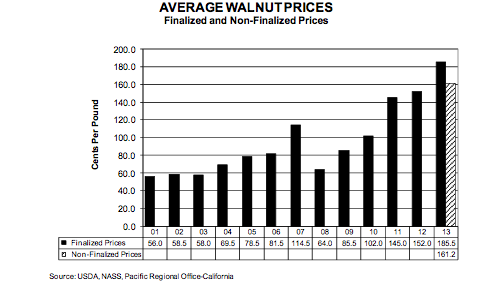
Walnut prices that have soared in the past 2 years could take a hit too some fear.Walnuts depend on exports to keep their value high and now account for 62% of shipments. Exports are up about five-fold since 1985 says the California Walnut Commission. USDA says the 2013 crop averaged just under $2/lb – $1.85 they said. That’s up from as low as 64 cents/lb in 2008.
.
The US walnut crop forecast for this fall was expected to be a record 545,000 tons, up 11 percent from 2013’s production of 492,000
tons. But as nut growers neared the end of their harvests, many said their crops may not reach preseason estimates. Almond and pistachio growers say a combination of drought and warm winter weather conspired to reduce harvests in many orchards. Some trees were removed or abandoned due to water shortages.
This week the October walnut shipment report came out showing year to date numbers -Sept& Oct. The report says export of in-shell nuts was down 12.46%, down 14 million lbs and shelled pounds up 24% – about 5 million lbs higher. The upshot -exports are down. And domestic sales are down 11%.
But Visalia walnut farmer Sam Sciacca expects export demand he has seen from Japan this year to help sustain export sales.So far this season shelled walnut shipments are about double last year’s number driven by the perceived health benefits for walnuts in Japan says Sciacca.”Europe could be down because of the strong dollar” he fears.
“I still see prices to stay around where they are at $2/lb or a little lower with demand up and the supply down.”
Both walnut and almond production this year is now expected to be lower but still, the strong dollar will make it harder to keep prices high.
Nut farm land whether almond, pistachio or walnut continues to be the highest valued farmland in every county in the SJV according to the American Society of Farm Managers and Rural Appraisers’ California chapter.

 USDA says California’s egg production during October totaled 375 million, up 20 million from September production and down 43 million from October 2013. The average number of layers during the month totaled 15.6 million,down 0.2 million from last month, and down 11 percent from October 2014. Eggs per 100 layers during the month were 2,408, compared to 2,251 a month earlier and 2,394 in October 2013.