California’s Three Largest Dairy Cooperatives Submit Proposal for California to Join the Federal Milk Marketing Order

Proposal to the U.S. Department of Agriculture will provide consistent regulation across the United States
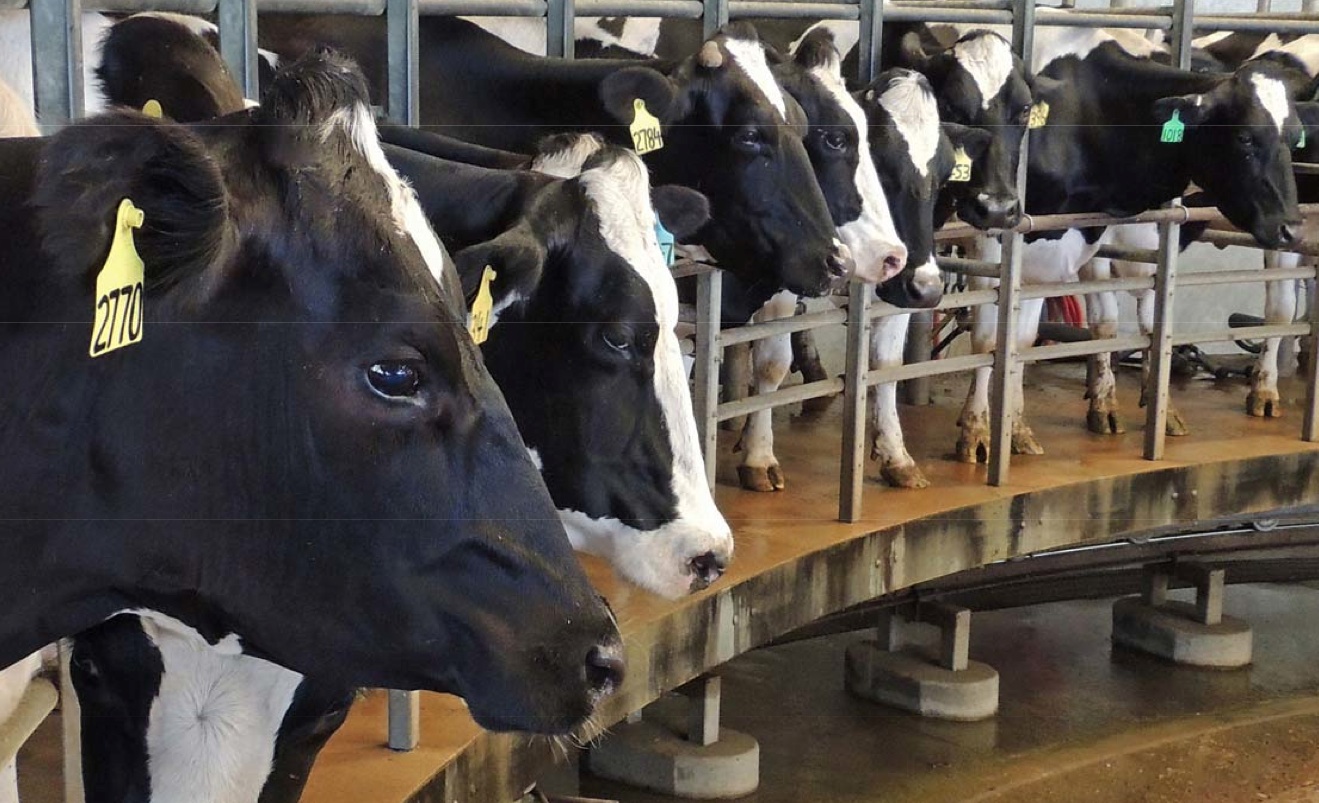
cows -07-08 at 12.06.50 PMVISALIA, Calif., SACRAMENTO, Calif. and ARDEN HILLS, Minn., Feb. 6, 2015 /PRNewswire/ — Underscoring continued support of their farmer-owners, the three largest dairy cooperatives in California submitted a joint proposal to the U.S. Department of Agriculture (USDA), petitioning for milk producers in the state to begin operating under a Federal Milk Marketing Order (FMMO). California Dairies, Inc. (CDI), Dairy Farmers of America, Inc. (DFA) and Land O’Lakes, Inc. submitted the proposal this week.

Under existing regulations, California dairy farmers operate under statewide milk pricing plans. The majority of farmers in other states operate under a FMMO, which provides uniform dairy prices for milk based on market prices. Shifting to a FMMO for California supports the desire of these cooperatives’ dairy farmers to receive more equitable, market-based milk prices.

Changes made to the California state order before 2011 resulted in California’s dairy farm families enduring unsustainable pricing for their milk. Cooperative leaders from CDI, DFA and Land O’Lakes, Inc. began advocating for a FMMO to work with the California Department of Food and Agriculture to correct pricing disparity.

As the first step in the process, the proposal requests USDA to announce a regulatory hearing that will provide ample opportunity for other dairy industry organizations, companies and producers to provide input.


Ag Briefs: Milk / Nuts / Energy Beets / Winegrapes

February 3,2015

Butter & Dry Milk Production Fall Big In Late 2014

CDFA says butter production fell 11percent in December year over year and down  3.4% for the whole year. Off by far worse  was dry milk  production off 56% in Novembe and 39% in December putting i it down 21.5% for the year.
Cash dry milk price has dropped by half form a year ago ago to $1 a pound.
While dairy farmers are facing lower margins this year unlike 2009 when many Valley dairies threw in the towel – feed costs are not at record highs  with corn now  selling for $3.70 a bushel. Also operations are not as stressed on bank loans.

Strong Dollar Hurting Nut Sales

click to enlarge
click to enlarge

Exports of almonds are down 16% this crop year and walnuts too are seeing lower sales overseas.Exports of California walnuts are  down 17% in December. The  strong US dollar may be to blame as our products are more expensive in the local currency.The index is up about 15% this year.

Farmers test processing of ‘energy beets’
A pilot plant in the San Joaquin Valley has begun processing sugar beets into ethanol. The demonstration biorefinery in Five Points will test processes for converting the beets. Farmers and researchers are testing a special variety of sugar beets, known as “energy beets,” which can deliver high yields of ethanol. Progress made at the pilot plant could lead to construction of a commercial-scale biorefinery later this decade.
By 2020, the US must have 36 billion gallons of renewable fuels in the market with 21 billion gallons from advanced biofuels. Advanced biofuels produce 50% less carbon emissions compared to petroleum-based fuels, reducing the greenhouse gasses that cause global warming.

New varieties could boost avocado production
The great majority of California-grown avocados come from coastal Southern California, but a University of California researcher says the crop shows promise in the San Joaquin Valley. Summer temperatures in the Central Valley generally prove too warm for traditional avocado varieties, so the researcher has been breeding new varieties better adapted to the region. She says the new varieties feature eating quality comparable to the popular Hass avocado.

With Big Pullout  – Winegrape Acreage May Stay The Same

Some 22,000+ acres of grapes were removed in 2014 in the interior of the state says Allied Grape Growers. The rate of the pullout is triple that of  2013.Of the 22,000 – about half were winegrapes. The estimate is that  up to 30,000 acres of winegrapes will be removed by the 2015 harvest leaving total producing acres of wine grapes about the same.

Shasta Set To Pass Last Years Storage Totals

February 2,2015

SF didn’t get any rain in January  but saw an atmospheric river in December and now one bearing done on us next weekend.When it rains – it pours.

atmospheric river
atmospheric river

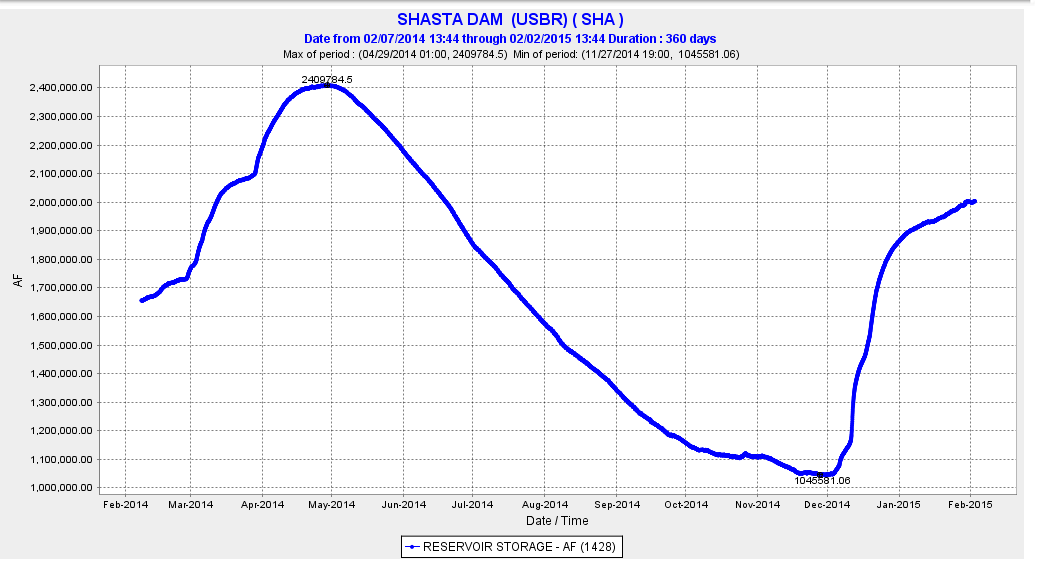
With this weeks atmospheric river storm in the offing (one foot of rain  in the N Bay says NWS-SF ) promising to drop 7 to 12 inches of precipitation in the Shasta reservoir region – it is possible we will pass last year’s totalShasta storage of 2.4 million acre feet in the next 3 weeks from its current level at 2 million.

Shasta is a key reservoir – the headwater to the mighty Central Valley Project. With only 1 million acre feet in storage as of last December 1 the reservoir quickly picked up around 900,00af in December (see how chart shoots straight up) and the rest by the end of January. Northern California saw a an atmospheric river event December 11 and 12,13,14.

click to enlarge
click to enlarge

Now with these series of wet events coming next weekend the lake level is likely to rise rapidly again on the way to passing that very low 2.4 MAF level of 2014.

That would put it at just a little over half full as the reservoir holds 5.4 MAF. The average for this time of year is 3.2 MAF and with enough wet weather in February we could reach that level.

That would put us in striking distance to the 4 million acre/ft or better high water level for April we saw in 2010, 2011 and 2012 before falling back to 378 mil/af in April 2013 and of course that meagre 2.4 MAF last year.

What’s the bottom line? Shasta fills if we have enough atmospheric  rivers coming into the north part of the state. With the  ground well saturated with day after day of rain, most rain does not sink in the ground but flows to the lake, notes a Bureau spokesperson.

Mozzarella Cheese Over 50% Of State Cheese Production

February 2,2015
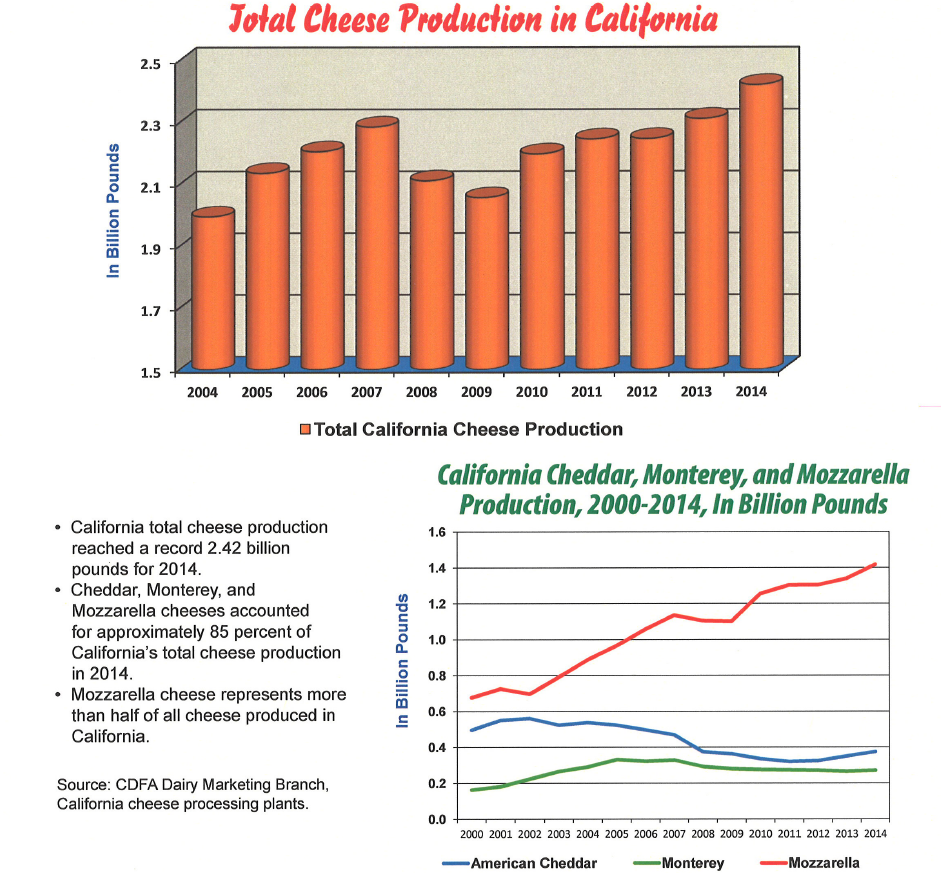
Screen Shot 2015-02-02 at 12.59.09 PMNot all dairy products are doing well with consumers theses days. Not so cheese and particularly mozzarella cheese enjoying a boom in consumption and production.Think SuperBowl weekend and all the Mexican food and pizzas gobbled up watching the game! Pizza Hut announced after the game they set a sales record this weekend.
While America’s cheese consumption has increased 42% over the last 25 years, according to U.S. Department of Agriculture it has been mozzarella that is tops in California, the US’s largest producer. Production of the low fat cheese variety has doubled in California since 2000 according to CDFA while  Monterey and Cheddar production has actually declined in the Golden State.
Incredibly, Mozzarella now accounts for over 50% of all cheese making in California as of 2014.
Tulare/Kings are by far the biggest producers of mozzarella cheese with major plants in Tulare and Lemoore accounting for most of that.
Consumption of the mild tasting cheese has taken off as American are eating out more often , and when they do, frequenting Mexican and Italian restaurants.  Consider that these restaurants and pizza makers are piling on more cheese than they used to with Domino’s 2010 redesign of their pizzas adding 40 percent more cheese.


Click to enlarge
Click to enlarge

Santa Barbara Aquaponics Farm Goes Organic

Water-efficient farming results in bountiful organic produce for chefs, consumers

GOLETA, Calif. (January 28, 2015) – Sustained Harvest Farms is leading an organic farming movement taking root in Santa Barbara County that uses minimal water and shortens the time bringing crops to market.
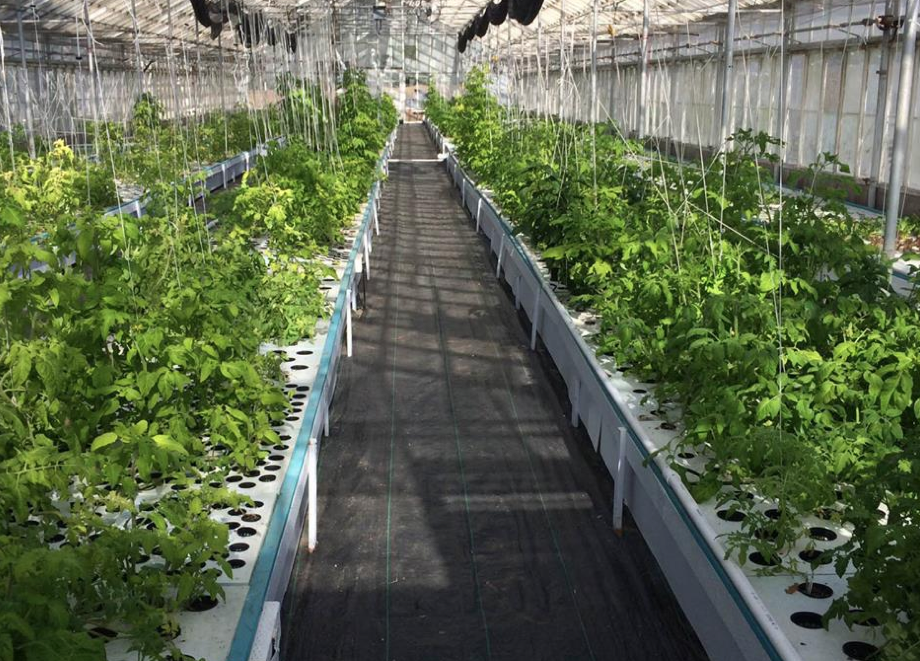
The largest commercial aquaponics farm in Santa Barbara and Ventura counties, Sustained Harvest Farms (SHF) uses nutrient-rich water fed by fish to grow vegetables in greenhouses on a bluff overlooking the Pacific Ocean. This sustainable farming method allows for most crops to be grown off-season and produce can be harvested as quickly as 30 days. Aquaponics farming uses just 10 percent of the water used in traditional farming.
Founded in 2014 by Miles and Linda Gassaway, and Linda’s son, John Edwards, SHF is supplying its USDA-certified-organic produce to area restaurants, grocery stores and direct to consumers at local farmers’ markets.
“With chefs and consumers placing such a strong emphasis on locally sourced and organic produce, we’re pleased to be able to provide premium-quality crops to the Central Coast,” said Linda Gassaway, co-owner of Sustained Harvest Farms.
The family team decided to open the 12,000-square-foot farm north of Goleta after seeing California endure a record drought. SHF uses just 200 gallons of water per week to feed their crops of specialty greens, lettuces, kale, chard, onions, celery, basil and other herbs.
Screen Shot 2015-01-28 at 10.59.48 AM“Water is scarce and isn’t going to change, so we need to be far more efficient in how we use water,” John Edwards said. “We strongly believe that using an aquaponics environment to grow organic produce is our best chance for sustainability in farming.”
The closed-loop aquaponics system grows the plants in water that is fed from several water tanks totaling 9,000 gallons, stocked with nearly 5,000 koi, comets and catfish. This nutrient-packed water helps the plants grow quickly, allowing SHF to deliver specialty produce to restaurants in about 30 days, less than half the time of traditional farms. SHF plans to sell the full-grown koi fish to local landscape contractors, and the other fish are used strictly to provide nutrients.
SHF uses only non-genetically modified organic seeds to start its seedlings, and the growing process is overseen by Edwards. The plants are suspended in net pots in shallow troughs with water continuously circulating throughout. The greenhouses moderate the temperatures and fans continuously circulate the air. All produce and fish are raised without pesticides, earning USDA organic certification.
As part of SHF’s environmental philosophy, produce will be sold within 100 miles of the farm, from Los Angeles to San Luis Obispo. The family farm also donates a portion of each month’s harvest to local food banks.
SFH is approved to sell at the Goleta and Gaucho Farmers markets, and looks to add additional Farmers Markets within the region, including Santa Barbara and Ventura farmers market. It also has contracts with high-profile chefs from top-ranked restaurants in the area. This initial success has led Sustained Harvest Farms to expand its growing operations by 2,000 square feet to keep up with the anticipated demand.
The company’s founders see aquaponics as the future of farming, especially in urban areas where smaller-scale systems can be set up for homes, schools and businesses.
“We made a conscious choice to do something that we believe will be self-sustaining, and an important component to the future for our children, grandchildren and our local communities,” said longtime Ventura resident Linda Gassaway. “I love growing produce. We’re the happiest when we get to grow beautiful, delicious produce for people who are equally happy to cook and create with it.”

Bird Flue In Foster Farms Turkeys

January 26,2015

In the first significant find in the US since 2004 a Foster Farm turkey ranch has been diagnosed with highly contagious bird flue.
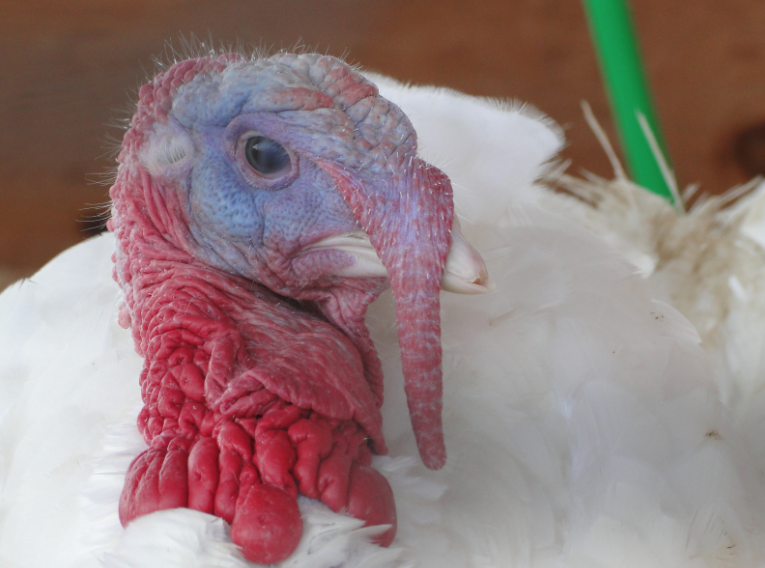
The USDA-APHIS has confirmed a diagnosis of avian influenza in a flock of turkeys belonging to Foster Farms in Stanislaus County, California. The initial isolation of the virus was performed in the Turlock Laboratory of the CAHFS and was characterized  as an H5N8 strain by the National Veterinary Services Laboratory in Ames, IA. This strain has been isolated from migratory waterfowl along the Western Flyway in recent weeks.
According to press reports Foster Farms is cooperating with Federal and State officials to destroy the flock. A significant challenge will be to limit possible extension of the infection which may have spread from the farm during the incubation period. Flocks may shed virus before demonstrating clinical signs of disease. Common feed mills with their delivery vehicles serving multi-species poultry operations or different integrations represent critical points for dissemination of infection.
Foster Farms has implemented a monitoring program for avian influenza since the outbreak of low-pathogenicity H1 strain AI in 2001. Appropriate surveillance has been initiated in terms of OIE mandates.
Several avian flu cases have been reported in wild birds and backyard poultry flocks in the U.S. Pacific Northwest since mid-December, prompting China to ban poultry imports last month.
The USDA has informed the OIE and trading partners of the outbreak of a Class A disease. It is hoped that importers of poultry products from the U.S. will accept the principle of regionalization and also allow transport of shipments of raw chicken in sealed containers through California to export ports.

Screen Shot 2015-01-26 at 12.34.30 PM

Spinach / Lame Dairy Cows / Tomatoes

January 19,2015

Stores Out Of Spinach – But Not Farmers Market

That cold spell that hit California around the first of the year has  cut short the Imperial valley  spinach crop that usually supplies the West Coast this time of year. The cupboard is bare at many markets and the San Luis Obispo Trader Joes  was completely out of Spinach as of the last weekend.

But no so at the Los Osos Farmer’s market today that featured multiple local growers with plenty of spinach- a but more expensive  to be sure,

Ag Scientist Temple Grandin Both Cheers and Scolds Dairymen

Speaking to a friendly crowd  of farmers last week in San Diego  Colorado Tate professor  Temple Grandin did not call for more regulation of animal welfare issues  but insisted that producers step up to the plate. Grandin made headlines some years back  when she was hired by McDonalds to improve  their animal  welfare practices.
“I am really happy with the slaughterhouses work: Grandin said in an interview.”The used to be awful.

Temple Grandin receives AFB award

”Grandin was given a medal at the American Farm Bureau convention.  One account says-

“Today she is concerned with what she calls “biological system overload”—the use of genetics and weight gain to get the maximum amount of meat, milk, or eggs out of an animal. Breeding to emphasize single genetic traits is at the root of some of the problems, and farmers and ranchers should focus on “optimal rather than maximum” production, she said.

Part of Grandin’s power in the food industry is that she eats meat, is practical, and is sometimes wary of animal-rights activists.
“I eat all meats. Don’t worry. I am no vegan or vegetarian,” she said. But she added, “We have to give the animals that raise the food a decent life. We have to do things right.”

Grandin recently scolded dairymen of sending too many lame animals( spent dairy cattle ) to the slaughterhouse instead of culling them on the farm. Speaking on This Week In Agriculture Grandin said the number of lame animals sent to the slaughterhouse  continued to climb and now is 30 percent  of all animals;

She says farmers “should forget trying to defend gestation crates for sows because consumers will not accept them. Instead, she said, farmers should concentrate on defending genetic modification of seeds because it makes no-till farming possible, and pointing out that ranching helps the land because grazing animals keep certain plants from dominating the landscape, and wildlife drink the water provided for food animals.”

Record 15 Million Tons Of Tomatoes Expected.

California’s tomato processors reported they have, or will have, contracts for 15.0 million tons this year, as of January. If realized this will be largest crop on record. Processors estimate that the contracted production for 2015 will come from 310,0 00 acres producing an average yield of 48.39 tons per acre.  The contracted planted acreage forecast is a 7 percent increase from what was expected.

Westlands – US Deal Told

January 11,2015

Screen Shot 2015-01-11 at 7.04.42 AMA news report today in the SF Chronicle say the US government and Westlands Water District have come to an understanding over the irrigation dispute festering for the past 20 years. The deal would lead to final retirement of more tainted farm lands in Westlands and perhaps a brighter future for these lands becoming a solar park.Here is what the newspaper reported.

“Details of the deal between Westlands and the federal Bureau of Reclamation have not been revealed to members of Congress, who would have to approve it. But according to a short “principles of agreement” document that has been made public, the deal would forgive $342 million in federal debt that Westlands owes for construction of the 1960s extension of the Central Valley Project to deliver water to the San Joaquin Valley farms.
In return, taxpayers would be relieved of an estimated $2.7 billion obligation to remove the contaminated water that results from the irrigation. Resolution of the drainage problem would be left to Westlands farmers.
Westlands would not have to retire any land beyond what it has already taken out of production because of salt buildup, even though federal agencies have recommended retiring more than 300,000 acres, or half the district, on the grounds that the only way to end the drainage problem is to stop irrigating the land.”

U.S. border apprehensions of Mexicans fall to historic lows

from Pew Research
January 11,2015
By and 9 comments

For the first time on record, more non-Mexicans than Mexicans were apprehended at U.S. borders in 2014 by the Border Patrol, according to a Pew Research Center analysis of more than 60 years of Border Patrol data. This shift is another sign that unauthorized immigrants from Mexico are crossing the U.S.-Mexico border significantly less often than they did before the Great Recession.

U.S. Border apprehensions of Mexicans fall to historic lowsAbout 229,000 Mexicans were apprehended by the Border Patrol in fiscal year 2014 compared with 257,000 non-Mexicans during the previous year, according to recently published Border Patrol data. Taken together, total apprehensions of Mexican and non-Mexican unauthorized immigrants (more than 486,000) were up 16% over the previous year.

These numbers are dramatically different than in 2007 when Mexican apprehensions totaled 809,000, compared with just 68,000 non-Mexicans. The number of Mexican immigrants apprehended at the border peaked at 1.6 million in 2000, the Pew Research analysis showed. The last time Mexican apprehensions were as low as they are now was in 1970 when 219,000 Mexicans were apprehended. In 1970, non-Mexican apprehensions totaled just 12,000.

How Maize Came To Southwest

January 6,2015

Screen Shot 2015-01-08 at 10.18.17 AM

After it was first domesticated from the wild teosinte grass in southern Mexico, maize, or corn, took both a high road and a coastal low road as it moved into what is now the U.S. Southwest, reports an international research team that includes a UC Davis plant scientist and maize expert.

The study, based on DNA analysis of corn cobs dating back over 4,000 years, provides the most comprehensive tracking to date of the origin and evolution of maize in the Southwest and settles a long debate over whether maize moved via an upland or coastal route into the U.S.

Study findings, which also show how climatic and cultural impacts influenced the genetic makeup of maize, are reported Jan. 8 in the journal Nature Plants.

The study compared DNA from archaeological samples from the U.S. Southwest to that from traditional maize varieties in Mexico, looking for genetic similarities that would reveal its geographic origin.

“When considered together, the results suggest that the maize of the U.S. Southwest had a complex origin, first entering the U.S. via a highland route about 4,100 years ago and later via a lowland coastal route about 2,000 years ago,” said Jeffrey Ross-Ibarra, an associate professor in the Department of Plant Sciences.

The study further provided clues to how and when maize adapted to a number of novel pressures, ranging from the extreme aridity of the Southwest climate to different dietary preferences of the local people.

Excavations of multiple stratigraphic layers of Tularosa cave in New Mexico allowed researchers to compare genetic data from samples from different time periods.

“These unique data allowed us to follow the changes occurring in individual genes through time,” said lead author Rute Fonseca of the University of Copenhagen.  Researchers used these data to identify genes showing evidence of adaptation to drought and genes responsible for changes in starch and sugar composition leading to the development of sweet corn, desired for cultivation by indigenous people and later Europeans.

The international team of authors also included Bruce D. Smith of the National Museum of Natural History at the Smithsonian Institution and M. Thomas P. Gilbert, University of Copenhagen. The study was funded primarily by the Danish Council for Independent Research and a Marie Skłowdowska-Curie fellowship from the European Commission.