
 Valencia Orange Crop Down Again
USDA is forecasting this year’s Valencia orange crop will be 20 million cartons. half the size it was as recently as 2006.In 2012 there were 25 million cartons. The fruit has been losing favor with growers looking for higher returns from other citrus varieties. Farmers have pulled about 5000 acres since 2012 in the state. The fruit is prized for juice which is down in popularity.
As for this season, it has been dry in many areas and measurements are indicating an average fruit size, but the fruit set has been negatively impacted. The USDA survey data indicates an average fruit set per tree of 545, well below the five-year average of 639 and the lowest set since the 2008-09 season. The average March 1 diameter was 2.571 inches, slightly above the five-year average of 2.562.
Costco’s Organic Produce Volume Doubles
Produce news reports say that Costco Wholesale Corp.’s sales of organic produce have seen tremendous growth recently. In 2014, the company’s organics were approaching $3 billion in sales, which Richard Galanti, chief financial officer, said was more than twice what the company did two years earlier.
“It’s growing fast,” he said in a conference call discussing Costco’s operating results for the first half of fiscal 2015. “I don’t know if it’s 50 percent a year, but it’s certainly growing at a high… number. And it’s great for us, because we show even a better value on that stuff than some of the things that it replaces.”
Category: Agriculture

State Board Allow More Water Exports
March 9,2015-
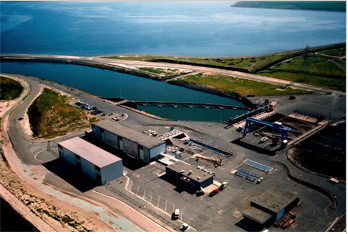 Overruling their executive director the State Water Resources Control Board Thursday issued revisions to its Feb. 3 Temporary Urgency Change Order covering state and federal water project operations amid the continuing drought.
The decision to allow some flexibility in deciding whether to allow some limited water exports south of the Delta came on the urging of of federal and state fish and wildlife agencies as well as political reps from both sides of the aisle.
Water districts south of the Delta hope some small amount of water can be sent south instead of being allowed to go out to sea to bolster storage in San Luis reservoir for summer irrigation.
According to the State Board, the revisions to export increases are intended to address the extensive written and oral comments on the human suffering caused by the drought, especially related to drinking water and job losses
The State Water Resources Control Board Thursday issued revisions to its Feb. 3 Temporary Urgency Change Order covering state and federal water project operations amid the continuing drought.
Specifically, the revised order:
Clarifies that water saved in reservoirs as a result the temporary urgency change petition must be used consistent with the Drought Contingency Plan and Temperature Management Plans for Delta operations, and is not subject to the discretion of the State Board’s Executive Director.
Clarifies that export limits do not apply to water transfers by State Water Project contractors or Central Valley Project contractors to farmers and urban water users south of the Delta.
Grants limited approval of additional exports under certain conditions. Under the conditions of the order, increases would only be approved when the Delta outflow in between 5,500 cubic feet per second and 7,100 cfs, when the Delta Cross Channel Gates are closed and when Department of Water Resources or the Bureau of Reclamation determine increases are needed to meet minimum health and safety needs.
According to the State Board, the revisions to export increases are intended to address the extensive written and oral comments on the human suffering caused by the drought, especially related to drinking water and job losses.
The State Board’s revised order concludes that “while further reductions in Delta outflows will likely have a negative effect on fish and wildlife, the approval of an additional intermediate export rate, that is only available for minimum public health and safety needs, is reasonable when weighed against the human suffering of the drought.”
A press release issued by the State Board said of the revisions: “the temporary urgency change orders approved by the executive director seek to find a balance between these competing needs in the face of historic dry conditions. Unfortunately, the drought has left California with no good options, only hard choices. This order makes further revisions to operations that benefit water supply while still maintaining minimal fish and wildlife protections.”
The order says “Under Petitioners’ proposal to increase unconditionally the maximum export rate to 3,500 cfs when Delta outflow is between 5,500 and 7,100 cfs, natural and abandoned flows would be shifted on a one-for-one basis from estuarine protection to south of Delta export. Assuming continued dry conditions, this intermediate export proposal could shift up to an additional 3,200 af per day for up to 20 days in March, with the likely monthly tradeoff between Delta outflow and exports ranging from 47 to 59 TAF in March.
While Valley farmers urged more water exports ,fish groups criticized the decision.

Chinese Milk Plant For Lindsay A No-Go
March 4,2015
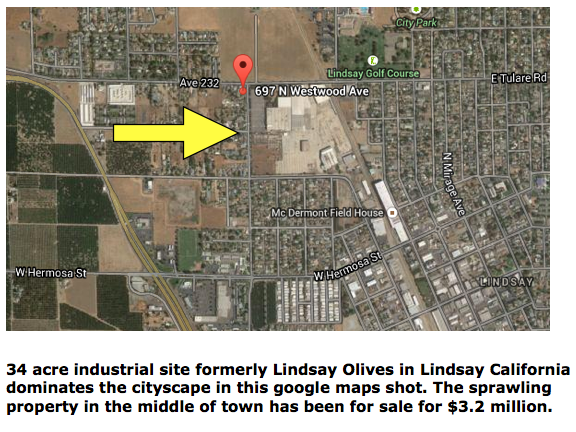
The deal to sell the former Lindsay Olive plant to a Chinese milk producer has fallen through confirms the realtor for the seller. “The contract expired February 24 – and we’ve put the property back on the market” says Marty Zeeb of Zeeb Commercial.”The potential buyer has suggested they may still be interested however.”
First revealed publicly last April the potential buyer had met with the City of Lindsay and said they would process milk product to be sent back to China. They told officials they needed a workforce of as many as 300 that they would have hired locally.
The shuttered food processing plant,last used by a frozen food maker, would have required a major investment to carry out the dairy foods plan.

McDonald’s Announces New Antibiotics Policy Inclding rbST
March 04, 2015-
 McDonald’s USA today announced new menu sourcing initiatives including only sourcing chicken raised without antibiotics that are important to human medicine.
In addition, McDonald’s U.S. restaurants will also offer customers milk jugs of low-fat white milk and fat-free chocolate milk from cows that are not treated with rbST, an artificial growth hormone.
“Our customers want food that they feel great about eating – all the way from the farm to the restaurant – and these moves take a step toward better delivering on those expectations,” said McDonald’s U.S President Mike Andres.
McDonald’s has been working closely with farmers for years to reduce the use of antibiotics in its poultry supply. This new policy supports the company’s new Global Vision for Antimicrobial Stewardship in Food Animals introduced this week, which builds on the company’s 2003 global antibiotics policy and includes supplier guidance on the thoughtful use of antibiotics in all food animals.
All of the chicken served at McDonald’s approximately 14,000 U.S. restaurants comes from U.S. farms which are working closely with McDonald’s to implement the new antibiotics policy to the supply chain within the next two years.
“McDonald’s believes that any animals that become ill deserve appropriate veterinary care and our suppliers will continue to treat poultry with prescribed antibiotics, and then they will no longer be included in our food supply,” said Marion Gross, senior vice president of McDonald’s North America Supply Chain.
While McDonald’s will only source chicken raised without antibiotics important to human medicine, the farmers who supply chicken for its menu will continue to responsibly use ionophores, a type of antibiotic not used for humans that helps keep chickens healthy.
“If fewer chickens get sick, then fewer chickens need to be treated with antibiotics that are important in human medicine. We believe this is an essential balance,” Gross added.
In another move, McDonald’s U.S. restaurants later this year will offer milk jugs of low-fat white milk and fat-free chocolate milk from cows that are not treated with rbST, an artificial growth hormone. The milk jugs are popular choices in Happy Meals.
“While no significant difference has been shown between milk derived from rbST-treated and non-rbST-treated cows, we understand this is something that is important to our customers,” Gross said.
All of these actions are the latest steps in McDonald’s USA’s journey to evolve its menu to better meet the changing preferences and expectations of today’s customers. In addition to the menu sourcing changes, McDonald’s USA this week was announced as a founding member of the newly formed U.S. Roundtable on Sustainable Beef. This engagement is a critical step in support of the company’s global commitment and effort to source verified sustainable beef.
“We will continue to look at our food and menu to deliver the kind of great tasting and quality choices that our customers trust and enjoy,” Andres added.

Almond Hullers & Processors Association applauds West Coast port settlement, urges quick action in resolving backlog
 (Feb. 24, 2015 Ripon, CA) – – The Almond Hullers & Processors Association today applauded the tentative agreement reached to resolve the West Coast ports situation. “We are pleased that the parties involved have responded positively to the efforts by U.S. Labor Secretary Thomas Perez to resolve this situation,” said AHPA President Kelly Covello. “This labor dispute has caused severe economic hardship to the California almond industry and we are hopeful the tentative settlement will be quickly approved by members of the International Longshore and Warehouse Union (ILWU.)”
Covello pointed out that, “Approximately 70 percent of California almonds are exported and nearly 80 percent of bulk almond exports by value are exported from the Port of Oakland. Bulk almonds alone accounted for over 16 percent of the $21.1 billion in goods exported from the Port of Oakland in 2014.”
The settlement between the ILWU and the Pacific Maritime Association (PMA) is just the beginning of a long road to recovery. “Port officials are saying it will take many weeks to recover from the backlog as ships are anchored off-shore waiting to unload cargo and pick up shipments,” pointed out Covello. “We urge both sides to work as efficiently and quickly as possible to eliminate this backlog and get shipping activity back to normal.”
The labor dispute has had more than just a short term economic impact. “The shipping delays have dealt a blow to the trust between shippers and buyers,” said Covello. “Importers and buyers expect a certain level of reliability and predictability and that trust was eroded by this slowdown. The California almond industry relies on the free flow of international trade. We hope those trade relations will be restored with the settlement of this dispute.”
The California almond industry provides nearly $22 billion in economic output and supports over 100,000 jobs directly and indirectly, of which 97,000 jobs are located in the Central Valley, according to a UC Davis economic study released in December 2014.

Sunkist Grows Revenues
February 19, 2015-
Co-op Moves Headquarters To Valencia
 Sunkist Growers announced the cooperative’s fifth consecutive billion-dollar revenue year at the company’s annual meeting Feb. 18, with 2014 grower payments increasing to $1.1 billion from $873 million in 2013.
“An extended cold period in December 2013 posed challenges, but the dedication and hard work of our growers and shippers, in combination with a disciplined sales strategy, allowed us to achieve positive results,” Russell Hanlin, Sunkist president and chief executive officer, said in a press release.
Sunkist issued its second grower distribution in 2014, a program made possible by strong results from Sunkist’s for-profit businesses. “Our for-profit businesses continue to contribute positive revenue streams and also help position Sunkist for future success,” added Hanlin.
Sunkist’s licensing program continues to grow. Notably, last year the cooperative announced a licensing agreement with India’s Future Consumer Enterprise Ltd, one of the fastest growing retail and consumer packaged goods companies in India. New partnerships in India and other significant global markets such as Brazil continue to extend the prominence of Sunkist’s brand globally. With 49 licensees in total, the “Sunkist” brand is used to market approximately 700 products in 77 countries.
“We also continued to realize the benefits of our juice processing partnership, which has resulted in improved by-products earnings, more timely payments and significant contributions to our grower distributions,” said Hanlin. “In the third year of this partnership, Sunkist’s business arrangement with Ventura Coastal continues to be important in our efforts to optimize efficiencies, and we look forward to continued strong results to benefit growers.”
The seamless and efficient completion of Sunkist’s corporate office move from Sherman Oaks to Valencia, CA, in September 2014 was another significant event for the cooperative. The relocation, offering an investment opportunity, further strengthened Sunkist’s financial position while also bringing the cooperative headquarters closer to its growers.
“Sunkist, as a 120-year-old organization, has a rich history that this new space honors along with updated technology that helps us better communicate with our customers and partners,” Kevin Fiori, Sunkist’s vice president of sales and marketing, said in the release. “Sunkist is well-positioned for growth in the current marketplace and we look forward to continuing the legacy of the cooperative from our new home in Valencia.”
Mark Gillette, president of Sunkist-affiliated Gillette Citrus Inc., was re-elected as chairman of Sunkist’s board of directors during the meeting. “We are pleased to be recognizing our success last year, but more importantly, we are optimistic about the future of the cooperative as a result of the strategic initiatives that Sunkist has undertaken,” said Gillette. “Sunkist is the leading brand for California fresh citrus and we look forward to continuing to provide high-quality fruit to our partners worldwide.”
Founded in 1893, the Sunkist cooperative of family farms offers more than 40 fresh citrus varieties and remains a brand that has been trusted by customers and consumers for over a century. With thousands of grower members in California and Arizona, the Sunkist cooperative reflects the values and legacy of its over 120-year history: family-owned farms where traditional growing practices, stewardship of natural resources and a dedication to innovation are proudly passed through the generations.
Founded under the principle that more can be accomplished by working together, Sunkist continues to promote a culture of family and collaboration with growers and customers to drive beneficial results for all. Sunkist offers a full range of cartons, bags, display masters, bins and reusable plastic containers, which have been designed with customers’ needs in mind. The company provides customer-specific creative marketing and promotional support to retail and foodservice trade designed to build consumer excitement, demand and sales.
Sunkist news relaease

Goodbye Artificial Flavors and FDA-Certified Colors
Nestle USA Commits To Clean Up Chocolate Bars

February 18,2015 –
Nestlé USA announced today its commitment to removing artificial flavors and FDA-certified colors, like Red 40 and Yellow 5, from all of its chocolate candy products. By the end of 2015, more than 250 products and 10 brands including NESTLÉ® BUTTERFINGER®, CRUNCH® and BABY RUTH® will be free of artificial flavors and certified colors. Products will begin appearing on store shelves by mid-2015, and will be identified by a “No Artificial Flavors or Colors” claim featured on-pack.
“Nestlé is the world’s leading nutrition, health and wellness company and our commitment to remove artificial flavors and certified colors in our chocolate candy brands is an important milestone,” said Doreen Ida, president, Nestlé USA Confections & Snacks. “We know that candy consumers are interested in broader food trends around fewer artificial ingredients. As we thought about what this means for our candy brands, our first step has been to remove artificial flavors and colors without affecting taste or increasing the price. We’re excited to be the first major U.S. candy manufacturer to make this commitment.”
According to Ida, Nestlé USA conducted research on brands like BUTTERFINGER®, which indicates that U.S. consumers prefer candy brands they know and love to be free from artificial flavors and colors. Further, findings from Nielsen’s 2014 Global Health & Wellness Survey show more than 60% of Americans say no artificial colors or flavors is important to their food purchase decisions.
Nestlé USA is achieving this commitment by removing artificial flavors and colors, and replacing them with ingredients from natural sources. For example, in the BUTTERFINGER® crispety, crunchety center, annatto, which comes from the seeds found in the fruit from the achiote tree, will replace Red 40 and Yellow 5. In CRUNCH®, natural vanilla flavor will replace artificial vanillin.
“We never compromise on taste. When making these changes to more than 75 recipes, maintaining the great taste and appearance consumers expect from the chocolate brands they know and love is our
#1 priority,” said Leslie Mohr, nutrition, health and wellness manager, Nestlé Confections & Snacks. “We conducted consumer testing to ensure the new recipe delivers on our high standards for taste and appearance.”

Ag: Milk Price Slump
February 16,2015
Milk Price Slump
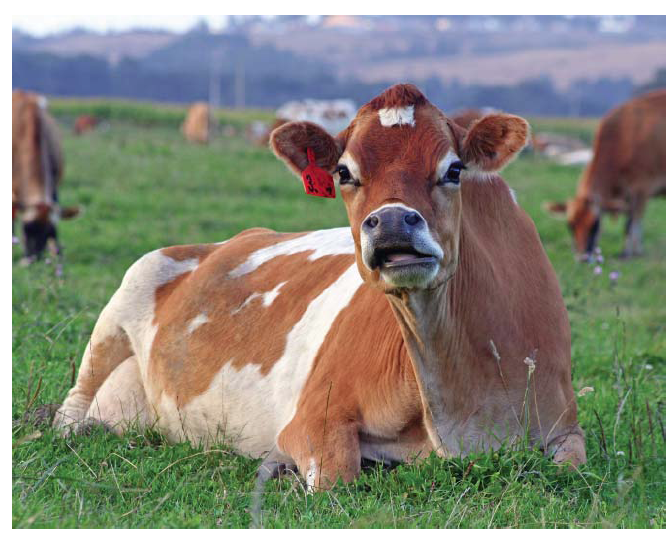 Exports of milk products in December are down 21% from a year earlier and the slump is hitting the dairyman in the pocketbook.”Our milk prices are down 25% from November and it kind of puts a bind in the party” quips Tulare County dairyman Tom Barcellos.The drop in prices follows many months of good returns however, and Barcellos is stoic.
“I can’t believe anyone would be surprised that something like this would happen.”
One major factor is the decision by China to shut down purchases of milk products from US suppliers including local co-ops . The drop in demand has hit member milk checks starting late this summer.”The Chinese appeared to overestimate demand as well as understate their own production.”
Regarding plans by the co-ops to move to a federal order Barcellos , who is president of Western United Dairymen, counsels a wait and see attitude noting the final deal is two years off. “We need to get the best prices from CDFA in the meantime”he says, “or we will have more dairymen going out of business.”
The industry is Tulare County’s largest.

Rare Agreement On Delta Fish Issue Promises More Water South Of Delta
February13,2015
State Water Resources Control Board will hold a public workshop Feb 18 on a plan that could send more water south of the Delta. In a rare move of unanimity both federal and state fish and wildlife agencies have joined a bipartisan congressional effort promote”flexibility” in deciding whether to send water south that could help water-starved communities and farmers“in dire need.”
With the state in its fourth year of below average rain, Dan Nelson,director of the San Luis & Delta Mendota Water Authority says its heartening to have these agencies on the same page for a change with only the staff executive director at the water board standing in the way. “The full board can unwind that decision Feb 18” adds Nelson.
A Feb 11 letter signed by congressional Democrats and Republicans from the Central Valley and Diane Feinstein urges adoption of the flexibility measure noting that “we are running out of time and water” to make the adjustment. Nelson says the flexibility could add an additional 20,000 af in coming weeks to San Luis Reservoir.
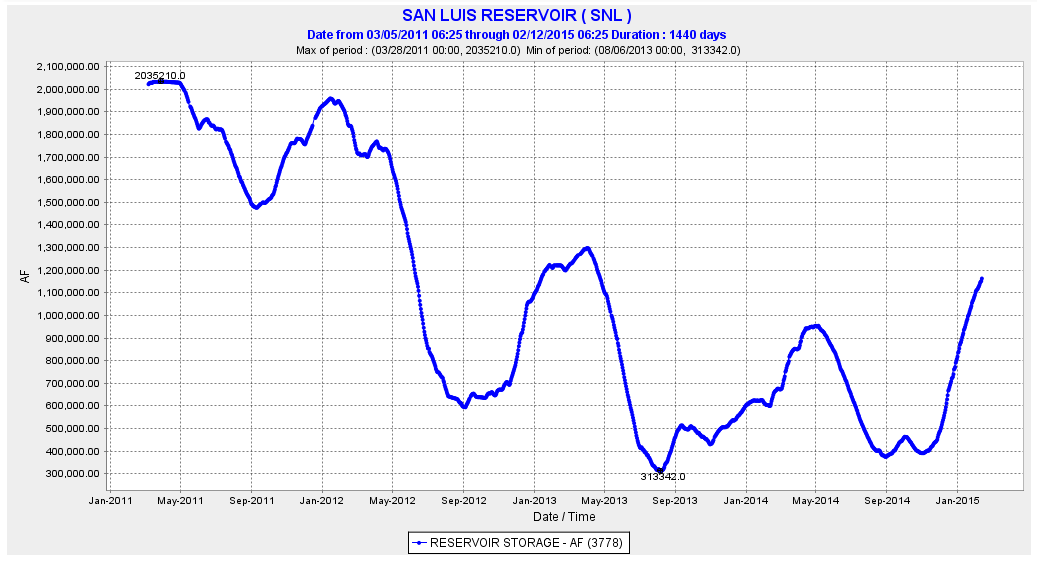
That key reservoir is at 1.18mil af – in much better shape than a year ago when it had only 603,293 af.

Citrus sales suffer as ports remain slow
From CFB
By Ching Lee

Kevin Severns, general manager of Orange Cove-Sanger Citrus Association, stands inside an empty packinghouse early in the afternoon last week. The plant should be running full force this time of year, but a slowdown at West Coast ports has cut the operation’s hours during its busiest export season.
Photo/Cecilia Parsons
Photo/Cecilia Parsons
What should be a bustling time in California citrus groves and packinghouses has ground to a halt in many cases, with pickers not harvesting much fruit and packing facilities sitting idle.
Contract negotiations between West Coast dockworkers and shippers have dragged into their ninth month, and California agricultural exporters say delays at West Coast ports have gotten worse—with severe impacts to citrus growers and packers, who are at the height of their exporting season.
Kevin Severns, general manager of Orange Cove-Sanger Citrus Association, a grower cooperative citrus packinghouse in Fresno County, said his facility should be packing 15 to 20 loads a week for export mainly to Southeast Asia, China, Japan and Korea, but it is doing only two to three loads. As a result, he’s had to reduce his workers’ hours, where normally the plant would be running 12 hours a day, five and a half days a week this time of year.
“We’re not going to be aggressive in trying to ship when we know there’s a potential for some of our containers to just wind up sitting,” he said.
California ports are so backed up now that not only are exporters unable to get their cargo loaded onto ships, but they also can’t get their fruit back to move it to domestic markets, with containers of fruit sitting at the ports spoiling, said Joel Nelsen, president of California Citrus Mutual.
The problem, he said, appears to be a lack of workers at the ports to move the containers, identify where the fruit is and then load it back onto trucks to be sent back to the packinghouse. Ships that are left sitting at anchor can no longer wait, he added, so they’re going to where they can load up and then head out.
“So all of these agreements that were reached between customers and between shipping lines are pretty much out the window,” Nelsen said.
Those agreements will need to be resolved between buyers and sellers—and it will be difficult to do if cash has already changed hands, he said. Losing a container of fruit and the revenue for it would be a big hit for affected growers, he added.
Nelsen estimated that at this point in the season, the state’s citrus sector has lost about 25 percent of its export opportunity, with volumes increasing as more fruit is harvested. The state historically exports 25 percent of its fresh tonnage. Meanwhile, offshore competition is beginning to fill the void, he said, with reports that fruit from as far away as Egypt is making inroads into markets such as Korea.
The port problems also come just as China—a top citrus export destination worth $30 million for the state—reopened its market last August to California citrus. China banned California citrus in 2013 after finding brown rot in some shipments. The state exported $899 million worth of citrus products in 2012, according to the University of California Agricultural Issues Center.
Keith Watkins, farm manager for Bee Sweet Citrus, a grower, packer and shipper in Fresno County, said with harvest slowing and the fruit staying on the trees longer, quality begins to drop, resulting in lower returns to growers.
“Once the fruit gets soft, you can’t export it and it goes to the domestic markets, but there’s only a certain amount that the domestic market could take,” he said.
Normally, the company is exporting more than 30 percent of its volume at this time, but it is now shipping less than 10 percent, he noted.
Warmer weather this winter, particularly in recent days, has accelerated fruit maturity, Fresno County citrus grower Keith Nilmeier said, and that will make it more difficult for growers to keep the fruit on the trees longer.
Growers typically try to hold a certain amount of fruit on the trees by using a growth regulator that slows the acceleration of rind maturity, so that they could pick through the month of April and have fruit going to market at different times, Nilmeier said. But Severns noted this year’s crop doesn’t have the normal holding quality because it endured a long, hot summer last year and in some areas the trees were stressed for water.
“If that fruit doesn’t ship export, it simply forces its way onto the domestic market,” and that could lead to a drop in prices, Severns said.
Nilmeier said his production this year has been manageable, as the citrus crop is not too big, “but if (the port slowdown) continues on for another month or six weeks, it could be more of a problem.”
Watkins said he’s heard of other packinghouses trying to reroute their cargo in order to bypass West Coast ports, but few options remain and none appears to make economic sense at this point.
Jock O’Connell, an international trade economist based in Sacramento, recommended that California agricultural exporters consider the current port congestion problems as a long-term issue that won’t necessarily end with a contract resolution between the International Longshore and Warehouse Union and the Pacific Maritime Association.
He said while the union has engaged in some “disruptive practices” that have contributed to the gridlock, he noted hearing complaints about congestion at ports starting about a year ago. Importers reported seeing the problems first, he said, noting that major importers are now building into their orders a longer lead time in expectation that it would take them longer to get goods into this country from overseas.
“There is a definite sentiment now that West Coast ports are a problem,” he said.
The growing trend of shipping lines using bigger vessels that are unloading more containers at these ports has been a factor in the congestion, O’Connell said. A shortage of chassis used for hauling containers has also plagued ports, after a decision by ocean carriers to divest their chassis to equipment-leasing companies. But these problems are not particular to West Coast ports, he added.
(Ching Lee is an assistant editor of Ag Alert. She may be contacted at clee@cfbf.com.)