November 12,2014 –
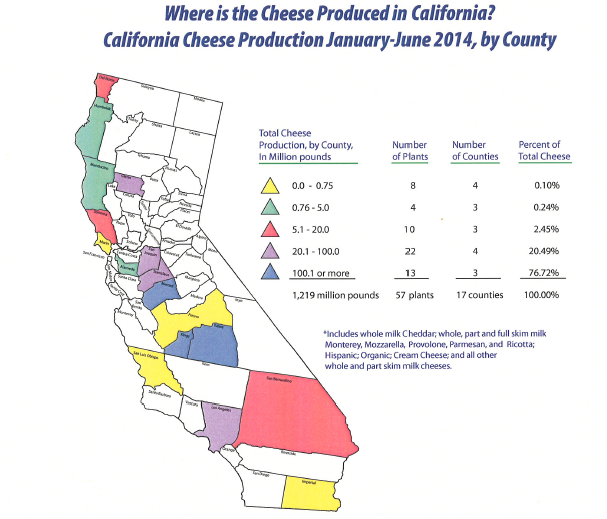
Three counties in California make nearly 77 percent of all the cheese manufactured in the state. The three are Tulare,Kings and Merced counties says CDFA. They are home not just to the greatest number of dairies but huge cheese plants.
In the latest CDFA report on milk production statewide volume is up 3% over last year. Number one Tulare County was up 2.8% in September and Kings County was up 5.6%. Merced was up 4%.
Just because milk production is up in California, consumers continue to drink less as fluid milk but are eating more of it as cheese and whey.
For January through September there was 3.4% less fluid milk sold than the same period a year earlier, a multi year trend.But organic milk is took less of a hit with sales from October 2013 through September 2014 up 2.6%.
If fluid milk sales are down (consumed exclusively in the domestic market) making cheese in the state is way up year over year fueled by booming exports. Cheddar is up 9.3%,Mozzarella up 7.8%,Hispanic cheese up 8.6% and whey powder ‘whey up’ 14.7% year to date.
CDFA says farmers got an average of $23.59 per hundredweight for their milk in September 2014 compared to $18.70 in September 2013. Margins are good with the higher sales price coupled with lower feed cost( corn) this year compared to last.
Year-to-Date Net Earnings Total $227.9 Million, Up 15 Percent From Last Year Third Quarter Net Earnings Are $5.8 Million
ARDEN HILLS, Minn. (November 5, 2014) – Land O’Lakes, Inc. today announced year-to-date financial results through September, reporting net earnings of $227.9 million, up 15 percent from the same period last year. Third quarter net earnings were $5.8 million compared to $49.4 million last year, with the lower results primarily attributable to cyclical market devaluations that were anticipated following an exceptionally strong first half. Year-to-date net sales were $11.4 billion, up 6 percent compared to last year, and third quarter net sales were $3.1 billion compared with $2.9 billion in 2013.
“Our solid year-to-date performance reflects the successful implementation of on-going, long-term strategies that embrace the great growth industries of agribusiness and food production,” said Chris Policinski, president and CEO of Land O’Lakes, Inc. “While third quarter results were influenced by market volatility, we continue to achieve significant enterprise growth by helping farmers produce more food in an increasingly sustainable manner to meet the nutritional needs of the world’s expanding population,” he said.
Year-to-date through September, each of the company’s three business segments achieved earnings that were ahead of last year:
Dairy Foods, including the company’s iconic LAND O LAKES brand, benefitted from strong markets for its butter and cheese products, improved branded butter volumes, manufacturing and supply chain efficiencies, and lower advertising expense.
Crop Inputs, including the WinField brand, slightly exceeded the record results of 2013 due to strong volumes and performance in soybean seed and STAMPs (seed treatments, adjuvants, micronutrients and plant nutrition), partly offset by lower volumes in other crop protection products and corn seed.
Animal Nutrition, including the Purina brand, benefited from lower input costs for livestock and lifestyle products plus strong volumes in both livestock and lifestyle feeds.
The Layers, or egg business operated through Moark, LLC, is no longer being reported as a separate business segment. The company has divested substantially all of the Western and Midwestern assets of this business and is evaluating options with respect to the remaining Eastern assets.
Total Land O’Lakes debt as of September 30, 2014 was $1.83 billion, down $45 million from the same date one year ago. The decrease was primarily due to Moark asset sales, partly offset by increased working capital.
Veteran auctioneer David Macedo of Tulare says he has never seen anything like it.”We’re setting a record price every week at the sales yard” observes Macedo who has been running the Tulare Sales Yard for over 30 years.
“Four year ago we were struggling to get 70 cents a pound on a 300 pound Holstein cow. Yesterday we sold some at a live auction for $3.15 a pound. Video sales have gone as high as $3.23.”
Macedo is also the city’s mayor. He says a recovery in the economy is helping the cattle and the dairy industry this year as well as his city’s budget picture. For now “ revenues are up and expenditures are down.”
Demand overseas continues to drive meat prices higher.
“We see no end to the price increase” even though a stronger dollar in the past month – up about 10% – could slow export sales. ”There are just not enough beef cattle out there which pushes the price of dairy cattle higher. “
The shortage has meant that local cattlemen are selling new born bull calves for $600 each “before they are born.”
Readers in LA got glimpse of the situation when a thief was caught with a calf in his back seat this week after it was heisted from a Riverside dairy.
In California the drought has impacted the number of head being raised adding to the shortage.
“Unlike poultry and hogs it takes a long time for the cattle industry to add new supply since a cow only has one calf a year. ”
The latest USDA report this week shows Cattle and calves on feed for slaughter in California feedlots totaled 415,000 head on October 1, 2014 which is 16 percent lower than October 2013. Marketings of 38,000 head were 28 percent below September 2013. California’s production of red meat during September 2014 totaled 109.7 million pounds, 9 percent higher than the previous month, but 22 percent lower than September 2013.
Live-cattle jumped to an all-time high of $1.705 a pound last week with futures prices up 23% this year. Now that the Midwest has seen a return to wet weather – operators are holding on to their herds looking to build them back up after last year’s Midwest drought. But that has meant for now – beef supply is short.
Consumer are seeing the increases as retail prices in September that have climbed more than 21 percent compared to September 2013 says USDA.
Another Psyllid Find In Farmersville: Tulare County Ag Commissioner Marilyn Kinoshita says several more Asian citrus psyllids were found in a Farmersville backyard in late October even after a foliar spray was applied nearby. ”Looks like we have resident population of the pest in Dinuba, Tulare and Farmersville” she says. About a month ago the CDFA expanded the quarantine zone to the entire county after more ACP were found. All of Tulare County was placed under quarantine for the Asian citrus psyllid (ACP) following the detection of two psyllids in the City of Tulare. The first ACP was detected in a trap in a residential neighborhood on September 10, in the City of Tulare. The second detection was on September 17, also in a residential setting within the City of Tulare. These detections, when added to previous detections elsewhere in the county, dictate that a countywide quarantine is the most effective response to contain the pest. The quarantine prohibits the movement of host nursery stock out of the quarantine area and requires that all citrus fruit be either cleaned of leaves and stems or treated in a manner to eliminate ACP prior to moving out of the quarantine area.
Popular Farm Chemical Will Be Phased Out
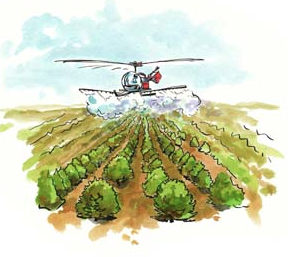
Insect spray Chlorpyrifos will be phased out by EPA says Tulare County Ag Commissioner Marilyn Kinoshita likely by Spring when growers use the material. Made by Dow Chemical,Chlorpyrifos is considered moderately toxic to humans, and exposure has been linked to neurological effects, persistent developmental disorders, and autoimmune disorders. Exposure during pregnancy retards the mental development of children, and most use in homes has been banned since 2001 in the U.S. In agriculture, it remains “one of the most widely used organophosphate insecticides”, according to the EPA. The pesticide is sprayed on 60 different crops including alfalfa, walnuts, oranges and cotton. Up to 2 million pounds each year are sprayed in California. In the Sierra scientists have found Chlorpyrifos in lakes in Sequoia Park, apparently carried by air currents, when they have been studying frog survival there.Monitoring data show some chlorpyrifos detections in air and water contamination in agricultural areas of California. In another move the California Department of Pesticide Regulations wants to make the active ingredient Chlorpyrifos a restricted use pesticide and has opened up a 45-day public comment period on the proposal ending this month. However the EPA action could supersede this.
Citrus Faces Rose Beetle Issue:
Fuller Rose Beetle
Farmers packing citrus this fall are concerned with a pest that could be a problem for exports if found in packed fruit.The Fuller Rose Beetle does not generally cause economic damage in citrus but the presence of viable eggs on fruit exported to other countries such as Korea can be a quarantine concern. Ag Commissioner Marilyn Kinoshita says the pest lays their eggs under the stem cap. Concern is that up to 20% of lots could be rejected. ”We are increasing our inspections. “
Fuller rose beetle adults feed along the margins of citrus leaves, creating notches and leaving a characteristic sharp, ragged appearance.
Drought Layoffs: The Tulare County Workforce Investment Board reports that 264 employees have been laid off or have had their work hours reduced due to drought since March, 2014 .
Saving Water: California’s ongoing drought has made it even more critical for growers to get the most crop per drop of water used. Scientists from UC Division of Agriculture and Natural Resources and UC Davis were honored by USDA for their years of research to help farmers better use microirrigation systems to sustainably irrigate their land.
Patrick Brown, professor in the Department of Plant Sciences at UC Davis, Jan Hopmans, professor in the Department of Land, Air and Water Resources at UC Davis, Larry Schwankl, UC Cooperative Extension specialist emeritus, and Ken Shackel, professor in the Department of Plant Sciences at UC Davis, are the UC researchers participating in the project “Microirrigation for Sustainable Water Use.” Using more precise irrigation management, California growers have increased water use efficiency on processing tomatoes by 54 percent and on almonds by 33 percent since 1990.
Conventional irrigation systems that apply high volumes of water over wide areas can lose a lot of water through runoff, wind, or evaporation. As a result, conventional irrigation systems often over water or under water plants. Instead, microirrigation, or drip, systems use special timers, sensors, and a network of narrow tubes to deliver the right amount of water at the right time.
Weather problems affect nut crops: As nut growers near the end of their harvests, many say their crops may not reach preseason estimates. Almond and pistachio growers say a combination of drought and warm winter weather conspired to reduce harvests in many orchards. Some trees were removed or abandoned due to water shortages. Farmers and marketers say harvests of almonds, pistachios and walnuts will still be large, as nut producers work to fulfill increasing worldwide demand.
Milk Prices Down: The California Department of Food and Agriculture announced the October 4b cheese milk price this week at $20.94 per hundredweight, down $1.45 from September but $4.12 above October 2013. That pulls the 2014 4b average to $20.57, up from $16.17 at this time a year ago and $15.16 in 2012.
The 4a butter-powder milk price is $21.51, down $1.21from September but $1.51 above a year ago. The 4a average is now at $22.93, up from $18.44 a year ago and $15.18 in 2012. On the commodity market butter has dropped from $3/ lb to around $2/lb in a month – after the Christmas orders for butter were filed.
U.S. may produce more pork than beef
It hasn’t happened since the 1950s, but pork production may surpass beef production in the United States next year. Drought across many cattle-producing regions has forced ranchers to reduce herds, and it may take several years after rain resumes for herds to be rebuilt. An American Farm Bureau analyst says competition from increased pork and chicken production could help moderate retail beef prices.
A trio of California water specialists will be among the headline speakers addressing pressing agricultural issues at the 33rd Annual Agribusiness Management Conference on Nov. 5 in Fresno.
This year’s event, “Issues and Outlook for 2015,” will focus on emerging issues and the outlook for California agriculture for the coming year. The program will host an array of economic, legal, water and industry experts.
Agricultural economist Terry Barr will lead the morning lineup of speakers by presenting his economic outlook for 2015, including the economic impact of the drought. Barr is chief economist for CoBank, a national cooperative within the farm credit system.
Lynnette Jacquez of CJ Lake, LLC will discuss the status of U.S. immigration reform and its impact in California and the Central Valley. Jacquez has experience in private law practice, government relations and the federal government, including counsel for the House Judiciary Committee under former Chairman Peter W. Rodino (D-N.J.) through the Subcommittee on Immigration, Refugees and International Law. Jacquez had primary responsibility for drafting and processing the Immigration Reform Act of 1986.
Water continues to loom largest in most people’s minds, noted Dr. Mechel Paggi, director of Fresno State’s Center for Agricultural Business and conference chair.
“Our industry continues to face major challenges such as food safety and immigration reform, but surely the drought is the greatest threat to California agriculture today,” Paggi said.
Water panelists include Richard Howitt, professor emeritus in the Department of Agricultural and Resource Economics at the University of California, Davis; Dane Mathis, senior engineering geologist for the California Department of Water Resources’ Division of Integrated Water Management; and Dan Dooley, senior vice president of the University of California.
Howitt will discuss the recent drought crisis report he co-authored, revealing California’s economy will lose $2.2 billion of income and 17,000 jobs this year as a result of the drought.
Panelists also will discuss legislative action being proposed in Sacramento.
The morning session will conclude with a discussion of “Food Safety Risks and Mitigation,” directed by industry leaders including Roger Isom, president and CEO of Western Agricultural Processors Association and the California Cotton Ginner and Growers Associations; David Acheson, president and CEO of the Acheson Group, LLC; and Martin Wiedmann, professor in the Department of Food Science and Cornell University.
George H. Soares, a Hanford dairy operator and founding member and managing partner in the law firm of Kahn, Soares & Conway, LLP, will be the keynote speaker at the conference luncheon. Soares regularly appears before the California State Legislature and has helped to draft thousands of legislative and regulatory proposals affecting agricultural and other interests.
In addition to this year’s conference, leaders in California’s dairy industry will hold a mini-forum after lunch.
The conference will be held at the Hotel and Conference Center downtown (formally the Radisson). Early registration fee (by Oct. 25) is $100. Late or walk-in is $125. For more information, call 559.278.4405 or visit www.csufcab.com.
With Friant water contractors getting a zero supply of CVP water this summer,contractors are now blaming a flawed state board process for the cuts that have helped dry up the orchards on the east side of the Valley.
How the State Water Resources Board and its executive officer, Thomas Howard, have made far-reaching drought emergency decisions have been legally challenged by the Friant Water Authority and most of its member agencies, all of which were denied deliveries of any Central Valley Project water this year.
A petition for writ of mandate was filed October 24 in Fresno County Superior Court contesting the State Board’s actions and also naming several state and federal agencies for their roles. They include the California Department of Water Resources, the California Department of Fish and Wildlife, the federal Interior and Commerce departments, U.S. Bureau of Reclamation, Fish and Wildlife Service, and National Marine Fisheries Service.
The Friant plaintiffs’ suit seeks “judicial review of a nine-month series of unilateral and unlawful decisions by the executive director of the California State Water Resources Control Board and then a fatally flawed decision by the State Board itself.”
Friant contends the State Board repeatedly failed to follow state law and its process failed to provide a hearing before depriving them of their water supplies. “Unfortunately, the State Board abdicated its responsibility to take action on petitions regarding critically important CVP water rights issues,” the Friant petition said. “Instead, it allowed its executive director to make seriously deficient decisions beyond his authority that adversely affected the water supply for millions of Californians.”
The plaintiffs assert that “these illegal actions … dramatically curtailed the irrigation, municipal and industrial water supply for petitioners and have directly, immediately and adversely affected the livelihoods of the many communities and family farmers who depend on this water.”
Friant’s petition takes issue with the State Board’s failure to honor water right seniority and imposition of “health and safety” use limitations on the Reclamation’s Delta water exports. The Congressionally authorized purposes of the Central Valley Project do not recognize a “health and safety” limitation on water use.
Much of the Friant petition focuses on a series of State Board executive director orders issues earlier this year in response to Temporary Urgency Change Petitions (TUCPs) filed in connection with drought conditions by the state DWR and Reclamation. These orders contributed to Reclamation’s failure to meet its obligation to provide the San Joaquin River’s senior water rights holders, the Exchange Contractors, with an adequate substitute supply of north state water. Instead, the Exchange Contractors were supplied much of the summer with water released from Friant Dam, a major cause of the Friant Division’s first- ever Zero allocation of CVP water.
Friant’s petition takes issue with the State Board’s failure to honor water right seniority and imposition of “health and safety” use limitations on the Reclamation’s Delta water exports. The Congressionally authorized purposes of the Central Valley Project do not recognize a “health and safety” limitation on water use. “The State Board is without authority or jurisdiction to adopt a water quality objective that requires Reclamation to consent to change the federally authorized purposes of the CVP,” the Friant petition asserts. “Additionally, the State Board is required to honor water rights priority in amending any water quality control plan by conducting a regulatory proceeding as well as an adjudicative proceeding to assign responsibility to the water users for meeting the water quality objectives of the plan.” Friant also contends the state violated applicable law “by failing to consider and balance factors relating to the public interest” when approving the Drought Operations Plan (DrOP).
The Friant petition also contends, “A TUCP changing a water quality control standard cannot have the effect of authorizing a junior diverter . . . to take water when senior water rights have not been fulfilled. … Despite the clear legal obligation of Reclamation to protect its senior water rights holders, and the clear legal duty of the State Board to uphold and enforce California’s water rights priorities when determining responsibility for meeting a water quality standard, both the TUCP Orders and the Order Denying Petitions abrogate this priority.”
The latter involves the most recent State Board action to which Friant objects. It came September 24 when board members denied petitions for reconsideration filed by Friant and other agencies. That action “affirmed” all of Executive Director Howard’s TUCP actions.
Friant’s petition asks for “an immediate review of these decisions by the Court along with necessary declaratory and injunctive relief.”
The Friant Water Authority is a public joint-powers agency representing 21 water agencies that deliver Central Valley Project water from the San Joaquin River to more than one million acres along the southern San Joaquin Valley’s East Side. The Authority operates and maintains the Friant-Kern Canal for the U.S. Bureau of Reclamation.
Rice protocol will help state achieve clean air goals while rewarding farmers with a new revenue source
(SACRAMENTO—October 28, 2014) The California Air Resources Board (CARB) today released draft standards and opened a 45-day comment period on its proposal to allow U.S. rice farmers to generate offsets to sell in the state’s cap and trade market. The Rice Cultivation Projects Compliance Offsets Protocol will provide financial benefits for growers while advancing the state’s goal of achieving its emissions reduction targets by 2020. Rice production is particularly important to California’s clean air efforts because it is a major contributor of methane, a potent greenhouse gas.
“As the state’s first crop-based protocol, the rice program is a model for a whole new generation of offsets from the agricultural sector, a major driver of our economy, especially in California,” said Robert Parkhurst, Agriculture Greenhouse Gas Markets Director for the Environmental Defense Fund. “The rice industry is once again setting the stage for programs that give other growers the opportunity to reap financial benefits while helping the environment.”
The voluntary program offers rice farmers three different options to implement environmentally friendly practices on their fields; dry seeding, the practice of sowing dry seed on the ground rather than applying pre-germinated seeds aerially; early drainage, in which farmers drain their fields seven to 10 days earlier than usual; or alternate wetting and drying, the practice of periodically flooding and then drying down a field throughout the growing season.
“The rice industry has long been at the forefront of innovative farming practices that promote stewardship and sustainability,” said Paul Buttner, Environmental Affairs Manager for the California Rice Commission. “By including a voluntary rice protocol in California’s greenhouse gas emissions reduction program, the state is taking an important next step in preserving the industry’s legacy of commitment to protecting our environment, including enabling us to identify where we can achieve reductions while avoiding other unintended impacts to the millions of water birds now so dependent upon California rice lands for habitat.
The rice program is unique from other protocols in the cap-and-trade system in that the emissions reductions come from changes to farming practices and are dependent on weather and the grower’s management decisions. And, unlike some other sectors, emissions reductions from rice are permanent and will never again be re-released into the atmosphere.
Sundale Vineyard Plan Major Cold Storage Expansion
Sundale Vineyards is seeking a Special Use Permit for a project on the west side of Road 140, approximately 1,800 feet south of Avenue 240 (Prosperity Avenue), east of the City of Tulare that would allow the expansion of an existing agricultural service establishment (cold storage and packing facility) by adding ±227,000 sq. ft. of cold storage space in phases over a period of five years on a 26-acre portion of a 90-acre parcel in the AE-40 (Exclusive Agricultural – 40 acre minimum) Zone. A public hearing is set through the Planning Commission on Wednesday, October 8, 2014, at 9:00 a.m.
Drought Cuts Field Crop Plantings
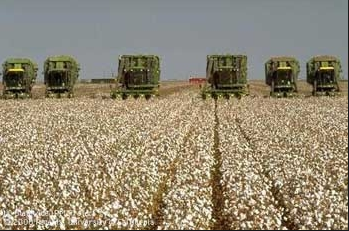
The California drought has helped cut expected harvest of field crops in the state this year with upland cotton down by 35% from a year ago. Pima cotton will be down 16%.
Also down this fall is the 2104 corn crop – down 45% from a year ago. Acreage planted was down 39% from 2013 to 110,000 acres statewide.
California hay production in 2104 is also expected to be down slightly from 2013 – from 140,831 tons to 135,946.
Well Moves 27 Feet Sideways Near Coalinga
A well drilled some 6 years ago for Granite Construction moved some 27 feet sideways due to seismic or land subsidence activity but still worked because the driller installed flexible plastic casing. The 1400 ft deep well near Coalinga still operates.
In a September 18 letter to CDFA secretary Karen Ross Tulare County’s top ag official asked the state to approve a countywide citrus psyllid quarantine, significantly expanding the current boundaries.
“We have 21,982 acres of citrus not yet under quarantine“ says Marilyn Kinoshita, Tulare County Ag Commissioner. The request ,expected to be approved, comes ”after over two and one half years of attempting to isolate trap finds into smaller quarantine areas.”
Pictured: Current ACP quarantine zones
Prompting the call are more finds of Asian citrus psyllids (ACP) outside current quarantine boundaries including two finds in Tulare and another in Dinuba in September.
Kinoshita says recent finds outside the current zones make it clear the dreaded pest “is not just more hitchhikers passing through” but an “endemic population” and the number of new finds makes it more difficult for her agency to coordinate both the fight against the pest and advising citrus growers and packers on protocol in handling fruit for shipment. “Growers are calling us all the time wondering if they are in or out of the zone.”
“We met with an industry group recently and nobody opposed the idea of a countywide quarantine” adds Kinoshita.
But UC citrus scientist Beth Grafton-Cardwell says smaller quarantine zones allow Kinoshita to mandate grower treatment 800 meters around a find and a large quarantine zone may not allow them to require such treatment. ”That issue is still up in the air” she suggests.
“There are pros and cons to a countywide quarantine” although she expect Secretary Ross will grant the request.
Kinoshita says she expects approval in a matter of weeks.
Grafton Cardwell says while there appears to be a” permanent population of ACP here – it is very small and growers have succeeded in knocking them down in commercial citrus groves.” But the fact there are new finds in urban areas shows there is likely a permanent population,not only in Tulare County but in Kern County, she believes.
“ACP are spreading from commercial groves to urban areas of Ventura County as well” she says.
A scientific panel said last March stated that “it is no longer feasible to eradicate ACP in Tulare County and all of Tulare County should be quarantined for ACP.”
Despite suggesting there is a permanent population of ACP here Grafton Cardwell notes that only one large discovery near Dinuba found what appears to be all life cycles, the hallmarks of a breeding population. ”Its such a tiny bug – it is hard to find.”
100% of Florida Groves Have HLB
Asian citrus psyllid can carry the tree killing “citrus greening disease” (HLB) although it has not yet been found in the San Joaquin Valley. A find of an HLB infected tree in Hacienda Heights in Los Angeles two and one half years ago suggests to a CDFA – ACP scientific panel that the pests carrying HLB could be moving north and the disease’s symptomatic long latency period – 3 to 4 years- must be considered. Grafton Cardwell says she is surprised it has not been found yet in the Valley. She considers it just a matter of time.
HLB has already wiped out 135,000 acres in Florida where Grafton Cardwell says “100% of the orchards across the state already have HLB”. It is on the march in Texas as well.
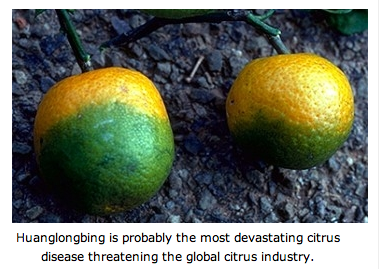
HLB is a bacterial disease that spreads internally throughout the plant. The disease, which is transmitted from infected plants to healthy ones by the Asian citrus psyllid, causes fruit to ripen unevenly and become lopsided, visibly smaller and bitter-tasting. The bacteria do not pose a health threat to humans, livestock or pets, but the effect on the fruit crop is devastating.
Once the disease is found – the only thing farmers can do is pull the trees.
Grafton Cardwell says the most promising tool for citrus farmers will be the proving of early detection techniques to “manage the disease” that will enable farmers to determine what trees have citrus greening before they show symptoms.That includes a new HLB whiffing dog that shows promise as well as other so called “PCR detection techniques that are rapidly evolving.”
The current zone runs through all but about 13% of the commercial citrus groves in Tulare County but excludes major urban areas where plenty of citrus grows.
Friday the spot dairy price for butter hit an all time high of $3 a pound on the Chicago Mercantile Exchange (CME). Butter has led dairy commodities higher this year as both domestic and export sales have surged. Tulare County dairyman Tom Barcellos says” “you know people in the US are ready to go back to butter when the cover of Time magazine says its OK to eat it.” Earlier this summer the magazines cover story was – Eat Butter: Scientists Labeled Fat the Enemy. Why they were wrong”.
But Barcellos and others expect the price to come back to earth in a matter of weeks as this is the time orders are strongest for the coming Holiday season when butter is in huge demand.
Butter prices in the past few years have been as low as $1.25 lb and started 2014 selling for around $1.50lb. That’s why it doubling to $3 is big deal.The previous record was $2.85 set back in 1988.Boosting butter has been a increase of 42% in exports in the first half of this year.
USDA Forecast Navel Orange Production At 78 Mil Cartons – Down From 85 & 90 Mil Cartons For Past Few Years
USDA is forecasting a Central Valley Navel Orange crop at around 78 million cartons, down from 85 million cartons last year and 90 million cartons the year before. The annual forecast says navel orange bearing acreage is down to 126,000acres from 128,000 last year and a high of of 135,000 acres in 2009. Average set per tree is 333,better than the 265 average last year. But the fruit size is somewhat smaller. The set per tree in Tulare County is 308 compared 396 in Kern County.Given fears of massive losses due the drought the fall and winter crop forecast is somewhat reassuring that production declines this year will be moderate.
DESPITE DROUGHT – RECORD WALNUT PRODUCTION FORECAST
The 2014 California walnut production is forecast at a record 545,000 tons, up 11 percent from 2013’s production of 492,000 tons. This forecast is based on the 2014 Walnut Objective Measurement (O.M.) Survey, officially conducted by the National Agricultural Statistics Service August 1 through August 22, 2014.
Despite a lack of chilling hours and a drought that has hit California, the 2014 walnut crop is forecast at a record level. Growers used surface water where available and groundwater when necessary to provide adequate water supply to the trees. Weather conditions during the growing season were mild thus benefiting the crop. Crop quality is excellent with low disease and insect pressures. Overall, the 2014 crop is developing faster than last year and harvest is expected to start early.
The 2014 Walnut O.M. Survey utilized a total of 746 blocks with two sample trees per block. Survey data indicated an average nut set of 1,372 per tree, up 11 percent from 2013’s record low average of 1,239. Percent of sound kernels in-shell was 98.7 percent Statewide. In-shell weight per nut was 21.2 grams, and the average in-shell suture measurement was 32.5 millimeters. The in-shell cross-width measurement was 32.4 and the average length in-shell was 38.1 millimeters. All of the sizing measurements were above average levels.