Bird Flu returns to California


CDFA lifts ban on exhibitions

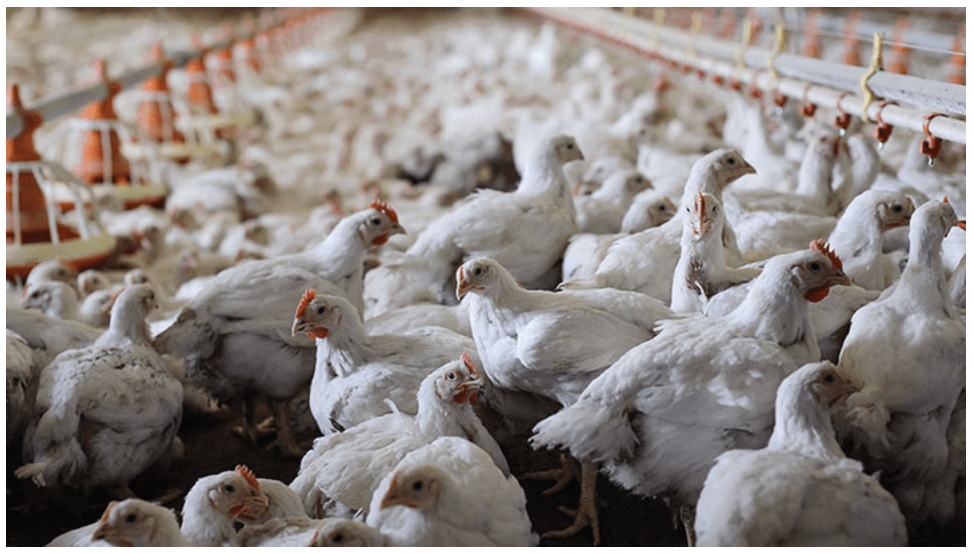
USDA reports that highly contagious avian influenza that hit the state hard in 2024 has surfaced again in California even as it has severely impacted the Midwest poultry industry in 2025. Last year bird flu hit 26 states in the US but almost half the cases were in Indiana and Ohio, reports Watt Poultry news. Last year some 285 commercial bird flocks were lost, says the industry publication.

As for California, the bird flu was last found in any big numbers in February last year even as the headline news in January 2025 was how high egg prices had become. Now as of this fall there are signs it could return. In late October an egg ranch in Sonoma County was hit that resulted in the destruction of 231,000 egg layers, the only way to stop the spread.

USDA reports that six farms in California have been hit since October including a flock in Placer County.

As of January 2, 2026, USDA is reporting that in the new year an affected flock of 34,600 gamebirds in Butte County had to be destroyed. Also on that date in North Carolina 14,000 turkeys tested positive.Two more commercial upland gamebird flocks in Kansas have also tested positive in the new year The virus is worldwide with new reports in Israel and Russia.

The California’s poultry industry hopes there is no repeat of what happened in 2024 into early 2025. A UC Davis report says in California, the disease led to the destruction of around 10.6 million laying hens, with another 1 million table-egg pullets (young hens about to start laying) also destroyed. Meat birds in the Central Valley including in Kings County were hit as well. But the biggest loss was a majority of the egg laying flock in the state that had to be rebuilt over many months.

Vaccinations urged

Considering that bird flu could return in big way in 2026, carried by the annual influx of migratory birds,another industry publication Egg News reports that as of December 11th, senators representing both sides of the aisle addressed a letter to the White House urging adoption of vaccination as an adjunct to biosecurity to address the endemic and widespread incidence of highly pathogenic avian influenza (HPAI) manifest as an epornitic (Attacking many birds in a region at the same time) since 2021.

“The group of 23 senators including Senate Majority Leader John Thune (R-SD), with Mike Rounds (R-SD) and Amy Klobuchar (D-MN), respectively Chair and Ranking Member of the Senate Committee on Agriculture, Food and Forestry, urged Brook Rollins, Secretary of Agriculture to implement “renewed action” to address the problem of HPAI. The letter stressed the need to apply science and to take into account the needs of all stakeholders. This implies balancing enhanced protection afforded to farmers against the possible loss of export markets for broiler leg quarters.

Besides the California egg industry, bird flu in 2024 spread to the state’s huge dairy industry affecting a majority of herds by early 2025 with industry suffering a drop in milk production that has since recovered.

CDFA lifts ban on county fair exhibitions

Meanwhile CDFA is loosening restrictions on shows.

In late December the California Department of Food and Agriculture (CDFA) said they are closely monitoring the status of H5N1 Highly Pathogenic Avian Influenza (HPAI) in both poultry and dairy cattle throughout California. Since the implementation of the statewide exhibition ban, CDFA has conducted ongoing surveillance, reviewed viral trend data, and consulted with epidemiologists and animal
health partners at both the state and federal levels.

“Based on a comprehensive review of current H5N1 infection trends, improved understanding of transmission dynamics, and enhanced mitigation measures now in place, CDFA has determined that the risk associated with poultry and dairy cattle exhibitions has sufficiently decreased. Effective immediately, the statewide ban on poultry and dairy cattle
exhibitions at fairs and shows is hereby lifted.”

The next big show in the state is of course the Tulare Farm Show – World Ag Expo set for Feb 10-12.

Human cases

The U.S. CDC says between January 1 and August 4, 2025, 26 human infections with avian influenza A(H5N1) viruses (H5 bird flu) have been detected globally, of which 23 were identified in 7 countries outside of the United States, including 11 infections that resulted in death.The three cases in the United States were previously reported, and there have been no cases reported in the United States since mid-February 2025.

Ag beat: beef prices/ more

Olive oil prices under pressure

Another California ag commodity under pressure.
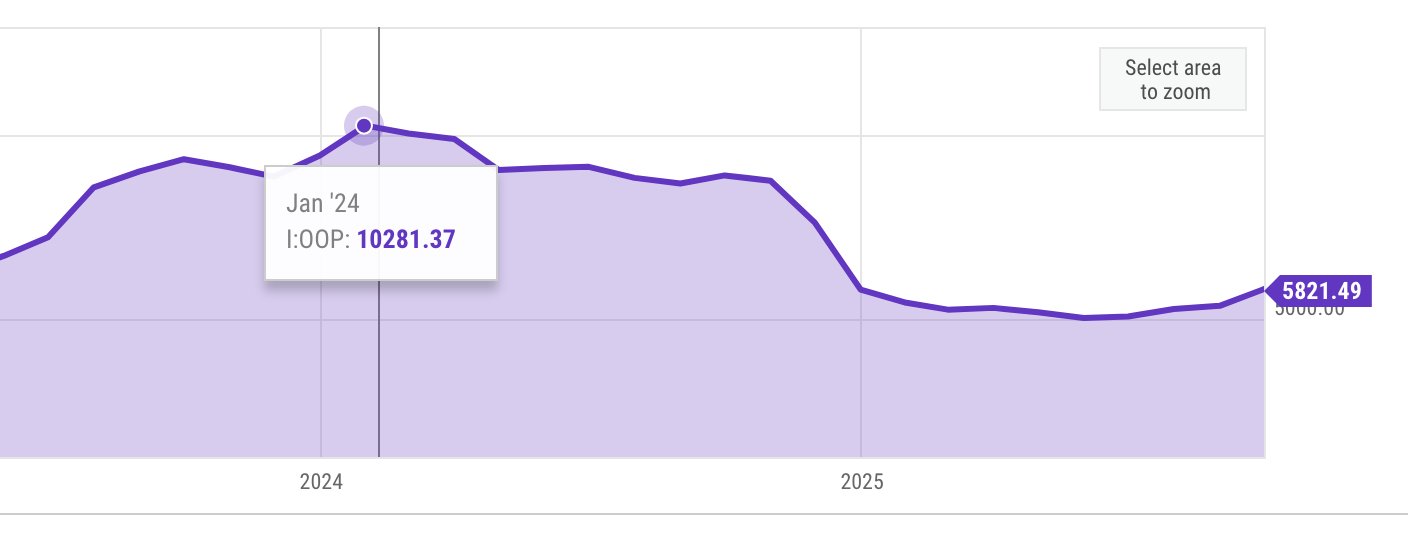
Olive oil prices have dropped almost 50 percent from January 2024.

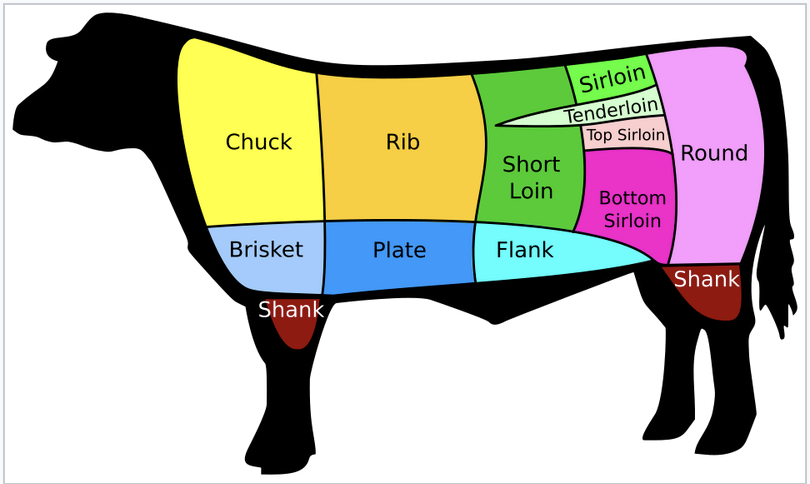
Beef packer closure could hurt beef prices

On November 21, Tyson Foods, one of the largest beef packing companies in the United States, announced it will close its cattle slaughter facility in Lexington, Nebraska and reduce its beef operations in Amarillo, Texas down to a single, full-capacity shift. Based on estimated slaughter at both facilities, it will reduce capacity to slaughter fed cattle by more than 7 percent says USDA.

USDA is predicting the 2026 beef price forecast is lowered $11 to $235 per cwt, which is still a 5-percent year-over-year increase.

USDA sees lower milk prices in 2026

A Dec 15 USDA forecast for 2026 says ample milk supplies and weaker-than-expected demand are expected to lower cheese and butter wholesale prices. Robust demand for whey-based protein products will likely reduce the availability of dry whey and hence put upward pressure on dry whey wholesale prices in 2026.Updated 2026 forecasts for wholesale dairy product prices (in dollars per pound) are: Cheddarcheese $1.675 (-6.5 cents), butter $1.675 (-2.5 cents), and dry whey $0.635 (+1.5 cents). The forecast price for NDM remains unchanged at $1.170 per pound.

The updated 2026 forecast for Class III milk is $17.05 per cwt, $0.60 lower than the previous forecast. The projected Class IV price is $14.40 per cwt, $0.10 lower than the previous projection. The all-milk price for 2026 is now forecast at $18.75 per cwt, a $0.50 reduction from last month’s forecast.

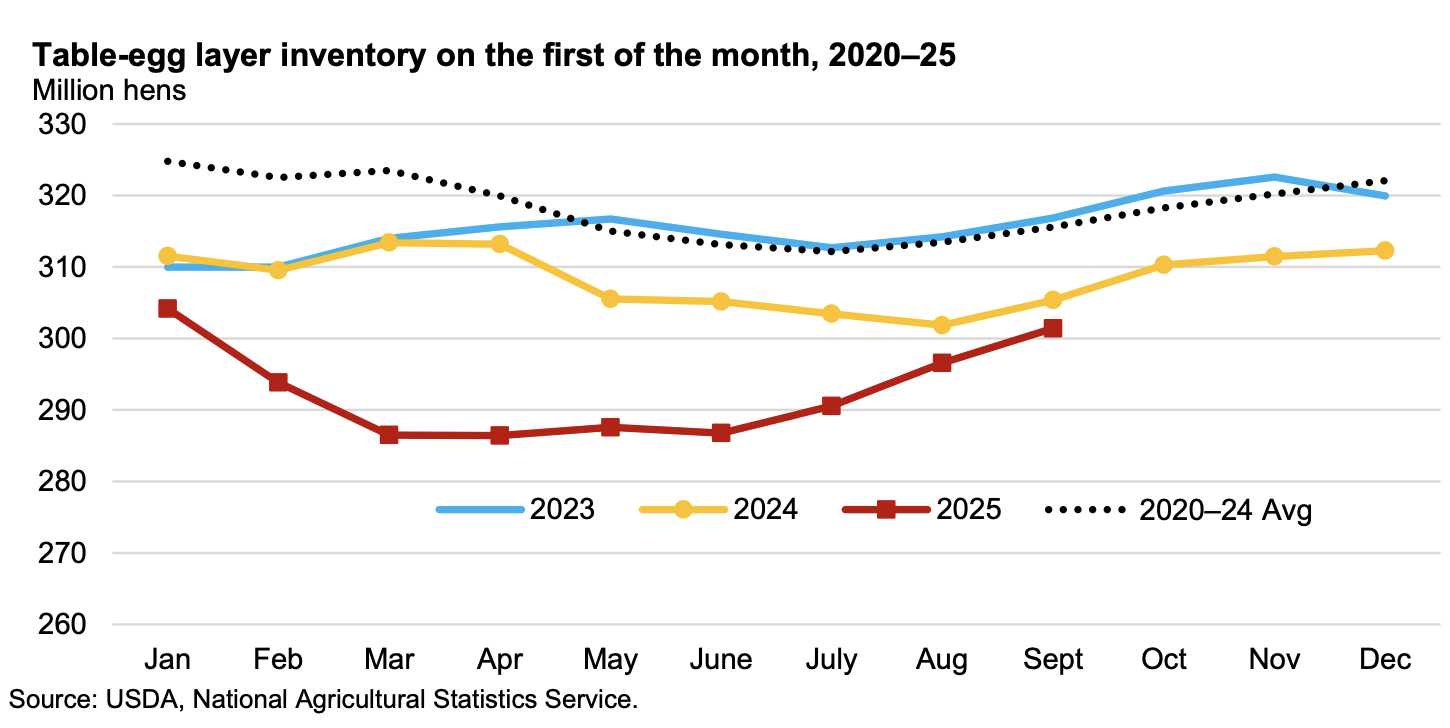
Egg Layer inventory coming back

The population of egg laying chickens is coming back from January of this year but still far behind numbers seen in 2023 or 2024 after bird flu hit the nation’s chicken flock.

​Wonderful donates Wasco ranch to UC Davis

Despite a win in court​, the UFW has not heard a final word from the ALRB ​ who has not yet decided whether the UFW can represent Wonderful’s employees at a Kern County​ grape nursery.But the issue may be moot as the company decided to close the Wasco nursery​ and donate the property to UC Davis, ending chances for a union at th​e 600 employee ranch.The UFW won an election ​i​n 2024 but the ​ employer claimed wrong doing by the union and argued the card check ​law was flawed. Regarding the closure, Wonderful said the grape industry has seen“significantly decreased sales and record losses, with no expectation of a turnaround anytime soon.​”

Bread & Butter

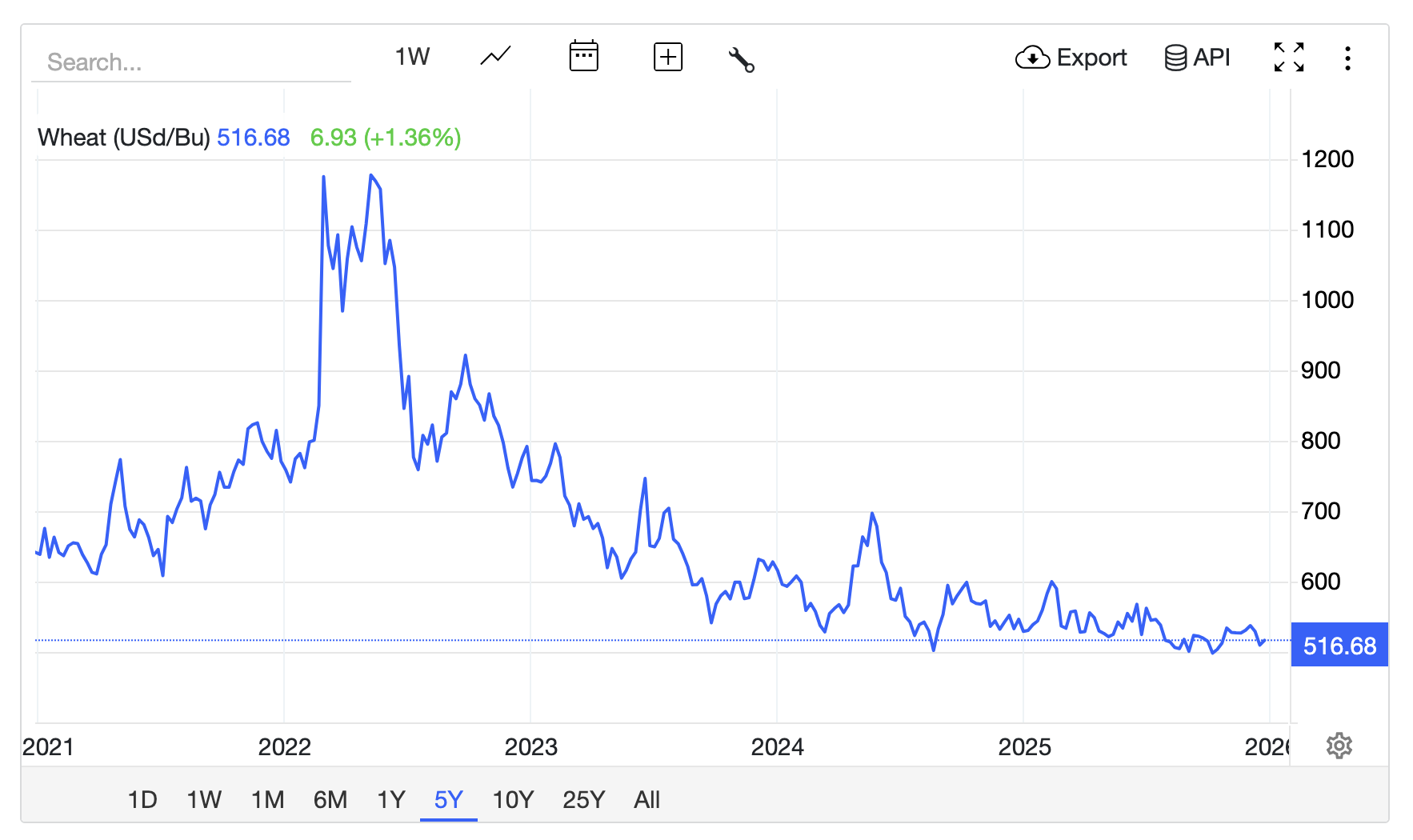
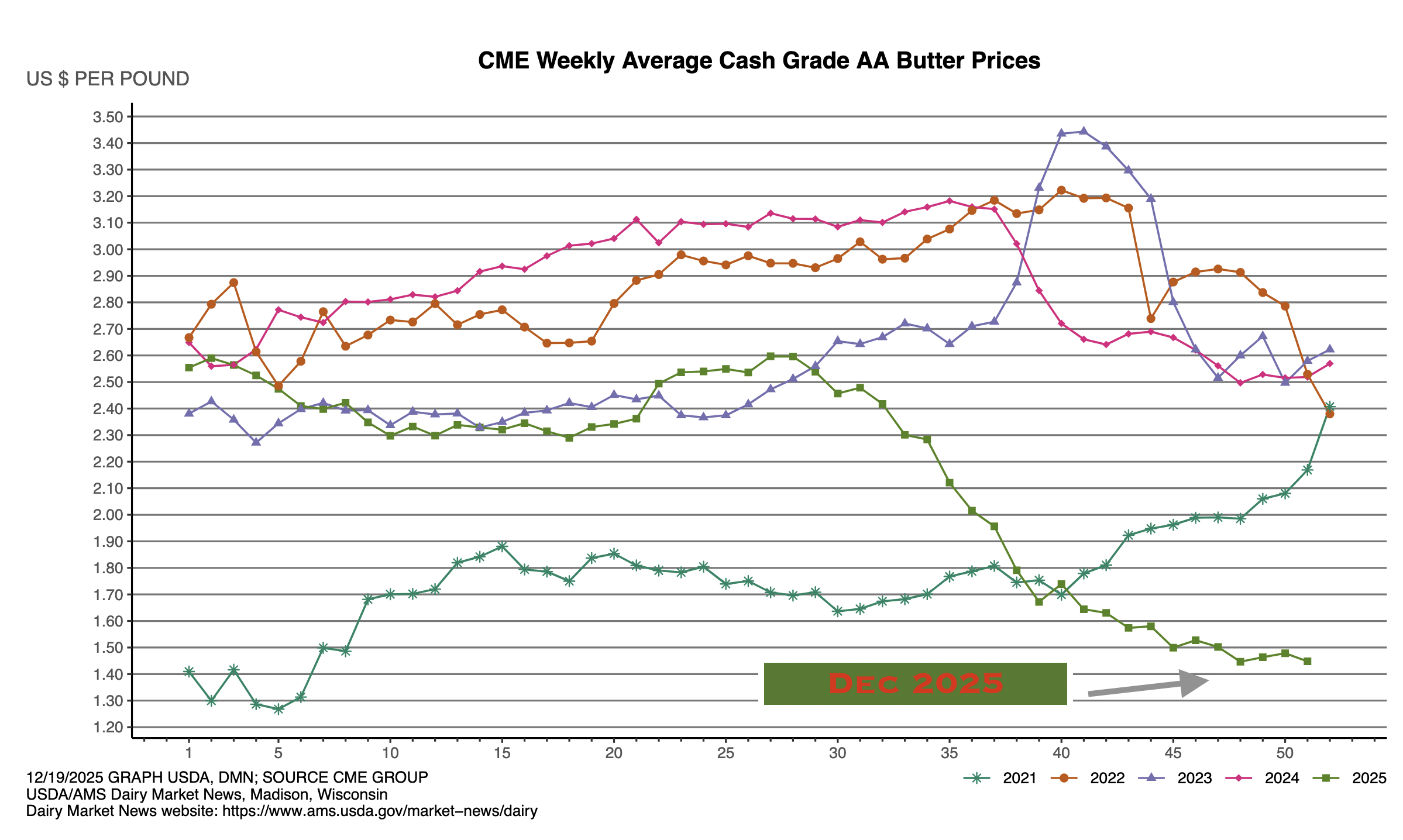
If you want to know how farmers are doing just consider what is happening  with bread and butter, as basic food as you can think of  and arguably a building block of civilization.

Well,  wheat prices are at a 5-year low on abundant global supplies  and record harvests among major exporters like Argentina and Australia.


Meanwhile, if you want to butter up that slice of bread, the CME average this week is $1.40 lb compared to $2.62 lb in January 2025, about half the per pound price.

Theses low commodity prices are hitting the ag economy hard.

American Farm Bureau – Now too much corn

Fears of $15 billion loss for corn farmers
Nov 26,2025


The American Farm Bureau is sounding the alarm about Midwest farmers’ financial strain. A recent podcast noted  “As the Chinese backed out of the market, that put further pressure on prices. As farmers were harvesting a crop, many of them didn’t have storage and had to sell at harvest-time lows. So even though we’ve got a framework in place, and the Chinese are starting to buy product, for a lot of growers, the economic benefits of these frameworks may come too late.”
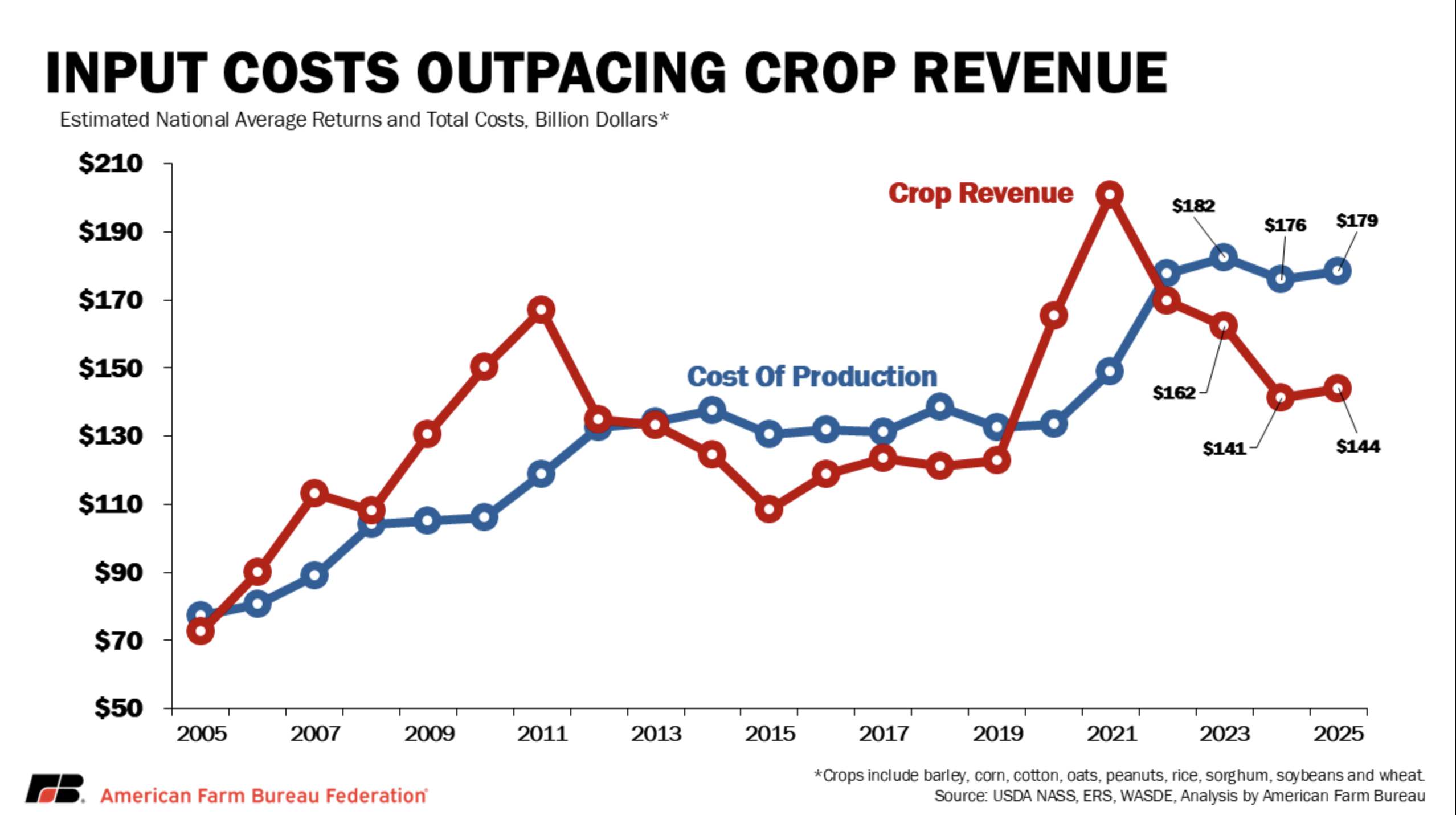
In general low crop prices and higher input costs are bleeding red ink in the US ag sector.
But now farmers switched to corn expected to build a surplus  that will lead to huge new losses.
That is happening since  China typically buys close to half of the soybeans grown in the U.S. But the ongoing trade war means farmers in the Midwest must consider other options — and none are as profitable.
“Due largely to the Chinese falling short of their Phase 1 soybean commitments, and more recent trade uncertainty, farmers across the Corn Belt pulled back on soybean acres and instead planted nearly 100 million acres of corn.
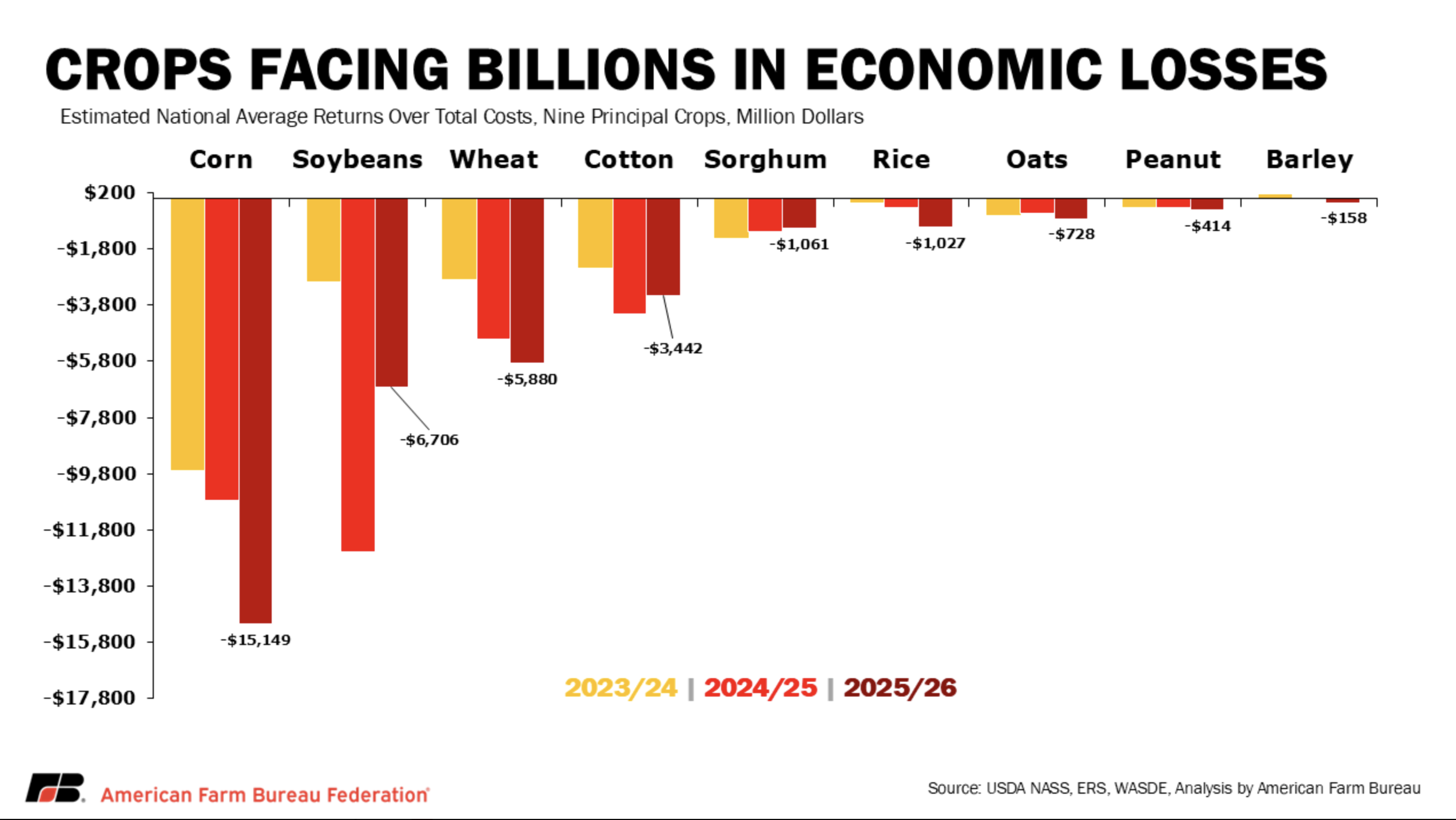
 At an average total cost (including fixed and variable operating costs) of putting the crop in the ground of approximately $900 an acre, corn farmers committed nearly $90 billion to sow a crop this spring. Now, even with an expected record yield of 186 bushels per acre and a $4 per bushel national average price, the return over total cost is estimated at a loss of over $150 per acre, with total losses nationwide eclipsing $15 billion.” That is just corn.

Farmers plant less cotton in face of stagnant market

California Farm Bureau


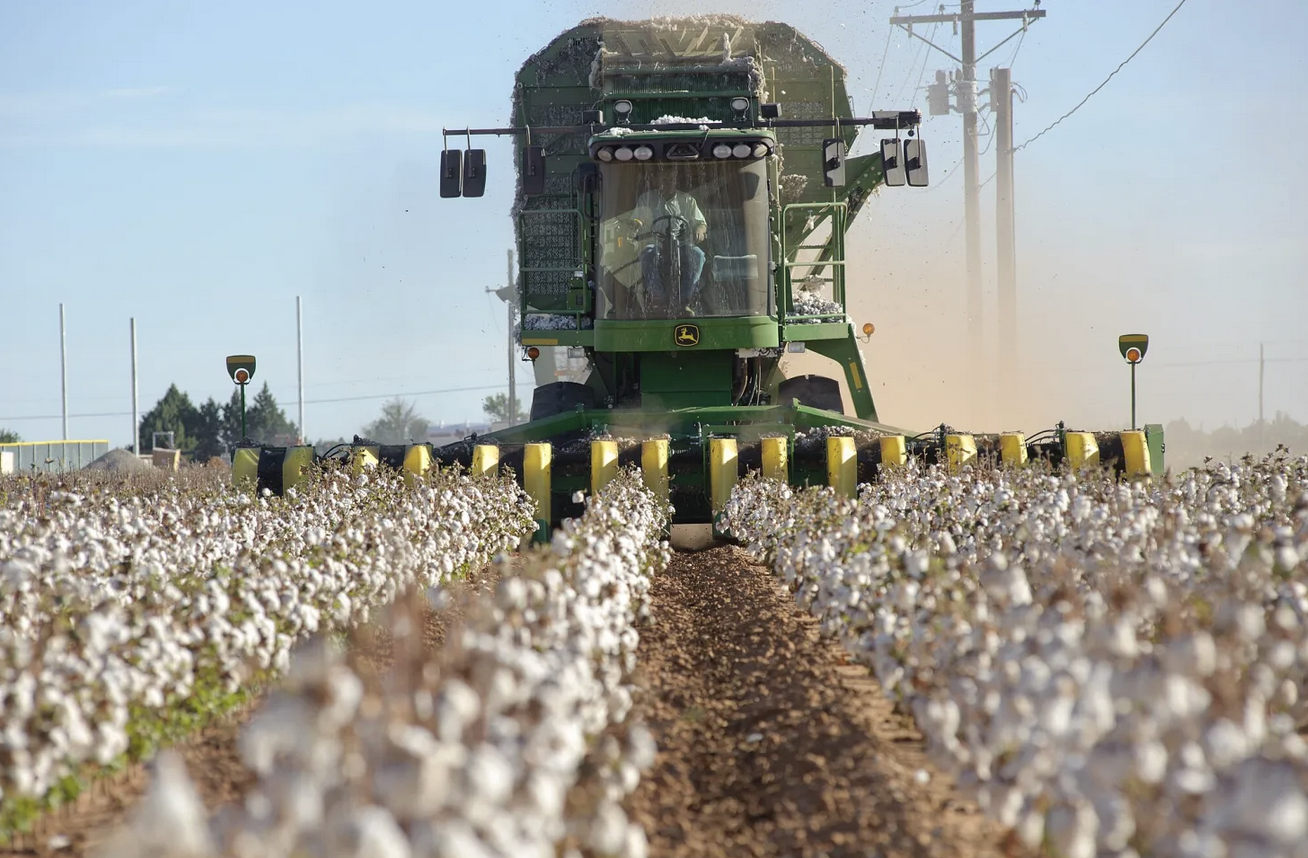
A harvester is in place at a Merced County cotton field to continue picking the 2025 pima cotton crop. California farmers planted 91,000 acres of pima and nearly 16,000 acres of upland cotton this year—a 33% decline in total cotton acreage from 2024 as the industry faces one of the worst markets in memory, according to the California Cotton Ginners and Growers Association. 

Jeff Mancebo spends his Sundays doing the bills for his family farm in the Merced County town of Dos Palos, an NFL game sometimes flickering in the background. This year, Mancebo and hundreds of other cotton farmers in the Golden State are getting pummeled like a slow, aging quarterback under an all-out blitz.

The 68-year-old lifelong cotton farmer said his production of harvested Hazera and pima cotton will match low global demand. With cotton prices around the world continuing to stagnate, Mancebo said he planted fewer acres of cotton than he did in 2024, while his grain, almonds and pistachios keep his farm afloat.

“I’m a pretty conservative guy,” Mancebo said. “Cotton used to keep the tree business going, and now it’s the reverse. When there’s a good cotton year, I don’t go out and buy a bunch of stuff. I just roll with it.”

Mancebo said he planted 550 acres of Hazera and pima this year, down from his normal 800-900 acres. He said prices of pima cotton—a premium variety usually much sought after for higher-end clothing, sheets and towels—need to be more than $2 a pound for farmers to break even. But prices have hovered between $1.25 and $1.50 a pound in 2024 and 2025. So, he planted fewer acres than before and now sits at the dinner table paying bills that have become tougher to cover.

Mancebo is not alone.

Roger Isom, CEO of the California Cotton Ginners and Growers Association, said cotton farmers face one of the worst markets in memory. In terms of acres planted and low demand, he said 2025 will be the second or third worst year on record since the CCGGA was founded in 1920.

“We (California) produce 90% of the nation’s pima cotton, and prices are stagnant,” Isom said. “Upland cotton is at 85 to 90 cents a pound right now. That’s the same darn price as when I started 30 years ago. It’s tough out there for our farmers.”

Isom said California cotton farmers produce 600,000 bales in an average year, but that production will drop to an estimated 400,000 bales in 2025.

California farmers planted 91,000 acres of pima and 15,968 acres of upland cotton this year—a 38% drop in pima but a 30% increase in upland from 2024, the CCGGA reported. Overall, cotton acreage declined 33% from last year, the CCGGA said. Kings County continues to lead in plantings, with 47,753 of the state’s 106,968 acres.

Isom said the CCGGA has been on the front lines in the battle over California water restrictions. He also serves as CEO of the Western Agricultural Processors Association and president of the Agricultural Energy Consumers Association, focusing on legislative and regulatory efforts in Sacramento—particularly those affecting water flowing through the Sacramento-San Joaquin Delta.

“We always want to protect as many of the water rights as we can,” Isom said, “because that means healthy soil for all of our farmers.”

Merced County farmer Mancebo said he has an advantage over many of the cotton growers outside his Dos Palos farming region: The Central California Irrigation District in which he farms has a variety of water rights that were grandfathered in almost a century ago.

Mancebo said he pays a lot less for an acre-foot of water than farmers outside the CCID. He said he pays a Tier 1 price of $18 an acre-foot, which also covers water to irrigate his almond and pistachio trees, which are approximately in the middle of their productive lives.

“Water is not much of a worry for us under these normal conditions,” Mancebo said. “But fertilizer, labor and fuel are so much higher that there’s just no way we could plant upland (cotton) and get way less than a dollar a pound.

“We had a good, clean pima harvest last year with about 85% at Grade 1 (best),” he continued. “What I’ve been hearing from the gin manager is the cotton has been great this year, so I expect the same results or better this year. Quality is great, but the demand is down.”

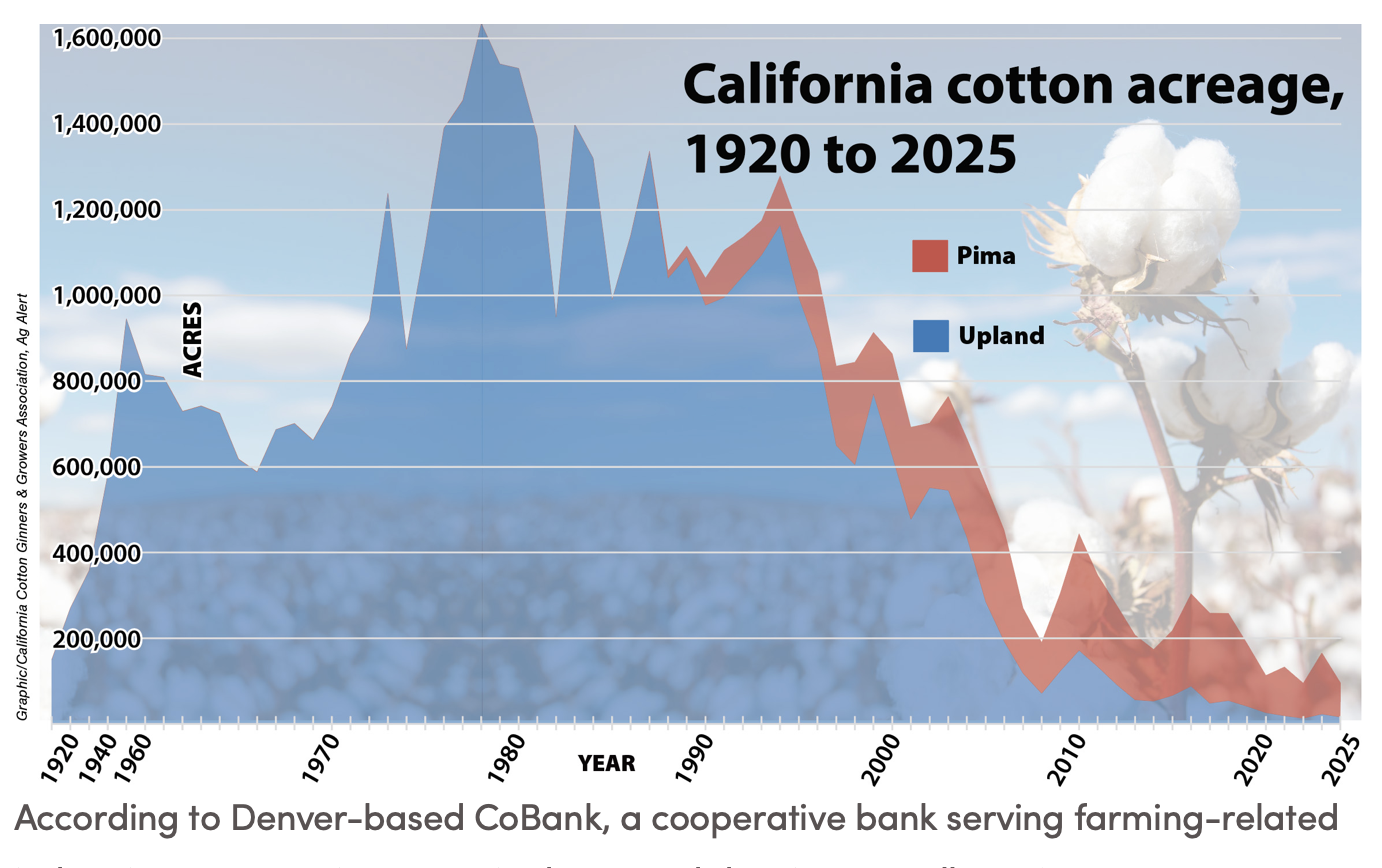
California cotton acreage 1920-2025According to Denver-based CoBank, a cooperative bank serving farming-related industries, cotton prices remain depressed despite a smaller U.S. crop.

The bank said a slowing global economy continues to affect clothing and apparel sales, pushing cotton prices lower. Cumulative U.S. export commitments of upland cotton were down 18% year-over-year as of mid-September, CoBank reported—a concern for U.S. cotton farmers, as 80% of the cotton crop is typically exported.

The U.S. Department of Agriculture estimated the 2025-26 cotton crop at 13.22 million 480-pound bales, down 8% from the previous harvest.

Isom said the stagnant-at-best cotton market has also hurt the revenue streams of businesses that support farmers, such as trucking companies and cotton gins. For example, Fresno County was the top cotton-producing county in the United States 20 years ago and had 26 gins in operation to handle the harvest. Now, he said, Fresno County is not even in the top 150 cotton-producing counties and has just one gin.

“Ten thousand jobs just went away,” Isom said.

Fresno regains top spot as Kings County crop value climbs 13.4%

Strong milk prices help Kings dairymen

Fresno County edged both Tulare and Kern Counties in 2024 for top spot in ag production value. Fresno crops’ value reached $9 billion in 2024 – a record number. That’s up 5.7% from 2023. 
Meanwhile dairymen saw high milk valuation last year helping boost Tulare’s total value in the number one milk producer nationwide.Tulare milk’s value makes up more than a quarter of the the total value of all ag production in that county.


Kings County had mostly good year
High milk prices on average of $21.60 per hundredweight last year also helped Kings County boost its total crop value 13.4% reported ag commissioner Jimmy Hook October 21.Valuation hit $2.44 billion in 2024.

High milk prices coming in on average of $21.60 per hundredweight last year also helped Kings County boost its total crop value 13.4% reported ag commissioner Jimmy Hook October 21.Valuation hit $2.44 billion in 2024

But it wasn’t just milk that boosted values in Kings as the county rebounded from the 2023 widespread flooding. Livestock and poultry increased 27% as the price of beef was up. Processing tomatoes also contributed to the increase.
Not every crop increased as alfalfa hay production and value per unit declined over 2023. Pima cotton acreage increased to 71,000 acres in 2024 versus flood ravaged 2023’s total of  just 27,000 acres. The crop came in at $134 million about double the number in 2023.
Returns were not as bountiful in the vineyards as the valuation of grapes dropped from $58 million in 2023 to $48 million. Hard hit Kings walnut growers saw better returns on fewer acres in 2024 as the value per ton doubled over 2023.


Poultry numbers drop two thirds
The impact of bird flu can be seen in the inventory of poultry in the county that fell from 2.6 million head in December 2023 to just 820,000 in December 2024 – down two thirds.
The top commodities in Kings County were milk, followed by pistachios, cattle and calves, processed tomatoes, and cotton in that order.
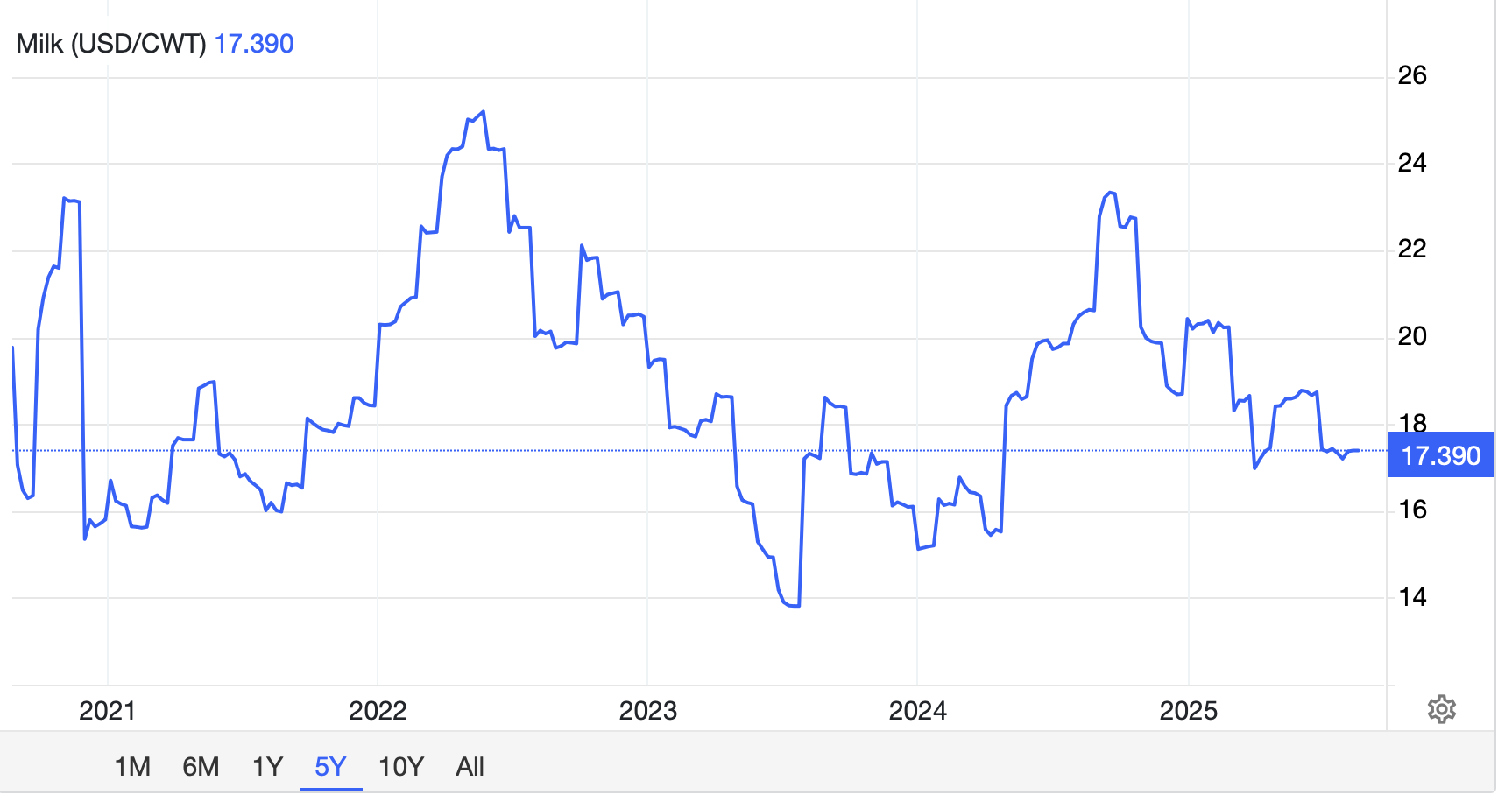
Kings County milk valuation followed commodity markets with the 2024 average of$21.6 per cwt compared to $19.30 in 2023 , a record $26.30 per cwt in 2022, $19.10 in 2021 and $18.60 in 2020. So far in 2025 while we don’t have an average yet it appears  they will be well below 2024. Class IV milk dropped from over $21 per cwt in January 2024 to $13.90 on the futures market for this December.Class IV is over 60% of pooled milk sold. The 2025 average is likely to be in the $17 to $18 per cwt range that will shrink crop valuation totals in big milk producing counties like Tulare and Kings.
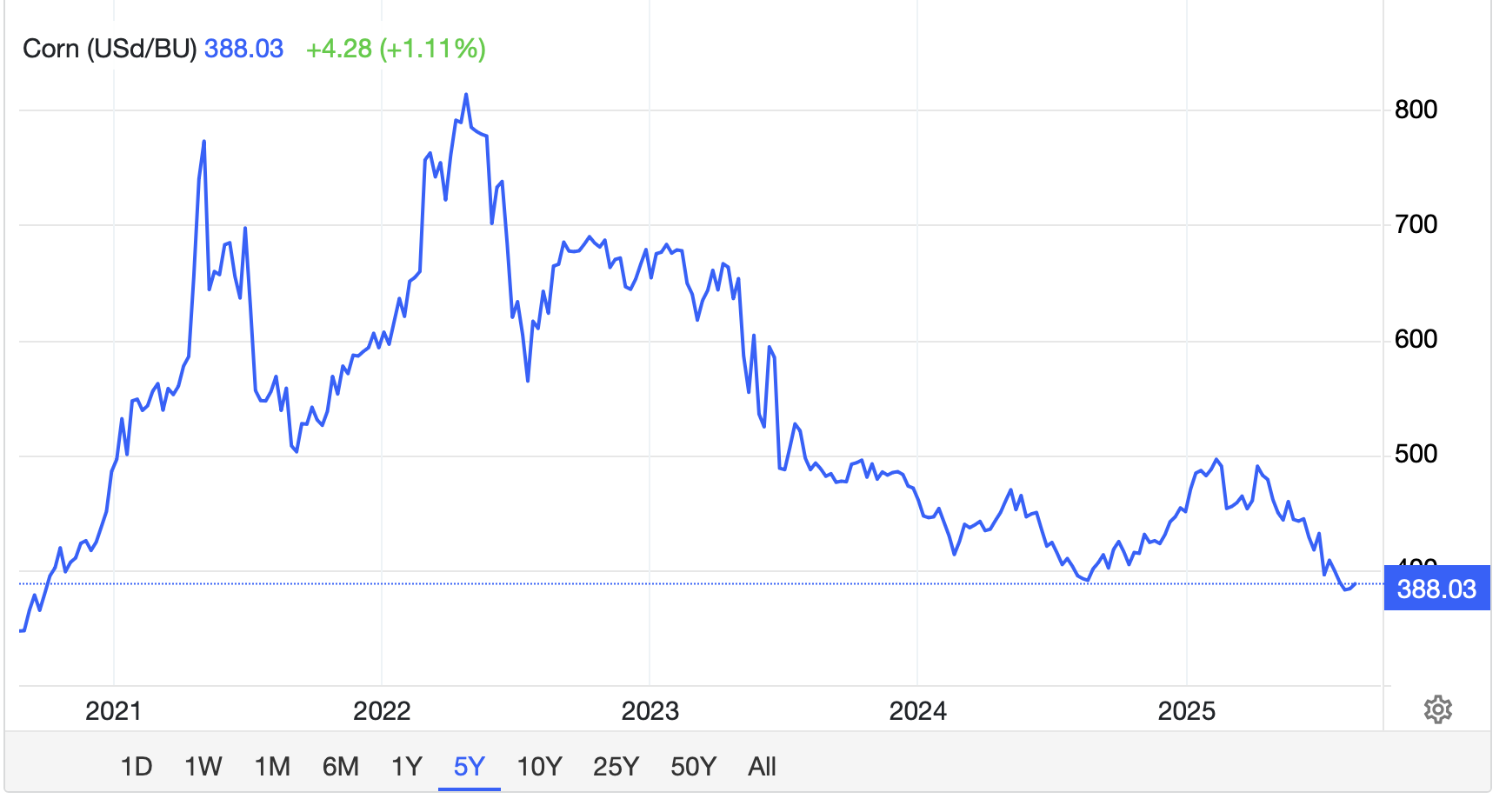
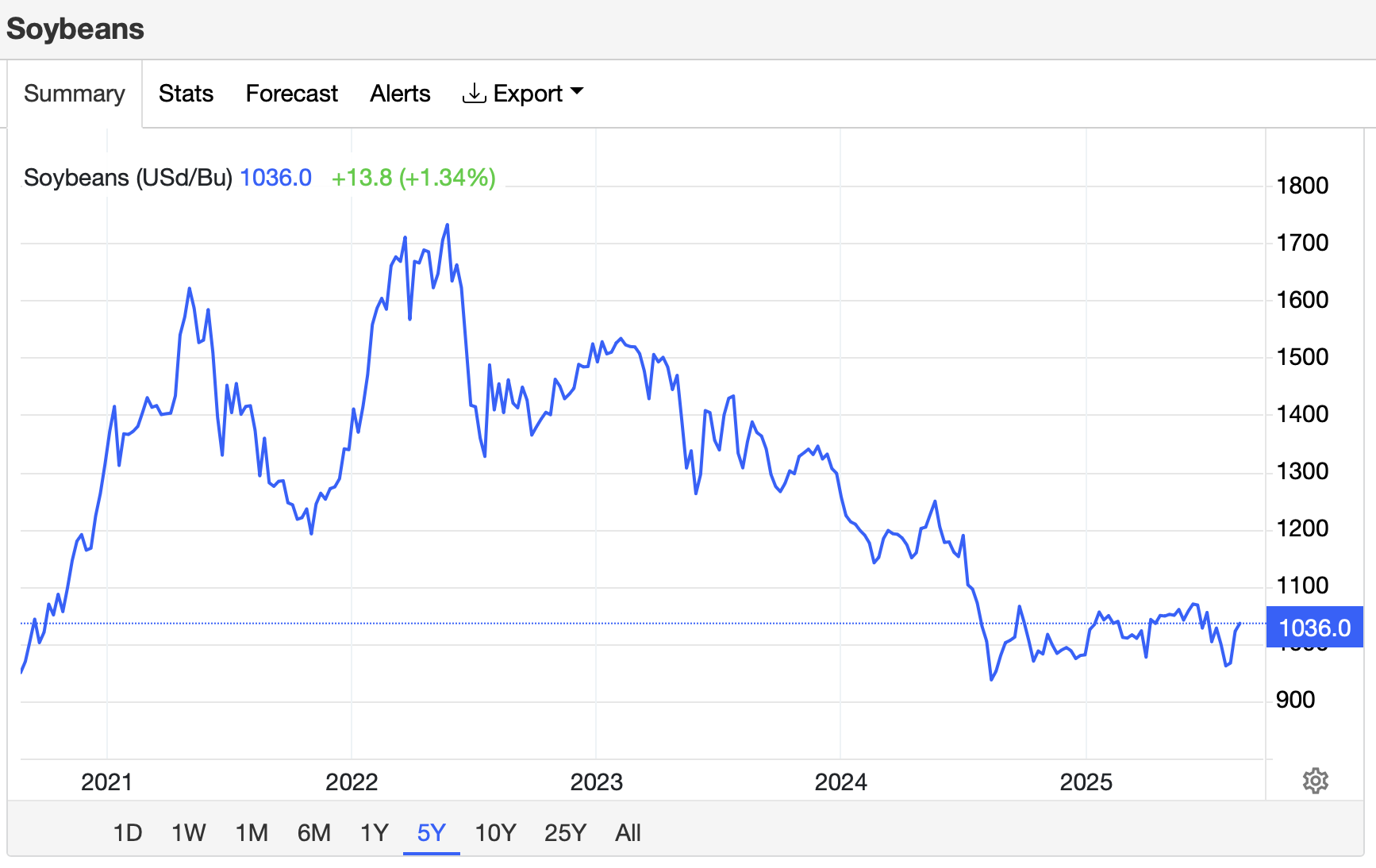
By the way, a big plus for dairy operators is the drop in feed prices in the past few years. From July 2023 to July 2025 corn is down 31%, soybeans down 30% and alfalfa down 15%.
Kern county was the 2023 leader of the pack but crop value dropped 8% from 23′ to 2024 in part due the downturn in grapes and wine grape valuation.The decline in value of wine grapes produced in the county was dramatic falling from $132 million in 2023 to just $27 million in 2024.

Ag Beat

California’s first solar-covered canal is now fully online


This story was originally published by Canary Media

The 1.6-MW pilot system is among a growing number of initiatives to put solar over waterways. The approach could generate gigawatts of power nationwide.

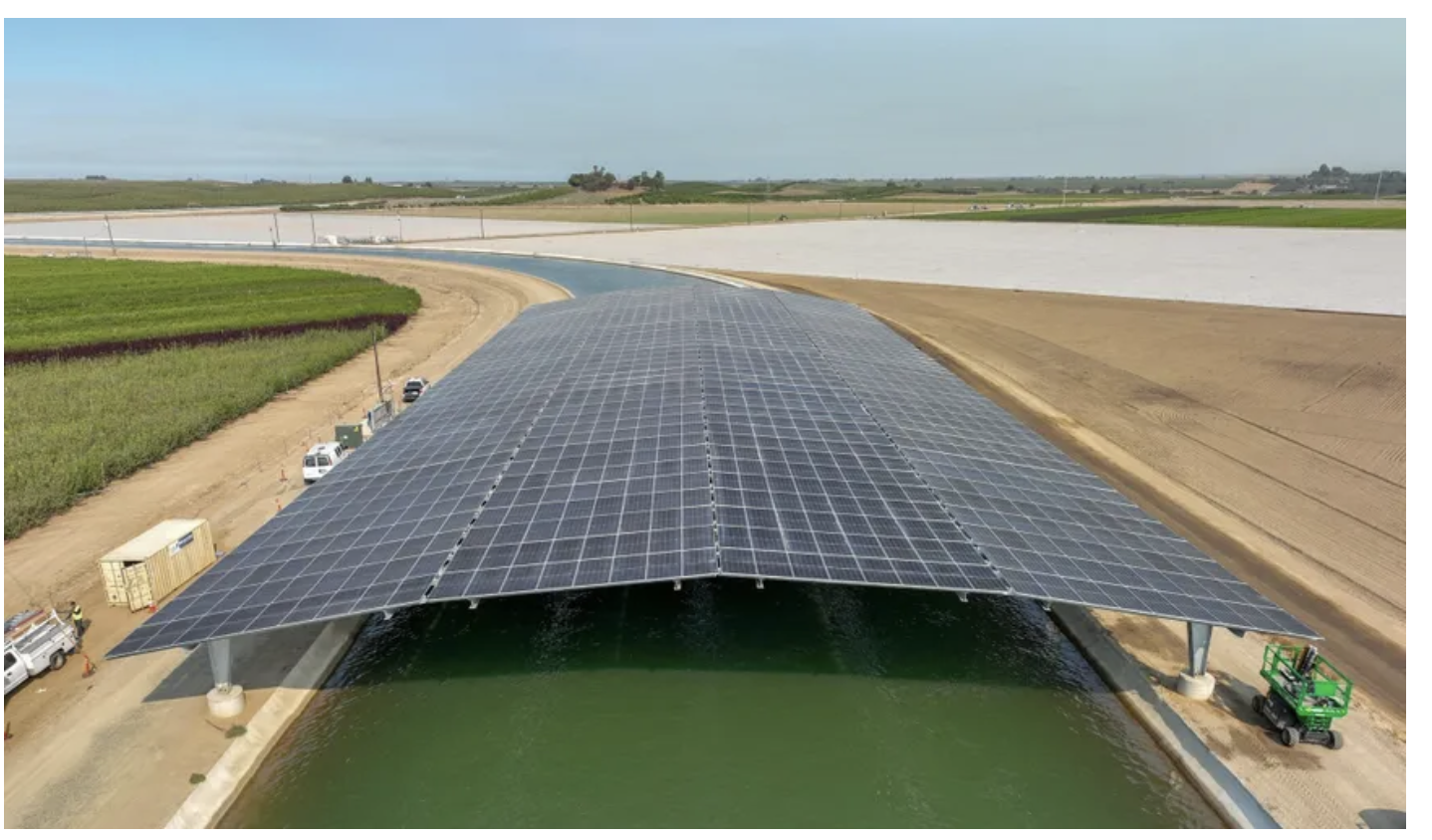
The roughly 110-foot-wide portion of the canal-top solar project near Hickman, California. (Turlock Irrigation District)

A novel solar power project just went online in California’s Central Valley, with panels that span across canals in the vast agricultural region.

The 1.6-megawatt installation, called Project Nexus, was fully completed late last month. The $20 million state-funded pilot has turned stretches of the Turlock Irrigation District’s canals into hubs of clean electricity generation in a remote area where cotton, tomatoes, almonds, and hundreds of other crops are grown.

Project Nexus is only the second canal-based solar array to operate in the United States — and one of just a handful in the world. America’s first solar-canal project started producing power in October 2024 for the Pima and Maricopa tribes, known together as the Gila River Indian Community, on their reservation near Phoenix, Arizona. Two more canal-top arrays are already in the works there.

In California, the solar-canal system was built in two phases, with a 20-foot-wide stretch completed in March and a roughly 110-foot-wide portion finished at the end of August. Researchers will study the project’s performance over time, while a new initiative led by California universities and the company Solar Aquagrid will push to fast-track the deployment of solar canals across the state.

Proponents of this emerging approach say it can provide overlapping benefits.

Early research suggests that, along with producing power in land-constrained areas, putting solar arrays above water can help keep panels cool, in turn improving their efficiency and electricity output. Shade from the panels can also prevent water loss through evaporation in drought-prone regions and can limit algae growth in waterways.

Plus, solar canals could offer a faster path to clean energy development than utility-scale solar farms, especially in rural parts of the U.S. where big renewables projects increasingly face community opposition. Placing solar panels atop existing infrastructure doesn’t require altering the landscape, and the relatively small installations can be plugged into nearby distribution lines, avoiding the cumbersome process of connecting to the higher-voltage wires required for bigger undertakings.

UC Merced says an almond orchard in Parlier provides a look into the future of farming.

Researchers at UC Merced and the University of California Agriculture and Natural Resources installed an irrigation system powered by artificial intelligence to deliver the precise amount of water needed and measure the results.

Led by computer science and engineering Professor Wan Du, the project was funded through the Fall 2023 Climate Action Seed Funds. It included a goal that’s almost as important as the work itself: spreading the word about the system and its potential.

The project includes two test beds: one irrigated via traditional methods and one served by the AI-powered system. Du is working alongside civil and environmental engineering Professor Safeeq Khan, a water resource management and soil science expert who built the soil model for the project, and computer science and engineering Professor Stefano Carpin, who developed the AI model.

“We will compare how much water each test bed will use,” Du said, “and then compare the production and result of these two fields.”

The system measures how much moisture is in the soil, then the potential for movement of water through a tree and eventually out the leaves. The data is uploaded to the internet.

“We have sprinklers under almost every tree so we can control them,” Du said. An algorithm processes the data and determines whether to open a sprinkler and how long it should run.

“We want to save as much water as we can,” Du said. “Saving water will reduce the cost to growers, and we can save the natural resource for the next generation.”

The system will be operational next spring, when the trees start to flower.

Avian Influenza Confirmed in Utah Poultry Farm

Five US states hit in past 30 days

The Utah Department of Agriculture and Food (UDAF) has confirmed highly pathogenic avian influenza (HPAI) in a commercial turkey facility in Sanpete County. HPAI is a contagious viral disease that affects domestic poultry and wild birds, often leading to high death rates in flocks.

“Commercial turkey facilities in the northern U.S. and here in Utah have been the most impacted by HPAI this falI. With migratory bird season just beginning, we may see a greater impact as the season progresses. It is imperative that poultry producers practice strong biosecurity.” said State Veterinarian Dr. Amanda Price.

Nearly 35,000 turkeys were culled after cases of highly pathogenic avian influenza were detected at a commercial turkey facility in central Utah.

.In recent days news of the most recent northern US losses includes a flock of nearly 3.1 million laying hens in Wisconsin.

For the third year in a row avian flu is spreading across the states in the US as the annual north/south bird migration progresses.So far this fall poultry ranches in North and South Dakota, Minnesota,Wisconsin and Utah have been hit.

Watt Poultry publication says the United States has lost more than 175 million head of commercial poultry to highly pathogenic avian influenza (HPAI) since the outbreak began in 2022.

Poultry owners should vigilantly watch their flocks for signs of HPAI, which include high death loss among flocks, nasal discharge, decreased appetite or water consumption, and lack of coordination in birds.

HPAI is often spread by wild migratory waterfowl. The virus can be carried into domestic flocks through direct contact with wild birds, contaminated equipment, or people moving between flocks. Anyone involved with poultry production, from small backyard flock owners to large commercial producers, should review their biosecurity plans to ensure the safety of their birds. While HPAI is a serious disease in poultry, it does not currently present an immediate risk to public health. As a reminder, the proper handling and cooking of all poultry and eggs to an internal temperature of 165˚F is recommended as a general food safety precaution.

Mandarin crop on the grow

Central Valley growers are reaching for that sweet spot as production of the tangy mandarin citrus crop keeps climbing.

USDA has released its latest forecast for Tango and W Murcott Afourer Mandarin groves finding that this winter’s crop should reach 33 million 49-lb cartons compared to 29 million in 24/25 and 21 million cartons in 22/23.

These citrus varieties are not only sweet, but seedless in the case of Tango and easy-to-peel mandarin fruit that were developed by the University of California and planted by San Joaquin Valley gowers starting some 20 years ago. The small size fruit has a rich flavor, deep orange color, and a sweet-tart taste that makes it popular for snacking, juicing and school lunch boxes.

This year mandarin acreage has climbed from 31,000 acres in the year 23/24 to 33,000 acres in 24/25 to 35,000 in 25/26.

This year’s survey, done in July and August found that fruit set is down 24% this year although fruit diameter is up 1%. The yield this year is expected to be 943 cartons per acre compared to 879 last year and 677 cartons per acre in the year 23/24.

Look for the fruit at your grocer or farmer’s market from January through April.

More than a dozen varieties of mandarins have been planted in recent years besides these two varieties adding up to nearly 70,000 acres with the Clementine variety a widely planted mandarin and the subject of its own USDA report not out yet.

Besides seedless mandarins, Exeter-based Citrus Mutual is proposing a standard for seedless lemons that are likely to become popular in coming years.

Mandarins are a growth industry for citrus farmers who have maintained their navel orange acreage at about 109,00 acres for the past five years but shrinking from 141,000 acres in 2007/08. The latest USDA production report forecasts a navel crop of 80 million cartons, up slightly from the average for each of the past five years.

California citrus production has now far outpaced rival Florida with around 79% of the U.S. total while Florida accounts for 17%. Florida has suffered citrus greening disease, cold snaps and hurricane damage to their industry. While California produces fresh market oranges and lemons, Florida oranges are largely used to make juice. Florida’s citrus industry’s production has dropped 90% in the last 20 years.

Farm machinery sales drop again 


U.S. sales of combines dropped 43.7%, 4 wheel drive tractors sales fell 40.2% while overall agricultural tractor sales fell by 4.9% in July 2025 compared with July 2024, according to numbers from the Association of Equipment Manufacturers (AEM).On year to date basis all farm tractor sales are down 9.9%.

Farm machinery giant Deere warned this past week that tariff costs for the company could reach a total of $600 million for the fiscal 2025 year.
Deere’s director of investor relations, John Beal, said“Tariff costs in the quarter were approximately $200 million, which brings us to roughly $300 million in tariff expense year to date based on tariff rates in effect as of today,” Beal said. “Our forecast for the pretax impact of tariffs in fiscal 2025 is now adjusted to nearly $600 million.”


Farm machinery sales are considered a barometer of the  US ag economy as the nation’s  biggest crops are at bumper volume with lower prices this year. 


Here are five-year price charts for corn, milk and soybeans

Here are a few other ag business briefs.
-Consumers are paying more for a staple food – ground beef. The average prices for ground beef rose to new record highs in July, reaching $6.25 per pound for 100% ground beef and just over $8 per pound for lean and extra lean ground beef, according to the Bureau of Labor Statistics. Cattlemen  are paying more  for feed and fuel, as well as a scarcity of cattle for processing relative to demand, particularly in the Western U.S., according to local reports. In addition, consumer demand for meat overall is rising as more consumers adopt high-protein diets.
-CA Milk Production up 3.8 Percent USDA reports that milk production in the 24 major States during July totaled 18.8 billion pounds, up 3.5 percent from July 2024..California milk production was up 3.8% as both cow numbers and milk per cow were each higher than a year ago.

–Milk Producers Council says dairy producers continued to hold onto as many cows as possible, allowing for expansion despite the heifer shortage. The dairy herd reached 9.485 million headlast month, up159,000 from July 2024 and the highest head count since May 2021. The year-over-year increase is large enough for producers to send an additional 900 head to slaughter each week and maintain an annual cull rate below30%, on par with the 2024 rate that fostered rapid expansion.