Pop Goes the Diesel! Average US diesel prices hit $5.446/gal, up nearly $1.75/gal from one year ago. Highest prices ever for harvest season and costliest freight surcharges ever on tap for the last 140 days of 2026.-oil analyst Tom Kloza
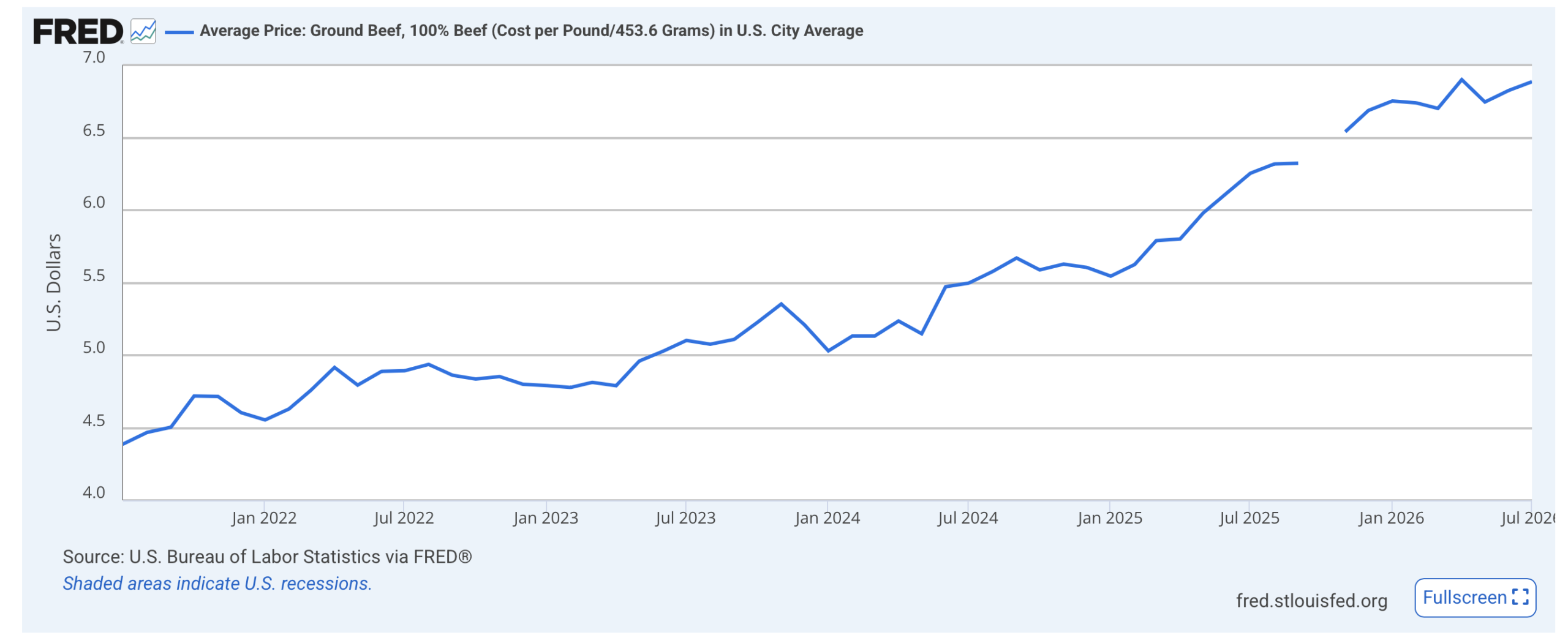
Beef prices: Tyson Foods is closing beef processing plants in Illinois and Utah while selling its Washington facility to streamline operations and adapt to one of the most severe cattle shortages in U.S. history, consolidating production at three centrally located facilities in Nebraska, Kansas, and Texas.When Tyson Foods on August 3 reported its financial results for the third quarter, it revealed that the company’s beef segment experienced an operating loss of $142 million. Here is a 5-year St Louis Fed chart of hamburger prices, now near $7/ lb.
Sorry Charlie:Tuna giant Bumble Bee Seafoods is shuttering their Santa Fe Springs Calif facility (LA) laying off 197 workers as of November 19 according to a state WARN notice. The seafood processing brand previously executed a smaller permanent layoff affecting 56 employees at the same location in December 2025.The business may be impacted by a confluence of factors including limits on fishing, a consumer shift away from traditional canned products toward innovative flavor pouches or alternative fresh proteins, Also the company has faced ongoing litigation costs over charges of human trafficking and forced labor. Higher Mortgage rates: Real estate analysts say that the 30-year mortgage rate climbed upward in July to 6.69%, the highest since July 2025 says Freddie Mac.The prediction is that it will continue to rise over the next few months. The boost in the rate is expected to hurt both new home purchases and refinance activity. The Freddie Mac figures show that the rate has risen from 6.43 per cent at the beginning of July and from 5.98 per cent before the Iran war began in late February.
Modesto wine cap maker lays off 66 workers: G3 Enterprises announced the layoff of 66 workers at their wine cap factory in Modesto, reflecting decling demand in the wine industry in California “Like many companies in our industry, we have experienced changes in customer purchasing patterns and production volumes,” Laura Bream, the company’s vice president of human resources, said in a statement. “While these changes have contributed to the need for restructuring, they reflect broader market dynamics affecting the entire wine sector.”
Wheat farmers hurt by higher costs: Kansas farmer Gary Millershaski is blunt in describing the economics of wheat production.“There has not been any profitability,” Millershaski said. “Our profitability is nothing right now.”
Millershaski took over as chairman of U.S. Wheat Associates in June, and will serve a one-year term. He spoke with Capital Press the morning of Aug. 7.Millershaski cites increased input costs as a result of first Russia invading Ukraine, and then conflicts with Iran. “Our nitrogen went from 60 cents a pound to $1 a pound; our fuel probably went up $1.50 a gallon,” he said. “Any time you mess with either one of those, it’s a domino effect that just explodes.” Machinery parts are also affected.
“We are in a hand-to-mouth society on parts,” Millershaski said. “Freight has just exploded. It used to be, we would get parts on stock order … that’s almost a thing of the past. If you do that, you may not get it for a month. Nobody inventories anything. A cylinder on my sprayer broke, nobody had one, it came out of Canada. It got tied up in Buffalo, N.Y., it sat there for a week. We can’t do that.” From Capital Press
Visalia lost a guiding light last week.Former mayor of Visalia Greg Collins passed away Thursday August 6 at his home after a debilitating illness. Arguably an important architect for Visalia, he started his public service as a city council member in 1975 when the population of Visalia was about 50,000. It is 150,000 today.Greg was 76 years old, survived by his wife Dorothy, daughter Kelcey and son Christopher.He was my friend.
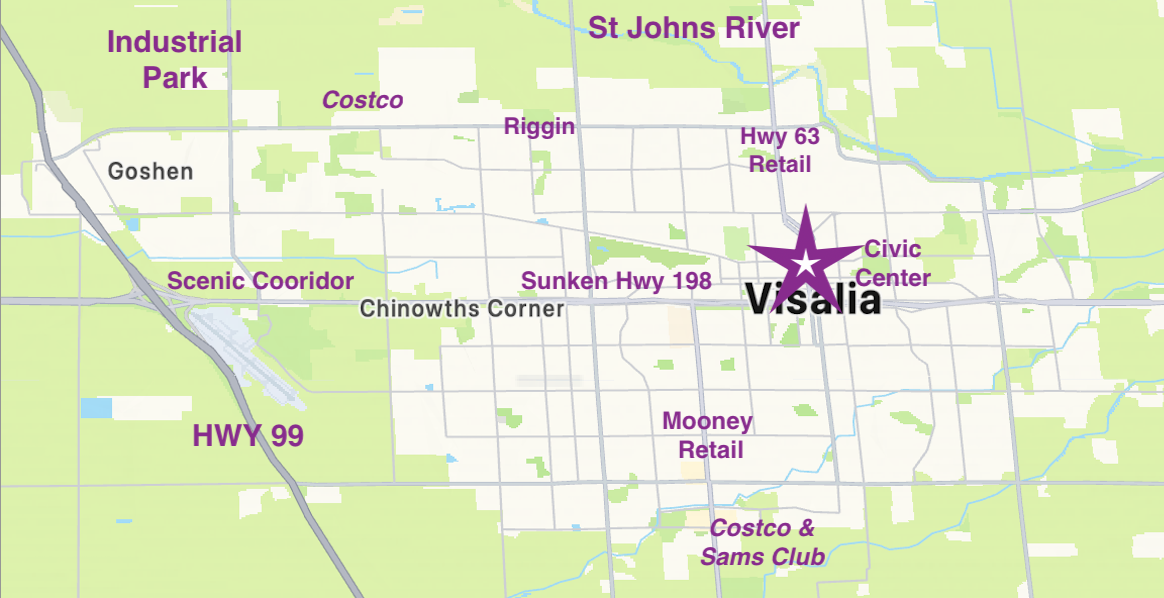
Collins literally shaped Visalia, as can be illustrated from this map of the community.Take a tour and you will see Greg’s hand everywhere in this city.
It was Collins among others who advocated the idea that the town should grow in a concentric manner anchored by Downtown.That theme is now widely accepted conventional wisdom in Visalia.
That meant limiting growth on its perimeters so that today we are the only Valley city that has no presence on Hwy 99.What’s the message? If you want to see Visalia, get off the freeway and walk around to experience this Tree City without the Fresno sprawl.Besides restrictions to the south limits were placed on growth to the north as well with city development not allowed to extend beyond the St John’s River.
To the west Collins carried the idea of saving our heritage oak forest establishing a “scenic corridor” entrance to the city.Collins was only the latest Visalian wanting to protect the oaks, remembering a delegation lobbying the State Highway Commission back in 1957 and a tree planting group in 1920s.
To the east Greg, the conservationist, promoted sinking basins that would replenish our groundwater as he helped save the Kaweah Oaks open space and established an oak tree nursery for the city.
If he backed preservation of agricultural land beyond Visalia promoting a controversial ag land preservation rule,he was a strong advocate of development within the city that has helped make it prosperous and boosted property values within the city.
He lobbied CalTrans to depress the 198 freeway below ground level – limiting noise and traffic impacts and preserving the streetscape in Visalia while speeding visitors to our national parks.
Speaking of the National Parks, Collins was there with other preservationists like his mentor Alan George to save the Mineral King Valley from Disney development years ago, and the pristine alpine Valley is still pristine today, part of Sequoia Park.
Collins won the battle over bringing a national hotel brand to Downtown Visalia, considered highly controversial back then.He was among those who persuaded Downtown merchants to tax themselves to support themselves by forming an improvement district. He has been a big supporter of preservation of our heritage buildings including the Darling Hotel that he convinced the county to finally sell and put the art-deco beauty on the market and on the tax rolls. We know what happened then. Now everyone wants to stay there as well as eat at the rooftop restaurant.
Civic Center plan & Swimming Pool
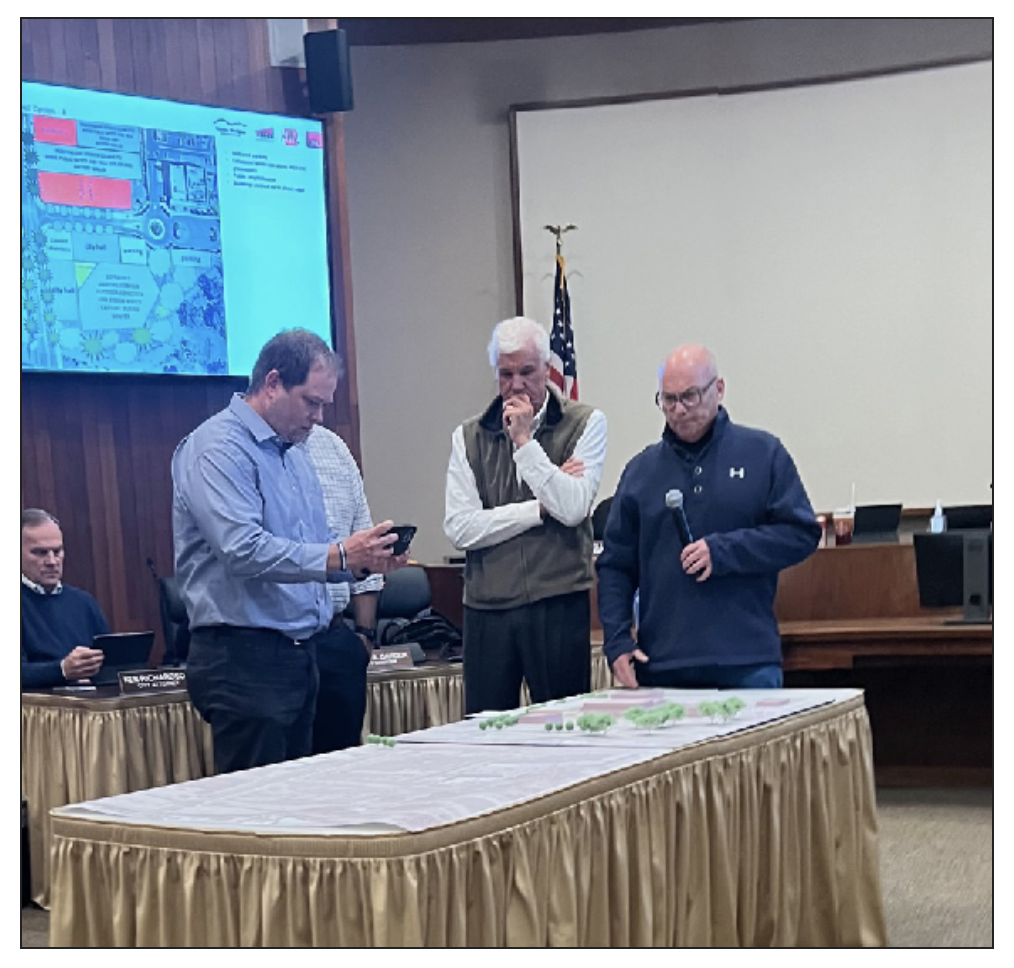
Speaking of expansion of Downtown, it was Collins’ idea to acquire the old railroad properties in East Downtown – the former Hobo Jungle to become the future Visalia Civic Center – now about ready to open but Greg won’t be there to cut the ribbon,or will he?
By the way, a key unresolved issue for Greg, the former water polo coach, was for the city to invest in a competition swimming pool. Now the current council seems poised to build it and name it after Greg Collins. Still undecided -where to put it? Collins told me two weeks ago -put it the middle of town – around the Civic Center area. Collins backed the idea of selling 21 acres the city owns at Akers and Riggin on the agenda to happen later this summer. The money would be placed in the Parks and Recreation budget who would oversee construction of a new public pool.
Speaking of preserving the economy in Downtown, Collins was a key player in keeping Kaweah Delta hospital in the Downtown area while many lobbied to move the district hospital to the outskirts of town.Today it brings thousands of job to the city center and has attracted competition to do the same like a giant magnet.
Because of the limitation on development over decades, the Mooney strip has been in-filled and renewed along the 3-mile stretch with new players, new retailers and services. So Mearl’s closed but the drive-in became The Habit. Gottschalks became Macys. The ramshackle 20th Century apartments (remember them?) is now Kohls.
Mooney rebirth
What did the growth limitation do? Take Sequoia Mall. It took a while but Visalia saw a transformation with four new retailers we never had – Sprouts, Nordstrom Rack,Barnes & Noble and now Sierra, an REI type outdoor store. A new gym, Crunch Fitness will replace the old Longs Drugs building.
Keeping the development boundary compact created a critical mass of development opportunity and ease of access for shoppers.
Northside growth
The growth limitation also spurred retailers to invest in a new vibrant shopping area north of Downtown along Hwy 63 as well in a part of the city that has historically been the low income area of town. Today it is the home to many national retailers- Target and Burlington- and restaurants including a second In-N-Out. The nearby retail also anchors new housing for Visalians in the north part of the city connected by walking trails and 4-lane landscaped thoroughfares- and a second way to get to Highway 99.
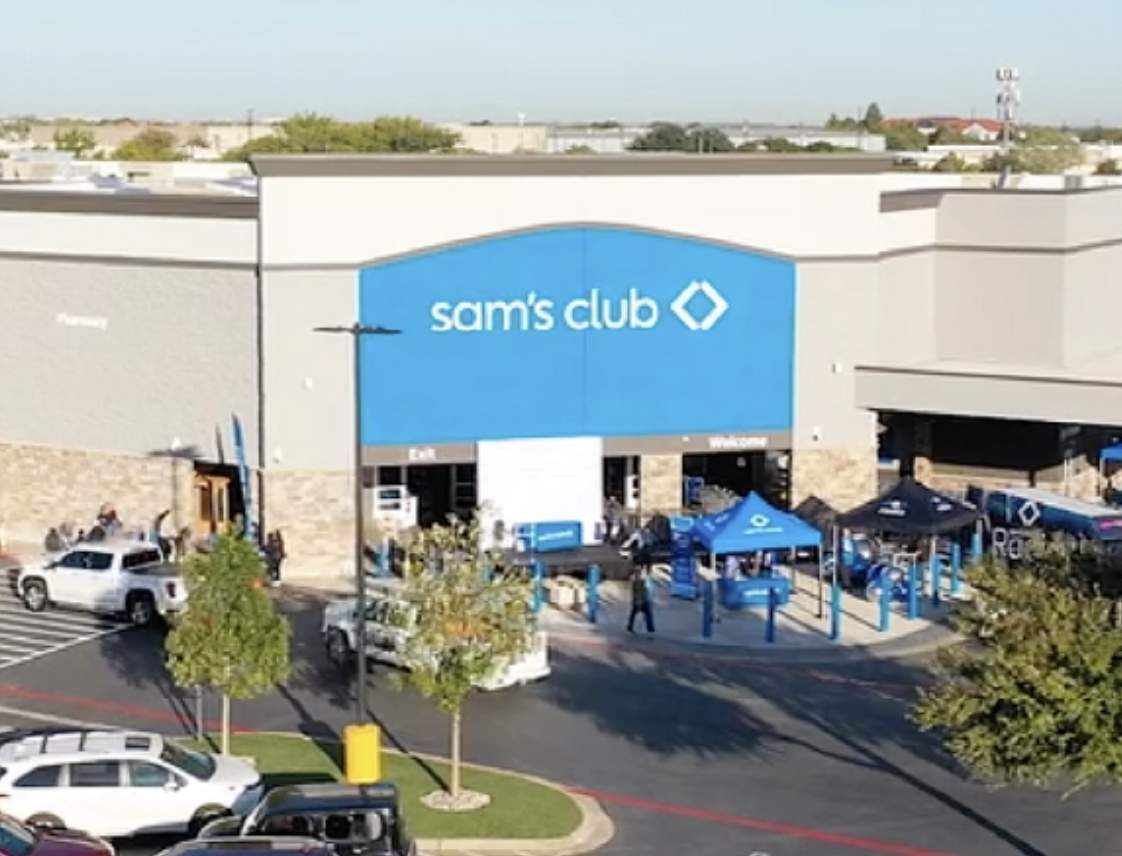
South Mooney is still strong but the north quadrant of the city snagged a second Costco that draws shoppers from northern Tulare County as the south city Costco draws from the rest of the county.All this boosts city sales tax revenue that has climbed regularly for decades. Now we will get a Sam’s Club and Chick-Fil-A on south Mooney want to be here too.
Collins pushed for design standards for a well planned industrial district that has impressed competing Fresno leaders with why Visalia continues to attract more industry.The city’s series of general plans has protected the big industrial area offering CEQA support against lawsuits while allowing for growth to the north – key to its success today.It is a huge job generator for Visalia with three Amazons, UPS and Ace Hardware and plans for new Carvana inspection center with 700 jobs likely opening next year.
Not every battle won
Collins didn’t win every battle over the decades. Collins fought against rezoning land on Plaza for an auto mall after dealers invested millions in the newly established east Visalia auto district- a battle he half-won with dealers today in both areas.He backed the idea of Mooney auto dealers to move to one of the auto districts leaving the retail strip to retailers Today the Plaza auto area includes used car dealers, CarMax now open and MyCarPark, about ready to open.
He half won the battle to limit retail development south of Packwood Creek.It turns out the city council did vote to allow growth for a large development to the south but the city has halted new projects at the Visalia Parkway. He lost the battle but not war.
He could not convince the County not to allow the Sequoia Gateway project at Hwy 99 and Caldwell proposed in 2018 but it appears market forces and slow pace of freeway construction have done the job to date.
The Visalia Chamber of Commerce announced Greg was Man of the Year in 2025. He was remembered for his strong advocacy for local parks, urban forestry (Tree City USA), and preserving Visalia’s historical character.Greg stepped down from council in late 2022.
Collins was also an author penning a book on water in the Valley in 2024. Called Seven Generations: The Past, Present and Future of the Tulare Lake Basin offering a one sentence summary. “The question becomes, will man learn to manage his water resources, or will he simply revert to business as usual?”
One review of the book suggests “The “Seven Generations” of the title comes from a principle of the Arapaho nation of indigenous people, who believed that decisions should be made in the present that will last through seven generations for that community to remain sustainable. Collins calculates that roughly five generations have elapsed since Californians began tinkering with the natural forces governing water in the Valley.”
Extreme heat in March and April has stressed a variety of crop yields in the Central Valley continuing this summer and now the fall pistachio crop looks to be impacted big time as well. Estimates are that the important nut crop could be down by more than half as the bloom was off, suffering pollination failure in parts of the Central Valley.
First crop out of the chute were cherries. The California Cherry Board estimated production to total fewer than 5 million boxes this season, compared to an average of about 8 million boxes annually over the past five years. Industry officials said an unusually warm March accelerated crop development before April and May storms caused widespread fruit cracking and quality issues near harvest according to press reports.Multiple counties have requested disaster designations.
This summer’s early grape crop was hurt by very hot temps over multiple days as well.
But the big news this month is the pistachio crop that already varies by year – being alternate bearing- has been hit by the heat as well. After producing more than 1.6 billion pounds last season- the highest number ever- industry estimates for this fall have dropped to 600 million to 900 million pounds, with one forecast around 650 million pounds statewide. That would be down by almost one billion pounds from last year.
Growers say high temps above 85 degrees during the spring bloom affected some orchards more than others. There are reports of 90% blank nuts as growers monitor their trees.
The Packer publication reports weather is the big issue this year with crop analyst Matt Wolf quoted saying “We knew it was going to be an off year, but we didn’t know that the heat in March was going to disrupt bloom like we’ve seen,” Woolf says. “Nut clusters are a lot smaller than what they typically are.”
In Kings County pistachios are the number-two crop behind only milk – with a $300 million valuation in 2025 covering about 60,000 acres.
Last year, the Valley saw about 25,000 new bearing acres to harvest. The predictions were for the pistachio crop in California to grow in most years, having reached the 1 billion pound mark in 2020 and perhaps a doubling by 2030.
In 2023, American Pistachio Growers (APG) retained The Tootelian Company to project annual pistachio production in California through 2031. They estimated that with regard to annual new plantings, the total number of acres of pistachios is expected to grow from nearly 583,400 acres in 2023 to nearly 811,300 acres in 2031. This represents a 4.3% increase per year.
Farmers have planted at a rapid pace across the Central Valley starting with just 1,700 acres in 1977, growing to 74,000 acres in 2000, to 178,000 in 2012,488,00 in 2024 and 520,00 in 2025.
Now with SGMA and since 2022, some lower prices, the bulls might need to curb their enthusiasm. Business Insider reports “Pistachio trees thrive in hot, arid climates, but a mature orchard typically needs over a million gallons of water per acre each year in order to produce any nuts for profit, making them vulnerable in times of drought.
Moreover, pistachios are among the most expensive nuts to grow and can cost about $20,000 per acre before a single nut is produced, and trees can take six years to yield a harvest — twice as long as almond trees.”
High Hopes
Pistachio acreage has increased nearly five times in the last two decades and bearing acreage is now more than a half million acres.Headlines in 2025 boasted of record highs and another “massive crop” boding well as demand worldwide was sky high.
We reported that looking to boost their production, at least three pistachio growers and processors in Kings County were indicating expansion plans looking to take advantage of their expectation of more and more nuts. Now it looks like Mother Nature or climate change, if you please, will have a say about that.
Heat is on
The Fresno Bee reported last week that “A dangerous heat wave backed by the largest heat dome on Earth is set to bake Fresno and the San Joaquin Valley this weekend, with temperatures approaching 108 degrees in some areas. The National Weather Service has issued heat advisories through Monday evening, and forecasters warn the triple-digit temperatures will linger into next week.” With the Pacific Northwest literally on fire this week as this heat, drought & fire pattern is sobering.Growers are wondering what a Super El Nino will mean in coming months.
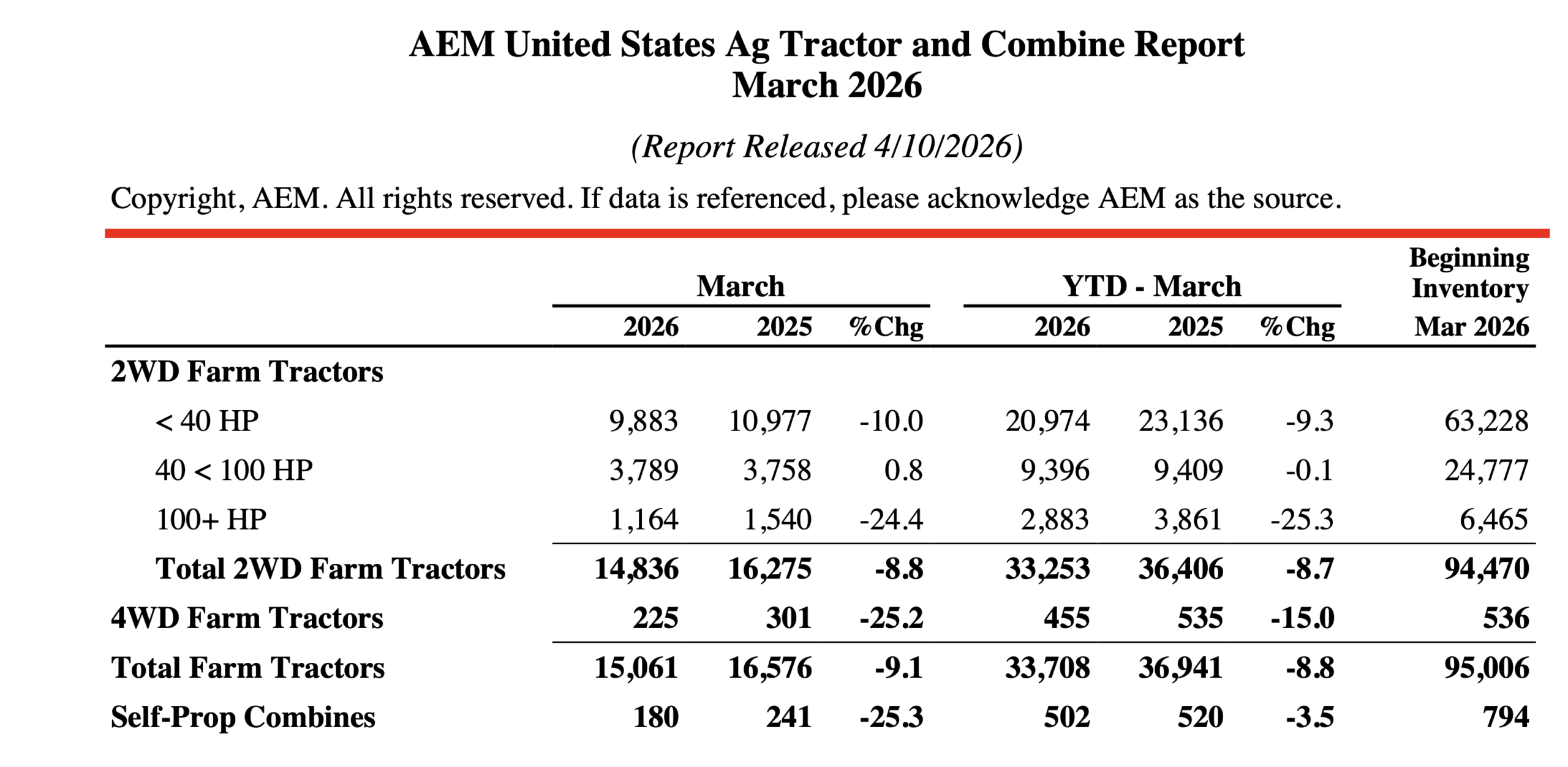
May tractor sales across the US were lower in May down nearly 25% from the same time last year. The numbers say clearly that farmers are not really ready to commit to new equipment at this time.
Stone fruit faces challenges
Ag Net West reports that California’s stone fruit season is running three to four weeks ahead of its typical timeline. The early development has altered the normal harvest progression, with multiple varieties reaching maturity at nearly the same time rather than arriving in the staggered sequence growers and packers typically expect.
Also growers are reporting a higher percentage of smaller-sized fruit this season. Industry observers suggest the accelerated development may have contributed to some orchards missing ideal thinning windows, although weather conditions may also be playing a role.
Consolidation in ag
A recent report suggests consolidation in ag:
Carrots: Two companies control 60% of the carrot supply. Prepared soups: Four companies own 70% of the prepared soups market. Almond milk: A whopping 81% of almond milk is owned by four companies. Dips: PepsiCo, with its popular brands like Tostitos, Lay’s, and Fritos, controls 88% of the dip market.
Meatpacking is one of the most consolidated industries in our food system. Of the more than 70 meat brands marketing to consumers and retailers under the guise of individual names and logos, just four corporations—Tyson, JBS, Cargill, and National Beef—are behind these brands. These four meatpacking giants control 80-85% of the beef industry
UC study shows how trade policy hurt California Ag
New research published by the University of California Giannini Foundation of Agricultural Economics shows how quickly changes in trade policy can destroy market access critical to the success of some agricultural sectors.
Agricultural economists Colin Carter, Sandro Steinbach and Yasin Yildirim found that in aggregate the top 13 California agricultural commodities exported to China fell from an average total annual value of around $1.55 billion in 2024 to $554 million in 2025 – a 64% decline in a single year.
After joining the World Trade Organization in 2001, China became one of California agriculture’s fastest-growing export markets, with exports of key crops (e.g., almonds, pistachios, dairy and cotton) to China expanding over the next two decades. But that trajectory changed in 2018-19 with the first U.S.-China trade war.
Then, in 2025, while California farmers were still recovering from the effects of the 2018-19 dispute, the United States imposed tariffs on Chinese imports under the International Emergency Economic Powers Act. China responded with effective retaliatory tariffs on U.S. goods — including many California-grown agricultural products.
States sue government over TotalEnergies wind for fossil fuels swap deal
A coalition of seven states has brought to court the Trump administration over one of its deals with TotalEnergies (EPA:TTE) that will see the French group exit its offshore wind activities in New York and invest in oil and gas instead. California has criticized a second similar plan that would pay the company OceanWinds to withdraw from their existing lease off Morro Bay if they invest in fossil fuels instead.
Chinese investor plans new West Coast offshore wind project
Chinese wind turbine maker Ming Yang Smart Energy Group Ltd (SHA:601615) will consider investing in an offshore wind project in the Hecate Strait off British Columbia, Canada, that will add between 1.5 GW and 2 GW of installed capacity.
The Chinese firm will assess opportunities to take part in the project under a non-binding Memorandum of Understanding (MoU) with Oceanic Wind Energy Inc (NKW.H:CVE), the latter said on Thursday. The scheme related to the pact is a 50/50 partnership between Oceanic Wind Energy and Indigenous-owned company Coast Tsimshian Enterprises (CTE).
In new attack on solar, lawmakers spread myths about potato farms
Is Frito-Lay categorically refusing to buy potatoes grown on farmland that has hosted solar installations? No, the company says.
That hasn’t stopped lawmakers in Michigan and Pennsylvania from spreading the false claim about one of the biggest purchasers of potatoes in the country.
In January, Michigan Republican state Rep. Cam Cavitt posted a 51-second clip to Facebook labeled “Solar Farm SECRET.” In the segment, he claimed that farmers in his district couldn’t grow potatoes on land where solar developments were sited.
“Frito [Frito-Lay] did the same with the potato growers up by us,” fellow Michigan Republican Rep. Dave Prestin told Cavitt in the clip. “Any field that had solar panels installed on it will never be allowed to grow potatoes for human consumption due to the leaching.”
More than 1 million people viewed that video. Pennsylvania Republican Sen. Cris Dush shared it and said he wanted “cash bond guaranteeing restoration” of the soil after a solar development was removed. “When Frito Lay refuses to accept potatoes from farms that had solar arrays we should all sit up and take notice!” he wrote.
PepsiCo, which owns Frito-Lay, told Canary Media that the company “has not issued blanket guidance to growers that fields with solar installations will not be accepted.”
Nor is there any published evidence that solar farms have a negative impact on potato farming, according to experts consulted for this story. On the contrary, there is agrivoltaics research showing that potatoes — and many other crops — can benefit from growing alongside shade-making solar panels. Canary Media
Local dairy farmers are getting mixed messages from the marketplace. As more processing plants open in the Midwest and Texas, there are fewer buyers for local milk production. Kings county dairyman Joqaquin Contente says when Leprino closed their Lemoore East plant “farmers lost 80 loads of milk” that means dairies no longer had a” home” for some volume of production. That is happening even as California milk production is up 2.3% and farmers continue to add cows here and nationwide.
So what’s happening?
If there is too much milk, milk co-ops are trying to tap down the volume this spring when production typically ramps up, says the Daily Dairy Report.The report says in the April 17 release that “in California, milk is abundant, and dryers are running as hard as possible. As the spring flush overwhelms processing capacity, a major California cooperative is incentivizing producers to rein in milk output with steep discounts on any milk shipped above their monthly base volume. Last year, avian influenza dragged down California milk output and national NDM and skim milk powder (SMP) production slumped to a 12-year low. The California comeback matters. Last year, despite the bird flu, the Golden State accounted for 44% of U.S. NDMoutput.Now that California’s cows are healthy and happy again, production is up. U.S. milk powder output topped 2024 and 2025 volumes in January and February.”
Contente says he believes all the milk co-ops are exercising production controls, helping to keep prices profitable and penalizing overproduction.
Highest price ever
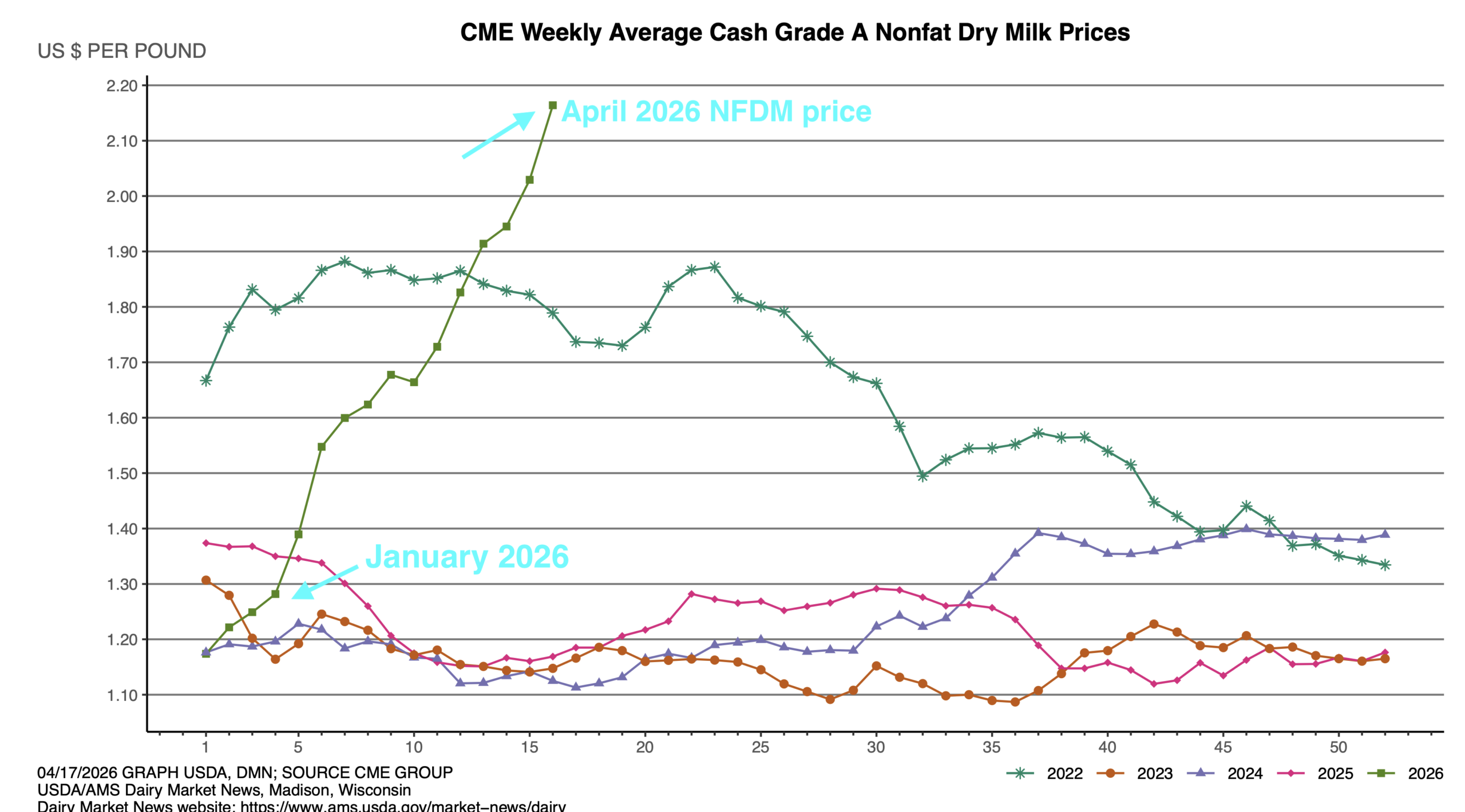
The co-ops appear to be succeeding. The nonfat dry milk (NFDM) price has run up in the past month to the highest price ever at $2.25 a pound today,more than a dollar higher than average on the CME cash market.The last time nonfat dry milk traded above two dollars per pound was in July of 2022.The run-up in price can be seen from the first of the year when the price was more typical at $1.17 lb. It’s almost doubled since then, highly unusual.
The high prices are benefiting the cooperative California Dairies, one of the biggest players in NDFM sales in the US. With headquarters and a big processing plant in Visalia, California Dairies Inc. (CDI), is the largest member-owned milk marketing and processing cooperative in California. They make some 900 million pounds of milk powder annually.The cooperative is co-owned by more than 300 dairy families. California Dairies markets milk powder both domestically and globally. Established in 1995, their DairyAmerica brand has command of approximately 50% of all milk powder produced in the US and is exported to 50 countries.
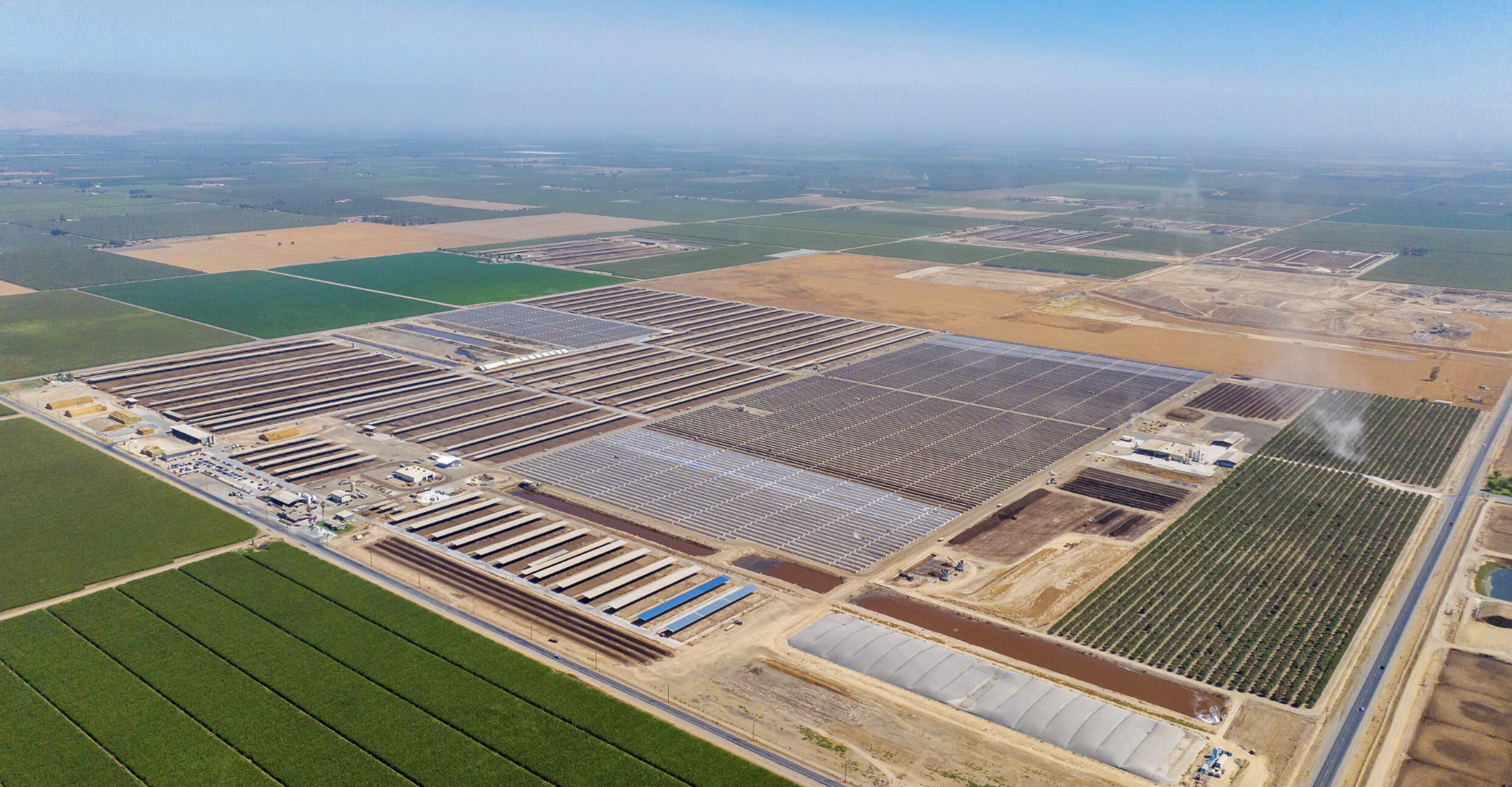
Processing milk requires high heat to remove the water content and at the CDI plant in Visalia they employ solar thermal heat for the dryers from a thousand solar collectors on the roof of their plant.Use of solar technology cuts the pollution from the plant installed in 2022.
So if there is too much milk, why are NFDM prices skyrocketing?
It seems likely that like other food and drink sectors there are real positive and negative impacts as Americans are shifting consumption choices,many of us on diets.In the case of some ag commodities, demand has dropped including for wine,beer, bread and high carb foods, many snacks and calorie-dense foods like potatoes.
About one in every eight U.S. adults is currently taking a GLP-1 drug, like Ozempic or Zepbound, according to the KFF Health Tracking Poll. Food industry surveys find a negative impact on consumption of fried chicken, fast food, bacon, sausage, pizza, and sugary foods and drinks like soda, candy, pastries, and desserts Since we are eating less pasta and pizza, tomato paste is impacted.All Together, this is a huge portion of the US food industry.
On the plus side, demand for high protein foods like milk powder that is used as an ingredient in hundreds of food products is suddenly very popular as a base for hot sellers like nutritional beverages, ultrafiltered milk and milk protein concentrate. NDFM is still used for sales to countries with little refrigeration like Mexico where about a third of our milk powders are sold.
Social media impact
Demand for protein seems to have a similar benefit for milk producers for formerly sleepy products like cottage cheese also now enjoying a boom. One report says “cottage cheese is experiencing a massive, social-media-driven resurgence (a 65% sales increase since 2021), transforming from a dated diet food into a trendy, high-protein staple. Driven by Gen Z on TikTok, it is celebrated for its versatility, high protein with 12g per serving) and creamy texture when blended.”
Also boosting dairy farmers profits is the generics-led Beef- on-Dairy trend that led to more animals on the farm. The Dairy Report notes ” It is remarkable that producers continued to add cows during the challenging margin period at the turn of the year and this dynamic suggests that other sources of income, such as beef sales, had a fundamental impact on producer decision making”
Demand for beef and high prices has propelled dairymen to convert some of their herd to beef, sending their young male calves to area calf ranches that do a big business with both beef animals and young future milk cows.
Kings County calf ranch
An industry report comments “By 2026, the dairy barn has effectively become the factory floor for the beef industry. Because a dairy cow calves every day of the year, the integrator (the dairy producer) can provide a steady, predictable stream of high-quality protein to the packer every single week. There is no calf crop season. There is only a continuous, scheduled flow.”
The trend is nationwide, says the American Farm Bureau. “Beef-on-dairy crossbreeding is the latest step in the evolution of dairy genetics and is now a key driver of the U.S. supply of both beef and dairy cattle. Some 72% of dairy farms are now incorporating beef genetics into their breeding programs, enhancing the marketability of dairy-origin calves by improving carcass quality and feed efficiency — traits highly valued by feedlots and packers. Crossbreeding, along with the widespread use of sexed semen, is helping stabilize beef supply while creating a reliable revenue stream for dairy producers.”
Beef-on-dairy crossbreeding uses beef semen like Angus on dairy cows to produce higher value calves.
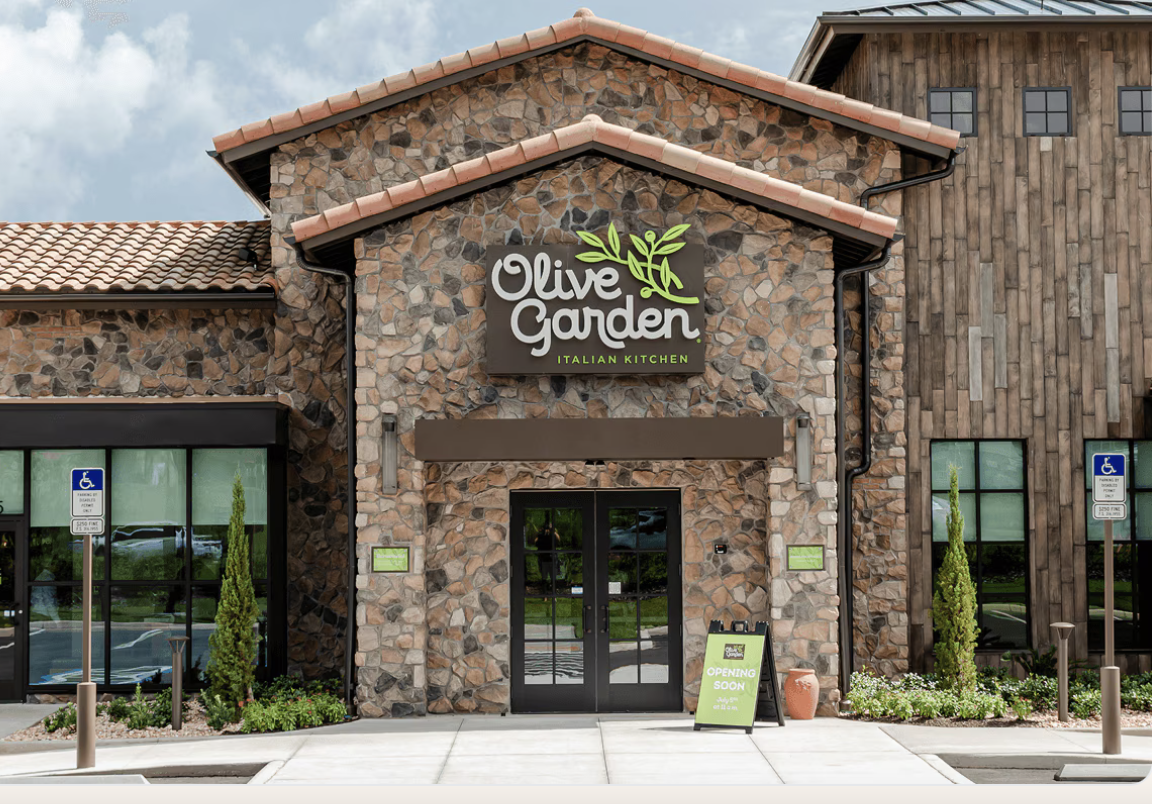
A new proposed shopping center in Hanford has filed plans to include two big name restaurants as tenants. Those big names are Olive Garden and Chick-fil-A. The 6.5 acre shopping center is located on arguably one of the best real estate corners in town and is owned by the Tachi Yokut tribe. Just a country block off of Highway 198, the site is the southeast corner of 12th Ave. and Mall Drive.
The project has been developed by Marcus and Millichap and broker/developer, Chris Ajluni. He says the project is the result of popular demand by Hanford residents who may it clear to City of Hanford officials that these are the type of businesses the community would like to see locate in town. Talks between the city, the developer and the tribe resulted in the plan to develop the vacant parcel after many years of sitting idle says Chris.”It’s really a joint effort.”
Chris says that if all things go right, the two big restaurants should open for business in about a year.
Both restaurants are family favorites known for affordable menus that everyday Kings County residents can afford to visit now and then.
The Olive Garden news was first reported on social media after someone noticed ABC liquor license notice posted on the empty lot. ABC staff in Fresno confirmed the application by Olive Garden Garden saying that it typically takes 30 to 90 days for licenses to be approved.
Mr Ajluni says that plans for the Olive Garden as well as the Chick-fil-A include building more than the standard number of parking places since both are big draws. The Olive Garden would be located on the corner of 12th and Mall Drive and would be about 6500 square feet with 143 parking places.
The Chick-fil-A would build a double drive-through to accommodate heavy customer demand seen typically at this popular restaurant. The 5000 square-foot building would have 93 parking places
The site plan also shows the possibility of a third tenant as yet unnamed.
The Italian-themed Olive Garden is owned by Darden restaurants who operate more than 2,100 Olive Garden, LongHorn Steakhouse, Yard House, Ruth’s Chris Steak House, Cheddar’s Scratch Kitchen, The Capital Grille, Chuy’s, Seasons 52, Eddie V’s and Bahama Breeze restaurants. The Florida based company is publicly traded and has a long time location in Visalia.
Chick-fil-A is privately held and is the largest quick-service restaurant chain in the U.S. specializing in chicken sandwiches.
Based in Atlanta Georgia, they have more than 3000 locations nationwide. The company has been expanding in the Central Vally recently with Visalia getting a location under construction on S Mooney and one location pending in Tulare.
New Sam’s Club expected to open this year on S Mooney
The annual mid-year budget review was heard by the Visalia City Council this week- a crucial component in ensuring financial transparency and stability. It allows the City Council to assess major operating funds like the General Fund Budget, make adjustments if needed, and gain a clear understanding of the City’s current financial health, says a Dept of Finance report. For the rest of us – it’s an unique snapshot of how the local economy is doing.
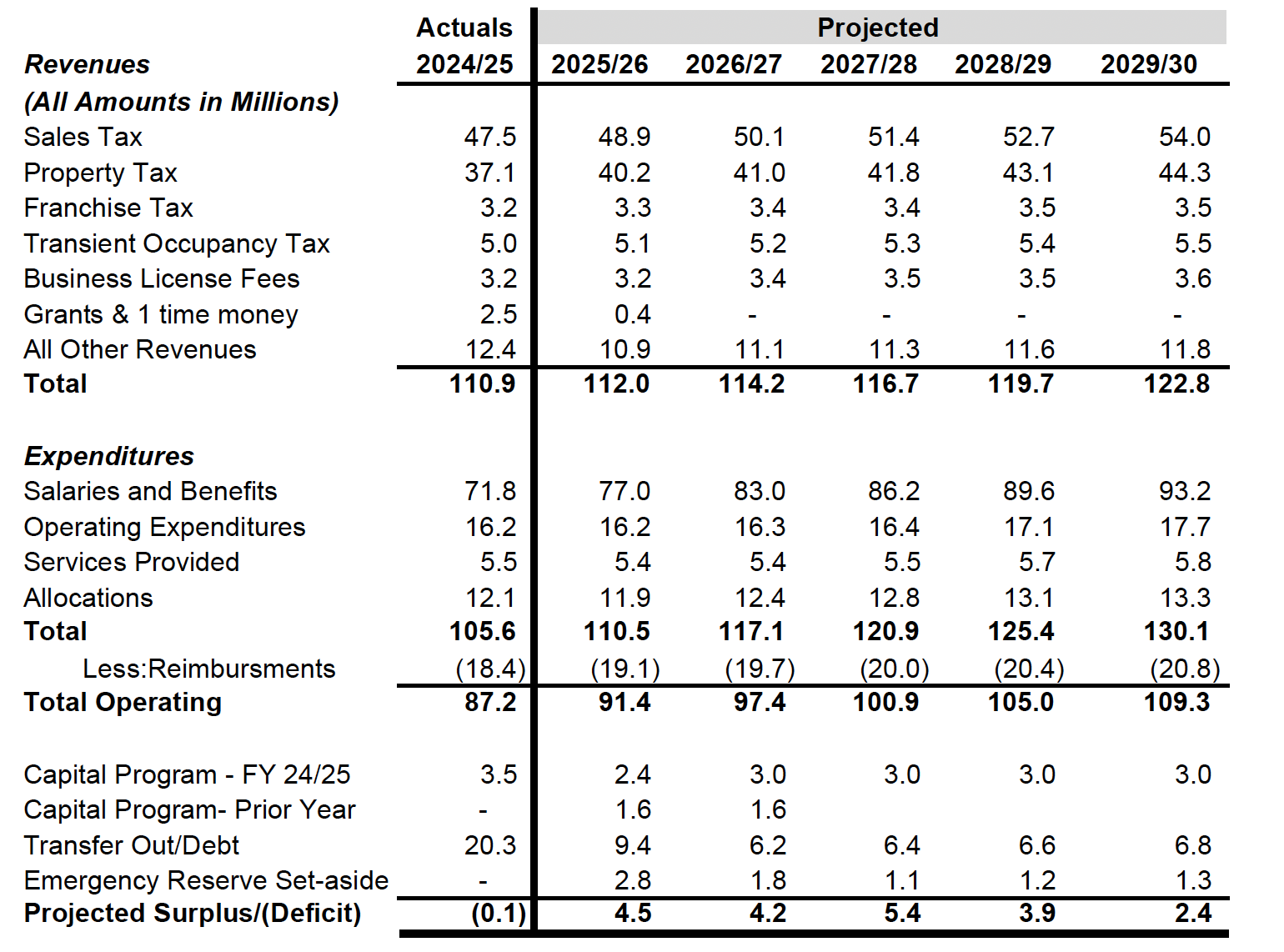
As in past years, General Fund revenues are up in the major revenue categories.The City is currently in the process of preparing the two year budget for FY 26/27 and 27/28.
General Fund Revenues are projected to be higher than budgeted by $9.5 million, almost 10% more than the city budgeted for. The majority of the increase is due to higher than anticipated Sales Tax, Property Tax, Vehicle License Fee Swap, and All Other Revenue categories. The revenues for the adopted budget were conservative for anticipation of a possible recession, says the report. It’s hard to blame these staff estimates that almost always expect less. You could say the council is almost never disappointed that way.
For 25/26 – the current year – Finance had estimated revenue to be $102.5 million. But it came in almost $10 million more at $112 million according to the latest estimate as the fiscal year nears an end, boosted by good sales and property tax increases.
Sales Tax is the largest revenue source for the General Fund and is projected to increase from budget by $2.3 million (5%). Compared to last year’s revenues, sales tax is projected to increase by $1.4 million or 3%.The 3% projected growth is the highest growth since FY 21/22. This increase reflects the City’s diverse economic structure, including business-to-business activity within the industrial parkContinued residential and commercial development is also strengthening the sales tax base and drawing additional taxable activity that might otherwise occur in neighboring cities.
Property Tax is the second largest revenue source for the General Fund and is projected to increase from budget by $3.7 million or 7%. Compared to last year’s revenues, property tax is projected to increase by $2.2 million (10%). This is due to an increase of assessed property values from the County and the continued real estate transactions with higher prices Visalia’s property values continue to increase, which creates higher property taxes when the property is sold. In addition, new commercial and residential growth has continued in Visalia. This projection is provided to the City by the County which is based on the property assessments calculated for the year in September.
Transient Occupancy Tax (TOT) or bed tax is projected to have an increase from the budget of $407,600 (8%).
Operating Expenditures – are projected to be higher than the budget by $3.9 million mainly due to wage and benefit increases that were negotiated with the bargaining units after the budget was prepared. A large portion of the increase comes for the police department budget making up $2.4 mil of the $3.9 mil jump.
Screenshot 2026-04-19 at 6.51.43 AM.png
Revenue looking up in Visalia
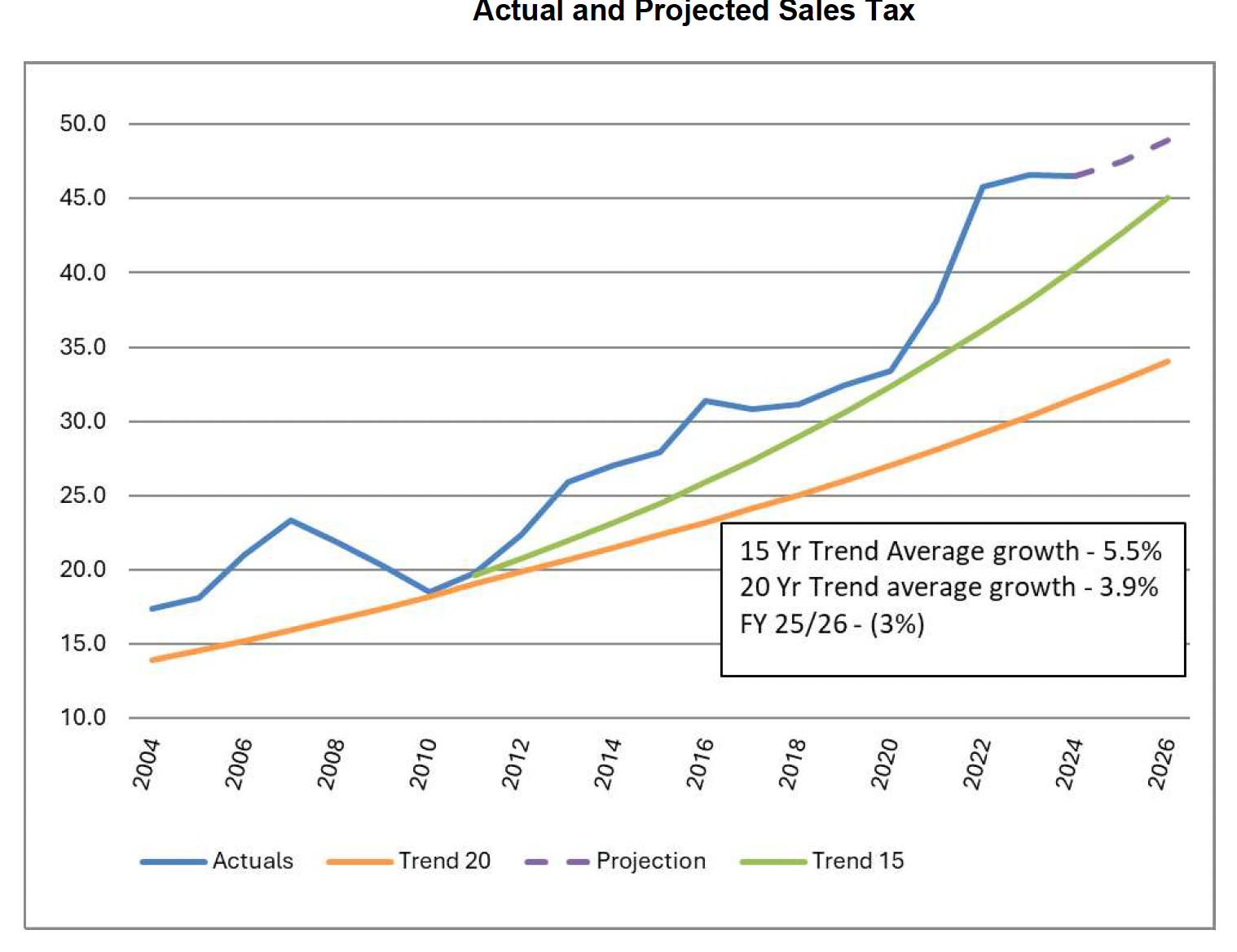
Actual and Projected Sales Tax, shows the projected sales tax revenue has been above the 15-year average growth of 5.5% since 2011. But sales tax continues to compete with the high cost of living such as rent, utilities, health care, and entertainment. These items decrease the amount of money available to spend on tangible items which results in less sales tax.
the city’s largest revenue source- sales tax- was only $18mil in 2010 but should grow to over $50mil next fiscal year
The 3% projected growth is the highest growth since FY 21/22. “This increase reflects the City’s diverse economic structure, including business-to-business activity within the industrial park. Continued residential and commercial development is also strengthening the sales tax base and drawing additional taxable activity that might otherwise occur in neighboring cities.
So what does the Dept of Finance see going forward?The city’s largest revenue source- sales tax- was only $18 mil in 2010 but should grow to over $50 mil next fiscal year, 26/27, says the city. The estimate may not include expected big sales tax revenue generators like the new Costco, the new Sam’s Club and new Amazon that will come on line over this coming fiscal year. The city sees a budget surplus of over $4 mil annually in coming years unless the economy hits the skids.
Derrel’s Mini-Storage plans two new Visalia locations
Storage king Derrel’s Mini-Storage already has six locations in Visalia and is working on two more. One will be across from the new northside Costco on Riggin on a 20-acre site he recently purchased near the SW corner of Riggin and Shirk. A second location is under construction on another 20-acre site east of Visalia near the old drive-in movie property along East 198.
Maverik travel stores plan east 198 store
Maverik Travel Centers are expanding in California with locations serving the Central Valley.The company has an existing location in Lemoore and a site near Cartmill in Tulare under construction. Now they are planning on an East 198 spot just beyond the Visalia city limits.
Sequoia Park visitation up this year
Recreational visits to Sequoia National Park are up about 13.6 % during the first 3 months of 2026 after a banner year in 2025. In the past three years the park has recovered from the low COVID-era numbers in 2020 of 796,000 visitors, ramping up to 1.3 million in 2024 and 1.38 mil in 2025.
Some farmers have a negative view of solar panels, thinking that solar developers are taking away productive ag land to erect miles of arrays. The truth is most PV solar goes on spent land with a perched water table – unproductive land that the farmer-owners hope can generate some income to keep their ag operations afloat.
But well known ag commentators like Edward Ring suggest “If new solar farms are destined to carpet hundreds of square miles of land, they should be dispersed throughout the state and near already existing high voltage lines. Or, they should be concentrated in California’s abundant stretches of uninhabited land such as the Mojave Desert.”
Take a drive along Highway 5 on the hot and dry Westside of the Valley and you see miles of uninhabited and idle land along side the state’s largest network of transmission lines.It is also where the Westlands Water District farmers are looking forward to construction of 136,000 acres of solar farms in the next few years with about half the income going to the district and the rest to private landowners. Not irrigating that land saves water for the farmland in the area that is still productive. Switching solar to Mojave leaves local farmers without an income source for their idle land in the valley.
Solar can also have a beneficial impact on farmer’s biggest want – more water. And independence. Farms are energy intensive and increasingly the tools on the farm from machinery, tractors, ATVs and pickup trucks are trending electric, requiring farms to have an on-site energy source that does not break the bank or depend on the Middle East for fuel.
In the past decade, the cost of solar panels has dropped by around 90%, largely thanks to a big jump in Chinese manufacturing capacity.
“Solar power is the cheapest form of energy in history,” economist Gernot Wagner from Columbia Business School told the German news agency DW. “This stuff is so cheap that Germans are installing it as garden fencing. It keeps the dog in and the car charged.”
Trouble is that President Trump is vehemently anti-renewable energy, including solar, that he calls “a big scam.”
Gee, it really is not. Instead, it is a power source that can not just light up homes but move water to where farms and communities can use it.
This past week Kern County officials dedicated a new solar farm, the Pastoria Solar Project, that will help the Department of Water Resources, to provide power for the operation of the California State Water Project, including irrigation for more than 750,000 acres of agricultural land.
Another pilot project shows that solar can do more.
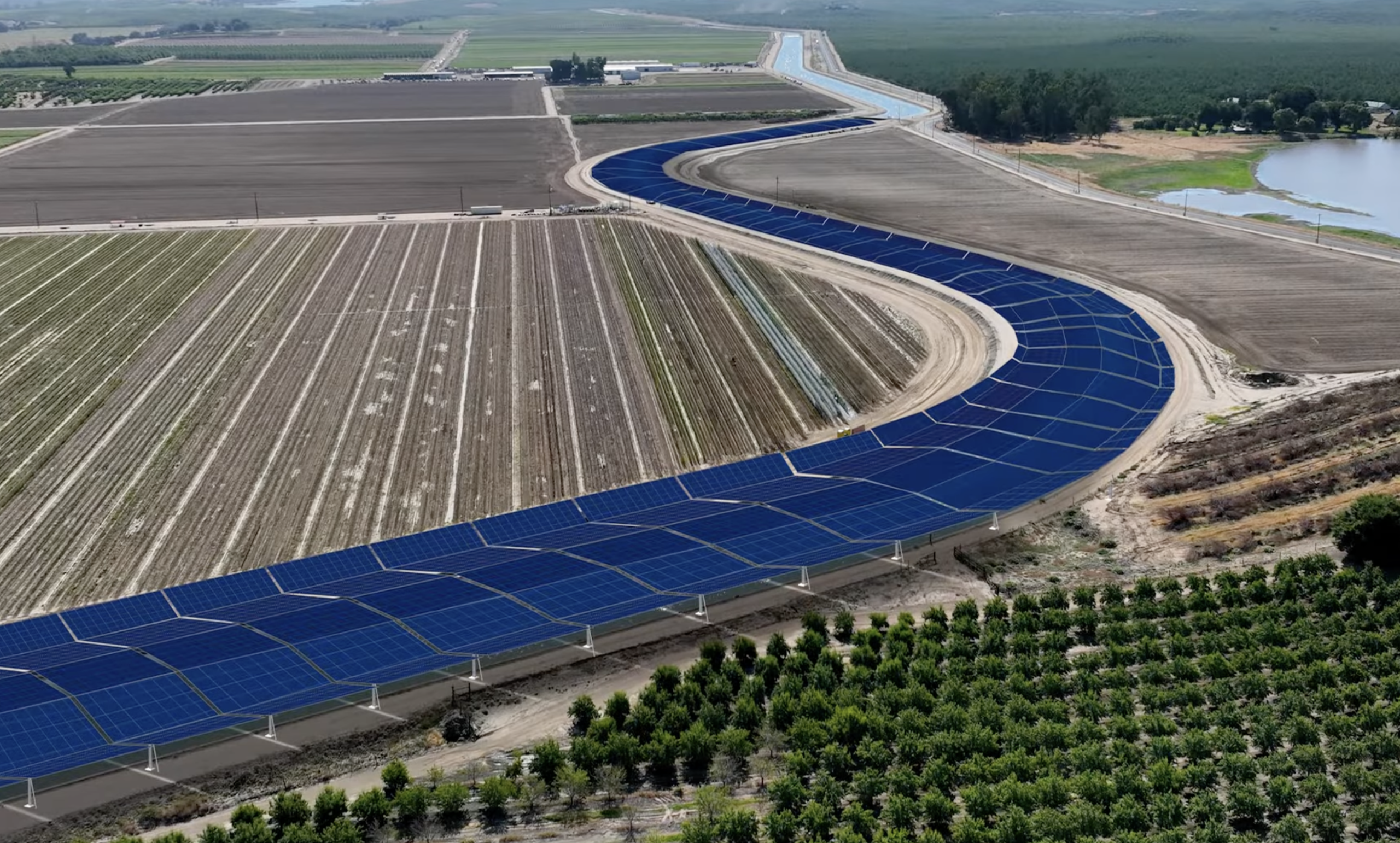
An initiative pioneered by Turlock Irrigation District set the stage for a future potential covering of California’s roughly 4,000 miles of irrigation canals with solar canopies. The panels generate electricity to move water as well as drastically reducing evaporation from the canals.
A UC study estimated that 4,000 miles of California’s open canals could save up to 63 billion gallons of water annually — enough to meet the needs of 2 million people.
Putting in the solar panels over the canals generates another positive impact by not taking any of the surrounding land out of production in order to have the benefits of solar. As is the case with Turlock Irrigation District who put solar panels over their canal – it generates an income source for the water district making it more self reliant.
So what’s keeping the idea from going beyond one large irrigation district in California? Again it’s Mr. Trump’s opposition to anything solar that seems to be a huge stumbling block. He calls solar “stupid.”
I’m sorry Mr Trump – I’m with stupid.
“We will not approve wind or farmer destroying Solar,” Trump, who has complained in the past that solar takes up too much land, posted on Truth Social. “The days of stupidity are over in the USA!!!”
Trump pulls plug on Delta Mendota solar canal project
In 2024 the Delta Mendota Water District was awarded $15 million by the Congress to do their own pilot version of the covered canal within their district. But now, two years later, no money has been released by the administration, despite farmers wanting to try the technology and Congress approving the money.
A spokesperson for the Delta Mendota District says there’s been no activity on the project because of lack of funding. No matter that farmers want to see if the technology could work as advertised.
At the time Federico Barajas, Executive Director of the San Luis & Delta-Mendota Water Authority said this funding could”improve the quality of water delivered to our contractors, and maximize the use of every drop of water in California by potentially reducing conveyance losses.”
So while farm advocates beg Trump for help with new water projects, they know any mention of solar is the kiss of death. The last thing they want to do is piss-off Mr Trump.
Meanwhile, farmers are pushing for more water in California by demanding more north to south transfers and seeking help from the Trump administration to help with their number one issue – subsidence – that limits the amount of water a canal can carry. That problem promises to get worse without billions of dollars to repair hundreds of miles of canals.That includes the 150-mile Friant Kern Canal along the eastern side of the Valley.If they are going to spend billions to redo these canals- why not allow solar to help pay for it? We know why.
By the way, while ground may be sinking in most of the Central Valley, it’s actually rising in some parts of southern Fresno County, says Westlands Water District. Land nearby has seen “measurable uplift” in and around the area between Cantua Creek and Huron of about 1.2 inches. The news offers support for efforts to cut excessive water pumping that may be showing results.
Trump has also cut any funding for farmers to erect solar on their barns,dairies and outbuildings despite the fact this can save them money on their power costs. The Associated Press has looked into this.
Department of Agriculture hasn’t awarded a dollar in rural energy grants or loan guarantees
“Within the first year of President Donald Trump’s second term, two federal programs critical to the growth of solar energy production — REAP and the clean energy tax credit — have been rolled back. To document how those policy changes are affecting farmers, The Associated Press and Grist analyzed data on both commercial-scale solar projects and small-scale rural energy development across the country. They found that, so far this fiscal year, the Department of Agriculture hasn’t awarded a dollar in rural energy grants or loan guarantees. Reporters contacted roughly a quarter of the nearly 300 developers that have proposed projects on agricultural land in the last two years and found that they are either preparing their businesses to do future projects without federal support or have already lost millions in investment because of the administration’s new tax credit policies.”
Among other moves the administration moved to deny new federal permits for wind and solar projects.Secondly,the “One Big Beautiful Bill” targeted renewable energy by restricting tax credits and threatening the 30% solar tax credit for homeowners by late 2025.Then regulations were introduced to block solar and wind projects on federal lands, aiming to prevent the use of farmland for energy production.
This month a new court ruling may provide some relief after a federal court seemed to have struck down a truckload of Trump administration moves designed to paralyze solar and wind permits.
One report says ‘U.S. District Judge Denise Casper in April enjoined a raft of actions by the Trump administration that delayed federal renewable energy permits, granting a request submitted by regional trade groups. The plaintiffs argued that tactics employed by various executive branch agencies to stall permits violated the Administrative Procedures Act. Casper — an Obama appointee — agreed in a 73-page opinion, asserting that the challenge was likely to succeed on the merits.’
Trump ‘s Dept of Interior lost on another front aiming to block offshore wind projects already under construction. Trump lost by allowing government legal challenges to offshore wind court rulings to expire. Now all five East Coast offshore projects can move forward unobstructed.