
August 4,2015-
SLO-based team plans to push technology on wave energy conversion
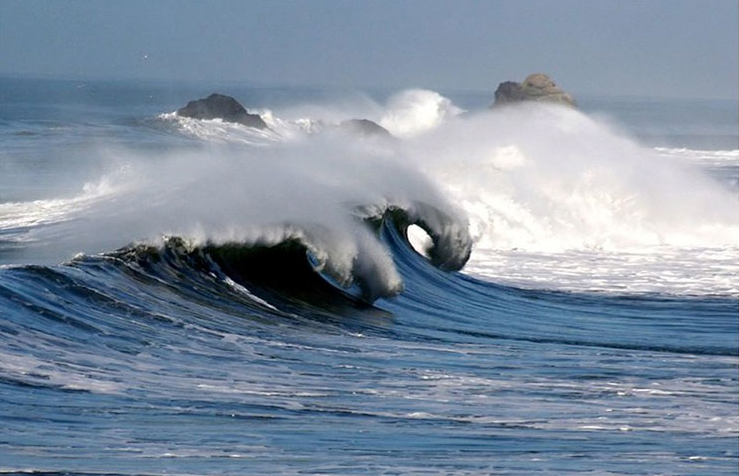 Waters off of Vandenberg Air Force Base in Northern Santa Barbara County are the most promising California location for a national wave park test facility says a San Luis Obispo based think-tank.
In a report filed with the federal Department of Energy (DOE) this month, Cal Poly’s Institute for Advanced Technology and Public Policy led by former legislator Sam Blakeslee,researchers compared the feasibility of a site off Humboldt County in northern California and off Vandenberg for tidal power generation.
Blakeslee’s group received $750,000 in DOE funding to do the study over the past 12 months, part of an effort to boost renewable power from ocean waves.
Vandenberg gets the nod for a number of reasons says a source familiar with the study.
First of all, wave energy is plentiful here but at the same time the northern Santa Barbara coast is already a place where oil drilling happens, it is not in a shipping lane nor is it a key fishing area. The upshot is that compared to Humboldt there are fewer environmental or other type conflicts.
For example the coast off Vandenberg AFB is isolated with few visitors or beach homes compared to much of the rest of the California coast.
.
A key factor to the attraction of this site has is the abundance of electrical infrastructure including some power lines that are connected to Morro Bay power plant that are available to carry power now that this plant is closed. The proximity and availability is a big plus in a state where permitting new lines can take a long time.
Then there is the fact that Vandenberg’s 22 square mile base itself is of course owned by the government, making permitting easier. And they want the power given the mandate that the Air Force get 25% of the future power from renewable sources.
Blakeslee has indicated this project will not be a retail wave energy farm but rather a test facility ready to help companies try equipment and compare results. The Obama administration as said they want to spend up to $40 million to keep the US a leader in wave energy research.
PG&E did a number of years of research on a wave energy park off both Humboldt and Vandenberg before mothballing their study in 2011.
Now Mr Obama is signaling he wants to move the US toward more renewable energy sources as California has done, to cut greenhouse gases from such sources as coal power plants.That works well with California’s plan where Governor Brown and the legislature have said they want the state to get 50% of power generation from renewables here by 2030.
By extracting only 5% of the technical resource potential for the U.S., wave power could provide electricity to 5 MILLION homes says DOE.
Capturing the Energy Prize
Blakeslee and Cal Poly continue to work on utilizing a patented technology to capture wave energy and announced as of July 1 a team has submitted to go through a DOE sponsored Energy Prize competition with a partner company.
The Wave Energy Prize will encourage the development of more efficient Wave Energy Conversion devices that double the energy captured from ocean waves, which in turn will reduce the cost of wave energy, making it more competitive with traditional energy solutions.A successful Wave Energy Prize could jump-start private sector innovation critical to the country’s long-term economic growth, energy security, and international competitiveness in the wave energy conversion sector. The competition has a purse of $2 million.
The contest has about 100 entrees but DOE promise to pare the list down to 20 by mid August.
Cal Poly’s partner in the DOE competition is Protean Wave Energy, Inc., based in Los Osos, California, is the U.S. subsidiary of Stonehenge Metals Limited and is the sister subsidiary to Protean Energy Australia Pty Ltd. Both of the latter two entities are located in Perth, Western Australia.
The Protean Wave Energy, Inc. approach to capturing wave energy and transforming it to useful electricity or desalinated water is to utilize all six degrees of wave movement. The goal is to design a wave energy converter to be cost competitive to manufacture, deploy, maintain and retrieve. In collaboration with Cal Poly, we hope to advance the Protean Wave Energy, Inc. design by going through the process that is the DOE Wave Energy Prize competition.
Team members in the competition include Mr Blakeslee who is trained as a scientist having attended U.C. Berkeley where he earned Bachelor’s and Master’s degrees in geophysics. He was awarded a Ph.D. from U.C. Santa Barbara for his work in seismic scattering, micro-earthquake studies and fault-zone attenuation. As a strategic planner and senior research scientist with Exxon, he received a patent for his innovative work in geologic imaging.
Also William Toman is an energy industry professional with more than 25 years of experience managing energy and environmental project development. He has been responsible for the development of over 2,000 MW of generating capacity for utilities and independent power producers both inside and outside the U.S. His current engagement is at California Polytechnic University at San Luis Obispo (Cal Poly) where he led a 12-month U.S. Department of Energy (DOE) funded study investigating siting, cost and feasibility issues for developing a national wave energy testing centre offshore of California’s Central Coast. While with California’s largest energy utility, Pacific Gas and Electric Company (PG&E), Mr Toman led development of the U.S.’s first open ocean, grid-connected wave energy testing and demonstration facility (Humboldt WaveConnect), a 5 MW project, through a Federal Energy Regulatory Commission draft pilot license application in Humboldt County, California.
Mr Toman holds an M.S. degree in Nuclear Engineering and a B.S. degree in Engineering from the University of California, Los Angeles (UCLA) with an MBA from Carnegie Mellon University’s Tepper School of Business. He has a particular depth of expertise with large-scale commercialization of renewable energy technologies. He has extensive experience in the program management of siting and developing utility scale energy projects with special concentration in marine and hydrokinetic (MHK) renewable technologies such as ocean wave, tidal energy as well as floating offshore wind energy.