
Harnessing The Ocean In Our Backyard
December 9,2105-
With proposals to study large-scale wind and wave farms off the Central Coast lining up and with some falling by the wayside, one company will likely be first to actually test the waters here, on a much smaller scale.
An Australian firm and Cal Poly are teaming up to test a small wave energy buoy off the Cal Poly pier in Avila Bay.The buoy could connect to a energy storage micro-grid that would help power the college’s research lab at the end of the pier, at 3000ft, the state’s longest.
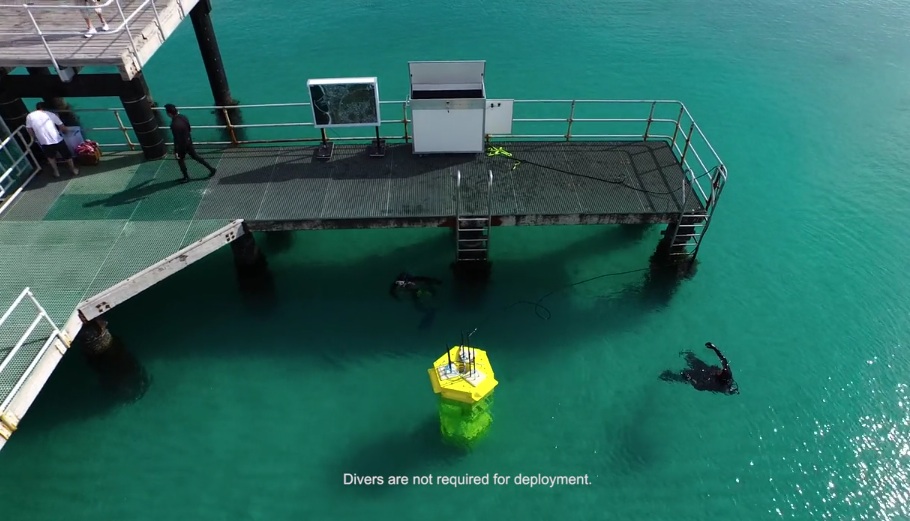
The Australian company recently renamed Protean Energy plans to deploy their technology around the world and the Central Coast is their US test site.
Protean is among a handful of firms looking to harness wave or wind power off the California coast north of Point Conception where winds and waves are favorable and the potential to tap this renewable resource is greatest. Waves are caused by the wind blowing over the surface of the ocean. In many areas of the world, the wind blows with enough consistency and force to provide continuous waves along the shoreline including here. Ocean waves contain tremendous energy potential say researchers.
Of course California is a receptive market both politically and economically for renewable electric power and has the coastal substation to transmission line infrastructure to accept the power that would be connected offshore to land by cable. The on-land infrastructure is tied into the grid even as coastal power plants are being mothballed or may be. That’s because they utilize once-through cooling,now outlawed by the state due to the harm to fisheries. Likewise Diablo Canyon,the state’s only nuclear power plant, may be facing a similar fate because of the same policy as well as due to fears of earthquake faults.
The upshot,California needs more electric power in the future, much of it renewable. The state has a new 50 percent goal for green power production so they will need scores of large new new solar and wind farms. Then there are hundreds of miles of coastline to consider.
Starting Small
“This first buoy deployment is the initial stage of the program to test seaworthiness and assess the environmental impact of the wave energy convertor off the coast of California” says Bill Toman a former PG&E engineer who is President of Protean’s US division and is also part of the Cal Poly CalWave project to establish a wave energy test site off the Central Coast. Toman ran a wave energy test project in Humboldt County as well as the Wave Connect project with PG&E here a few years back.
Toman says the 3ft-square buoy in Avila Bay could be deployed by April or May.
The device’s simplicity and size give it major advantages over competitors, figures Toman ”Unlike some – our technology is small, flexible, scalable and inexpensive.” Toman says the buoy or wave energy convertor deployment should not make make waves in the fishing community or among environmentalists as other larger wind and wave projects have locally.
But what about the general public?
Wave and wind ocean devices are planned to be located several miles off shore and in general have a low profile, you can’t see them from the shore. Depending on their scale, this makes it less likely the public would object to their deployment because of fears they might ruin the view scape.
In the past few years at least three wave energy projects have said they wanted to study the idea of local deployment – later withdrawing their plan, including PG&E,Green Wave Energy and Archon Energy.
To locate in federal waters – beginning 3 miles off the coast, companies need a permit from a federal agency Bureau of Ocean Energy Management (BOEM) who require millions of dollars of environmental studies before they get approval, among many other agencies says Toman. They also need a Federal Energy Regulatory Commission (FERC) permit to just study a project.
One of two pending projects is Morro Bay power plant owner Dynegy who has the right to inject 650MW of power from some source into the PG&E substation switchyard next to their mothballed plant. Dynegy has proposed two possible locations off the Morro Bay coast to build a 650MW wave energy park. The wave park would cost a billion dollars.
Last year the Dyngey project was opposed by the Morro Bay City Council over their sites with one council member saying “It looks to me, in the proposal … that they just ignored everything the fishermen said.”
Now a second firm, Seattle-based Trident Winds is proposing to study a 1000 MW floating wind farm off of Morro Bay.The company hopes to install about 100 floating wind turbines, tethered to the ocean floor, some 20 miles offshore. Trident plans a public meeting from 6-8 p.m. Dec. 10 at the Veterans Memorial Building at 209 Surf St. in Morro Bay to discuss their plan.
Here too fishermen are wary although Trident has met with them and others and may relocate the planned deployment location.With large wind turbines, bird deaths are a concern. So far the City of Morro Bay remains a cautious supporter.
In the case of the Protean project, the company’s pint-size energy devices would cobbled together in a sort of platform once a full project was approved years form now.The project would be in federal waters where approvals are easier than in state waters.
This wave energy device’s scale is in marked contrast to current wave energy devices made in the 1980s and 90s that are the size of a train car or submarine. Two European firms who developed these devices are now in bankruptcy.
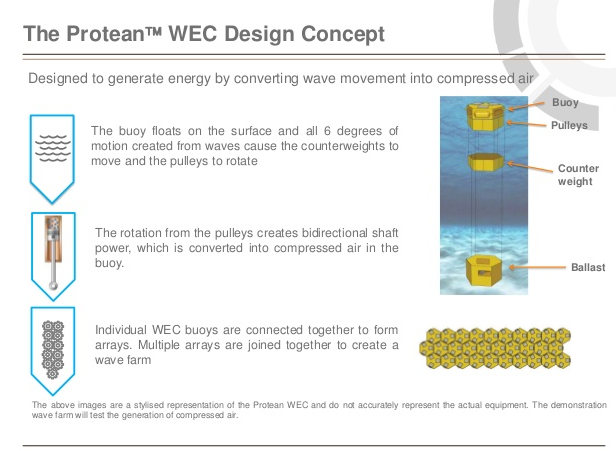
Toman says the Protean buoys have an 80% capacity factor, much higher efficiency than solar PV or wind power turbines. Unlike some other technologies, the buoys are not anchored to the seafloor.
Protean is among a handful of firms looking to harness wave or wind power off the California coast north of Point Conception where winds and waves are favorable and the potential to tap this renewable resource is greatest. Waves are caused by the wind blowing over the surface of the ocean. In many areas of the world, the wind blows with enough consistency and force to provide continuous waves along the shoreline including here. Ocean waves contain tremendous energy potential say researchers.
Of course California is a receptive market both politically and economically for renewable electric power and has the coastal substation to transmission line infrastructure to accept the power that would be connected offshore to land by cable. The on-land infrastructure is tied into the grid even as coastal power plants are being mothballed or may be. That’s because they utilize once-through cooling,now outlawed by the state due to the harm to fisheries. Likewise Diablo Canyon,the state’s only nuclear power plant, may be facing a similar fate because of the same policy as well as due to fears of earthquake faults.
The upshot,California needs more electric power in the future, much of it renewable. The state has a new 50 percent goal for green power production so they will need scores of large new new solar and wind farms. Then there are hundreds of miles of coastline to consider.
Starting Small
“This first buoy deployment is the initial stage of the program to test seaworthiness and assess the environmental impact of the wave energy convertor off the coast of California” says Bill Toman a former PG&E engineer who is President of Protean’s US division and is also part of the Cal Poly CalWave project to establish a wave energy test site off the Central Coast. Toman ran a wave energy test project in Humboldt County as well as the Wave Connect project with PG&E here a few years back.
Toman says the 3ft-square buoy in Avila Bay could be deployed by April or May.
The device’s simplicity and size give it major advantages over competitors, figures Toman ”Unlike some – our technology is small, flexible, scalable and inexpensive.” Toman says the buoy or wave energy convertor deployment should not make make waves in the fishing community or among environmentalists as other larger wind and wave projects have locally.
But what about the general public?
Wave and wind ocean devices are planned to be located several miles off shore and in general have a low profile, you can’t see them from the shore. Depending on their scale, this makes it less likely the public would object to their deployment because of fears they might ruin the view scape.
In the past few years at least three wave energy projects have said they wanted to study the idea of local deployment – later withdrawing their plan, including PG&E,Green Wave Energy and Archon Energy.
To locate in federal waters – beginning 3 miles off the coast, companies need a permit from a federal agency Bureau of Ocean Energy Management (BOEM) who require millions of dollars of environmental studies before they get approval, among many other agencies says Toman. They also need a Federal Energy Regulatory Commission (FERC) permit to just study a project.
One of two pending projects is Morro Bay power plant owner Dynegy who has the right to inject 650MW of power from some source into the PG&E substation switchyard next to their mothballed plant. Dynegy has proposed two possible locations off the Morro Bay coast to build a 650MW wave energy park. The wave park would cost a billion dollars.
Last year the Dyngey project was opposed by the Morro Bay City Council over their sites with one council member saying “It looks to me, in the proposal … that they just ignored everything the fishermen said.”
Now a second firm, Seattle-based Trident Winds is proposing to study a 1000 MW floating wind farm off of Morro Bay.The company hopes to install about 100 floating wind turbines, tethered to the ocean floor, some 20 miles offshore. Trident plans a public meeting from 6-8 p.m. Dec. 10 at the Veterans Memorial Building at 209 Surf St. in Morro Bay to discuss their plan.
Here too fishermen are wary although Trident has met with them and others and may relocate the planned deployment location.With large wind turbines, bird deaths are a concern. So far the City of Morro Bay remains a cautious supporter.
In the case of the Protean project, the company’s pint-size energy devices would cobbled together in a sort of platform once a full project was approved years form now.The project would be in federal waters where approvals are easier than in state waters.
This wave energy device’s scale is in marked contrast to current wave energy devices made in the 1980s and 90s that are the size of a train car or submarine. Two European firms who developed these devices are now in bankruptcy.
Toman says the Protean buoys have an 80% capacity factor, much higher efficiency than solar PV or wind power turbines. Unlike some other technologies, the buoys are not anchored to the seafloor.
Incremental Approach
Coordinating the wave energy project with the Cal Poly CalWave program allows Protean to use the ocean up to 100ft off the Cal Poly pier to do research with few other environmental approvals needed. Starting small under the umbrella of a university has its benefits -R&D can move forward quickly. But not too quickly.
“Our approach is incremental” cautions Toman “and inclusive” noting he is consulting with stakeholder groups like the Surfrider Foundation at every stage of development.
Toman is part of the CalWave project at Cal Poly working with Sam Blakeslee who heads up CalWave. The research group expects to land a second year $1.5 million grant from the Department of Energy (DOE) to assess the feasibility of locating a National Wave Energy Test Facility offshore of California. The Central Coast is competing with a site in Oregon.
Toman is not surprisingly, an advocate for the Central Coast test site off Vandenberg pointing to multiple advantages including a ready customer at the Air Force base, good power substation infrastructure onshore and a fleet of heavy work boats stationed off Port Hueneme who are ready to maintain units at sea and are here because of the oil platform industry.
Then there is power costs.Unlike the Pacific Northwest that enjoys cheap federally produced hydropower the California electric market offers higher rates, an incentive to bring new innovative power projects to market
Toman notes that as part of this year’s DOE application for funding the CalWave project is partnering with both PG&E and the State of California in matching grants. News of final approval of the federal grant could come in the next few weeks.
Besides this project – Protean plans 30-buoy demonstration wave farm off the coast of Bunbury, Western Australia and a planned commercial pilot wave farm in the Maldives.