Heating / Transportation costs head lower

-December 12,2023-
Reduced demand and ample supply of domestically produced oil has increased the supply of gasoline and diesel resulting in the lowest prices for fuel in 30 months across the US.

In Kings County the cheapest gas is being sold at Yokut Gas for $3.65 a gallon, one of the lowest price in the state.The Visalia Costco is selling regular for $3.99 this week.

Nationwide fuel costs are dropping says oil expert Tom Kloza

“Virtual certainty this weekend will see the lowest US gasoline prices in 30 months. Current gasoline average is $3.137/gal and a 5cts/gal drop will lead to the lowest gas prices since the second half of June 2021. Diesel disinflation also major with sub-$4/gal average likely.”

The national average diesel price dropped below $4 a gallon for the first time in nearly five months after shedding 10.5 cents to $3.987, according to the Energy Information Administration data released Dec. 11.

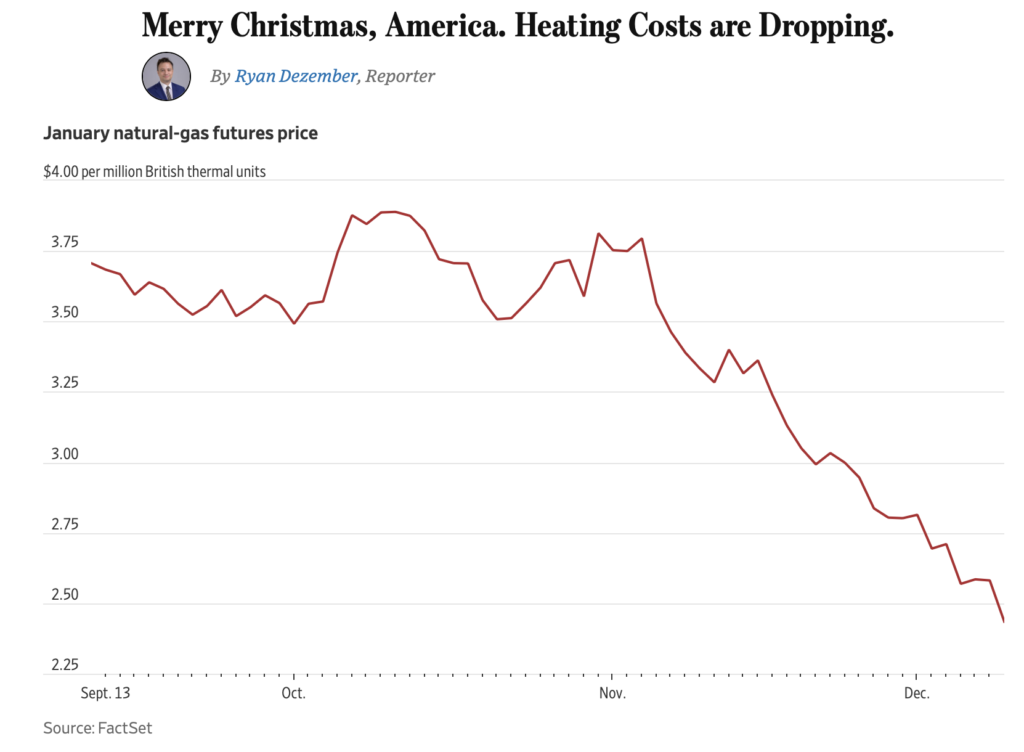
Meanwhile a warm winter looks to decrease demand for natural gas as the national market price is down below $2.50 per million BTU.

Graphic from Wall St Journal

Screenshot 2023-12-12 at 6.08.40 AM

In southern California SO Cal Gas is selling Natural gas to heat homes and produce electricity at $5.60 per M BTU this month- likely heading lower in January.Compared to a year ago, the procurement rate is about 47.0% lower (105.329 ¢/therm) than what it was effective December 2022.

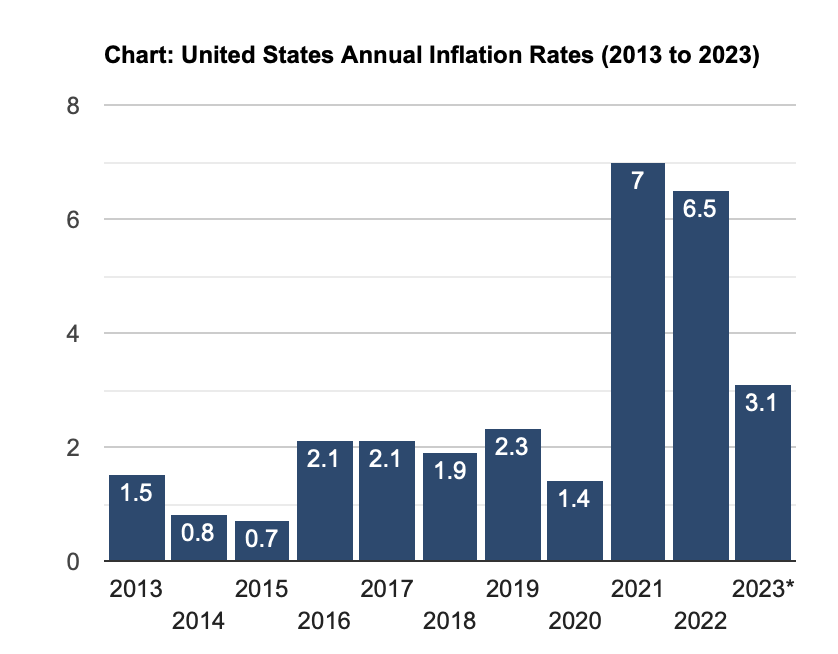
All these collapsing, energy costs are helping to reduce inflation, say, economists making it less expensive to grow vegetables, apply fertilizer, and reducing the cost of bringing goods to your community.The annual inflation rate is now 3.1% compared to 6.5% for 2022.

Screenshot 2023-12-12 at 6.40.57 AM

No sign of an EV slowdown

From Bloomberg

-December 7,2023-

Sales of passenger EVs are on pace to hit 14 million this year, up 36% from 2022
Screenshot 2023-12-07 at 7.19.58 AMFor all the headlines written in the last six months about how EV demand is faltering, the data definitely doesn’t support that, or at least not yet.  Sales of passenger EVs are on pace to hit 14 million this year, up 36% from 2022. In the US, where most of the concerns on demand have been raised, sales are growing even faster and will be up 50% this year. Sales might be less than some manufacturers were hoping for, but they are in line BNEF’s forecast from the beginning of the year, and most industries would be very happy with that kind of growth rate.

A slowdown could still be coming, but for now this looks much more like a winnowing down of who is competitive in the market than a general drop-off in demand. Pure-play EV automakers like Tesla, BYD and Li Auto will capture 7% of the global vehicle market this year, up from just 1% in 2020. Many legacy automakers have launched products that are not competitive on price, range or features and will have to go back to the drawing board.

More progress on ZEV adoption in emerging economies

EV adoption is rising quickly in emerging economies like India, Thailand and Indonesia, where low-cost models are driving demand. EVs are already 9% of cars sold in Thailand – a similar adoption rate to the US – which runs counter to the argument that EVs are only a rich-country phenomenon. The numbers are still modest overall, but the growth rate is encouraging in these fast-growing auto markets. With more new models in the $10,000 range hitting the market, growth should continue.

The US Inflation Reduction Act (IRA) has supercharged investments in the North American EV supply chain over the past year

BNEF data shows that IRA has attracted $100 billion of new investment announcements in EV and battery manufacturing as well as other areas like battery components and recycling. Constructions is already underway for many of these and BNEF expects the first IRA-related EV and battery manufacturing facilities to open fully in the second half of 2024, with more ramping up in 2025 and beyond. Canada and Mexico also benefit, given their integration in the US automotive supply chain and access to key critical minerals.

Ambition on phasing out combustion vehicle sales has stalled

From 2015 to 2021 the number of countries committing to ending sales of new combustion vehicles rose quickly. This received a big boost in 2021 when the EU announced its target of a 2035 phase-out, but progress has stagnated since then with only a few minor additions to the list over the last two years. Countries with phase-out targets in place now represent 19% of new passenger vehicle sales.

Full phase-outs are not the only targets that matters. Indeed, both the US and China have partial targets in place for 2030, when China is aiming for EVs to be 40% of sales and the US is aiming for 50%. The China target could be achieved as early as next year, but the US one will be more challenging. Setting targets is easier than delivering on them.
Announcements from automakers have also stalled. A total of 18 automakers of various sizes have announced net-zero commitments targeting 2050 or before. These automakers represent 54% of the global passenger vehicle market, but not all of them have clarified whether their targets will cover the vehicles they sell or just their own operations. The number of them formally committing to ending sales of new combustion vehicles is smaller and covers 32% of global sales.
No new automakers announced net-zero or combustion vehicle phase out commitments in 2023, and some like Ford and GM moved their near-term EV targets back this year citing worse-than-expected demand.

Electric vehicles remain one of the fastest moving parts of the energy transition and there are plenty of reasons for optimism, but a stronger push from both policymakers and automakers will be needed to keep up the momentum in the years ahead.

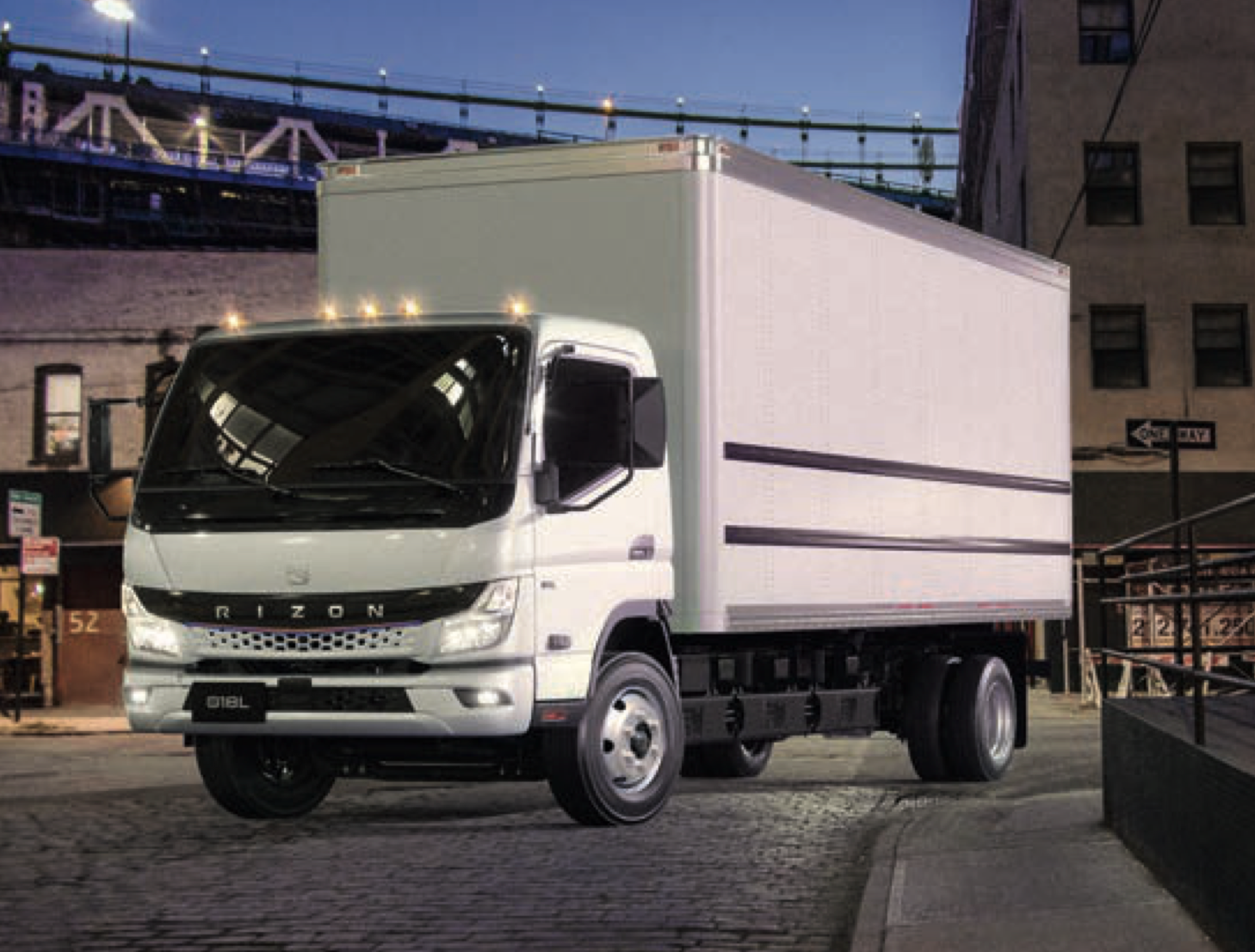
California Truck Centers Certified as Authorized Dealer for RIZON Battery-Electric Trucks


Fresno, California, Nov. 16, 2023 (GLOBE NEWSWIRE) — Velocity EV, the exclusive U.S. distributor of RIZON battery-electric trucks, has added California Truck Centers, one of the state’s largest and family-owned commercial truck dealerships, to its authorized dealer network. California Truck Centers is now certified to sell and service the Class 4-5 zero-emissions cabover trucks – engineered by Daimler Truck – at six of its eight California locations in Fresno, Oakland, Sacramento, Santa Maria, San Luis Obispo, and Keyes.

Screenshot 2023-11-16 at 9.10.23 AM“The need for battery-electric Class 4 and 5 trucks is increasing across California as fleets eye quickly approaching regulatory deadlines and their customers’ increasing interest in zero-emission urban delivery,” said Alex Voets, general manager, Velocity EV. “With their extensive customer service reputation in the commercial truck industry, California Truck Centers’ sales and service teams are well-skilled in helping customers navigate the transition to battery-electric trucks. Customers can contact a California Truck Centers dealership to test drive and experience the advanced technology and safety features of these innovative electric trucks.”
California Truck Centers has been owned and operated by the Howard family in Fresno since 1930. For more than nine decades, the dealer group has served the trucking industry in Central and Northern California with new and used light- to heavy-duty conventional and vocational truck sales, adding electric vehicles to its inventory in 2021. With more than 800 employees who specialize in OEM truck parts, body shop service and repair, in-house financing, and rentals and leasing, California Truck Centers earned Certified Elite Support status through Daimler Truck. The dealership network has trained a team of 95 vehicle technicians on how to perform safe and efficient service on RIZON trucks, as well as equipped its dealerships with on-site diagnostic equipment, RIZON parts inventory, and charging infrastructure at six dealer locations.

“We are excited to introduce RIZON’s medium-duty electric trucks to our commercial truck lineup, expanding our zero-emission offerings to include Class 4 to Class 8 electric trucks for Northern and Central California,” said Doug Howard, president, California Truck Centers. “The RIZON Class 4 and 5 trucks offer electric solutions at very affordable prices. At California Truck Centers, we take pride in leading the way in sustainability by providing zero-emission solutions and support for our customers.”

RIZON trucks purchased in California through California Truck Centers are eligible for a base voucher of $60,000 per vehicle as part of the state’s Hybrid and Zero-Emission Truck and Bus Voucher Incentive Project (HVIP). The zero-emission vehicle (ZEV) designation was approved in September by the California Air Resources Board (CARB), enabling fleet operators to further reduce their total cost of ownership of RIZON trucks with HVIP credit. The CARB certification designates all four RIZON models, which include the e16M, e16L, e18M, and e18L, as compliant under the Advanced Clean Fleets rule that mandates 50% of overall state, local and municipal vehicle purchases be zero-emissions starting January 1, 2024

Gasoline / Electric News

-October 17,2023-

California gasoline sales drop from 2018 high

Screenshot 2023-10-17 at 9.04.07 AMCalifornia gasoline sales were 3.4 billion in the second quarter of 2023 according to state of California figures. That’s down from a high of 3.9 billion gallons during the same quarter in 2018, The drop amounts to a decline of around 15% in the five year period reflecting reduced demand for gasoline nationwide.The Energy Information Agency(EIA) U.S. gasoline demand proxy figures show that demand is 10.4% below 2019 levels, 5% below year-ago levels for the seasonal period, and even 3% below 2020 levels, according to a Gas Buddy spokesperson. “Gasoline prices have peaked for the year” and gasoline crack spreads — the difference between the price of oil and the selling price of product — have plummeted to late 2020 levels. Americans are using less gasoline in part due to the purchase of electric vehicles, better mileage on the existing fleet of gas powered cars and fewer workers heading to the office daily to go to work.
 
Petroleum Diesel is Disappearing from California

by Aaron David Smith  October 02, 2023

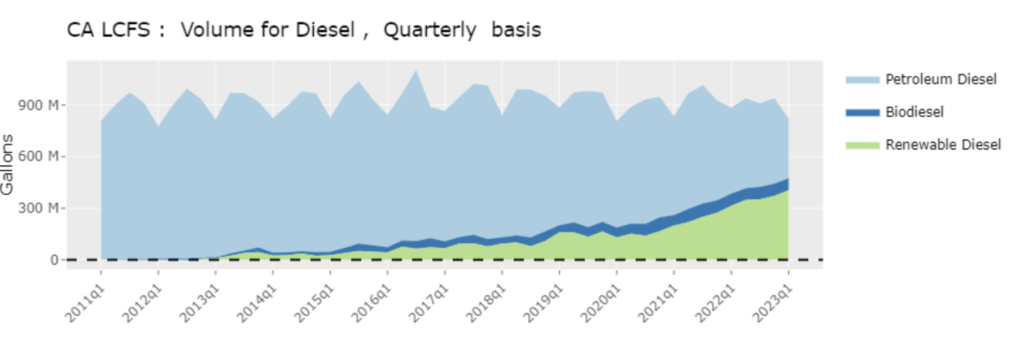
Screenshot 2023-10-16 at 6.39.55 PMCalifornia trucks and trains burn about 3.5 billion gallons of diesel per year. Five years ago, petroleum supplied 85% of diesel.  In the first quarter of 2023, less than half the state’s diesel came from petroleum. Most California diesel is now made from animal fat, corn oil, soybean oil, or used cooking oil.
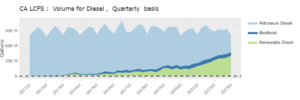
This trend is likely to continue. Under current policy, there is a high chance there will be no petroleum diesel used in the state in 2030. That’s one conclusion of a recently released working paper by Jim Bushnell, Gabriel Lade, Julie Witcover, Wuzheqian Xiao, and meWhat are the Alternatives to Petroleum Diesel?Rudolf Diesel experimented with multiple fuel sources when developing his engine in the late 1800s, including kerosene, coal dust, and vegetable oils. At the 1900 World’s Fair in Paris, he displayed a prototype that ran on peanut oil. Modern diesel engines require a fuel that is less viscous than vegetable oil, so pouring peanut oil into your diesel engine is a bad idea. However, two products of vegetable oils and fats work well in modern diesel engines: biodiesel and renewable diesel.

Biodiesel is produced through a chemical process that reacts organic oils and fats with alcohols and catalysts. Biodiesel has some limitations that curb its use, including a lower energy density than petroleum diesel, potential corrosion of storage tanks, potential clogging of fuel lines, and sensitivity to the cold.

Renewable diesel doesn’t have the drawbacks of biodiesel, but it is more expensive to produce. It is created by reacting hydrogen and catalysts with oils or fats under high temperature and pressure. This process removes oxygen, leaving a fuel that contains only hydrogen and carbon; it is a hydrocarbon just like petroleum diesel and can be used in diesel engines without restriction. Renewable diesel production capacity in the United States has boomed in the past couple of years as oil refineries have repurposed to produce the fuel. Almost all United States renewable diesel is consumed in California.

EV Sales Boost

DETROIT (AP) — Starting next year, people who want to buy a new or used electric or plug-in hybrid vehicle will be able to get U.S. government income tax credits at the time of purchase.
Eligible buyers, including those that bought an EV or hybrid this year, have had to wait until they filed their federal income tax returns to actually get the benefits.


The Treasury Department says the near-instant credits of $7,500 for an eligible new vehicle and $4,000 for a qualifying used vehicle should lower purchasing costs for consumers and help car dealers by boosting EV sales.


More Good News for EV Buyers

Berkeley Energy Institute Blog

The broadening EV market means that government subsidies will flow to buyers – not sellers.
The electric vehicle market continues to grow. There are now more than 100 different EV models for sale in the United States, up from only 2 in 2011. Current offerings come from Audi, BMW, Cadillac, Chevrolet, Ford, Genesis, Hyundai, Jaguar, Jeep, Kia, Lexus, Lucid, Mercedes, Mini Cooper, Nissan, Polestar, Porsche, Rivian, Subaru, Tesla, Toyota, Volkswagen, and Volvo. This broadening of the market is great news for EV buyers. There are more options than ever before, and the market is becoming more competitive, with lower prices for EVs and shrinking profit margins for EV manufacturers. A recent piece by Liam Denning, for example, points to shrinking markups at Tesla. For today’s post, I want to talk about an additional related benefit for buyers. Throughout the last decade, supply constraints led EV sellers to capture a large part of government EV subsidies. But the broadening of the market is relieving these constraints and – in the language of economics – making the supply of EVs more elastic. This means that moving forward government subsidies will tend to flow to buyers – not sellers.


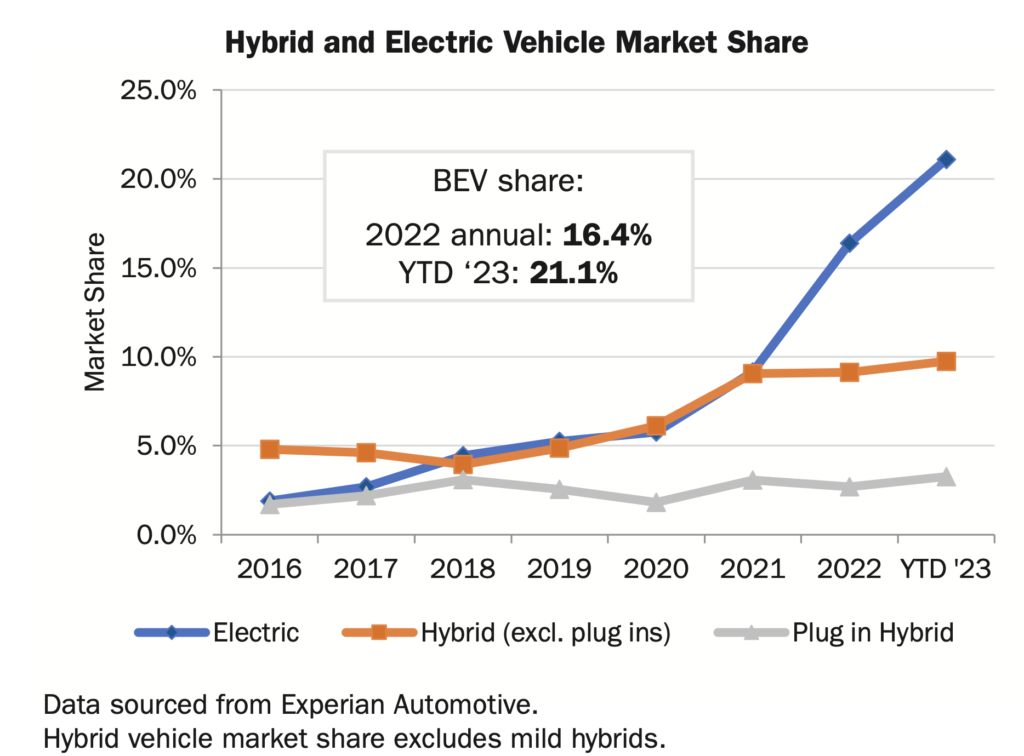
California electric vehicle share reaches 21%

Screenshot 2023-10-17 at 6.16.33 AM Screenshot 2023-10-16 at 6.39.55 PM

Wholesale gasoline prices fall even as oil heads higher

-September 29,2023-

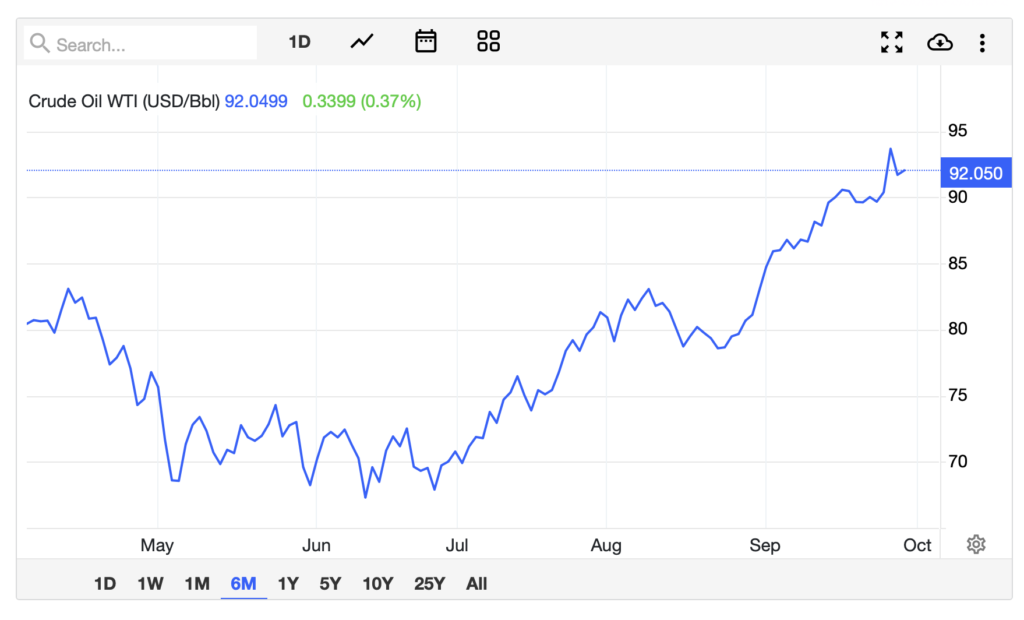
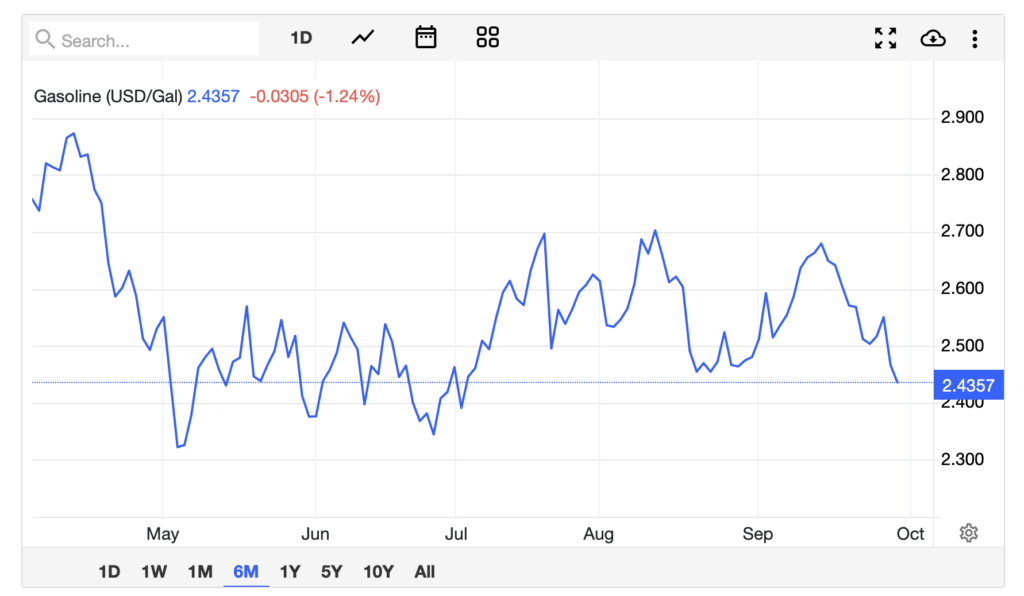
One quirky aspect of higher oil prices this year is that at consumers main interface with supply – at the gas pump – you can’t say the wholesale price has climbed.As you can see in these charts the price for gasoline is down 44 cents from the high this past April. Oil companies may not be passing this savings on to the motorists but the fundaments are there.During the same time for the past 6 months the price of WTI crude has raced higher by over $20 a barrel as exporters like Saudi Arabia and Russia have cut supply.

In California oil analyst Tom Kloza just reported the wholesale price of gasoline in LA just fell big time today.

“OPIS reports L.A. CARBOB at ~$3.67/gal this morning – –down 72cts/gal from Tuesday’s high. Recognize, however, that CA will lose about 50,000 b/d of gasoline output in 1Q24 when Phillips 66 goes to all renewables (Renewable diesel & SAF) in the Bay Area. Worth a calendar note.”

Screenshot 2023-09-29 at 6.29.20 AM Screenshot 2023-09-29 at 6.24.21 AM

ARE WE THERE YET? GAS PRICES MAY DIP AS FALL ARRIVES

September 24,2023-
Screenshot 2023-09-24 at 11.01.27 AM

The national average for a gallon of gas rose by a nickel since last week to hit $3.85. The primary culprit is the surge in oil costs, which have jumped several dollars to hover around $90 per barrel.

Oil rich countries including Saudi Arabia and Russia have cut supply by about 2 million barrels a day.

“Oil costs are putting upward pressure on pump prices, but the rise is tempered by much lower demand,” said Andrew Gross, AAA spokesperson. “The slide in people fueling up is typical, with schools back in session, the days getting shorter, and the weather less pleasant. But the usual decline in pump prices is being stymied for now by these high oil costs.”

According to new data from the Energy Information Administration (EIA), gas demand decreased significantly from 9.32 to 8.31 million b/d last week. Meanwhile, total domestic gasoline stocks jumped from 214.7 to 220.3 million bbl. Although gas demand has dropped amid increasing stocks, elevated oil prices have pushed pump prices higher.

There is still another factor in lower demand. The EIA reduced the U.S. gasoline consumption forecast this week because the U.S. Census Bureau revised its population estimates for the United States to include fewer people of working age and more people of retirement age, who tend to drive less. The revised population estimates have also resulted in a downward revision of our vehicle miles traveled(VMT) forecast, which directly affects motor gasoline consumption. They forecast U.S. gasoline consumption will average 8.9 million b/d in 2023 and 8.7 million b/d in 2024. The 2024 forecast is down by 0.2 million b/d from our August STEO.

Today’s national average of $3.85 is the same as a month ago but 15 cents more than a year ago.But not in California where the average pump price has gone up 53 cents to $5.76 a gallon!

Wholesale gasoline futures for Los Angeles predict a big drop of 70 cents in October. We can only hope.

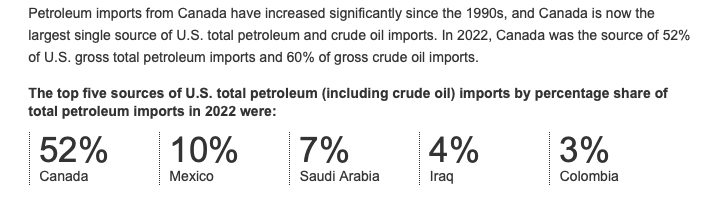
Worried about how much we import? Most it it is now comes from Canada.Screen Shot 2023-09-18 at 6.37.35 AM


DOD approves Vandenberg wind farm

-August 22,2023-


Deployment set for 2027

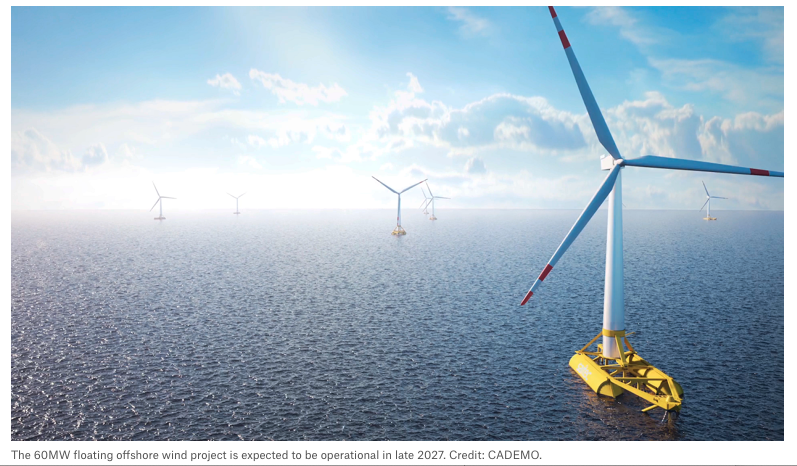
The US Department of Defense (DoD) has given its approval to Floventis Energy for the development and operation of CADEMO, the first floating offshore wind farm with 60MW of capacity, to be located off the California coast near the Vandenberg Space Force Base in northern Santa Barbara County.
A series of de-confliction protocols will be created for the wind turbines’ spinning blades, the tips of which are expected to reach heights of 870ft, to operate in the busy airspace.
This is one of the first agreements signed by the US military, setting a precedent for the offshore wind industry to expand across other locations in the coming years.
Screen Shot 2023-08-22 at 9.28.27 AMThe DoD and the US Air Force have committed to filing non-objection letters to the Federal Aviation Administration and other federal and state agencies to allow for CADEMO’s permissions process.
Environmental reviews are still under way and will form part of the final permit decision by the California State Lands Commission and other state and federal agencies.
Floventis Energy director and CADEMO owner and developer Mikael Jakobsson stated: “This agreement is a big step, both for our project and for the California offshore wind industry.
“The military has many complex operational needs here, and that is why it took two years of negotiations to hammer out this deal. It helps create a testing and verification process to ensure that offshore renewable energy can co-exist with national security.”
The CADEMO project demonstrates new practices in the environment and supply chain development while co-existing with a military base. The project will also help generate knowledge and public acceptance of the successful growth of the sector.
The floating wind farm project will be located 2.8 miles (4.5km) off Point Arguello. It will feature four 15MW floating turbines and is expected to begin operations in late 2027.
This location is unique on the coastline of California because of its wind conditions. It is also not close to any housing areas and will therefore have a reduced visual impact.
The location does not overlap with any sanctuary or natural-resource-protected area. Being close to a military-industrial space launch complex, the area has very limited access to civilians.
Due to its proximity to the shore, scientists and researchers can have easy access to environmental testing, equipment and mitigation measures. The location is also close to electrical grid connections.

California battery storage reaches 5600MW

-August 11,2023-

from ISO

Screen Shot 2023-08-03 at 6.10.47 AMCalifornia has ambitious climate targets in an effort to decarbonize its electric grid and combat climate change. To help reach these goals, which include generating energy in a greenhouse gas-neutral manner by 2045, the California Public Utilities Commission (CPUC), the California Energy Commission (CEC), and the California ISO have worked collaboratively to construct plans to transition from the current fleet, which is predominantly natural gas generation, to a fleet where most of the energy consumed in the state comes from renewable sources.

Representing the largest concentration of lithium-ion battery storage on any grid in the world, the growing storage capacity – we reached 5,600 MW as of July 1 – is critical in decarbonizing the bulk power system and to our ability to keep the power flowing as California transitions to a carbon-free system. This is a testament to the state policy makers, regulators, utilities, and storage developers who have worked so hard to get us to this point.

The 5,000 MW milestone represents a 10-fold increase from 2020 when we had just 500 MW. Nearly all of these resources are lithium-ion 4-hour duration batteries and by 2024 the CPUC plans call for build outs that exceed 10,000 MW of aggregate storage on the system. This pace of adoption enhances reliability during the most challenging times of the day like relate even when solar resources head down and helps ensure that new and existing solar resources are more effective on the grid.

Report: Nearly a Third of Gasoline in California Consumed by Just 10% of Drivers,

-August 8,2023-

Low-income “Gasoline Superusers” Spend Nearly a Quarter of Income on Gasoline
MENLO PARK, Calif., March 30, 2023 /PRNewswire/ — The top ten percent of California drivers in terms of gasoline consumption (“Gasoline Superusers”) burn 28% of the state’s gasoline, and use on average 3.5 times as much gasoline as other drivers, per a new report by the nonprofit Coltura.

out of gas 2015-07-01 at 12.42.34 PMThe majority of Gasoline Superuser households earn less than the median household income, and their heavy gasoline use comes with enormous financial cost. “Prioritizing Superusers’ switch to EVs would maximize emissions reductions and improve the finances of the most gasoline-burdened families,” said Janelle London, co-executive director of Coltura.
For instance, Compton has more than 5,000 Superusers and a median household income of $54,000. Superuser households there spend annually on average $15,000, or 28% of their income on gasoline.

“Among Latinos, who earn less, face longer commutes, and suffer many health impacts from vehicle pollution, incentivizing a transition away from gasoline is especially urgent,” said Andrea Marpillero-Colomina, Sustainable Communities Program Director for Green Latinos.
The report findings include:
• California has approximately 3 million Superusers
• Superusers drive an average of 2,000 miles a month
• Superusers spend on average 15% of household income on gasoline, and 24% with maintenance and repairs
• A typical Superuser spends about $500 a month on gasoline

• There are twice as many Superusers in rural areas as in urban ones.
A bill would target EV incentives to those who most need them – low and moderate-income drivers who use the most gasoline.”
The bill passed the Assembly Transportation Committee with a unanimous vote on March 27. If it becomes law, it would be the first legislation linking EV incentives to drivers’ gasoline use.

California will import wind power from Wyoming

-August 7,2023-

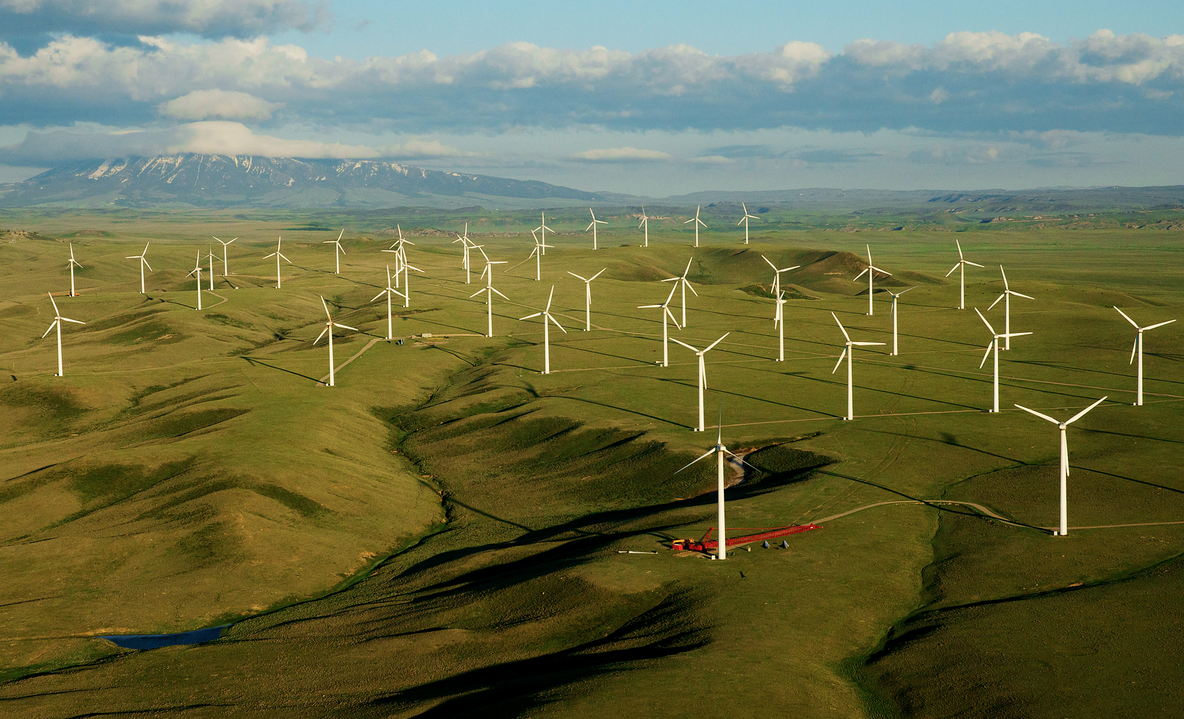
Screen Shot 2023-08-07 at 8.21.47 AMThe state agency that manages the electric grid grid, the California ISO, has approved a plan to import wind power based electricity from Wyoming that could flow here as soon as 2027. The agency is looking to booster a mix of supplies of power sources the are 100% renewable.
They plan to add more transmission lines in the state to bring in offshore wind, add more battery power facilities to store solar power into the evening hours and now import wind power from out of state allowing more diverse sourcing.

Wyoming has one of the highest wind power potentials of any state in the United States The TransWest Express (TWE) transmission project will build a 732-mile combined high voltage direct current (HVDC) and alternating current (AC) transmission line that has the potential to bring up to 3,000 megawatts (MW) of clean Wyoming wind power into California and other states in the desert Southwest.The line splits at the end of the HVDC portion in Utah, allowing 1,500 MW to go to the Los Angeles Department of Water and Power, while the remaining 1,500 MW can serve the ISO and NV Energy.

Costs for the $3 billion project will be recovered through TWE tariffs from subscribers using the transmission lines to move power and would not affect the ISO’s transmission access charge. The subscriber rights would pay for the generation, transmission, and congestion on the portion of the line used by the subscriber.

A ceremonial groundbreaking for the transmission line, which has been in the planning and development stage for some 20 years, took place in Wyoming on June 20, 2023. If successful in securing subscribers for the generation, TransWest Express plans to energize in 2027. Adding more wind power to our grid would also help bolster reliability, as demand for electricity is projected to grow significantly in the coming years through increased electrification of the transportation and building industries, and as California continues adding more renewable energy to the grid as part of its overall climate goals.