Just before the July 4 holiday, oil expert Tom Kloza writes June 26 about the latest EIA estimate: Poor start to summer for gas demand (8.97m/day) and distillate (3.536m/day). Combined offtake down 858,000 b/d from last year. Brisk distillate exports but Northeastern stocks grew by 1.8-mil bbl. This is NOT the report that refiners were looking for, suggestive of torpor.
They were clearly hoping for a way to raise prices at the pump.
Several supply and demand factors are in play here. First, we are producing more oil and gas in the US than ever. Here is the chart from the EIA showing the ram up in oil production. Meanwhile, per-capita gasoline consumption makes the scenario even clearer. As the population has grown over the last two decades, while gasoline consumption has gone nowhere, per-capita gasoline consumption has plunged by 15% from 2003 and by 21% from 1978:
Trading Economics reports today:
WTI crude futures erased gains to trade below $81 per barrel on Wednesday after EIA data showed a surprise increase in US crude stockpiles, raising concerns about weakening demand in the world’s top oil consumer. US crude oil stocks rose by 3.591 million barrels last week, contrary to market expectations of a 3 million barrel decline, as per EIA. Also, crude stocks at the Cushing, Oklahoma, delivery hub decreased by 0.226 million barrels, following a 0.307 million build the previous week.
Gasoline stocks increased by 2.654 million barrels, against expectations of a 1.10 million barrel decline.
Moreover, investors remained cautious ahead of US PCE inflation data this week, which could influence the Federal Reserve’s interest rate decisions. Oil prices have been near two-month highs amid heightened geopolitical risks from Ukrainian drone attacks on Russian oil infrastructure and the failure to secure a peace deal between Israel and Hamas.
The number of miles driven by highway-legal vehicles of all types – cars and light trucks, buses, motorcycles, delivery vans, medium-duty and heavy trucks – rose to 3,264 billion miles in 2023, squeaking past the prior record of 2019, according to estimates by the Department of Transportation. There are a lot more people, but they’re on average driving less.
Meanwhile the fleet of cars sold the US and in California for example, are using less gas per gallon or no gas. In the Golden State a growing number of sales are either hybrid or zero emission vehicles.23.9% of all new cars sold in California last quarter were ZEVs, according to the California Energy Commission.
Combined share for BEVs, PHEVs, hybrids, and fuel cell vehicles in California was 37.5 percent in 1Q ‘24, up from just 11.6 percent in 2018.
Existing combined solar,battery and hydrogen facility in Southern California
Proposed 3.1 million solar panel farm in Westside includes major hydrogen production plant and giant battery facility
Retail hydrogen blending coming to Orange Cove
Group sues to stop Pixley hydrogen plant
Plans for using hydrogen to fight climate change are sprouting all over the San Joaquin Valley this summer. Projects are in the works in western Fresno County, in Pixley in Tulare County and in Orange Cove where SoCal Gas will blend 5% hydrogen with natural gas for retail customers reducing overall greenhouse gases.
When hydrogen is injected into a fuel cell, hydrogen generates electricity but emits only heat and harmless water vapor and has great potential to cut global carbon emissions and keep toxic pollutants out. Experts say hydrogen could make the biggest difference in sectors now mostly powered by fossil fuels- trucking, shipping and aviation.
In the westside of the Valley, the Darden Clean Energy Project would cover 9500 acres owned by Westland Water District and include a trifecta of green technologies including a 3.1 million solar panel farm, a 1,150MW green hydrogen plant and a 4600MWE hour battery storage plant. An electrolyzer water treatment plant would be powered by solar power capable of producing 220 tons of gaseous hydrogen per day that could be used as zero carbon transportation fuel. To bring electricity to the grid the sprawling energy farm would be connected to a 15 mile transmission line to a PG&E substation near Highway 5.
Instead of seeking approval through Fresno County, the massive project is going direct to the California Energy Commission (CEC) for final permitting under a new provision approved by the legislature in 2022 called opt-in, the first in the state to do so.
Largest in world
The Darden Clean Energy Project more than rivals the largest solar battery storage combination in the world in Kern County at Edwards Air Force Base said to be about 4000 acres, 1.9 million solar panels and 3287MWh for the battery storage facility. The Kern County project also does not include a hydrogen manufacturing component.
In terms of the hydrogen plant at the Darden site, the capacity at 220 tons of hydrogen a day compares to just 3 tons a day at the largest existing hydrogen production plant on 324 acres also in Fresno County that started up last year led by a Spanish firm.
The CEC must find that Darden has submitted a complete application and then has 270 days to approve the project -considered a fast-track process in order to get more battery storage in California on-line sooner.
Hydrogen’s flexibility as a fuel source including for transportation, industrial, and power generation sectors and its ability to be stored is helped by new tax incentives under the Inflation Reduction Act. Producing only water as a byproduct hydrogen can be injected into the natural gas distribution system managed by utilities like SoCal Gas and PG&E. Add the synergy of combining solar power generation and hydrogen manufacturing – the process is given a big boost by the power from the sun typically on-site.
Lawsuit in Tulare County
In Pixley in Tulare County, another company is proposing to build a 1.2 million square-foot 28 acre hydrogen plant that will manufacture, store and distribute pressurized liquid hydrogen fuel for trucks and include 114 acres of solar power generation. The location of the $120 million plant is at the southwest corner of Avenue 120 and Road 120 near Highway 99.
Last summer the County of Tulare determined their project was allowed by right under the CEQA common sense exemption since the property was already located in a manufacturing zone. In March 2024 a citizen group with members from Pixley filed a lawsuit objecting that the county had not properly followed CEQA rules and should require a full impact report.
Oil company wants in
Also this spring,Chevron New Energies, a division of Chevron U.S.A. Inc., announced it is developing a 5-megawatt hydrogen production project in Lost Hills.
The project aims to create lower carbon energy by utilizing solar power, land, and non-potable produced water from Chevron’s existing assets at the Lost Hills Oil Field in Kern County. This low carbon intensity electrolytic hydrogen will be produced through electrolysis, which is the process of using electricity to split water into hydrogen and oxygen.
“Hydrogen can play a vital role in our journey toward a lower carbon future,” said Austin Knight, vice president for hydrogen at Chevron New Energies.
Blending hydrogen
Use of hydrogen will hit the retail market in Orange Cove says SoCalGas.
At the direction of the California Public Utilities Commission, SoCalGas is proposing a local demonstration project that could safely blend up to 5% clean, renewable hydrogen into the natural gas system serving approximately 10,000 residents, along with commercial customers in the City of Orange Cove, in Fresno County.
SoCalGas is proposing a 18 month demonstration project that will blend clean, renewable hydrogen serving residents and businesses. This project would offer a real-world environment to better understand how clean hydrogen and natural gas can be safely delivered to customers in the future. This is part of a broader effort by California and utilities to develop a standard for safe hydrogen blending, which could reduce greenhouse gas emissions and improve air quality,says the company.
If there’s one commodity consumers watch to determine how things are going in their pocketbook, it’s gasoline prices. So what is the trend in 4 battleground states who may decide the presidency this November? For the last 12 months, energy prices were up 2.1%, lower than the overall 3.5% inflation. Gasoline gained 1.3% for the past year, while electricity jumped 5% says Reuters.
Info below is from AAA.
Arizona: average price of regular
5/09/24. – $3.99 Week Ag $4.03 Month Ago $4.07 Trend DOWN
5/09/24 $3.78 Week ago $3.81 Month ago $3.69 Trend MIXED
Wisconsin:
5/09/24. $3.32 Week ago. $3.36 Month ago. $3.38 Trend DOWN
In another inflation watch commodity -used car prices, the wholesale used-vehicle prices (on a mix, mileage, and seasonally adjusted basis) were down in April compared to March. The Manheim Used Vehicle Value Index (MUVVI) fell to 198.4, a decline of 14.0% from a year ago.
The Buttonbush Solar and Storage Project site straddles Interstate Highway 5, east of Buttonwillow Raceway Park, just north of Highway 58, and south of Kimberlina Road, with the majority of the site being on the northeastern side of the I-5. The eastern section of the project site is approximately six miles west of the City of Shafter, while the northern section is 5.5 miles southwest of the City of Wasco. The huge 12,785 acre solar farm is a proposal by 29SC 8me LLC, the same project developer of the big Rexford Solar Farm near Ducor in Tulare County, already one of the largest projects in the nation at 1200 MW of solar and the same in battery storage.The new company name is now Avantus.
Said to be 8 years in the planning this new Kern County project appears to be by far the largest solar power plant in the US when built at 2000MW and 2000MW of battery storage.Thats the power output of Diablo Canyon nuclear power plant It would rival the largest in the world- the Bhadla Solar Park in the Thar Desert of Rajasthan, India that sprawls over 56 square kilometers and has a total installed capacity of 2,245 megawatts. The Kern project would be supported by a 500-kV, overhead gen-tie and/or underground electrical transmission line(s) originating from one or more on-site substations and terminating at the Pacific Gas & Electric Midway Substation. PG&E will modify the Midway Substation’s 500 kV yard, within PG&E’s Midway Substation property boundary, to accommodate the proposed interconnection. The Buttonbush project would be located on 132 parcels, scattred farm parcels that would require cancellation of approximately 413 acres of active Williamson Act Land Use Contract. In late March, the US private equity firm KKR & Co Inc (NYSE:KKR) said they signed a definitive agreement to acquire a majority stake in California-based solar and solar-plus-storage developer Avantus via KKR-managed investment funds and accounts.
KKR said that it will invest, alongside EIG, more than USD 1 billion in growing Avantus, encompassing equity and financing facilities, including commitments from third parties
Avantus, formerly 8minute Solar Energy, has developed and sold 6.5 GWp of solar and 6.3 GWh of storage projects since its founding in 2009, according to KKR. Today, the California-based developer owns a project pipeline filled with 30 GWp of solar and 94 GWh of battery storage projects, which could power as much as 20 million people if realised, the private equity firm added. Analysts say in the next two decades, the Valley could accommodate the majority of the state’s estimated buildout of solar energy under a state plan forecasting transmission needs, adding enough capacity to power 10 million homes as California strives to reach 100 percent clean electricity by 2045. as fewer acres are planted, facing water scarcity. The Buttonbush project will get its first hearing Wednesday, May 15 at the Kern county Planning Department in Bakersfield. The hearing will cover a notice of preparation, a step that proceeds the filing of a full EIR.
New 300MW solar project near Avenal
BayWa r.e. Solar Projects LLC, based in Irvine, is proposing a 300MW solar farm a few miles from Avenal in Fresno County. The company currently has a pipeline of solar and storage projects totaling over 10 GW across the US. Since 2014 they have brought over 1 GW online and manage over 1 GW. The Cornucopia Solar Project would sit on 2446 acres of ag land 4 miles west of Interstate 5.The project site is intersected north to south by State Route 33 -South Lost Hills Road- and east to west by Sutter Avenue.It would also feature 300 MW of alternating current (MWac) battery storage. Fresno County is processing the company’s draft EIR.
Amazon big rigs go electric
Amazon is rolling out 50 all-electric big rigs in Southern California, eight of them out of the Ports of Long Beach and Los Angeles saya the WSJ.Already, the state has banned brand new diesel trucks from seaports in California, although diesel trucks purchased through 2023 will be allowed inside for years under certain conditions.
The batteries in the big rig tractors, manufactured by Volvo, can travel up to 275 miles before a recharge, “with zero tailpipe emissions,” Amazon said. The trucks will haul shipping containers from the ports to the Amazon freight center in Sante Fe Springs, where containers will be unloaded and the goods shipped to distribution centers and airports, and finally to delivery stations, where vans load up on packages for homes and businesses.
The company won’t say how much it’s paying for the trucks. The full price currently ranges from $300,000 to $500,000, compared with about $120,000 for a diesel truck. But California and the federal government offer big subsidies to buyers of low-carbon trucks, and Amazon is in a position to buy in bulk and extract a discount.
More than 1 in 5 cars sold globally this year will be electric
The US Energy Information Agency (EIA) reported this week that gasoline demand slumped to 8.4 million barrels a day in the week ending April 19,2024 – down from 8.6 million barrels the week before and down more than 10% from the same date a year earlier, when gasoline use across the US was 9.5 million barrels a day.
The chart below shows demand for gasoline has been lower than the year before starting in February to the present.
A Reuters story points to higher prices at the pump and the expectation of relief as a possible reason. ”A spring surge in U.S. gasoline prices is set to fizzle out earlier than expected as geopolitical concerns abate, raising optimism that motorists will find some relief at the pump ahead of peak summer travel demand.
U.S. gasoline prices are under a microscope ahead of the country’s presidential elections in November, with stickiness in inflation among top issues plaguing consumers and policymakers.”
Looking longer-term The International Energy Agency (IEA) a few weeks ago cut crude oil demand forecasts for the year, with rates expected to fall further next year as consumption returns to the pre-COVID-19 trend, increasing the odds of a peak in oil consumption this decade, the agency said.
A key factor in oil consumption is the conversion of the world fleet of gasoline powered vehicles to electric. Critics have said EV sales are slumping but the counter view is that tough competition in the EV sector is lowering prices for those who want to enter into the market.
The electric car effect
A CNN story this past week adds that “Global electric vehicle sales are set to rise by more than a fifth to reach 17 million this year, powered by drivers in China, according to the International Energy Agency.
More than 1 in 5 cars sold globally this year will be electric
In a report Tuesday, the IEA projected that “surging demand” for EVs over the next decade was set “to remake the global auto industry and significantly reduce oil consumption for road transport.”
It expects half of all cars sold globally to be electric by 2035, up from more than one in five this year, provided charging infrastructure keeps pace. The IEA includes battery electric vehicles and plug-in hybrid vehicles in its definition of EVs.
The agency’s bullish long-term outlook for EVs — based on current government policies — comes just days after the world’s biggest battery EV maker Tesla slashed its prices in major markets to counter declining sales and growing competition from Chinese upstarts and established carmakers.
Recent negative headlines about slowing EV penetration are out of step with positive global trends, according to IEA executive director Fatih Birol. The data “does not at all show a reverse of the growth of electric cars. It shows an extremely robust increase of global electric car sales,” he told reporters Tuesday.
The growth is not driven just by Chinese buyers. The number of new battery electric cars sold in the European Union rose almost 4% in the first quarter of this year compared with the same period in 2023, according to the European Automobile Manufacturers’ Association.
In a statement, Birol said: “Rather than tapering off, the global EV revolution appears to be gearing up for a new phase of growth.”
Despite the upbeat trends, EV makers are grappling with slim profit margins, squeezed by price wars as competition heats.
In the past few days, Tesla and Chinese EV maker Li Auto have cut prices on major models in China, the world’s biggest EV market, with Tesla also cutting prices in Germany and the United States.
In China, more than 60% of EVs sold last year were less expensive than conventional cars, but in Europe and the United States the purchase price for new cars with internal combustion engines remains lower on average.
“Intensifying market competition and improving battery technologies are expected to reduce (EV) prices in the coming years,” the IEA said.
“Growing electric car exports from Chinese automakers, which accounted for more than half of all electric car sales in 2023, could add to downward pressure on purchase prices,” it added.
Phoenix-based Proteum Energy will invest $120 million to build a clean hydrogen plant in Central California near the town of Pixley. Tulare County is processing an application to build on a 104 acre site at the southwest corner of Road 120 and Avenue 120, just west of Highway 99.
The facility will be called Golden State Hydrogen with a capacity to produce up to 35 metric tons of fuel grade hydrogen per day, which will then be liquefied, stored and delivered under a joint development agreement. That is with a second firm who will store up to 150 metric tons of liquid hydrogen and ship 12+ truckloads of liquid hydrogen per day.
The mid-state location was selected in part because it is across the street from Calgren Renewable Fuels who produce ethanol on site that will be used to make liquid hydrogen.
The new Proteum site will also have room for a 23MW solar farm and battery storage. Helping to move the project forward is the fact that the location is already zoned M1, allowing the company to simply apply for building permits with all approvals in place.They do need Air Board approval . The county published a Notice of Exemption (NOE) posted Jan 31.
The notice says” The project will include a 104-acre, 23-megawatt peak solar array with a 20 megawatt per hour storage that will supplement 20MW of power generated on site. The facility would generate 30 metric tons per day of low/negative carbon intensity fuel cell grade renewable clean and green hydrogen for transportation. Clean hydrogen will be liquefied on site, stored, and trucked to refueling stations and fleets throughout California. The hydrogen plant will also produce at least 1,800 MMBtu/day of renewable natural gas, which will be delivered to a Southern California Gas natural gas distribution line near the site.”
The site is also the confluence of numerous ag and energy related companies, including California Dairies processing plant, Calgren RenewableFuels, and the JD Heiskell feed mill. It is also a transfer point for renewable fuels to be injected into the Southern California Gas lines distribution system. A number of nearby dairies supply methane rich biogas that is converted into renewable fuel for trucks to take the place of diesel that is favored to reduce California’s carbon footprint.
This existing cluster of ag and energy companies attracted Proteum Energy to the site along with the fact Highway 99 has both rail,highway and distribution lines to connect up and down the state.The town of Pixley “town plan” calls for industrial zoning that dates from a county decision in 2014.
A memorandum posted online says Proteum will purchase 150 acres of land for $6.5 million. According to the memo, escrow closed on the property a few months ago.
“The benefit of Tulare County’s support and enthusiasm for Golden State Hydrogen cannot be overstated. Receiving prompt project approval and an NOE will take months, if not years, off our planning” says the company president Larry Tree.
In December the University of California posted this news release, announcing federal funds were on their way to California to boost the construction of infrastructure for this new clean burning fuel. The sectors where hydrogen power could make the biggest difference — like trucking, shipping and aviation — are still dominated by fossil fuels.
The UC posting says “You might remember from chemistry class that hydrogen is the lightest and most abundant element in the universe. You might not have learned that it’s also a powerful way to deliver clean, carbon-free energy. When it’s fed into a device called a fuel cell, hydrogen generates electricity and emits only heat and harmless water vapor. Energy experts say hydrogen has great potential to cut global carbon emissions and keep toxic pollutants out of our air and water. And yet the technology hasn’t completely caught on in California, even as the state leads the way in other climate-friendly tech like electric vehicles. A few transit agencies run fuel cell buses, and you might be able to spot the occasional hydrogen-powered car on the highway. But the sectors where hydrogen power could make the biggest difference — like trucking, shipping and aviation — are still dominated by fossil fuels. As the State strives to meet its goal of eliminating greenhouse gas emissions by 2045, hydrogen’s fortunes might be starting to change. In October, the federal Department of Energy chose California as one of seven hydrogen hubs, regions where the agency will fund coordinated networks of hydrogen fuel producers, purveyors and consumers. A University of California-backed consortium called the Alliance for Renewable Clean Hydrogen Energy Systems, or ARCHES, managed the state’s application to DOE, and will steer up to $1.2 billion in federal funding toward 39 hydrogen infrastructure projects up and down the state. Altogether, ARCHES projects are estimated to eliminate 2 million metric tons of carbon emissions every year, equivalent to taking 445,000 gas-powered cars off the road. They’ll create over 200,000 new good jobs. And by swapping diesel combustion engines spewing toxic exhaust for zero-pollution fuel cells, Californians will save nearly $3 billion in health care and related costs annually.”Also the California Energy Commission states that” Hydrogen fuel cell electric vehicles are critical to the state’s go
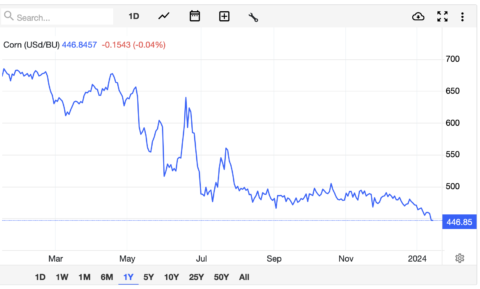
Ethanol, blended with your gasoline at 10%, has decreased 0.09 USD/GAL or 5.32% since the beginning of 2024, according to trading on a contract that tracks the benchmark market for this commodity. Historically, ethanol reached an all time high of $4.33 in June of 2006.Last summer, the renewable fuel reached the $2.50 level -now down about a dollar today . This time last year corn was trading at $6.80 a bushel today down to $4.46. That’s a drop of about 1/3.
Diesel price drops 30 cents
The the cost of diesel fuel in California is also down this new year to $5.15 a gallon says the federal EIA. That compares to $5.48 in early December – a decline of over 30 cents. California diesel hit a high of $6.89 the summer of 2022. Used to both ship goods and plow fields, the decline in the price of this fuel is considered key to fighting inflation.
Robust US demand for renewable diesel is incentivizing soybean oil processors in the country to expand their operations with the addition of 12 new plants and five plant expansions by 2026, Several recent report say farmers have responded by planting more soybeans and soybean oil futures have fallen more than 40% from record highs in 2022.
Airlines enjoys cheaper jet fuel
Jet fuel to power your next flight is down from last fall say analyst Tom Kloza. Consider that “in the oil space, the greatest disinflation shows up in jet fuel prices.”
Location 1/10/2023 1/1/2024
NYHarbor $3.68/gal $2.63/gal
Gulf Coast $3.41/gal $2.57/gal
Los Angeles $3.19/gal $2.58/gal
GasBuddy expects lower gas prices in 2024
GasBuddy released its annual Fuel Price Outlook with some good news for drivers: expect lower gasoline and diesel prices in 2024. The outlook highlights key trends in gasoline and diesel prices, forecasting that, after two years of above average gas prices, 2024 will bring relief at the pump for consumers as several factors contribute to less of a pinch at the pump. GasBuddy expects the yearly national average will drop from $3.51 per gallon this year to $3.38 in 2024. But drivers in some West Coast cities could again briefly see prices above $6 per gallon in the peak summer period, although most major U.S. cities will see prices peak near $4 per gallon in 2024.
Who needs Middle East oil?
The U.S. has hit a record high in crude production estimated at 13.3 million barrels per day last week. The news was paralleled by record outputs in Brazil and Guyana.
In January 2021, the first year of the Biden administration, US daily pumping was around 11 mil barrels /day -now almost a 20% increase.
Western hemisphere oil production is increasing and replacing what had been Middle East oil imports of the past.
In 1979 the US was importing 6.4 mil barrels per day from OPEC countries. Today it’s just 1.1mil pd from OPEC coutures. Our largest import country is friendly neighbor Canada.
New South American players include the country of Guyana. Oil production in that country averaged around 389,000 barrels per day in 2023 That’s five times more than in 2020, according to figures from the International Energy Agency.
Brazil: Data from April 2023, showed Brazil pumped an average of 3.1 million barrels of oil per day – 5% greater year over year. Brazil has the potential to become the world’s largest oil producer, with production increasing to 3.4 million barrels as of January 1 2024. Brazil’s energy ministry expects the country will be pumping 5.4 million barrels daily by 2029.
Canada’s oil production is set to jump by about 10 percent over the next year and become one of the largest sources of increased supply around the world. The country produces about 4.8 million barrels per day of crude and that figure could climb by about 500,000 bpd to about 5.3 million bpd by the end of 2024, according to S&P Global Commodity Insights.
Mexico is one of the largest oil producers in the world at 1.6 million barrels produced daily in 2022 and the fourth largest in the Americas after the United States, Canada, and Brazil. In2023 they upped their daly production to 1.9 mil pd.
Don’t forget Venezuela. The US EIA estimates that Venezuela’s total oil output will increase to about 900,000 b/d by the end of 2024.
With 3.7 million units sold globally in 3Q 2023, electric vehicles made up 18% of total passenger vehicle sales in the world. BloombergNEF expects global EV sales to reach 14 million in 2023 and 16.7 million in 2024.The 2024 forecast marks a slowdown in annual growth rates caused by the regulatory schedule in Europe, market saturation in China, US consumers facing high interest rates, slow embrace of EVs by the Big Three automakers in the US and Tesla failing to refresh its model lineup.
The passenger EV market in China grew 27% year-on-year in 3Q 2023, exceeding 2.2 million EVs sold. EV sales in the country are set to total 8.1 million in 2023. Still, a slowdown is approaching in 2024, with BNEF expecting EV sales in China to be just 18% higher than in 2023 – at 9.7 million EVs sold – caused by a weaker regulatory push, market saturation and a tougher economic situation in the country.
EV sales in Europe in 3Q 2023 grew 31%, to just under 800,000 units. Europe is still on track to meet BNEF’s forecast of 3.3 million units sold in 2023, but weaker pressure from fuel-economy targets, and subsidy changes in markets like France and Germany will keep the growth in the region muted in 2024, with sales expected to reach 3.6 million.
EV sales in North America rose 54% in 3Q 2023. BNEF now expects North America passenger EV sales to total 1.6 million in 2023, with 1.4 million of those located in the US – up 47% compared to 2022. In 2024, we expect the market to be up 32%, to a total of 1.9 million units in the US and 230,000 in Canada. The US result will be supported by the EV tax credit being available at the point of sale from 2024. Yet, for the total to be reached, the Big Three automakers – GM, Ford and Stellantis – need to step up their efforts.
Strategies for collecting water from the atmosphere using minimal energy could fill a crucial gap in sustaining communities that have limited access to water. By Michael Eisenstein
A creative illustration of a scientist squeezing water out of the sky.
Illustration: Sam Falconer
In late summer, Death Valley National Park earns its name. The heat in this region of California and Nevada is relentless. Record temperatures are set, and the air is often bone dry. The 22 August 2022 was no exception, with an average temperature during daytime of 51.6 °C and humidity of just 14% in the location aptly known as Furnace Creek.
Despite the heat and aridity, there was a slow but steady drip of water into the collection vial of Omar Yaghi’s device, an assembly of components loosely resembling a telescope. By the end of the day, this system had collected only a few millilitres of water — barely enough for a refreshing sip. But these results, published in July1, nevertheless represent a landmark in the field of atmospheric water harvesting (AWH).
Given the extremity of the testing conditions, the results suggest that the key ingredient in this device — a water-absorbing compound called MOF-303 — has the potential to deliver life-sustaining volumes of clean water to regions that currently struggle to access it. “The vision there is to have something like a village-scale device,” says Yaghi, a chemist at the University of California, Berkeley. “If you’ve got a tonne of MOF-303, you could deliver about 500 litres of water a day, every day for five to six years.”
By current estimates, roughly two billion people lack access to clean drinking water. Desalinated seawater can meet some of this need, but the technology required remains costly and is limited to communities with coastal access. This explains the growing enthusiasm for alternative solutions that extract clean water from the air. The US Geological Survey estimates that Earth’s atmosphere contains nearly 13,000 cubic kilometres of water — more than six times the volume of the world’s rivers. “You cannot deplete it — it’s always replenished by natural evaporation from a larger water body,” says Tian Li, a materials scientist at Purdue University in West Lafayette, Indiana. And although many of the most promising AWH technologies are still at the stage of lab demonstrations or proof-of-concept devices, the field is quickly building momentum towards real-world systems that produce plentiful amounts of water at low cost.
Searching for suitable sorbents
There are already several commercially available AWH systems. In mountainous, foggy regions, it is possible to literally cast a net to collect water from ever-shifting cloud masses. Such installations are producing water from the air in South America, India and parts of Africa, according to Thomas Schutzius, a mechanical engineer at the University of California, Berkeley. There are also systems for collecting the water that accumulates overnight as dew. But both fog and dew harvesting are limited to high-humidity areas. And for dew, only modest volumes of water can be produced even under optimal conditions.
Port of Long Beach plans 400-acre wind turbine staging area on dredged “new land”
A massive project to build a 400-acre offshore wind turbine assembly terminal at California’s Port of Long Beach is expected to cost $4.7 billion, port officials say
The port released a concept report back in May outlining its proposal for the facility it says would be the largest of its kind in the U.S. specifically designed for offshore wind turbines.Once assembled at Long Beach, the turbines would be towed to sites off the coast including Morro Bay. Port officials hope to start construction as early as January 2027 for the proposed Pier Wind project. Under that timeline, the first 100 acres could open for operations in early 2031 and the whole facility could be open in 2035.
Several hearings on the project are scheduled(see below).
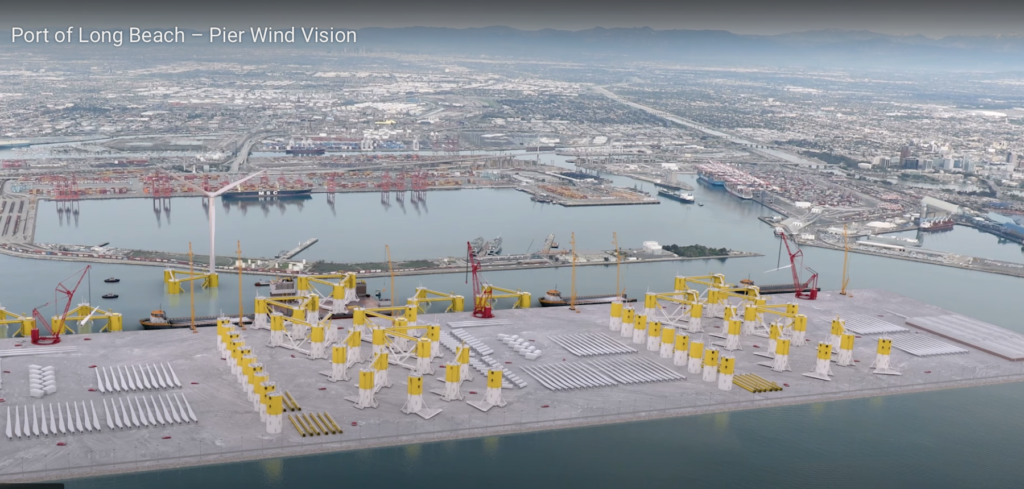
The Port of Long Beach plans to construct a 400-acre terminal and 30-acre transportation corridor for receiving, staging, and storing wind turbine generator components (tower sections, nacelles, and blades) and foundation sub-assemblies, performing final assembly of floating foundations, and integrating components with the floating foundation to create floating offshore wind turbine systems.
The project would construct “new land “at the Port that would best meet the land requirements for waterfront facilities necessary for efficient staging, integration, and floating foundation assembly of large floating OSW turbine systems
In-water construction activities would include approximately 50 million cubic yards of dredging for fill material and surcharge, construction of rock revetment dikes, and construction of a terminal wharf, sinking basin, wet storage areas, and concrete piers adjacent to the transportation corridor.Dredging would be under the supervision of United States, Corps of Engineers.
Advocates say Pier Wind project helps California:
Harness the powerful wind in deep waters in order to generate renewable energy at a lower cost while enhancing air quality by reducing reliance on fossil fuels.
Meet the state’s goal of producing 25 gigawatts of offshore wind power by 2045.
And contribute toward lowering the national cost of offshore wind power by 70% by 2035.
California has some of the best OSW energy resources in the world and OSWs tend to blow harder and more uniformly than on land, says a report.
Energy agency NREL found that building larger turbine systems and maximizing production at one site can lead to significant cost reductions for OSW energy, creating a valuable opportunity for cost savings. Turbines can provide more consistent output during the winter months when solar production is lower and increase the average amount of renewable electricity generation available in the early evening hours as solar generation begins to decline, says NREL.
Long Beach is well-poised to meet the unique requirements to accommodate a terminal for foundation assembly by creating 400 acres of new land in the Outer Harbor using material dredged from within the POLB. This approach offers flexibility for foundation assembly in a centralized location, supporting economies of scale crucial for meeting OSW energy goals efficiently and reducing the overall cost. The proposed Project would strategically deepen areas around the Pier Wind Terminal to create a sinking basin, channel, and wet storage at depths necessary to meet operational needs. The terminal would be located in front of the Long Beach International Gateway Bridge
Presentations of the big project are slated for the following.
Wednesday, December 13, 2023 (In-Person)
Open House from 5 to 6 p.m., Scoping Meeting starts at 6 p.m.
Port of Long Beach Administration Building, 415 W. Ocean Blvd., Long Beach, CA 90802 (Open House and Scoping Meeting)
Open House and Scoping Meeting #2
Date: Time: Location:
Wednesday, January 10, 2024 (In-Person)
Open House from 5 to 6 p.m., Scoping Meeting starts at 6 p.m.
Port of Long Beach Administration Building, 415 W. Ocean Blvd., Long Beach, CA 90802 (Open House) and Bob Foster Civic Chambers, adjacent to the Port of Long Beach Administration Building in the Long Beach Civic Center, 411 W. Ocean Blvd., Long Beach, CA 90802
(Scoping Meeting)


 The U.S. has hit a record high in crude production estimated at 13.3 million barrels per day last week. The news was paralleled by record outputs in Brazil and Guyana.
 With 3.7 million units sold globally in 3Q 2023, electric vehicles made up 18% of total passenger vehicle sales in the world. BloombergNEF expects global EV sales to reach 14 million in 2023 and 16.7 million in 2024.


 The Port of Long Beach plans to construct a 400-acre terminal and 30-acre transportation corridor for receiving, staging, and storing wind turbine generator components (tower sections, nacelles, and blades) and foundation sub-assemblies, performing final assembly of floating foundations, and integrating components with the floating foundation to create floating offshore wind turbine systems.