Pacific Ethanol Explores Sale Of Madera Granary

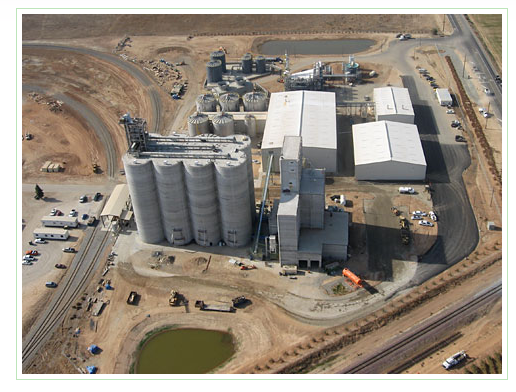
loop track on property

“Were Getting Closer To Reopening The Ethanol Plant ”

Madera County Planning Commission approved a tentative parcel map split  requested by Pacific Ethanol in July allowing the sale of the granary next to the idle ethanol plant on Ave 12 near Madera.

The granary is also idled since the ethanol plant shut down in January 2009 after operating for less than 3 years. The whole acreage was a lumber mill that closed down in 1995.

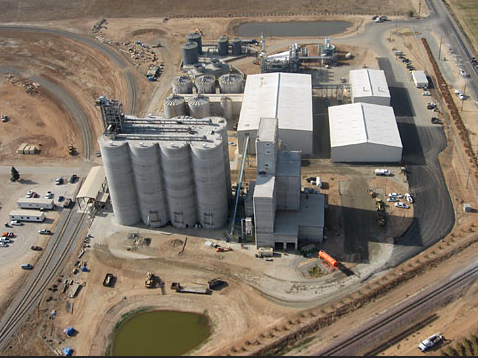
In their parcel map application Pacific Ethanol asked that the 137 acre parcel be split to allow the granary and the huge loop track that covers most of the property to be on one parcel and the 40 million gallon ethanol plant on the other. Currently a conveyor belt crosses the  parcel. The train track infrastructure allows 100 car unit-trains brimming with corn to be parked to unload at the feed mill. The granary will in turn feed the ethanol plant. But the granary units could do much more the application says.

”While the current owner has handled all grain deliveries necessary to operate the ethanol plant,the granary has a much greater unused capacity and a feed mill” says a county staff report. Pacific Ethanol “wants to sell off Parcel 2 to a party with expertise in grain handling and feed production.”

The county approved the tentative map but Pacific Ethanol has yet to file a a final map application because that would imply a buyer is at hand.

Getting Closer

The idea is not to dispose of the facility to raise cash or something but to invite an operator to participate in a business deal.

Pacific Ethanol spokesperson Paul Koehler says this step is preliminary but it ”sets the stage for what the company hopes to do – reopen the Madera Pacific Ethanol plant.”

“We’re getting closer” he says since ethanol making margins have improved from last year.

Koehler says that “2012 was record bad year for our industry with strong oversupply and high corn prices” due to the drought. By early  2013 things turned around and by Q2 there was a better balance” as the company reported their first profit in years.

“We will definitely reopen the plant“ he assures but won’t say just when they will pull the trigger. ”We want to make sure we can keep producing” noting that “California can use the ethanol.”

Besides exploring a sale of the adjacent granary Koehler says they would install corn oil-making technology at the ethanol plant prior to reopening,something they have done at several of their plants.

feed operation closest to camera

Could Add 60 Jobs

But as of now Koehler says they are not working with a buyer for the granary although operating a granary separately from the ethanol plant”is a model used by others in the Midwest and makes sense.”

“We need to find the right player to work with.”

The county staff report says if both enterprises come back to life – it could add 30 jobs at each – 60 jobs for Madera County.

Tulare County Expects More Electric Power From Anaerobic Digesters

Tulare County Board Of Supervisors expect more anaerobic digester projects in the county buoyed by government incentives to reduce greenhouse gases,lessen organic and foods waste and reduce odors. The plants would also make electric power. A memo from  staff says the county RMA intends to streamline the permitting process after companies interested in developing digesters contacted them and indicated to expect “numerous projects”.

The county will collect a fee from the annual revenue as well. Currently county gets $1000 per megawatt for solar projects on private land and $125 per megawatt for projects built on public land.The county would extend the fee to biomass digesters. Anaerobic digestion is a collection of processes by which microorganisms break down biodegradable material in the absence of oxygen.The process is used for industrial or domestic purposes to manage waste and/or to produce fuels. Much of the fermentation used industrially to produce food and drink products, as well as home fermentation, uses anaerobic digestion. Silage is produced by anaerobic digestion.

The BOS are expected to approve the plan this week.

Several new digesters are seeking permits now including 2 in  the Tulare area and 1 near Tipton.

More Plummeting For Local Gas Prices

Many Southern California cities saw gas prices drop by about a penny a day in the last week, bringing the majority of gas station prices under $4 a gallon, according to the Automobile Club of Southern California’s Weekend Gas Watch. The state average is $3.871 a gallon for regular today – 6.1 cents lower than last week.

On the Central Coast, the average price is $4.005, which is 4.8 cents below last week, 11 cents lower than a month ago, and 12 cents less than last year.In Morro Bay the Valero is selling for $3.79.

In Bakersfield the price has dropped more than 7cents in the past week. In Tulare Gas Buddy says $3.63 is the cheapest price.

The average price of self-serve regular gasoline in the Los Angeles-Long Beach area is $3.904 per gallon, which is 7.3 cents less than last week, 18 cents lower than last month, and 21 cents lower than last year. In San Diego, the average price is $3.904, which is 5.8 cents below last week, 15 cents below last month, and 19 cents lower than last year. In the Inland Empire, the average per-gallon price is $3.892, down 6.7 cents from last week, 15 cents lower than last month, and 19 cents less than last year.

“For the first time all summer, drivers are paying less now at the pump than they were at the same time last year,” said Auto Club spokesman Jeffrey Spring. “Because of supply issues in other parts of the country, right now California drivers are paying about the same amount for gas as those in Connecticut, Idaho, New York and Washington, D.C.”

The state’s motorists are paying  about 25 cents less than a month ago despite the jump in oil prices.

USDA Expects 2013 Crop To Be Record-Breaker

Ethanol Industry Denies Food Vs Fuel Argument

(August 12, 2013) WASHINGTON — The U.S. Department of Agriculture (USDA)  has projected that farmers will harvest a record corn crop of 13.76 billion bushels in 2013, up 28 percent from last year and 5 percent larger than the previous record crop. USDA expects that farmers will achieve a national average yield of 154.4 bushels per acre; that would be the third-highest yield on record, despite farmers experiencing one of the slowest, wettest planting seasons on record.
“America’s farmers have again risen to the challenge of producing abundant feed, food, and fuel for consumers around the world. After the disappointment of last year’s drought-stricken crop, farmers have responded by producing what is likely to be the largest crop of all time,” said Renewable Fuel Association President and CEO Bob Dinneen. “By rapidly adopting new seed and equipment technologies over the past decade, this country’s corn growers have distinguished themselves as the most productive in the world.”
Dinneen continued, “While it is important to remember the crop is not yet in the bins, today’s report should be the last nail in the coffin of the ridiculous ‘food versus fuel’ argument. Corn stocks are likely to hit an 8-year high and prices are at a 3-year low. Meanwhile, USDA is projecting food inflation to average just 2 percent in 2013, down from 2.6 percent in 2012 and well below the historical average of 3 percent. Meat prices are expected to advance just 1.5 percent this year, compared to 3.4 percent last year. All this while ethanol production, demand, and consumption continues to increase. Clearly, the link between the RFS, ethanol, and food prices does not exist.”
__________________________________________________________________

“Meat prices are expected to advance just 1.5 percent this year, compared to 3.4 percent last year. All this while ethanol production, demand, and consumption continues to increase. Clearly, the link between the RFS, ethanol, and food prices does not exist.”
______________________________________________________________________

Dinneen noted that USDA’s report suggests livestock and poultry feed will remain as the top use of corn, accounting for 53 percent of total demand (when animal feed co-products from ethanol production are properly considered). By comparison, the ethanol industry is projected to account for 26 percent of corn demand on a net basis, exports will account for 10 percent, and food, seed, and industrial use will make up 11 percent. Additionally, feed usage is projected to be 15 percent higher than last year.
USDA expects global grain production to hit 2.43 billion metric tons in 2013, up 8 percent from last year and a new record. “Not only is U.S. corn production expected to achieve a new record, but world grain output is projected to soar to a new record as well,” Dinneen said. “Simply put, there isn’t a grain of truth to the notion that U.S. ethanol or the RFS are having any kind of meaningful impact on American or world food prices.”
–

Climate Change Is A Growing Threat to California, Study Says

A new report from Cal/EPA chronicles how climate change is reshaping California’s physical and biological systems, including the state’s water resources.
Mountain lakes are getting warmer, extreme droughts and floods are becoming more common, springtime runoff is coming earlier, and ocean levels are rising, according to a comprehensive report released Thursday by Cal/EPA’s Office of Environmental Health Hazard Assessment.
To draw its findings, the report used 36 environmental indicators — a combination of monitoring data and scientific studies — to update an earlier 2009 report on the same topic.
“Together, these indicators paint a disturbing picture of how climate change is affecting our state and its growing threats to our future,” OEHHA Director Dr. George Alexeeff stated.
Besides water, the study looks at how global warming is contributing to more severe and prevalent wildfires, increased air and surface temperatures, changing habitat and mortality patterns among plants and animals, and more extreme weather events.
Here are a few of the many water-related observations contained  in the report:
There hasn’t been a discernible change in snow-water content statewide, but the amount  has declined in the northern Sierra Nevada and increased in the southern part of the mountain range, “likely reflecting difference in precipitation patterns.”
Conditions are warming at high altitudes. During the past 20 years, the altitude at which temperatures drop below freezing has risen by about 500 feet, the report said, potentially affecting the state’s snowpack.
More precipitation is falling as rain instead of snow, partly contributing to less and earlier springtime runoff. The date of peak snowmelt in California has shifted 2.5 weeks earlier since 1961, the report said.
Mountain glaciers in California have retreated 20%-70% during the past century, while sea levels went up an average of 7 inches on California’s coast.
Officials said California is one of the first states to compile its own set of indicators to assess climate change. In May, Gov. Jerry Brown joined thousands of scientists in signing a “consensus statement” proclaiming that there is “overwhelming” evidence that human action is damaging Earth’s life support systems.
“Whether you live in California, Texas or Timbuktu, climate change is real, and it’s long past time for action,” Brown said upon the release of CAL/EPA’s report Thursday.
Access the report at the OEHHA website here.

From ACWA

Plug It In

Getting charged up in SLO

Plug-in Electric Vehicles
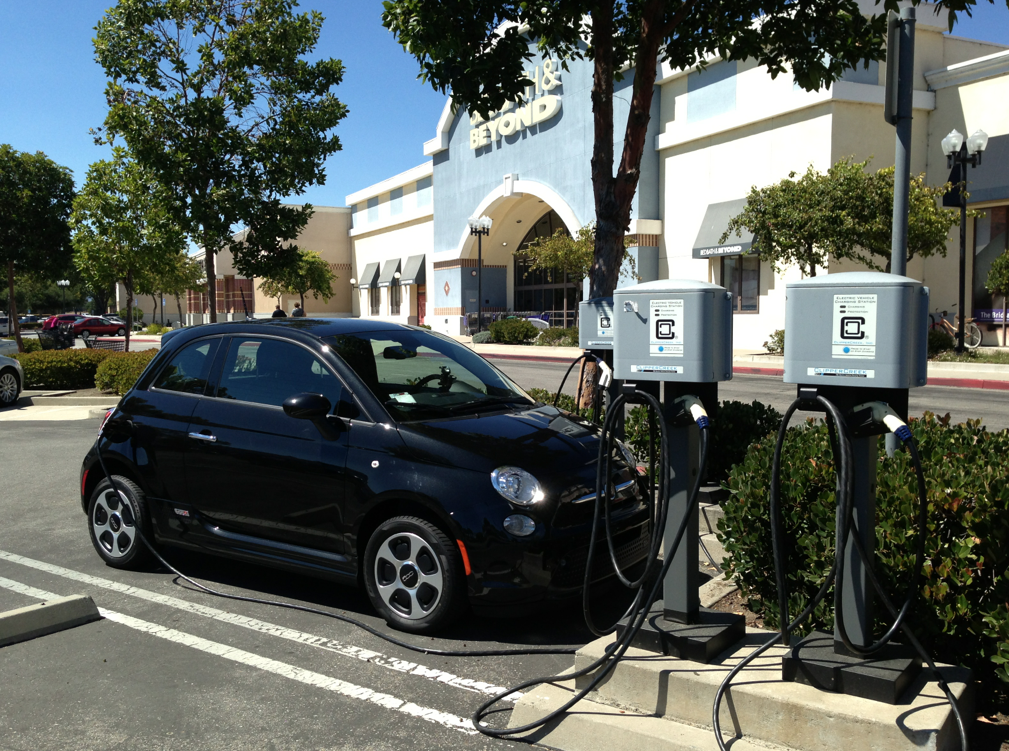
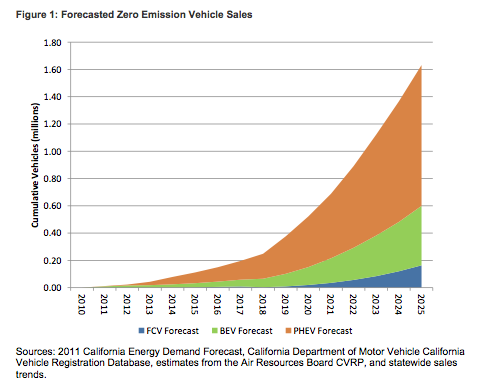
A California Energy Commission report estimates as of June 2013 there are over 32,000 PEVs and over 14,000 neighborhood electric vehicles on the roads. Sales of the new generation of plug-in hybrid electric vehicle (PHEV) started in December 2010 and since then over 28,000 of these vehicles have been purchased in California. The primary incentives for the sale of these vehicles in California came from both the Air Resources Board’s Clean Vehicle Rebate Project (CVRP) and the federal tax credit for electric vehicles. Charging stations are helping to encourage the trend. Private instrustrture such as Tesla Motors project to build  dedicated charging stations up and down California add to the effort.Tesla has stations in Buellton and Harris Ranch on Hwy 5 in Central California.

U.S. Wind Energy Production and Manufacturing Reaches Record Highs

California Adds New Generation

WASHINGTON – The Energy Department released two new reports today showcasing record growth across the U.S. wind market — increasing America’s share of clean, renewable energy and supporting tens of thousands of jobs nationwide. According to these reports, the United States continues to be one of the world’s largest and fastest growing wind markets. In 2012, wind energy became the number one source of new U.S. electricity generation capacity for the first time – representing 43 percent of all new electric additions and accounting for $25 billion in U.S. investment.
In the first four years of the Obama Administration, American electricity generation from wind and solar power more than doubled. President Obama’s Climate Action Plan makes clear that the growth of clean, renewable wind energy remains a critical part of an all-of-the-above energy strategy that reduces harmful greenhouse gas emissions, diversifies our energy economy and brings innovative technologies on line. The Obama Administration has committed to another doubling of the renewable electricity generation from energy resources like wind power by 2020.
“The tremendous growth in the U.S. wind industry over the past few years underscores the importance of consistent policy that ensures America remains a leader in clean energy innovation,” said Energy Secretary Ernest Moniz. “As the fastest growing source of power in the United States, wind is paving the way to a cleaner, more sustainable future that protects our air and water and provides affordable, clean renewable energy to more and more Americans.”
The tremendous growth in the overall U.S. wind industry has led directly to more American jobs throughout a number of sectors and at factories and power plants across the country. According to industry estimates, the wind sector employs over 80,000 American workers, including workers at manufacturing facilities up and down the supply chain, as well as engineers and construction workers who build wind installations.
Wind Technologies Market Report
The Energy Department and Lawrence Berkeley National Laboratory today released the 2012 Wind Technologies Market Report – detailing the latest trends in the U.S. wind power market.
Last year, over 13 gigawatts (GW) of new wind power capacity were added to the U.S. grid – nearly double the wind capacity deployed in 2011. This tremendous growth helped America’s total wind power capacity surpass 60 GW at the end of 2012 – representing enough capacity to power more than 15 million homes each year, or as many homes as in California and Washington state combined. The country’s cumulative installed wind energy capacity has increased more than 22-fold since 2000.
At the same time, the proportion of wind turbine components such as towers, blades, and gears made in America has increased dramatically. The report estimates seventy-two percent of the wind turbine equipment installed in the U.S. last year was made by domestic manufacturers, nearly tripling from 25 percent in 2006-2007.
The report also finds that nine states now rely on wind power for more than 12 percent of their total annual electricity consumption – with wind power in Iowa, South Dakota and Kansas contributing more than 20 percent. Additionally, Texas added over 1,800 megawatts of wind power last year, more than any other state. On a cumulative basis, Texas remains a clear leader with over 12 GW installed at the end of 2012 — more than twice as much as California, the next-highest state.
Also according to the Energy Department’s 2012 Wind Technologies Market Report, technical and design innovation allowing for larger wind turbines with longer, lighter blades has steadily improved wind turbine performance and has expanded wind energy production to less windy areas. Since 1998, the average capacity of wind turbines in the U.S. has increased by 170 percent. At the same time, wind project capital and maintenance costs continue to decline, lowering the cost of wind energy to near-record lows. The price of wind under long-term power purchase contracts signed in 2011 and 2012 averaged 4 cents per kilowatt hour – making wind competitive with a range of wholesale electricity prices seen in 2012.
Distributed Wind Market Report
For the first time, the Energy Department and Pacific Northwest National Laboratory today issued the 2012 Market Report on Wind Technologies in Distributed Applications – highlighting strong growth in the U.S. distributed wind energy market.
Compared to traditional, centralized power plants, distributed wind energy installations directly supply power to the local grid near homes, farms, businesses and communities– helping to improve grid reliability and efficiency. Turbines used in these applications can range in size from a few hundred watts to multi-megawatts, and can help power remote, off-grid homes and farms as well as local schools and manufacturing facilities. Over the past ten years, the U.S. distributed wind market has grown more than five-fold.
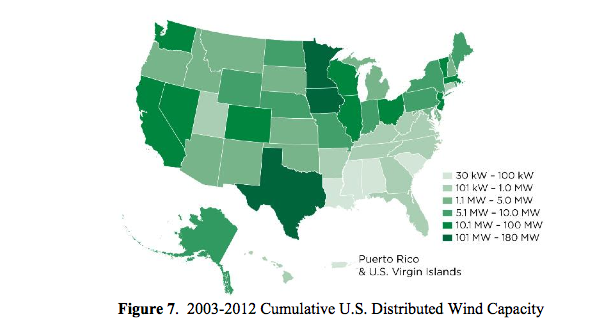
The report finds that distributed wind in the U.S. reached a 10-year cumulative installed capacity of more than 812 megawatts (MW) at the end of 2012 – representing more than 69,000 units across all 50 states. Between 2011 and 2012, U.S. distributed wind capacity grew by 175 MW, with about 80 percent of this growth coming from utility-scale installations. At the state level, Iowa, Massachusetts, California and Wisconsin led the nation in new distributed wind power capacity in 2012.
Still, most distributed wind buyers continue to choose small wind turbines, which have a rated capacity of no greater than 100 kilowatts. Last year, domestic sales from U.S. wind suppliers accounted for nearly 90 percent of new small wind generation capacity. Broadly, nine out of the top ten wind turbine models installed last year in U.S. distributed applications were made in America.
The wind sector’s growth underscores the importance of continued policy support and clean energy tax credits to ensure that wind manufacturing and jobs remain in America. The 2012 Wind Technologies Market Report expects 2013 to be a slow year for new capacity additions, due in part to continued policy uncertainty and project development timelines. While the report notes that 2014 is expected to be more robust, as developers commission projects that will begin construction in 2013, it also notes that projections for 2015 and beyond are much less certain.
For more information on these two new reports – including infographics, video and our latest interactive map – visit www.energy.gov/windreport. Join us Thursday, August 8, to discuss key findings from the reports during a special Google+ Hangout on wind energy in America.

Local Energy Briefs: Solar / Wind / Ethanol

Energy giant NRG has announced commercial operation of a 20 megawatt solar project in Kings County this month – the so-called Kansas South project. The solar farm developed by Recurrent Energy was acquired  by NRG earlier this year.The energy project is the second utility-scale solar farm in Kings County owned by NRG after the county’s first in rural Avenal. NRG is also developing California Valley Solar Ranch  in San Luis Obispo County, under construction now. Kings county has a pipeline of some 3 hundred MWs of solar projects approved by the county and one mega-5000 MW project – Westlands Solar Park in the EIR process.

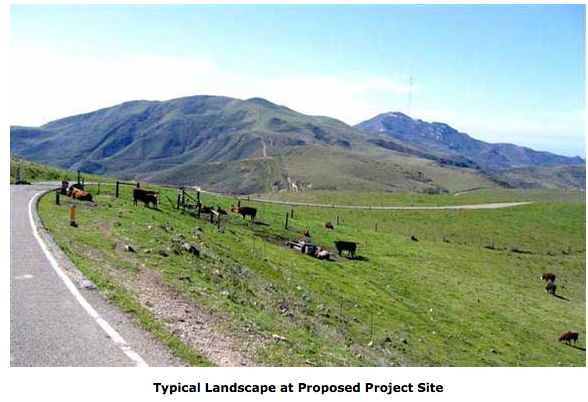
Key issue in the decision of Acciona Energy not to pursue the Lompoc Wind Farm project appears to be a lack of a Power Purchase Agreement with PGE. That PPA had been in place for years with the big utility but a long wait for permitting allowed the agreement  to lapse says a county planner.The wind farm would use 65 wind turbines, each standing 389-397 feet high located on  the wind swept ridge above Lompoc to produce 97.5 megawatts, enough to power over 40,000 households. The alternative energy project had been proposed on grazing land but saw stubborn opposition in court and on appeal from a neighbor. The wind project was first approved back in 2008.

Pacific Ethanol Posts Profit : Sacramento-based Pacific Ethanol posted a profit in their second quarter of 2013 with net sales up 14%. The company reported increased profits to $736,000 in the quarter, compared with a $2.9 million loss a year earlier.

Improved margins for fuel ethanol from corn helped improve net income to $1.1 million compared to a loss of $10 million for the same quarter a year ago.
The company cited improved market conditions, increased plant ownership and “bottom line growth”.

Pacific Ethanol will install corn oil separation technology at all its plant offering this co-product to the poultry feed and biodiesel feedstock markets. In addition the company said it was continuing to use more sorghum instead of corn to cut feedstock costs and improve its carbon footprint.

The company reported its adjusted crush margin $/gallon rose from  a low of 35 cents last September to around 80 cents as of June 2013.
Investors liked what they saw pushing the firm’s stock to $4.62, up 11.5% today on the Nasdaq.

Boosting margins is the drop in corn prices as this falls harvest approaches. Corn is now $4.73 a bushel for December delivery on the futures market.The Midwest drought last year boosted prices above $8 last year hurting ethanol makers and the US livestock industry who blamed the ethanol companies.

Solar: Stanford Scientists Break Record For Thinnest Light-Absorber


Stanford scientists have built the thinnest, most efficient absorber of visible light on record, a nanosize structure that could lead to less-costly, more efficient, solar cells.

Carl Hagglund An electron micrograph shows the cross-sectional view of the record-thin absorber layer created at Stanford. Shown are three gold nanodots, each about 14-by-7 nanometers in size, coated with in sulfide. An electron micrograph shows the cross-sectional view of the record-thin absorber layer created at Stanford. Shown are three gold nanodots, each about 14-by-17 nanometers in size, coated with tin sulfide.

Stanford University scientists have created the thinnest, most efficient absorber of visible light on record. The nanosize structure, thousands of times thinner than an ordinary sheet of paper, could lower the cost and improve the efficiency of solar cells, according to the scientists. Their results are published in the current online edition of the journal Nano Letters.

“Achieving complete absorption of visible light with a minimal amount of material is highly desirable for many applications, including solar energy conversion to fuel and electricity,” said Stacey Bent, a professor of chemical engineering at Stanford and a member of the research team. “Our results show that it is possible for an extremely thin layer of material to absorb almost 100 percent of incident light of a specific wavelength.”

Thinner solar cells require less material and therefore cost less. The challenge for researchers is to reduce the thickness of the cell without compromising its ability to absorb and convert sunlight into clean energy.

For the study, the Stanford team created thin wafers dotted with trillions of round particles of gold. Each gold nanodot was about 14 nanometers tall and 17 nanometers wide.

Visible spectrum

An ideal solar cell would be able to absorb the entire visible light spectrum, from violet light waves 400 nanometers long to red waves 700 nanometers in length, as well as invisible ultraviolet and infrared light. In the experiment, postdoctoral scholar Carl Hagglund and his colleagues were able to tune the gold nanodots to absorb one light from one spot on the spectrum: reddish-orange light waves about 600 nanometers long.

Mark ShwartzThese four wafers contain the thinnest light-absorber ever built.These four wafers contain the thinnest light-absorber ever built. The absorber layer consists of billions of gold nanodots. Each round dot has a volume equivalent to a flat particle of gold 1.6-nanometers thick.

“Much like a guitar string, which has a resonance frequency that changes when you tune it, metal particles have a resonance frequency that can be fine-tuned to absorb a particular wavelength of light,” said Hagglund, lead author of the study. “We tuned the optical properties of our system to maximize the light absorption.”

The gold nanodot-filled wafers were fabricated at a nearby Hitachi facility using a technique called block-copolymer lithography. Each wafer contained about 520 billion nanodots per square inch. Under the microscope, the hexagonal array of particles was reminiscent of a honeycomb.

Hagglund’s team added a thin-film coating on top of the wafers using a process called atomic layer deposition. “It’s a very attractive technique, because you can coat the particles uniformly and control the thickness of the film down to the atomic level, ” he said. “That allowed us to tune the system simply by changing the thickness of the coating around the dots. People have built arrays like this, but they haven’t tuned them to the optimal conditions for light absorption. That’s one novel aspect of our work.”

Record results

The results were record-setting. “The coated wafers absorbed 99 percent of the reddish-orange light,” Hagglund said. “We also achieved 93 percent absorption in the gold nanodots themselves.  The volume of each dot is equivalent to a layer of gold just 1.6 nanometers thick, making it the thinnest absorber of visible light on record – about 1,000 times thinner than commercially available thin film solar cell absorbers.”

The previous record-holder required an absorber layer three times thicker to reach total light absorption, he added.  “So we’ve substantially pushed the limits of what can be achieved for light harvesting by optimizing these ultrathin, nano-engineered systems,” Hagglund said.

The next step for the Stanford team is to demonstrate that the technology can be used in actual solar cells.

“We are now looking at building structures using ultrathin semiconductor materials that can absorb sunlight,” said Bent, co-director of the Stanford Center on Nanostructuring for Efficient Energy Conversion (CNEEC). “These prototypes will then be tested to see how efficiently we can achieve solar energy conversion.”

In the experiment, the researchers applied three types of coatings – tin sulfide, zinc oxide and aluminum oxide – on different nanodot arrays. “None of these coatings are light-absorbing,” Hagglund said. “But it has been shown theoretically that if you apply a semiconductor coating, you can shift the absorption from the metal particles to the semiconductor materials. That would create more long-lived energetic charge carriers that could be channeled into some useful process, like making an electrical current or synthesizing fuel.”

 Final goal

The ultimate goal, Bent added, is to develop improved solar cells and solar fuel devices by confining the absorption of sunlight to the smallest amount of material possible. “This provides a benefit in minimizing the material necessary to build the device, of course,” she said. “But the expectation is that it will also allow for higher efficiencies, because by design, the charge carriers will be produced very close to where they are desired – that is, near where they will be collected to produce an electrical current or to drive a chemical reaction.”

The scientists are also considering nanodot arrays made of less expensive metals. “We chose gold because it was more chemically stable for our experiment,” Hagglund said. “Although the cost of the gold was virtually negligible, silver is cheaper and better from an optical point of view if you want to make a good solar cell. Our device represents an orders-of-magnitude reduction in thickness. This suggests that we can eventually reduce the thickness of solar cells quite a lot.”

Other researchers on the project include Engineering Professor Mark Brongersma and former postdoctoral scholars Isabell Thomann and Han-Bo-Ram Lee from Stanford; and Gabriel Zeltzer and Ricardo Ruiz of Hitachi Global Storage Technologies in San Jose, Calif.

The research was supported by CNEEC, an Energy Frontier Research Center funded by the U.S. Department of Energy. Additional support was provided by the Marcus and Amalia Wallenberg Foundation.

Mark Shwartz writes about energy science and technology for the Precourt Institute for Energy at Stanford University.

Media Contact

Stacey Bent, Department of Chemical Engineering: (650) 723-0385, sbent@stanford.edu

Carl Hagglund, Department of Chemical Engineering: (650) 723-0410, hagglund@stanford.edu

Mark Shwartz, Precourt Institute for Energy: (650) 723-9296, mshwartz@stanford.edu

Dan Stober, Stanford News Service: (650) 721-6965, dstober@stanford.edu

 30  655  81 StumbleUpon1

Strange Weather Department Quick Takes

Past month saw wet weather in Northern California and Arizona
click to enlarge

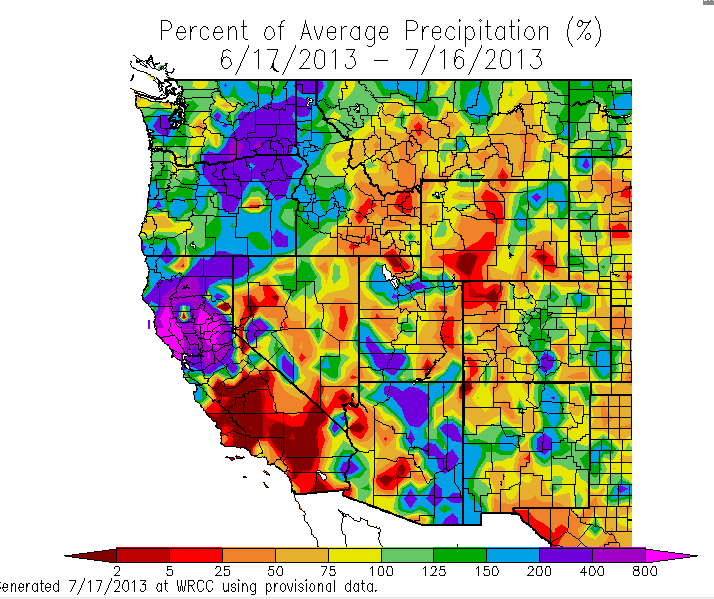
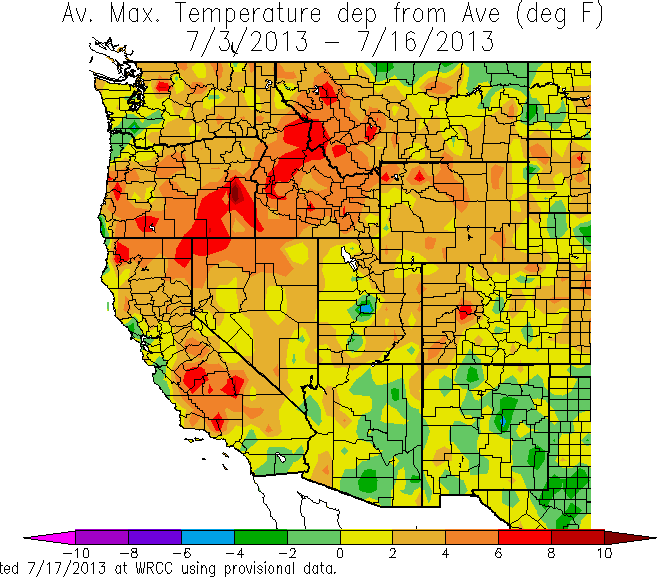
This past month has bought a fair share of strange weather pattens including a few days of wet weather in northern California and several weeks of Monsoon rain in Arizona ,some spilling into southern California.(see maps)

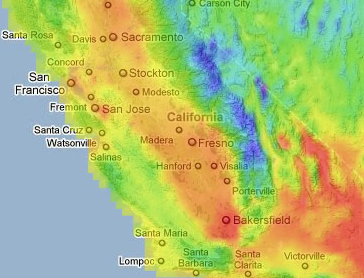
hot spots – click to enlarge

In the mid Valley the past 20 days have been over 100 degrees, a few 108s and a 109 in Fresno says NWS. Finally the spell was broken July 16 when it was only 95. Map shows state hots spots including Tulare County.

Meanwhile the warm temps have heated up our cooling off spots like along the Kaweah River near Three Rivers  that reached 82 degrees July 5 says the Kaweah River Page website. Water temps on the Kaweah this week are in the high 70s every day at some favorite water pools.

It can be exciting up high as well with thunderstorms for two days this past week in the Sierra Nevada Mountains. Flash flooding occurred on I-80 near Truckee. The 24-hour rain amounts were in the 2 to 3 inch range in the Sierras. Such showers typically occurred during a 2-hour period.

The warm temps are hurting fish too. Global warming is likely to bring mass extinction the state’s freshwater fish says a UC Davis study.

Just another reason why we could use some more dams to store and time release cold water in the summer months to help them out.The UC research showed that 82 percent of the 121 native fish species present in California are likely to become extinct, while 19 percent of California’s 50 non-native fish species risk going extinct.