Taft Oil Train Terminal Cited By EPA

May 4,2015-

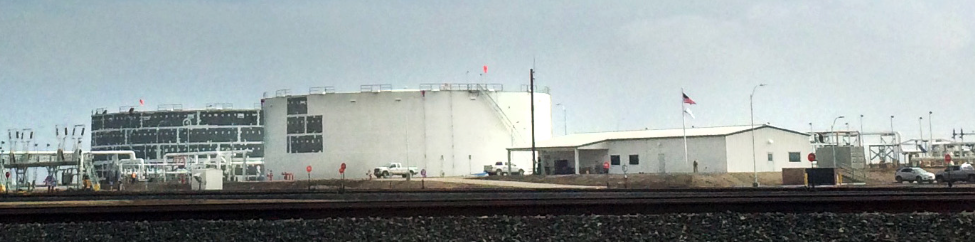
The U.S. Environmental Protection Agency has cited Plains All American Pipeline LP’s Bakersfield crude by rail terminal with a number of violations in violation of the Clean Air Act. In operation since November of last year the EPA notice says the company must correct the deficiencies including installation of Best Available Technology.

In January, Earthjustice and Communities for a Better Environment sued the San Joaquin Valley Air Pollution Control District, which issued what the environmental group calls an invalid permit, over the permitting process for the facility’s expansion—a process that they say was conducted without public review. Earthjustice is representing the Association of Irritated Residents (AIR), ForestEthics, Sierra Club and the Center for Biological Diversity.

“The EPA’s announcement declares the Air District’s permit a sham and that the Bakersfield terminal is operating illegally,” said Elizabeth Forsyth, Earthjustice attorney. “Air District officials went out of their way to exclude the public from the process and speed the approval through, ignoring the environmental review required by state and federal law. We applaud EPA for stepping in and enforcing the Clean Air Act.”
EPA’s action could subject the terminal to serious Clean Air Act fines, and should force the Bakersfield Crude Terminal to undergo the major source permitting required by the Clean Air Act.

“The EPA stepped in to protect California from this crude-by-rail facility’s dangerous air pollution,” said Vera Pardee, an attorney with the Center for Biological Diversity.
Screen Shot 2015-05-04 at 4.24.44 PM

Cargill, Tesla, PG&E Collaborate At Fresno Beef Plant To Ease California Peak Energy Use

New Battery Cuts Costs

Screen Shot 2015-05-01 at 10.31.54 AMFRESNO, Calif., May 1, 2015 /PRNewswire/ — Cargill has collaborated with Tesla and Pacific Gas & Electric (PG&E), to install Tesla’s Energy Storage product at the company’s Fresno beef processing facility.  Tesla’s batteries help to reduce energy costs by storing electricity at off-peak use times, then using it during peak periods.  In total, the Tesla batteries have a 1 megawatt capacity that will be charged daily from the existing PG&E electricity grid system during off-peak hours, when electricity rates are lowest.  The electricity stored in the batteries will then be used when rates are the highest each day during peak use times.  By doing so, Cargill is reducing its contribution to the daily state power peak, when less environmentally friendly electricity generation might otherwise be required to meet demand.

Electric utility cost savings are estimated to be more than $100,000 annually.  As the first large-scale battery installation at a Cargill meat processing facility, the company hopes to learn from this project for future potential use of this technology at its plants around the world.

“Tesla Energy Storage is another example of our willingness to employ new and different concepts for reducing our environmental footprint in ways that benefit the community and our beef business,” said Jon Nash, Cargill’s beef plant general manager at Fresno.  “We understand that while we produce nourishing protein for millions of people on the West Coast, it is important for us to do so as responsibly as possible.  Proper stewardship of the resources required to produce food is crucial to the ongoing success of our business and is important to current and future generations as the world’s population increases from more than 7 billion people today to more than 9 billion in 2050.”

Installation of Tesla’s Energy Storage system at Cargill’s Fresno beef processing facility coincides with the company’s global Earth Day activities around the world.  The company’s efforts range from resource conservation to trash removal from waterways; educating farmers in emerging nations how to optimize resources for long-term food production and more efficient transport of food that reduces emissions and use of fossil fuels; and collaborating with non-governmental organizations (NGOs) and farmers and ranchers to improve agriculture.

In recent years, Cargill pioneered the use of new technology to improve its environmental footprint at Fresno.  In 2013, the company worked with a third party to install a solar water heating system on the roof of the beef plant’s main building, resulting in a reduction of the facility’s use of natural gas while also reducing its cost to heat water for food safety and plant sanitation purposes.  Years earlier, the plant installed a methane gas recovery system for its wastewater pond, which captures this greenhouse gas for use as a fuel source to heat boilers.  Water from the boilers is used for daily plant sanitation.  Using this system eliminates greenhouse gas from being released into the atmosphere.  Additionally, the plant’s water use has been significantly lowered through an ongoing program of reduction and reuse.

New California Goal Aims to Reduce Emissions 40 Percent Below 1990 Levels by 2030

April 29,2015-

Screen Shot 2014-11-30 at 3.52.40 PMSACRAMENTO – Governor Edmund G. Brown Jr. today issued an executive order to establish a California greenhouse gas reduction target of 40 percent below 1990 levels by 2030 – the most aggressive benchmark enacted by any government in North America to reduce dangerous carbon emissions over the next decade and a half.

“With this order, California sets a very high bar for itself and other states and nations, but it’s one that must be reached – for this generation and generations to come,” said Governor Brown.

This executive action sets the stage for the important work being done on climate change by the Legislature.

The Governor’s executive order aligns California’s greenhouse gas reduction targets with those of leading international governments ahead of the United Nations Climate Change Conference in Paris later this year. The 28-nation European Union, for instance, set the same target for 2030 just last October.

California is on track to meet or exceed the current target of reducing greenhouse gas emissions to 1990 levels by 2020, as established in the California Global Warming Solutions Act of 2006 (AB 32). California’s new emission reduction target of 40 percent below 1990 levels by 2030 will make it possible to reach the ultimate goal of reducing emissions 80 percent under 1990 levels by 2050. This is in line with the scientifically established levels needed in the U.S. to limit global warming below 2 degrees Celsius – the warming threshold at which scientists say there will likely be major climate disruptions such as super droughts and rising sea levels.

Biomass Plant Closures Affect Farmers

April 22,2015

 
Screen Shot 2015-04-22 at 9.24.17 AM
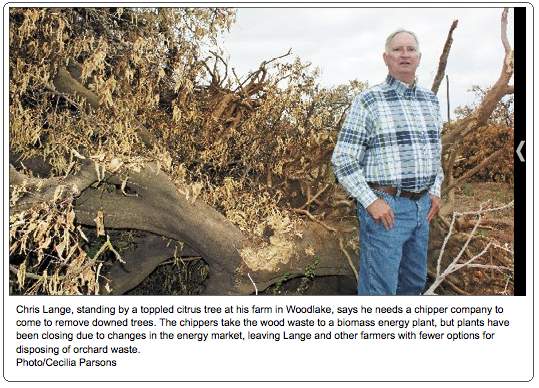
Chris Lange, standing by a toppled citrus tree at his farm in Woodlake, says he needs a chipper company to come to remove downed trees. The chippers take the wood waste to a biomass energy plant, but plants have been closing due to changes in the energy market, leaving Lange and other farmers with fewer options for disposing of orchard waste.
Photo/Cecilia Parsons

With utilities choosing not to renew contracts with biomass power plants and plants closing as a result, fewer facilities remain to process orchard waste and other biomass—leaving growers looking for solutions.
Tulare County farmer Chris Lange has about 80 acres of uprooted citrus and olive trees that he needs to have cleared and chipped. Lange said he is waiting on a chipping company, which has not yet received approval from biomass plants to bring the orchard waste in to be processed into electricity.
“We have been waiting for the chipper to come and it is just not happening,” Lange said. “I understand that the contracts for the chippers by the cogeneration plants are not being renewed. We (in the San Joaquin Valley) have more permanent crops being pushed out than ever, and this leaves everybody hanging.”
The root of the problem, according to Executive Director Julee Malinowski Ball of the California Biomass Energy Alliance, is 25- and 30-year contracts between biomass plants and utility companies that were established in the 1980s. Those contracts are now expiring and not being renewed, forcing biomass plants to close.
“The contracts were set for the first 10 years at a very high, fixed price to get the facilities built, and then the price would fall off into a market price. No one ever anticipated that the market price would be as low as it is because of the price of natural gas,” Malinowski Ball said. “Utilities will continue in some instances—but not all—to recontract, but they can’t recontract at a price that is so above market right now.”
Karen Norene Mills, California Farm Bureau Federation associate counsel and Public Utilities Department director, said there is “widespread acknowledgement and support for the extensive benefits attributable to biomass generation facilities,” but that the ongoing challenge is how to monetize the benefits.
The development of biomass energy in California was stimulated by the Biomass Development Program, which provided long-term support, funding or seed money, according to the California Energy Commission. The commission cited expiration of government price support to the biomass sector as the main reason for a reduction in biomass power generation in California, which peaked at 800 megawatts in the early 1990s.
About two-dozen direct-combustion biomass facilities currently operate in the state, with many of those subject to closure as contracts with utility companies expire.
Consultant Matt Barnes of Grid Subject Matter Experts said a number of plants “have shut down or will be shut down in the next few years when contracts expire, because they just can’t get a high enough rate from the market to justify continuing to operate.”
The California Biomass Energy Alliance points to environmental benefits of biomass such as reducing carbon emissions, diverting waste from landfills and reducing the demand for fossil fuels as reasons for maintaining the plants’ viability. According to the alliance, California biomass plants dispose of an estimated 8 million tons of waste per year and cut carbon dioxide emissions by 1.5 million to 3.5 million tons annually. Together, the plants produce 565 MW of electricity, enough to power more than 420,000 homes.
“We have lower energy prices, we have expiring contracts and we have an industry that is not only a renewable generating facility providing benefits to avoid fossil power generation, it is providing a whole host of other environmental and economic benefits,” Malinowski Ball said. “There needs to be a cost-share mechanism developed to help the plants survive.”
Steve Brink, California Forestry Association vice president of public resources, said electricity produced from natural gas costs 2-6 cents per kilowatt, whereas biomass power costs about 10 cents per kilowatt.
“With no direction from state government to pay the known environmental benefit, what would you expect the utility to do?” Brink said. “The state has not provided any direction of where this (biomass) needs to go. There’s 1 million, bone-dry tons just in the Northern California forests on both public and private lands that is piled up and burned, now that there’s no place to take it.”
With orchard growers pulling out and replacing older trees with young trees in an effort to conserve water during the drought, and with fewer biomass plants operating, “the problem is now amplified,” Brink said.
“As the contracts or power purchase agreements expire on plants on the valley floor—which almost 100 percent get their feedstock from crop agriculture—crop agriculture is not going to have anywhere to take it (orchard waste),” he said. “This is going to become a major problem for crop agricultural waste in the San Joaquin Valley particularly.”
Because there are specific restrictions on agricultural burning, farmers have fewer options for managing waste in many of the state’s air districts.
Timber operators, who are not located in the Central Valley and are not under the strict state air quality requirements related to agricultural burning, are allowed to pile and burn forest waste. However, Brink said, “The research is well established on the benefits of controlling combustion of wood in a boiler vs. out in the open and piled and burned.”
Kern County farmer Greg Wegis said if this issue is not resolved, San Joaquin Valley farmers would likely be spending several hundred dollars more per acre to have orchards cleared.
“We have our orchards removed for $100 to $200 an acre now, and if the cogeneration plants close it could cost us $900 per acre plus removal, which could cost another $900 an acre if we have to go to landfills,” Wegis said, “or we may have to figure out how to incorporate wood chips into our soils onsite if plants close. This is all an extra expense to growers.”
Tulare County citrus farmer Lange said removing his old trees is the first step needed before he can plant new trees.
“We’ve got young trees in a nursery that we anticipated planting this spring and we’re just sitting around waiting,” he said, adding that the tree removal is only one step in the replanting process. “When you have the trees chipped and then the chips hauled off, then we still have to rip the soil, do leveling, put in new irrigation, add berms and then plant.”

California Gas Prices Could Be On The Rise

April 15,2015

WTI oil climbed 5 percent today after the EIA said crude inventories  rose only a little and gasoline inventories fell .As we go to press WTI oil futures climbed to $56, the first time in months it moved much higher than $50.

Here is the Gas Buddy Blog on the latest EIA report that suggests California gas prices may now rise.They have fallen to near $3 per gallon in California in the past month.

Screen Shot 2014-09-10 at 11.26.48 AMCRUDE INVENTORIES:

Crude oil inventories increased by 1.3 million barrels (mb) to a total of 483.7 million barrels. At 483.7 million barrels, inventories are 89.6 million barrels above last year (22.7%) and are well above the upper limit of the average range for this time of year.

GASOLINE INVENTORIES:
Gasoline inventories decreased by 2.1 million barrels to 227.9 million barrels. At 227.9 million barrels, inventories are up 17.6 million barrels, or 8.4% higher than one year ago. Here’s how individual regions and their gasoline inventory fared last week: East Coast (-1.4mb); Midwest (+0.5mb); Gulf Coast (-0.8mb); Rockies (-0.2mb); and West Coast (-0.2mb). It is important to note which regions saw increases/decreases as this information likely drives prices up (in the case of falling inventories), or down (in the case of rising inventories).

DISTILLATE (diesel, heating oil) INVENTORIES:
Distillate inventories increased by 2.0 million barrels to a total of 128.9 million barrels. At 128.9 million barrels, inventories are up 17.0 million barrels, or 15.2% vs. a year ago.

IMPLIED DEMAND:
Gasoline supplied to end users amounted to 8.9 million barrels per day (mbpd), or 304,000 barrels per day higher than the previous week. So far in 2015, gasoline supplied is 3.4% higher versus 2014, according to the EIA.

REFINERY OUTPUT/UTILIZATION:
Refinery utilization increased by 2.2% vs. last week’s numbers to 92.3%. Gasoline production increased to 9.2 million barrels per day while distillate fuel production decreased slightly last week, averaging 5.0 million barrels per day.

Utilization rates for the last week were as follows: East Coast: 86.9%, Midwest: 96.3%, Gulf Coast: 92.8%, Rocky Mountain: 93.8%, West Coast: 87.6%. These percentages show how much of a region’s overall capacity were used to refine oil. It is important to note these percentages, because the lower the utilization percent, the lower output, which has a direct impact on local gasoline prices. If refiners in your region have low output, your more likely to see prices rise.

Pacific Ethanol Report Cheers Investors

Swings to Profit in 2014 From Loss in 2013

March 4,2105

Pacific Ethanol's Madera plant is installing corn oil extraction technology this month
Pacific Ethanol’s Madera plant is installing corn oil extraction technology this month

Investors appeared pleased after financial results from the latest quarter and full year were released today for Pacific Ethanol and were better than expected.
The company, based in Sacramento, the leading producer and marketer of low-carbon renewable fuels in the Western United States, reported its financial results for the three- and twelve-months ended December 31, 2014.
Shares were up after hours to $10.47, more than 11%, after results beat expectations on earnings per share for the the quarter at $0.41 compared to expectations of $0.18. Revenue was down slightly at $256.2 million compared to an expectation of $258.1 million.
Some feared the collapse of gas prices that helped drive down ethanol prices in recent months would put the hurt on the biofuel maker despite a pending merger deal.
Reported for the year ending December 31, 2014:
-For the year Pacific Ethanol earned $20 million on sales of $1.1 billion – up from a $2 million loss in 2013 and sales of $908 million.
-Net income of $20.0 million, or $0.88 per diluted share
-Adjusted Net Earnings of $59.9 million, or $2.64 per share
-Adjusted EBITDA of $95.0 million

Neil Koehler, the Company’s president and CEO, stated: “Our record financial and operating results in 2014 are a culmination of numerous efficiency and debt reduction initiatives we implemented over the past several years combined with strong market fundamentals. With our solid balance sheet and cash flow, we are both reinvesting in our production assets and pursuing a merger with Aventine that will redefine Pacific Ethanol’s competitive position in the ethanol industry, making us the fifth largest ethanol producer and marketer in the country. In 2015, we are focused on driving sustained profitable growth through successfully closing the Aventine merger, integrating our combined companies, further improving plant efficiencies, diversifying feedstock, introducing new revenue streams and pursuing advanced biofuels production.”
Financial Results for the Three Months Ended December 31, 2014
Net sales were $256.2 million for the fourth quarter of 2014, compared to $215.3 million for the fourth quarter of 2013. The increase in net sales was attributable to an increase in total gallons sold, slightly offset by a reduction in the Company’s average sales price per gallon.
Gross profit was $18.4 million for the fourth quarter of 2014, compared to $21.6 million for the fourth quarter of 2013. The decline in gross profit was due to particularly strong production margins in the fourth quarter of 2013.
Selling, general and administrative (“SG&A”) expenses were $4.7 million for the fourth quarter of 2014, compared to $4.4 million for the fourth quarter of 2013. The increase in SG&A expenses reflect an increase in professional fees related to the pending Aventine merger of approximately $1.0 million, partially offset by a reduction in year-end compensation expense of approximately $0.8 million.
Operating income for the fourth quarter of 2014 was $13.6 million, compared to $17.2 million for the same period in 2013.
Fair value adjustments resulted in income of $2.2 million for the fourth quarter of 2014, compared to an expense of $2.5 million for the same period in 2013.
Interest expense, net was $1.1 million for the fourth quarter of 2014, compared to $3.7 million for the fourth quarter of 2013. This reduction is due to the Company’s significantly reduced debt balances in 2014.
Provision for income taxes was $1.5 million for the fourth quarter of 2014. In the fourth quarter, the Company finalized its estimate of net operating losses available to be utilized in 2014, which resulted in a reduced provision for income taxes for the quarter.
Income available to common stockholders for the fourth quarter of 2014 was $12.2 million, or $0.50 per diluted share, compared to $8.3 million, or $0.54 per diluted share, for the fourth quarter of 2013.
Adjusted Net Earnings, which excludes fair value adjustments and warrant inducements and extinguishments of debt, was $10.0 million, or $0.41 per diluted share for the fourth quarter of 2014, compared to Adjusted Net Earnings of $12.0 million, or $0.79 per diluted share for the same period in 2013.
Adjusted EBITDA was $16.3 million for the fourth quarter of 2014, compared to Adjusted EBITDA of $18.3 million for the fourth quarter of 2013.
Financial Results for the Year Ended December 31, 2014
Net sales were a record $1.1 billion for 2014, compared to $908.4 million for 2013.
Gross profit was a record $108.5 million for 2014, compared to $32.9 million for 2013.
Operating income for 2014 was a record $91.4 million, compared to $18.9 million for 2013.
Net income available to common stockholders for 2014 was $20.0 million, or $0.88 per diluted share, compared to a loss of $2.0 million, or $0.17 per diluted share, for 2013.
Adjusted Net Earnings for 2014 was $59.9 million, or $2.64 per diluted share, compared to Adjusted Net Earnings of $2.0 million, or $0.16 per diluted share, for 2013.
Adjusted EBITDA for 2014 was a record $95.0 million, compared to Adjusted EBITDA of $28.6 million for 2013.

California Board to Consider 7.5 Cent Gasoline Excise Tax Rate Cut

February 17,2015

Sacramento – The California State Board of Equalization (BOE) will consider lowering the excise tax rate for gasoline by $0.075 for Fiscal Year (FY) 2015-16 during its February 24, 2015 meeting in Culver City.

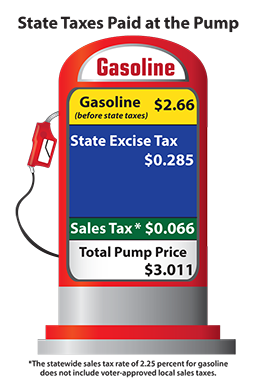
Screen Shot 2015-02-17 at 11.02.52 AMSince 2010, the “fuel tax swap” law has required the Board to adjust this tax rate by March 1st of each year. If adopted, between July 1, 2015 and June 30, 2016, the excise tax rate on gasoline will be $0.285 per gallon. The current excise tax rate of $0.36 is in effect until June 30, 2015.

The excise tax on gasoline pays for public road improvements and mass transit. In FY 13-14, the BOE collected nearly $5.8 billion for the Motor Vehicle Fuel Account, Transportation Tax Fund. Sales tax funds a variety of state and local programs.

BOE’s Mandated Role

The BOE is required by law to adjust the excise tax rate each year.

Gasoline Tax Structure Change in 2010

Drivers pay two types of state taxes on gasoline — sales tax and a per gallon excise tax. Before the “fuel tax swap” took effect in 2010, drivers paid the full sales tax rate (then 8.25 percent), and an excise tax of $0.18 per gallon.

The “fuel tax swap” lowers the sales tax rate to 2.25 percent on gasoline and requires the BOE to set the per gallon excise tax rate, so drivers pay the same amount of state taxes on gasoline as they would have paid under the prior tax structure.

How the Rate is Calculated

The projected average gas price during FY 15-16 is $2.66 a gallon, which includes the federal excise tax of $0.184 but not state gasoline taxes. The number of gallons sold is expected to remain steady during FY 15-16.

In addition to projecting sales tax revenue that would have been generated under the old tax structure, the law also requires the BOE to review the actual excise tax revenue generated in the prior fiscal year and subtract that from projected revenue for the coming fiscal year. This calculation determines the coming fiscal year’s rate.

Pixley Biogas Holds Grand Opening

new digester is a box in the ground

February 13,2015
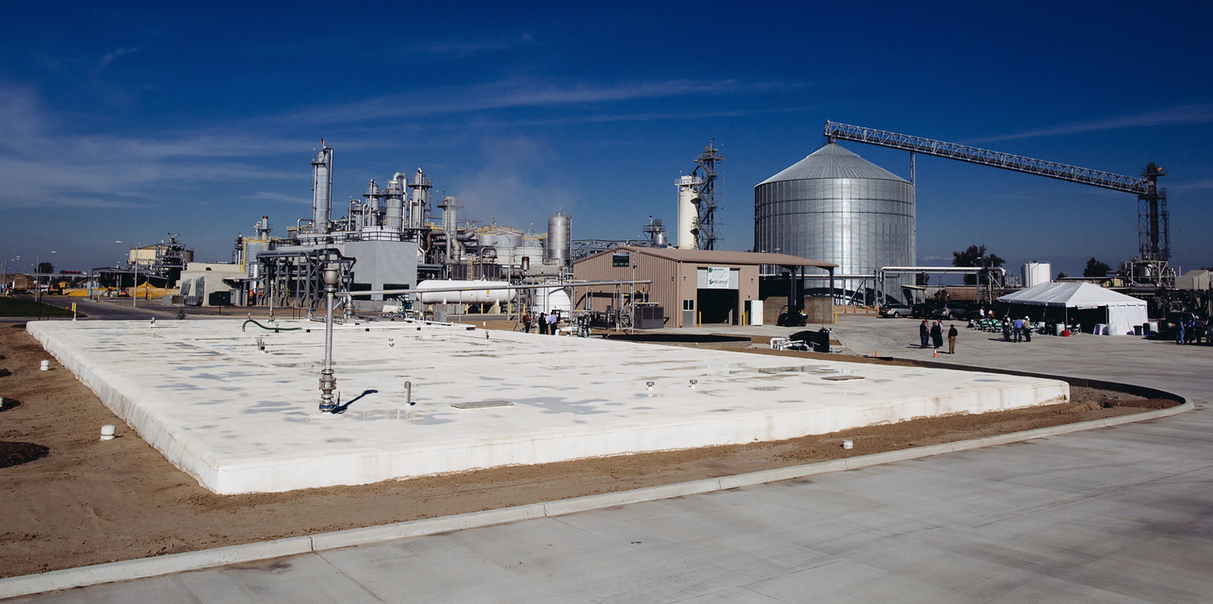
A project that is the first California digester to use agricultural waste to create renewable natural gas to power another renewable energy facility was dedicated during the Farm Show this week. The project -Pixley Biogas-  was controversial to some utilizing 1.4 million gallons of dairy waste to power a Pixley ethanol plant.
Lyle Schlyer, President of Calgren Renewable Fuels says “I am proud of the contribution that Calgren can make to this incredibly green, low-carbon intensity project. Digesters are often talked about, but actually building one and getting it into operation doesn’t happen all that often. This is a marriage of industrial and dairy interests.”
The California Energy Commission recently issued rules that could send the number of digester projects around the state skyrocketing, says one of the companies involved in the venture. Regenis vice president Bryan VanLoo said “Our mission is to reimagine reusable resources. In the case of California, that potential is almost limitless. Utilizing digesters would not only create hundreds of new construction and operation jobs in rural communities like Tulare County, but there is enough organic waste to power 2 to 3 million homes or to generate 2.5 billion gallons of clean, ultra-low carbon transportation fuels.”

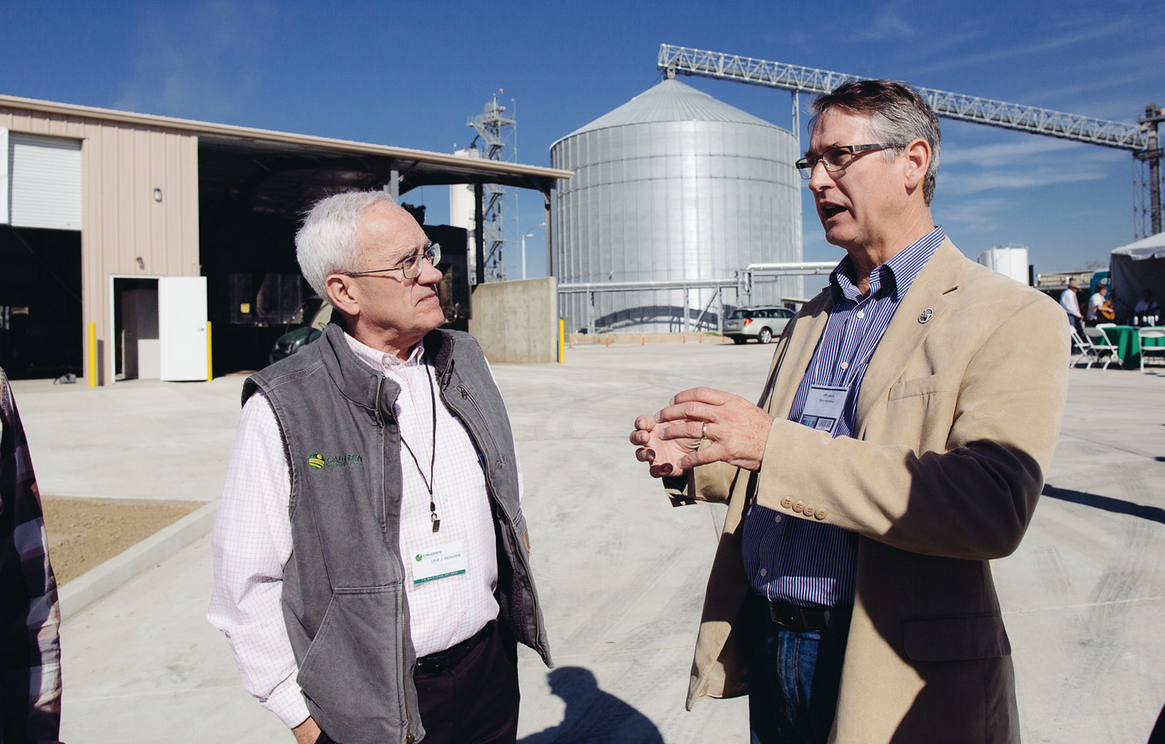
Tulare County Supervisor Steve Worthley and president Lyle Schlyer of Calgren chat at grand opening
Tulare County Supervisor Steve Worthley( right) and president Lyle Schlyer of Calgren chat at grand opening

Google Buying Wind Power

“Once the installation is complete, and the 370 legacy turbines are replaced, it will take just 24 new ones to generate as much power as our campus uses in a year.”

Feb 12,2015
One day after Apple announced it would power their California  facilities with solar power from the central Coast Google announced it would be buying wind power from Altamont Pass.
Here is the news release from Google.

Technology can help us do more with less. For example, making use of natural climates has helped us make our data centers 50% more efficient than the industry average, and green building technology has helped us limit energy consumption in our offices around the world. Now, we’re doing more with less to power Google’s North Bayshore campus in Mountain View.

We’ve recently signed a long-term agreement to purchase enough local wind energy to offset the electrical consumption of our North Bayshore headquarters on an annual basis. While we’ve been committed to being a carbon-neutral company since 2007, and we purchase clean energy for our data centers, this agreement is the first of its kind when it comes to our offices.

The agreement with NextEra Energy Resources will help to repower an iconic Bay Area wind farm at California’s Altamont Pass with new turbines that will pour 43 MW of electricity onto the grid starting in 2016. This new technology is twice as efficient, and also safer—especially for wildlife.

The new turbines will generate energy that feeds into the grid that powers our North Bayshore buildings in Mountain View. While these electrons can’t be traced once they enter the grid, we can measure how many of them leave the turbines, as well as how many we use on campus on an annual basis (tracked through a system of renewable energy credits, or RECs). So even though the electrons follow an untraceable path through the California electricity grid, we can be sure that we’re offsetting the electrical consumption of our North Bayshore headquarters with the renewable energy from the new turbines.

Since our first wind investment in 2010, we’ve developed close relationships with renewable energy providers, helping us secure renewable energy agreements like this one for our campus and data centers—more than 1.1 gigawatt’s worth to date—and it’s also made it possible for us to make equity investments in 17 utility-scale renewable energy projects. And over the years we’ve been thrilled to see other California leaders, from tech companies to universities, also working to bring more renewable energy online.

Finally, if we can geek out for a minute: We think this project is especially cool because back in the 1980’s, the golden hills of Altamont Pass were an early test bed for the first large-scale wind power technology in the U.S. We’ve been blown away (pun intended :)) by how far turbine technology has come since then. Once the installation is complete, and the 370 legacy turbines are replaced, it will take just 24 new ones to generate as much power as our campus uses in a year. Talk about doing more with less.

Apple Buys Power From New Central Coast Solar Plant

February 10, 2015

First Solar and Apple Strike Industry’s Largest Commercial Power Deal

Screen Shot 2015-02-10 at 2.00.53 PMTEMPE, Ariz.–(BUSINESS WIRE)– First Solar, Inc. (Nasdaq: FSLR) today announced that Apple has committed $848 million for clean energy from First Solar’s California Flats Solar Project in Monterey County, Calif. Apple will receive electricity from 130 megawatts (MW)AC of the solar project under a 25-year power purchase agreement (PPA), the largest agreement in the industry to provide clean energy to a commercial end user.

The plant is to be  located on the Monterey/ SLO County line near Parkfield.

Apple CEO  Tim Cook made an announcement in SF today saying the solar farm would “biggest and boldest” and be able to power Apple’s new Cupertino headquarters now under construction.

“Apple is leading the way in addressing climate change by showing how large companies can serve their operations with 100 percent clean, renewable energy,” said Joe Kishkill, Chief Commercial Officer for First Solar. “Apple’s commitment was instrumental in making this project possible and will significantly increase the supply of solar power in California. Over time, the renewable energy from California Flats will provide cost savings over alternative sources of energy as well as substantially lower environmental impact.”

The 2,900-acre California Flats Solar Project occupies 3 percent of a property owned by Hearst Corporation in Cholame, Calif. Construction is expected to begin in mid-2015, and to be completed by the end of 2016. The output of the remaining 150MW of the project will be sold to Pacific Gas & Electric under a separate long-term PPA, and the project is fully subscribed between the Apple and PG&E PPAs.

In January, the Monterey County Planning Commission unanimously approved the California Flats Solar Project, sending the project to the Monterey County Board of Supervisors, which will consider final approval of the project today.

Building on its proven record of developing, building and operating utility-scale solar power plants, First Solar has placed a strategic focus on directly providing large commercial and industrial customers with wholesale electricity through long-term agreements. This deal marks the first wholesale commercial and industrial PPA executed by First Solar.


h