Informational Hearing on Drinking Water Set For Feb. 22 In Visalia

The Senate Environmental Quality Committee has scheduled an informational hearing on Central Valley drinking water issues on Feb. 22 in Visalia.

The hearing, titled “Achieving Clean Drinking Water in the Central Valley: An Inventory of Drinking Water Systems,” is set for 2 p.m. at the Tulare County Board of Supervisors Chamber in Visalia.

Agenda details have not yet been posted.

Selma Hospital Plans New Pavilion With Two Stories For Lease

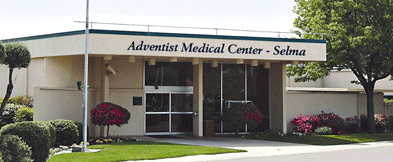
Adventist Medical Center – Selma serves southern Fresno County and its surrounding communities.The hospital plans a new 3-story, 76,400 sf, Medical Pavilion that will be attached to the North side of the existing Selma Hospital in two places creating a courtyard.

Selma City planner Bryant Hemby says the hospital is hoping for approvals of its negative declaration on the 3-story, 58 ft project at the  March city planning commission. This week began a 45 day comment period on the new wing.
Hemby says Adventist plans several phases to expand the property including moving some hospital functions from off campus into the new pavilion. The approvals include the merging of several properties. Significantly,two of the three stories planned will be for lease for medical purposes.Bryant says Adventist plans a remodel of the current hospital as well.

Adventist Medical Center-Selma – part of Adventist Health’s Central Valley Network, is a 57-bed acute-care community hospital that serves 13 communities in southern Fresno County in Central California, operating as a satellite campus of Adventist Medical Center-Hanford. Services include a 24-hour emergency, birthing center with five LDRP suites, direct observation unit, surgery, laboratory, pharmacy, cardiology, diagnostic imaging and digital mammography.

The four acute-care hospitals that comprise the Central Valley Network are Adventist Medical Center-Selma (formerly known as Selma Community Hospital), Adventist Medical Center-Hanford, Adventist Medical Center-Reedley and Central Valley General Hospital. Together in 2011, these hospitals had 13,766 admissions, 3,032 deliveries, 100,414 ER visits, 728,555 outpatient visits, 19,709 home health visits and 8,493 hospice visits. The Network is staffed by 484 physicians, 2,768 employees and 167 volunteers. In addition, over $46.7 million in free and low-cost services were provided to the community.

Adventist Health completed their new hospital in Hanford in December 2010.They acquired the 49 bed Reedley hospital in November 2011.Nearby, they opened Adventist Medical Plaza – a new clinic in September of 2012.

The new Selma pavilion will have a east connection will be to the existing hospital Main entrance. The West connection will be an OSHPD permitted project consisting of approximately 2,413 sf of enclosed space and a second entry canopy. The west connection will be to the existing hospital Emergency Department entrance.

Kaweah Delta Net Income Rises / Applications for GME Positions Flood In

While other local hospitals appear to be struggling financially, Kaweah Delta has reported net income for the first 7 months of their 2012 fiscal year of $12.9 million compared to a budgeted $6.1 million. Through December acute admissions were down slightly but patient revenue was up 4.6% from the same period the year before. Increases in income came from a growing network of rural clinics and other outpatient services. Cardiac cathlab services were up 8%. CEO Lindsay Mann says with these kind of results the district is hopeful they can improve their credit rating by the time they may need to borrow money for a new capital project. “We’ve got a healthy position.”
This July the district will welcome the first 12 of 76 graduate resident physicians that will practice in Tulare County over the next several years. Mann says some 500 applications and 120 interviews were held for 6 Family Medicine positions and 250 applications were received and 100 interviews will be ranked for 6 ER docs.”We are now a certified teaching hospital with boots on ground in July” says a proud Lindsay Mann.

Navy Picks Lemoore For Joint Strike Fighter Base

Good news for the Central Valley as the US Navy has given a preliminary nod to basing the West Coast squadron of the next generation of stealth fighters at NAS Lemoore rather than El Centro near San Diego. The F-35C has been developed as the Navy’s next strike-fighter aircraft as a replacement to FA-18C Hornet.
“Beginning in 2016, seven Navy Pacific Fleet FA-18 squadrons (70 total aircraft) currently based at NAS Lemoore would progressively transition to the new F-35C aircraft, with the transition to be complete by 2028. In the 2017 timeframe, the west coast F-35C training squadron (also known as Fleet Replacement Squadron or FRS), consisting of approximately 30 aircraft, will be established to meet the requirements for training Navy pilots” says a Navy news release dated February 14.
The Navy has set March 19 for a public meeting in Lemoore to discuss the findings of the 2 year impact study.In January 2011 he Navy narrowed down its list of potential home bases from 134 military air facilities in the continental U.S. and found that Lemoore and El Centro “best meet Navy F-35C requirements.”
If the Navy had picked El Centro – locals feared the impact would hit Kings County hard.
A 2008 economic assessment study found the Lemoore base contributed $161 million in labor income annually to the local economy and counting the spinoffs – has a total economic impact of just under $1 billion every year. The total population associated with the local base that straddles Kings and Fresno Counties is around 44,000 says the study.
That will grow with the basing of the new fighters here.The Navy established the Kings County base in 1961, the newest West Coast base. NAS Lemoore now hosts the Navy’s entire west coast fighter/attack capability.

South Valley Population Growth Led By Hispanics –

Tulare County Projected To Be 68% Latino by 2060
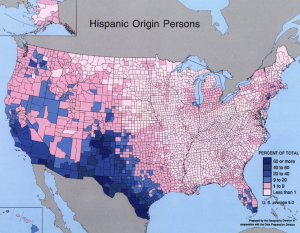
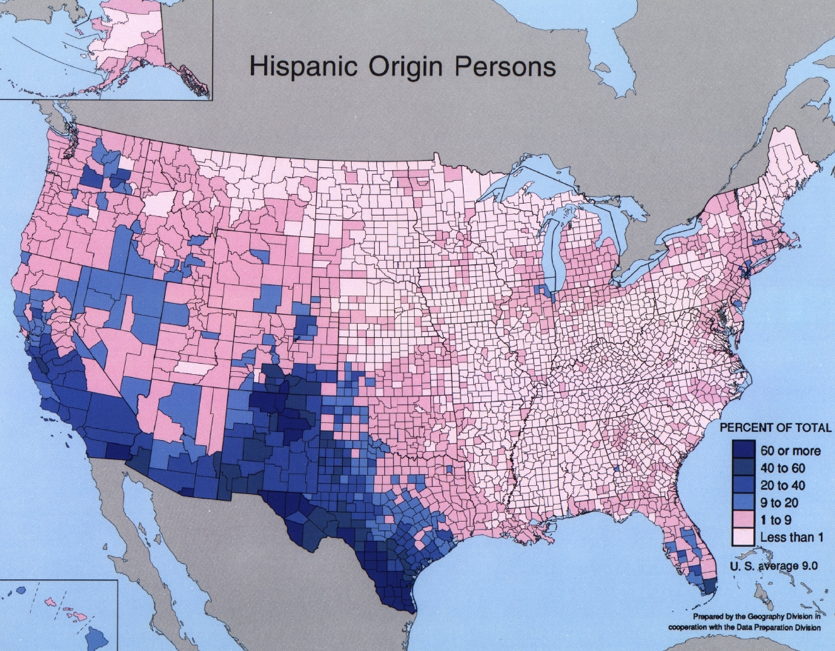
New projections by the California Department of Finance say that 2014 will be the year California will become 50% Hispanic. A number of Valley counties are there already. The growth in the Hispanic population in the south Valley including Fresno,Tulare and Kern counties – is the main reason this region will see some of the fastest growth in the state over the next 50 years.

The population projections announced  last week say Fresno County will grow from 932,377 residents in 2010 to 1.6 million by 2060. Today,of the 932,377 people some 470,000 are Hispanic or about half.That percentage will rise to about 60% in 2060. Of the 1.6 million population in Fresno County in 2060 – 989,000 will be Hispanic says the state study.

In Tulare County the Hispanic majority will grow to more than two thirds, about 68% Hispanic in 2060 to 548,000 Hispanics out of a total  836,500. Tulare County is around 60% Hispanic today.

Kern County’s population will grow faster than most large metro counties in the state by 2060 says the projection with 2.05 million residents from 841,000 in 2010. Kern’s Hispanic population will be around 60% in 2060 at 1.22 million says the state. It was 49.3 % Hispanic and 38.7 percent white in 2010. Kern’s growth will outpace Fresno County – roughly matching Sacramento’s expected growth – the two bookends of the San Joaquin. Buoyed by natural resources and opportunity in oil, renewable energy, ag and merchandise distribution, the county is a beacon for investment on multiple fronts.

Mega-counties like Los Angeles is expected to grow more slowly on a percentage basis from 9.8 million to 11.5 million residents in 2060.

By 2060, California will have 13 counties of one million or more, with eight of those with 2 million
or more residents. Six of the counties with at least one million will be inland counties. The four
new counties reaching one million will be Fresno, Kern, San Joaquin, and Ventura. California’s population will cross the 50 million mark in 2049 and grow to
nearly 52.7 million by 2060 says the report.
Other points covered by the report:

– For the population as a whole, the median age will increase from 35.2 to 41.9 years old.
Whites have the highest median age in 2010 (44.5) while Asians have the highest in
2060 (47.0). Hispanics’ median age (27.2 in 2010 and 39.0 in 2060) is consistently
lower than all other race groups other than Multi-Race.
– In 2030, there will be 9.6 million Hispanics in the prime working ages of 25 to 64; Whites
will have 7.2 million and Asians 3.1 million. By 2060, Hispanics will be the largest group
in the working ages by a considerable margin: 12.1 million Hispanics to 7.4 million
Whites and 3.2 million Asians.

– Southern California will lead the State’s growth over the next 50 years (2010 to 2060),
growing by 8.3 million to 31 million in population. For this report, in the interest of
geographic simplicity, Southern California includes San Luis Obispo, Santa Barbara,
Kern, San Bernardino, Ventura, Los Angeles, Orange, Riverside, San Diego, and
Imperial counties

-The San Joaquin Valley will add 3 million new Californians, growing from 3.1 million to
6.2 million. Valley gains will be led by San Joaquin County (growing by 852,000), and
Fresno County (growing by 683,000). For the purpose of this report, the San Joaquin
Valley includes San Joaquin, Stanislaus, Merced, Madera, Fresno, Kings, and Tulare
counties. Please note, for this report Kern County was included in the Southern
California region and not the San Joaquin Valley region.

News Nuggets Around Tulare/Kings… Sales Tax / Second Amendment / Hotel Biz

Visalia Sales Tax Growth Near 16 Percent

Visalia sales tax figures reported for the latest four quarters and released in December 2012 show cash receipts of $18 million vs $15.5 million for the four quarters reported in December 2011. The $2.5 million increase amounts to about 16%. City finance chief Eric Frost says the figures don’t tell the whole story since the cash receipts are three quarters  of what the city ends up receiving.But the tend lines are clear,sales tax  is up and up more strongly than in the past 5 years.

The number actually fell during the recession year of 2008 -2009,stayed level from 2009-10 and climbed from $14 million to 15.5 million by December 2011. Now that pace has accelerated.

The $18 million figure compares to a budget amount of $16.4 million.But if the multi-year recession had not pulled the rug out on sales growth in the city, the figure should be closer to $21.8 million says the city using a straight trend line from 2006.

Both retail sales,building materials,and vehicle sales -the three major sectors have shown recovery in the past year.Car registrations in California have increased 25% says the California New Car Dealer Assn.


weapons used in Sandy Hook killings

Lemoore Council To Vote On Pro-Gun Resolution

Below is the text of a staff report regarding a resolution in support of the second amendment and against proposals pending in Congress to limit gun ownership to be heard by the Lemoore City Council February 5. Senator Dianne Feinstein has been leading the charge to ban so called assault weapons and  large ammunition clips as well as proposing universal background checks.

During the December 18, 2012 Council Meeting, Council Member Rodarmel requested
that an item be placed on a future agenda to consider a resolution in support of the
Second Amendment to the United States Constitution. The Second Amendment was
adopted on December 15, 1791 as part of the Bill of Rights and the original hand-written
document, which is on display at the National Archives in Washington D.C., reads as
follows:
A well regulated Militia, being necessary to the security of a free State,
the right of the people to keep and bear Arms, shall not be infringed.
The purpose of the Second Amendment is to protect the right of the people to possess
and carry firearms. This interpretation was established by two landmark Supreme Court
decisions. In 2008, District of Columbia v. Heller, the Court ruled that the Second
Amendment protects an individual’s right to possess a firearm, unconnected to service in
a militia, and to use that arm for traditionally lawful purposes, such as self-defense within the home. However, the ruling was silent as to whether the law pertains to the States.

In 2010, McDonald v. Chicago, the Court ruled that the Second Amendment applies
equally to the States and Federal Government. The following link provides commentary
on the background leading to the Second Amendment, the Court cases, definitions, etc.
http://en.wikipedia.org/wiki/Second_Amendment_to_the_United_States_Constitution.
Attached for Council’s consideration, is Resolution No. 2013-01, which supports the
Second Amendment and the rights of our citizens to keep and bear firearms for the
defense of life, liberty, and property as intended by the Founding Fathers of the United
States of America, and which opposes any action that infringes upon the rights listed.
For many, the ownership of firearms also provides for the personal enjoyment of target
practice, competitions, hunting, and collecting of guns.

Also attached is a letter written by U.S. Marine Joshua Boston to Senator Dianne
Feinstein opposing gun control, and news reports and a letter from Fresno County
Sheriff, Margaret Mims, to the White House expressing her opposition to “useless gun
control legislation.”

Tulare County Hotels Enjoy Good Holiday
Hotel occupancy was up in the Tulare/Visalia area in December according to Smith Travel, the second strong month in a row. Rooms sold were up 8.6% year over year and occupancy was up 7% to 44.2%.
Not that it has been easy in this business. The Comfort Suites 50 room hotel in Tulare is on the market for $2.99 million after a foreclosure action.

Regional Water Supply Could Help North Tulare County Towns

click to enlarge

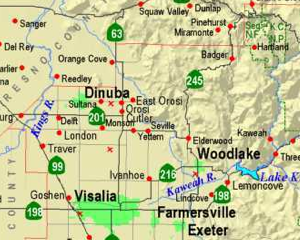
Some of the worst drinking water problems in the county are in the north in a number of small “disadvantaged” communities like Cutler,Orosi, East Orosi, Sultana, Seville and Monson. Water with high nitrates and DBCP contamination,probably most from agricultural applications – has forced schools and communities to buy bottled water. The extent of the problem has caught the attention of the national media in the past few months including a November NY Times story that recounts that at one time Tulare County identified 15 “non-viable” communities in the 1970s based on a prediction that mechanical harvesters would soon replace the farm workers who lived in places without public water and sewer services and the best solution was for folks to move.
But instead of waiting for these towns to disband or help provide a solution one by one -there is now some new optimism over a regional approach to deliver clean water though farm water purveyor Alta Irrigation District with Tulare County as the lead agency.

Northern Tulare County has a cluster of small farm worker communities with tainted water

Making this possible Alta district, based in Dinuba, has built two new water recharge basins near Traver that have captured storm water to add to their annual supply says Alta manager Chris Kapheim. Because of the new supply the district has budgeted stored water behind Pine Flat Dam to provide a surface water supply for the potential project.One idea is to transfer the water along the Friant Kern canal to a site for new regional water treatment plant perhaps near East Orosi where the canal runs, says water engineer Dennis Keller who is helping on the project and sits on the county Water Commission.

Kapheim notes that over the years Alta’s role” has evolved to one with a better understanding and ability to address local water quality issues and implement regional solutions” to manage the scarce water supply. The idea could be a win-win for agriculture and the farm worker communities of the Alta district.

An additional benefit of delivering surface water to those communities will be the reduction in groundwater pumping in the Cutler-Orosi area of the District, thereby reducing the stress on the existing aquifer.

In 2007, Alta Irrigation District, Cutler Public Utilities District, and Orosi Public Utilities District signed an MOU to jointly fund a $75,000 water supply study to evaluate water quality and to recommend options for providing potable water in the Cutler-Orosi area.

With the help of the county, this CDPH feasibility study is in a phase 2 stage to study if the regional water project could also provide good drinking water for Monson,Yettem and Seville suffering the same bad ground water problem.

Alta’s Kapheim says by using a regional solution, the District is able to address multiple solutions in different areas, i.e., storm water utilization enhanced recharge in Traver and reduced groundwater pumping through the use of surface water for drinking water in the Cutler-Orosi area – now other nearby towns as well.

Studies have found that separate solutions for each community that treat groundwater are too expensive.The latest study underway will gauge the cost of a joint water project project and how they could be connected. Surface water would be blended with groundwater to meet standards.  Eventually, there  would be a Prop 218 vote by the communities. Recently Seville and Yettem were added to the  feasibility study to completed by mid-2014.
One estimate puts the capital cost at $17 million.

In this region nitrates have closed wells in many of these systems over the past few years as contamination levels continue to rise in existing wells. Cutler PUD has had to close numerous wells due to nitrate contamination and now relies on a well with DBCP over legal limits says East Orosi’s two wells are closed due to nitrates, notes advocate group Community Water Center.

A UC Davis study has suggested most of problem is due to leaching of farm fertilizer and chemicals. Now,Alta ID, a a farm-based water suppler, has decided it is their role to do more than irrigate farmland,but help manage a solution to tainted groundwater.
For Tulare County a potential long term solution will help these communities to grow economically, attract business instead of just waiting for the next delivery from the water truck.

Fry’s Electronics Warehouse Coming To Hanford?

Big box retailer reportedly seeks warehouse center in Hanford

Some 180 New Jobs On Tap

Kings County officials confirm that a major retail company will be relocating its warehouse and central repair depot operations to Hanford within the next few months. They are starting a recruitment drive to fill approximately 180 positions. The unnamed firm is locating in the vacant 175,000 sf International Paper Corrugated Box Plant in the Kings Industrial Park at 10555 Iona Avenue. Local officials say they cannot release their name.
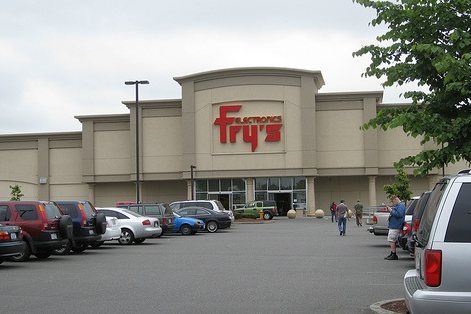
However,when anyone Googles that address in Hanford – San Jose-based Fry’s Electronics comes up.The company has been rumored by industrial real estate brokers to be interested in a Hanford warehouse, mid-point between their Northern and Southern California retail stores.Hanford would be a logical overnight shipping location for their California stores.
Fry’s is a privately owned top big-box retailer of computers, consumer electronics, and appliances with some 34 stores in about 10 states.The popular store has no Valley locations but a big presence in LA and the Bay Area.On the retail front they compete with Best Buy and WalMart.They had $2 billion in sales in 2011 and 14,000 employees.
Fry’s Electronics, Inc. was founded in 1985 in Sunnyvale, California in a 20,000 square-foot location by the three Fry brothers, John, Randy, and Dave; and Kathy Kolder. Fry’s is a closely-held private company, and all of the founders are actively involved in the daily operation of the business.
Spawned from Silicon Valley’s passion for retail electronics, the store provides a one-stop-shopping environment for the Hi-Tech Professional. Fry’s says they continues to keep hi-tech professionals supplied with products representing the latest technological trends and advances in the personal computer marketplace. Fry’s retails over 50,000 electronic items within each store, now totaling 34. There are currently 8 stores in Northern California, 9 stores in Southern California, 8 stores in Texas, 2 stores in Arizona, 2 stores in Georgia, and 1 store each in Illinois, Indiana, Nevada, Oregon and Washington. The stores range in size from 50,000 to over 180,000 square feet. Fry’s also provides customers with added shopping opportunities via its online center at Fry’s.com.

Central Valley Irrigation Intensifies Rainfall, Storms Across Southwest

Irvine, Calif., Jan. 28, 2013 – Agricultural irrigation in California’s Central Valley doubles the amount of water vapor pumped into the atmosphere, ratcheting up rainfall and powerful monsoons across the interior Southwest, according to a new study by UC Irvine scientists.
Moisture on the vast farm fields evaporates, is blown over the Sierra Nevada and dumps 15 percent more than average summer rain in numerous other states. Runoff to the Colorado River increases by 28 percent, and the Four Corners region experiences a 56 percent boost in runoff. While the additional water supply can be a good thing, the transport pattern also accelerates the severity of monsoons and other potentially destructive seasonal weather events.
“If we stop irrigating in the Valley, we’ll see a decrease in stream flow in the Colorado River basin,” said climate hydrologist Jay Famiglietti, senior author on the paper, which will be published online Tuesday, Jan. 29, in the journal Geophysical Research Letters. The basin provides water for about 35 million people, including those in Los Angeles, Las Vegas and Phoenix. But the extra water vapor also accelerates normal atmospheric circulation, he said, “firing up” the annual storm cycle and drawing in more water vapor from the Gulf of Mexico as well as the Central Valley.
When the additional waves of moisture bump into developing monsoons, Famiglietti said, “it’s like throwing fuel on a fire.”
Famiglietti, an Earth system science professor in the School of Physical Sciences, and colleague Min-Hui Lo, a postdoctoral researcher at the University of California Center for Hydrologic Modeling who is now at National Taiwan University, painstakingly entered regional irrigation levels into global rainfall and weather models and traced the patterns.
“All percent differences in the paper are the differences between applying irrigation to the Central Valley and not applying it,” Famiglietti said. “That’s the point of the study – and the beauty of using computer models. You can isolate the phenomenon that you wish to explore, in this case, irrigation versus no irrigation.”
Famiglietti’s team plans to increase the scope of the work to track how major human water usage elsewhere in the world affects neighboring areas too. A better understanding of irrigation’s impact on the changing climate and water availability could improve resource management in parched or flooded areas.

A Cut For Enterprise Zones – Good News Bad News For Tulare County

The Good News
The State of California has approved a long awaited proposal to expand the Sequoia Enterprise Zone in Tulare County this month effective immediately. The expansion will add acreage in several parts of the county where businesses are located or want to locate who can now take advantage of the tax incentives the zone offers. County Economic Development Manager Mike Washam say he expects several businesses to expand as a result.  But if the state is offering in one hand they appear to be taking back with the other.
The Bad News
A new state plan to cut the size and tighten the rules for enterprise zones that offer tax incentives for business expansion in California has Valley officials worried they will result in job losses in the future. The new draft rules announced January 11 will impact the 40 zones in the state including Fresno,Tulare and Kings counties.

The zone benefits are targeted to economically depressed parts of the state to attract new companies and retain those looking to relocate out of the state of California.The Enterprise Zones (EZ) are a series of geographic areas in California where companies receive special tax breaks.

Right now many businesses in Tulare County,considered distressed   because of its persistent high unemployment, can hire a new employee from any part of the county and potentially receive a tax credit.
But all that would change under the new rules.

“As we understand it, about 30 of 72 census tracts in the county would no longer be eligible for hiring credits” says Michael Washam.

If the employee lived in most neighborhoods in Visalia or Tulare for example, that have a higher income level than most of the county,that person would not be eligible for the tax incentives once these new regulations are in effect. The department that runs the program, Housing & Community Development, says they will take comment on the new plan until February 28, 2013.

Fresno County would be hard hit by the proposed regulations says Victor Bribiesca, manager of the local program for the Fresno EDC.”They would cut the number of eligible census tracts by about half” he says. ”That translates into employees who won’t qualify for jobs. I would call this plan devastating to Fresno County.” Kingsburg City Manager Don Pauley says the proposed cuts would hurt job psopects for Kingsburg residents whowould no longer qaulfy for employer tax incentives.