Sinking Land Cuts Key Channel Capacity

There is a growing ripple effect on the San Joaquin River flow capacity due to vigorous groundwater pumping in one part of the Valley – in Madera County. The land below some farmers feet is sinking and sinking faster and the implications resonate far and wide.

Land adjacent and just east of the San Joaquin River between Dos Palos and Los Banos is sinking at an accelerated rate new state studies have found. So says Chris White,manager for Central Valley Irrigation District who told his findings to a meeting of Associated California Water Agencies (ACWA) in Fresno last week.

Survey work on the San Joaquin River as part of the Bureau of Reclamation restoration process in 2010 found land subsidence in this area of nearly 2ft  compared to benchmark survey done in 2008.

White says a dramatic illustration of the drop came when a farmer last July texted him a photo of his well casing that had been painted a bright color down to ground level a few years earlier but now was unpainted a good 18 inches from the ground.”What’s going on here” asked the farmer?

It wasn’t gophers. More like an episode of ’Honey, I Sunk The Farm.’

“If this problem is left unchecked it is possible to see land subsidence of 28 feet or more.” Did he say 28 feet?

A famous photo shot near Mendota in 1977 shows just how much Valley farm land sunk from 1925 to 1977 which was about 28 ft according to a USGS study. More on this later.

The subsidence has been a long term problem in the area caused by over pumping of deep groundwater by farmers but the rate until recently had been slower. Identification of a rapid ground level decline in this specific area only dates to May of last year, says White, and adds up to as much as 5 ft over the past few years at at a rate of 1.25 ft a year.

“This land subsidence if left unchecked has serious impacts to public safety,flood conveyance and water supply” White told the AWCA meeting of fellow water agencies.
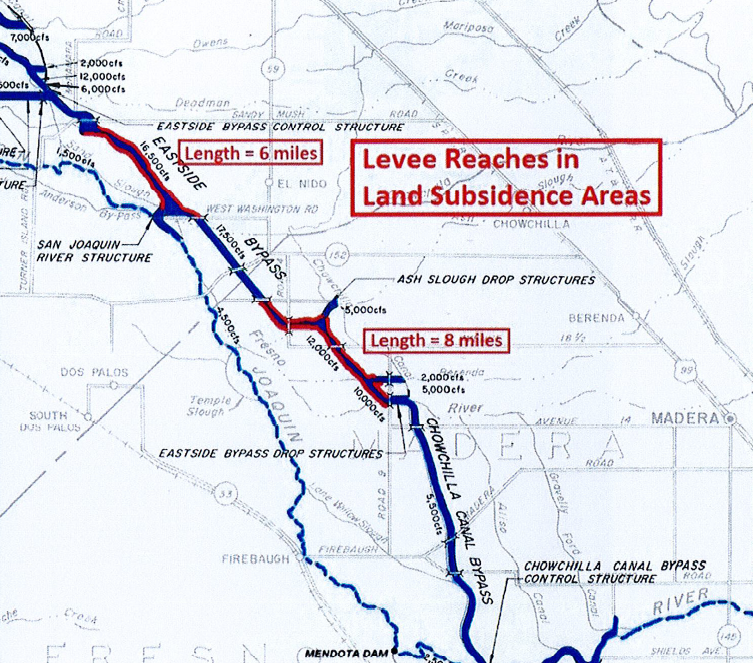
channel capacity faces cuts along 14 miles of the the river’s EastBypass

25% Decline In Channel Capacity

A recent analysis by the state DWR shows that “subsidence has caused about a 4000 cfs reduction in flood water conveyance or about 25% of capacity along the river’s important East Side Bypass. The parallel San Joaquin River flow capacity has also been reduced he says, although that flow reduction level is still under study. “It looks like the river channel is sinking about 6 inches a year but we don’t know how much that has cut its carrying capacity.” He says “we may know in a few weeks.”

The sinking land could spell all kinds of trouble. In the event of a flood flow the size the region experienced in 2006 – the river would overflow its bank says White, likely flooding Hwy 152,the City of Dos Palos, farmland nearby and an elementary school in the Red Top area.

Beyond flood issues,the sinking land has water supply implications for Valley water districts nearby and in other parts of the Valley.

White explains that the Bypass and the San Joaquin River depend on gravity flow to deliver water and if the subsidence continues at the current pace it would “ jeopardize about 55,000 acres in the San Luis Canal Co district and the Central California Irrigation District” that White heads up.The district serves some 1600 farms.

About 14 miles along the ByPass are affected.

Since these key channels can not pass some flood flows from both the San Joaquin River drainage and Kings River – the reservoirs that hold water back could face new management issues including Pine Flat,Friant Dam and Hidden and Buchanan Dams,  in other words the water supply for much of the Valley.

Flood vulnerability in the Los Banos area would force the Corp of Engineers to require earlier and reduced water releases to avoid the flood potential.The upshot would be that all who depend on those waters would be at risk of reduced water supply since the SJR is the only outlet to the sea for the Central and South Valley.

The issue is a touchy in in the current  drought climate when Valley farmers are giving up water for fish and because of the same drought -farms have literally pumped up ground water extraction to keep their plants alive.

It becomes a vicious circle.

“This problem could lead to finger pointing by a number of water users affected by the pumping of a few farmers” says Ron Jacobsma of Friant Water,who depend on SJR River water. A lower level in this area could lead to migration of  groundwater from one area to another also raising water quality issues – salt water moving for example. Along the river landowners affected by failing levees could claim damage.

Seeking Solutions

White says a short term plan now underway will be to buy and deliver 10,000 acre ft of surface water and replenish the deep aquifer near Sack Dam where the worst of the subsidence is happening.”These farmers don’t currently have access to surface water for recharge.”

White says long term the plan will be to develop more conjunctive use water adding around 700 acres of recharge basins,developing a plan to divert flood water,developing a 10,000 acre ft annual supply of purchased water to continue the recharge effort and re-drilling deep wells as shallow wells to allow the recovery of water levels below the Corcoran Clay that hold up what has been termed the richest ag region in the world.

Besides problems in in this district – levees along the entire stretch of the San Joaquin as it heads to the Bay Area are at risk – almost 200 miles as  the land sinks and those levees sink too – creating instability and leaks that turn to floods.

There is an issue for the Department of Reclamation as well planning the restoration of the San Joaquin River to accommodate salmon with plans to invest millions in infrastructure to do so. Sack Dam where the subsidence is worse is a focal point as the engineers look to design fish passage through sinking waterways.”What elevation should they design for” asks  Friant’s Jacobsma.

White adds that the area where they are designing fish ladders for salmon returns for 3 decades of useful life – the rug is being pulled under the engineers who may now need to build the infrastructure as much as 15 ft higher.

Reduced capacity on the San Joaquin also could affect Friant’s ability to get restoration water flows recirculated that they are counting on long term in this water short valley.
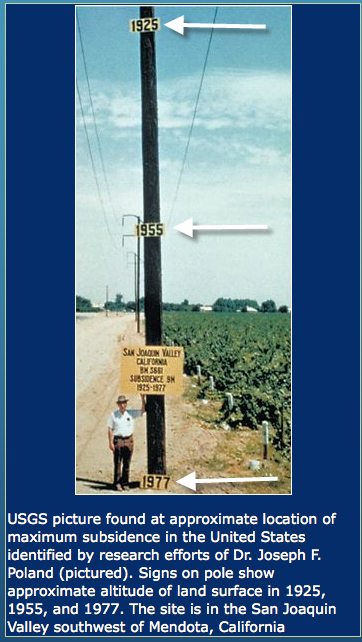
click to enlarge
28ft drop

DejaVue All Over

In a 1977 USGS report Dr Joe Poland wrote in an abstract:

Land subsidence which began in the mid-1920’s due to ground- water overdraft in the San Joaquin Valley has caused widespread concern for the past two decades. Withdrawals for irrigation increased from 3 million acre-feet in 1942 to 10 million acre-feet in 1966. Water levels declined at unprecedented rates during the 1950’s and early 1960’s.
Pumping lifts became inordinately high,well casings failed at alarming rates, and differential settlement caused numerous farming and engineering problems.

By 1970, 5,200 square miles of Valley land had been affected, and maximum subsidence exceeded 28 feet.( see pic)

The valley wide volume of subsidence totaled 15.6 million acre-feet one-half the initial storage capacity of Lake Mead. This subsidence represents one of the great environmental changes imposed by man.

The report adds that importation of surface water in the late 60s and early 70s through the Friant-Kern Canal and the California Aqueduct  has meant  pumping of ground water has been reduced, and the rapid decline of artesian head has been reversed in parts of the areas of overdraft.

A similar recharge effort of surface water in the Hwy 152 area could help stem the falloff says White, adding  he is  optimistic the cooperation of farmers to do recharge  and limit pumping will make this happen.

Farmers in the rest of Valley hope he is right.

Drought Spurs Recycled Wastewater Trade

Appears to be another drought year and water is top of the mind. A statewide call for water conservation is prompting some Valley cities to enter a growing market to sell treated wastewater or in this case trade it.

In Visalia, the big news is that the city council recently voted to support the biggest public project in Visalia history. The main project is the upgrade of its Water Conservation Plant valued at $142 million. But now comes the water trade part that like construction of the treatment plant,is also expected to move forward this year.

The coupled project’s two main objectives are to provide for the City’s wastewater treatment needs and to help mitigate the groundwater overdraft condition within the city. To achieve these objectives, the plant will be upgraded to produce recycled water that is California Title 22-compliant, the highest standard for recycled water in the world.

Once completed, the plant will produce recycled water unrestricted in its use, except for drinking water purposes.

In addition, the bulk of this water, about 12,000 acre ft, will be traded –  delivered by gravity to the Tulare Irrigation District (TID) where it can be used for crop irrigation. In exchange, the TID will deliver surface water – placed in the City’s waterways and basins to recharge the groundwater. The city will regularly deliver 2 acre ft of reclaimed water for 1 acre ft of federal canal water delivered in wet years upstream from Visalia. The city and TID began conversations about the exchange in 2010 and now the $14.5 million recycled water pipeline project too will break ground this summer. The pipeline would extend south some two miles to a TID basin.
Construction on both big projects could last 3 years.

Fresno Study Assures Growers

Before any final deal is done however,farmers in the TID district need to know the reclaimed water is safe to use on crops and for animals. The city and TID commissioned a California Water Institute at Fresno State (CWI) to provide an independent third party evaluation and to look a the issues.

TID general manager Paul Hendrix says the report that will be released at two grower meetings in Tulare March 6 and 7 “pretty well assures there will be no problem” with use of the water on crops.”It’s very favorable” adds the city’s wastewater plant chief Jim Ross.

Tulare May Be Next

Now Hendrix notes that TID would be interested in a potential sale of tertiary treated WWT plant water from the City of Tulare since that city too may be interested in selling its supply of 14,000 acre/ft of water to farmers says city public works director Lew Nelson.

The very purpose of TID is to enhance groundwater supplies for the district’s rich cropland using a combination of federal contracts and rights to Kaweah water suppled through 330 mile of canals and some 1100 acres of recharge basins.TID serves some 230 farms with a boundary that includes the City of Tulare – totaling 77,000 acres.

In wet years when there is a surplus of water, TID would essentially  pay back the City of Visalia and fill up 80-acre ponding basins east of Visalia within city limits and replenish the city’s sinking water table. Final Bureau of Reclamation approval is needed to seal this deal and  is expected in the next few weeks.

Besides this exchange – Visalia will put some of its recycled wastewater to use east of the wastewater plant – back across Hwy 99 – delivered by other pipelines to the city golf course, parks  and airport as well as Hwy 99 and 198 landscaped areas.

In support of this agreement, the City and TID have secured grant funding from two separate sources: approximately $700,000 in Water Smart Grant from the US Bureau of Reclamation and approximately $2.2 million of Integrated Regional Water Management Grant from Proposition 84 funds from the Department of Water Resources. These funds will be used to offset the cost to construct the recycled water pipeline to TID.

The value of recycled wastewater continues to rise with some companies approaching cities to see if they would be interested in brokering their water for resale to firms looking to use treated effluent for oil and gas production, thermo electric power generation, nuclear power generation as well as agricultural production and mining.

Westlands WD Launches Review Of Mega-Solar Farm

Would Bolster I-5 Transmission Corridors

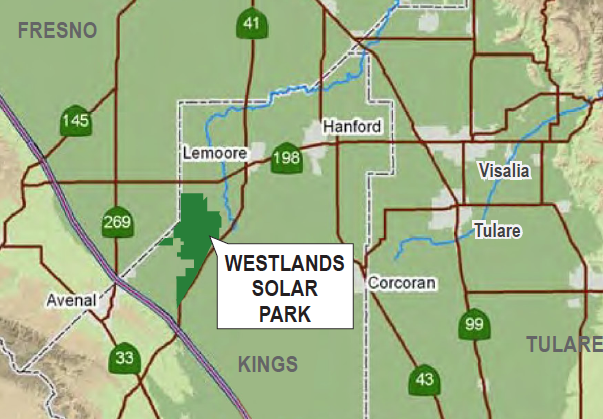
Westlands Water District announced last week they would launch an environmental review of a planned 2400 megawatt solar industrial park on 24,000 acres in their jurisdiction – located in Kings County.

The big project – in the discussion stage for several years – would begin the multi-agency approval process to cluster solar farms along the busiest north-south power transmission corridor in the state adding capacity to that corridor as it seeks to draw solar developers to build what would be billions of dollars of solar panels in coming years.

In a chicken and egg scenario the developers and water district understand you can’t generate all those electrons without a way to get the juice to urban areas on this already busy energy corridor.

Sun vs Nuke

The review states that the the “overall pacing of solar development is expected to proceed at an average rate of 2,000 acres (or 200 MW) per year over 12 years.” At buildout – 2400 MW of electricity generation would exceed that of Diablo Canyon nuclear power plant.

Ironically, its another advocate group that just 2 years ago was pitching a similar size nuclear power plant to be located nearby – also in the Westlands – a plan that you don’t hear much about any more.

Wastelands engineer Kit Buelna said the water district would be holding a scoping session on the solar master plan April 9 at the Fresno Westlands office. A full environmental review could last a year or longer.

So why is this embattled water district – the focal point for many controversial water issues in California and the largest ag district in the US – now looking at the rewnewable energy business?

In their preliminary notice Westlands says they wish to “retire”  these “drainage impaired” lands, laden with salt and selenium and no longer receive surface water delivery for them from the federal Central Valley project. As such the lands would be considered non-prime and under the Williamson Act as amended in October 2011”would be eligible for conversion to Solar Access Easements.”

Offering these tainted ag lands to both regulators and developers is in contrast to large solar projects in California’s more biologically sensitive desert areas – hoping to attract favor for more Central Valley solar projects but still avoiding the prime ag-land issue raised by the Farm Bureau and others.

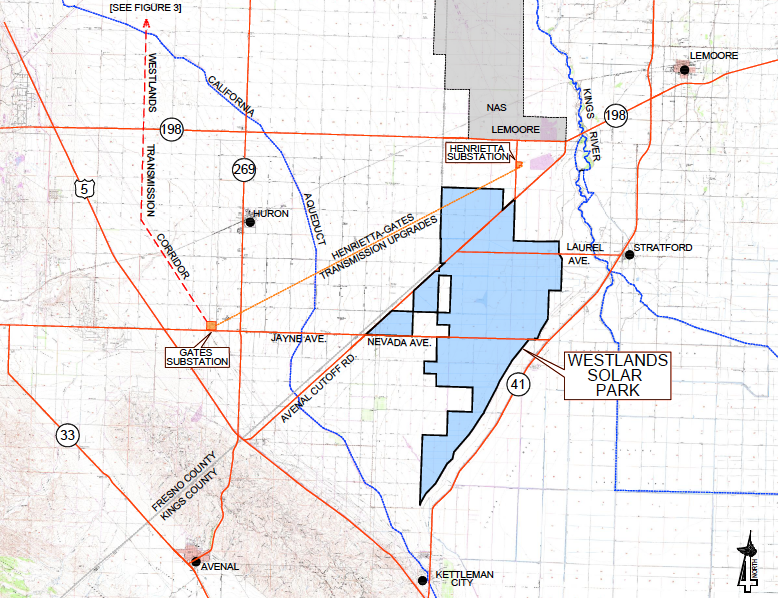
To encourage developers to locate solar farms in western Kings County the plan offers these objectives for the addition of the Westlands Transmission Corridor.

• Help provide reliability, flexibility, and stability to the State electrical grid by completing needed upgrades to the Gates to Los Banos segment of the Central California Transmission Corridor.
• Provide for electrical transmission through the areas of physically-impaired retired farmland in the interior eastern portions of the Westlands Water District in order to facilitate the productive reuse of these retired lands for renewable solar generation.
• Adopt a transmission route that achieves the primary objectives of this transmission facility in a manner that is cost-effective and results in the least impacts to the environment and the
agricultural community.

Political Headwinds

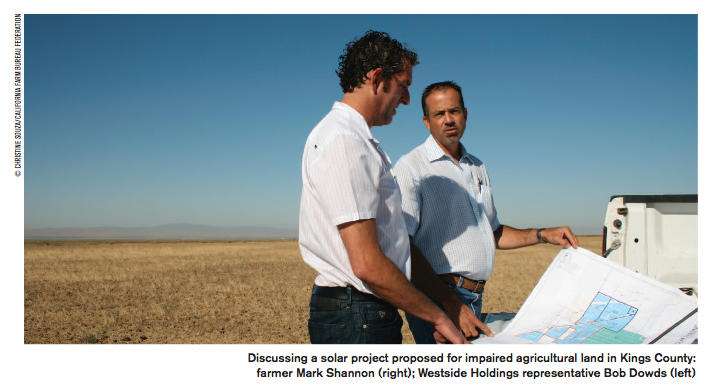
So called sponsors of the plan – land owners on or near the Shannon Ranch called Westside Holdings spokesperson Josh Martin adds several  other key points: The first pilot project is near and long term – the overall project faces political headwinds.
 
– Westside Holdings (Westlands Solar Park) now has a little more than 20MWs of short term projects under PPA negotiation or MOU aka “pilot” projects for the initial phase of the master plan.  The pilot projects are expected to begin construction in 2014.
 
– Leaders in the State of California and Federal Government have endorsed the idea of converting drainage impaired farm ground into solar generation but to date we have not yet seen the political will and ambition to join forces with Westlands and the Westlands Solar Park team to support the project in any major capacity, especially with identification and approval of new transmission that can serve the resource area as well as have additional reliability benefits in the central valley region.  Instead the state has focused continued efforts on the desert areas under the process known as DRECP trying to find new or different ways of developing projects in the CA desert.
 
The WSP team still believes strongly in the future of solar energy as a peaking energy resource in CA, the costs are coming down dramatically and retail prices are going up creating a convergence of greater opportunity on the near term horizon for the state solar market.  With some leadership from state regulators at the CEC, PUC, and ISO as well as federal agencies the Westlands Solar Park is well positioned for success that will benefit: farmers, environmental groups, and valley communities.

To distinguish the Westlands location from California desert locations an analysis of comparable costs for each found that solar PV projects in the Westlands Solar Park will have lower integration costs, be less susceptible to wildfires, and have no adverse environmental impacts, and no reduction in import capacity compared to similar sized solar projects in the desert.

While power delivered from Westlands might be 8% higher than some desert solar projects that receive more solar radiation – that cost can be more than offset by substantial savings in transmission costs from the Westlands says a 2011 study.

Lower Transmission Cost

The study compares the cost of delivering 800 MWs of solar PV production from the Westlands Solar Park at $2.27/MWh or about $70 million to upgrade the transmission network. Using figures from two large desert projects – far from the statewide grid – we see costs of $9.40 to $21.08/MWh in the case of SCE’s Lugo-Pisgah project, which could move as much as 1,750MWs with a total cost of $750 million. In another case, the transmission-related cost of renewable energy carried by the Pisgah-Lugo project is $24.32/MWh.

This puts the total transmission cost as much as 10X as much as the Central Valley site, and no unhappy tortoises. Convincing the leadership in the state at key agencies like the California Energy Commission,ISO and PUC that this makes sense is job-one for the proponents. Likewise for federal authorities who are backing huge desert projects in the  Ultimately, the big private utilities must be convinced as well.

The Westlands Solar Park(WSP) is the only state (RETI) designated renewable energy zone in Central California and it is the  state energy zone with the strongest levels of support from both environmental and agricultural communities say WSP.

By working to get all approvals in place Westlands – the water district and WSP -the developers – hope to have the pathway cleared perhaps a year from now so that solar developers won’t encounter long permitting delays and lawsuits that they often find elsewhere in California.

Environmental Groups Back Project

Environmentalists seem to back the idea.

In 2012 Defenders of Wildlife strongly recommended steering more solar projects ”to low-value, low-conflict areas and degraded agricultural lands—aiming to avoid or minimize adverse impacts on wildlife, valuable agricultural lands, and high-value resource lands such as vernal pools, foraging habitat, riparian corridors and transitional biotic zones. This approach has two clear benefits: protecting vital natural resources and speeding up the permitting process for renewable energy projects.”

Defenders pointed out that “Energy planners are concerned over the cost of adding transmission lines to move renewable power from rural areas where it is expected to be generated to urban areas where it is needed.”

Back then former Sierra Club spokesperson Carl Zichella said “They could build 1000MW of solar power in Westlands right now without adding any new transmission capacity”. Zichella strongly supported the idea of placing utility-size solar on retired farmlands like in the Westlands. The lands are tainted by salinity and contamination and unlike more natural areas – attract little wildlife.

“I see plenty of reasons to do the Westlands solar project and no reasons why not.”

Already the Westlands Water District has welcomed several other solar projects in the face of more drought as well as regulatory cut-backs on water. As a result, many of the district’s farmers are seeking new economic uses for their land.

The majority of the solar PV projects proposed for Fresno County are in the district, including the high-profile Westlands Solar Farms (not affiliated with Westlands Solar Park). Other large Westlands WD located solar projects are Mustang in Kings County on 1400 acres being proposed by Recurrent and in Fresno County – a 1890 acre project near Mendota being  proposed by SunPower that could generate 200MW. The 100MW Henrietta project in Kings County is also in the district-  owned now by SunPower and moving forward with a power purchase agreement in hand from PG&E.

Defenders Of  Wildlife argue that such projects on “degraded” and “impaired” ag lands will help avoid farmland of higher quality as well as avoiding sites that are more sensitive environmentally with wildlife impacts for example – some desert site proposals pending.
To help this area the group urges the PUC to upgrade electricity infrastructure in this sector both north/south and east/west arguing a mid-state location makes more sense geographically, financially and environmentally. Because of the renewable power potential in Kern, Kings,Tulare and Fresno counties, upgrading the transmission infrastructure or not – will tell the tale of just how big Westlands Solar Park as well as other Central Valley renewables will get.

Around Tulare County….Cider Mill / Wonder Bread /Trampoline Center /More

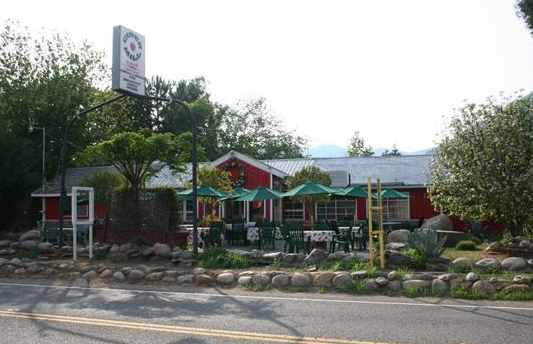
Three Rivers Sequoia Cider Mill Will Rebuild: Landmark Sequoia Cider Mill that burned down last June will begin the rebuilding process.  Owner Efrain Ponce says demo on the property has begun and new construction should be underway by April with a plan to reopen this summer. The fire year tragically killed  Efrain’s young nephew who lived in a residential addition in back. Efrain says the new restaurant   will be the same square feet without a residential area – doubling the size of the eatery. ”We had lots of encouragement and good wishes from Three Rivers residents and support from my family – that’s why we want to reopen.”
Efrain and Martha have owned the place since 2007 offering apple cider for sure but the BBQ ribs – the biggest seller.


Wonder Bread Come Back?
Flower Foods who purchased part of the bread division of bankrupt Hostess has leased a 5000sf warehouse for bread distribution at 1746 E Mineral King in Visalia. The company will employ about 12 at the new location says the building owner Danny Freitas. Flower Foods has purchased  the Sara Lee and Earthgrains brands and is expected to purchase former Hostess brand Wonder Bread. Wonder Bread, along with Butternut, Home Pride, Merita and Nature’s Pride, will go to Flowers after no other bidder stepped up to make a competing offer in the Hostess bankruptcy process. Wonder Bread – well known for its soft and spongy texture and polka-dot wrapper – has been a family favorite for decades.Hostess had a distribution location in Tulare before they closed last fall.

ImaginU Museum is ready to build applying for their conditional use permit  for their long awaited 15,600 sf building at Oak and Tipton in Visalia.The project will be taken up at the March 25 Planning Commission meeting.

Jumping To A Conclusion? Former Home Base building on south Mooney, vacant since 2001, looks like will get a big retail tenant – just weeks away from an announcement.But the tenant won’t take all the 150,000sf space. Part of it could be leased to 2extremArena, a trampoline center that already has a location in Clovis. The owner went through a city site-plan review process here a few weeks ago. These sprawling centers feature a large grid trampoline covering 10,000sf and more for kids jumping, dodge ball and games.

Really? O’Reilly Auto Parts is building its fourth store in Visalia this Spring – the latest being on the Northside – on Dinuba Blvd. They have 2 locations on Mooney and 1 on Ben Maddox.The publicly traded company is now the third largest auto parts chain in the country, after AutoZone and Advance Auto Parts.

The long vacant Visalia Pipe & Supply
property at Johnson and Murray in Visalia will be the home of Victory Outreach who is seeking a conditional use permit this month for a 200 seat church inside the big vacan

Tulare Gets Its Voice Back / Newspaper Restarts E-Version

front page news

After a 14 month hiatus,Tulare Voice newspaper is back delivering local news in an internet version only. Funded by Tulare investors led by banker Phil Smith and with veteran Tulare journalist Julie Fernandez as editor, the paper launched it first edition this week on-line at tularevoice.com. Owner of paper is a group called Tulare News,LLC located at 220 E Tulare Ave Tulare, CA 93274

The print and on-line edition was last seen in December 2011 as the Tulare edition folded along with parent Valley Voice Newspaper of Visalia. The free newspaper had better than a 32 year run started as a monthly in 1979 and becoming a weekly in 2006 when the Tulare Voice was also launched.

Phil Smith offered some perspective on the goals of the reborn Tulare Voice that closed not because of lack of interest but finances.

“First, gather the details and report the facts accurately and objectively within a framework of balance, context and clarity.  We do not intend to allow our reporting to be influenced by political, social or monetary pressures.
Second, maintain an operationally and financially viable organization. If the new Tulare Voice cannot sustain itself as a business, then we will obviously be unable to achieve the first goal identified above.”

Smith added that “This first edition of the Tulare Voice e-journal has been brought to you courtesy of the consistently expressed desire of local citizens for local reporting.”

“This publication is intended to be Tulare’s primary news and information resource.  It is owned by people you know and come in contact with every day.  Together, over time, we can create a publication which truly serves our culturally diverse and agriculturally blessed community. Please join us as we strive to recognize and celebrate this place we choose to call “home.” Let’s WORK together Tulare!”
Editor Julie Fernandez wasted no time offering a hard hitting piece on Tulare District Hospital facing a financial crisis, with its future very much in doubt.
The reader should know that this reporter,John Lindt,had a hand in starting both newspapers although the paper had been sold to an investment group in 2005.The group hired current Porterville Recorder editor Rick Elkins to guide the ship but times were tough recounts Elkins in an article penned in January 2012-Sad to see Valley Voice silenced.
“Unfortunately, going weekly was not well thought out and the timing could not have been worst. It was the beginning of the recession and coupled with the increased costs, it made it difficult for the Voice to survive. Throw in some other internal problems, and its fate was set.”
Times have improved and the appetite for local news is still there. Fortunately, Julie Fernandez, who has been covering Tulare since 1974, is there to help make it happen and Tulare will get it chance to support the effort.
Good Luck.

New Biz Activity AROUND TULARE COUNTY

Near Goshen west of Hwy 99 Papich Construction is underway building an asphalt batch plant providing road material for the planned Hwy 99 widening says Dennis Cruce of Papich who also owns Sierra Pacific Materials who has a rock quarry near Orosi.”We will be providing local material for this project and future projects we hope”including high speed rail, he says. The plant should be operational by May located at 29779 Rd 68 – along Hwy 198.

Speaking of Tulare, a Kern County firm, Sunmet Juice is in escrow to buy the 58,000 sf, 12.7 acre – former Structures Plus property near the Tulare airport. The company makes fruit pulp purees for food processors to add as ingredients.The company declined comment.This would be the second juice company to come to a town that virtually swims in milk.

Down in Pixley,French-owned Air Liquide will be build a multi-million dollar carbon dioxide plant to capture CO2 from the ethanol making process at Calgren Renewable Fuels and turn it into a valuable product used to carbonate beverages and as a coolant in the food industry.This will be the first CO2 plant in the Valley.

They have good news in Dinuba as well with the construction under way of new 30,000 sf corporate office for Ruiz Foods replacing portable buildings at their big Alta Ave campus.”We are very pleased the Ruiz family made this commitment to keep their corporate office in Dinuba” said City Manager Ed Todd.

Dinuba Transit Center

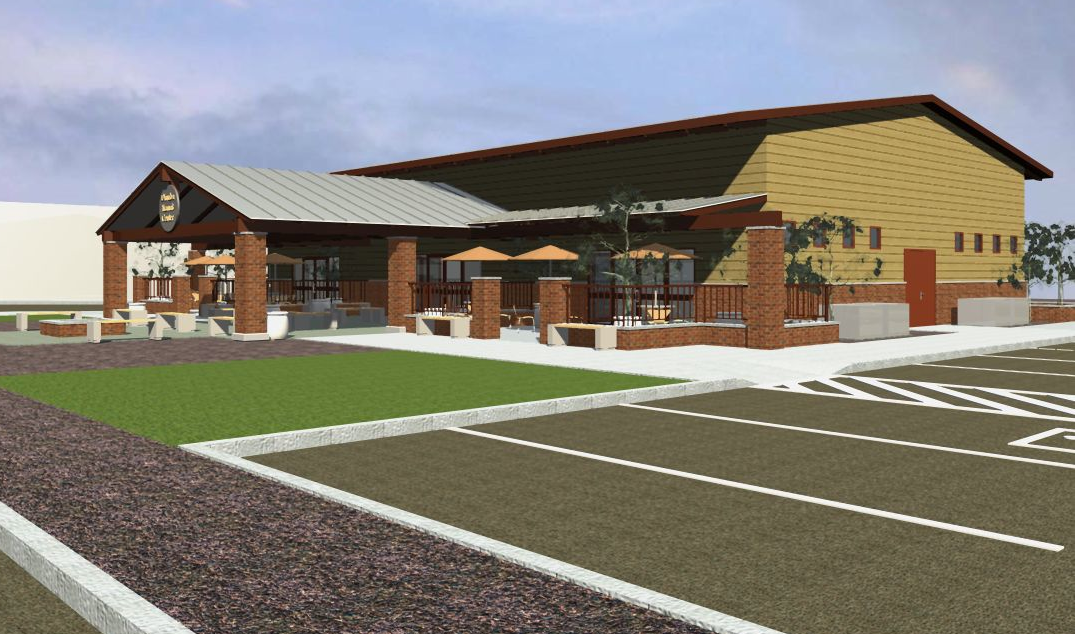
Also in Dinuba – work is underway on the new million dollar city Transit Center that will enable residents to travel easily 20 to 30 miles in any direction by bus says city manager Ed Todd.”This will be  the new hub for the community.”The transit center is near a new 70-unit senior apartment complex.Todd says the transit center  that will have new city sponsored manager will be completed by the end of the year. Rendering is courtesy of 4Creeks Inc.

Back in Visalia construction work is underway at 8945 W Goshen Ave by contractors for AT&T who plans to open a 45 worker dispatch garage that will serve the region installing AT&T’s new digital TV service. The center will open in the next few months says spokesman John Britton.

In Rural Tulare County – Dollar Stores Are Adding Up

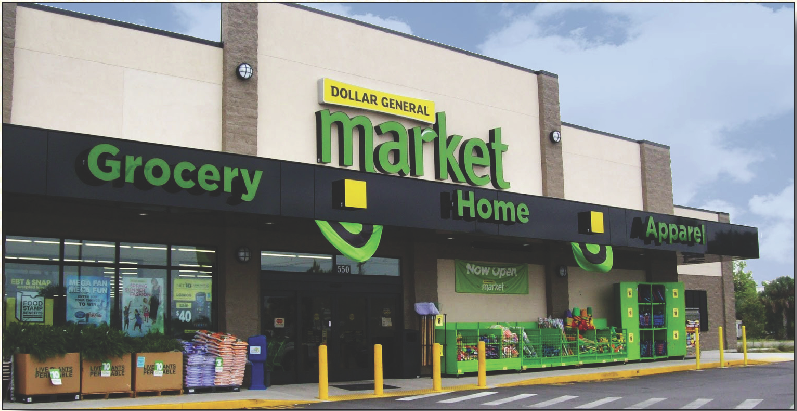
New Dollar General store being built in Porterville

Like a swarm of mini-Walmarts three national “dollar stores” continue to pop up in almost all Tulare County towns.The three largest rival retailers,Family Dollar,Dollar General and Dollar Tree appear to be in a flat out race to open the most outlets in the county and often to be first to do so – in towns never targeted by national retail chains before.

Saving a buck has never been more popular.

Next week construction of the new Family Dollar store on Ave 328 in  the farm town of Invanhoe will start from scratch says the project manager for Construction Developers Inc of Fresno, who plans to have the 8320 square ft building “completed in 90 days.”

The fast growing, publicly traded retailer already has locations open in Dinuba,Farmersville and Woodlake and 3 stores – built or on the drawing board in Tulare – as well as one in North Visalia. Last October, Family Dollar said they want to open 500 stores nationally in 2013.

This week the county’s Economic Development Manager – Mike Washam says new permits have been issued for Family Dollar stores in Cutler-Orosi on Ave 416 and in Terra Bella in southern Tulare County.

Lindsay Plans

Also this week the Lindsay City Council is holding a public hearing for a new Family Dollar store to be built at the southeast corner of Mariposa and Ave 65. And that’s not all.

Even more impressive – at the same meeting – the Lindsay council is being asked to approve an application to build a 9100sf Dollar General – Family Dollar’s big rival – at the southwest corner of Hermosa and Mirage,just down the block. The project would demo two older buildings to make room.

Woodlake/Exeter

There is also a new Dollar General store expected to break ground in Woodlake soon says Woodlake city planner Greg Collins. In addition Collins says a company representative is meeting with him this month in Exeter and wants to build a new Dollar General store in Exeter too, where is also the city planner.

Dollar General has stores ether open or ready to build in Porterville, Farmersville,Visalia,Tulare and now one being planned in previously ignored Earlimart at Ave 56 and Hwy 99, says Mike Washam, part of a small strip development in this low income town of 8500. Dollar General would be part of a new shopping center on the north end – the town’s first.

Not to be left too far behind is Dollar Tree with locations in Dinuba,Tulare, Visalia and Porterville and Farmersville (where all three rival dollar stores will go head to head).

Dollar Tree offers household goods, seasonal items and assorted knickknacks all priced at a $1 or less. The  discount chain has enjoyed  robust sales  -up 14.6% in the latest quarter or $2.23 billion.

Of course there are other players in this category including 99Cent  Only stores in Visalia,Porterville and Tulare and scores of smaller Mom & Pop stores that use the “99Cent” name too.

Analysts say instead of offering a Walmart retail model of a few big stores to attract hoards of thrifty customers from the hinterland – these pint-sized but modern formatted dollar stores are offering a downsized discount store experience close to where the shopper lives. Cash strapped shoppers looking for low prices on basic items can make fewer car trips to the larger communities on items that sometimes include groceries, particularly at larger Dollar General locations.

Consider just a few years ago there were none of these national dollar stores in Tulare County compared to an estimated 25 locations slated to be open in the next year.

Green Light For First HS Rail Segment?

rendering of bullet train along side freight train north of Fresno

The California High Speed Rail Authority is now three for three  combating lawsuits looking to derail the first 60 mile leg of the bullet train’s statewide route.

This week the Authority announced they had reached another agreement to settle a California Environmental Quality Act (CEQA) lawsuit. The four Central Valley businesses which brought
litigation, Timeless Investments, Inc., Millennium Acquisitions, Inc., Horizon Enterprises and G.P,. Everspring Alliance, L.P. have filed a dismissal of their suit which challenged the Authority’s Environmental Impact Report for the Merced to Fresno portion of the high speed rail project.

A few weeks earlier, on January 28, 2013, the Authority announced the settlement of a CEQA lawsuit brought by the City of Chowchilla.

“We greatly appreciate the good faith effort of the plaintiffs to engage in cooperative talks which brought an end to this litigation,” said Jeff
Morales, CEO of the Authority. “This second settlement is another step in moving high speed rail forward, starting construction this summer and creating thousands of jobs.”

Last November, a Sacramento judge rejected arguments for an injunction that included these two plaintiffs and the Madera County Farm Bureau to halt all planning on the project suggesting the lawsuit would likely not prevail in trial. Now this Madera FB case will go to trial in April.

If this last case is dismissed it could give the project a green light to break ground on the first leg this summer. Offers to buy property for the route are in the hands of property owners.

The the focus will then turn south to Kings County where the next segment of the route is being planned as well as litigated. A hearing on the alternative routes through Kings County is expected in April in front of the Authority board.

The board will chose between a route that would head south of Fresno on the BNSF alignment and go around Hanford either on the east or west side of town before returning to the BNSF route near Corcoran. Hanford has rejected any study of a route through their city.

While Kings officials either on the county or city level are not expected to testify which route would be better not wanting to grab what is a hot potato – Tulare County representatives are expected to plead with the board to approve an east side route that would put a station just east of Hanford and Hwy 43, closer to the population centers of Tulare County instead of a possible station site between Armona and Lemoore.

The west side route is rumored to be somewhat cheaper and it could be cheaper still without a station.In fact the CHSRA has never fully authorized what has been called out on the maps as a Kings/Tulare station. Offsetting this argument is the fact the south Valley is expected to be one of the top growth areas in California in coming decades.

Also on the agenda in the next few months – a decision on the preferred location for a heavy maintenance station where the train fleet will sleep each night – expected to employ 1500. The Fresno County location is thought to be favored.

As for the litigation on the 100 mile Fresno to Bakersfield section farmer John Tos, resident Aaron Fukuda and the Kings County Board of Supervisors  have joined in a suit claiming the rail authority’s funding plans violate Prop 1A with a trial set for a Sacramento jury May 31.

FedEx Will Double Size Of Fresno Distribution Center

FedEx site

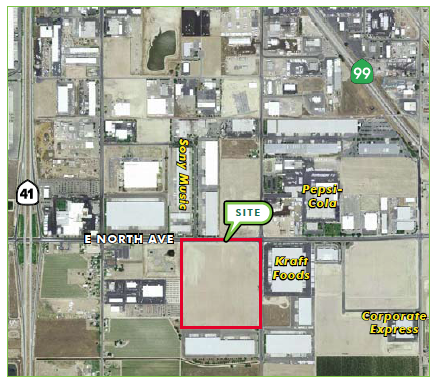
FedEx Ground will double the size of its Fresno distribution center later this year confirms the company. An affiliate firm has purchased a 20 acre parcel at  the southwest corner of East Ave and North Ave  – two blocks from Highway 99, says real estate broker Nick Audino of CB Richard Ellis.
Audino who handled the sale from Buzz Oates says escrow closed on the property in December and that FedEx will take a long term lease. Plans call for a 198,000 sf warehouse, double the size of FedEx’s current ground shipping center on Willow.
The new building is in its design phase says Audino.
FedEx spokesperson Allison Houser offered these remarks.
“FedEx Ground is building a new distribution center at the intersection of East North Avenue and South East Avenue in Fresno, Calif., that will be more than 198,000 square feet when it is completed in July 2014.
The new facility will replace an existing facility nearby, allowing us to continue to meet and exceed customer demands in the region. When the new facility opens, positions will transfer from the existing station, and we will add to the workforce as necessary to support increased demand for service in the area.
The site was chosen because of its ease of access to major highways, its proximity to customers’ distribution centers and a strong local community workforce for recruiting employees. The new facility is part of a nationwide network expansion to boost daily package volume capacity and further enhance the speed and service capabilities of the FedEx Ground network. Since 2005, the company has opened 11 new hubs featuring the most advanced material-handling systems and expanded or relocated more than 500 local facilities.

The network enhancements have resulted in accelerating ground service delivery by one day or more in more than two-thirds of the United States. FedEx Ground delivers more than 61% of packages in two days or less and more than 82% of packages in three days or less.  With these changes, FedEx Ground is faster to more overall locations and FedEx Home Delivery is faster to more residential locations than UPS.”

More new Construction
There are a few more signs of new construction plans for distribution companies in the Central Valley. Just few blocks away from the planned FedEx center – developer Leland Parnagian plans to build a $5 million,92,000 sf ‘spec building’ to be completed this summer says Parnagain.”We have pretty good interest” and expect to fill it by the time construction is complete he says. Parnagian has some 500,000sf under roof in his North Pointe business park that spans 230 acres in southwest Fresno.
FedEx has already been expanding in the Central Valley as it battles with rival UPS for business even as the US Post Office seems to be shrinking
FedEx has just completed occupancy of its new $24 million,32 acre, 200,000 sf transfer station in Kettleman City that takes in both north and south bound shipments allowing the drivers to return home instead of making the entire trip down I-5. The new complex will bring 60 to 80 joss to Kettleman City.
In some good news for breathers in the past few weeks – nine businesses in Kettleman and nearby Avenal, including the new FedEx transfer station in Kettleman City, signed a “good neighbor” agreement  to follow idling laws, work to cut air emissions with new cleaner technology and educate drivers.
“FedEx is committed to the environment and the communities we serve,” spokesman Scott Fielder said.
Big Box Center
Just a few weeks ago in nearby Hanford big box retailer Fry’s Electronics  announced they would remodel the 200,000 sf former International Paper facility in the Hanford Industrial Park to establish a mid-state repair center to service both its northern and southern California stores. The investment will bring about 180 jobs says the Kings EDC.  The hiring for the project is already underway as jobs are shifted from San Jose to Hanford where costs are lower.
Fry’s strategy to use our mid-state location to serve both southern and northern California – each 2 to 3 hours away – has been the mantra of  local economic development officials for decades that clearly makes sense to more firms who can consolidate two regional centers into  one.
Fresno, Kings and Tulare counties each use their location to snag plenty of jobs at companies who not only ship by truck or train but use the two big package express companies to reach  most of the markets in the state overnight by affordable ground shipment.
Visalia in particular has landed a dozen companies or more in the past decade who say they have located in the Visalia Industrial Park to be close to the big UPS hub down the block.
Because of the location a large number of companies can effectively ship to six states: California, Oregon, Idaho, Nevada, Utah, and Arizona within one day primarily through Visalia’s UPS and FedEx facility, the airport, trucking & by way of rail. Seizing this geographical location, Visalia has devoted more than 1,500 acres of the northwestern portion of the city to support industrial growth and employment says a city report.
UPS has been making a splash recently announcing the start-up of 100 clean air delivery vehicles for use in the Central Valley including Fresno.The electric trucks are made in Stockton.

Greener Pastures For BioFuel

Ethanol Makers Want Sorghum As Feedstock,Look To Capture More Co-Products

Aemetis ethanol plant in Keyes 

Looking to wean themselves from corn, California’s ethanol makers are gearing up to use more grain sorghum to make low carbon biofuel and get paid more handsomely for it. Also, looking for profitability – a number of the ethanol companies are adding on-site production plants to capture more co-products that are part of the ethanol distilling process.
On January 15 biofuel company Aemetis idled its 60 million gallon plant near Modesto joining scores of ethanol plants in the Midwest who have shut down at least for a period because of the high price of corn.The industry’s trade group, the Renewable Fuels Association, tells the Associated Press that 20 out of 211 U.S. ethanol plants have halted production over the past 12 months  -including five in January.
But Aemetis announced hope for a greener path a few days ago  saying that it had agreed to contract with local farmers to plant seed sold  by Chicago-based Chromatin for 30,000 acres of hybrid grain sorghum to be used to make ethanol starting this summer.
In a second major announcement February 18 Chromatin and Pacific Ethanol announced a similar agreement to contract with local farmers to plant 30,000 acres of sorghum near their Stockton plant.
“As the benefits of sorghum become more widely known, especially its resiliency, flexibility and its affordability compared to corn, we are optimistic that it will become the feedstock of choice in ethanol production” says Chromatin Chief Executive Officer Daphne Preuss.
“We are pleased to extend our collaboration with Pacific Ethanol, which previously confirmed that locally-grown sorghum is well-suited to ethanol production. We also welcome the opportunity to provide crop producers in California with a new market for their products by providing sorghum feedstocks that serve as an economical and energy efficient source of biofuel.”
“We have taken initiatives to diversify our feedstock base and further reduce the carbon profile of our ethanol. Our agreement with Chromatin represents one of these important initiatives and will help California farmers to produce sorghum for production of low carbon ethanol and high value animal feed,” said Neil Koehler, CEO of Pacific Ethanol.
Pacific Ethanol and Aemetis are not alone.
Tulare County’s Calgren Renewable Fuels has contracted for about 10,000 acres of sorghum this fall and 30,000 acres over multiple years  to decrease the train loads of corn shipped in from the Midwest this year and after says Lyle Schlyer president of Calgren. Chromatin is the seed supplier as well. Calgren did a test run to make ethanol from  sorghum last year that worked out fine says Schlyer.
Air Liquide Plant
Also in Pixley Calgren has contracted with industrial gas provider Air Liquide to build a multi-million dollar CO2 plant that will help Calgren to demonstrate that it it has captured CO2 emissions that would otherwise contribute to global warming.Carbon dioxide is part of the  fermentation process and all California industry is now mandated to cut  CO2 emissions or pay into a cap and trade program. With the new plant in place the carbon dioxide is cleaned of any residual alcohol, compressed, and sold to other industries for carbonate beverages, or as a coolant in the food industry to name a few uses. Calgren’s neighbor California Dairies uses CO2 as a coolant. The rule of thumb is one pound of CO2 for every pound of produced ethanol (6.5 pounds per gallon).Schyler says the Pixley facility will be the first CO2 plant in the valley.  French-owned Air Liquide who helped build the Calgren plant has said they expect to issue a press release soon on the project
Pacific Ethanol is also adding a corn oil extraction plant at their Stockton facility looking for more ways to boost their income.Corn oil is already captured at the Pixley Calgren plant.Of course the most important co-product from California ethanol plants is wet distillers grain used to feed millions of nearby cows
Advanced Fuel
Shifting some ethanol production from corn to sorghum will please livestock critics of  ethanol in California who have done a full court press both in the state and nationally to try to defund all corn ethnaol incentives that they say have helped drive up their feed costs.
With the agreement of the EPA grain sorghum as a substitute will qualify as an ”advanced biofuel” with half the lifecycle greenhouse-gas emissions of gasoline. U.S. gasoline and diesel producers are mandated to blend 2.75 billion gallons of advanced biofuels with their products in 2013 along with the 16.6 billion-gallons of biofuel that are corn-based.
Chromatin is currently working with California growers who are attracted to sorghum as a grain source because it is easy to grow, uses less fertilizer and water than corn and is tolerant to both heat and drought conditions. It is also an effective double crop alternative behind wheat or in rotation with cotton and vegetable crops. In addition, the residue from the harvest of sorghum grain can be used as high quality animal feed.
In the south Valley sorghum is being planted on more marginal lands with little or no irrigation but its success  will depend on rainfall.
Ethanol plants in California have been seeking alternative crops to corn to reduce feedstock costs, to improve their carbon footprint and to source feedstock from locally grown energy-efficient crops. California-grown sorghum has proven to be cost effective and energy efficient, and using sorghum grain enables ethanol producers to qualify as Advanced Bio-fuel Producers and become eligible for financial incentives.
Just having their feedstock grown locally instead of sent by diesel powered unit trains across the country will help California ethanol makers show a greener footprint.That in turn will translate  into preferred sales in California in coming years according to new state rules.
Advocates say sorghum uses from a third to half the water of corn, needs less nitrogen to produce the same yield, and has greater salt tolerance.
Sorghum has not been a big crop in California with much larger plantings in Texas and Oklahoma. Just 45,000 acres was planted in California in 2008 ,which is the latest period we have records.
Between these three ethanol makers alone, that could jump to 90,000 acres.