News Briefs Around Visalia

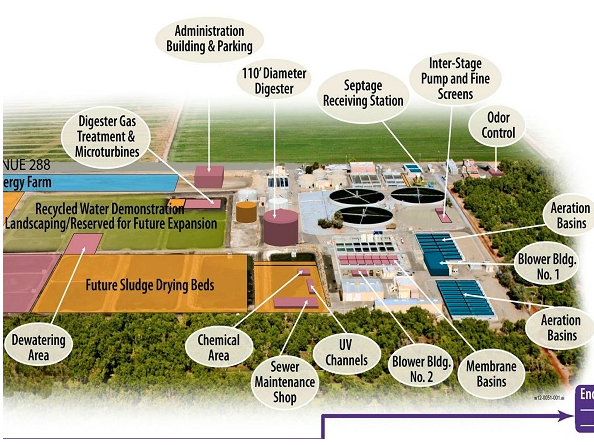
Screen Shot 2013-09-13 at 7.25.43 AMRebid On Visalia Wastwater Plant Expansion?

Visalia’s largest construction project ever – the expansion of the city wastewater treatment plant – has run into a snag. The ambitious project was bid out in June with Fresno-based W.M. Lyles the low bidder at around $92 million. But complaints from another bidder has spurred staff to recommend that a new round of bidding take place because of “irregularities in all the bids” says WWT plant  administrator Jim Ross. “We will be recommending to City Council Sept 16 to do a rebid and we think it can be done in the next 2 months.”
Sources say the irregularities are minor and that rebidding often results in a higher low bid the to the city now that everybody’s cards are on the table.But with the threat of litigation the city wants this deal to be squeaky clean. The council will decide. Some 10 contractors are bidders on the project – all from out of town.

Quad Knopf Moving Downtown

Long time Visalia planning firm Quad Knopf is moving its headquarters from West Visalia to 901 E. Main Street. The company is purchasing the former gym building on the corner of Burke and Main in the old auto district of Downtown. Company president Mike Knopf says that the new Quad Knopf office will be some 12,00sf with 10,000sf for their use and 2000sf for lease. Knopf says the vacant gym building – originally built for industrial use in the 1960s – will get a makeover “top to bottom “remodeled with a”industrial tech” theme.
Quad Knopf is the oldest and largest planning and engineering firm in town with about 50 employees. Founded in Visalia in 1972 by Randy Zeeb and Harry Tow, Mike Knopf joined as a partner in 1998. Today the company acts as city engineers for 7 smaller cities, and contract planners for several cities as well.
“We will be the first redeveloped office space in this part of the Downtown, but our ‘pioneer’ status shouldn’t last too long. The City of Visalia is currently designing their new 911 dispatch center on city-owned property two blocks to the north.”
Indeed, the City Council took steps in the past few weeks to do just that.

New Home Building Co

Speaking of home building a new start up- San Joaquin Valley Homes, based in Visalia, says it plans to build as many as eight new home projects in the area soon with some underway. The partners are Joe Leal, Jim Robinson and Randy Merrill, all formerly with McMillin Homes.

Visalia Carrows Restaurant Could Become Black Bear Diner

The owners of Black Bear Diner have filed preliminary plans to remodel the Carrows Restaurant on Mooney Blvd. Sources with the company said they could not comment. Carrows was in Tulare, then closed and became a Black Bear Diner some years ago. Carrows is owned by a Japanese company Zensho Co., Ltd. Black Bear Diner is California chain launched in the mid 90s in Shasta and now sports around 60 locations that include Porterville,Tulare and Hanford. Like Carrows,they offer comfort food but in a down-home atmosphere.. The chain has several local connections including the fact that Visalia muralist Colleen Mitchell-Veyna has done over 20 murals in Black Bear Diner locations in the past 10 years.

Family Dentistry Plans Mixed-Use Project Downtown

Settimi Family Dentistry really is a family affair – headed by father Ned Settimi, now retired and two daughters – Dr. Janine Settimi and Dr.Stephanie Settimi.The family is planning to build a two-story, mixed-use building on Acequia where they will demolish the old dentistry building, erect a new dentist office on the ground floor and two residential units on the second floor. It is the first such commercial-residential unit although not technically not a ‘live-work’ arrangement since they docs won’t live there. Also Downtown, there is another approved mixed-use plan at the southeast corner of Church and School. The new Settimi complex on Acequia, across from City Hall is expected to break ground as soon as all construction permits are approved says architect Deborah Woodle.

New Ambulatory Surgery Center

Plans were filed this week for a new 4500sf ambulatory surgery center Downtown at 210 S Johnson to be operated by Dr Talaksoon Shonneh Khademi in the existing building across from City Hall.

Visalia Might Get Its Way On High Speed Rail – Kings County Plays Chess To Block It – Kaweah Delta Plays Checkers

News Nuggets From The Central Valley
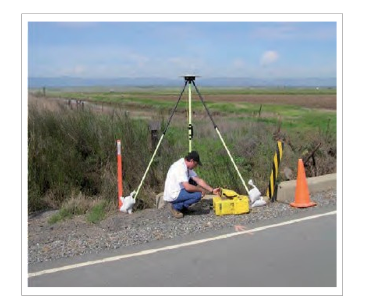
Kings County is blocking soil sampling work by contractors for the California High Speed Rail Authority along the proposed right-of-way. Kings County Public Works Director Kevin McAlister said a letter was sent Aug 16 denying the request saying the project “did not comply with the county’s General Plan.” The application was for a encroachment permit to do soil boring along public roads. CHSRA spokesperson Lisa Marie Alley acknowledges receipt of the letter and says “we are working with Kings County to see what our next step might be.” But McAlister says since the county is not going to change their General Plan “I don’t know how we can proceed”- essentially closing the door on any next step.
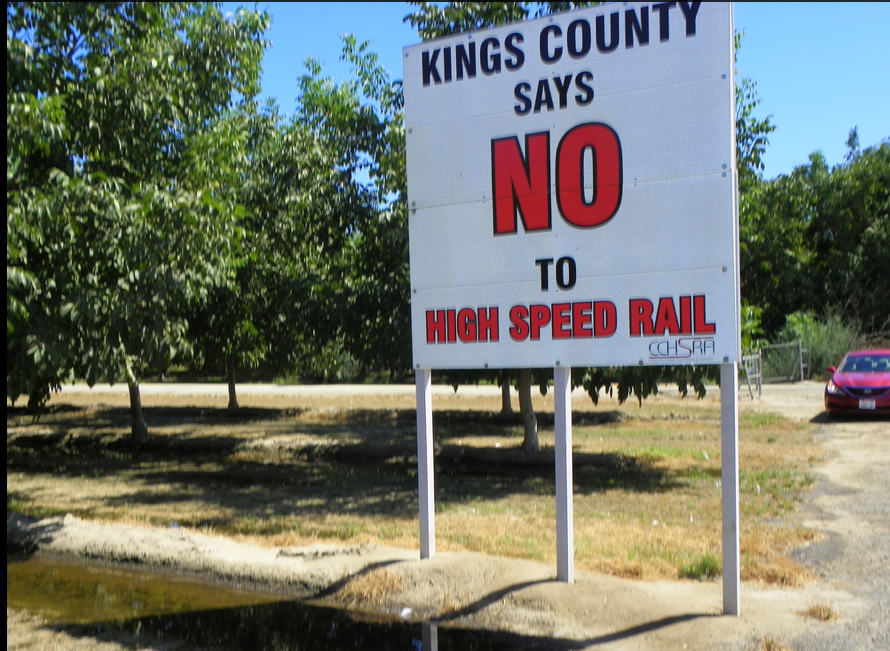
These type applications are routinely approved. Not in this case in Kings County where the bullet train has strong opposition and the county itself has actually filed suit  to try to stop the project from moving forward.This week Tulare County approved a similar encroachment permit through the southwest part of the county.

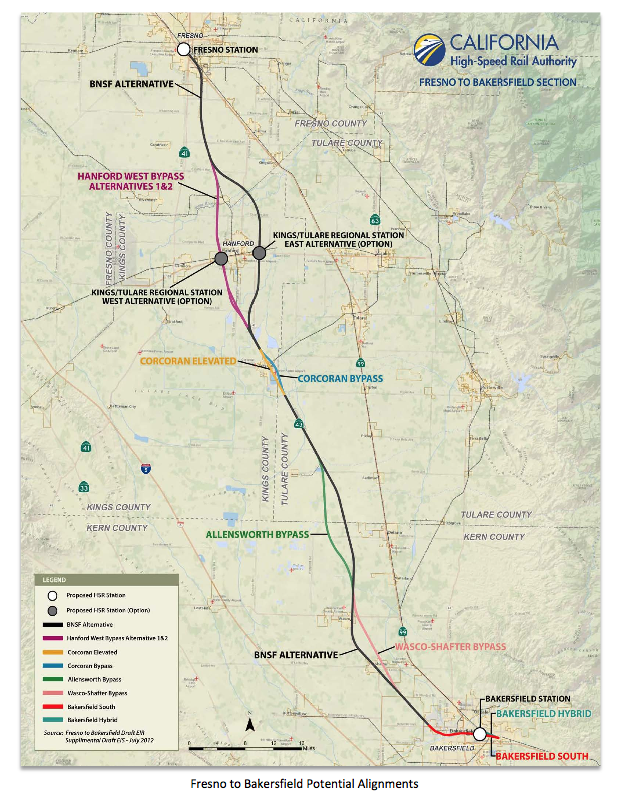
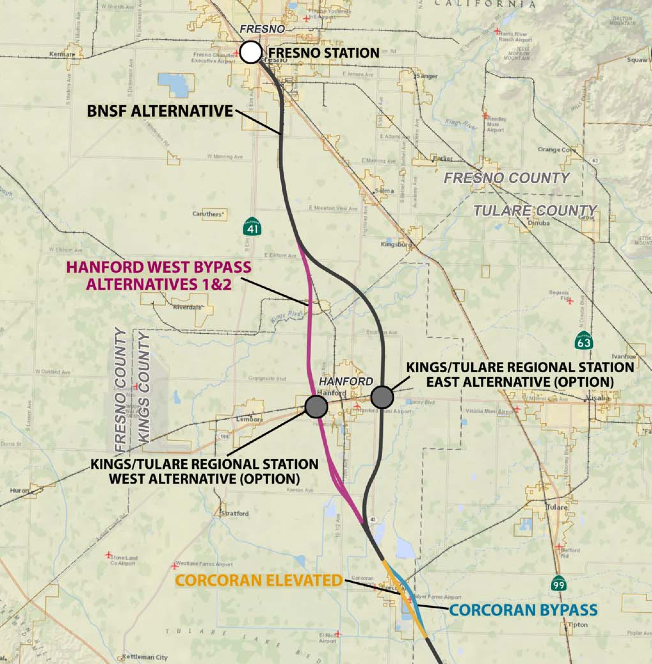
If the controversial bullet train does move forward, it looks like the East of Hanford route is now favored. A published monthly report by URS Corp consultants who advise the California High Speed Rail Authority on planning and engineering services to construct the rail line suggests that the Authority has decided to plan for a route through Kings County to the East of Hanford (the original plan) rather than West of Hanford as they announced this Spring.The consultants progress report says Authority staff told URS” In July 2013, further verbal direction was given to replace the Hanford West Bypass 2 Below-Grade Alternative with the Hanford East Alternative as part of the single PA (preferred alternative), and to explore options for adjusting that alignment to avoid or reduce impacts on the Baker Commodities facility.” The change of heart may be due to two factors. The engineers only lately became  ware of the high water table on the West of Hanford route.Secondly, never-say-die lobbying by the City of Visalia aimed at CHSRA board members themselves may have finally gotten their ear.
That would be a huge victory for Tulare County who has argued for a station stop closer to Hwy 99 for more than a decade.  In 2004 the mayor of Visalia told the press that “Without a high-speed rail station in Visalia, eventually 1 million people will be underserved,” Jesus Gamboa said.Of course the stop won’t be in Visalia but at least, to the east of Hanford. The Authority won’t make it official until later this year – perhaps October. One city official who was there through a half dozen mayors – retiring City Manager Steve Salomon along with his replacement Mike Olmos – probably worked the hardest.

Whether the rail project, the biggest public works effort in state history moves forward or not  – is being played out in a game of chess with the next round set for 9/27/13 before Judge Kinney who ruled against the Authority in the related case recently. Kings County attorney Colleen Carlson says the Authority is seeking issuance of about $8.5+ billion worth of general obligations bonds pursuant to Prop. 1A while the county and fellow litigants Tos and Fukuda seek to block this issuance of bonds.

Seems like a strange match but Kaweah Delta now owns the Checkers Hamburger stand property on Acequia. But CEO Lindsay Mann says customers don’t need to worry the burger joint will go away any time soon. “We are many years off to needing this land or the old Taco Bell property but we now own all the way to West St.” Mann adds that “we will go up – not out to expand.” In fact Kaweah Delta has now told the City of Visalia they won’t need their property (city hall block) for future expansion as was once thought.

Now that Kaweah Delta is a teaching hospital the graduate docs will be doing clinical research says Chief Medical Officer Dr Mark Garfield.”It will be very practical” says Dr Garfield, with research going on in all 5 specialties that will be part of the hospital’s Graduate Medical Education program.In the Family Practice program carried out at the Exeter clinic,graduates will offer to test patients with no symptoms, to see if they have diabetes. Almost one in ten Tulare County resident has the disease which is a leading cause of death.”But people don’t know they have it.” Early detection helps both the patient and the care provider to help the patient. Research will monitor what difference this makes.

More News at Kaweah Delta
includes the opening of the new 7-bed Labor and Triage area for expectant mothers to be evaluated, a new MRI facility, and recent notice that the hospital was designated a “Center of Excellence” for their new Minimally Invasive Gynecology program. Lastly, Mann says the new helipad – christened this summer-  has already made a big difference in a half dozen lives both coming in for care and being sent out to another med center.”The community can be proud it raised $2.2 million to make this happen.”

Dollar General Plans Exeter Store / New Battle In Lindsay:
Fast growing retailer Dollar General will build a new store in Exeter on Visalia Rd adding to their string of new stores in the Tulare County orange belt area.The company is seeking a a conditional use permit from the Exeter Planning Commission at their next meeting September 19, says planner Greg Collins.“They want to build a 9000sf store west of Burger King and across the street from Savemart on Visalia Rd.” Just this month the discounter opened their new 12,500sf Woodlake store and in the past month the company got approval to build a new store in Lindsay after selecting a location that did not displace a historical building in town. But the chess game goes on. Dollar General’s second choice,approved now by the city is being opposed in court by activist Trudy Wischemann of Lindsay and attorney Richard Harriman.

Success To Fill This Winter / District Could Pay Not To Farm: After seven years of limitations on filling Success Dam above Porterville due to earthquake safety concerns, the US Army Corp Of Engineers is expected to lift the restrictions this fall according to several local informed sources.

That would be some rare good news in this – another drought year – because if it does rain this winter “we can capture more surface water instead of continued all-out ground water pumping” says local water expert Dick Schafer.

“But I am afraid even with several good years we are too far behind on the overdraft of our groundwater to make it up” says Schafer, a Visalia civil engineer. Instead, two Porterville area water districts are in discussion on a possible locally organized groundwater management plan that could potentially take several directions says Schafer.
Schafer says the two hottest ideas being floated right now would be that existing farm owners would pool money to pay other farm owners not to farm. An alternate would be to eliminate double cropping. A second plan following what is happening in southern California – would be some kind of well monitoring and allocation – meters for example.

“Right now it’s who can drill the deepest” shrugs Schafer.

He says the district will likely work to organize a local management plan under state groundwater management legislation. Locals want to try to do this themselves rather than have the state step in.

Another Headache For High Speed Rail: The Earth Is Falling

Some critics believe and even root for a Sky Is Falling curse on High Speed Rail referencing all their recent troubles,false steps and delays. It turns out however, that Chicken Little need not bother looking to the heavens but better watch out down below.

Geotechnical studies along the proposed high speed rail route through Fresno and Madera counties northwest of Fresno have found that the ground has collapsed 18 inches since 2011 when monument markers where placed by CHSRA engineers to study land subsidence. The problem is caused by farmer’s heavy groundwater pumping in the region.

This is another news nugget from the most recent URS Corp regional consultants’ CHSRA Progress Report dated Aug 14. (They are the RC in the paragraph below -PMT is the Project Management Team.)

The report says ” The potential for ground subsidence as a result of groundwater extraction and oil extraction was raised in the FB geotechnical reports, and its potential impacts on the FB HST structures are being discussed with the EMT. The RC has identified subsidence as a project risk, and considers this a program-wide issue that affects several HST segments and that may influence the choice of HST infrastructure, such as trackform. This information was expanded in the revised Draft Geotechnical and Seismic Hazard Report issued on April 19, 2013. Recent survey of the existing Authority monuments indicated up to 18 inches of settlement since their installation circa 2011, as well as some lateral movement. The RC and PMT met with Caltrans on July 26, 2013, to discuss settlement issues on their infrastructure within the FB section. Caltrans has noted the subsidence issue, but has not had to undertake repairs to their facilities in the Central Valley as a result of subsidence.”

Just where the 18 inch subsidence was measured is not clear.The trackform mentioned appears to be referring to some kind of floating track used in the industry.

Subsidence issues are reverberating across a wide swath of the Valley’s economy impacting water, ag,construction, public budgets and political spheres. Among other unsuspected twists are accelerating subsidence is impacting the federal effort to restore the San Joaquin River and its wildlife as well as flood control capacity because of reduced carrying capacity of the San Joaquin River channel.

Ironically it has been farmer opposition to the construction of the rail system through their farms that has been the most vocal.Now as it turns out -their overpumping may literally pull the rug out from the high speed rail track – and their own future as well.

Need To Solve Issue

High speed rail builders in China face the same issue as outlined in this 2011 story.

“The land subsidence also has consequences for China’s prized high-speed railways. The Beijng-Tianjin, Beijing-Shenyang and Beijing-Tanggu high-speed lines run across land subsidence areas. Taiwan’s high-speed rail crisis serves as a direct lesson. The rail system, which cost NT$500 billion, might be forced to close in 10 years if the land subsidence problem cannot be solved.

According to the design of the Beijing-Shanghai high speed railway, which runs at a speed of 300 kilometers per hour, the land subsidence cannot exceed 5 millimeters over 100 years. As the railway runs across the world’s largest land subsidence area, it raised high demands for early designs and later subsidence monitoring.”

A Sierra2theSea story earlier this year highlights where perhaps the  worst of the problem lies – south of Hwy 152 near Dos Palos.Here is an excerpt.

 A 28 Ft Ripple Effect

There is a growing ripple effect on the San Joaquin River flow capacity due to vigorous groundwater pumping in one part of the Valley – in Madera County. The land below some farmers feet is sinking and sinking faster and the implications resonate far and wide.

Land adjacent and just east of the San Joaquin River between Dos Palos and Los Banos is sinking at an accelerated rate new state studies have found. So says Chris White,manager for Central Valley Irrigation District who told his findings to a meeting of Associated California Water Agencies (ACWA) in Fresno last week.
Survey work on the San Joaquin River as part of the Bureau of Reclamation restoration process in 2010 found land subsidence in this area of nearly 2ft compared to benchmark survey done in 2008.
White says a dramatic illustration of the drop came when a farmer last July texted him a photo of his well casing that had been painted a bright color down to ground level a few years earlier but now was unpainted a good 18 inches from the ground.”What’s going on here” asked the farmer?
It wasn’t gophers. More like an episode of ’Honey, I Sunk The Farm.’
“If this problem is left unchecked it is possible to see land subsidence of 28 feet or more.” Did he say 28 feet?
A famous photo shot near Mendota in 1977 shows just how much Valley farm land sunk from 1925 to 1977 which was about 28 ft according to a USGS study.
Just what impacts land subsidence could have on the tracks along Hwy 152 as it swings away from Hwy 99 toward the Bay Area remain in question.

Kings County Blocks Soil Sampling For Bullet Train

In Kings County No Means No

Denies High Speed Rail Authority Encroachment Permits For Engineering
Work On County Rights-Of-Way

Tulare County Board of Supervisors are being asked to approve a permit for the California High Speed Rail Authority (CHSRA) engineering contractors to do soil borings – geotechnical sampling – along county rights-of-way,mostly roads. The work is already under way in Fresno County along the expected path the proposed bullet train would run – the first 29 mile segment that appears to be closest to breaking ground.

A Tulare County staff report says that in Kern County an application to do the same has been made from the Tulare/Kern County line south to near Bakersfield – what would be the third leg of the Central Valley 120 mile segment.

Does Not Comply With General Plan

The memo continues that in Kings County on the other hand, the county has refused to cooperate – saying the project “does not comply with the county’s general plan.”

Kings County administrator Larry Spikes confirmed the stance saying a letter was sent to the CHSRA. Public Works Director Kevin McAlister says the letter was sent August 16 “denying the request” referencing non-compliance of the project to the county’s general plan citing safety,circulation and the county’s dairy element, he says.

CHSRA spokesperson Lisa Marie Alley acknowledges receipt of the letter and says “we are working with Kings County to see what our next step might be.”

But McAlister says since the county is not going to change their General Plan “I don’t know how we can proceed”- essentially closing the door on any next step.

The applications are for so-called encroachment permits and are routinely approved. Not in this case in Kings County where the bullet train has strong opposition and the county itself has actually filed suit  to try to stop the project from moving forward.

Kings County sued CHSRA over any potential use of Prop 1A funds to construct the project and appears to have won an opening round with a Sacramento Superior Court judge’s ruling August 16. The practical outcome of that ruling has yet to explained by the court pending another hearing.

The court ruling mandates that all environmental approvals have to be in place to expend the state bonds funds that voters approved.

Doing the soil boring is part of the environment review.

With the Fresno to Madera work underway, the rail Authority plans to do further  geotechnical study on the next segment south – from American Ave south to the Tulare/Kern counties line –  over 68 miles, mostly in Kings County.It includes a small sliver of Tulare County in its southwest corner around Allensworth.

While the Kings County portion of the soil sampling won’t be going forward for now – Tulare’s portion will. Tulare County administrator Jean Rousseau said the agenda item today will be “more informational” and expects no opposition.

The work is being done by engineering firms and a well digger only on public rights-of-way, so no private land owners will be affected.

Confirming the delay in the geotechnical investigations a URS consultant report dated Aug 14 says the consultant is attempting to make some changes to get a permit from Kings County but the delay has jeopardized their schedule – already delayed from other problems.

Back in Tulare County a second agreement would allow the CHSRA contractors to review plans and access county road documents to“minimize the disruption of the county road system and provide reimbursement to the County for their staff time.”

The Tulare County work would begin in late September.

Construction Delay?

A URS staff report cited earlier expects a Record of Decision in the Fresno to Kern County section to be delayed until at least July of 2014.

The Tulare County staff memo says the CHSRA deadline for all engineering documents is Spring 2014.”It is anticipated that,pending several project challenges,the first of three phases may begin construction in Summer or Fall 2014”, it states.

This appears to put back what has been the latest construction schedule estimate of early 2014 for the Fresno-Madera segment with the Authority bogged down on several fronts.Until recently CHSRA pronouncements had talked about ground breaking this summer.

If Kings County has their way – bogged down it will stay.

Another delay the Aug 14 URS report says – revolves around the CHSRA board making a decision on a preferred rail alignment either west or east of Hanford. A decision has been pending for months but won’t be an agenda item at their next meeting September 10, says Lisa Marie Alley.

High Speed Rail:East Of Hanford Route Now Favored.

click to enlarge

A published monthly report by URS Corp consultants who advise the California High Speed Rail Authority on planning and engineering services to construct the rail line offer a glimpse inside of what is the biggest public works project in California history.
The short version is that planning the bullet train route is complicated and chaotic. And people change their mind.
The consultants send out this monthly progress report on their work  laying out their successes and challenges and sometimes making news.
Case in point is their latest report published August 14 covering July activities. The news here is it appears to suggest that the Authority has decided to plan for a route through Kings County to the east of Hanford (the original plan) rather than West of Hanford as they  announced this Spring.
URS and its partners are responsible for defining the detailed design and construction requirements as well as identifying the agricultural, residential, industrial and recreational areas along the route to determine which alignments will have the least environmental impact. They are coordinating reports with the Federal Railroad Administration who have set up milestones for tasks to be accomplished in a timely way.
The URS report August 14 included this short paragraph.
Referring to Authority staff, URS writes “In July 2013, further verbal direction was given to replace the Hanford West Bypass 2 Below-Grade Alternative with the Hanford East Alternative as part of the single PA, and to explore options for adjusting that alignment to avoid or reduce impacts on the Baker Commodities facility.”
PA is the preferred alternative.
That’s a far cry from last April when the Authority staff recommended a West of Hanford route.The route they wanted would be below-grade, meaning it will run under main streets and not require new overpasses. It would run mostly along a line just east of 13th Avenue before swinging southeast to join the Burlington Northern Santa Fe railroad track south of Hanford.

Sinking Feeling?
So what happened between April and July?
Staff of the California High Speed Rail Authority announced their preference for a West-of-Hanford rail alignment and station just east of 13th Ave,north of 198 earlier this Spring.The rail alignment and station would be located below grade says the staff report in a 3 mile, 40-foot-deep trench to keep noise down as the trains speed through this populated part of the county near Armona.
But a key issue that appears to have escaped the attention of the engineers and planners could literally sink the idea.
Kings County just west of 13th and spanning a large swath of the county has a high impermeable clay layer – close to the surface – pooling groundwater a mere 10 to 15 feet below ground level says Kings County Water District general manager Don Mills.
“It’s an anomaly in this area.”  Across the railroad tracks toward Hanford ground water is at 100 feet or more he says.
Asked if the CHSRA representatives knew about the shallow water, Mills noted that “I don’t know why they did not check with us or any local agency I know of.”
The water district has a groundwater map that shows groundwater depth measurements made last fall showing levels 160 to 200 feet in Hanford and east of Hanford as well – but a sudden raised clay layer generally west of the BNSF tracks at 198.The shallow water pool runs north and south from Flint Ave to Kansas,some 11 miles and is around 4 miles wide to the east and west – spanning 13th to 17th Ave. Altogether this sprawling, raised clay layer is 40 to 50 square miles.
Kings County civl engineer John Zumwalt says the perched water in this area is well known locally as irrigation water hits the clay layer and stays there.
Zunwalt says where the two levels meet near 13 Ave there is sudden drop off that can create almost a waterfall effect as the groundwater rushes to the lower level.
No mention of the shallow water levels along the potential rail corridor is made in the CHSRA reports reviewed by this reporter until June in a URS report.The draft EIR refers to the average groundwater levels in the Hanford area as 60 ft or more and displays a chart of depth to groundwater that lists Hanford at 100 to 120 ft.
Mills and Zumwalt each caution that they are not engineers and assume one could build a water tight tunnel to run the train in but offer the that the higher water levels could have complicating implications and unanticipated costs.
Initially the West route was touted as $800 million less expensive but that may not have included knowledge of the water issue.
The West alternative was also said to impact fewer dairies.Case in point is the Baker Commodity facility near Hwy 43 on the East of Hanford alignment.
The URS staff report indicates they will try to steer around it.
All this is good news for advocates of an East of Hanford route  like people from Tulare County who want the station to be as close as possible to boost ridership.
Besides the water issue lapping at their feet, Authority board members have appeared to hear the voices from Tulare County who have stepped up their lobbying efforts in recent months.
In addition, Kings EDC president John Lehn says a west of Hanford alignment would rule out any chance for Kings County to compete for a heavy maintenance facility that could employ 1500 because all their submitted candidate sites are on the east side.
Just when the Authority board will finalize  this ssue is still a ways off.It won’t be on the agenda in September says Lisa Marie Alley, the Authority’s spokesperson.

Kings County Nixes Bike Path Between Visalia & Hanford


Now Tulare Co Supervisors Will Throw in Towel Too

As part of the widening of Hwy 198 between Hanford and Visalia, now complete –  CalTrans has offered both Tulare and Kings counties a 22 ft wide swath of land the public already owns for a future bike path. But since Kings County has refused to accept the portion that is in their county – Tulare County Supervisors are now poised to reject it as well  this coming week. The land being discussed Aug 27 is on the south side of 198 between the county line at Rd 44 to Road 68. That’s not too far from Plaza Park in West Visalia.

A county report says Cal Trans will vacate some 10 miles of land to adjacent property owners.

If they wont keep it for a bike path – save it for the Hyperloop?

Visalia Planning Firm Quad Knopf Moving To East Main Street

Quad Knopf president Mike Knopf shared some “exciting news” with his staff in the past few days. In a memo sent out Wednesday Aug 21,Knopf spilled the beans. “Our Visalia office will be moving to new quarters in downtown Visalia by the end of this year. Starting in 2014, we will have a new address; 901 E. Main Street!”
Knopf explained that the firm has been operating on a month-to-month lease in their current headquarter space on Cypress in West Visalia, but now the shareholders of the company will be investing in their own new corporate office at the corner of Burke and Main – only a few blocks away for the new city Civic Center project taking shape this summer.
The new Quad Knopf office will be some 12,00sf with 10,000sf for their use and 2000sf for lease. Knopf says the vacant gym building –  originally built for industrial use in the 1960s – will get a makeover“top to bottom “remodeled into a”industrial tech”theme.
Quad Knopf is probably the oldest and largest planning and engineering firm in town with about 50 employees. Founded in Visalia in 1972 by Randy Zeeb and Harry Tow, Mike Knopf joined as a partner in 1998. Today the company as acts city engineering for 7 smaller cities, and contract Planners for several cities as well.
Quad Knopf will use their new redesign as a calling card for what they do – redesigning of buildings,neighborhoods and cities – transforming this windowless warehouse in the heart of what was the old Visalia auto sales district decades ago- now being transitioned into a new mixed -use government and office district anchored by the new city offices
Knopf makes reference to their ”pioneer” status,building a large office here. “We will be the first redeveloped office space in this part of the downtown, but our “pioneer” status shouldn’t last too long. The city of Visalia is currently designing their new 911 dispatch center on city-owned property two blocks to the North.  Before too long, Burke Street may become a future main entrance into the City of Visalia’s new Civic center complex.”
City watchers will recall Buckman Mitchell is probably the first major company to take that pioneer plunge some years ago,before the recession, with a new building.
By contrast Mike notes in his office memo that West Visalia where they are relocating from, is being transitioned into a medical district with the rents that go with it. He shares that the new space even after the remodel – will be one third less than their rented space now.
After construction is completed,he expects to move in over the holidays this year.
Quad Knopf serves five major market sectors; municipal (cities and counties), Education (both k-12 and college level), energy (natural resources and infrastructure), water purveyors and public service districts, and private land development.

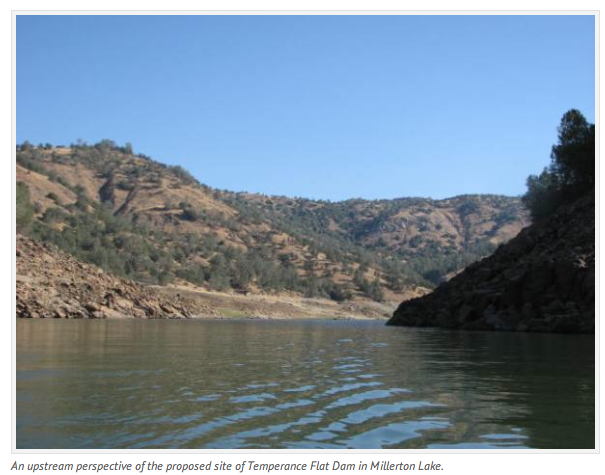
Temperance Flat EIR Expected This Fall

photo courtesy Friant Waterline

Friant Water Users General Manager Ron Jacobsma says they are anticipating a fall release for the long awaited Temperance Flat  reservoir draft EIR from the Bureau of Reclamation.The huge project  has been estimated to cost between $1 billion to above $3 billion.
Temperance Flat Dam is a proposed dam project on the San Joaquin River west of Auberry, California. The dam’s main purpose would be to supplement storage capacity in the upper San Joaquin River basin, greatly increasing the amount of water that could be used instead of lost to the sea in years of high runoff. Under the largest proposal, Temperance Flat would nearly quadruple reservoir storage in the San Joaquin basin above Friant Dam although the latest plan appears to increase overall storage by about 3X.
Temperance Flat is the key SJV reservoir backed by Central Valley  water interests who argue that the storage will help save water in a wet year to not only supplement deliveries to farmers and municipalities but to assist in the ongoing restoration of the San Joaquin River to promote a salmon fishery. The fish require cold water to help them survive in the Valleys rivers in the torrid summer months.
The call for more storage jibes with Tulare County Board of Supervisors recent letter opposing any state water bond that does not include money for more surface storage – dams. Jacobsma says Friant’s 31 water districts are allied with ACWA (Association of California Water Agencies) position supporting storage as a part of the bonds. AWCA’s proposal is in the neighborhood of $8.2 billion including some for Temperance Flat while a smaller rival plan comes in at $5 billion with little for storage says Jacobsma.
In June Jacobsma says “We learned that Temperance Flat Reservoir is still looking feasible, but operations, costs, bond eligibility for public benefits and issues related to water supply, water quality and project beneficiaries all need further analysis.”Development of the proposed.Temperance Flat Reservoir has been studied extensively in recent years and, although much analysis is still needed, a number of objectives have been identified with progress made on planning project details, Jacobsma said.
Study of the big dam has been going on for more than ten years.
Critics have said the Bureau is unlikely to show that the benefits of the huge project  exceed the costs and that the dam would flood remaining wild sections of the river and some fish habitat.
Known as the Upper San Joaquin Basin Storage Investigation, Temperance Flat’s feasibility study has identified design, capacity and operational characteristics that would increase water supply and system flexibility for farm, urban and environmental water uses in the valley and other parts of California says Jacodsma.
“We continue to encourage Reclamation to supplement the feasibility study with analysis of how Temperance Flat might be integrated into other parts of the south-of-Delta water supply system,” Jacobsma said.
The favored Temperance Flat Dam site is located within the existing Millerton Lake, a short distance upstream from its confluence with Finegold Creek in Madera County. It would create a reservoir of up to 1.2 million acre-feet while modestly reducing Millerton Lake’s capacity.
Millerton Lake, formed by Friant Dam northeast of Fresno, is the primary storage facility for the Central Valley Project’s Friant Division but has a comparatively small storage capacity of 520,500 acre-feet. That capacity is called upon to control average annual runoff of 1.8 million acre-feet.
Temperance Flat Reservoir would be larger than Millerton Lake and all of the many existing upstream hydroelectric power reservoirs combined.
It would capture high flows generated by above-average water years.
Such flows currently are mostly “spilled” as flood releases because of a lack of Millerton Lake capacity and conveyance capacity constraints in the Friant-Kern and Madera canals, that limit Friant Division groundwater recharge and banking opportunities in above-average water conditions.
That recharge could help turn around the Valley’s declining groundwater levels.

Court Decision Offers More Questions Than Answers For High Speed Rail

A Sacramento Superior Court judge ruled that the California High Rail Authority “abused its discretion by approving a funding plan that did not comply with the requirements of the law” based on wording of the Prop 1A. That bond measure, passed in 2008, required the Authority to not only specify where the money was coming from but to have all environmental clearances in place before breaking ground on a segment says Judge Michael Kenny in his August 16 ruling.

The crux of the dispute is over what is a “usable segment” as it applies to the wording of Prop 1A. The Authority has argued that they need only have money in hand and environmental clearance for the first 130 mile segment in the Central Valley from north of Fresno to Bakersfield, what they have called the Initial Construction Segment (ICS).

But Judge Kenny says the term applied to a larger corridor – the Initial Operating Segment (ISO ) – either from Fresno to the Bay Area or Fresno south to Los Angeles.

“The funding plan explicitly addressed, and was required to address, the entirety of the chosen ISO, and not merely the ICS” he claims.
The Authority has never claimed to have either all funds or environmental approvals for the longer route to either metro area yet.
It does have the $6 billion in hand to complete the 130 mile Valley segment.

Critics says the judge has this wrong and that Prop IA does not define what the usable segment has to be and merely says “corridor,or usable segment thereof.”

If the mandate for both funds and environmental clearance includes the ISO and not just ICS – the start of construction that has been set for this summer in the Central Valley would be years away at best.”This will derail the project” a number of headlines have asserted.

So now what?

The judge’s ruling is clearly a big victory for Kings County landowners and Kings County itself who joined the suit filed in 2011.”It’s a great feeling” says rural land owner Aaron Fukada who with Kings farmer John Tos launched the suit against the train that might impact their properties if the route chosen comes their way.

Clearly they would win big if the bullet train was stopped cold and did not recover from this legal blow like critics hope.”Some of the violations are so serious that the project will never be able to commence.” said the plaintiffs’ attorney Michael Brady back in March,

On the other hand the Authority’s chair Dan Richard says they are still planning to build this line that no matter which route is selected – runs through Kings County.

Indeed the judge while finding for the plaintiffs did not stop the train.

Judge Kenny said he could not rule to to invalidate the legislative appropriation.”Proposition 1A appears to entrust the question of whether to make an appropriation based on the funding plan to the legislature’s collective judgement.The terms of Proposition 1A itself give the Court no authority to interfere with that exercise of judgement.”

So it appears the judge will not try to throw out the legislature’s  approval of $2.6 billion for the train as had been requested in the suit.

What Remedy?

Judge Kenny has asked lawyers for the two sides to offer briefs for a proposed remedy.How will the plaintiffs get relief? The judge has offered no time table on how this phase of the case will play out.

Plantiffs have already called for a “permanent injunction that since Proposition 1A has been violated, it would be appropriate to enjoin any effort by the Authority to commence construction, since to do so would involve the illegal expenditure of public funds.”

There is no injunction in place now.

Kings County Counsel Colleen Carlson calls the judge decision”positive” requiring “accountability by the Authority” but doubts the judge would grant an injunction.”We are working hard  to craft a remedy” she says.Carlson adds the ruling is “just one small victory in a larger battle.”

What will all this confusion do to the Authority’s’ plan to break ground this September around Fresno?

Kings County Route Up In The Air

The wording of Prop 1A – even if it only applies to the 130 mile Valley segment – makes it clear that environmental clearance must be in place on the entire segment before the 28 mile subsection from Fresno north can break ground.

The Authority has yet to identify the alignment through Kings County – the Fresno south to Bakersfield section – that may plow through Tos and Fukada’s properties on the east side of Hanford. That would happen unless the Authority selects the western route that will impact Mr Tos ,who owns land here too, and other farmers west of Hanford.The Authority has appeared to postpone this hot button issue for months now but will have to choose sooner than later or wait even longer to break ground north of Fresno. The clock is ticking on a federal rule to spend the money.

Now it appears construction will be postponed because of engineering issues anyway a contractor told the media a few days ago.That may move slower to ensure the Authority’s plan to cross the San Joaquin River with a bridge is well reviewed. Construction work may be delayed over this issue until early 2014.

That assumes Judge Kenny allows construction to begin even then or  the Kenny case is appealed to higher court.

Then there is the confusion over environmental clearance.Is it possible the CHSRA must only complete federal NEPA clearance rather than California CEQA clearance?

To help the CHSRA board sort all this out the State Senate just appointed Richard Frank to fill up the Authority Board of Directors. Mr. Frank is currently a Professor of Environmental Practice and Director of the California Environmental Law and Policy Center (CELPC) at the University of California at Davis School of Law.

Sounds like they will need his advice. The next CHSRA meeting is set for September 10.

Tulare Co News Briefs…Top 10 Eateries, More

Visalia Council Wrestles With New Public Safety Complex

The Visalia City Council will offer staff direction next week on what scale to build a new public safety complex in the new Cvic Center area in East Visalia. The council may consider combining the proposed 911 Emergency Center with a new public safety administration building if they can handle the cost.”That makes sense if the numbers work” says council member Greg Collins. The city finance department has said they could weigh refinancing the convention center to help pay for a larger project,perhaps even a Civic Center. Another factor, city council member Warren Gubler says the city may want to take advantage of the competitive bidding atmosphere out there for building projects. As much as $15 million could be made available without hurting cash flow says a city report. The 911 Center will be built on a 16 acre city-owned parcel at the SE corner of Goshen and Burke.

Around Visalia: Orchard Supply management has told their Visalia staff that the Walnut and Mooney store will stay open with no changes after the ownership switch to Lowes,customers are being told. VP Still Tops: Visalia’s top 10 eateries ranked according to the popular website Trip Advisor are 1.Vintage Press 2.Thai Basil 3.Pita Kabob 4.Fugazzis 5.Vhar-cu-te-rie 6.Pizano’s Wood Fired Pizza 7.Brewbakers 8.Tahoe Joe’s 9.Cafe 225 10. Alejandras. Big Vacancy: Some 50,000sf of the Cigna building is available again now that San Joaquin Valley College has relocated to several smaller buildings around town.”It’s the largest office space in town” says broker Doug Burr. The building has another  25,000 ft at the west end he expects to lease up soon.

Tulare: New $36 Million UC Davis Lab Expected To Break Ground In November
Tulare’s UC Davis Veterinary Center will get a $36 million – 2 story,35,000sf California Animal Health & Food Safety Lab expected to break ground in November. The lab will provide diagnostic sampling for the Valleys dairy,cattle and poultry farmers.The lab will employ 37.The state’s labs “are the backbone of California’s warning system” says a 2011 report, for both animal diseases and food borne pathogens.
Project manager Joe Dickson says the new construction at the Tulare Veterinary Center would be the first since 2004.The November ground breaking is  dependent on a successful lease revenue bond to be sold to investors in September by the state. The bonds are sold based on getting lease money from an asset although the ownership reverts to the state after 30 years.
Dickson says the lab should take 2 years to construct. It is out to bid this month.

Banking: Sierra Bank Corp Profit Up 48% 
For the second quarter of 2013, Porterville-based Sierra Bancorp reported a net income of $3.8 million, up 48%, from the second quarter of 2012. and its stock is up over 40% year-to-date.The bank holding company has 25 branches and 400 employees. Bank of Sierra has just under a 20% market share in the county for deposits, the top bank ahead of number two Bank of America in the latest FDIC survey. The health of the bank is good proxy for the health of Tulare County. Its latest results are the highest since the fourth quarter of 2009  – just as the recession hit.
CEO Jim Holly says the region’s economy has rebounded from being the hardest hit during the housing collapse and economic downturn.”Ag is now enjoying five of its best years ever,excluding the dairy business. Around the Central Valley national home builders have returned and at the bank we have the strongest pipeline of new loan applications in our history.”
Boost for Bravo Gardens

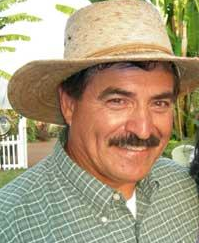
Manuel Jimenez

Woodlake: The City of Woodlake is using $1 million of its Measure R money to help improve the towns biggest tourist attraction – the 13 acre Bravo Gardens owned by the city. Founder and retired farm advisor Manuel Jimenez says the funds given as mitigation for road projects will be put to good use improving the experience at the garden that serves as a youth volunteer lab as well as park and source of pride for the community.In 2003 the city bought the former rail right-of-way along Bravo Lake and it is now planted to all manner of  fruit trees, vines and flowers. Jimenez says they expect to purchase another 5 acres on the east end of the garden for large events like the berry tasting fest and others as well as adding two sets of bathrooms at each end of the garden and water fountains for the kids plus visitors.The garden is owned by Woodlake Pride Inc,a nonprofit who guides their mission and offers tax exempt donations.