Links Plan Retirement Sale – Building Sold To Sam Sciacca
Links Men’s and Women’s Wear, a business that has been a mainstay of Downtown Visalia for some 73 years will be hanging it up in the new year. Owners Bob and Tom Link plan a retirement sale starting in November through the holidays as he and brother Tom plan to close the landmark clothier.
Located at 115 E Main, Bob Links says their building that they own has now been sold.
”I will be be looking for the next adventure in my life”quips Link. He says the building that houses their store has been in the family for more than 40 years. The business started by their father Joe Link has been Downtown since 1941.Bob Link joined the enterprise in 1959.
Life long Visalians Bob and Tom have both been involved with civic life and the rebirth of Downtown Visalia as one of most successful Downtowns in the San Joaquin Valley.
Bob Link has been a city council member since 1999 and has served as both mayor and vice mayor. Tom has been busy with the Downtown merchant and PBID organizations, the new sports park and earned an award for 2012 Visalia Chamber of Commerce “Man of the Year.”
If the Links are big Downtown boosters – the buyer of the building – Sam Sciacca – is pouring his money made from recent sales of some walnut holdings into Downtown where he says ”the future is bright.”
Sciacca says while all approvals are not yet in place he hopes to remodel the 9000sf building to leave retail on the ground floor and add as many as 6 new residential units in the two upper floors.
This would not be the first time Sciacca, a realtor in his day job, has done something like this. You will remember that Sam and wife Marlene bought the Togni building across the street a few years back and have remodeled a portion for Marlene’s business Chelsea Street Boutique with an apartment upstairs that has been rented out for years.”The renter loves it there” he says.There has been interest in building more residential in the Downtown area that also includes a unit above Crawdaddys and now several planned units on Acequia in the upper floor of a new dentist building.
Sciacca says just who will be taking the ground floor retail being vacated by Links (about 3000sf) is not clear but ” hopefully another clothier to continue the Links tradition.”
Visalia home builders permitted 57 new homes in October, the largest number of the year. Home building activity was already up 38% through September. Valuation in October was $14.2 million, also highest of 2013.
Trend of converting former car showrooms in east Visalia to office use continues with a plan being heard at the Visalia Planning Commission November 12 to remodel the 16,700sf – former Pontiac dealership building at 700 E Mineral King to office use. First in line will be property owner Don Groppetti’s radio station that will relocate there.
State of California and TCAG are wrestling with how many affordable houses should be built in Tulare County over the next 9 years. TCAG’s population projections suggests we might need around 23,000 while the latest state estimate says we should build 31,000 units.That would mean Visalia would need to insure the city offers a third more low income targeted homes than planned now says Josh McDonnell, city planner.
Landmark Oak Pit Restaurant in Porterville will reopen November 13,now owned by the Tule River Tribal Council. Located at 615 N Main, the popular steakhouse closed in 2012 but the tribe took on the project adding to a a growing list of off-reservation endeavors. The tribe owns Eagle Feather Trading Post along Lake Success as well as the Eagle Feather Trading Post on the way to the Coast at Reef City.
Tulare Outlet Mall will get a new shoe store for the holidays as German-owned Rack Room Shoes opens its first California store north of Calexico. The store remodel will start in November and be open in time for Christmas.In 1984, Deichmann Schuhe of Germany, the largest privately held shoe retailer in the world, made its first investment in the United States by buying the Lerner’s chain. Through the direction of Deichmann Schuhe, Rack Room Shoes began a period of accelerated growth,relocating its U.S. headquarters to a 72,000 square foot facility in Charlotte N.C. Today, Rack Room Shoes has over 400 stores in 26 states.
The vacant storefront along 198 at the Farmersville interchange, formerly Starbucks will now be a Taco Bell with the Subway relocating to a new building across the parking lot.
California gas prices fell 20 cents in October with the Eagle Feather Trading Post on 190 offering some of the cheapest gas in the county at $3.29 according to Gas Buddy. Gasoline is below $3 in few states in the Midwest this week. It’s $3.43 at the Visalia Costco. Friday the price of oil fell below $95 a barrel for the first time since June, a huge bonus for the consumer.
Staff of the California High Speed Rail Authority are recommending that the board select the East of Hanford route as its preferred alignment along the Fresno to Bakersfield segment. The November 7 CHSRA agenda staff report is being posted today says spokesperson Lisa Marie Alley. The news is welcome at the City of Visalia who have lobbied hard for a station site closer to Tulare County on the east side of Hanford instead of an alternative route west of Hanford with a station site near Armona. Visalia argued that ridership would improve if the station was closer to the larger population centers. Alley says there were fewer environmental issues on the east side as well.
The selection will probably not please opponents of the bullet train project including Kings County residents who own property along the east side route and who have sued the agency.
In fact on November 8 a court hearing is set to hear a judge’s ruling on what sanctions if any will be mandated regards the expenditure of state Prop 1A funds by CHSRA to build the project.
Rail officials have argued they will move forward with federal dollars to build the first segment of the line – a 29 miles route from Fresno to Merced, while the state monies issue is litigated.
east or west of Hanford?
The second segment is Fresno to Bakersfield – a 114 mile section. On this segment, the CHSRA is requesting the federal Surface Transportation Board approval of an exemption effective December 31 even though a final EIR would not yet be certified. In their STB filing – CHSRA says they expect to complete construction of the Bakersfield to Fresno section by December 2018 and start HST service by 2022. Such an exemption was granted on the first Fresno to Merced section.
Also in news of interest in the Central Valley – former Tulare County Farm Bureau director Cheryl Lehn has been hired as a public information officer for CHSRA starting next week. She will be headquartered at the new Fresno office. Lehn has been working for the consulting firm URS assigned the high speed rail
NATIONAL PARK SERVICE WANTS TO ESTABLISH NEW NATIONAL HISTORICAL PARK TO HONOR CÉSAR CHÁVEZ
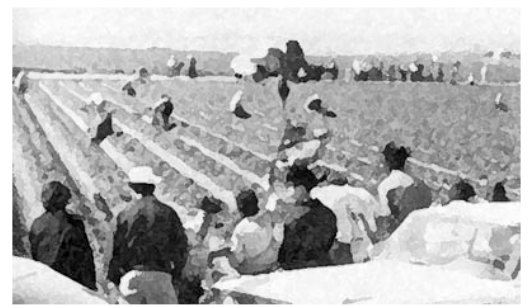
Under Special Resource Study’s Preferred Alternative, Newly-Established César E. Chávez National Monument Would Act As Cornerstone For National Historical ParkWASHINGTON, DC – In response to a request from Congress to study sites related to the life of César Chávez and the farm labor movement, the National Park Service today transmitted a final resource study recommending the establishment of a new national historical park to interpret the life of the civil rights leader and preserve the places important to the Farm Labor Movement.“César Chávez was one of the most important labor and civil rights leaders of the 20th century, and the Farm Movement he led improved the lives of millions of agricultural workers,” said National Park Service Director Jonathan B. Jarvis. “Sites associated with his life and the movement he led are an important part of American history and should be included in the National Park System not only to honor his legacy but also to ensure that future generations learn about what the movement accomplished. I am pleased to transmit these recommendations to Congress for their consideration.”“César Chávez was at the epicenter of some of the most significant achievements of the Civil Rights and labor movements in our nation’s history and through his leadership, farmworkers achieved unprecedented labor, political and social gains,” Secretary of the Interior Sally Jewell said. “Recognizing these sites associated with his leadership of the United Farm Workers as part of a national historical park will ensure that his contributions to the Civil Rights movement will be preserved and shared as an inspiration for future generations.”Historians from the National Park Service, and California State University, Fullerton evaluated approximately 100 sites related to Chávez and the farm labor movement in developing the report, entitled the César Chávez Special Resource Study, which was requested by Congress in the Consolidated Natural Resources Act of 2008 (P.L 110-229.)The report not only considered sites for inclusion in the park system but also for additional designations, such as listing in the National Register of Historic Places or designation as a national historic landmark.
Under the selected alternative, five sites would be included in the new national historical park:
The Forty Acres National Historic Landmark, Delano, CA Filipino Community Hall, Delano, CA Nuestra Señora Reina de la Paz, Keene, CA (César E. Chávez National Monument, established October 2012) McDonnell Hall, San Jose, CA The Santa Rita Center, Phoenix, AZ.
A partnership-based national park site or technical assistance program which provides opportunities for collaborative management to protect cultural resources, provide public access, interpretation, and educational opportunities at certain sites associated with the life of César E. Chávez and the farm labor movement is a feasible addition to the U.S. National Park System. There is a need for National Park Service management to achieve partnership-based protection of significant resources and enhanced visitor appreciation of the important resources and stories associated with the life of César E. Chávez and the farm labor movement.Under the preferred alternative transmitted to Congress today, the César E. Chávez National Monument in Keene, Calif. would serve as a cornerstone for the new national historical park. The monument was created on October 8, 2012, by President Obama as the 398th unit of the National Park System and includes Chávez’ home and the headquarters of the United Farm Workers of America (UFW) since the early 1970s when Chávez was its president. It is funded in part by the American Latino Heritage Fund of the National Park Foundation, which supports the work of the National Park Service in preserving historic places that tell a more inclusive story of American Latinos’ economic, civic and cultural contributions to the American experience.
Croatian Exhibit to Debut at Farm Labor & Agriculture Museum
The History of Tulare County Farm Labor & Agriculture Museum will debut a next exhibit on November 3 – Diligence Grown from Strong Roots: Honoring Croatian Experiences in Tulare County.
The public is invited to attend a reception to honor the opening of the new exhibit from 1 p.m. to 3 p.m. at the museum, located inside of Mooney Grove Park in Visalia. Admission to the park and museum is free.
The museum has collaborated with members of the local Croatian community to create a display that will tell the story of the influence that this community has had on Tulare County.
Photographs and artifacts from local Croatian families aim to showcase the Croatian culture, which includes a wide variety of elements such as widespread participation in the table grape industry, musical instruments and strong family ties.
The exhibit opening program will include: traditional music played by a live Tamburica band and brief talks by community members featured in the accompanying video produced by Tulare County Office of Education. Deli meats, cheeses, and pastries, provided by A1 Imports of San Pedro and Biljana Koncevski, will be available for tasting during the event.
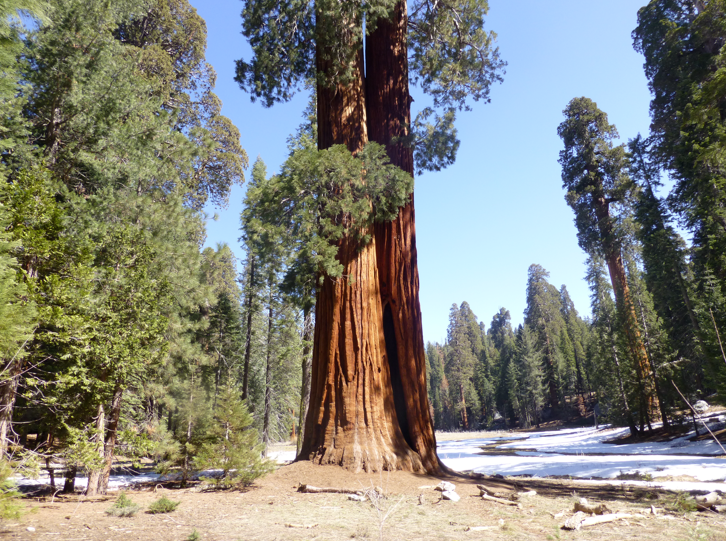
little snow in Giant Forest in Sequoia in early April
Sequoia Trees And Climate Change
By Kate Siber
Who doesn’t love a good mystery?
Stand amidst a grove of sequoias, the largest trees on Earth, and you’ll notice the shade, the peace, and the contemplative silence of other visitors. But you may also notice another novelty: the confounding inability to wrap your mind around the scale and age of these 20-story-tall plants.
“Sequoias fascinate us simply because as living things, they surpass our understanding in more ways than almost anything else,” says Bill Tweed, the former chief naturalist of Sequoia and Kings Canyon National Parks and author of Challenge of the Big Trees. “They grow so much larger than we do. They live so much longer than we do. They are so much more resilient than we are. They just appeal to human nature in a very fundamental way.”
Over centuries, these trees have weathered blizzards and droughts, thunderstorms and forest fires. Despite their longevity, however, giant sequoias will encounter novel challenges this century. Climate change will present a number of new threats, as fires grow more severe and winter snowpack diminishes. Scientists are working to understand how this mysterious species will respond, but many are concerned that the groves won’t be able to adapt quickly enough.
“It’s highly probable we’ll see lots of tree die-off,” says Nate Stephenson, an ecologist at U.S. Geological Survey’s Sequoia and Kings Canyon Field Station. “Animals can migrate by walking or flying. How do trees migrate? Well, they die in one place and have to reestablish in another.”
Giant sequoias currently grow in a narrow belt of the Sierra Nevada in nearly 80 groves, many of which are protected by Yosemite, Sequoia, and Kings Canyon National Parks. These giants top 300 feet in height, live more than 3,000 years, and, according to recent research, put on a greater mass of wood each year.
Already, the tree species that surround sequoia groves are showing signs of stress under climatic changes. Research led by Stephenson, which evaluated 18,000 trees over about 20 years, found that the firs and pines of the Sierra Nevada have been dying at higher rates—and that the increase in mortality is linked to rising temperatures.
Scientists believe that if temperatures rise as much as projected in California—between three and nine degrees over the next century—sequoias will be threatened, and seedlings would struggle to establish themselves at all.
Young sequoias thrive in environments that are moist but see frequent, mild ground fires. One projected effect of global warming is that the mountains’ deep snowpack—a critical reservoir for these giant trees—will melt sooner in the spring, meaning that the groves will need to subsist on less water for longer. A drought of only two years can kill new seedlings.
Forest fire patterns also could change. Already, a 100-year history of fire suppression has allowed small plants to grow rampant in American forests, acting as kindling for an increasing number of large, destructive blazes. Mature sequoias can bounce back from fires, even when more than 95 percent of their canopies are scorched; seedlings, however, are wiped out. Under prolonged fire conditions, it could be difficult for any seedlings to grow successfully.
Much is still unknown about how mature sequoias will react in the face of environmental changes—and when. Researchers from Humboldt State University and the University of California–Berkeley are looking for answers with a landmark study of coastal redwoods and sequoias. The team surveyed 16 plots in state and national parks, recorded baseline data on the trees, and established climate-monitoring stations in canopies.
Todd Dawson, a professor at Berkeley and a leading scientist on the study, hopes that the data collected will help conservation organizations, national parks, and legislators make management decisions to protect the species in the future. “It takes a lot of resources and energy to maintain such a massive organism,” says Dawson. “If you change the environment abruptly or in the wrong way, these really big organisms seem to be affected first. That’s why we think these trees could be a pretty important barometer for monitoring climate changes in California.”
Other scientists, such as Stephenson, believe that mature individuals might be more resilient than pines and firs because they have survived nasty droughts and spent millennia digging their roots deep into cracks in the granite. Over their 100-million-year history, they certainly have endured a lot. Still, they have not faced the speed of change the 21st century brings.
But the Park Service is taking action. In Sequoia and Kings Canyon National Parks, fire ecologists perform prescribed burns to prevent massive forest fires and to create the bare, mineral-rich soil in which seedlings thrive. This summer, Yosemite is launching a $20-million restoration of Mariposa Grove, which will remove a parking lot, gift shop, and road so workers can restore soil and ensure that water flows through the area more naturally.
Of course, no one knows precisely what conditions this new century will bring, and it’s likely these trees still have a thing or two to teach us.
“The human mind can become habituated to even the most amazing things over time,” says Tweed. “But the more time you spend with sequoias, the more fascinating and compelling they become.”
Retail News: Burlington Coat Factory held its grand opening on Oct. 25 for their new 50,000 square foot store in part of the former Home Base location.Now Mor’s Furniture is coming a few blocks north.But the latest news is that Ashley Furniture – the fast growing upholstered furniture store and maker is scouring the town for a spot as well.The company has 400 stores nationwide and is in Bakersfield and Fresno.The retailer has more than $3.3 billion in sales. Furniture sales are up as the housing market has recovered.
Fewer Distressed Homes: Here is a good sign.California Association of Realtor reports there are fewer distressed home sales in state and in Tulare County. The decline in REOs and short sales in the county is dramatic – from 54% of all sales in Sept 2012 to 26% in Sept 2013. Statewide,distressed sales fell from 37% to 14.5% over the same
time.
Roof Top Solar Boom: Homeowners in Tulare County and all over the state are signing up for solar panels on their roofs in record numbers. The biggest player in the field is Wall Street favorite Solar City who is installing more than half the units here. According to permit figures the number of residential solar building permits in Tulare County has grown from 77 for this date in late October in 2011, valued at $2.3 million, to 640 units during the same period in 2012 valued at $17.8 million. This year the numbers are up to 786 permits at $22.2 million,more than a 10 fold increase in both numbers and value from just two years ago.
Tulare County PACE Program recently approved by the BOS offers to do 100% financing for solar installations at commercial and ag properties with director Mike Washam adding there is some $13 million in projects awaiting final approval including a big packing house and dairy among others.
Visalia’a largest public works project ever will now go forward. At their October 21 meeting the Visalia City Council denied the appeal by Balfour Beatty Co and authorized award of the $93 million construction contract for the Water Conservation Plant upgrade to W.M. Lyles, Inc. Staff anticipates executing the contract in early to mid-November. On Sept.16, Council had directed staff to continue with the award of the project to W.M. Lyles, the lowest responsive bidder.Staff at the city had recommended re-bidding the project citing irregularities.But a majority on the council found those issues to be minor with member Collins voting to rebid.The city hopes avoid any court fight.
Come next July Kaweah Delta Medical Center will add 15 more graduate physicians working in the district including a new psychiatric program.But the district is not the only local health care provider bringing in student docs to bolster care here.
Reason To Smile: Visalia-based Family HealthCare Network has partnered with Lutheran Medical Center’s dental program to set up a dental residency program at FHCN health centers.The dental residency program places dental residents in community health center sites for comprehensive general dentistry training.Dental services are offered in Porterville, Visalia, Goshen, Woodlake, Cutler and Hanford. A seventh site in Terra Bella is scheduled to open December and will offer dental services. Post-doctoral dental residents will begin their first year beginning in July 2014.
Dollar Stores Fallout: Two planned new dollar stores in Lindsay are on hold after some disputes. Activist Trudy Wischemann sued the city on the location for a Dollar General store after she objected to a previous plan. “Dollar General is not coming” stated mayor Danny Salinas at their most recent council meeting.”We lost one of our biggest projects, a million dollar project” he said. A second Family Dollar store in town is also on hold because of issues with CalTrans.Meanwhile, a Dollar General store is moving forward in Exeter. Wischemann,who writes a column in the Exeter paper, says Lindsay did not follow planning rules.”Our city has been ignoring those laws so long they think they’re exempt.”
Rock On: The step up in construction activity has spurred Orosi Rock on Ave 420 to seek permits to increase its aggregate volume from 6.8 million to 10.8 million tons. Also nearby the Hunsaker Mine -1.5 miles northeast from East Orosi – wants to expand its operations adding an additional 55,000 cubic yards of crushed material at their site.
Parks Congressional Reps Split On Re-Opening Government
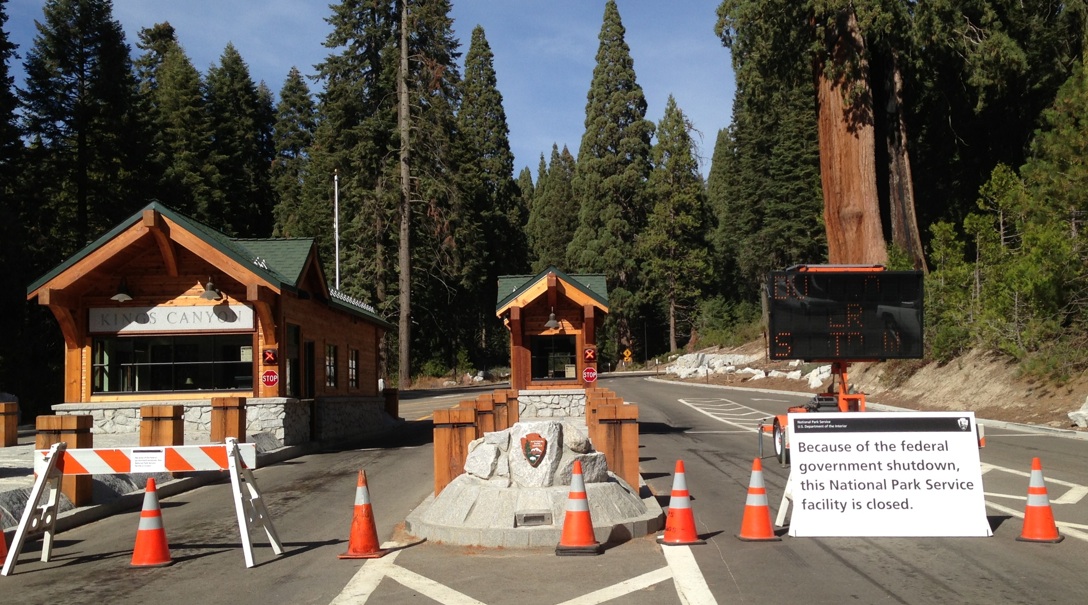
Entrance To Kings Canyon NP
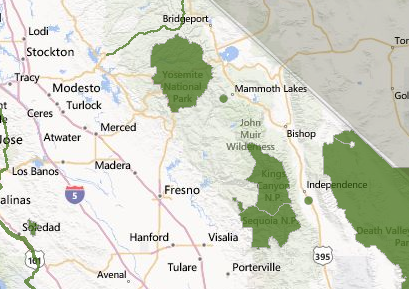
After 16 days of being shut down by the drama in Washington – the Central Valley’s largest tourist draws have re-opened for business.The news is welcome by the Valley’s gateway communities, at the base of these world famous national parks – Yosemite,Kings Canyon, Sequoia Park and Sequoia National Monument – who have been hard hit by visitor cancellations, job layoffs and big financial losses said to be in the millions.Yosemite receives an average of nearly 4 million visitors a year meaning as many as 150,000 tourists were turned away during this 16 day period. Sequoia and Kings Canyon get around 1.7 million tourists a year combined. Parks’ spokesperson Dana Dierkes says that Sequoia gets about 4000 visitors a day who want to visit the Big Trees during October meaning that perhaps 64,000 tourists were turned away in the past several weeks.The news that the parks were shuttered has reverberated in Europe where some long-made plans to visit the Western US this Fall are now long-gone despite the end to the shutdown. A state tourist industry exec says the shutdown has had a “negative impact on current international and domestic travel, as well as future bookings.”
“Early October is a huge time for visitors – particularly Europeans” says Sequoia Natural History Association director Mark Tilchen. The nonprofit group has felt the pain itself laying off 13 staffers during the government shutdown. Tilchen estimates the organization that offers educational, interpretation, research and the natural and historic preservation in these parks lost about $80,000 in revenues from visitors not spending money entering Sequoia’s Crystal Cave, run by the group, or at parks gift stores where the SNHA gets a cut.
Echoing what Three Rivers merchants said about their summer business Tilchen says Crystal Cave visitation was up 5% this summer but that the “closure in last few weeks in October have erased that.”
Yesterday SNHA hosted a dinner for laid off employees of the Park as a morale booster says Tilchen that turned into a celebration once news came out – folks were going back to work.
That’s good news for the Parks private concessionaires particularly Delaware North with National Park facilities in both Sequoia and Yosemite that were closed along with lodges in Grand Canyon and Niagara Falls.
Inside Yosemite,Kings Canyon and Sequoia boundaries 7 hotels where shut down for some period but finally open late this week.
In the community of Three Rivers the owner of one the popular motels, Glenn McIntyre of the Gateway Lodge, led a letter writing campaign to lobby our congressmen to end the budget standoff.
At a community meeting on the shutdown National Parks spokesperson Dana Dierkes stated that in October about 4000 visitors enter the park on a daily basis. The shutdown furloughed 284 NPS employees while 63 continued to work.
How They Voted
The congress members representing the parks include the GOP’s Devin Nunes who voted in favor of re-opening the government this week while another Republican – Tom McClintock who represents the Yosemite area – voted no. The votes reflect the split in the Republican party. Also voting yes to re-open were he GOP’s Kevin McCarthy of Bakersfield and the 21th District’s David Valadao while Jeff Denham of Oakdale voted no.All Democrats voted yes.
Another Three Rivers hotel owner Buckeye Lodge’s Dennis Villavicencio added that the foothill community’s businesses were ”bleeding money right now” that will never be recovered, he told the Three Rivers newspaper.
Taxes Lost
The sudden cut in revenues has hurt private business as well as the cities that depend on that spending.Tulare County’s travel impacts were nearly $400 million in visitor spending 2011 according to a Dean Runyon Associates study – with tax receipts of nearly $25 million.
Kern and Tulare County gateway towns near the Sequoia National Monument were also affected by the closure. Ironically, many foreign visitors turned away at Sequoia Park headed out to see the Giant Sequoias in lesser known reserves like Tulare County’s Balch Park and the state park Mountain Home – both near Springville.
The impact on the communities surrounding Yosemite was compounded by September’s RIM Fire that scared visitors away during the height to the travel season.
During the shutdown Yosemite Park was called a “ghost park” by one employee,Dan Williams quoted in the Bee as motorists who did use the highway to Tioga Pass were warned not to stop – even for a photo.
“I remember there was a Japanese family that arrived and there was a grandmother in the back of the sedan and she wanted to see a giant sequoia,” Williams said. “I remember having to say, ‘No, you can’t do that,’ and turn them around, and they got so close.”
If the unexpected shutdown ruined visitor plans it was tough for businesses who service the Yosemite visitor economy.
The Mariposa Chamber of Commerce released this statement on the financial impacts on October 8.
“With Yosemite Gateways still reeling from the Rim Fire, a government shutdown that forces Yosemite National Park to close will hit this region with a one two punch that will have crippling effects to our communities. It will take years to recover. Some businesses may not even survive.
The trickle down impact from over 1600 employees being laid off or furloughed from both the National Park Service and the Concessionaires inside that park will add to the disastrous effect this government shutdown yields on our local businesses. For our small rural community this equates to approximately 25% of our workforce. These unintended victims will have to hold off on purchases, cut back on simple things like dining out, and perhaps even feel it necessary to delay medical treatments. Thus deepening the effect of the government closure has on all of us.
When this happened seventeen years ago, it was winter time. We are still on the high end of our shoulder season, plus we need to account for seventeen years of inflation. Therefore, we can only anticipate the damage to be the same if not worse than it was in 1995. Then lodging occupancy dropped by 80% in Mariposa County. The concessionaire inside Yosemite National Park lost between $200,000 and $300,000 a day with hundreds of thousands more being lost daily from the gateway’s outside of Yosemite.”
That includes Fresno that advertises itself as the gateway to Yosemite and includes the Yosemite name in their airport. The Dean Runyan study says Fresno had 2011 travel spending of $1.23 billion and tax receipts of some $81 million. Travel related employment tops 12,250.
Mariposa Chamber executive director Kathy McCorry says earlier this week some lodges near the park had just a 5% occupancy as visitors trying to enter the park were turned away unless they simply drove through on the way to Hwy 395 on the state’s east side.
The same Dean Runyan study says visitor spending in Mariposa County in 2011 was about $356 million with tax receipts of $22 million.
Now that the gates are open McCorry says starting today the chamber will launch a massive media campaign with the help of a newspaper and TV station offering free exposure to get the visitors coming back.People who complain about the crowds in Yosemite might want to take this unique opportunity.
“All Trails Lead To Mariposa” is the kickoff campaign.
Mariposa County needs the money.The Dean Runyan study says 92% of Mariposa’s tax revenues comes from visitor spending.
The feared Asian Citrus Psyllid appears to be spreading across the citrus belt this fall with new finds this weekend( Sept 30) in Fresno County between Orosi and Orange Cove, a new find near Strathmore and a third new ACP find in a trap in southern Tulare County near Ducor. All three are not far from sites where the pest was discovered in Tulare County at multiple locations this summer but each some miles away.
According to Tulare County Agriculture Commissioner Marilyn Kinoshita the find in Fresno County is near the intersection of Hills Valley and Floral near the Fresno/Tulare County line northeast of Dinuba. Dinuba is where a significant find of all lifecycles of the pest was discovered earlier this month. But this latest find in commercial grove is miles from Dinuba and is closer to Orosi, south of Orange Cove . The Dinuba finds have been called a breeding population located in backyard citrus in that town discovered around September 10.
The newly found Strathmore discovery is near the Porterville quarantine zone set up by CDFA in late July but north of it. Likewise the new find near Ducor is south of the last find and also outside the Porterville area quarantine zone by miles.
“This shows the pest is the spreading” says Kinoshita noting that citrus expert Dr Beth Grafton Cardwell had predicted recently “we will find more ACP in the area this fall.”
The new finds are making it more likely that the quarantine zones will be expanded just in time for the new citrus season and impact Fresno County for the first time.
The zones include 90 square miles around Porterville, a new Kern County zone around Wasco – as a result of a backyard find – that is 88 miles and now a new zone being developed in northern Tulare County and southern Fresno Counties.
Citrus stock within the zones may not be moved outside the zones without a permit and commercial citrus fruit must be cleaned of all leaves and stems before it can be shipped.
As of yet the insects are not carrying the dreaded citrus greening disease or huanglongbing (HLB) disease that kills citrus trees and is spread by this insect, the Asian citrus psyllid.
Still the disease was found in one LA backyard some years ago and it is “just a matter of time” until the disease finds its way to Tulare County – the number one citrus producing county. ”We assume it is in LA and it is also moving up from Mexico.”
Backyard citrus is a major problem since homeowners don’t typically watch for the tiny insect. Some 60% of homes in the state have citrus and there are more backyard citrus trees in the state than commercial citrus trees ,says Grafton Cardwell.
Researchers are working on several fronts including developing a rapid detection test that “sniffs VOC’s” put out by a diseased tree.
Both cold weather and hot weather slow the insect down, a benefit of the California climate.
Researchers have a few tricks up their sleeve when disease does come here. One involves using the vector for another citrus disease – the mild strain of Tristeza (CTV) spread by aphids that causes little production losses compared to severe strains. Grafton Cardwell says the idea is to use the CVT virus as a carrier into the tree that would inoculate the tree from HLB. Also, modify a psyllid that can not acquire HLB and flood the area where these harmless insects disrupt the mating of HLB carrier psyllids.
Another highly visible but empty property on Mooney is being filled up. We are talking about 3000 South Mooney Blvd that has been a car dealership for over 40 years since Ottmar Thomas days and a vacant car dealership in more recent years. Now it will be the new home of Mor Furniture For Less who is buying the 4 acre property and plan to remodel both the front showroom building for their new furniture store and the rear building into a furniture returns center where you can get a deal on pre-owned goods.This is according to a plan filed with the city.
Mor Furniture already has a Visalia connection since its Valley distribution warehouse is in the industrial park. They have been looking for the right spot for a retail store here for several years.
A application with the city says they will add 12,110sf to the front building and 24,322sf to the rear building or about 60,000sf of furniture sales – likely the biggest offering in town.
Mor Furniture was launched in San Diego in 1977 as a water bed store (remember those?) where its corporate office still is.The retailer has 27 locations around the West.
Red Ink, Black Ink – Tale Of Two Hospitals
Two district hospitals only a dozen miles apart appear to be on remarkably different tracks.
Tulare Regional Medical Center has put out the “for lease” sign hiring a consultant firm this week to give them a “market value” for their facilities.Meanwhile their latest financial snapshot reports nearly a $2 million loss for the first two months of this fiscal year through August.That continues a trend seen last year with a reported $8.1 million loss as of last May.This week TRMC reported some Tulare docs were choosing other hospitals to send their patients. The hospital reported a daily census in August of 44 compared to 53 patients in August 2012. Tulare Regional Medical Center CEO Shawn Bolouki some months ago let the community know their district will not last without a partner. No timetable yet on when such a “partner” might emerge.
At Visalia’s Kaweah Delta’s Healthcare District the picture is one of growth,of welcoming a dozen new resident physicians this summer and its new status as a Level 3 Trauma Center, with a new helipad. The hospital’s Emergency Department has over 80,000 annual patient visits. The financials for Kaweah Delta show by contrast to TRMC – a large “surplus” of funds.
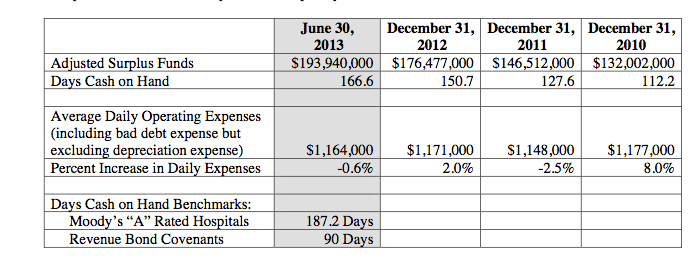
Earlier this month CFO Gary Herbst released their semi-annual investment report showing that this institution has definitely bounced back from the recession with their surplus funds experiencing a 47% increase from 2010 to 2013, and the number of days cash on hand increasing 48% from 2010.
Herbst wrote that the increase in total surplus funds of $61.9 million from 2010 to 2013 are a result of its net income increasing $47.2 million over those years,charitable contributions of $9 million, debt retirement of some $19.2 million,a decrease of its property,plant and equipment expenses and an increase of its net accounts receivable of $8.3 million. One metric that is closely watched is “days cash on hand” that has increased to166.6 days in June 2013 from 112.2 days in December 2010, the height of the recession.
Tulare County Leads On Obesity
Tulare County has a big problem.Too many of its residents are either obese or overweight says a Community Needs Assessment of people in the Kaweah Delta Healthcare District comparing counties in the Valley. The study found that 31.10% of Tulare County adults were obese and 37.59% were overweight – both the highest percentage in the Central Valley.By comparison 23.25% of people in California are obese and 36.20% are overweight. A 2010 study found that among children – Tulare County led again with 43.8% of them overweight compared to 38% in California. Kaweah Delta is working on ways to address this and high diabetes rates.
Setton Pistachios has purchased some 7 acres of railroad land next to their plant in Terra Bella, the largest industry in town, and plans to develop it as community park and playing fields. For this low income community it will be their first park as well as offering a place to get clean drinking water. GM Lee Cohen says the project has been in the works for months awaiting a parcel spilt and work can move forward in October to put in picnic and children’s play area. Later phases could add a soccer field.
Supers Don’t Like Fish Wildlife Plan
Tulare County Board of Supervisors have written the US Fish and Wildlife Service to oppose a plan to establish a California Foothill Legacy area that would include 35,000 acres in Tulare County. The plan would deny development on easement lands in perpetuity say the BOS. But the program claims that” the easements would encourage continued ranching operations because of the wildlife benefits they provide, while limiting the type and amount of development that may take place on a property in the future. The proposed program would be completely voluntary. No new regulatory requirements would be placed on lands within or outside the program area.”
New Jail In Works
Supervisors plan to replace old jail facilities at Sequoia Field a notice says.Tulare County wants to replace 4 older buildings at Sequoia Filed that date from WW2. Included in the notice to be replaced are the Mens Correctional Facility with 200 bunk beds (for 400) and the Day Reporting Center that includes the sheriff crime lab.
New Clinic In Terra Bella
Family Healthcare Network plans to build a 4212 sf health clinic on a parcel owned by Terra Bella Union School in Terra Bella. The county approved the project earlier this month
198 Corridor To Get New Homes
Tulare County approved a parcel split on West 198 land on the edge of Visalia city limits. The split approved this week by will allow an annexation of one parcel as two into the city. That annexation of land on Rd 88 north of 198 would bring them in designated for different uses depending on which side of the creek they are on.The smaller parcel on the south side of Mill Creek and abutting 198 would be zoned conservation and the nearly 20 acre parcel to the north of Mill Creek would be annexed into the city for residential use.The development would be the first on West 98 to include new housing along portions of the formerly ag-based “scenic corridor” allowed now because of a new city council policy. That policy also insures that a strip of land along the corridor remain open space.
New vehicle registration has revved back since the Great Recession in Tulare County mirroring a trend seen across the nation.
“We’re not all the way back from the high during the 2005/06 period” says the county’s largest auto dealer Don Groppetti of Visalia.
Still the improvement is dramatic
Groppetti received a report of all new registrations and through July of this year there were 6756 new vehicles in the county.
By comparison through July 2010 only 3937 cars and trucks were registered.
“Id says we are still some 15 to 20% below all time highs but we’ve made it most of the way back.”
Talking about the market Groppetti says truck sales have rebounded but the “recreational user” of trucks is not what it used to be.Instead, mid-size and SUV brands are the strong players.
Since the recession some dealers in the Visalia car sales market have changed like Frank Serpa, who has exited. Only his Kia line remains independent being operated by dealer Dwight Nelson. The Surroz family has sold its Chrysler store in Visalia to the Lampe family but continue to run their BMW dealership .
Around California the California New Car Dealers Assn says the California new vehicle market had another double digit percentage increase in the Second Quarter of this year, with new light vehicle registrations improving 12.4 percent versus a year earlier.
It was the eleventh consecutive quarterly year-over-year increase. The Assn is now projecting that this year’s annual total will approach 1.7 million units, up11.1 percent from 2011 and more than a 60 percent increase over the recessionary low point in 2009. Used Car Sales Down
Also during the second quarter of this year used vehicle registrations fell 5.3 percent. Four year old vehicle sales declined due to tight supplies Used registrations in the state declined 5.3 percent during the first six months of this year.
The California new vehicle market has been growing at a faster pace than the used market for the past several years. New vehicle registrations increased 25 percent in 2012, while used registrations were up just 1.9 percent.
Franchised new car dealerships continued to increase their share of the overall state used vehicle market. Franchised dealers accounted for 18.6 percent of the market in the first half of this year, up from 12.9 percent in 2009 and 17.5 percent last year.
Visalia’s historic road connections have been shaped by the railroad and it is only recently that that the town has pushed to connect dead end roads that have hampered access and investment in older parts of the city
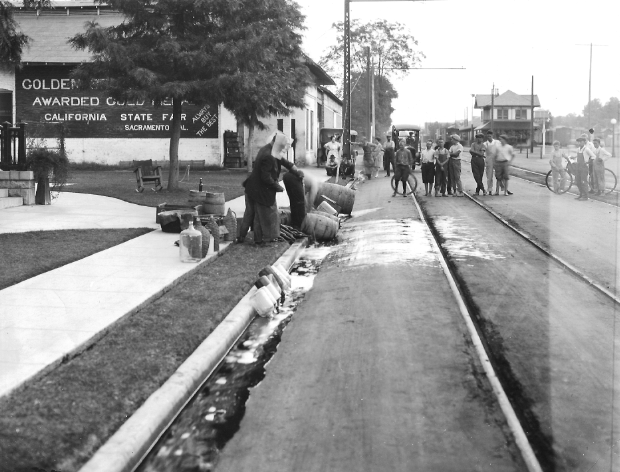
Beer spills down Oak Street in Visalia during Prohibition – Oak St was a dead end at the rail yard seen in the back.Notice tracks built into the street scape.Today the city is being thwarted by UP Railroad to expand the same design of the street further east.( click pics to enlarge)
The turn around came in 2010 with the construction of the Santa Fe bridge across Hwy 198 eliminating a bottleneck on a street that crosses virtually the entire city but because of poor access has been a virtual backwater for new development.
Now the bridge allows traffic, bikes and pedestrians to travel from one edge of the city to the other with a bottleneck remaining north of Houston where only old rail ROW remains to be paved through the heart of the northside.
Speaking of Santa Fe the old rail ROW south of town is soon to be transformed into a bike and walking path between Visalia and Tulare as it is through the city of Tulare already, soon spanning the main UP tracks with a pedestrian bridge.
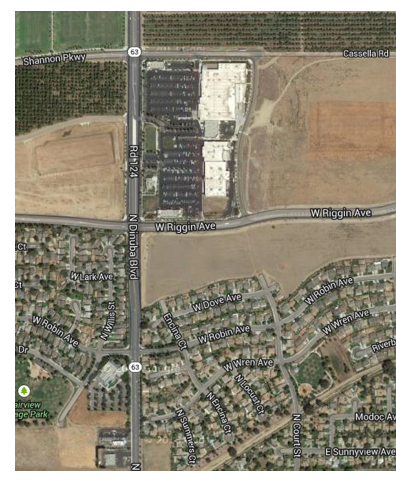
Back in Visalia, Court St will get the connection as well ,a cross-town street that dead-ends at its northern leg until now.The recently approved 10 acre commercial development by Bridgecourt Homes at the southeast corner of Riggin and Dinuba Highway will result in the developer connecting Court St – a dead-end now – to Riggin. Historic Court St will now connect the city’s two big big box areas from Cameron to Riggin. Riggin is suddenly a big street for development on the city’s northern tier because it connects to Hwy 99. All this is drawing new investment to what was a dusty country road a few years ago.
Left ,Santa Fe bridge – Below,extending Court St
Likewise east of Downtown where the old rail yard and stock yard has always limited street access and resulted in this place literally being a dumping ground and backwater, a hobo jungle through most of the the last 100 years.
With the city purchase of land over a multiple block area east of Tipton this forgotten part of town,last to be asked to the dance – will soon be first. – the new Civic Center area.
Now lowly School St – not a major address in the Downtown area – will be the only street extended in this district all the way to Ben Maddox likely providing a major access point off o fBen Maddox and 198 into the new Civic Center district.
Other infrastructure work planned will be to improve Burke and underground all utilities in the area.
Completing Oak Street is another matter. As you know well the rail line blends into Oak street east as it has for years as seen in this historic photo (above).
Looking at the photo shot from across the street from the Depot you see the old freight depot,no longer there, and what was a streetless rail yard until it was redeveloped by the city.This was a tough part of town and site of the old jail,a creamery and other old industrial uses.
Once the street went east of the Depot restaurant the city has encouraged development attracting Family Health Network clinic ,the Chamber of Commerce and Buckman Mitchell Insurance as well as the city’s new Transit Center and offices.
To encourage standard development the city continued the rail-within pavement along the blocks to the east completing Oak St to Tipton.
New Civic Center area roads,or lack of them.(Click to enlarge map)
Now here is the news part -the UP will not allow the same embedded rail-in-pavement pattern east of Tipton – in the heart of where the new Civic Center was to be designed.
City officials say UP wants no pedestrians on the tracks leaving the rail only in place and forcing the city to rethink how Oak St will happen.
Also, when the railroad sold the city the land – they had a clause limiting the types of development.That has prompted the city to design the new 911 Dispatch Center as well as Public Safety building further east – near Burke and Goshen Ave – off of former UP-owned land , potentially making Oak another dead end.
One more piece of good news – Foreign Auto Works will relocate its auto repair business to Cain St by the DMV in October making room for the demo of the old service-commercial building to construct the new ImaginU Children’s Museum at the corner of Oak and Tipton whether the railroad wants it or not.

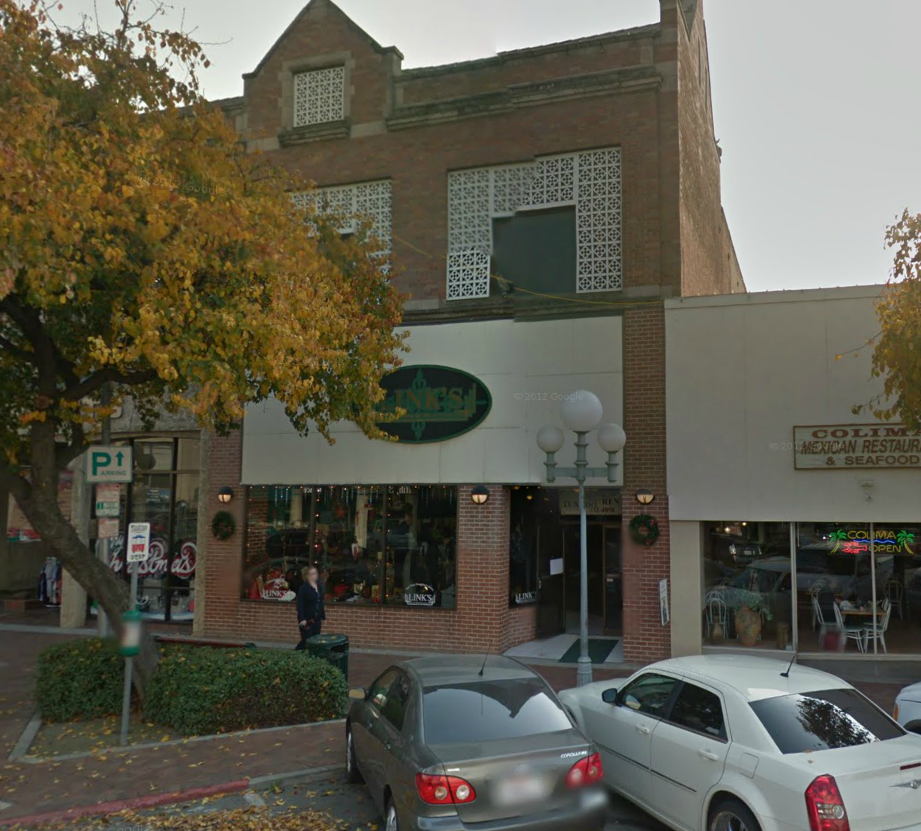 Links Men’s and Women’s Wear, a business that has been a mainstay of Downtown Visalia for some 73 years will be hanging it up in the new year. Owners Bob and Tom Link plan a retirement sale starting in November through the holidays as he and brother Tom plan to close the landmark clothier.





 Gateway Communities Lose Millions Of Dollars