Retailer Home Goods store, a division of TJMaxx will replace the OfficeMax store in the Irish Hills Plaza shopping center in the new year. Bids to do the tenant remodel in the building on Froom Ranch Way at Los Osos Valley Rd are due November 12 according to reliable sources and contractors have been touring the space.
HomeGoods had some 415 stores nationwide at the end of last year but none on the Central Coast.
HomeGoods offers home fashions with a broad and fresh array of products from around the world, such as giftware, home basics, table-top, accent furniture, lamps, rugs, bath and bedding, decorative accessories, children’s furniture, seasonal merchandise, and wall décor.
The closure OfficeMax comes as former rival Office Depot announced the merger last winter. Office Depot has only one store in the market in Santa Maria.There are two other OfficeMax stores in SLO County including locations in Paso Robles and Arroyo Grande.
In SLO city the departure of OfficeMax leaves only Staples in the office supply superstore category.
The merger of Office Depot and OfficeMax was finalized November 5, only a few days ago. The combined company will use the name Office Depot, Inc. and will trade on the New York Stock Exchange under the symbol ODP. The company has combined annual sales of approximately $17 billion, employs about 66,000 associates, and serves consumers and businesses in 59 countries with more than 2,200 retail stores.
Energy giant Dynegy announced this week they would close the 60 year old Morro Bay Power plant adding that the site could still have a future – a green future.
Dynegy said in a statement they were advising the State of California that they were“currently evaluating alternatives for the site including developing renewable energy shaping technologies as well as preferred renewable resources, as defined by California laws and regulations, at the site with Starwood Energy Group Global, Inc.”
The natural gas fired plant that uses water from the ocean to cool its turbines was expected to close as a result of state regulations requiring coastal power plants – including the state’s two nuclear power plants – to phase out the use of once-through cooling systems. The process is said to harm aquatic life.
About a year ago Dynegy advised the state it would not upgrade the waterfront plant to a new technology or modernize the aging facility although they are modernizing a similar plant in Moss Landing.
By the end of 2015, the Morro Bay plant has to either eliminate or drastically reduce the amount of seawater it uses for cooling. The Tribune quoted Morro Bay city attorney Rob Shultz as saying earlier this year “I don’t know how they go past 2015.”
It turns out they won’t go past 2015..
This week Houston-based Dynegy, fresh out of bankruptcy for some of its operating units, confirmed the Morro Bay plant will close as soon as February 2014.The company filed their 10Q financial report with the SEC this week and the closure was mentioned in the document.
About 40 are employed at the plant has a nameplate capacity of 1056MW with its rating now at 600MW. The plant has been used recently only in the hot summer months when the state is low on power. The plant no longer has a long term contract to sell electricity and has been running at something like 5% of capacity or less – key reason why it is shutting down. Ironically , the state appears to be low on baseload power these days with the sudden shut down of Santa Onofre and threat to do the same with nearby Diablo Canyon.
For the City of Morro Bay – who leases the plant to the company, it means the loss of $750,000 a year that has gone into their budget.
The big question remains what happens to 50s era hulk of a building and its 110 acres located on the waterfront of Morro Bay’s vibrant Embarcadero.It could be a grim picture for the community of Morro Bay because it’s likely the landmark power plant with its three 450 ft tall stacks will sit mothballed for many years – a huge eyesore for this tourist town.
Green Future?
If the old plant casts a grim shadow it also offers an opportunity as the Dynegy announcement alluded to.
Greenwich Conn-based Starwood Energy has a track record of investing in both renewable and fossil fuel-based power plants including some in California. In September the company announced the sale of some gas fired peaker plants they built.
The company website offers a glimpse of what the company does.”Starwood Energy is a private equity investment firm based in Greenwich, CT that specializes in energy infrastructure investments. Through its existing general opportunity fund, Starwood Energy Infrastructure Fund, LP (“SEIF”) and other affiliated investment vehicles, Starwood Energy manages total equity commitments of approximately $1.2 billion. To date Starwood Energy and its affiliates have committed to energy infrastructure transactions totaling nearly $4 billion in enterprise value. Recent transactions include investments in a combined cycle power plant in Colorado, a 70MW solar photovoltaic project in Ontario, interests in two biomass projects in the eastern U.S., and Hudson Transmission Project, a 660 MW submerged power cable connecting Manhattan to New Jersey that began commercial operation in June 2013.”
Ocean Technology buoy off Hawaii
The company has also worked with New Jersey-based Ocean Power Technologies,Inc. who specializes in wave power technology. Ocean Power has been struggling to launch some its patented energy producing buoys off of the Oregon coast for several years.
Most recently they announced a deal with Japan to help that country diversify its nuclear power dominated energy portfolio in light of what happened at Fukushima.
According to Ocean Power announced last month – the Japanese Environment Minister has said that Japan’s strategy is to increase the present generating capacity of renewable energy in Japan by more than six times. The Japanese government specifically identified wave energy as a component of this policy, setting a goal of 1,500 MW in new power generation capacity by 2030 using wave and tidal power sources.”
Could Starwood be looking at wave technology off of Morro Bay? PGE and others appeared to give up on the idea off the Central Coast in the past few years.
Morro Bay’s own visionary Tom Fee, who owns Ecobaun,a construction company, spent several years on a plan to retrofit the Morro Bay power plant for a renewable future that included a school collaborating with top universities that would study green energy projects. Fee worked with Dynegy on the concept until 2009 in an office inside the big plant.
Now he is on to other things but worries that people don’t understand that even if it shuts down “ the Moro Bay power plant is not going away any time soon.”
Staring At The Corpse
Some may be happy”we’ve killed the giant but the corpse is still there.”
Fee recites some facts he says people may not be aware of; ”There is 12 million cubic feet of space with a major asbestos problem.” Fee says he has heard the cleanup costs could reach $100 million.
Further he says the lease agreement with the City of Morro Bay allows that Dynegy does not have it clean it up and can mothball the plant for 15 years. After that, the city can become the proud owner of the problem for $1.
Fee says he has visited the waterfront in Baltimore where there are several mothballed water-cooled power plants just sitting there.
Still,Fee offers a vision of how the plant’s problems can be cleaned up over time with a market-based redevelopment of the facility – if there was a cash flow.
“It has a fantastic future if you are practical about it” maintains Fee. You can’t just put some green project on the property without a plan to clean it up, he says.
What could Starwood be looking at for the facility? Fee says several options he has studied might have merit.
Water & Waves
One is to use the reverse osmosis technology already at the plant to generate drinking water from the sea – creating a revenue stream while helping to solve a big problem for a parched California economy.
Secondly, because of its proximity to the sea,kinetic energy from waves – making tidal power has merit although ”it would come at price.” “We’re talking about lots of buoys about the size of a VW in Estero Bay.” He wonders what the surfers fishermen and public think about that.
Generating electricity or water – the product could be sold to the San Joaquin Valley where both are in high demand. A pipeline that once carried oil still connects Morro Bay with the San Joaquin Valley.
In his 2009 proposal Fee offered this vision for the future of the Morro Bay plant.”Situated at the foot of windy coastal foothills, on the shores of the Pacific, beneath plentiful California sun and atop some of the country’s richest geothermal potential, the 12 million cubic foot plant will become the shell for studying and developing advanced power systems to harness the potentials of wind, wave, tidal, solar and geothermal energies; incubating innovation in energy production with the potential to not only supply its own power demand, but to sell clean power to Morro Bay and the region beyond through the existing distribution network.”
Fee works on other major construction projects these days including overseeing the building of the luxury Ayers Hotel in Paso Robles and several school parking lot solar projects.He says the Ayers will have a 400kw solar array.
Other ideas are out there.It could be the renewable option might bring solar power based electricity generated elsewhere – into the facility to make something,say drinking water for example. Alternatively, the plant could use biogas instead of natural gas to power air cooled jet engines to make power. Such a project could build up green credits that enables you to sell the electricity in the California market because it cuts global warming.
A spokesperson for Starwood has yet to respond to our questions about what technology is under consideration.
On September 30, 2013 the Los Osos Community Advisory Council met in a special meeting to consider and vote on the McDonald’s project that would be located in the shopping center anchored by Vons on Los Osos Valley Rd.
In a letter dated October 28 to the county – the advisory group – who has been wrestling with the fast food company’s application – said earlier reviews by the LOCAC Land Use Committee and the full Council did not come up with a determination.That prompted this special meeting.
“We felt that the application was not complete and that more information was necessary for us to make a recommendation on this project “said the letter signed Vicki Milledge, chairperson.
But with the information at hand – the Council voted 5-3-0 to recommend that the project be approved, surprising some who thought ‘Mickey D’s’ would get a thumbs down.
A noisy town meeting earlier this summer was attended by about 100 people ,many of who loudly criticized the company.
Despite the LOCAC favorable vote – the Oct 28 letter continues about misgivings about the eatery.
“That being said, we have serious concerns regarding its potential impact on our community. They are as follows.
Water Use:
• We request that there be water use offsets to the greatest extent required.
• We request clarification of the projected water use if the Cad’s location is used again. If this happened, we are concerned about the effect on the water use
calculations. We request that County staff address this potential over-use of our water.
• Even though the applicant is not responsible for the current water usage, we remain concerned about the apparently excessive water use in the complex at this time.
We request that all the water use calculations be verified by County staff. Traffic:
• We request that County staff verify that there will not be material negative traffic impacts.”
Clearly the town is divided on the matter with supporters pointing to a large amount of vacant commercial space in the community and opponents arguing that McDonald’s will hurt the local restaurants already here.The restaurant with drive-thru who take the spot vacated some years ago by Bank of America.
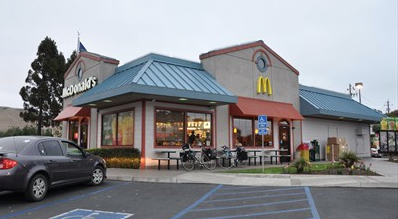
Water use appears to be a key issue with the applicant pointing to its Morro Bay location’s
Morro Bay McDonalds
water use for comparison.
County planner Kerry Brown says an environmental initial study should be ready to post on the project’s impacts in about a month, the first step before the decision makers, the Board of Supervisors, have the final word sometime next year.
70 passenger jet could connect SLO with Denver daily
County and business leaders are optimist that a well oiled campaign to encourage United Airlines to begin daily flights from San Luis Obispo next Spring will be successful. “We have a good track record United can look at.When we have seats – we fill them” says acting SLO County airport manager Craig Piper.
“Demand to fly to Denver is there.”
As proof SLO-area businesses have stepped up to pledge some $1.2 million in non-binding commitments in the past few weeks through the SLO-based Economic Vitality Corporation(EVC) to use the service, adds Piper.
“I can confirm we were able to reach our goal in corporate sponsorships” says Michael Manchak, executive director of the EVC.
In addition, the SLO County Board of Supervisors will be asked next week to add some $250,000 to a $500,000 Dept of Transportation fund in place now that could used to subsidize start-up cost for the new air service for a year.
A Sixel Consulting Group marketing study found that United Airlines faces a possible $1.5 million loss in the first two years of service that this county subsidy fund could help reduce.The funds committed by SLO area businesses also helps assure United that demand is there mitigating the airline’s risk.
“We want to assure United they will not lose their shirt” adds Piper.
Local businesses pitched in the Sixel constant study they were presented with in September seemed convinced that driving to LA round trip was costing them more than $200 not including the lost time it takes.
70 Passenger Jet
The Sixel study suggests United would likely fly a 70 passenger jet CRJ-700 for the daily service to and back – a 2.5 hour flight each way.
A Denver flight would be the first service to travel east instead of strictly north and south to LA,SF and Phoenix.“This could get you half way across the US and opens up 28 additional one-stop destinations for SLO traveler who now have to make two stops for many destinations, he says.
Piper says if funds are approved by the BOS next week airport staff plan to meet with United in a matter of weeks and adds ”we are optimistic this will work out.”
If the airline gives the green light Piper says look for a Spring launch of the service – perhaps May.Meanwhile, a new airport administrator will be taking the place of Richard Howell who left the position recently. Kevin Bumen,a Cal Poly grad and manager at the Tahoe/Truckee airport will be relocating to SLO starting duties here November 12. Mr Piper will continue as assistant manager.
More Passengers/Flights
Notable, the number of passengers using the SLO airport rose in September by 4.8% compared to a year earlier.Piper says their load factor now is about 80% proving good demand if the seats are offered.The airport is served by United flying to LA and SF and US Airways who flies to Phoenix.
Piper says United will add a flight to LA in December.
In a related matter,SLO airport staff plan to ask the Board of Supervisors for permission to move forward on construction drawing s for the new airport terminal also next Tuesday. Piper says an earlier plan would have had the new terminal under construction by 2015 Btu the schedule could slip.
Caycuos Pier Gets Bracing For Winter
Built in 1872 the popular Cayucos Pier will get a $500,000 interim bracing before the start of winter. County Parks want to add steel braces to shore up the structure with the pier closed while repairs are made. Ironically, the pier gets the most use from special events like the “Lost at Sea” memorial event when several hundred people use the pier at one time. A strong winter storm could make things worse. Since July the western end of the pier has been closed.
Wet Seal Coming To SLO
Teen retailer Wet Seal is coming to San Luis Obispo with plans to open a store next to Urban Outfitters on the 900 block of Monterey. Work to tenant improvements is underway.
Shandon To Get State Water
The community of Shandon will get state water next summer with construction of a new turnout bringing 100 acre feet yearly to the area. The water district has only 186AF now, says county Public Works staffer Jeff Lee. He says the project will go to bid next spring and be completed in 2 months. The greater Paso Robles area has been suffering a severe drought for the past several years. The water will got to mostly residential use – not ag, says Lee.”It is not intended to be growth inducing.” The County Master Water Plan records a decline in groundwater levels in the Shandon area of 65 feet between 1981 and 2009.The district uses 102 acre feet of water per year form groundwater supplies.
Bike Trail Extension
The county of San Luis Obispo is working to construct an approximately 4.4 mile segment of a class 1 and class 2 bike path from the City of San Luis Obispo to the staging area of the existing area of the existing Bob Jones bike path at Ontario Road within the Avila Valley area. The project includes improvements to a staging area at the Octagon Bark parking lot, construction of four bridges and crossings along South Higuera Road. The proposed project is within the Agriculture and Rural Lands land use categories and is located in between the south-western edge of the City of San Luis Obispo, approximately 2,000 feet south of the intersection of South Higuera and Los Osos Valley Road down South Higuera, along San Luis Obispo Creek, Monte Road and Ontario Road.
Fewer Distressed Homes: Only 11% of September homes sold in SLO County were distressed sales compared to 28% in September 2012 CAR reports.
Paso Robles is not letting a little thing like drought spoil the scale of ambitious development plans that now include two new large projects with hearings set soon.
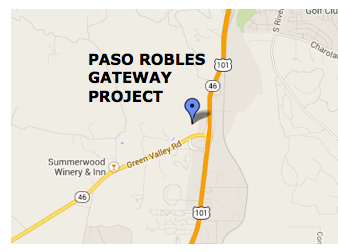
They are the PASO ROBLES GATEWAY, a 270 acre, three hotel, 438,000sf commercial and mixed use development along the northwest corner of west Hwy 46 and Hwy 101 on the hill overlooking 101.(see map).The city posted a Notice of Preparation for a full EIR on the project October 16 .
Also in recent weeks the city held a workshop to consider a plan for the BEECHWOOD SPECIFIC PLAN that would add 1011 residential units and a 5 acre commercial center on 236 acres in the southeast edge of the city(see map).
A draft of a conceptual site plan was considered by the Planning Commission on October 8, 2013 and will be by the City Council on October 29th.
Three Hotels Near Wine Country
The City of Paso Robles is also currently processing applications for the GATEWAY PROJECT along the highway west to the coast, Cambria and Cayucos. This project includes applications for an Annexation, Sphere of Influence Update, General Plan Amendment, Prezone, Development Plan and Subdivision Map to develop land located the northwest quadrant of the Highway 101 and State Route 46 West.
The project, proposed by Quorum Realty, would include 3 resort hotels, approximately 63,000 square feet of commercial retail space, up to 35 single family homes, vineyards and dedicated open space. The project also includes consideration of realigning South Vine Street so that that it would align with opposite of Theatre Drive (across SR 46 West).
An Environmental Impact Report (EIR) is being prepared to evaluate potential impacts that result from the proposed project. Potential environmental impacts identified to be studies in the EIR include:water demand, supply & quality traffic (traffic generation & impacts to surrounding areas)public services (police & fire response, other services)
utilities and service systems (water & wastewater treatment & delivery)
air pollution & greenhouse gas emissions biological resources (oak trees and other resources)noise land use planning and compatibility aesthetics (hillside development)
A public scoping meeting has been scheduled to be held at the Paso Robles Planning Commission meeting on Tuesday, November 12, 2013 at 7:30 p.m. in the Paso Robles Library Conference Room/City Council Chambers, 1000 Spring Street. The public is invited to attend the public scoping meeting to learn more about the project and to provide input on potential environmental impacts to be analyzed in the EIR.
The city asks anydirect any questions regarding the scheduled meeting or related matters be forwarded to Susan DeCarli, Planning Manager or Ed Gallagher, Community Development Director. They can be reached at (805) 237-3970 or by email: Susan DeCarli (sdecarli@prcity.com) or Ed Gallagher (egallagher@prcity.com).
Move by Nation’s Highest Court Ends 16 Years of Litigation; Leaves Santa Maria With Favorable Court Decision
SANTA MARIA, Calif. _ The U.S. Supreme Court declined to review a challenge to the Santa Maria groundwater basin plan, ending 16 years of litigation over the issue and ensuring long-term water supplies for the city and a large portion of the Central Coast.
Last November, the management plan for the groundwater basin was validated by a state appellate court. After the California Supreme Court later refused to hear the case, some landowners upset with the appellate decision petitioned the nation’s highest court, which on Oct. 7 declined to review whether a state court had the power to allocate water from a federal reclamation project contrary to federal irrigation preference.
“We are thrilled that our city’s residents and businesses have a reliable source of water that is no longer in question,” said Gilbert A. Trujillo, Santa Maria city attorney.
Eric Garner, a water rights attorney with Best Best & Krieger LLP who has handled the case for the city from the beginning, said the question at issue before the Supreme Court was the allocation of water from the Twitchell Reclamation project, a key reservoir in the region.
“The Supreme Court’s refusal to hear the case means that the appellate decision is unchanged,” Garner said. “The city has a right to the Twitchell water allocated to it by the trial court and the right of the city to use groundwater in times of shortage remains strengthened.”
The Santa Maria groundwater basin underlies 163,700 acres in northern Santa Barbara County and portions of San Luis Obispo County, and is the principal source of water for thousands of residents and landowners.
Questions over the basin’s use surfaced in 1997 when the Santa Maria Valley Water Conservation District filed the first lawsuit.
A Superior Court judge several years later upheld Santa Maria’s right to pump water from the local aquifer and approved a court-supervised management plan identifying and prioritizing the water rights held by the hundreds of users of the groundwater basin.
The court-supervised management plan addressed the concern that aging infrastructure and a growing population would lead to shortages in the future. Thus, the groundwater management plan also involved a method to pay for the ongoing maintenance and operation of Twitchell Reservoir, which provides flood control protection and helps to recharge the groundwater basin.
Some farmers and landowners who had refused to sign the management plan filed an appeal, claiming the cities and public agencies had very limited rights to the water in the Santa Maria Valley.
But on Nov. 21, the 6th District Court of Appeal in City of Santa Maria v. Richard E. Adam largely upheld the lower court’s decision, saying the trial court had acted within its discretion in approving the management plan hammered out by the City of Santa Maria and the other users of the groundwater basin.
A key part of that ruling, Garner said, confirmed that cities in California and other public agencies, which invest money and resources into building and maintaining infrastructure such as the Twitchell Reservoir or to import water from the State Water Project and deliver it to their residents, have rights to that water even after it seeps into an aquifer, such as when a resident waters their lawn.
In this case, the farmers had wanted rights to that groundwater.
This case was also the first where “prescriptive” water rights were fully tried in California. It clarified an area of the law where cities or public agencies as well as farmers have been pumping from an aquifer that has been in overdraft for a long time.
Garner said the appellate court found that people have at least an equal right to crops in a water shortage, and the court importantly recognized that Santa Maria’s historical pumping can continue into the future and be protected during a shortage.
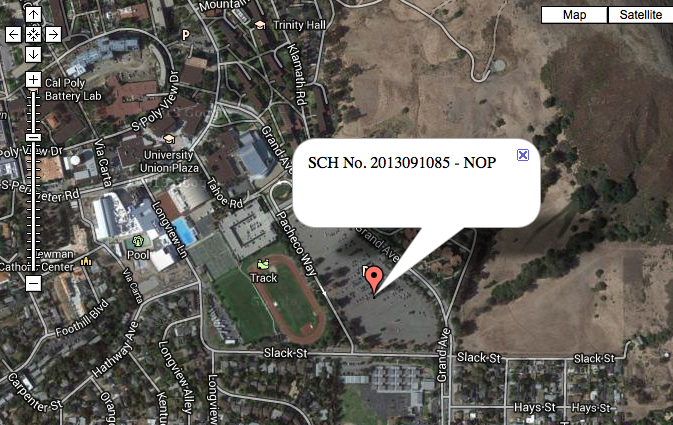
Cal Poly San Luis Obispo is planning a 1475 bed residential complex, likely 5 stories tall, to be built on the parking lot along Grand Ave at the southern entrance to the campus.
Coming only weeks after Cal Poly President Jeffrey Armstrong announced he would seek to grow the campus by 4000 to 5000 students over the next few years, the big project appears to demonstrate that the administration is determined to make it happen.
Facilities manager Joel Neel says the new complex could open in 2018 to be constructed on a design/build basis. This week’s announcement entitled Student Housing South was filed as a notice of preparation – an environmental document.
Neel says the campus currently has 6900 beds leaving the private sector to house the remaining population of the campus. All told – Cal Poly has almost 20,000 students.
The last major housing project built on campus was Poly Canyon Village that added 2660 beds and was completed in 2009.
The enlarged Cal Poly campus could enroll around 25,000 if Armstrong‘s vision is fulfilled.
Cal Poly seeks to offer enough housing to accommodate students for the first two years at the campus. Even with the this new construction the number of units would fall short of the future need.
The notice of preparation shows the construction of the residential complex on 12 acres now used as a major parking lot along Grand Ave near the athletic track. The notice says besides the residential dorm there would be a parking structure for as many as 500 cars.
Poly Canyon Village
Neel says to help power the building the college would likely build another co-gen facility as they did at Poly Canyon.
With an eye to increasing renewable power generation at Cal Poly, the school’s facility department is preparing a wind study for Poly Canyon to test the wind resources overlooking the big SLO campus.
The campus of course, is more like a city with 5 million square feet of buildings to power up and a daytime population of 20,000 souls.
Facilities staffer Dennis Elliot,assistant director of energy, utilities and sustainability for Cal Poly says his current work program is to move forward on wind tests at Poly Canyon near the 1400 ft elevation to see of the idea of wind power makes sense here.
Cal POLY engineering students test a new turbine at Escuella Ranch near Cal Poly
That’s good news to Cal Poly professor Dr Patrick Lemieux who for several years has been working with his engineering class to erect student engineered wind turbines at Escuela Ranch near the campus and is a believer that the idea of a campus wind farm may work. Lemieux’s wind research center helps prepare students for jobs in the field
Their latest model is a 70 ft tilt-down version of a wind turbine that is easier to maintain,generates about 3kw that has been modified several times to do energy calculations. After 3 years of studies on whether the area could support a potential wind farm – the results were promising and outlined in this student thesis.
“Wind resource assessment at California Polytechnic State University shows there is potential for wind power generation on Cal Poly land. A computational fluid dynamics model based on wind data collected from a campus maintained meteorological tower on Escuela Ranch approximately 5 miles northwest of campus suggests there are areas of Cal Poly land with an IEC Class III wind resource at a height of 80 meters above ground.”
“In addition during the daytime when the campus uses the most energy there are large portions of land with annual average daytime wind speeds above 6.9m/s. These areas have been identified by analyzing the wind speed and directional data collected at the meteorological tower and using it to create the boundary conditions and turbulence parameters for the computer model.”
“Before constructing a wind farm for power generation, additional meteorological towers should be constructed in Poly Canyon to further confirm the wind resource prediction.”
So that’s where we are.
Lemieux says the wind resources that are available track Cal Poly’s power needs with the wind blowing the most from 6 AM to 6PM and typically blowing stronger during the school year months of October through April.
Lemieux says that any Poly Canyon study would be followed by meteorological towers being placed at scattered locations above the campus and left for a year of data collection.
His guess is that perhaps 10 wind turbines,200ft tall could produce 3MW (300kw each) or about half the average power needed at the campus – around 6MW. Elliot says that actual demand varies between 3 to 10MW.
A 200ft tall turbine while large pales in size to 300 meter units that are a standard at big wind farms like Tehachapi with Lemieux hoping their more modest scale will be accepted considering the SLO foothills already sport similar size tower lines.
With a small 300kw solar unit in place for several years on an engineering building Elliot says they continue to plan for a 1MW solar unit to be constructed by a third party under a power purchase agreement with PG&E as the CSU campuses statewide follow mandates to add more renewables.
Cal Poly faculty and staff began the new academic year Monday with the kickoff to the university’s annual Fall Conference, which precedes the start of classes on Sept. 23. Monday’s activities included a state-of-the-university keynote address from Cal Poly President Jeffrey D. Armstrong, who welcomed faculty and staff to the new school year and outlined near-term strategic goals. Among his goals and initiatives, Armstrong announced that the university will investigate how it will increase enrollment to respond to California’s needs for more four-year college graduates. “Enrollment growth is essential. California — really, the country — needs more Cal Poly graduates,” Armstrong said. “However, the extent, nature and timing of growth are questions that we need to investigate with all of Cal Poly’s stakeholders — on campus and off campus. Armstrong also outlined four goals for the university to focus on this year and the next few years: improved graduation rates; further implementation of the Teacher-Scholar Model; an enhanced campus climate; and increasing private support to strengthen Learn by Doing and sustain the university’s national reputation for excellence.
“Enrollment growth is essential. California — really, the country — needs more Cal Poly graduates,” Armstrong said.
Assessing the growth requires evaluating the master plan, engaging the Academic Senate, as well as consulting with city and community leaders. “We must work together in asking and answering the right questions.’’
Among the questions, he said, would be an assessment of what the impact would be on the community as well as what the economic impact would be on the city and region. At the campus level, he said, there are many complexities, including what facilities the campus would need for classes, labs, and offices as well as for student housing and dining.
Enrollment this fall will be about 19,800 students, including graduate students. Armstrong said Cal Poly should consider growing by as much as 4,000 to 5,000 students over the next few years, depending on state funding, private support and the ability to physically accommodate new growth.

 Retailer Home Goods store, a division of TJMaxx will replace the OfficeMax store in the Irish Hills Plaza shopping center in the new year. Bids to do the tenant remodel in the building on Froom Ranch Way at Los Osos Valley Rd are due November 12 according to reliable sources and contractors have been touring the space.