SLO County: Board Backs Urgency Water Measure / Will Look At Supplemental Sources Too

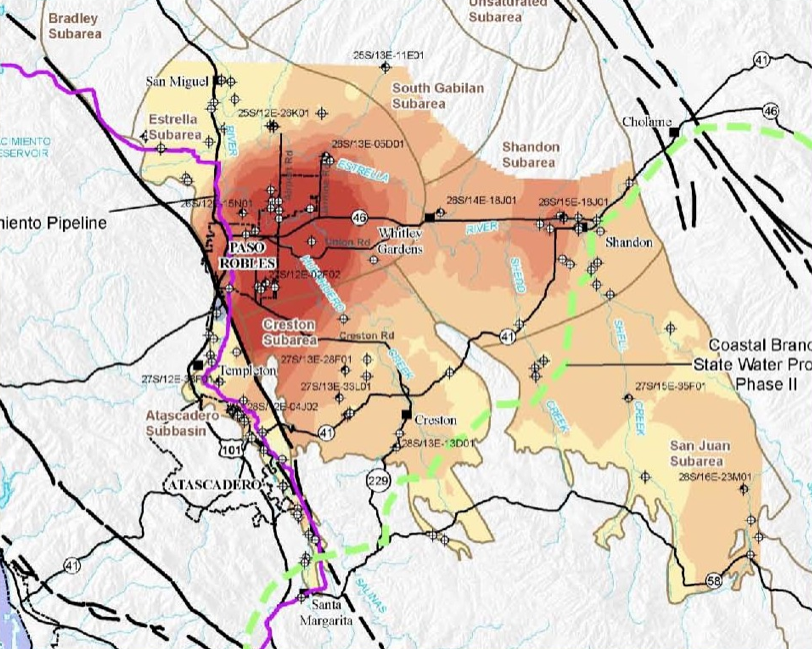
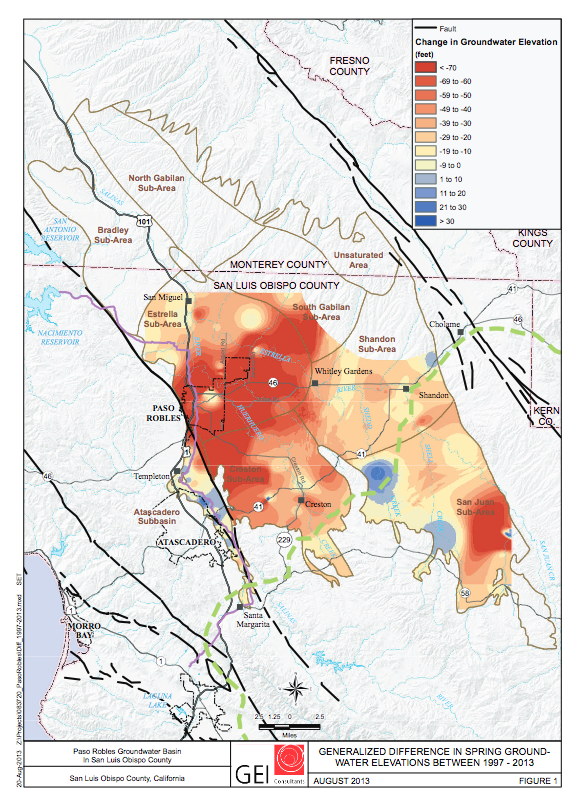
Red shows drops of 70 ft or more -Click To Enlarge

August 28, 2013
The San Luis Obispo County Board of Supervisors have adopted an urgency ordinance this week that that prohibits new development or the planting of crops in the Paso Robles Groundwater Basin area unless water use can be offset on a 1-1 ratio. All four sitting supervisors agreed to the plan surprising some observers. The measure required all four agree to be implemented.
The ordinance comes as the Paso Robles area has experienced a drastic drop in groundwater levels of as much as 70 feet or more in the past 16 years (see map).Critics blame the big increase in grape vineyards in the region over the years and of course the drought.
Some areas like San Miguel and Shandon were not included – areas where the drop in water level has not be so severe. The measure is in place for only 45 days and then supervisors can extend it for up to two years.
The ordinance requires the metering of new irrigation wells that will be monitored by the county.
Supervisors  have vowed to look at all ways to help the Basin including Conservation -Supplemental Water and Recycled Water as well as Basin Management
Based on suggestions from a Blue Ribbon Task Force outlined in May a feasibility study will also look at tapping supplemental sources of water.
That includes water from Nacimiento Lake as well as State Water Project supplies that the county has a right to tap but over the years has chosen not to.
The supervisors- wearing their San Luis Obispo County Flood Control and Water Conservation District hat – on Aug 16 authorized a release of request for qualifications to prepare several feasibility studies.
One would look to analyze options for using water that may be available in the Salinas River Watershed, Salinas Reservoir and Nacimiento Reservoir to offset pumping and stabilize groundwater levels in the Paso Robles Groundwater Basin .
Some option here are:
– Capturing, diverting and/or detaining an estimated 10,000 – 12,000 AFY average annual spill over the dam at various locations
–  Exchanging available Nacimiento water for additional Salinas Reservoir releases via cooperative agreement
Additional recharge of the Salinas River or main Basin with Nacimiento Water
There is 6,095 AFY unsubscribed and available for purchase.
A second supplemental source is State Water Project water where up 15,273 AFY is available.
In 1963 SLO County contracted for 25,000 acre ft per year of State Water delivered by pipeline from the California Aqueduct in the SJ Valley near Kettleman City. Only about 8487 acre ft is delivered leaving an excess allotment. The State Water Projects’ Coastal Branch Aqueduct was completed in 1997 to serve San Luis Obispo and Santa Barbara counties.
But in SLO County only some area take State Water and Paso Robles is not one of them.Bringing in State Water could encourage the wine growers not to pump groundwater helping the Basin recover – or so goes the argument.
Supervisors will look to expert consultants to advise them about tapping these supplemental sources, the costs and timelines, pluses and minuses.
Back in 2006 the county considered using State Water to recharge  Paso Robles groundwater but decided at the time the pipe infrastructure was too expensive.
A Tribune story back then mentions a key reason why SLO County has not committed to the water – fear of growth.” The county signed up with the state in 1963 for 25,000 acre-feet of water a year, but cities and other local water agencies, some leery of possible growth and worried about the cost, only reserved about 8,500 acre-feet of that. An acre-foot of water serves two to three homes for a year in the hot North County and four to five homes on the cooler coast.”
But after several years of drought and the promise of more dry years -could there be a change of heart? It sound like some months before we get some answers and consultants are ready to start their work on these studies.
Some argue that these are potential “long term” solutions and the Basin might not see this water for many years. That’s what they said back in 2006.

It should be noted at all major ag counties in California supplement their hometown water with imported water from the rainier parts of the state. For this benefit ag is asked to be a major player in footing the bill.

It should be b

Maps Reveal Extreme Drought On Central Coast

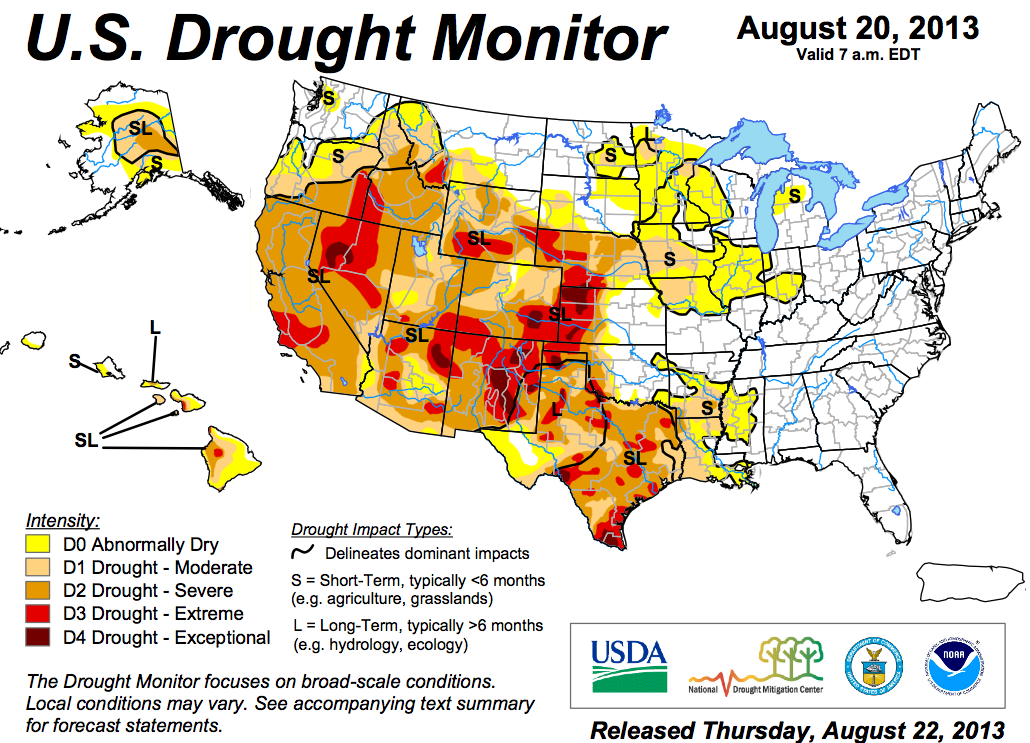
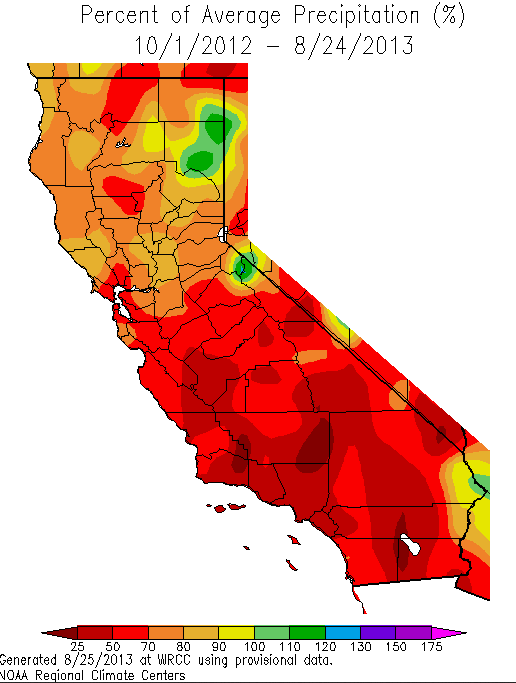
The latest edition of the NOAA Drought Monitor map published late last week shows SLO County and region in ”Extreme Drought”conditions. A second map from CalClime shows rainfall  25% to 50% of average in the area (colored brown) in the past year. The past 8 months have been among the driest across the West. In California there is a few wet spots near Lakes Shasta and Tahoe.
This is the first time that SLO County has designated Extreme Drought conditions since the U.S.Drought Monitor started up in 1999.
SLO weather forecaster John Lindsey write in his column this weekend that “the past two rain seasons (July 1-June 30) have seen well-below-average precipitation. In fact, this year’s January-June period for the city of San Luis Obispo will go down as the third-driest such period on record at Cal Poly (home of climatology for the city) since 1870, when weather observations started.
Since January, Cal Poly has recorded only 3.5 inches of rain. Normally, it should have received about 15 inches.
The county’s extreme drought condition will continue to increase competition for water among agricultural, environmental, residential and industrial interests, and as the price of water increases, conservation will become progressively important.”

Big Jump Projected For California Travel Over Holiday

SLO City

Central Coast Remains One Of Top Destinations

Labor Day travel statewide and in Southern California is projected to be 6 percent higher than in 2012 – the biggest bump in holiday travel for 2013 – with 2.44 million Southland residents projected to take trips over the holiday weekend, according to the Automobile Club of Southern California. This jump outpaces the national projected increase in Labor Day travelers of 4.2 percent.

Gas prices this week are down 21 cents from a month ago with a state low at $3.39 in the Sacramento area according to Gas Buddy.Compared to a year ago prices are 30 cents lower.

More than 1.93 million Southern Californians are expected to drive to their destinations, an increase of 6.2 percent over the 1.82 million who traveled by car last year.

The number of Southland travelers by plane is expected to increase by 4.4 percent to 320,000, compared to 306,000 last year. The number of travelers by all other modes – including bus, train, RV and cruise ship – is expected to increase by 6.1 percent to 186,000, compared to 175,500 last year.

Statewide, 3.93 million travelers are expected to get away this holiday weekend, compared to 3.7 million last year.  Of those, 3.11 million will drive, which is a 6.2 percent increase from last year’s 2.93 million, and 515,000 will fly, which is a 4.4 percent increase from last year’s 493,000 air travelers statewide. About 300,000 are expected to go by other modes of travel, a 6.1 percent increase from 282,000 in 2012.

“As this year progressed, we have seen more and more people coming into the travel marketplace as a result of increased affordability, consumer confidence and the importance that a vacation plays in people’s lives,” said Filomena Andre, the Auto Club’s vice president for travel products and services.

The average amount that will be spent by Californians and other West Coast residents on their upcoming Labor Day trip is $622 – below the national average of $804. “In California, we have the luxury of choosing many affordable driving-distance getaways,” Andre said.

More than 34 million Americans are projected to travel at least 50 miles away from home during the holiday period between Thursday and Monday. That’s a 4.2 percent increase from last year’s 32.7 million travelers.

The top destinations for local Labor Day travelers, according to a survey of the Auto Club’s AAA Travel agents, are:
1) San Diego
2) Las Vegas
3) San Francisco
4) Central Coast
5) Grand Canyon

Local holiday weekend travelers will benefit from falling gas prices, which are about 25 cents a gallon lower than at this time last year. However, road and freeway reconstruction is in high gear throughout the region, so travelers should be sure to either check their route ahead of time by calling the California Highway Information Number at 800-427-7623, visiting www.dot.ca.gov/hq/roadinfo/ or by using a real-time traffic and mapping application ahead of time to find out if their route will be affected by detours.

Around SLO County

Jobless Rate at 6.9%

The unemployment rate in the San Luis Obispo County was 6.9 percent in July 2013, up from a revised 6.4 percent in June 2013, and below the year-ago estimate of 8.6 percent. This compares with an unadjusted unemployment rate of 9.3 percent for California and 7.7 percent for the nation during the same period.  By far the largest decline month over month was in the government sector with the seasonal layoffs of education employees for the summer. Year over year the e number of jobs in the county  climbed 3%.

July Hotel Bookings Strong

Smith Travel reports SLO County hotel bookings were strong in July with an impressive 10.5% increase in room revenue over the same month a year ago. Occupancy was up 3.5%.

SLO Solar Projects Move Forward

Everyone knows about the mega scale  utility size solar projects under construction in eastern SLO County, some of the largest in the world.

Now several smaller but still utility-scale  projects are ready to break ground as well.

Pristine Sun, a SF based developer of smaller so called feed-in-tarrif projects have pulled permits on two north county solar farms. One is an $8 million dollar, 1 MW solar farm a the ranch of Mary Jardine on 10 acres on Nacimiento Rd. A second solar farm at 5475 Jack Creek Rd is valued at $2 million and will generate 0.45MW located five miles west of Templeton.

Pristine Sun has several other small solar farms pending in SLO County. The state’s big utilities are mandated to buy these pint size projects  under an apportionment agreement overseen by the PUC. Typically the developer – in this case Pristine Sun – owns the projects and leases the land.They tie into the power grid on low voltage lines. PG&E will buy the power.Pristine Sun claims to have a pipeline of $1 billion worth of projects.

Also this month at the SLO County Planning Commission approved  a request by Vintner Solar LLC for a Minor Use Permit to develop an approximately 1.5 megawatt (MW) solar generating facility on an approximately 4.8 acre portion of a 97.21 acre parcel.The project is located at 6 03 El Pomar Drive, about 1.5 miles northeast of the community of Templeton, in the El Pomar – Estrella planning area. ECOS Energy is steering the feed-in-tarrif project with power to be sold to PG&E The solar farm will have 7350 arrays.

Port San Luis Will Add New Dorns Eatery

Olde Port eatery photo courtesy Trip Advisor

The Port San Luis Pier on scenic Avila Bay will sport a new class seafood restaurant to add to the Olde Port Inn that is already there.

Port San Luis harbor manager Steve McGrath says “we expect to sign the lease with Chris Dorn this week.” Dorn has a landmark fish restaurant in Morro Bay. Chris Dorn will run the new eatery but they are not sure of the name adds McGrath.”I know they want to be open as soon as possible.”

A Dorns employee said that is not likely until sometime next year.

The new restaurant will hold forth on the east end of the iconic pier as Olde Port looks out to the west.

In other restaurant news McGrath says their tenant Fat Cats – at the entrance of Port San Luis is on a month to month basis after a bankruptcy filing allowing the owners to reorganize he says.
.
In other port news McGrath says work to finalize all entitlements for the ambitious Harbor Terrace project are moving forward with completion likely 2 years away.

Construction of the new campground/resort will then go forward replacing the former trailer park on the hill.

SLO News Update: Water / Rental Cars / More

Paso Robles is epicenter for falling ground water levels

Debate Over Paso Robles Water Ordinance

SLO County Board of supervisors decided to wait this week regards any urgency ordinance covering Paso Robles area groundwater. The urgency measure would  require all four sitting members to agree to pass any new law and the board appears to be split.

Pressure to do something has mounted after reports of rural land owners wells going dry this summer.

Supervisor Adam Hill said it was clear to him that “people are over pumping the basin” and this is why groundwater levels are dropping. “It’s a common pool”.

The regions’ groundwater has been dropping for the past two decades even as new plantings of vineyards are helping the area economically -but drawing on the aquifer in another drought year.

Calls for a two year urgency measure may yet bring this issue to a head August 27 although there is debate over how large an area should be targeted.

“The Paso Robles area is where all the wells have been impacted “says supervisor Frank Mecham arguing for a smaller footprint for any urgency ordinance and not the entire North County.

Supervisor Debbie Arnold who represents the Paso area says she wants to see what impact the importation of Nacimiento Reservoir water will be on the worst part of the problem identified in red on this map. (see map).She also asked why staff had suggested ag ponds be banned in a version of the ordinance since this helps irrigate “more efficiently.”

The City of Paso Robles has only taken its first drop of Nacimiento Lake water last month as it was waiting to complete their new wastewater treatment plant now scheduled for 2015 – until they took an allocation.

The city has a 4000 acre/ft annual allocation approved in 2004 but unused until this summer.

But it is now taking some water to recharge their aquifer right into the sandy bottom of the Salinas River where it soaks down in a hurry. The city plans to continue this practice in the summer months hoping to rebuild groundwater near their muni wells.The application spills 2000 gallons a minute.
Airport To Get New Car Rental Facility

SLO County has filed an environmental document to build a Rental Car Quick-Turnaround (QTA) facility on an approximate 3 acres at the airport.

Airport manager Richard Howell says the facility has been in the works for years and is now expected to open by this time next summer. Howell will be leaving the job next month after 5 years here.

The proposed project includes the development of the following:

– a 1,200 square foot accessory building for storage; towel wash and dry; employee break room and restrooms;
– four covered manual car wash bays (approximately 2,900 square feet total) with state of-the-art wash water recovery and recycling systems
-98 car parking stalls, including two handicap/disabled van accessible spaces; and • a 6,000 gallon above ground auto fuel tank with associated infrastructure (required by the rental agencies).
The purpose of the project is to provide a safe and efficient Rental Car QTA facility that will serve the passenger needs of the existing and future terminal building. The need for the Proposed Project will be to clear the existing location near 965 Airport Drive, which lies on a broken concrete slab and WWII era hangar area on the east side of the Airport. In addition, the existing location would be used for future development of a new terminal building at the Airport. The new Rental Car QTA facility will reduce rental car trip distance from 800 feet to 400 feet, which would affect an average of 73 round trips per day.

The SLO County board of supervisors approved a $1.6 million loan last year to be repaid form from revenues.The airport rents around 20,000 cars a year.


Quick Takes:

The median price of a home in San Luis Obispo County climbed to $415,00 in June 2013 up 12.39% from a year ago. In SLO City the median rose to $547,000 -up 12.3% from a year earlier.


California hotels get busier

SLO County’s hotels were busier this June than last. Hotel occupancy was up 2.3% form a year earlier and room revenue was up an even stronger 7.1%. On a year to date basis room revenue was up 9.3%.

Construction is underway at the new 39,000 sf SESLOC Federal Credit Union complex  on Broad across  from Vons in San Luis Obispo. The building has  8858 sf for lease on the ground floor.The building is expected to be completed in summer 2014.

Strawberries Fields Thrive In Central California With Far Less Methyl Bromide

Strawberry fields may not be forever but they are still around after the phase out of what was considered to be a a must-have soil fumigant to limit pests.

The 2013 strawberry crop is thriving in Central California with the volume shipped so far this year from the Santa Maria district up around 5 million flats over last year says UC advisor Surendra Dara.

It’s not just higher acreage but improved yields that are helping says Dara.

It’s another huge crop for the Santa Barbara and San Luis Obispo counties’ number one crop with statewide volume up this year around 5% says the US Berry Report.

The Santa Maria strawberry district monitored by the California Strawberry Commission that includes both Santa Barbara and San Luis Obispo counties has some 10,660 acres of strawberries this year, up 11.6% from the year before.  California produces over 90% of the nation’s strawberries with acreage climbing above 40,000 acres this year.

It’s better than a $2.3 billion industry.

By contrast Mexico has about 20,000 acres.

The state’s industry has relied on soil fumigants like methyl bromide, used to pretreat the soil before planting in the past and farmers have greatly feared the phase out of the fumigant ,put in place after the discovery that the stuff depletes the ozone.

Comments like these from a Salinas grower as recently as 2012 were typical.

“There won’t be anything as good as (methyl bromide),” said Tom AmRhein, a veteran Pajaro Valley strawberry grower and an executive with Salinas-based Naturipe Berry Growers. “We’ve spent enough years and time and money on this thing to know you are just not going to be able to have that level of production and quality that you have now.”

But the level of production since the phase out has clearly gone higher  and consumers are raving about the quality of the fruit.

As of 2003 – ten years ago – most uses of methyl bromide were being phased out under an international treaty designed to protect the ozone layer.  Under the Federal Clean Air Act, most production and importation of methyl bromide ended in the U.S. by January 1, 2005. The Clean Air Act also mandated interim supply reductions from 1991 use levels: 25% in 1999, 50% in 2001, and a 70% cut in 2003.
Annual methyl bromide use in California has declined in recent years. DPR use reports show that methyl bromide applications fell from 15 million pounds in 1999 to 6.6 million pounds in 2001.

But it has not gone away.

As of 2011,the latest year that the California Department of Pesticide Regulation has tracked – counties continue to provide a”critical use” exemption and nearly 4 million pounds of the fumigant were used.
That’s because even after the phaseout, the treaty allowed continued but very limited use of methyl bromide, under specified conditions.
As of 2011 in Central California – methyl bromide was applied to only 20% of the strawberry growing acreage with SLO County at 503 acres treated with the fumigant and San Barbara County with 1406 acres.That’s a total of under 2000 acres in a 10,600 acre district.
Even with that low application rate DPR continues to monitor air emissions and recently found no trace of the chemical in the air in Santa Maria.

Still, DPR reports statewide – the area treated with fumigants in 2011 increased 7 percent. Chloropicrin and 1,3-dichloropropene (1,3-D) use increased 9 and 10 percent, respectively, while methyl bromide and metam-sodium use decreased 1 and 6 percent respectively.

The soil fumigant methyl bromide, which growers have depended on for decades, will no longer be available starting in 2015 and supplies are running out even for some who hoarded what is left.
Methyl iodide, a potential substitute, is a harmful chemical, but can be used safely with proper precautions, said Salinas area UC Cooperative Extension weed scientist Steve Fennimore.

“The professional fumigators are really good,” Fennimore said. “If the public saw how the companies do the fumigation, they’d probably be more comfortable with them.”

But as the Wall Street Journal reported last year:
“ Berry farmers had hoped to use a new fumigant, methyl iodide, as a key tool. But amid pressure from environmental and scientific critics, who say the product is highly toxic and threatens public health, the sole manufacturer of the chemical, Japan’s Arysta LifeScience Corp., in March said it was pulling methyl iodide from use in the U.S. “based on its economic viability” in the country.
Strawberry plants are vulnerable to soil diseases such as Macrophomina phaseolina, which can wipe out an entire field, making a fumigant or some other way to guard against disease vital, farmers say.
“We are very, very afraid,” said Victor Ramirez, who grows strawberries on about 350 acres here in Santa Cruz County and adjoining Monterey County—together home to nearly half the nation’s $2.1 billion of annual strawberry production. “Without a fumigant, that may be a deal breaker for us.”
A falloff in production could have a wider economic impact. In Monterey County, strawberries have overtaken leaf lettuce as the top cash crop, jumping 21% in value to $751.1 million in 2010 from $619.3 million in 2008, according to the Monterey County Agriculture Commissioner’s office.
Several factors are behind the increased production. The returns from strawberries are considered by farmers to be better than other crops, such as lettuce and broccoli, prompting them to increase acreage. Better weather, including fewer freezes and damaging rains, has also helped, industry officials say.
Without good fumigants, many farmers said they are left with less effective and more expensive ways of controlling soil disease, such as growing strawberries in a soil substitute made of plant waste that is disease-free. Strawberry yields in fields using an organic disease-control technique are often only about 60% of those using methyl bromide, Mr. Ramirez said.
The California Department of Pesticide Regulation said it is working with farmers to develop additional nontoxic techniques, such as mixing in onion skins or rice waste to fumigate fields naturally, said Brian Leahy, director of the state agency. “The goal,” he said, “is to keep a very vibrant industry going.”

So how was Monterey County’s 2012 strawberry crop? A few weeks ago it was reported that Monterey’s strawberry value increased by 10% and acreage climbed over 500 acres.It remains the county’s number two crop.

Another fumigant, chloropicrin, is widely used in combination with methyl bromide and methyl iodide to provide the most pest-free soil for growers.
UC researchers are also  considering the use of hot steam fumigation on coastal central California farms to prepare soil for planting strawberries and new orchards and vineyards. Farmers there have for years relied on methyl bromide, but the phase-out of the powerful soil fumigant is closing in.

To study the steam method, UC weed specialist Steve Fennimore outfitted a tractor with a boiler that heats steam to more than 300 degrees F. Ten-inch spikes inject steam into the ground.
It’s not that most of the state’s strawberry growers are going organic; there are about 1776 acres of organic strawberries grown in California (out of 40 thousand acres) and that number has not increased that much in the past five years.

But they are doing largely without methyl bromide and production is just going higher.

2012 Air Monitoring Shows Pesticides Well Below Health Screening

Preparing field for fumigant applicaion

Results Show Santa Maria Data

July 31, 2013
SACRAMENTO – For the second year in a row, the Department of Pesticide Regulation (DPR) air monitoring, in various California rural agricultural communities, shows nearly three dozen pesticides have residue levels well below levels established to protect human health and the environment.
“This is reassuring news for residents,” said DPR Director Brian Leahy. “Our monitoring in 2012 shows that none of the pesticides exceeded their screening levels, indicating a low health risk to the people in these communities. These findings indicate that the state and county restrictions are keeping air concentrations below the health protective targets set by DPR.”
In 2012, as part of its commitment to statewide air monitoring, DPR monitored 33 pesticides and five pesticide breakdown products in three California communities: Salinas (Monterey County), Shafter (Kern County) and Ripon (San Joaquin County).
These communities, part of the DPR air monitoring network (AMN), were selected from a list of 226 communities based on pesticide use on surrounding farmland and demographics, including the percentage of children, the elderly and farm workers in the local population.
The pesticides were selected based on their potential health risks and the amount used. They include methyl bromide and chlorpyrifos. Results released today also include methyl bromide concentrations monitored by Air Resources Board stations in Oxnard (Ventura County), Santa Maria (Santa Barbara County) and near Watsonville (Monterey County) at DPR’s request.
Overall, the AMN 2012 report found that 94.5 percent of the 6,002 analyses (number of samples times the number of chemicals analyzed) resulted in no detectable concentrations.
Other key findings include:
For 2012, all measured pesticide air concentrations were less than DPR’s regulatory targets or screening level.
Of the 33 pesticides and five breakdown products that were monitored, 14 could not be detected at all and 13 were only detected at trace levels.
The pesticides detected the most often were chlorpyrifos and MITC. Both were found at all three locations 28 percent of the time, at air concentrations that were low relative to the screening levels.
No state or federal agency has established health standards for pesticides in air. Therefore DPR developed health screening levels for the monitored pesticides to place the results in a health-based context.
“The data helps DPR to determine whether our restrictions on pesticide applications protect people and the environment in the long term,” added Leahy.
California is the only state that monitors air as part of its continuous reevaluation of pesticides to ensure the protection of workers, public health and the environment. This includes conducting field studies to monitor exposure to workers and to measure how pesticides move and break down in air, soil and water. DPR uses this information to decide if further regulatory measures are necessary.

Diablo Canyon Installing Bubble Curtain To Divert Jellyfish From Intake Pipe

salps – small jellyfish critters are mucking up the works at Diablo Canyon

Diablo Canyon power plant  produces about 10% of the state’s electricity. Going forward – the PG&E owned plant will be the only nuclear power plant operating in California as the industry has been beset by problems including fears of terrorism and earthquake fault zones. But  now  they have to worry about critters too.

Each power unit at the plant  has a pressurized water reactor coupled with steam generators, feed water systems and cooling water systems. The seawater intake for the power plant is located within a cove that was built as part of the original plant construction.

The seawater enters the intake structure, passes through a series of bar racks and screens, and enters the plant where it is used to condense steam from the reactors.

In the past few years, there has been an increase in the population of salps, gelatinous ocean dwellers resembling small jellyfish, along the California Coast and in the vicinity of the DCPP Intake Cove.

Although individually innocuous, a large mass of many individuals can be problematic, clogging seawater intakes and damaging fishing nets. In April of 2012, PG&E was forced to shut down one of the nuclear reactors at the DCPP (the other had been previously shut down for scheduled maintenance) for several days when a massive salp population boom clogged the intake pipe.

In researching how to address this problem, PG&E found that the Ringhals Power Plant in Sweden installed a bubble curtain to divert salps from its intake pipes. Bubble curtains have also been recommended by the National Marine Fisheries Service (NMFS) as a safe and effective method to divert aquatic organisms away from underwater construction sites and decrease impacts associated with construction noise.

Now PG&E proposes to investigate the efficacy of this method by installing a temporary bubble curtain system in the DCPP Intake Cove for two years with installation of  curtains in the next few months.

This month the California State Lands Commission offered their blessing on the project. The  Coastal Commission already approved the plan earlier this spring.

US Airways Offers First Class Service On Select US Airways Express Flights Through San Luis Obispo County

The San Luis Obispo County Regional Airport (SBP) is pleased to announce that US Airways is now offering First Class service on select US Airways Express flights. This service is being offered on US Airways dual-class CRJ 900 jet with 9 first class seats and 70 main cabin seats.
“We are pleased with US Airways’ decision to offer First Class service in our market. We feel it will be a welcome addition for our business and leisure passengers traveling to Phoenix and beyond” stated Richard Howell, Airport General Manager.
US Airways offers 3 daily departures from SBP to Phoenix and serves more than 200 destinations worldwide through its hubs in Phoenix, Philadelphia, and Charlotte.
For more information, visit www.sloairport.com or www.usairways.com

SLO Airport Passenger Traffic Up

San Luis Obispo County Airport traffic shot higher in June, the first month in several years passenger numbers toook a good jump.Passengers flying through the airport on the airports two carriers saw a 5.3% bump in June with US Airways leading the increase. June saw 10,326 passengers board US Air compared to 8,377 in May and 8241 in June 2012. July and August are  the busiest times for the airport.