
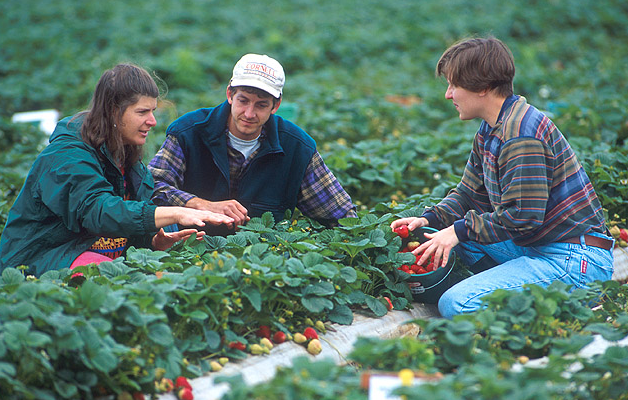
 Strawberry fields may not be forever but they are still around after the phase out of what was considered to be a a must-have soil fumigant to limit pests.
The 2013 strawberry crop is thriving in Central California with the volume shipped so far this year from the Santa Maria district up around 5 million flats over last year says UC advisor Surendra Dara.
It’s not just higher acreage but improved yields that are helping says Dara.
It’s another huge crop for the Santa Barbara and San Luis Obispo counties’ number one crop with statewide volume up this year around 5% says the US Berry Report.
The Santa Maria strawberry district monitored by the California Strawberry Commission that includes both Santa Barbara and San Luis Obispo counties has some 10,660 acres of strawberries this year, up 11.6% from the year before. California produces over 90% of the nation’s strawberries with acreage climbing above 40,000 acres this year.
It’s better than a $2.3 billion industry.
By contrast Mexico has about 20,000 acres.
The state’s industry has relied on soil fumigants like methyl bromide, used to pretreat the soil before planting in the past and farmers have greatly feared the phase out of the fumigant ,put in place after the discovery that the stuff depletes the ozone.
Comments like these from a Salinas grower as recently as 2012 were typical.
“There won’t be anything as good as (methyl bromide),” said Tom AmRhein, a veteran Pajaro Valley strawberry grower and an executive with Salinas-based Naturipe Berry Growers. “We’ve spent enough years and time and money on this thing to know you are just not going to be able to have that level of production and quality that you have now.”
But the level of production since the phase out has clearly gone higher and consumers are raving about the quality of the fruit.
As of 2003 – ten years ago – most uses of methyl bromide were being phased out under an international treaty designed to protect the ozone layer. Under the Federal Clean Air Act, most production and importation of methyl bromide ended in the U.S. by January 1, 2005. The Clean Air Act also mandated interim supply reductions from 1991 use levels: 25% in 1999, 50% in 2001, and a 70% cut in 2003.
Annual methyl bromide use in California has declined in recent years. DPR use reports show that methyl bromide applications fell from 15 million pounds in 1999 to 6.6 million pounds in 2001.
But it has not gone away.
As of 2011,the latest year that the California Department of Pesticide Regulation has tracked – counties continue to provide a”critical use” exemption and nearly 4 million pounds of the fumigant were used.
That’s because even after the phaseout, the treaty allowed continued but very limited use of methyl bromide, under specified conditions.
As of 2011 in Central California – methyl bromide was applied to only 20% of the strawberry growing acreage with SLO County at 503 acres treated with the fumigant and San Barbara County with 1406 acres.That’s a total of under 2000 acres in a 10,600 acre district.
Even with that low application rate DPR continues to monitor air emissions and recently found no trace of the chemical in the air in Santa Maria.
Still, DPR reports statewide – the area treated with fumigants in 2011 increased 7 percent. Chloropicrin and 1,3-dichloropropene (1,3-D) use increased 9 and 10 percent, respectively, while methyl bromide and metam-sodium use decreased 1 and 6 percent respectively.
The soil fumigant methyl bromide, which growers have depended on for decades, will no longer be available starting in 2015 and supplies are running out even for some who hoarded what is left.
Methyl iodide, a potential substitute, is a harmful chemical, but can be used safely with proper precautions, said Salinas area UC Cooperative Extension weed scientist Steve Fennimore.
“The professional fumigators are really good,” Fennimore said. “If the public saw how the companies do the fumigation, they’d probably be more comfortable with them.”
But as the Wall Street Journal reported last year:
“ Berry farmers had hoped to use a new fumigant, methyl iodide, as a key tool. But amid pressure from environmental and scientific critics, who say the product is highly toxic and threatens public health, the sole manufacturer of the chemical, Japan’s Arysta LifeScience Corp., in March said it was pulling methyl iodide from use in the U.S. “based on its economic viability” in the country.
Strawberry plants are vulnerable to soil diseases such as Macrophomina phaseolina, which can wipe out an entire field, making a fumigant or some other way to guard against disease vital, farmers say.
“We are very, very afraid,” said Victor Ramirez, who grows strawberries on about 350 acres here in Santa Cruz County and adjoining Monterey County—together home to nearly half the nation’s $2.1 billion of annual strawberry production. “Without a fumigant, that may be a deal breaker for us.”
A falloff in production could have a wider economic impact. In Monterey County, strawberries have overtaken leaf lettuce as the top cash crop, jumping 21% in value to $751.1 million in 2010 from $619.3 million in 2008, according to the Monterey County Agriculture Commissioner’s office.
Several factors are behind the increased production. The returns from strawberries are considered by farmers to be better than other crops, such as lettuce and broccoli, prompting them to increase acreage. Better weather, including fewer freezes and damaging rains, has also helped, industry officials say.
Without good fumigants, many farmers said they are left with less effective and more expensive ways of controlling soil disease, such as growing strawberries in a soil substitute made of plant waste that is disease-free. Strawberry yields in fields using an organic disease-control technique are often only about 60% of those using methyl bromide, Mr. Ramirez said.
The California Department of Pesticide Regulation said it is working with farmers to develop additional nontoxic techniques, such as mixing in onion skins or rice waste to fumigate fields naturally, said Brian Leahy, director of the state agency. “The goal,” he said, “is to keep a very vibrant industry going.”
So how was Monterey County’s 2012 strawberry crop? A few weeks ago it was reported that Monterey’s strawberry value increased by 10% and acreage climbed over 500 acres.It remains the county’s number two crop.
Another fumigant, chloropicrin, is widely used in combination with methyl bromide and methyl iodide to provide the most pest-free soil for growers.
UC researchers are also considering the use of hot steam fumigation on coastal central California farms to prepare soil for planting strawberries and new orchards and vineyards. Farmers there have for years relied on methyl bromide, but the phase-out of the powerful soil fumigant is closing in.
To study the steam method, UC weed specialist Steve Fennimore outfitted a tractor with a boiler that heats steam to more than 300 degrees F. Ten-inch spikes inject steam into the ground.
It’s not that most of the state’s strawberry growers are going organic; there are about 1776 acres of organic strawberries grown in California (out of 40 thousand acres) and that number has not increased that much in the past five years.
But they are doing largely without methyl bromide and production is just going higher.