SLO Airport Adds Third Jet Flight To SF

June 6,2015-

Flights Are All On 50 Seat Jets

Screen Shot 2015-06-06 at 7.04.29 AM

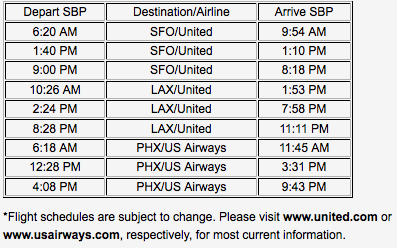
Starting September 1, 2015, United Express Operated by SkyWest Airlines will offer a third round trip SFO flight from the San Luis Obispo County Regional Airport (SBP).
Coupled with three existing flights to Los Angeles and three to Phoenix, SBP passengers will soon have nine, non-stop,50 seat jet flights to choose from daily.

Beginning September 1, 2015 the schedule will be as follows:

Screen Shot 2015-06-06 at 6.58.50 AM

Record Earnings At Calavo

Screen Shot 2015-06-04 at 1.15.48 PMSANTA PAULA, Calif. (June 2, 2015)—Calavo Growers, Inc. (Nasdaq-GS: CVGW), a
global avocado-industry leader and expanding provider of value-added fresh foods,
today reported that fiscal 2015 second quarter operating results reached their highest
single-period totals in company history. Revenues, gross margin, net income and
earnings per share all rose to new record levels.
For the three months ended April 30, 2015, net income advanced to $8.5 million,
equal to $0.49 per diluted share, from $1.6 million, or $0.09 per diluted share in the
prior-year second quarter. Fiscal 2014 second quarter results include non-cash
operating expenses, primarily related to the revaluation of earn-out liability associated
with the acquisition of Renaissance Food Group, LLC (RFG), which net of income tax
approximated $5.2 million, or $0.34 per diluted share.

Recycle Water To Fight Drought?

May 31,2015-

Screen Shot 2015-05-31 at 8.20.31 AM
People don’t realize that California has plenty of water – it’s just not using it correctly. Yes, there is the yuck factor to overcome when drinking treated wastewater, for instance. But technologies are in use today that make California’s treated wastewater and stormwater runoff safer to drink than bottled water.
So says Doug Owen, a water engineer for ARCADIS and an industry expert who has devoted his life to educating governments and enterprises about water resources. Here’s his pitch.
·       Reusing wastewater – Every day in California, billions of gallons of highly treated wastewater are discharged into the ocean that could be recycled. Studies estimate that treated wastewater could yield more than 1 billion gallons a day of potable water, enough to meet the needs of more than 8 million Californians. Today’s purification technologies — combining micro- or ultrafiltration, reverse osmosis, ultraviolet disinfection and advanced oxidation — are safe, reliable and leave the water cleaner than most bottled water. Case study: Orange County is re-using 70 million gallons of treated wastewater per day to recharge its aquifer and is currently commissioning another 30 mgd.
·       Reusing stormwater – A one-inch rain storm in L.A. County can produce more than 10 billion gallons of runoff, with most of that water ending up in the Pacific Ocean.  Capturing runoff and recharging depleted ground water aquifers, or treating it for urban and industrial use, is more beneficial.
For example, stormwater runoff in San Francisco and Southern California could recharge local water supplies by between 420,000 and 630,000 acre-feet per year, or about the same as the water used by L.A. in one year.
·       Desalination – The Carlsbad desalination plant near San Diego will go on-line this fall and is expected to deliver 50 million gallons per day or 7 percent of San Diego County’s potable water for residential, agricultural and industrial use. It’s a tactical approach to enhance the water portfolio in areas where drought is expected for long periods.
·       Importing water is not sustainable – In terms of cost, energy requirements, environmental considerations and reliability, importing water over long distances is a poor solution.
·       Conserving water – It’s important, but you can’t conserve your way out of an extended drought.
Doug says, “The amount of water on Earth doesn’t change. Throughout time, all water is reused water. Recycling water is drought-proof, cost-competitive and safe.”
Doug Owen is executive vice president and chief technical officer of water for Arcadis North America, Board Chair for WateReuse Research Foundation, and board member of the Water Environment Research Foundation. He is a published author on water resources, policy and treatment and is based in San Diego.


2014 California Wine Sales Grow 4.4% by Volume and 6.7% by Value in the U.S.

May 28, 2015

Screen shot 2012-06-15 at 12.12.22 PMSAN FRANCISCO — California wine shipments in the U.S. were 225 million cases in 2014, up 4.4% from the previous year, with an estimated retail value of $24.6 billion, up 6.7%. California wine sales to all markets, both domestic and international, increased 3.7% by volume to 269 million cases in 2014.

“California has had three excellent harvests in both quantity and quality in 2012, 2013 and 2014 and these vintages are receiving global recognition,” said Robert P. (Bobby) Koch, Wine Institute President and CEO.

“The premium wine segment — $10 and above — is strong and with excellent prospects for continued growth over the next few years,” said wine industry consultant Jon Fredrikson of Gomberg, Fredrikson & Associates in Woodside. “The value-priced wine segment has been shrinking because consumers are buying more expensive wine and because of competition from the increasing number of alcohol beverage offerings.”

Stats at a Glance

  • California wine sales in the U.S. grew 6.7% in value and 4.4% in volume in 2014
  • Estimated retail value of 2014 California wine sales in the U.S. was $24.6 billion
  • Total California wine sales (in U.S. and exports) grew 3.7 percent in volume
  • 2014 represents the 22nd consecutive year of growth for all wine sales in the U.S.
  • The U.S. has been the world’s largest wine market since 2010

Fredrikson explained that value-priced wines made up 75% of California table wine volume in 2014 while premium wines accounted for 25% of wine volume but almost half (47%) of winery revenues.

“With beverage alcohol production permits exploding by 68% in six years to 14,700 in the U.S., there is enormous competition in the market with a large number of wine, beer and spirits offerings that continue to squeeze distribution channels. Wineries are making direct-to-consumer sales, now legal in 42 states and the District of Columbia, through tasting rooms, wine clubs, online marketing and other direct sales channels, reaching consumers through the Internet, mobile apps and social media. Premium keg wines have also been a positive development for wine, providing draft wine at restaurants and other on-premise outlets,” he said.

Because of the consumer transition to higher value wines, dollar sales grew faster than purchase volumes in 2014, according to Nielsen, a global provider of information and insights into consumer preferences and purchases In U.S. food stores, total wine volume sales grew 1% while total revenues increased 4%.

“The number of brick and mortar retail outlets once again increased this year,” said Danny Brager, Senior Vice President of Nielsen’s Beverage Alcohol Practice Area. “And many outlets have developed sophisticated websites to support the marketing and sales of its wines.”

According to Nielsen, in measured U.S. off-premise channels, the most popular wine types by volume were Chardonnay (19% share), Cabernet Sauvignon (13%), Red Blends/Sweet Reds (10%), Pinot Grigio (9%) Merlot (8%), followed by Moscato (6%), Pinot Noir (5%), White Zinfandel (5%), and Sauvignon Blanc (4%). Red blends accounted for the strongest volume gains, along with Moscato, Sauvignon Blanc, Pinot Noir and Cabernet Sauvignon.

The U.S. Wine Market
Wine shipments to the U.S. from all production sources—California, other states and foreign producers—grew 1% to 375 million cases with an estimated retail value of $37.6 billion. This represents 22 consecutive years of volume growth. The U.S. has been the largest wine consuming nation in the world since 2010. California’s 225 million cases shipped within the U.S. in 2014 represent a 60% share of the U.S. wine market.

Sparkling Wine and Champagne
Shipments of sparkling wine and champagne to the U.S. reached 19.7 million cases in 2014, up 8% over the previous year. The sparkling wine and champagne category has grown with the overall U.S. wine market, returning to peak sales levels of three decades ago.

U.S. Wine Exports
U.S. wine exports, 90 percent from California, reached $1.5 billion in winery revenues in 2014. Volume shipments were 443 million liters or 49.3 million cases. The European Union was the top destination for U.S. wine exports, accounting for $518 million; followed by Canada, $487 million; Japan, $101 million; China, $71 million; Hong Kong, $69 million; Mexico, $24 million; South Korea, $22 million.

# # #

SLO Jobless Rate Down to 4.3 Percent

May 25,2015

Screen shot 2013-01-19 at 11.41.42 AMThe unemployment rate in the San Luis Obispo County was 4.3 percent in April 2015, down from a revised 4.6 percent in March 2015, and below the year-ago estimate of 5.1 percent. Non farm jobs are up 2700 from a year  ago and farm jobs saw a decline of 100.

The 4.3% rate is the lowest since 2007, per-recession years. The 4.3% rate is 14% lower than a year ago.

The last April it was this low was 2007 when the jobless rate was 3.8%.

The unemployment rate in the county compares with an unadjusted unemployment rate of 6.1 percent for California and 5.1 percent for the nation during the same period.

Get A Grip On Bottled Water Controversy

opinion by John Lindt

May 11,2015-

The drought in California has set up a hypersensitivity to water use in the Golden State, perhaps understandably. The target this past week was bottled water made in California.
Screen Shot 2015-05-11 at 5.24.36 PMThere are something like 108 water bottlers in the state and in many cases the region where the bottling is done imports water from another watershed to meet its daily needs for local cities, farms, homes and yes –  the local beverage industry.

Critics found a vulnerable target when they discovered that Starbucks bottled water  made in “parched” Merced, that supplies their popular Ethos brand water from a spring.

After press criticism Starbucks announced they would relocate their bottling out of state shifting it to Pennsylvania for now.

Now the same critics are are targeting other “corporate giants” who are bottling water in the “driest parts of the state” – and “profiting while California is dying of thirst.”

OK, but a map of where the bottlers are located shows that more than half are in southern California – a region that imports most of their water supply from either Arizona or Northern California.

If LA is not part of the “parched part of the state” it is only because they have contracts to import surface water.

Even if they would halt all water bottling in LA it would make virtually no difference in water savings. The fact is – bottled water use nationwide amounts to 10 billion gallons, about 3 weeks worth of tap water in LA. Going after the green lawns in LA would – on the other hand – make a difference.

Agriculture is the big user of water in California, not just statewide but in the Tulare Lake Basin as was reported recently in the Visalia Times Delta with information from John Austin.

Each hydrologic region in California has vastly different splits on their water use. The Tulare Lake watershed is the largest agricultural region in the state, home to about 3 million acres of irrigated agriculture (the total watershed is about 11 million acres). Therefore, its agricultural water consumption is significantly higher than every other region of California.
Between 2001 and 2010, the average percentage of agricultural water use was 82.5 percent (about 10.8 million acre feet out of a total of 13 million acre feet in applied water). With a relatively small, though steadily growing population (2.27 million people in 2010), its share of urban and industrial water use was only 5.7 percent over the same 10-year period. Environmental demand, mainly used for wild and scenic rivers, consumed 11.9 percent, of which .07 percent was used for managed wetlands.
For comparison, the state’s average during the same ten-year period was as follows: 42.4 percent for agriculture, 11.1 percent for urban, 46.5 percent for the environment (including wetlands, instream flow, required Delta flows, and wild/scenic rivers).

The bottom line –  the Basin will have to lose some ag production most experts agree with the drought continuing.

But urban uses like manufacturing including food processors and bottling companies use a fraction of the whole water pie. It is not untrue to say that bottled water represents a drop in the bucket compared to other water users.

So when critics cheer Starbucks relocating their water bottling – done in Merced – to out of state –  they are not tackling the real issue.

Ellen Hanak, director of the Water Policy Center says the vocal reaction to bottled water is “disproportionate to its impact.”

Crystal Geyser who is opening a plant in northern California will use less water annually than it takes to irrigate 50 acres of alfalfa, she adds. Hanak would focus our efforts on groundwater management rather than try to pick which industry should survive.

Singling out the water bottle industry make no sense because all beverage plants from soda to juice and milk processors – use copious amounts of water as do almonds and quarter-pound hamburgers.
In fact, the whole lot of them use more water to produce their products than makers of bottled water.

People complain about bottled water but the stuff is actually good for you and has gained popularity at the expense of sugary drinks which are not. People demand convenience and at least you can choose bottled water instead of a Slurpy at the Quiki Mart.

Often the bottlers of water are the cola makers. Would you have them shut down too?

Note that driving these food makers out of state not only hurts the  economy in lost jobs but forces trucking of these products at a higher cost – also pushing up air emissions.
Screen Shot 2015-05-11 at 5.18.04 PM

If you think you are targeting bad’ol Starbucks – the plant where the water was bottled is owned by Safeway and according to a Merced newspaper article in 2009  – employed 70 workers. How many jobs will be gone with the loss of business?

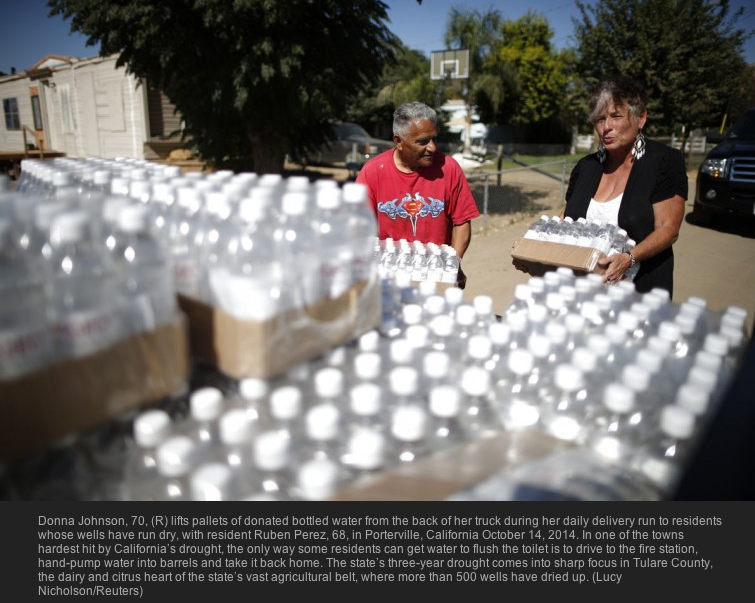
Ironically it is bottled water that has helped ease the drought in parched Tulare County where poor residents either have only bad water or are suffering from more than 1000 private well failures in the county.  Back in 2011 bottled water began arriving in small Tulare County towns like Monson where groundwater remains contaminated.

This year and last,Tulare County continues to supply some 739 households each week with bottled water at low income homes, all they have.

Tulare County officials recently stockpiled about 500 gallons of drinking water for residents this summer who may need the help.

While critics rightly point to fact that plastic bottles can stick around  for 700 years – the state of California has implemented rules to see they don’t. In California, about 21 billion California Refund Value (CRV) eligible containers were sold in 2013. Of those, more than 18 billion were recycled! Now a company has opened in Visalia who will turn those used plastic bottles into fruit packaging offering the local economy up to 100 jobs.


Cal Poly Study Says Benefits Of Marine Protected Area Will Take 20 Years

May 5,2015-

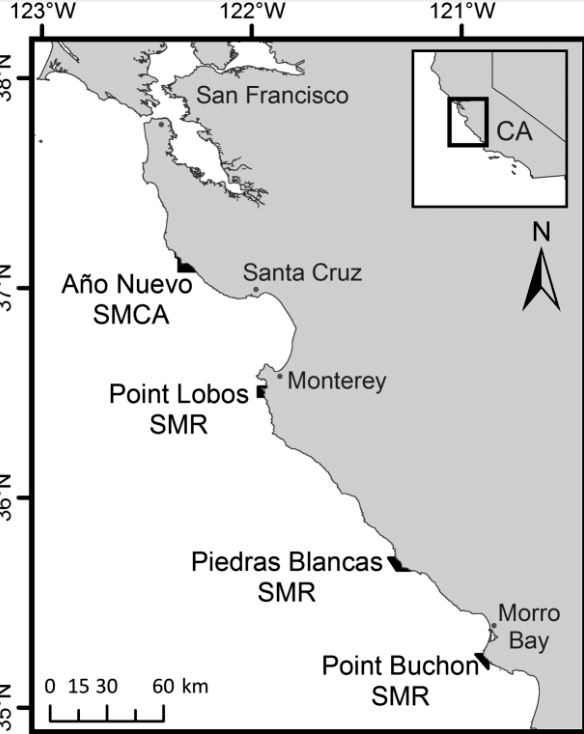
Benefits from a Marine Protected Area are likely to accrue in the California Current ecosystem, but that 20 years or more may be needed to detect significant changes in response variables that are due to MPA implementation .That is the word from a Cal Poly SLO study published in March.

The study is a result of monitoring the first seven years of 4 marine protected areas off the Central Coast. In those areas commercial  fishing is restricted to encourage habitat recovery.

Older reserves show and abundance of larger fish over time while this study showed little change after 7 years.One older reserve area is off Pt Lobos.

“The differences between MPAs and reference sites did not greatly change over the seven years of our study, indicating that reserve benefits will be slow to accumulate in California’s temperate eastern boundary current. Fishes in an older reserve that has been closed to fishing since 1973, however, were significantly more abundant and larger than those in associated reference sites.”

Screen Shot 2015-05-05 at 11.54.40 AM

Cal Poly Announces New Location, Expansion Plans for SLO HotHouse Programs

May 5,2015Screen Shot 2015-05-05 at 7.00.38 AM

University Leases 15,000-Square-Foot Location in Downtown San Luis Obispo

SAN LUIS OBISPO, Calif. — Cal Poly has leased a 15,000-square-foot space in downtown San Luis Obispo to relocate and expand its SLO HotHouse — a collaborative effort with the city and local business community aimed at supporting promising innovators, entrepreneurs and building a unique and passionate startup culture in San Luis Obispo.

The university recently signed a 10-year lease on the space along the 800 block of Higuera Street, directly above the Ross Dress for Less store.

“With the help of the City of SLO and the local business community, the SLO HotHouse has become a key player in the economic development of our County,” said Judy Mahan, director of the SLO HotHouse, “We are incredibly excited with the opportunity to continue increasing our impact with access to more space for more startups to launch and grow locally.”

The SLO HotHouse programs, currently housed in a roughly 6,000-square-foot space on Morro Street in downtown, will be shifted to the new location gradually beginning in June and through early fall.

The SLO HotHouse programs include the Accelerator, a three-month program designed to help startup companies launch successful businesses. Participants are provided with $10,000 in seed funding, SLO HotHouse office space, hands-on mentoring, and weekly workshops. Throughout the process, they are challenged to adapt their business model and product through customer development. Along the way, they learn valuable communication, leadership, and teamworking skills.

The SLO HotHouse Incubator is the next step. Selected companies are invited to remain at the SLO HotHouse for 24 months and continue working on their business. Programming includes monthly Peer Roundtable Discussions, an Incubator Advisory Board, networking opportunities, and exclusive access to various entrepreneurial events in the community. Companies pay a membership fee, starting at $50 and increasing every six months until it reaches average market price for a comparable downtown office space.

The Center for Innovation & Entrepreneurship (CIE) had eight groups in its most recent Accelerator program and has about a dozen companies in the Incubator. The larger space could allow for each program to roughly double in size, as well as allowing space for other CIE programs.

The SLO HotHouse also includes a Coworking program, through which all community entrepreneurs and startups are eligible to take advantage of office space, technological infrastructure and other aspects of the program’s synergistic shared-work environment.

And the SLO HotHouse also houses Cal Poly’s Small Business Development Center for Innovation — a service center of the UC Merced SBDC Central California Regional Network co-funded by Cal Poly’s CIE and the federal Small Business Administration. The center provides assistance for both startups and established companies helping local entrepreneurs launch companies, attract capital investment and create jobs to help contribute to the prosperity of the Central Coast.

“The San Luis Obispo business community has been integral in the success of the CIE and the SLO HotHouse — monetarily, in an advisory capacity, and by working directly with our budding entrepreneurs,” said Scott Dawson, dean of Cal Poly’s Orfalea College of Business. “The new location will enhance our SLO HotHouse programs, resulting in more and stronger startups leading change in a variety of industries.”

For more information on the SLO HotHouse programs and the Center for Innovation and Entrepreneurship, visit cie.calpoly.edu.

# # #

Morro Bay Maritime Museum Takes Big Step

May 4,2015-

Screen Shot 2015-05-04 at 11.22.50 AMThe Morro Bay Harbor Commission is expected to recommend a plan to build a 400sf Maritime Museum building on Front street on the city’s Embarcadero this week. The proposal would then go to the city council.

The Central Coast Maritime Museum Association and the City of Morro Bay have a long history working together, including a memorandum of understanding (MOU), for the shared goal of establishing a Central Coast-centric maritime museum in the northern Front Street Parking Lot area. While the City and CCMMA are currently working on updating that MOU to account for current realities, including the City’s imminent acquisition of the “Triangle Lot” area of the power plant, CCMMA has proposed a modest scale “Phase I” project to finally give the museum a physical presence on the Morro Bay waterfront.
Currently the museum has one boat on display at the property  – the rescue submarine  DRSV Avalon.They are nearing completion of the restoration of the historic tugboat Alma. A Coast Guard vessel would also be displayed.

The museum grounds will be next to new pocket park on the site being purchased from Dynegy.

California & Local Housing Market Accelerates in March

SLO County Sees Both Median Price and Sales Rise

Screen shot 2012-07-05 at 7.20.30 AMLOS ANGELES (April15) – California’s housing market continued to pick up steam as existing home sales and prices propelled higher, with both posting back-to-back increases in March, the CALIFORNIA ASSOCIATION OF REALTORS® (C.A.R.) said this week. 
 
Closed escrow sales of existing, single-family detached homes in California totaled a seasonally adjusted annualized rate of 391,680 units in March, according to information collected by C.A.R. from more than 90 local REALTOR® associations and MLSs statewide.  Sales in March were up 6.3 percent from a revised 368,400 in February and up 7.3 percent from a revised 365,120 in March 2014.  The year-over-year sales increase was the first back-to-back sales gain since December 2012 and the largest observed since May 2012.
In San Luis Obispo County the median price rose to $507,440 from $491,670 in February and $491,350 in March 2014. Sales were up smartly both on a monthly basis – up 38% and year over year – up 20%
“The housing market is picking up momentum and continuing its upward trend as economic conditions improved throughout the state”, said C.A.R. President Chris Kutzkey. “A better economy, improved job creation, and an increase in inventory in Central Valley and Southern California, in particular, are pushing sales higher, which led to the strongest February-to-March increase we’ve seen since 2008.”
The median price of an existing, single-family detached California home jumped in March from both the previous month and year. The median home price was up 9.2 percent from $428,970 in February to $468,550 in March, the highest level in seven months. The increase was stronger than the long-run February-to-March average of 3.9 percent. March’s median price was 7.2 percent higher than the revised $437,100 recorded in March 2014. The median sales price is the point at which half of homes sold for more and half sold for less; it is influenced by the types of homes selling as well as a general change in values.