
opinion by John Lindt
May 11,2015-
The drought in California has set up a hypersensitivity to water use in the Golden State, perhaps understandably. The target this past week was bottled water made in California.
 There are something like 108 water bottlers in the state and in many cases the region where the bottling is done imports water from another watershed to meet its daily needs for local cities, farms, homes and yes – the local beverage industry.
Critics found a vulnerable target when they discovered that Starbucks bottled water made in “parched” Merced, that supplies their popular Ethos brand water from a spring.
After press criticism Starbucks announced they would relocate their bottling out of state shifting it to Pennsylvania for now.
Now the same critics are are targeting other “corporate giants” who are bottling water in the “driest parts of the state” – and “profiting while California is dying of thirst.”
OK, but a map of where the bottlers are located shows that more than half are in southern California – a region that imports most of their water supply from either Arizona or Northern California.
If LA is not part of the “parched part of the state” it is only because they have contracts to import surface water.
Even if they would halt all water bottling in LA it would make virtually no difference in water savings. The fact is – bottled water use nationwide amounts to 10 billion gallons, about 3 weeks worth of tap water in LA. Going after the green lawns in LA would – on the other hand – make a difference.
Agriculture is the big user of water in California, not just statewide but in the Tulare Lake Basin as was reported recently in the Visalia Times Delta with information from John Austin.
Each hydrologic region in California has vastly different splits on their water use. The Tulare Lake watershed is the largest agricultural region in the state, home to about 3 million acres of irrigated agriculture (the total watershed is about 11 million acres). Therefore, its agricultural water consumption is significantly higher than every other region of California.
Between 2001 and 2010, the average percentage of agricultural water use was 82.5 percent (about 10.8 million acre feet out of a total of 13 million acre feet in applied water). With a relatively small, though steadily growing population (2.27 million people in 2010), its share of urban and industrial water use was only 5.7 percent over the same 10-year period. Environmental demand, mainly used for wild and scenic rivers, consumed 11.9 percent, of which .07 percent was used for managed wetlands.
For comparison, the state’s average during the same ten-year period was as follows: 42.4 percent for agriculture, 11.1 percent for urban, 46.5 percent for the environment (including wetlands, instream flow, required Delta flows, and wild/scenic rivers).
The bottom line – the Basin will have to lose some ag production most experts agree with the drought continuing.
But urban uses like manufacturing including food processors and bottling companies use a fraction of the whole water pie. It is not untrue to say that bottled water represents a drop in the bucket compared to other water users.
So when critics cheer Starbucks relocating their water bottling – done in Merced – to out of state – they are not tackling the real issue.
Ellen Hanak, director of the Water Policy Center says the vocal reaction to bottled water is “disproportionate to its impact.”
Crystal Geyser who is opening a plant in northern California will use less water annually than it takes to irrigate 50 acres of alfalfa, she adds. Hanak would focus our efforts on groundwater management rather than try to pick which industry should survive.
Singling out the water bottle industry make no sense because all beverage plants from soda to juice and milk processors – use copious amounts of water as do almonds and quarter-pound hamburgers.
In fact, the whole lot of them use more water to produce their products than makers of bottled water.
People complain about bottled water but the stuff is actually good for you and has gained popularity at the expense of sugary drinks which are not. People demand convenience and at least you can choose bottled water instead of a Slurpy at the Quiki Mart.
Often the bottlers of water are the cola makers. Would you have them shut down too?
Note that driving these food makers out of state not only hurts the economy in lost jobs but forces trucking of these products at a higher cost – also pushing up air emissions.
If you think you are targeting bad’ol Starbucks – the plant where the water was bottled is owned by Safeway and according to a Merced newspaper article in 2009 – employed 70 workers. How many jobs will be gone with the loss of business?
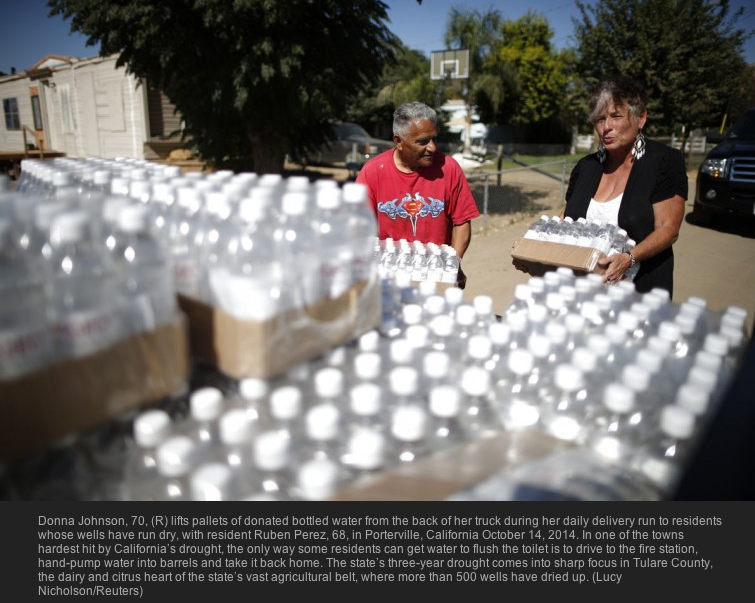
Ironically it is bottled water that has helped ease the drought in parched Tulare County where poor residents either have only bad water or are suffering from more than 1000 private well failures in the county. Back in 2011 bottled water began arriving in small Tulare County towns like Monson where groundwater remains contaminated.
This year and last,Tulare County continues to supply some 739 households each week with bottled water at low income homes, all they have.
Tulare County officials recently stockpiled about 500 gallons of drinking water for residents this summer who may need the help.
While critics rightly point to fact that plastic bottles can stick around for 700 years – the state of California has implemented rules to see they don’t. In California, about 21 billion California Refund Value (CRV) eligible containers were sold in 2013. Of those, more than 18 billion were recycled! Now a company has opened in Visalia who will turn those used plastic bottles into fruit packaging offering the local economy up to 100 jobs.