SLO Jobless Rate Drops To 4.6%

April 17,2015

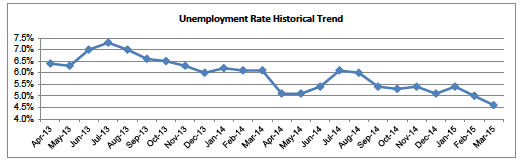
The unemployment rate in San Luis Obispo County fell to 4.6% in March 2015, the lowest March number since 2008 – before the recession. It was 5% in February and 6.1% a year ago.

The number of unemployed in the county was 6600 ,a 22% improvement over a year go when there were 8500 unemployed people.

Nonfarm jobs increased by 2.6% from a year ago according to the EDD . Construction jobs are up 7.8 % from a year ago and hospitality jobs are up 5.6%.

Screen Shot 2015-04-17 at 10.51.00 AM

Future Demographics: SLO To Grow A Few Shades Grayer

March 15,2015-

Screen Shot 2015-03-16 at 1.52.44 PM

SLO residents attend outdoor rock concert
photo from EdHat

My friend Craig told me when he picked his retirement home in SLO he wanted to make sure it was in  “walker distance” to the senior center. HAHA! He got his wish even though he is still ambulatory.So have thousands of other baby boomers (born 1946-1964) who have been landing in San Luis Obispo County.

Look for this graying of SLO County to get a few shades grayer in the future. A new California Department of Finance report says almost all the growth in SLO County will be in the age groups 65 and higher in the next five decades. The result will be nearly one-third of the residents will be elderly and I can assure you they will want their ‘senior discount.’

While California’s senior population is about 12% of the total – in SLO County today it is about 17 percent. But over the next fifty years SLO seniors will make up a bigger chunk of the total.

In 2010 SLO County had 270,000 residents of which 46,000 were 65 or older (17%). A December 2014 state report says slow growing SLO County will increase by a total of 49,000 people by 2060 over those 5 decades from the 2010 census.

While most age groups below 65 will grow very little, college age kids cohort for example, will actually decline, the seniors 65 and older will grow by a total of 44,000 over that same period.

That would mean SLO County will have a population of 319,00 in 2060 of which 90,00 would be seniors over 65 or about 29% compared to 17% today.

Looked at a different way – with the total growth of the county at 49,000 more people by 2060 – 44,000 of them will be over 65. More than 90 percent of the growth will be gray!

Bring on the Rolling Stones concerts and don’t forget that discount.

Around SLO: Jobs, Tourism & Tall Ships

San Luis Obispo Jobless Rate Up In January, Below Last Year’s Rate

SLO County unemployment rose from December to January but was lower than January 2014. January’s jobless rate came in at 5.4% compared to 6.2% a year ago. December 2014 had a unemployment rate of 5.1%. Year over year, there were 2500 more jobs than January 2014 including 100 more farm jobs.

SLO Tourism Numbers Impressive

The city of San Luis Obispo continues to sport impressive numbers when it comes to visitation.  Reports for February 2015 by Smith Travel Research show occupancy at SLO city hotels was up 4 percent yea over year while RevPAR, revenue per room was up 14.2 percent. Paso Robles enjoyed a RevPAR of 7.8%.
In another measure of strength the city of SLO bed tax revenue for December 2015 was up 20.5% year over year.

Cabrillo Returns To Morro Bay

A replica of Juan Rodriguez Cabrillo’s galleon that “discovered” Morro Bay visiting our shores as it toured the West Coast in the mid 1500s will visit Morro Bay again this fall. Construction of a replica of the tall ship is nearing completion, being built by the Maritime Museum of San Diego.The ship is on schedule to be completed in April.
Now Morro Bay will be a host port for an expected visit in October with City of Morro Bay looking to participate in the historic event including fund raising for the volunteer driven project.


Screen Shot 2015-03-11 at 3.11.15 PMScreen Shot 2015-03-11 at 3.12.32 PM

More Urban Heat; Less Summer Fog On California Coast

March 9,2015-

By Larry O’Hanlon

The summer fog that shrouds coastal southern California – what locals call the June Gloom – is being driven up into the sky by urban sprawl, according to scientists who have studied 67 years of cloud heights and urban growth in the region. Less fog may, at first, seem like a good thing. But less fog is bad news for native plants in the coastal hills and mountains, which depend on the cool fog as their only source of water during the rainless summer months. So less fog means warmer, drier, less healthy hillsides and potentially more fires.

Coastal fog inundating a stand of Bishop pine trees on Santa Cruz Island, CA in August 2011. Photo by Sara Baguskas.

Coastal fog inundates a stand of Bishop pine trees on Santa Cruz Island, CA in August 2011. A new study shows how urban heat is pushing the summer coastal fog higher, away from the ground and the native plants that depend on the moisture. Photo by Sara Baguskas.

What Park Williams of Columbia University’s Lamont-Doherty Earth Observatory in New York and his colleagues find is that the urban heat island effect – caused by concrete and asphalt retaining heat during the day and warming up the nights – is pushing up the moist coastal cloud layer. That turns what was once misty fog into a cloud layer that does not touch the ground.

“Los Angeles and San Diego have the strongest trends for rising cloud-bases and urban warming since 1948,” said Williams, regarding the two most heavily urbanized areas of southern California. “The Channel Islands (which are remote and undeveloped) and other locations have less strong trends.” The new findings were accepted for publication in Geophysical Research Letters (GRL), a journal of the American Geophysical Union.

Suspecting that increasing urban warmth might be driving fog and clouds upward, Williams and his colleagues dug into detailed, often hourly, meteorological data from the region’s many airports back to 1948. The data was trimmed to include observation times that all airfields had in common – 7 a.m., 10 a.m., 1 p.m. and 4 p.m. This was necessary because while some airfields – like Los Angeles – have nearly perfect hourly records around the clock, smaller airports which haven’t always operated at night sometimes had only daylight observations.

The researchers also used census-based estimates of household density in  1950  to estimate urban density within a 10-kilometer (6 mile)  radius of the airports. For more recent years, they were able to use more accurate data from the National Land Cover Dataset. Since urban growth in much of southern California didn’t really take off until the latter half of the 20th century, there has been a lot of urbanization over those nearly seven decades.

What they found is that cloud-bottom heights have risen at airports where there was the most urban growth. The pattern is especially clear at  at night and early morning,  when fog is most common.

“At night and early morning, that’s when clouds are closest to the ground,” explained Williams. “That’s when fog clouds deposit water directly on plants. This effect has been weakened.”

“The cloud water inputs are really important” along the entire West Coast, concurred Todd Dawson, a biologist at the University of California, Berkeley, who studies plants and their environments, and is not a coauthor on the GRL paper. The effect that Williams reports, he said, could potentially harm groves of the legendary central California coast redwoods – among the tallest trees in the world – in zones where human settlements encroach on the forests.

“Redwood forests get 35 percent of all their water in the form of fog drip,” Dawson explained, referring to the adaptations redwoods and many less conspicuous coastal California plants have for obtaining water from foggy air. “If the fog declines, you not only remove water inputs and cooling effects, but the warming means more evaporation. You are really changing the local micro-climate.”

Another surprising discovery was what Williams and his colleagues saw on the undeveloped airfields on islands off the coast of southern California: Cloud height lowered over the last 60 years.

The temperature inversion layer in the atmosphere that holds the moist marine air close to the ground (the same inversion that can hold smog near the ground) actually has been getting stronger, making it harder to break up the clouds, Williams said. It’s the opposite trend to what was seen in the urban areas, which suggests another long-term climate trend, like global warming, is causing the change, he added. “In the absence of urbanization we might see an increase in fog,” he concluded.

– Freelance science journalist Larry O’Hanlon acts as AGU’s blogs manager and social media coordinator.

Dynegy Ready To Sell Morro Bay Plant In Package Deal ( Update – Bids rejected)

February 24,2015

“The Morro Bay Power Plant (MBPP) and power plants at Moss Landing and in Oakland are currently owned by Dynegy. Dynegy is apparently planning to make a complete break from business in California and all three of those properties are up for sale.”

Screen Shot 2013-11-08 at 11.38.51 AMSo says a City of Morro Bay staff report that will be discussed this evening. Staff seeks direction on how to handle the situation that may mean both a new owner and potential new use for the landmark property along the city’s Embarcadero.
In a package deal, Dynegy is believed to be selling three power plant properties that may have as much value as waterfront properties than power plants.

UPDATE: Feb 25,2015  Dynegy posted this message on their website today – “California Strategic Review – The sales process for the California portfolio has been terminated as the bids received were below our view of the portfolio’s value.”

Can City Buy Property For $1?

There is a clause in the current deed that states the City of Morro Bay may purchase the entire MBPP for one dollar, 20-years after power generation stops. (The actual language revolves around a calculation of 15 years after the end of any 5- year consecutive period of the plant not selling or generating at least 876K megawatt hours of electricity – so the time period is effectively 20-years from the date of last production of those megawatt hours.) The start date for that 20 years is likely September 30, 2013. So, whether or not Dynegy sells the MBPP, the City would be able to purchase the property around 2033 for $1, if 876K megawatt hours are not produced at the plant between September 30, 2013 and September 30, 2018. That said, the cost to tear down and cleanup the site is extremely high, perhaps too high for even the Morro Bay of 2033 to afford. There is no requirement for the City to purchase the MBPP at the end of those 20 years.

Looking for a new buyer the city staff report says “The City, elected officials and staff, have been involved in some broad consultation with potential buyers and developers. At this point, none of those buyers have found a business case that has resulted in their purchase of the property. The City remains engaged and reaching out to potential buyers with a special interest in appropriate redevelopment that may result in the removal of some of the most unsightly parts of the MBPP facility.”

Uncertain Future

The city staff report concludes “The MBPP as it currently stands is, and may remain, a significant presence in Morro Bay long into the future. A small portion of the property has been transferred to the City, and the City has received our $525,000 and $80,535 payments from Dynegy. The City will continue to receive the annual $40,000 fire service payment. No other major property or financial transfers are anticipated in the near or medium term future, unless or until Dynegy is able to sell the MBPP. The PG&E switchyard will likely remain in place and operational for generations.

While the City’s land use authority provides measurable influence over future use, the MBPP remains private property and while we can be a partner, we are more in the passenger seat than the driver’s seat – unless we had ~$100M or so handy to buy the facility and property and perform a major environmental cleanup project.”
Unlike the Morro Bay property both the Moss Landing and Oakland facilities may well be used for future power generation since Dynegy  has invested in technology to avoid the “once through cooling system” that has now been now outlawed in the state.The three plants are the 2,529 MW natural gas fired Moss Landing Power Plant, located between Monterey and Santa Cruz on the coast, the 650 MW natural gas fired Morro Bay Power Plant, locate in that city (now closed) and the 165 MW Oakland Power Plant adjacent to Jack London Square.

The city staff report says Dynegy will not consider breaking up the package of all three properties for sale.

Around SLO: Busy January For Tourism / Mangano Plans New Marsh St Project / 69 Units Near Miners in SLO

February 18,2015-

Visitor Traffic Up Around SLO County In January

Visitor traffic was up in January according to Smith Travel Research. Hotels in the City of Paso Robles enjoyed 58.1% occupancy compared to 53.7% in January 2104. Pismo Beach  was down with 54.9% compared to 56.6% in January 2014. In the  City of San Luis Obispo occupancy jumped to 59% compared to 54.3% in January 2104. Closely watched revenue numbers  RevPAR figures were up even more impressively with Paso Robles seeing a 12.9% increase,Pismo up 5% and SLO City up 17.4%. In a separate report bed tax revenue in SLO City has  been enjoying a robust 10 to 16% increase in recent months compared to a year earlier.

Mangano Plans Another Marsh St Mixed Use Project

Screen Shot 2015-02-18 at 3.48.03 PM

Developers Andy and Craig Mangano are building another mixed use project along Marsh with plans for a 4 story 15,000sf building discussed Feb 18 at the Architectural Review Commission.The project is at the southwest corner of Marsh and Broad in the Wells Fargo parking area . The site is now part of the shopping center where Mountain Air is.
The Manganos recently completed Marsh St Commons a few blocks away, also a mixed use project where Couch Potato now occupies the ground floor.
The new project would feature two small commercial spots  spot on the ground floor with the remainder residential units.
The project will be discussed at the Feb 23 city planning commission meeting.

69 Unit Hosing Project Planned for South Of Miner’s

Screen Shot 2015-02-18 at 2.51.29 PM

Plans are in the works for a major project just south of Miners on Santa Barbara.Ave in SLO. The site backs up into the UP rail line. It calls for for 3000sf of commercial and 69 units of residential in what will be a major infill project.
The multi-story development would offer 42 studio apartments and 27 one bedroom units.
The project is being heard by the city Cultural Heritage Committee because it is located in the old railroad district. The total acreage is 1.62 acres. The site was last occupied by the Southern Pacific Milling warehouse demolished in 1999.

Reuters Reports Harvard Buys Paso Grape Land

February 16,2015

The following is a Jan 22 Reuters story

Harvard buys up water rights in drought-hit wine country

Screen Shot 2015-02-16 at 3.54.12 PM

Jan 22 (Reuters) – Harvard University has quietly become one of the biggest grape growers in California’s drought-stricken Paso Robles wine region, securing water well drilling permits to feed its vineyards days before lawmakers banned new pumping, according to records reviewed by Reuters.
The investment, which began as a bet on the grape market, has turned into a smart water play as the wells boosted the value of its land in the up-and-coming wine region of Paso Robles. But it has also raised questions about the role of big investors in agriculture in the midst of a water crisis.
“It remains to be seen what commitment they have to the business of agriculture,” said Susan Harvey of environmental advocacy group North County Watch, which has been following the drought closely. “Is Harvard going to keep pumping ground water, or cut back on returns to protect water quality and quantity?”
Brodiaea Inc, wholly owned by the secretive $36 billion Harvard endowment fund, has spent more than $60 million to purchase about 10,000 acres in Santa Barbara and San Luis Obispo counties since 2012, making it one of the top 20 growers in Paso Robles.
Harvard Management Company, which runs the fund, declined to comment, citing a policy of not discussing individual investments. Brodiaea officials did not respond to repeated phone messages.
Dana Merrill, who owns a vineyard services firm near Paso Robles and sold land to Brodiaea in 2012, said the company was among several big investors that have entered the wine grape market in California in recent years. He said he didn’t believe Brodiaea’s land buys were part of a well-timed water play.
“You’ve got a value-added product, you’ve got agricultural real-estate as a hedge against inflation, and if you can be smart about operating it you can come up with a pretty consistent cash flow that can produce a return on investment that is not as volatile as other products,” he said.
Real estate brokers said irrigable land in the heart of the Paso Robles region is running about $15,000 to $20,000 per acre, versus $3,000 for an acre of dry pasture – a spread that has widened sharply as the drought has tightened its grip.

BUYING SPREE
Since it began its buying spree – which coincided with the start of California’s latest drought – Brodiaea has acquired rights to drill 16 water wells of between 700 and 900 feet deep, two or three times deeper than the average residential well, according to county records. Deeper wells will continue to give them access to water as shallower wells run dry.
“The area they bought in has some of the best groundwater in the region, and having working wells puts their investment in a strong position,” said David Hamel, a local real-estate appraiser.
No environmental advocacy group has accused Brodiaea of trying to profit from the drought, but North County Watch’s Harvey said the drilling of deep wells in the Paso Robles wine region has the potential to exacerbate problems for locals.
“A deep well pumping high volume can draw down wells up to a mile away,” she said.
As local lawmakers were trying to figure out how to deal with the worsening water shortage in Paso Robles in 2013, Brodiaea and a number of other investors, agricultural land owners and residents moved fast to secure water rights.
The company got permits for seven 800-foot wells on Aug. 21, 2013, six days before a ban on new pumping from the hardest-hit part of the basin took effect, according to previously unreported data from the records.

RISING PRICES
An analysis published by real estate investment company Pacifica Real Estate Group this week said it expected Paso Robles irrigable land prices to rise further due to increased interest from investors from Napa Valley and Sonoma, where an acre now fetches between $75,000 and $100,000. But, “with a three-year drought upon Paso Robles, good water supply will be one of the biggest factors.”
Harvard’s investment arm, often a pioneer in new asset classes, has faced criticism in the past for some of its timber and energy investments and last year the school signed on to U.N.-backed principles for responsible investment.
Investments in natural resources were a priority for Jane Mendillo who lead the endowment until December. She has been replaced by insider Stephen Blyth.
For the fiscal year that ended June 30, Harvard’s endowment returned 15.4 percent and for the last 20 years it returned an average 12.3 percent a year. During the most recent year, investments for natural resources returned 9 percent, beating the benchmark’s 7.5 percent return. (Additional reporting by Svea Herbst-Bayliss,; editing by Ross Colvin)

Around SLO: Brewery By Airport / More

February11,2015

Local Strawberry Acreage Lower

The Santa Maria production district has some 6% less strawberry acreage this winter compared to the year before. The California Strawberry Commission says  statewide acreage is down 5.8%.  Santa Maria district that includes SLO  has 8,461 acres of strawberries ,down 544 acres from 2014. Yields are up however. The lower acreage is said to be related to water and labor issues.

Screen Shot 2015-01-28 at 6.07.05 AMMorro Bay To Adopt New City Logo

City of Morro Bay is expected to adopt  this version of a city logo/seal at their February 10 meeting. This version was the top pick on an on-line survey. The current seal dates from 1965.

Lake Nacimiento Storage Is Up  

Rainfall this past week helped increase Lake Nacimiento storage to 27% of capacity with 102,820af. That is up from 23% and 86,515af on Jan 31. Rainfall to date this year is 9.62in vs 1.46 this time last year.

Couch Potato Opens In Morro Bay

Couch Potato furniture has opened a new store at 381 Quintana In Morro Bay, former location of Morro Bay Furniture.

Pickleball Boosted

America Pickleball Association provided the Morro Bay Council with information and national statistics regarding pickleball saying
pickleball is the fastest growing sport in America.
Morro Bay has put in three courts at Delmar Park and Cambria is building 6 pickleball court .

Brewery By SLO Airport Gets Hearing

Screen Shot 2015-01-29 at 11.10.42 AMOwners of the SLO Brewing Company want to build a a brewery  and tasting room by the SLO airport on 855 Aerovista Ln. They plan a 12,00sf beer making facility with about 19,000 additional space for lease. The project was heard at this months Architectural Review Board meeting.SLO Beer is now brewed Downtown on Garden St but the new manufacturing facility would allow increased production for beer on tap  at local eateries and in bottles. SLO Brewing Co also plans to relocate the main restaurant to the the 700 block of Higuera in mid-2015.

Old Bobs Big Boy in Morro Bay Finally Gets New Tenant

February 10,205

Going Local With ‘Grill Hut’

Empty for three years the former Bob’s Big Boy restaurant on Quintana in Morro Bay will get a new tenant as of April 1. The restaurant that many also remember as a Denny’s has been completely remodeled by the property owner AJ Wright.

Screen Shot 2015-02-10 at 1.01.37 PMComing in is a local favorite – Morro Bay‘s own Grill Hut who currently have a 40 seat place in North Morro Bay at 3118 Main.

Owners Lori and Jason Scheer are Bakersfield natives who have been in Morro Bay for two years and have definitely mastered the art of great BBQ dishes.

Grill Hut will be be open for breakfast, lunch and dinner at their new expansive location  with its huge jump in seating capacity with room for 140 eaters and a huge parking lot.

“It will be a much better location for us since it seems too many people don’t know we are here” shrugs Jason with their “hut” tucked away in a small strip center.

Favorite dishes at the eatery are tri-tip,ribs and pulled-pork as well as all homemade sides including potato salad and Loris’s cole slaw. The popular BBQ place offers daily specials.

The Scheers emphasize they don’t offer fast food but ”good Food Fast.”

SLO Airport To Host Conference

January 30,2015

With passengers traffic up more than 11 percent this past year SLO Airport is hoping for more growth ahead  They have been courting two airlines – United and Alaska – in recent months to begin flights to new cities from San Luis Obispo.Now the airport will host the twice yearly Sixel Air Conference in Avila Beach in April says airport manager Kevin Bumen.

Screen Shot 2015-01-30 at 11.05.09 AMSixel is a national consultant firm consultant who works with muni airports like SLO and all the airlines to put the two together.

Coming to the SLO air conference will be 50 airports and 18 airlines.

The airpot conference will shine the spotlight on SLO County,already a tourist Mecca with hopes more airlines will see the potential business  by connecting here. The timing good be right with lower costs for airlines and full planes on most routes.

Bumen says SkyWest will be converting the current fleet of propeller passenger planes to large jets beginning in April connecting us to LAX and SFO.