Where Is SLO’s Future Water Coming From? One Word – Nacimiento

May 29,2016-

The City of San Luis Obispo’s Planning Commission took up a a draft water management plan for the future at its May 25 meeting. The City assumes it needs to plan for a population of 57,200 within its urban reserve until 2035, up from 48,802 as of 2015.

Screen Shot 2016-05-28 at 7.00.06 AM

To supply the water needs of that population, they are counting on surface water shipped from Nacimiento Lake near the Monterey County border fed by pipeline. With little prospect of groundwater sources and only a small increase in recycled water – in March 2016, the City Council approved the addition of 2,102 acre feet per year from Nacimiento Reservoir to the City’s secondary water supply.

The City says the secondary water supplies are used to meet short term losses to the City’s water supply due to events such as drought, pipeline maintenance, and repair of infrastructure. With uncertainty of future climatic conditions, regulation and aging infrastructure, the additional supply of Nacimiento water to the City’s portfolio reduces pressure on use of water supplies in the Whale Rock and Salinas reservoirs. It would serve to extend these stored supplies during critical water shortage periods

That takes the annual supply of potable water from Nacimiento to 5482 AF added to its other reservoir water sources – assuming a loss of some supply from siltation at Whale Rock Reservoir.

The upshot is to meet the additional need for water from growth in the city – Nacimiento Lake is the go-to source although other existing reservoirs offer a base supply.

The San Luis Obispo County Flood Control and Water Conservation District (County) has held an entitlement to 17,500 acre-feet of water from Nacimiento Lake since 1959.
Screen Shot 2016-05-29 at 6.35.10 AM

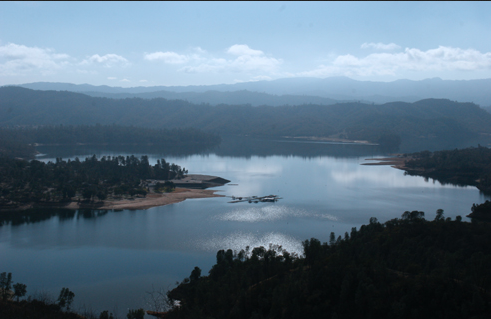
The lake has some 125,000 acre-feet stored as of this week.The reservoir has a storage capacity of 377,900 acre-feet and serves the purpose of abating seawater intrusion in the groundwater aquifers of the Salinas River Valley.The County began construction in 2007 on a 45-mile pipeline project to deliver water from the Nacimiento Reservoir to participating agencies and cities.

Despite  what they call a “reliable” water portfolio for the future totaling 12,109AF the City is expected to need – demand some 6035 acre-feet as of 2015 and increase demand to 7779 AF by 2035 even after 3 dry years.

Screen Shot 2016-05-28 at 6.54.14 AM

As one can see from this chart the City’s share of water from Salinas Reservoir (Santa Margarita Lake) and Whale Rock combine enough to supply our annual use for many years with Nacimiento being the insurance  policy if things got worse.

In a second report presented the same day the planning commission  heard their analysis of residential and non residential growth expected.

The report offers some interesting insights.Although the residential population here is 48,000 – the city’s daily population is over 70,000.

CalPoly is the top employer with 3055 jobs.As the top employer, Cal Poly maintains a student enrollment between 18,260 and 19,780 students with a projected enrollment at 20,912 students by the year 2020. While Cal Poly has its own water supply source, the City treats and distributes water to the University which is located just outside of City limits.The report notes that  Cal Poly is out of session at this time, thus reducing the overall daily population served by the City during the summer months. In 2015, with the update to its Master Plan underway, Cal Poly indicated that it is considering the idea of year-round instruction by expanding summer classes.

Adding the numbers regards new residential growth the City’s plan assumes an additional 5000 new units to be added by 2035.The analysis  indicates that nonresidential growth will remain below the City’s one percent average annual growth rate throughout the general plan buildout period to 2035.

SLO County Files Complaints Against Two Los Osos Sewer Contractors

May 16,2016-

Screen Shot 2016-05-16 at 5.10.50 PMSan Luis Obispo County has filed complaints against two contractors who are working on the Los Osos Wastewater project doing home lateral connections. The complaints have been filed with the California Contractors State License Board. The notice is included on today’s update to the project’s Contractor Interest List that gives consumers a list of approved contractors to do the pipe connection from the street   to homes. The excavation and septic tank work must be done using county guidelines as the homes stop using their septic systems and hook up to the new sewer line.

The two complaints were filed against Hometown Plumbing Sewer & Drain, based-in Bakersfield ,Mike Solorio, contact – as well as Pumping For Less, based-in Bakersfield,Billy Williford, contact person.

The notice says that the complaint “is only an allegation of probable violation.” It does not affect the status of the licenses as of now.”If the complaint is referred to the Office of the Attorney General for legal action, it may result in suspension or revocation” the county’s notice says.

SLO County 2015 Crop Value Down 8 Percent

May 15,2016-

Screen Shot 2016-05-15 at 7.22.21 AM


The San Luis Obispo County Department of Agriculture/Weights and Measures announced the release of the 2015 production statistics for the local agricultural industry this past week..  Statistics can be found on the Department’s website at www.slocounty.ca.gov/agcomm.

Total gross crop values for 2015 are $828,800,000.  “This 8% decline in value compared to 2014 is directly attributable to the cumulative impacts of the ongoing drought”, according to Martin Settevendemie, County Agricultural Commissioner/Sealer.  Settevendemie cautioned the statistics only represent commodity gross values and do reflect net profits received by producers.  Also, reported values do not include multipliers related to secondary economic benefits to the community.
The top ten commodities ranked by value for 2015 were:  1. Strawberries, 2. Wine Grapes, 3. Cattle, 4. Broccoli, 5.Vegetable Transplants, 6. Cut Flowers, 7. Head Lettuce, 8. Leaf Lettuce, 9. Avocados, and 10. Lemons.
For the second year in a row, strawberries were the top valued crop.  Strawberries benefitted from dry weather conditions that plagued other crops.  Over 3,400 acres were planted, meeting the high demand for fresh and processing berries.

Wine grapes were ranked number two in value.  Unusually cool spring temperatures and strong winds caused grape blossoms to shatter before the fruit was set on the vines.  This severely reduced yield, resulting in a 31% drop in production for wine grapes, compared to 2014.  Despite prices remaining favorable, the value for all wine grapes decreased 28% compared to 2014.

Avocado trees continued to be stumped throughout the county in 2015.  Stumping is a cultural practice that reduces the leaf canopy and water demand of trees when there is a lack of water for irrigation.  It will take a few years for avocado trees to rebound once normal rainfall returns.

Dryland farmed walnut trees were especially hard hit by the continued drought.  Loss of half century old trees and low yields contributed to an overall 25% reduction in value compared to 2014.

Vegetable crops were in high demand in 2015, due to reduced production throughout California’s drought stricken vegetable production areas.  This is reflected in the strong prices for most vegetable varieties.  However, an overall 6% reduction in harvested acreage was reported.  It was also reported some fields were left fallow due to lack of irrigation water and insufficient farm labor.  Overall, the value for all vegetables increased 10% compared to 2014.

The impact of the drought to cattle production was dramatic.  Lack of forage on grazing land forced the sale of cattle beginning in 2013.  By 2015, herd sizes had been significantly reduced and the number of cattle sold in 2015 was less than half the number sold in 2014.  The total value for the Animal category plunged 48% compared to 2014.

Grain and hay growers who ventured to plant a crop amidst a severe drought were rewarded with solid yields as the late spring rains helped to maintain production.  However, prices were down, a reflection of the decreased demand for feed due to the reduction in livestock numbers statewide.  The total value for field crops dropped 7% below 2014 values.

Water use restrictions that went into place across California in 2015 created mixed results for nursery stock producers.  Succulents and other drought tolerant plants remained popular.  A slight rebound in housing construction created an increased demand for drought tolerant landscape plants.  The resulting 19% rebound in value over 2014 restored production values closer to historic levels.

“Agriculture continued to be a significant economic contributor in 2015 and represents a central component of the rural character enjoyed by the local community, and a dependable source of high quality food and products for consumers around the world.  Despite challenging drought and unusual weather during 2015, agriculture in San Luis Obispo County remains strong”, explained Settevendemie.  With over one hundred different crops produced in the county, this diversity provides for stability when growing conditions become challenging.
Statistics of the local agricultural industry featured in Annual Reports for 1928 through 2015 can be viewed at www.slocounty.ca.gov/agcomm .

French Company Lays Off 168 In Santa Maria

May 11,2016 –

Screen Shot 2016-05-11 at 2.45.19 PMSanta Maria’s largest private employer, French-owned Zodiac Aerospace seat shells division will lay off 168 workers next month according to a new state WARN notice published this week. The company employs around 1800 workers in Santa Maria according to their website.

The division specializes in passenger seats for regional aircraft manufacturers. The Santa Maria facility, expanded in 2012, is located in a 82,000sf building on Airpark Drive. Zodiac operates 100 sites worldwide with eight locations in California and three in Washington.

In a March financial report to its shareholders the company pointed to issues with the Santa Maria operation.

“The recovery and industrial transformation plans for the Seats branch are proving long and costly, especially at its seat shell manufacturing site at Santa Maria, California.” For the first 9 months of the fiscal year the firm said revenue in the seat division was down 4.2%.
The March report says” Within the Zodiac Seats branch, the Zodiac Seat Shells division at Santa Maria, California, has around 1,800 employees and has seen in-depth restructuring in recent years with the doubling of its size and the move to more industrial production.” A few years ago the company employed 1200 according to the the city.
Zodiac Seats U.S. is one of the world’s top manufacturers of commercial aircraft seats for airlines and commercial aircraft manufacturers. Its headquarters and primary manufacturing facility is located in Gainesville, Texas with final assembly lines also located in Rancho Cucamonga California, Tianjin, China and a component manufacturing facility in Chihuahua, Mexico.

Zodiac acquired C&D Aerospace in 2005 which had a plant in Santa Maria.

Calls to the corporate office in HuntingtonBeach were not returned.

Around The Coast: Roundabout / Strawberries & Avocados

Roundabout Likely At Hwy 41 & Main In Morro Bay

City Public Works Director Rob Livick says CalTrans is suggesting a roundabout,traffic circle, at the confluence of Highway 41 and Main Street in  Morro Bay as the best way to move traffic at the busy intersection in the future. The city and CalTrans are working together on the idea that might be a recipient project under the funding plan for the countywide half-cent sales tax measure on the November ballot. The roundabout would still allow room for construction of a new Sonic Drive-In where the USA gas station is today.

Strawberry Acreage Down – Berry Production Takes Hit

Screen Shot 2016-05-09 at 1.44.46 PMCalifornia strawberry acreage is down from 2015 by 12% and down 25% in the Santa Maria growing area. Acreage dropped from 8,305 in 2015 to 7,100 acres in the Santa Maria/San Luis Obispo district in 2016.

According the the California Strawberry Commission “While consumer demand remains strong, rising production costs and regulatory restraints are eroding returns to growers, resulting in adjusted acres planted for 2016 production.”

Through the first week of May the Santa Maria district has produced 17.4 million flats vs 21.6 million flats for the same period a year ago according to the National Berry report. Statewide the drop-off is even more dramatic from 71.9 million flats to 53.6 million flats so far this year, a 26 percent drop.

Some farms have gone out of business due to financial problems and the drought. Others point to loss of soil pest chemicals in the state including fumigants such as chloropicrin and Telone that face regulatory scrutiny. Methyl bromide, is being phased out completely this year.

The commission points to development of new strawberry varieties and increased productivity on the farm as cause for hope. They also note  that Cal Poly San Luis Obispo has launched the California Strawberry Sustainability Research and Education Center.

“For 2016, California continues as the leading production region in the world and is expected to supply over 79% of the volume consumed in the U.S.”

Among other berries blueberry production in California  is also down this year while imports from countries like Chile are way up. California  raspberries too are down this year.

Avocado Sizes & Prices Down

The California avocado crop is small in size but big in volume while prices have declined this year. Big avocados are coming from Mexico  this year. The California Avocado Commission reports that mid-size avocados ( 48s) FOBs this year have declined to $25 a box from $37 a box as of the first week of May compared to the same time last year.
This year’s California avocado crop is expected to be around 30% larger than the year before. Mexico too has a large crop expected  to be a record.

Morro Bay To Localize Water Supply

Desal &  Aquifer Recharge Could Replace Imported Water

The City of Morro Bay gets about 87 percent of its drinking water from the State Water Project piped in from Northern California.

Screen Shot 2016-05-07 at 7.49.40 AMNow the city is ready to launch their “One Water” plan that would localize the water supply says Rob Livick, the city’s Public Works Director. The city would like to plan for 1200 acre-feet of water a year to meet growth needs although it uses about 1075 acre-feet today. The plan is being presented to the City Council May 10.

Instead of counting on uncertain and perhaps unreliable imported water in the future the new plan calls for a “diversified portfolio” says Livick. While it is few year off the plan calls for about 1000/af of the supply to come from the city’s new Water Reclamation facility being sited now likely in or near the Chorro Valley – along Highway 41.

In addition Morro Bay wants to use their desal plant on a permanent basis to the tune of 250 acre-feet annually from seawater and brackish well water.To do that need Coastal Commission approval.In August the  Commission will meet here and the issue will be one the table.

Adding these two local sources to replace the State Water the city looks to save big time. Projections of future cost suggest State Water may cost Morro Bay $3 million a year for 1200/af while the two local sources will cost $1 million total.

State water is expected to rise in cost once new tunnels are built around the delta to be paid by all contractors including Central Coast communities.

Key to Morro Bay’s plan is the siting of their water reclamation plant away from its present oceanside location, a move mandated by the state. Water processed and recharged at the future plant will be uphill from city wells in the Chorro Valley and perhaps some in the Morro Valley up Hwy 1 depending on the site selected.

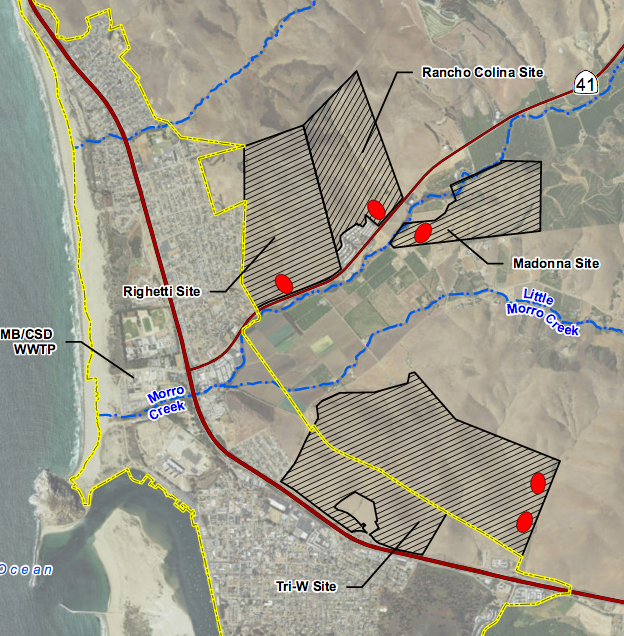
In recent months the council seemed convinced the so called Righetti site in the Chorro Valley as best, in part because it is the least expensive and is in close proximity to those wells.

But the site is the viewscape on some homes on a hill whose owners have complained loudly.

Screen Shot 2016-05-07 at 11.56.52 AMThe city is now considering an alternate site -the so-called TriW sites. The city staff report to be discussed at the May 10 meeting as well says while “Righetti is the site with lowest capital and lifecycle cost if the project proceeds with few delays that could otherwise lead to cost escalation.

However, if cost and timing certainty are considered more important than choosing the overall lowest cost alternative in the context of risk that could lead to delays and cost escalation, the portion of the TriW site identified in this report is considered the best overall location
for a new WRF among the five sites studied in this report. This includes either of two roughly 15 acre pieces of land within the TriW parcel currently within the County, not the City.

This location has no immediate neighbors, is generally not visible from public roadways, and is large enough to potentially accomplish other City goals (including a corporation yard and possibly a solar power facility). Pipelines to and from the site could largely be built within City
streets and parks, rather than in Caltrans right of way. These advantages are likely to reduce the differences in costs between the TriW and any of the Morro Valley sites.”

Livick says the city would  likely favor the TriW site number 2 – not in the city limits – as the TriW site that is closest in and in the city limits may have other urban development uses in the future while the other is out of sight on a relatively flat site to the north.

He adds that even if the site is not close to city wells it would be connected to recharge the aquifer and meet the city’s future water supply goal.

It’s not just Morro Bay that is planning to use desal water in the future.

Screen Shot 2016-05-06 at 6.20.37 AMSanta Barbara’s desal plant will begin supplying water in October 2016 with a production of nearly 3 million gallons per day. This is equivalent to 3,125 acre-feet of water annually or about 30% of the City’s demand. At additional expense, the City has the option to expand the facility, up to the permitted capacity of 10,000 acre-feet of water annually, if drought conditions continue and additional water is needed says the water district.

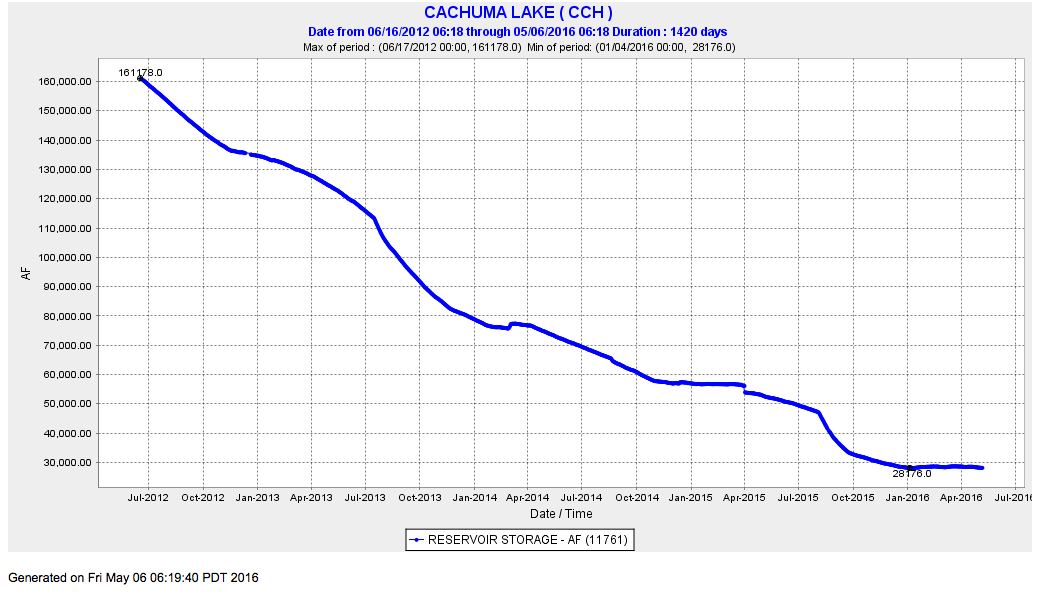
Stung by the drought the region’s big Cachuma Lake reservoir is nearing minimum pool after declining from 160,000 acre-feet in July 2012 to 28,000 acre-feet today amid fears it will go dry.

There is a new desal facility in Carlsbad near San Diego that is now operational. In addition, about 15 other desalination sites are being proposed in the state.

In SLO County the BOS recently approved plans to expand the desal facility at Diablo Canton to supply water to south county communities.

Meanwhile Los Osos will be using water discharged up gradient from the town piped in from their new WWT plant to recharge drought impacted wells and to push back seawater to hopefully provide a sustainable water supply for this town.

Los Osos Grocery Outlet May Not Open Till Late 2016

April 22,2016-
Screen Shot 2016-04-22 at 12.06.42 PMGrocery Outlet has signed a lease for the vacant Haggen store in Los Osos confirms shopping center manager Clayton Gambril as well as a Grocery Outlet spokesperson.
Gambril has been marketing the empty space for several months to prospective grocery tenants. The store closed last summer but went through an extended bankruptcy process delaying any new use.
VP of Real Estate For Grocery Outlet Bill Coyle said this week that “lots of people asked us to open in Los Osos and we decided that want to be part of the community”he says. “They practically begged us.”
Each Grocery Outlet has a local owner but it is not clear who that might be in this case. One of the owners of the store in SLO says no one has been selected yet by the corporate office. Coyle confirms that no local party has been identified to oversee the store but a there is “no shortage” of existing operators who would love to live in the Central Coast town.
Delaying an opening of the store are a couple of factors including the need to do “an extensive remodel of the store” figures Coyle “like we did in San luis Obispo.”  That store is “doing extremely well” he adds.
Then there is the fact that the Bay Area-based firm is committed to opening a number of stores already in the pipeline, he says.
“We may be able to squeeze Los Osos in the schedule by the last quarter of this year – but it might be early 2017.”
County planner Kerry Brown says they have been contacted by an architect representing the company who plans to submit some modifications to the building.The grocer has also filed for a sign permit.
Gambril believes filling the Haggen space will help plans to rejuvenate the center. Gambril expects more good news as he fills each empty space left.The new remodeled Starbucks plans to open in June and two spaces within the same building are expected to be leased out to new tenants as well he says.
Regarding the rumor that Starbucks may seek to sell beer and wine at their new Los Osos location, the former B of A building, there is no firm answer. One press report points to the growing trend by the  coffee chain. “There are more than 300 Starbucks locations across the United States — including Seattle, Chicago, Los Angeles, Santa Rosa and San Mateo — that offer “Starbucks Evenings,” selling small plates, beer and wine after 4 p.m., according to the company spokeswoman.” There are at least 2 locations in SLO County who have filed withe ABC to sell beer and wine.

UBER CLEARED FOR “TAKE OFF” AT SLO COUNTY REGIONAL AIRPORT

April 18,2016-

Screen Shot 2016-04-18 at 1.11.24 PMSAN LUIS OBISPO, CA — San Luis Obispo County Regional Airport (SBP) patrons will now have another option available to them for their ground transportation needs. Uber has joined the ranks of Taxi, Shuttle Bus and Limousine ground transportation service offerings.
“We are excited to be able to offer this popular transportation network company service as part of our continued commitment to explore ways to enhance our customer experience,” said Kevin Bumen, Director of Airports.
Uber will pick up and drop off riders at one of the white curbs in front of the terminal and operate from off-airport locations at all other times.
For more information or details, visit www.sloairport.com or call 805-781-5205.

Grocery Outlet Signs Lease In Los Osos

April 13,2106-

Screen Shot 2016-04-13 at 4.47.03 PMGrocery Outlet has signed a lease for the vacant Haggens store in Los Osos confirms shopping center manager Clayton Gambril. “We just received the papers yesterday” says Gambril who has been marketing the empty space for several months to prospective grocery tenants. The store closed last summer but went through an extended bankruptcy process delaying any new use.

Gambril says he has not been told how soon the store might reopen.But county planner Kerry Brown says they have been contacted by an architect representing the company who plans to submit some modifications to the building.The grocer has also filed for a sign permit.

Each Grocery Outlet has a local owner but it is not clear who that might be in this case. One of the owners of the store in SLO says she doe not believe one has been selected yet by the corporate office. Calls to the corporate office in the Bay Area were not returned by press time.

Gambril expects filling the Haggen space will help plans to rejuvenate the center. Gambril expects more good news as he fill each empty space left.The new remodeled Starbucks expects to open in June and two spaces within the same building are expected to be leased out to new tenants as well he says.

Regarding the rumor that Starbucks may seek to sell beer and wine at their new Los Osos location, the former B of A building, there is no firm answer. One press report points to the growing trend by the  coffee chain. “There are more than 300 Starbucks locations across the United States — including Seattle, Chicago, Los Angeles, Santa Rosa and San Mateo — that offer “Starbucks Evenings,” selling small plates, beer and wine after 4 p.m., according to the company spokeswoman.” There are at least 2 locations in SLO County who have filed withe ABC to sell beer and wine.

Around SLO County: Coast BMW Plans New Showroom On Calle Joaquin In SLO

New BMW Location

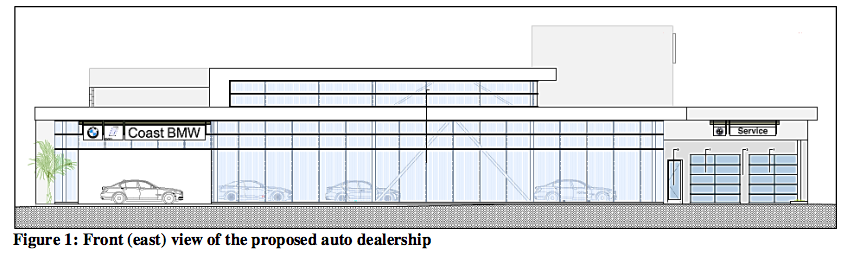
Screen Shot 2016-04-11 at 3.01.36 PMCost BMW plans to build a new 24,000 square foot two-story auto dealership at 1251 Calle Joaquin on 2.7 acres. The project to be located just off LOVR and Hwy 101 got the approval of the city Architectural Review Commission earlier this month. The building would be located at the developed end of the street with Hwy 101 to the south and east.To the west is the new tire store and Chevy/ Mercedes dealership.
Relocation the current site for the BMW showroom from Los Osos Valley Road should give its owner, the Cardinale Group, room to expand its Nissan dealership next door or otherwise add a new franchise.Cardinale owns both dealerships. Monterey-based Cardinale owns dealerships in Seaside,Salinas,Corona, Tahoe, Las Vegas and Mesa Arizona.

SLO TOT Monies Up 5.5% in March

The City of San Luis Obispo saw a 5.5% increase in bed tax revenue TOT’s, in March 2016 compared to March 20015. For the fiscal year so far TOTs  are up 6.2%.

Marriott Residence Inn Plan For New Hotel In Paso

The City of Paso Robles is processing a permit for a 119 room Marriott Residence Inn. The four story extended stay hotel is seeking a conditional use permit. The project is located off Union Rd on South Vine.

Sonic Drive Inn Plans Morro Bay

Sonic Drive Inn is moving forward on plans to build a new restaurant  at the corner of Main St and Hwy 41 in Morro Bay. The city has filed a mitigated negative declaration  that will allow the project to move forward.The eatery would be 1400sf and includes both drive up service and drive thru service.