
Desal & Aquifer Recharge Could Replace Imported Water
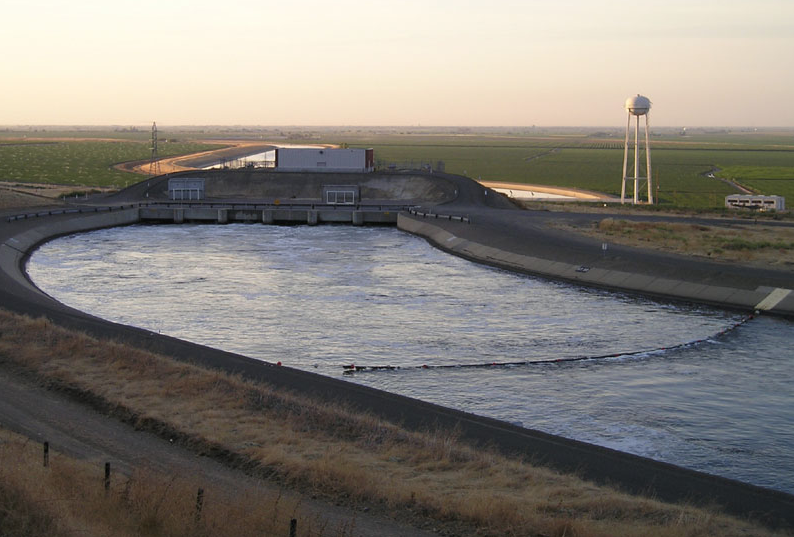
The City of Morro Bay gets about 87 percent of its drinking water from the State Water Project piped in from Northern California.
 Now the city is ready to launch their “One Water” plan that would localize the water supply says Rob Livick, the city’s Public Works Director. The city would like to plan for 1200 acre-feet of water a year to meet growth needs although it uses about 1075 acre-feet today. The plan is being presented to the City Council May 10.
Instead of counting on uncertain and perhaps unreliable imported water in the future the new plan calls for a “diversified portfolio” says Livick. While it is few year off the plan calls for about 1000/af of the supply to come from the city’s new Water Reclamation facility being sited now likely in or near the Chorro Valley – along Highway 41.
In addition Morro Bay wants to use their desal plant on a permanent basis to the tune of 250 acre-feet annually from seawater and brackish well water.To do that need Coastal Commission approval.In August the Commission will meet here and the issue will be one the table.
Adding these two local sources to replace the State Water the city looks to save big time. Projections of future cost suggest State Water may cost Morro Bay $3 million a year for 1200/af while the two local sources will cost $1 million total.
State water is expected to rise in cost once new tunnels are built around the delta to be paid by all contractors including Central Coast communities.
Key to Morro Bay’s plan is the siting of their water reclamation plant away from its present oceanside location, a move mandated by the state. Water processed and recharged at the future plant will be uphill from city wells in the Chorro Valley and perhaps some in the Morro Valley up Hwy 1 depending on the site selected.
In recent months the council seemed convinced the so called Righetti site in the Chorro Valley as best, in part because it is the least expensive and is in close proximity to those wells.
But the site is the viewscape on some homes on a hill whose owners have complained loudly.
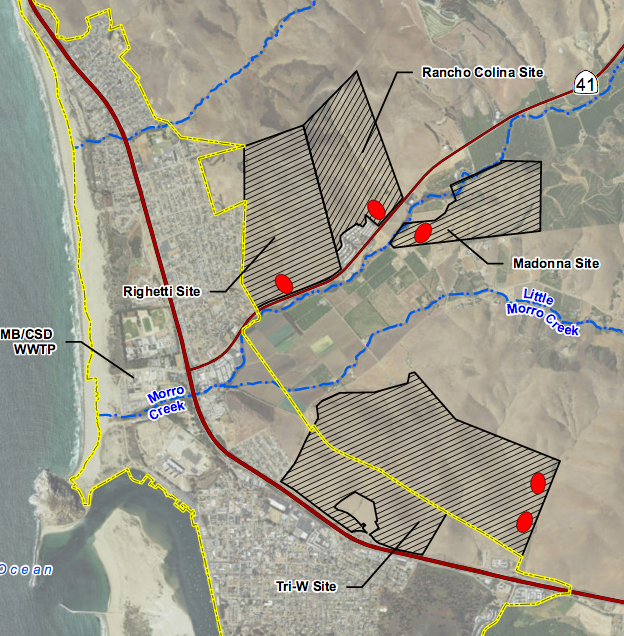 The city is now considering an alternate site -the so-called TriW sites. The city staff report to be discussed at the May 10 meeting as well says while “Righetti is the site with lowest capital and lifecycle cost if the project proceeds with few delays that could otherwise lead to cost escalation.
However, if cost and timing certainty are considered more important than choosing the overall lowest cost alternative in the context of risk that could lead to delays and cost escalation, the portion of the TriW site identified in this report is considered the best overall location
for a new WRF among the five sites studied in this report. This includes either of two roughly 15 acre pieces of land within the TriW parcel currently within the County, not the City.
This location has no immediate neighbors, is generally not visible from public roadways, and is large enough to potentially accomplish other City goals (including a corporation yard and possibly a solar power facility). Pipelines to and from the site could largely be built within City
streets and parks, rather than in Caltrans right of way. These advantages are likely to reduce the differences in costs between the TriW and any of the Morro Valley sites.”
Livick says the city would likely favor the TriW site number 2 – not in the city limits – as the TriW site that is closest in and in the city limits may have other urban development uses in the future while the other is out of sight on a relatively flat site to the north.
He adds that even if the site is not close to city wells it would be connected to recharge the aquifer and meet the city’s future water supply goal.
It’s not just Morro Bay that is planning to use desal water in the future.
 Santa Barbara’s desal plant will begin supplying water in October 2016 with a production of nearly 3 million gallons per day. This is equivalent to 3,125 acre-feet of water annually or about 30% of the City’s demand. At additional expense, the City has the option to expand the facility, up to the permitted capacity of 10,000 acre-feet of water annually, if drought conditions continue and additional water is needed says the water district.
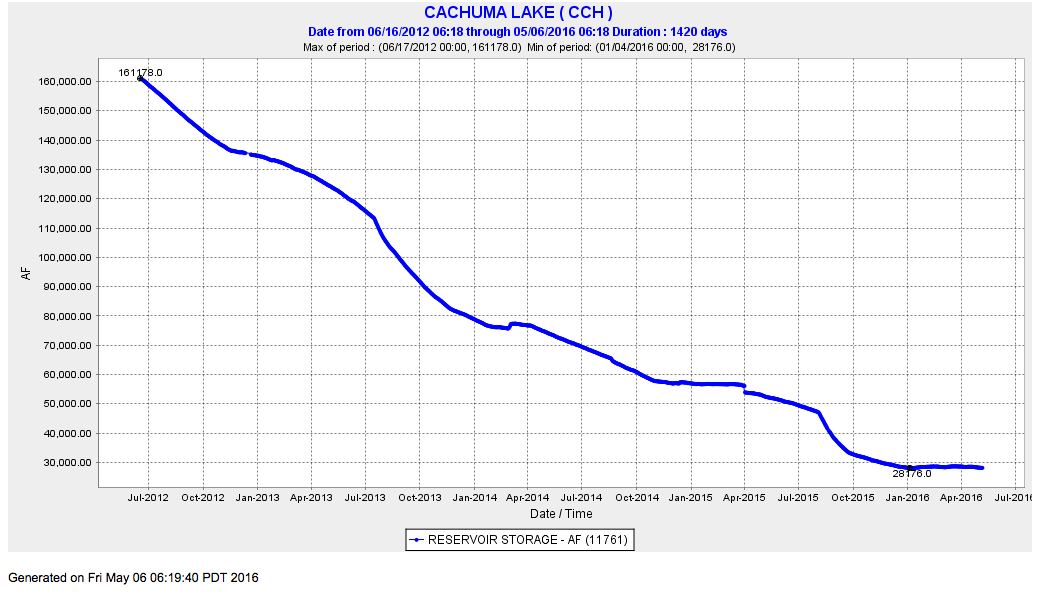
Stung by the drought the region’s big Cachuma Lake reservoir is nearing minimum pool after declining from 160,000 acre-feet in July 2012 to 28,000 acre-feet today amid fears it will go dry.
There is a new desal facility in Carlsbad near San Diego that is now operational. In addition, about 15 other desalination sites are being proposed in the state.
In SLO County the BOS recently approved plans to expand the desal facility at Diablo Canton to supply water to south county communities.
Meanwhile Los Osos will be using water discharged up gradient from the town piped in from their new WWT plant to recharge drought impacted wells and to push back seawater to hopefully provide a sustainable water supply for this town.