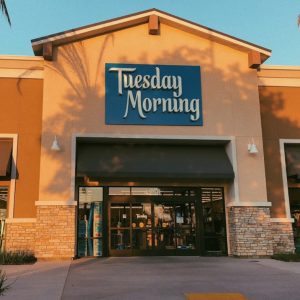
Texas retailer Tuesday Morning is the latest San Luis Obispo store to announce a Chapter 11 bankruptcy filing on May 27. Tuesday Morning has a location at the Marigold Shopping Center on Broad.
The company has said they would shutter 230 of its 687 stores in their court filing. The filing lists the locations that will be closed in a “first wave” including 13 California stores.
San Luis Obispo’s 8100 square foot store at 3680 Broad is on this closing list.The store is near to the former Michael’s location, now vacant, and a few storefronts down from Vons. Kimco Realty manages the center.
In their court papers Tuesday Morning says “Due to the COVID-19 pandemic, the Debtors have faced unprecedented challenges including rapidly declining sales at their retail locations.”
There are 133 stores expected to be closed beginning June 1, 2020 with a listing that includes San Luis Obispo.Ironically the SLO store is still shuttered due to COVID 19 but will apparently have to open its doors for the expected closing sales event. The company said before the bankruptcy filing that they had scheduled multi-state re-openings and were bringing associates back to work over the next few coming weeks.
Store locations in California set to close in this first wave include Monterey,San Luis Obispo, Fresno,Visalia,Thousand Oaks, Aliso Viejo, Pleasanton, Pleasant Hill, Santa Clarita, Culver City, Eureka,Union City, Placentia and Vacaville.
Tuesday Morning was launched in Dallas in 1974, The off-price retailer focuses on closeout home goods. The unique name comes from founder Lloyd Ross when he held his first “garage sale.” The story has been told that Ross decided on Tuesday Morning as the company name because “it is the first positive day of the week.” Perhaps that is why they waited until Wednesday May 27 to file their bankruptcy papers.
Upscale department store Nordstrom will shut 16 full-line stores later this year, the company announced last week. The permanent closures include six in California. On the Central Coast, the store in the Paseo Nuevo shopping center in Downtown Santa Barbara is set to close by August.
The closures do not include any of the off-price Nordstrom Rack locations.
In Santa Barbara the closure devastates the iconic Paseo Nuevo open-air retail complex on lower State Street where Macy’s closed several years ago leaving the shopping center without an anchor store. Downtown Sant Barbara, once a shopping Mecca has suffered from a long term downturn in recent years due to the 2008 Great Recession, the impact of online shopping and now the corona virus shutdown.That includes the loss of most tourist traffic.
The Nordstrom outlets in California set to close include these locations:
•Arden Fair Mall, 1651 Arden Way, Sacramento, California
•Paseo Nuevo, 17 W Canon Perdido St., Santa Barbara, California
•Montclair Place, 5015 N. Montclair Plaza Ln., Montclair, California
•Westfield North County, 270 E Via Rancho Pkwy, Escondido,
•3601 The Galleria at Tyler, Riverside, California
•Stoneridge Shopping Center, 1600 Stoneridge Mall Rd., Pleasanton,
Launched in 1901 the Seattle-based chain started as shoe store founded by John W. Nordstrom and Carl F. Wallin. The luxury department store included a grand piano serenading shoppers at their Santa Barbara location. The closure in well heeled Santa Barbara follows the demise of several other high-end stores in recent years including Macy’s in 2017, Sacks Off 5th, I-Magnin, Robinson’s and Tiffany & Co who closed their high-end shop in Santa Barbara’s La Cumbre Plaza earlier this year. Upper crust steak house Ruth’s Chris shuttered at La Cumbre in 2011. Macy’s at La Cumbre on upper State is the last department store in town left. Sears closed their department store here last year.
Struggling to find a formula for Downtown, the city now owns the former Macy’s building in Paseo Nuevo.
Fresno/Clovis/Bakersfield/Tulare rank high for growth
-May 8,2020- California added 87,494 residents to bring the state’s estimated total population to 39,782,870 people as of January 1st, 2020, according to new population estimates released in early May by the California Department of Finance. Many communities experienced slow growth but some areas actually shrunk.
You can imagine a good chunk of San Luis Obispo residents are cheering the top headline wanting to keep our little bit of paradise a secret. The demographic report says San Luis Obispo County population fell from 278,355 in 2018 to 277,259 by January 2020.That is a decline of 0.4%.
By percentage Pismo Beach was down the most from 8237 to 8,139 residents – a 1.2% decline.The City of San Luis Obispo was flat while Atascadero lost 1%.
In our reading area more robust growth was seen inland like in Tulare County – where the county grew 0.7% to just under 480,000. Dinuba grew 1.2%, Woodlake grew by 1.1% and Visalia grew by 0.7% to just under 138,000 and adding nearly 1000. Tulare was the fastest growing city in the county reporting 2.1% growth and 1377 more residents in 2019.
The report contains preliminary year-over-year January 2020 and revised January 2019 population data for California cities, counties, and the state. These estimates are based on information through January 1, 2020, and do not include adjustments for potential effects of the COVID-19 pandemic.
Key findings of the state’s annual report include:
California’s population grew by only 0.2 percent, continuing a historically slow growth trend since the Great Recession.
Growth remains strong in the interior counties of the Central Valley and the Inland Empire, while remaining modest in the Bay Area, and slowing to near zero and even negative in most of the coastal counties.
Los Angeles County, the state’s most populous county, has now lost population the last two years, dropping 0.3 percent in 2018 and 0.1 percent in 2019. Rural counties in the mountain regions of the state and counties impacted by wildfires experienced the most population loss.
San Francisco was the top growth city by number – adding 6785 more residents followed by Sacramento, Bakersfield and Fresno who added 2757 persons- the 5th fastest growing city in California.Clovis wasn’t far behind adding 2566 new residents.
Fastest growing cities in our reading area- many well inland – include Guadalupe that grew by 4.1%, Wasco 4.85%, Shafter 2.98%,Kingsburg 2.65%,Clovis 2.24%,Merced 2.37%, Tulare 2.07%, Manteca 1,68%, Coalinga 1.50%, Parlier 1.48% and Bakersfield 1.43%.
Paradise makes modest comeback
Near the top of the fastest growing communities statewide is wildfire-devastated Paradise in Butte County that recorded a population. increase of 3.26% in 2019 from 4485 in 2018 to 4631.
The city was destroyed by the Camp Fire in November 8, 2018 when eighty-six people died, tens of thousands displaced and 18,804 buildings were destroyed. It was the deadliest and most destructive fire in California.
Before the fire the small city had a population of 26,800. After the Camp Fire a door-to-door count in April 2019 found just 2,034 people left.
Now there is a modest comeback, according to the state count, to 4631 persons as the community slowly rebuilds
The Board of the Monterey Bay Community Power Authority is expected to vote to change their name to Central Coast Community Energy reflecting a growth in the membership of cities and counties along the Central Coast of California. The new name will be approved at a JPA board meeting June 3, 2020 and in place after September.
As of December 2019 the joint powers authority had enrolled the counties of Monterey, San Benito and Santa Cruz and the cities of Capitola, Carmel, Gonzales, Greenfield, Hollister, Marina, Monterey, Morro Bay, Pacific Grove, Salinas,San Juan Bautista, San Luis Obispo, Sand City, Santa Cruz, Scotts Valley, Seaside,Soledad and Watsonville.
Monterey Bay Community Power (MBCP) is a Community Choice Energy agency established by local communities to source carbon-free electricity for Monterey, San Benito and Santa Cruz counties and now parts of San Luis Obispo county while retaining PG&E’s traditional role delivering power and maintaining electric infrastructure.
The authority describes itself as a locally controlled not-for-profit it says provides cleaner energy at a lower cost, supporting low-income rate payers, and funding local renewable energy projects.
Southern expansion
Early next year the authority plans an expansion into Santa Barbara and SLO Counties to include a wider service area – the County of Santa Barbara, cities of Arroyo Grande, Carpinteria, Del Rey Oaks, Goleta, Grover Beach, Guadalupe, Paso Robles, Pismo Beach, Santa Maria and Solvang.
Altogether the authority has grown to 32 member agencies across the Central Coast says spokesperson Shelly Whitworth.”We are thrilled to continue our expansion..” she adds.In their two years of operations there has been over $17 million in customer savings claims Whitworth, based on lower rates than PG&E.
Rate cut in works
Looking to give residents and businesses an additional break on their power bill due to the widespread impact of the COVID-19 crisis the non-profit authority plans to allow customers to pay a reduced amount for their electrical generation in May and June amounting to a cut of 50%.Also customer bills for those two months will be reduced an additional fraction by the CPUC those months.The rate cut will be on your May and June bills.
New power agreements
Kings County solar plant delivers power to the coast
The board recently signed several new renewable power agreements, 2 geothermal and two solar projects including energy storage.
Geothermal will now be 11% of the load- boost on the authority’s ability to replace so called peaker plants with continuous energy supplied by these 24/7 geothermal operations.
-Approved in January 2020: Ormat Mammoth Casa Diablo IV geothermal PPA is to receive 7 MW of geothermal renewable energy from a new construction project with a 10-year term, located in Mono County, has a not to exceed amount of $42,400,000 and will serve about 1% of the local power load
-Approved in April 2020: Coso geothermal PPA is to receive a share of an existing 130 MW geothermal project with a 15-year term, located in Inyo County, has a not to exceed amount of $496,000,000 and will serve about 8% of the local load.
-Approved in April 2020: First Solar Rabbitbrush Solar plus Storage PPA is to receive 60 MW of Solar PV renewable energy plus use of a 12 MW lithium-ion battery energy storage system from a new construction project with a 15-year term, located in Kern County, has a not to exceed amount of $97,000,000 and will serve about 3% of the local load.
-The fourth approved power agreement(PPA) was the result of the Battery RFO. Recurrent Energy offered to upsize the RE Slate battery at an attractive price and was thus selected as part of this competitive process. Given that this project was being shared with SVCE under existing PPAs, they were brought into the subsequent negotiations.
Approved in February 2020, Recurrent RE Slate Solar plus Storage PPA is to receive 67.5 MW of Solar PV renewable energy plus use of a 33.75 MW lithium-ion battery energy storage system from a new construction project with a 17-year term, located in Kings County, has a not to exceed price of $145,000,000 and will serve about 3.5% of the local load.
California avocado growers face quiet Cinco De Mayo this year
When is Cinco de Mayo? Just kidding.
California avocado growers know just when it is -often the kickoff event of the California crop year that extends into December.
This year with the Covid-19 crisis closing all your favorite Mexican food eateries in the Golden State growers are bracing for fewer sales as food service is larger than grocery sales, typically.
California’s avocado acreage continues to shrink to around 44,000 bearing acres this year compared to 59,000 acres ten year ago.
Harvest volume still bounces aroundwith some years – like this one – when we get a big crop.This year’s estimate is around369 million pounds all year vsjust 216 million pounds in 18/19.
So far this calendar year California avocado harvest by pounds is way ahead of last year. In 2018/19 we shipped just 17 mil pounds by this date compared to 70 million pounds this year as of April 15.
San Luis Obispo remains the northern most production county but here too acreage has fallen off to around 4400 in 2012 to 4000 acres today.
The California Avocado Commission estimates that by 2024, California avocado production will vary between 287 and 344 million pounds annually.
Strawberry production up this year
Major strawberry regions in the Americas are providing more strawberries this year than last.
California has produced some 34.8 million trays so far this year through April 15 compared to 33.2 mil trays last year at this date.
The Santa Maria area has shipped 5.7 mil trays so far compared to 5.1 mil as of the same date in 2019.
Other growing regions including Florida are ahead this year shaping 31 mil trays vs to 24.4 mil on this date in2019.Mexico is about the same as last year.,35 million trays-the same volumeas California. Figures from the National Berry Report.
NOAA had predicted a dry April a week ago but models now are advertising a couple of weeks of wet weather starting April 4/5 and lasting at least until mid month – as farout as they go.Most of the storms are looking to come into the state from the north meaning they should be snowmakers. Many are not soakers but some kind of wet weather in some part of California is expected almostevery day between April 4 to 15. Rain and snow is much needed given the snow water index of around 54% in Central Sierra and precip index at 53% statewide as of March 30. Most of the state will get wet around the 7th and 8
JPMorgan Chase is closing about a fifth of its bank branches nationwide to help contain the spread of the COVID-19 virus the company announced recently.
That includes some of their branches in San Luis Obispo county. Other Chase locations here remain open with reduced hours.
Bank locations that are now temporally closed with only ATM service available include Los Osos, Madonna Rd in San Luis Obispo, Cal Poly Student Union, Atascadero, Grand Ave in Arroyo Grande and Rancho Parkway & West in Arroyo Grande.
Operating with reduced hours are bank branches in Morro Bay,Niblick & River in Paso Robles and Chorro Street in San Luis Obispo.These branches are open 9:30 to 4 PM, M-F and from 9 AM to 4 on Saturdays.
The financial institution, the largest in the nation, will close about 1,000 Chase bank locations temporarily around the country.
A slow-moving storm will bring heavy snow to California’s Sierra beginning this weekend.
Several feet of snow may accumulate through the middle of next week.
This is great news for the state’s snowpack, a key for replenishing reservoirs in spring and summer.
California’s record driest February increased concern for drought.
Snowpack remains much lower than average in the Sierra, but reservoirs generally remain in good shape.
Much-needed snow will blanket California’s Sierra Nevada high country this weekend into next week, bringing hope of a “Miracle March” that could replenish vital, water-providing snowpack after a record-dry February.
A major change in the weather pattern is taking shape for Northern California as unsettled and colder conditions will emerge. This change will be accompanied by low pressure that will track southward near the West Coast this weekend and will remain near California early next week before this system pushes eastward into the Great Basin.
Significant precipitation in Northern California is often associated with this pattern, the National Weather Service office in Sacramento commented in its forecast discussion Thursday morning.
Precipitation has begun in Northern California and will persist for much of the state into the middle of next week. The heaviest snowfall will likely occur Saturday night into Sunday evening. Major impacts are likely in the Sierra, with whiteout conditions expected at times.
Current Radar
Feet of snow are anticipated in the higher elevations of the Sierra Nevada, and winter storm warnings have been posted for elevations above 2,500 feet in Northern California. At least 6 inches of snow is also expected in California’s Siskiyous and higher elevations of the coastal ranges.
Moderate to heavy rainfall is also likely in the lower elevations.
Rain and Snow Forecast
Recent Dry Conditions
The term “Miracle March” comes from March 1991 when California was “experiencing the worst drought since the Dust Bowl” and Lake Tahoe was at a record low, according to Tahoe Mountain Lodging. Then, it began snowing March 1, and Lake Tahoe’s snowpack increased from 17% of average to 73% by the end of the month.
California is not suffering nearly the magnitude that drought.
Forty-eight percent of the state is now in moderate drought, the lowest grade of drought in the weekly U.S. Drought Monitor.
Drought Conditions
(U.S. Drought Monitor)
So, they don’t really need a “miracle” of heavier mountain snow this March. But it certainly would be welcomed.
California’s driest February on record followed a drier-than-average January. San Francisco and Sacramento received no precipitation in February, a month usually in the heart of the wet season. It was just the second time San Francisco recorded no precipitation in February and the first such occurrence in Sacramento in records dating to the mid-19th century.
Snowpack in the Sierra is less than 50% of where it typically is this time of year. The Sierra as a whole is at about 38% to average, according to California’s Department of Water Resources.
So, this upcoming snowfall is essential to avoid dire conditions heading into the dry season. Snowpack in the mountains melts during the spring and summer and replenishes reservoirs in the dry months. A lack of snow during the wet season is concerning for water supply and the wildfire threat.
Snow Water Equivalent in the Sierra
(California’s Department of Water Resources)
Despite the poor condition of the snowpack, reservoir conditions across most of the Golden State are near average for early to mid-March, due to last season’s rain and mountain snow.
The Weather Company’s primary journalistic mission is to report on breaking weather news, the environment and the importance of science to our lives. This story does not necessarily represent the position of our parent company, IBM.
Morro Bay has approved two new medical use cannabis dispensaries in town but they will likely be able to sell pot on a recreational basis in coming months. City Community Development Director Scot Graham says the two retail locations in town are about month a way from getting tenant improvement approvals.One is across the street from the Bay Theater at the former copy shop and the other will be located at 1000 Quintana. In the mean time Graham says the city attorney is drafting a recreational(adult use) ordinance to be considered by city council within the next few months.The 2 operators will be Natural Healing Center (NHC), owned by Grover Beach cannabis retailer Helios Dayspring, and Perfect Union, which operates multiple retail shops in the Sacramento area, are the two businesses that are in the process of being licensed.
Oyster bar to open on Embarcadero
Grassy Bar Oyster Co ,one of two local oyster farm operators in the bay will open a retail store at 1215 Embarcadero, Suite D in coming weeks where you can taste and order oysters. The business is owned and operated by the Trevelyan family since 2009. Founder and owner George Trevelyan brings over 21 years of experience in the shellfish business.
Morro Bay is known for cultivating two types of oysters in the bay- Pacific Gold and Grassy Bar.
The second oyster farm in town is Morro Bay Oyster Company – Since 2004, founder Neal Maloney has worked to produce the freshest oysters possible for Morro Bay.
City approves plan for drive-thru coffee at car wash site
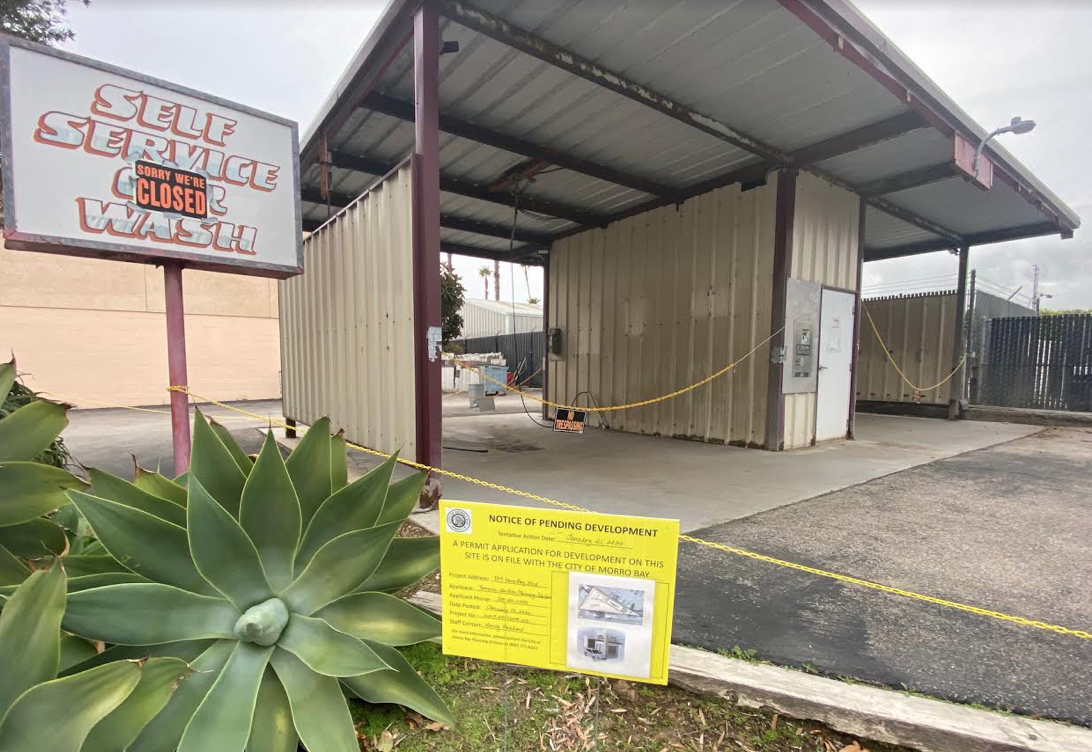
Morro Bay Planning Commission recently approved plans to remove the old car wash on Main Street to be replaced by a 600sf drive-thru coffee place. Project is proposed by Pat Mitchell of Moss Lane Ventures
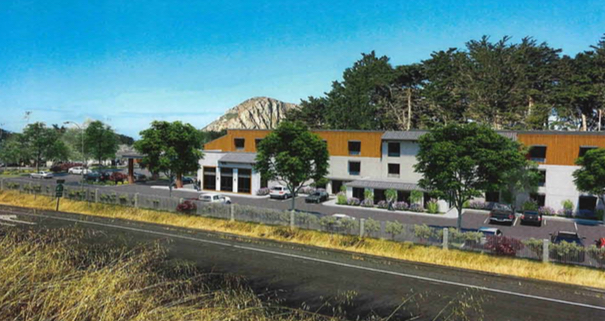
Commission approves 83-unit hotel next to high school After approvals by the planning commission the Morro Bay City Council will review an application to build a new 83-unit hotel on a vacant 2 acre parcel on Atascadero Rd next to the high school – just west of Hwy 1. A hearing on the application by the Patel family is set for March 10.
Bank of America property on the sales block
The shuttered Bank of America property at 390 Morro Bay Blvd is expected to be put up for sale as of June. Owners of the Sinclair gas station nearby say B of A will relocate their ATM in the next few weeks to their service station.The city has been told by a B of A source that the vacant bank property will be marketed and sold.The bank closed in February 2018 as more customers bank online said a spokesperson.
O’Reilly Auto Parts may lease former Dollar Tree store location
O’Reilly Auto Parts is expected to lease the former Dollar Tree location on Quintana near Albertsons say sources. Dollar Tree moved a block away to the former Cookie Crock site with their sister company Family Dollar opening next door. The O‘Reilly store would compete against fellow national chain Auto Zone and several home town auto parts suppliers.
Frog resolution expected mid-March for wastewater project
The City of Morro Bay has been working with the Environmental Protection Agency for the past several years to secure low-interest funding for the new Water Reclamation Facility project. In 2017, the Water Reclamation Facility project was selected as one of twelve projects in the nation to receive WIFIA funding during the inaugural year of the funding program.
Since the project will be receiving Federal funds, it must comply with the requirements of the National Environmental Policy Act (NEPA). One of these requirements is review by the United States Fish and Wildlife Service (USFWS) under Section 7 of the Endangered Species Act. This review began in June 2019.Last October 10, USFWS required a further review of the city application delaying approval of funding and plans to begin construction.
Now a new city report on the project says ”In December 2019, the decision was made by the EPA to pursue formal consultation with USFWS for the California Red Legged Frog.
While this formal consultation process requires additional time to complete, it will protect the City from potential schedule delays that would occur during construction as a result of CRLF take. The EPA requested the USFWS to expedite the formal consultation and issue their Biological Opinion (BO) by the end of January 2020. The USFWS indicated in December that they would make every effort to honor this request. However, the NO has not yet been received. Based on the latest information from EPA, the final BO will be received by March 05, 2020. The EPA has committed to completing their environmental review/checklist within a week after receipt of the final BO. This will allow the City to sign the WIFIA loan agreement and issue the construction notice to proceed for the WRF in mid-March 2020.”
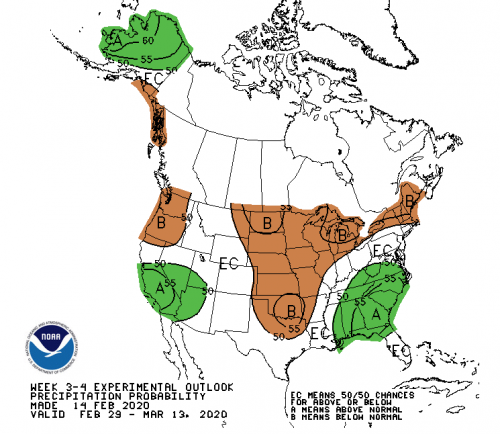
Hopefully it won’t take a miracle to get some rain into California in March.After a dry January and February there is hope that by the end of February and early March there will be some relief particularly from the Bay Area south. A forecastmodel today calls for storms around the 29th of Feb and a stronger event on the 3rd of March.
Here is the latest “experimental” NOAA forecast showing above normal chances for rain for the first half the month.The map was made on Feb 14.

 Texas retailer Tuesday Morning is the latest San Luis Obispo store to announce a Chapter 11 bankruptcy filing on May 27. Tuesday Morning has a location at the Marigold Shopping Center on Broad.
 Upscale department store Nordstrom will shut 16 full-line stores later this year, the company announced last week. The permanent closures include six in California. On the Central Coast, the store in the Paseo Nuevo shopping center in Downtown Santa Barbara is set to close by August.
 California added 87,494 residents to bring the state’s estimated total population to 39,782,870 people as of January 1st, 2020, according to new population estimates released in early May by the California Department of Finance. Many communities experienced slow growth but some areas actually shrunk.
 As of December 2019 the joint powers authority had enrolled the counties of Monterey, San Benito and Santa Cruz and the cities of Capitola, Carmel, Gonzales, Greenfield, Hollister, Marina, Monterey, Morro Bay, Pacific Grove, Salinas,San Juan Bautista, San Luis Obispo, Sand City, Santa Cruz, Scotts Valley, Seaside,Soledad and Watsonville.

 This year with the Covid-19 crisis closing all your favorite Mexican food eateries in the Golden State growers are bracing for fewer sales as food service is larger than grocery sales, typically.
 NOAA had predicted a dry April a week ago but models now are advertising a couple of weeks of wet weather starting April 4/5 and lasting at least until mid month – as far