Monterey Business Bank Coming To SLO Town

September 10,2014

Screen Shot 2014-09-10 at 1.08.57 PMMonterey-based 1st Capital Bank plans to open a branch in San Luis Obispo at 142 Cross St – off Tank Farm Road. The bank filed a notice with the FDIC this month to establish what would be their first branch outside of Monterey County.The locally-owned business bank has a branch as far south as King City. The bank has assets of $454 million  and as of the second quarter and saw both record growth and a record balance sheet. Ist Capital hopes to expand market share  along the Central Coast.The bank states as of the 2nd quarter it has increased its loan portfolio by 17% in the past six months

1st Capital describes itself this way.”We provide professional banking, credit and cash management services to businesses, professionals and residents throughout the Central Coast. 1st Capital Bank is recognized by BauerFinancial Inc as a “five-star” superior rated bank and by the Findley Company as the only “Premier Performing Bank” based in Monterey, Santa Cruz and/or San Benito counties.”

In terms of market share in SLO County Rabobank is number one with 26.14% market share as of June 2013 according to the FDIC,up slightly from the year before.Wells Fargo,Bank of America and Chase follow with similar market shares ranging from 14% to 11%. Some 11 other institutions have single digit market share as of this report. Total bank deposits in SLO County was $5.32 billion vs $5.18 billion as of June 2012.

El Nino Fading – What Me Worry?

September 10,2014

“I never felt more confident in a prediction of normal to above-normal precipitation this rain season.”  –John Lindsey

At least two California forecasters are not giving up – worrying that a weak El Nino event this fall/winter will mean another drought year for the Golden State. Instead they are counseling patience but suggesting that the rain will fall.

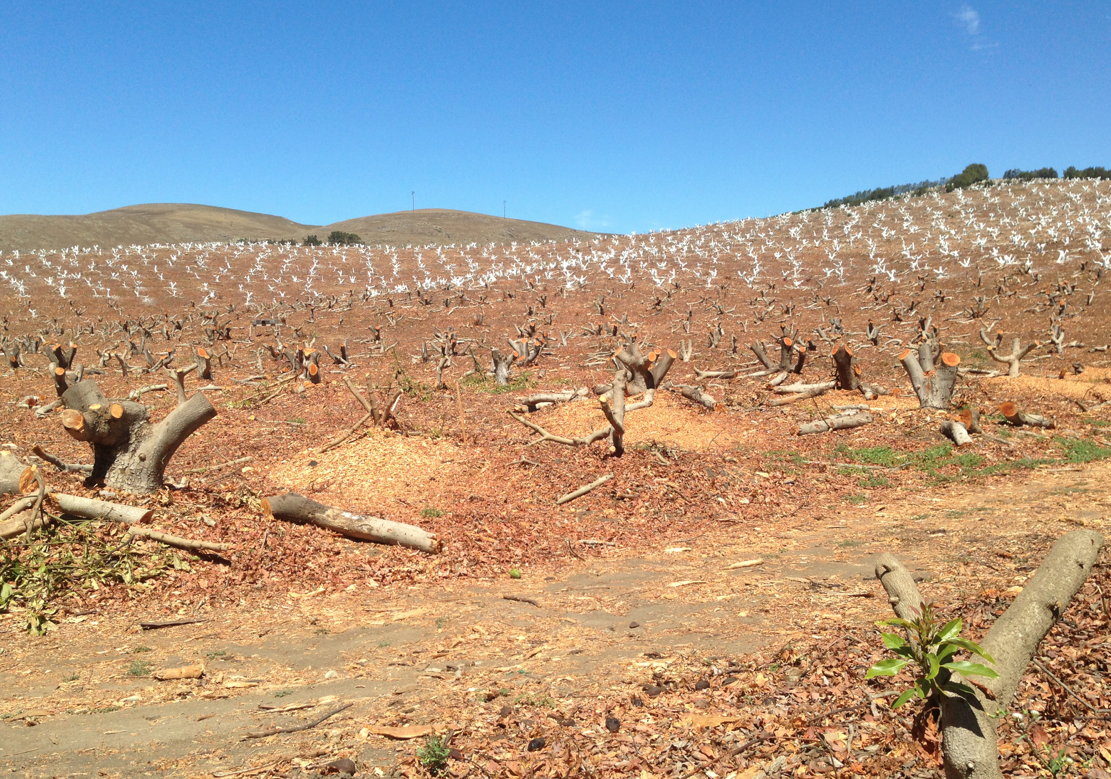
Avocado trees near Morro Bay stumped and painted white due to lack of water

This week the New York Times weighed in with the headline “Hopes for a strong El Nino Fade in Parched California” reciting downgrades in chances for coming months.

In their latest prediction National Oceanic and Atmospheric Administration (NOAA), put the odds of an El Niño occurring during the October through January time period at 60 to 65%, which is down slightly from the 65% figure given in early August. (The odds for the November through January period stayed the same.) Previously, the odds of an El Niño had been as high as 80%.
But two meteorologists who watch our area continue to see a good chance for wet weather,not early but once winter sets in.
PG&E forecaster John Lindsey said this past weekend he had been offering talks to local civic groups about the potential for wet weather this winter.

Toward the end of a weather column he pens for the Tribune in SLO Lindsey lets it all hang out.

“I never felt more confident in a prediction of normal to above-normal precipitation this rain season.”
“This leads to the question, when can San Luis Obispo expect its first rain? Overall, rain is most likely around Feb. 15, with precipitation occurring 33 percent of the time. The first rains of the season usually occur in October or November.”

warm waters bring abundant food for Morro Bays birds this past weekend
warm waters bring abundant food for Morro Bay birds this past weekend

He points to warm seawater temps bringing in unexpected sea life to SLO coastal shores recently including ” the greatest occurrence of humpback whales that I have ever seen have been gorging themselves on bait balls composed of anchovies, sardines and smelt.”
Besides El Nino – Lindsey point to a warm PDO pattern as another bullish factor for above normal rainfall.
Besides Mr Lindsey Ag forecaster Alan Fox who advises avocado growers says on his latest blog that El Nino is not going away.

“Seasonal Outlook /El Niño Update – September 21 to December 15… With regard to El Niño induced rainfall in southern California, Fox Weather does not expect above normal rainfall to start until January 2015. The latest results from the Climate Forecast System (CFS2) model currently show about normal rain amounts in California through November.

NOAA/CPC selects above normal rainfall for southern California for September and October.
The latest results from Scripps Institution of Oceanography’s Experimental Climate Prediction Center (ECPC) and NOAA/CPC are showing a slow increase in the El Niño pattern in December to near maximum in January and February 2015. Recent statements in the press about El Niño ‘going away’ do not make sense to us, nor are they confirmed by Scripps or NOAA/CPC guidance. Recent daily variations in El Niño have shown a decrease, and El Niño is weaker than earlier in the summer. However, it is the normal seasonal pattern for El Niño to be weakest in July-September and strongest in January and February.”

Valley Biz Index Rises

Drought concerns do not slow Valley economic indicator growth

Sep 4, 2014 ⋅ by ⋅

For the ninth consecutive month, the San Joaquin Valley Business Conditions Index rose above the 50.0 threshold, pointing to economic growth for the next three to six months. The overall August index rose to 57.6 from 57.3 in July. This marks the highest point the index has hit since March 2013.

“Despite the healthy reading, more than one-third of the businesses in the region reported negative impacts from the drought,” said Dr. Ernie Goss, research faculty with Fresno State’s Craig School of Business. “More than 70 percent expect a continuation of the drought to negatively impact their business. Even with drought conditions, business activity was healthy for the month, especially for non-durable goods manufacturers including food processors.”

The index, produced by the Craig School, is a leading economic indicator from a survey of individuals making company purchasing decisions in the counties of Fresno, Madera, Kings and Tulare.

The index uses the same methodology as that of the national Institute for Supply Management.

Other survey findings:

Employment: After moving below growth neutral for January, the hiring gauge has held above the 50.0 threshold for the past seven months. The job index slid to a solid 57.0 from 58.1 in July. According to Goss, the region is adding jobs at a healthy pace. “Since the national economic recovery began in July 2009, the region has added almost 24,000 jobs for a gain of 8.2 percent.”

Wholesale prices: The prices-paid index, which tracks the cost of purchased raw materials and supplies, increased to indicate elevated inflationary pressures at the wholesale level. The wholesale inflation gauge slumped to 66.0 from 70.2 in July.

Business confidence: Looking ahead six months, economic optimism, captured by the business confidence index, declined to 58.6 from 61.3 in July.

Inventories: Businesses reduced inventories of raw materials and supplies for the month.  The August inventory reading sank to 47.2 from July’s 47.5.

Trade: The new export orders index advanced slightly to a very weak 43.6 from July’s 43.5. Goss said the weak new export orders index over the past several months will place some downward pressures on regional growth. The regional import reading for August advanced to 52.4 from July’s 49.3 as expanding sales encouraged businesses to add to their buying from abroad.

Other components: Other components of the August Business Conditions Index were new orders at 61.0, down from 62.5 in July; production or sales at 66.6, up from July’s 62.6; and delivery lead time at 56.2, up slightly from 56.1.

S2S Biz Headlines For September 3 / Solar,Strawberries & Factory Outlets

September 3 2014

-CNBC is reporting that Tesla has selected Nevada to build their new ” gigafactory ” battery plant. A news conference is set for Thursday in Carson City.

-Gas prices continue to sink in September with a few Fresno stations among the state’s lowest at $3.42 this week.Cheapest in Tulare is $3.45 and in SLO County, in Nipomo at Vons for $3.61. All info from Gas Buddy.

-Corn futures took another dive on the way to $3 a bushel today down 11 cents to $3.52. The drop is bullish for livestock owners and ethanol makers in the state who saw up to $8 a bushel corn a few summers ago.

Screen Shot 2014-09-03 at 4.27.32 PM-Now that the new factory outlet mall at the Grapevine is open – Outlets At Tejon – Tulare Outlet mall store owners will be watching traffic to see if they are affected and by how much. The new shopping center on Hwy 5 opened August 10 with 71 stores enticing motorists coming from the south about an hour before they reach Tulare.

-Roger’s Helicopters showed of a their new larger helicopter to Kings County officials a few weeks ago. The new helicopter will be a boon to public safety able to reach traffic accidents with medical help and carry two victims at a time if need be.

-Looks like the drought has not hurt coastal strawberry production at least to date. Total California production has hit 168.37 million flats so far this year compared to 161.57 million through the same date – August 28 of last year according to the National Berry Report.

-400 MW Fresno County Solar Project Gets October 9 Hearing

A hearing will be held October 9 by the Fresno County Planning  Commission  expected to approve  the Tranquility Solar Generating Facility, which would generate a total of up to 400-megawatts (MW)- the largest in the County. The Solar Facility would operate year-round to generate electricity during daylight hours when electricity demand is at its peak and would provide solar power to utility customers via an interconnection to two existing Pacific Gas and Electric (PG&E) transmission lines: the Panoche-Helm and Panoche-Kearney lines.The project being developed by Recurrent Energy will likely be sold off in components. Construction is expected  to start in early 2015.

Fitch Removes Negative Rating Watch On Tulare Hospital

September 3,2014
TRMC 2014-08-04 at 3.23.18 PMIn a reversal from only a few months ago Fitch Ratings has affirmed the ‘B’ rating on $15,230,000 series 2007 fixed rate bonds issued by the Tulare Local Health Care District d/b/a Tulare Regional Medical Center (TRMC).In addition Fitch said the Rating Watch Negative has been removed and the Rating Outlook is Stable.
The Fitch report says there are new signs of a “dramatic turnaround “ although financials remain weak. The report does not delve into the district’s need to raise more capital to finish its delayed tower project that has been estimated at needing $40 million more to complete.
The latest TRMC financial report for July shows continuing operational issues with acute patient days revenue for the month 23% lower than July 2013.
Here are Fitch’s comments.
Fitch said the removal from Rating Watch Negative reflects growing clarity and progress on construction plans achieved over the last six months. A settlement was reached with the previous contractor in July 2014. A new team has been put in place under HealthCare Conglomerate Associates’ (HCCA) leadership, and a completion plan has been established. Currently, TRMC is evaluating various funding options, but no new debt is expected at the TRMC level.
SIGNS OF TURNAROUND: The Stable Outlook reflects the dramatic turnaround in operating and financial performance since Fitch’s last review in February 2014. TRMC posted an operating loss of $3.9 million through the six months ended Dec. 31, 2013, but a positive operating income of $1.6 million in the second half of the year. Improved operating margin of negative 3.3% at fiscal year ended (FYE) June 30, 2014 (unaudited interim results) was attributable to revenue enhancement as well as expense reduction initiatives.
Fitch believes the positive trend over the last few months indicates performance improvement plans taking hold and signal recovery.
LIQUIDITY REMAINS WEAK: TRMC’s liquidity position remains very low, albeit slightly improved from one year ago. Unrestricted cash and investments were $10.4 million at FYE 2014 was over 20% increased year-over-year, and equated to 57.3 days cash on hand, 4.1x cushion ratio, and 57% cash to debt.
DISPUTE WITH TRUSTEE: By letter dated Aug. 4, 2014, the US Bank, as Trustee, issued a notice to TRMC asserting the occurrence of various defaults and Events of Default (EoD) under the Indenture, including failure to achieve the required long term debt service coverage ratio for fiscal years 2012 and 2014. TRMC has denied the existence of any defaults or EoD and the Trustee has withdrawn the Notice of Default by letter dated Aug 8. At this time, TRMC has made all required payments under the indenture. Fitch expects that this matter will be resolved without any negative impact to bondholders or the credit profile of TRMC.
CLARITY ON PROJECT FUNDING: Considerable amount of uncertainty around the timing and funding sources remain, although meaningful progress has been made over the last six months. Fitch believes that the hospital can continue to operate without completion of the project over the near term. Further, additional debt funding secured by the revenues of the hospital is not expected to be pursued over the near term.
Tulare Local Health Care District, d/b/a Tulare Regional Medical Center owns and operates a 112-bed hospital in the city of Tulare, California. Total operating revenue in FYE June 30, 2014 was $68.6 million (exclusive of tax revenues related to GO bonds debt service). Since January 2014, TRMC has been managed by HealthCare Conglomerate Associates under a management agreement.
Construction Plans Developing
TRMC has a construction project in progress featuring a 24-bed emergency department, a new diagnostic department, a 16-bed obstetric unit, four surgery suites, and 27 new private patient rooms meeting seismic requirements. This new expansion tower was initially slated to open October 2012, but suffered disruptions due to concrete delamination issues and ensuing conflicts with the contractors.
Over the last six months, TRMC was able to reach a settlement agreement with the previous contractors and put a makeup schedule and budget in place. The completion of the project is now pending a funding source, with several options currently under evaluation. Fitch assumes that the ultimate decision will not have a material impact on TRMC’s solvency, and will evaluate any impact of funding sources after plans are finalized and disclosed.
Signs of Turnaround
TRMC posted a loss of $2.3 million (negative 3.3% operating margin) in fiscal 2014, which is significantly improved from a $3.9 million loss (negative 12% operating margin) through the six months ended Dec. 31, 2013. Similarly, operating EBITDA margin improved from a negative 3.8% to a positive 4.2%. Management’s initial goal was to breakeven in calendar year 2014. Given the $1.6 million operating income generated in the six months ended June 30, 2014, Fitch believes TRMC is on track to meet its targets.
Under a new leadership team from HCCA, the performance improvement plan largely focuses on putting sustainable operating structures in place, with a two-pronged approach at enhancing revenues and reducing expenditures. With inpatient volume continued to weaken, fiscal 2014 marked the first year of growth in outpatient surgeries and emergency department visits in over three years. Fitch also believes MediCal expansion will also be beneficial for TRMC in generating additional outpatient traffic.
Weak Liquidity
Liquidity showed modest growth in fiscal 2014, following four years of rapid declines driven by IT investments, other capital spending, and negative cash flow. Unrestricted cash and investments totaled $10.4 million at June 30, 2014 compared to $8.7 million at FYE 2013 and $24.4 million at FYE 2010. Days cash on hand of 57 days, cushion ratio of 4.1x, and cash to debt of 57% remain weak compared to Fitch’s median for below investment-grade ratings. Continued expense control and improvement in revenues should improve overall cash flow and slowly rebuild the balance sheet. While not expected, demand on unrestricted liquidity to support operations or fund the construction project would be viewed negatively.

More Oil Will Ride The Rails in Middle California – Big Time

Issue On Front Burner in Kern and SLO County

September 2,2014

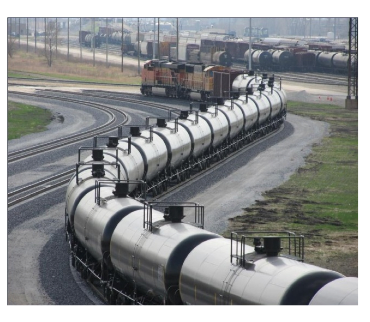
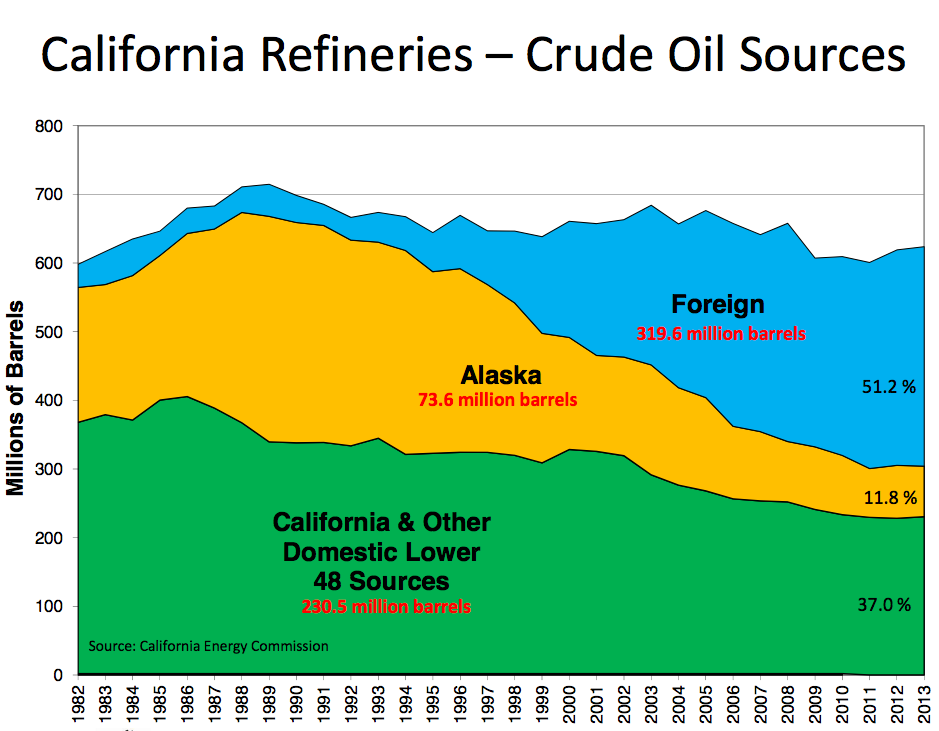
Screen Shot 2014-09-02 at 11.43.35 AMA recent California Energy Commission (CEC) report predicts 80 to 100 car oil trains will be a part of California’s future especially in this blog’s reading area – Central California. Statewide we could see a dramatic rise in the number of these trains. Today about 1 percent of oil is brought into California by rail. By 2016 the supply of oil coming into the state by rail could rise to 23 percent estimates officials. Despite an expectation there will be an in-state oil boom sometime soon coming out of the Monterey Shale deposits, the percentage of oil that is produced in California continues to decline. From 1985 to 2103 in state production is down nearly 50% says the CEC.

Screen Shot 2014-08-31 at 3.45.00 PM Yes We Have No Bonanza

Earlier this year a federal energy agency threw cold water on all the  “black gold” boom talk – slashing by 96% the estimated amount of recoverable oil buried in California’s Monterey Shale deposits in Central California. Instead of 13.7 billion barrels thought to be recoverable, the US Energy Information Agency said it was more like 600 million barrels. You could feel the balloons deflate across the state’s oil patch. Drillers like Zodiac Explorations who have helped fuel talk of a new oil bonanza in Kern, Kings and San Luis Obispo counties have seen their stock deflate. Zodiac has said they had 86,000 acres in Kings County alone they hoped to drill on back in 2011. Today the company has gone through a name change,just fired their chief financial officer and saw its stock plunge from $1.80 a year ago to 0.29 cents.

Kings County oil play.Click to enlarge

Now called Mobius Resources Inc  the company now claims to have some 67,000 acres in the Valley. In their most recent filing they say they have “continued ongoing efforts to seek out partners to jointly develop Mobius’ land or monetize the California properties through discussions with several companies.” The same report issued Aug 28 2014 shows a $55 million net loss for the first nine months the year.

Refiners Seek CBR

If there is no turn-around in California oil production the state needs to get oil from somewhere either by rail, pipeline or boat.  Interstate pipelines connected to California are now used to export transportation fuels to Arizona and Nevada, so dont’ count on pipelines to bring the cheaper crude from the Midwest,Canada or Texas. On the other hand other hand North Dakota oil interests looking to get rid of a gusher supply offer a discount of about $14 a barrel to refiners in Southern California says a CEC report. With the boom in oil production elsewhere in the US in Texas and North Dakota as well as Canada  – the importation of oil by rail into the state went from 1.21 mm barrels in 2012 to 6.3mm barrels in 2103 says the CEC. So far this year Crude by Rail (CBR) into California is up 95% compared to the same period in 2013. At issue are concerns is that this variety of crude that may be both more flammable and more explosive than the region’s heavy oil with routes through populated areas both in the Central Valley and on the Coast down the main UP line, where Amtrak runs, in SLO County. Helping to boost the expected volume are several Central California oil / rail terminals in the works or under construction now. The most immediate is the Plains All American facility in Bakersfield (near Taft) that will be operational later his year. This company will be able to ship cheaper  crude oil north to Bay Area refineries and south, so they will obviously have customers lined up says an energy official. Between the Plains AllAmerican and the proposed Alon USD refinery rail project – Bakersfield and the Central Valley will see three 100-car CBR trains a day. Every town along the route has to be paying attention because of the accident potential CRB is arriving both on the BNSF and UP lines.

Alon Plans

Alon refiner’s former owner went bankrupt in 2008. Now the new Dallas-based owners see expansion on the horizon with their plan set to go to the county Planning Commission September 9 and on to the Board Of Supervisors after. The staff report says the objective of the project is to provide ” greater flexibility” for the existing Alon refinery  to utilize a variety of crude types,not just the SJV’s heavy crude. Crude will be transferred by rail and either processed into products in Bakersfield or shipped by pipeline. The company has another refinery in LA. One fact in the report is that with the new supply – the refinery will be able to increase pipeline shipments to Fresno of diesel and gasoline   from 8736 barrels per day to 19,000 BPD. That would replace truck shipments of product from the Bay Area refineries to Fresno daily argues Alon. Alon says they will build the infrastructure improvements  and refinery modifications  n 9 months and will be ready to receive by the last quarter of 2015.

SLO County Project Draft EIR Expected This Month

Besides these two Bakersfield CBR projects Central California will also see crude by rail shipped into San Luis Obispo County under a proposal by Phillips 66 at their Santa Maria/ Nipomo refinery.  The plan calls for  five 80 car unit trains a week delivering oil through what is termed a “twisty approach” on this rail line and offloading within 2000 ft of homes says a description of issues presented June 25 at an energy commission CBR hearing. The CEC hearing cites other hazards to be wary of including a number of schools, a hospital, earthquake faults and a host of “sensitive species” in a “pristine coastal area.” The County is seeking an early warning system in the event of an accident. The SLO Board of Supervisors are expected to weigh in by early 2015 after a new draft EIR is circulated this fall. The company wants to bring in about 41,000 BPD by rail. Phillips 66 says the feedstock would be sourced from oilfields throughout North America based on market economics and other factors. The most likely sources would be the Bakken field in North Dakota or Canada says a CEC analysis. But a Phillips 66 spokesperson denies  they will receive any lighter Bakken oil. In April the Tribune reported “We told the county to put it right in the project description that we will not receive Bakken crude,” said Jim Anderson, project manager for the rail spur proposal. Some opponents said that their concerns remain despite any promises about the type of crude oil coming by rail into the county. “Regardless of the type of oil, the trains coming through here are a bad idea,” said Martin Akel. Members of the Mesa Refinery Watch group say Phillips 66’s proposal would dramatically transform its business model locally by creating a new, high-intensity operation with 250 more oil-hauling trains traveling through the county and significantly increasing the potential for accidents.”

The Mesa Refinery Group Facebook page says this week a ”revised draft environmental impact report for a proposed rail spur extension at the Phillips 66 refinery is expected to be released by the first or second week of September, San Luis Obispo County officials told a group of residents at a recent meeting organized by Mesa Refinery Watch.”

Hard Cider Gains Popularity: SLO & Bakersfield Companies Expanding

August 30,2014

What would Johnny Appleseed Say?

Basque drinkers in  a cider house. Johnny Appleseed would approve
Basque drinkers in a cider house. Johnny Appleseed would approve

Paso Robles-based Lone Madrone winery has expanded its offerings to include hard cider like they serve in England. The company has opened the Bristol Cider House in Atascadero where you can get hard cider not just in a bottle but on tap.The cider house us located at 3220 El Camino Real.

According to their website it started like this. “Bristols cider is a part of the Lone Madrone winery, owned and operated by brother and sister Neil and Jackie and Neil’s wife Marci. Jackie and Neil grew up in the West Country of England which is very much cider country. We are not talking murky apple juice here but the fermented version. When Neil moved to California he was disappointed to find none of the traditional beverage of his home, of which he had been known to partake on occasion. So in 1994 Neil began making small batches of cider from local apples under the Bristols name.”

It grown from there like it has across the US – out of dorm room operations into the mainstream.

Of course SLOs apple growing district includes SeeCanyon where  three cider makers use apples from this area.

The alcoholic drink is popular in Europe including parts of France and Poland.Now the trend is coming to Johnny Appleseed’s home turf as  younger drinkers here appear to be ready to experiment beyond beer and wine. According to the Beer Institute, a beer industry association, domestic cider production rose by 264 percent between 2005 and 2012 .

Bulk Product

Near Bakersfield Langers Juice Company is ready to go for it on a larger scale.The company is already one of the 10 largest juice makers in the USA. The company just received approval to expand into apple cider brewing at their plant 9.5 miles east of Taft.

They will install a brewery in a 4230sf building next to where they process fruit juices including apples, pomegranates and peaches.

According to their Kern County application – the plant will crush 48 tons of raw apples per week operating year-round. Kern County has about a thousand acres of apples. California is the nations fifth largest apple producer with fruit coming off the trees from July through October.At issue ,will there be enough apples it this boom continues.

Besides this addition the company plans to add three more buildings to the site including an office,cold storage and restroom with a parking lot for 85. Langer operates four juice plants in the state where it presses and bottles juices and makes carbonated juices.

This project was approved by the Kern County Planning Commission August 14.

Anheuser-Busch’s parent company InBev has added hard cider to their offerings earlier this year.
Johnny Appleseed Hard Apple Cider has been described as a “sweet and intense hard apple cider” in their advertising. Johnny Appleseed has an alcohol content of 5.5% and includes apple juice from fruit harvested in the U.S. and outside the country with the cider made in Baldwinsville, N.Y.
Hard cideralcohol content varies from 1.2% ABV to 8.5% or more in traditional English ciders, and 3.5% to 12% in continental ciders.
By the way – one story is that “Johnny Appleseed’s apples were for cidermaking, not eating, as the alcoholic beverage was safer to drink than water.) But when Prohibition went into effect, stringent laws restricting the production of even non-alcoholic cider caused orchards to stop growing cider apples altogether, dealing our cider tradition — and the apples themselves — a death blow.”

Rim Fire Brings Recovery & Frustration

August 27,2014

from Farm Bureau news–
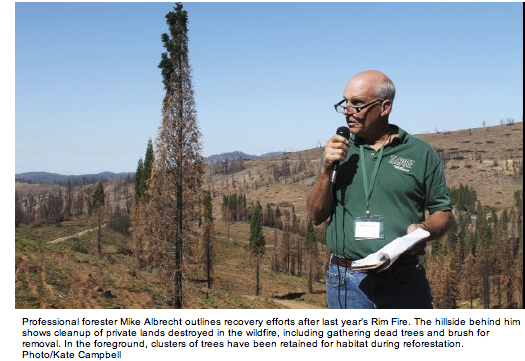
Screen Shot 2014-08-28 at 12.48.06 PMWildfire recovery has become a disturbingly common part of managing California’s 33 million acres of forestland, while firefighting costs run far ahead of the ability to prevent fires. During a tour of areas damaged a year ago in the nearly 260,000-acre Rim Fire, experts outlined the cleanup work accomplished so far and the continuing recovery efforts on both private and public lands.
Registered professional forester Mike Albrecht told California members of the Society of American Foresters during last week’s tour that his crews immediately went to work helping clean and salvage what they could from the fire.
But forest managers estimate about 2.5 million tons of biomass remains dead or dying in the Stanislaus National Forest. At this point, they report local lumber mills are full with salvage logs, biomass plants can’t handle any more fire debris for power generation and environmental restrictions prevent burning charred timber and slash.
Forest roads remain unstable, they said, and drainage infrastructure has been destroyed or is too small to handle increased runoff, especially if there’s a heavy winter. Watersheds are vulnerable to erosion; the raw landscape is susceptible to infestation by invasive plants; wildlife habitat is in shreds.
Forest cleanup on the magnitude of the Rim Fire is slow, costly and dangerous, said Albrecht, who is president of Sierra Resource Management, which specializes in forest thinning.
He said his message is simple: “If we unite, we can do better by the forest.”
Nearly 60 percent of California’s forests are government-owned, with about 40 percent in private ownership.
“The difference between public and private wildfire recovery is very frustrating,” said Tuolumne County cattle rancher and county supervisor Sherri Brennan. “There are laws that tie the hands of government forest managers, compared to what can be done on private lands.”
From a county perspective, she said experts are saying that probably only about 25 percent of the burned timber in the Stanislaus National Forest will be salvaged because of regulatory constraints. It’s expected that litigation by environmental groups will further slow cleanup and restoration efforts, while driving up recovery costs.
“We’re sitting on 2.5 million tons of charred biomass,” Brennan said, referring to burned timber and brush. “Right now, I don’t know how the problem will be handled.”
For its part, the U.S. Forest Service said it has worked during the past year to put together an environmental impact statement that covers timber salvage efforts in the Rim Fire burn. Officials said they expect the final environmental document to be signed this week, so salvage work can begin this fall.
Meanwhile, U.S. Agriculture Secretary Tom Vilsack released a new report that shows the cost of fighting forest fires has rapidly increased during the last 20 years. Because of inadequate and uneven funding, agencies have been “borrowing” money from programs intended to better manage forest fuel loads.
Vilsack joined a rising chorus—including the California Farm Bureau Federation, the Nature Conservancy and the Western Governors Association—in calling on Congress to allow an existing disaster fund to help cover the costs of fighting catastrophic fires.
Pending legislation—The Wildfire Disaster Funding Act—would address these problems by funding a portion of federal wildfire suppression costs through an approach similar to other predictable disasters, allowing more reliable funding for wildfire-prevention programs.
In addition to finding more rational ways to fund skyrocketing costs for fighting wildfires, forestry managers advocate changes in the way both public and private lands are being managed, using current research to adjust methods.
During the tour of the Rim Fire area, Dan Tomascheski, vice president of Sierra Pacific Industries—which lost about 16,000 acres of timber during the Rim Fire—said a number of new forest management practices, some relatively inexpensive, could help protect forestland in the future.
“We’ve found the practice we call ‘contour tilling’ on flat-to-moderate slopes reduces erosion rates from winter storms,” Tomascheski said.
“There’s nothing more important than high-quality water for those who rely on Sierra watersheds,” he stressed. “But while there’s a lot of focus on water quality and reducing sediment, there hasn’t been much discussion of post-fire effects on water yield.”
Forest researchers report that long-dry creeks in the Rim Fire burn area are carrying water again, even in one of the most severe droughts in state history. Studies show shrubs and brush use three times as much water as an area reforested with trees.
In Shasta County, which has had a series of lightning-sparked wildfires during the past several weeks, rancher and county supervisor Pam Giacomini said a community forum on recovery made it clear that salvaging trees and getting them marketed has to be a top priority for cleanup.
“Experts say they (the burned trees) need to be marketed this year,” Giacomini said, so the land can be cleared in order to begin reforestation efforts.
“The state seed bank is getting pretty low and we need to get our order in this fall, so we have what we need to begin replanting in the spring,” she said.
(Kate Campbell is an assistant editor of Ag Alert. She may be contacted at kcampbell@cfbf.com.)

Less Distress On The Home Front

August 27,2014

The latest snapshot of the housing economy by California Association of Realtors ( August 26) shows how far the housing recovery has come in the past year.

Simply put – there are fewer distressed sales in the marketplace with  the state’s overall numbers dropping about 50% in this category from just year ago.

The category includes properties held by banks for resale (foreclosed) as well as short sales, in essence properties that were upside down.

Dramatic Drops Here

In our reading area the drop is fairly dramatic. In San Luis Obispo County distressed sales fell from 9 percent of all sales a year ago to just 5% this July. In the Central Valley were the percentage was much larger the one year improvement shows as well. In Fresno County distressed sales had made up as much as 32% of all sales in July 2013 but has now dropped to 17%. In Tulare County it was 31% a year ago but down to 18% in July 2014 (see list).Screen Shot 2014-08-27 at 9.30.18 AM

Statewide the share of equity sales – or non-distressed property sales – continued its upward trend, inching up in July to 90.6 percent, up from 90.3 percent in June. Equity sales have been rising steadily again since the beginning of this year. Equity sales have been more than 80 percent of total sales for more than two years and have risen above 90 percent for the second straight month. Equity sales made up 82.8 percent of sales in July 2013.

The combined share of all distressed property sales declined further in July, dropping from 9.7 percent in June to 9.4 percent in July. Distressed sales continued to be down more than 50 percent from a year ago, when the share was 17.2 percent.

Twenty-one of the 41 reporting counties showed a month-to-month decrease in the share of distressed sales, with 20 of the counties recording in the single-digits, including Alameda, Contra Costa, Marin, Orange, Plumas, San Diego, San Luis Obispo, San Mateo, Sonoma, and Santa Clara counties — all of which registered a share of five percent or less.

Of the distressed properties, the share of short sales fell to its lowest level since February 2008, falling to 4.9 percent in July, down from 5 percent in June. July’s figure was less than half the 11.6 percent recorded in July 2013.

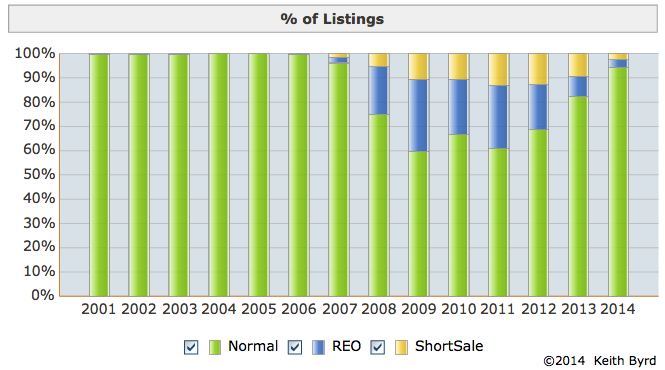
In the SLO area broker Keith Byrd’s blog shows the housing market recovering from a high of 40% distressed properties (the short sales and REOs) in 2009 to just 5% today (see chart).
Screen Shot 2014-08-27 at 10.44.08 AM


In a related  story– CoreLogic® released its July National Foreclosure Report, which provides data on completed U.S. foreclosures and foreclosure inventory. According to CoreLogic, for the month of July 2014, there were 45,000 completed foreclosures nationally, down from 57,000 in July 2013, a year-over-year decrease of 21.2 percent. On a month-over-month basis, completed foreclosures were down by 8.5 percent from the 49,000* reported in June 2014. As a basis of comparison, before the decline in the housing market in 2007, completed foreclosures averaged 21,000 per month nationwide between 2000 and 2006.

Completed foreclosures are an indication of the total number of homes actually lost to foreclosure. Since the financial crisis began in September 2008, there have been approximately 5.1 million completed foreclosures across the country.

As of July 2014, approximately 640,000 homes in the United States were in some stage of foreclosure, known as the foreclosure inventory, compared to 976,000 in July 2013, a year-over-year decrease of 34.4 percent. The foreclosure inventory as of July 2014 made up 1.6 percent of all homes with a mortgage, compared to 2.4 percent in July 2013. The foreclosure inventory was down 3.3 percent from June 2014, representing 33 months of consecutive year-over-year declines.

“The stock of distressed debt continues to rapidly decline, especially in western states,” said Sam Khater, deputy chief economist at CoreLogic. “The number of seriously delinquent loans fell by more than 25 percent from the prior year in 10 states and seven of those states were in the west.”

“Based on current trends, the overall foreclosure inventory could trend down to as low as 500,000 homes by year-end which is very positive news for the housing market. The picture is considerably brighter in the non-judicial states which maintain consistently lower foreclosure stocks and, in general, lower levels of serious delinquency,” said Anand Nallathambi, president and CEO of CoreLogic. “In total, there are now 36 states with an inventory of foreclosed homes lower than the national rate of 1.7 percent.”


Tropical Hurricane Could Bring Rain To Northern California / UPDATED

August 25,2014

NWS-SF is now saying precipitation in less likely in latest model runs……

BIGGEST FORECAST CHALLENGE AS OF LATE HAS BEEN THE
POSSIBILITY OFMOISTURE FROM HURRICANE MARIE MOVING
TOWARD OUR AREA. MODELS HAD GENERALLY BEEN 
PORTRAYING TWO GENERAL SOLUTIONS. THE FIRST HAD 
MARIE HEADING TO THE NW BEFORE EVENTUALLY TAKING A SHARP
TURN TO THE RIGHT WITH ITS ASSOCIATED MOISTURE 
INTERACTING WITH A LONGWAVE TROF DIVING DOWN FROM CANADA
ND GOING INTO NORCAL BY THE WEEKEND. 
THE OTHER CAMP INDICATED LESS OF A SHARP TURN WITH THE
MOISTURE AND HAD THE RIDGE ACTING MORE LIKE A BLOCK WHICH
WOULD PREVENT THE ENTRAINMENT. RUN AFTER RUN OF THE NAEFS
HAD BEEN INDICATING A 1 OUT OF 3 SHOT OF MOISTURE MAKING
IT GENERALLY FROM SF NORTHWARD FOR SATURDAY AND/OR SUNDAY
WHILE THE OPERATIONAL ECMWF CONTINUED  TO DEPICT A DRY
SOLUTION. 

FOR THIS MORNING THERE IS NOTED TREND IN THE GUIDANCE
TOWARD THE DRIER SOLUTION AS LESS THAN 10% OF THE NAEFS
BRING EVEN 1/10" OF RAIN FOR A 6 HOUR PERIOD INTO THE
NORTH BAY WHILE THE OPERATIONAL GFS HAS GONE COMPLETELY DRY.
IT NOW APPEARS THAT IT IS ALSO  SHOWING LESS OF A SHARP
EASTERLY TURN DUE TO THE RIDGE ACTING MORE AS A BLOCK.
THEREFORE...DECIDED TO DROP POPS BELOW 15% WHICH 
TAKES OUT ANY MENTION OF RAIN IN THE EXTENDED. WE WILL STILL
KEEP AN EYE ON IT, BUT AT THIS TIME IT LOOKS VERY UNLIKELY
TO BE A RAIN RODUCER.

Oh Well…


August 24,2014

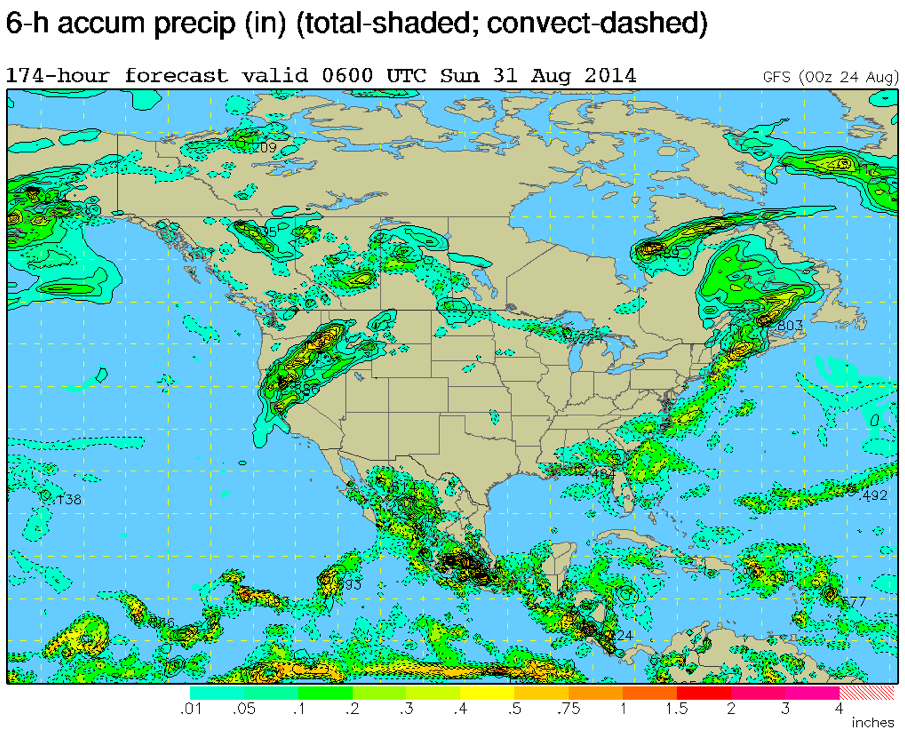
Today the NWS San Francisco said in their forecast discussion that the Bay Area and northern California could see something unusual next weekend –  rain – up to two thirds of an inch!  Here is what they say adding that this uses one model and is “uncertain” but provocative.
THE MOST INTERESTING…AND UNCERTAIN…PART OF THE FORECAST  CONCERNS MOISTURE FROM HURRICANE MARIE. THIS HURRICANE IS
RAPIDLY INTENSIFYING OFF THE WEST COAST OF MEXICO THIS MORNING. MARIEIS FORECAST TO MOVE TO THE WEST-NORTHWEST OVER THE NEXT FEW DAYS AND RAPIDLY WEAKEN ON WEDNESDAY…ONCE IT ENCOUNTERS COLDER WATERS NORTH OF 20N. HOWEVER…MOISTURE FROM MARIE MAY BECOME IMPORTANTTO OUR FORECAST BY NEXT WEEKEND. THE GFS HAS BEEN RELATIVELY CONSISTENT IN STEERING SUBTROPICAL MOISTURE FROM HURRICANE MARIE NORTHWARD ALONG 130W AND THEN PHASING THAT MOISTURE WITH A LONGWAVE UPPER TROUGH APPROACHING THE WEST COAST LATE IN THE WEEK. THE RESULT IS THAT THE GFS FORECASTS WIDESPREAD RAIN ACROSS OUR AREA NEXT WEEKEND. IN FACT…IF THE 00Z GFS WERE TO VERIFY SAN FRANCISCO WOULD PICK UP TWO-THIRDS OF AN INCH OF RAIN FROM SATURDAY MORNING THROUGH SUNDAY AFTERNOON. THAT MUCH RAIN IN SAN FRANCISCO IN AUGUST WOULD BE UNUSUAL TO SAY THE LEAST…ESPECIALLY CONSIDERING THAT THE RECORD RAINFALL IN DOWNTOWN SAN FRANCISCO FOR THE ENTIRE MONTH OF AUGUST IS ONLY 0.80 INCHES (IN 1976).

Here is the GFS model for next Sunday with yellow indicating higher rainfall.

Screen Shot 2014-08-24 at 7.10.52 AM