Mortgage Rates Rebound, Remain Below Four Percent

October 30,2014


Mortgage Rates Rebound, Remain Below Four Percent

MCLEAN, VA–(Marketwired – Oct 30, 2014) –  Freddie Mac (OTCQB: FMCC) today released the results of its Primary Mortgage Market Survey® (PMMS®), showing average fixed mortgage rates moving higher across the board this week and rebounding from the lowest rates of the year.

News Facts

  • 30-year fixed-rate mortgage (FRM) averaged 3.98 percent with an average 0.5 point for the week ending October 30, 2014, up from last week when it averaged 3.92 percent. A year ago at this time, the 30-year FRM averaged 4.10 percent.
  • 15-year FRM this week averaged 3.13 percent with an average 0.5 point, up from last week when it averaged 3.08 percent. A year ago at this time, the 15-year FRM averaged 3.20 percent.
  • 1-year Treasury-indexed ARM averaged 2.43 percent this week with an average 0.4 point, up from last week when it averaged 2.41 percent. At this time last year, the 1-year ARM averaged 2.51 percent.

Forecasters Say Middle California Will Finally Get Wet: Updated

October 28,2014

Forecasters on both the Central Coast and in the San Joaquin Valley agree  our parched part of the state will get its first significant storm this weekend including snow in the Sierra.

In SLO County PG&E forecaster John Lindsey points out that the region has been without out rain for nearly 190 days but that an area of low pressure will move out of the Gulf of Alaska on Halloween with rain totals from Total rainfall amounts in San Luis Obispo County are expected to range between 0.75″ in the coastal valleys and 1.25″ along

the coastline. Lesser amounts are expected in the North County.He adds that “this storm system may produce the first decent Sierra snowfall this season above 4,500 feet.”

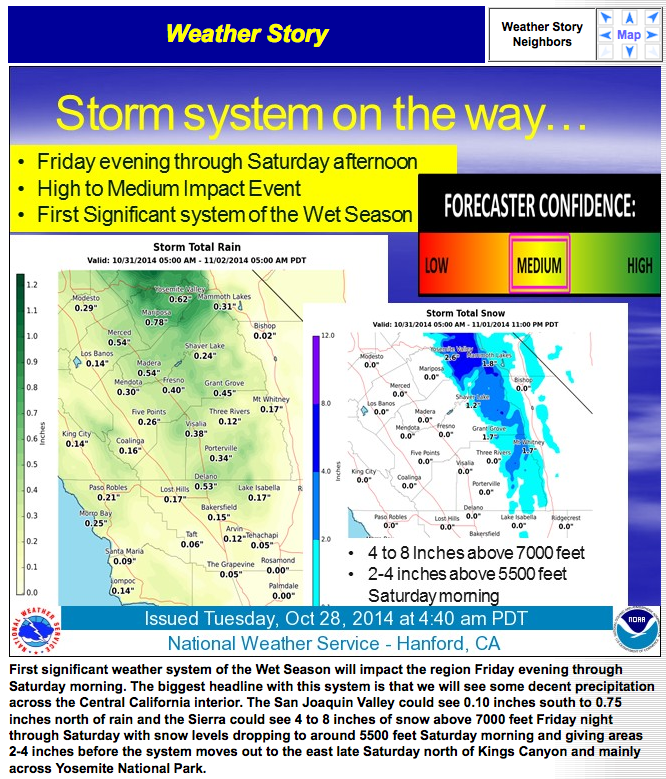
Screen Shot 2014-10-28 at 12.22.14 PMThings are even more promising in the Central Valley where the NWS Hanford predicts the Central Sierra could get 4 to 8 inches of snow Friday and Saturday. Fresno could get 0.4 inches out of this storm (see chart).

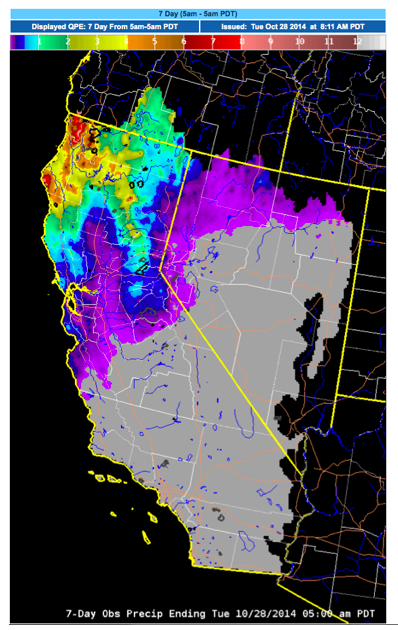
Most storms this Fall, at least to date to date, have come into the state from the Pacific Northwest wetting only the northern part of California (see map of past 7 days) but leaving the rest of us high and dry. Screen Shot 2014-10-28 at 1.35.37 PM


In the last week the 7 day total precip shows around 3 inches falling as far south as Shasta (in yellow on map) and even more on the upper California coast.

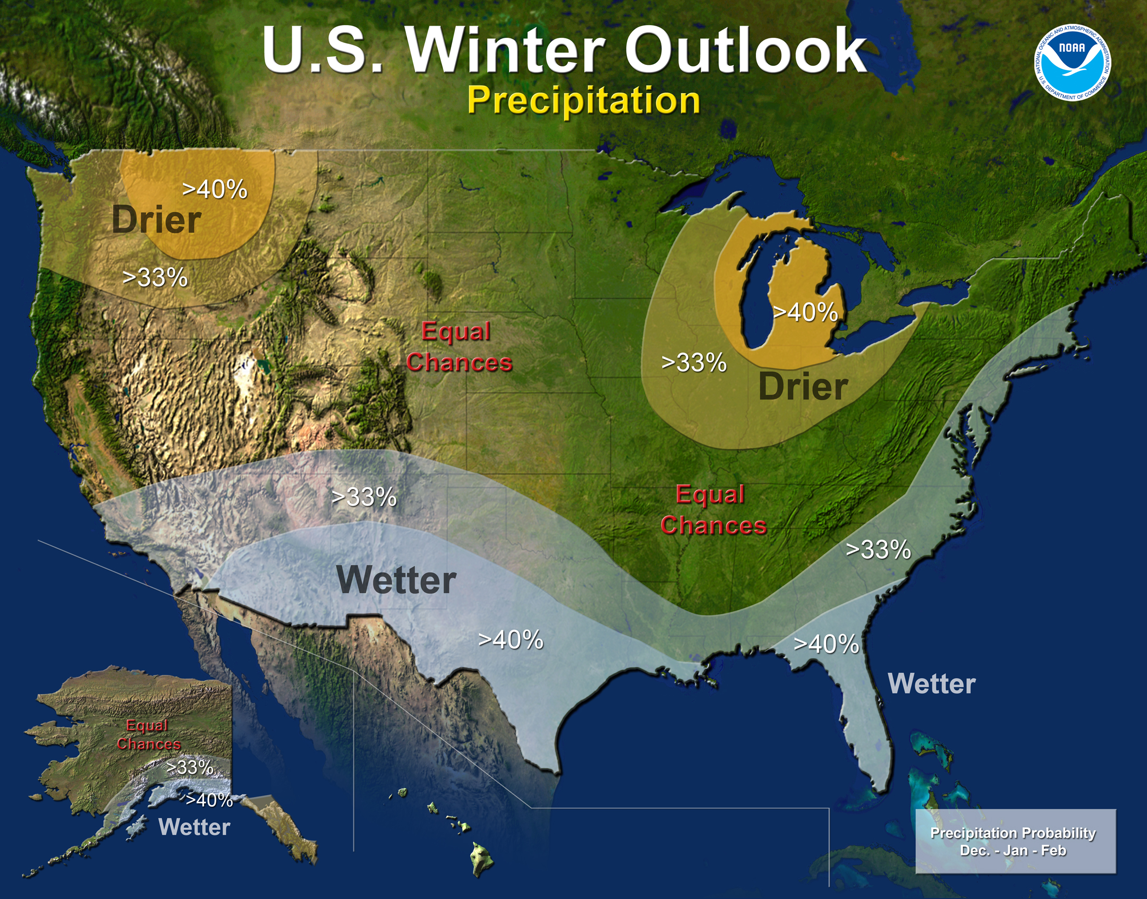
NOAA prediction for a wet southern California

This pattern is different from the long term prediction offered by NOAA showing wet conditions this winter across southern California but a dry Pacific Northwest.

Which ever pattern we see our neck of the woods (midstate) seems to be always on the edge of the systems.

After this weeks storm another low pressure system is in the works by the end of the following week as “unsettled weather” is in store says John Lindsey.

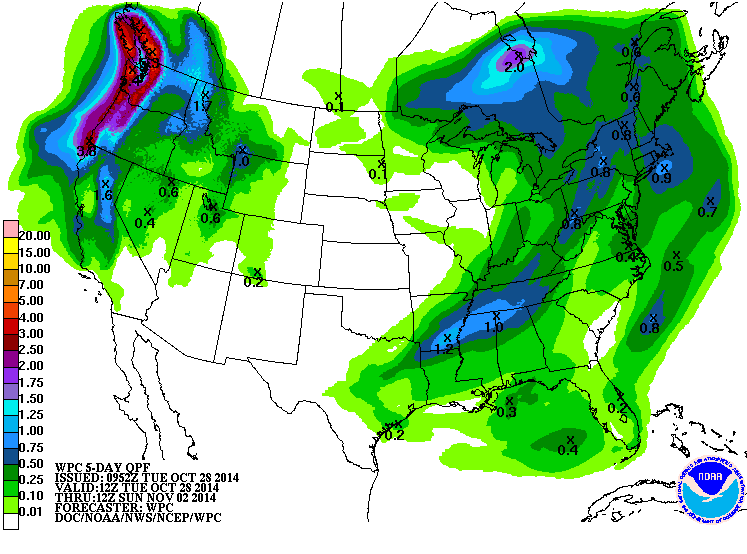
Here is the forecast rain totals for the next week

Screen Shot 2014-10-28 at 11.16.28 AM

Tulare County Sports Lowest Gas Price

October 28,2014

Tulare County leads the state in low gas prices


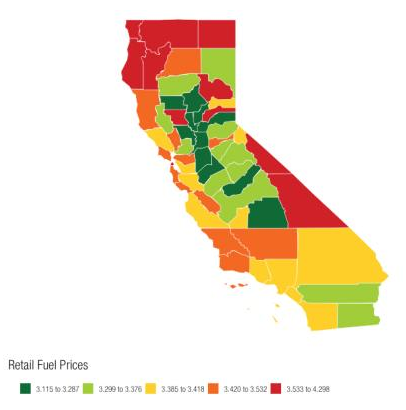
Tulare County gas stations in the Porterville area continue to sport the lowest prices for gasoline in the state this week. GasBuddy posted the above map that shows the Cantral Valley offering cheaper prices than the rest of California.
This week one station near Porterville,Eagle Feather near Lake Success, is offering regular for $2.85 per gallon with more than dozen outlets at $2.91 and below.
Statewide Gas Buddy says the California average has dropped to $3.38 from $3.70 a month ago and $4 a gallon late July. It was $4.28 in late April the highest of the year.
Nationwide the average is nearing $3 as oil prices have dipped to to around $80 a barrel from over $104 this summer. A year ago the average Califrnia price was $3.73. The last time gas prices were this low was Fall of 2010.
If low gas prices are good for the average consumer as well as many businesses and farms  it is not helping drive the sales of alternative fuel vehicles. Hybrids, EVs and other alternative-fuel vehicles don’t sell well when gas prices are falling.
Gas Buddy reports that Tanner Hulette, general manager of Mechanicsville Toyota near Richmond, Va., said he’s seeing higher demand for pickups and SUVs, and less interest in the Prius hybrid. The store’s year-to-date light-truck sales are up 5 percent while car sales are down 5 percent. And gas near him is as low as $2.70.
“The floor traffic is dictated by what’s going on with fuel,” Hulette said. “If we didn’t have SUVs and light trucks right now we’d definitely be feeling some pain.”

How Deet Works To Fend Off Mosquitoes

Oct 27,2014

DEET has been the gold standard of insect repellents for more than six decades, and now researchers led by a University of California, Davis, scientist have discovered the exact odorant receptor that repels them.

They also have identified a plant defensive compound that might mimic DEET, a discovery that could pave the way for better and more affordable insect repellents. Findings from the study appear today, Oct. 27, in the journal Proceedings of the National Academy of Sciences: http://bit.ly/1v6yAoB.

More than 200 million people worldwide use DEET, developed by scientists at the U.S. Department of Agriculture and patented by the U.S. Army in 1946.

“Mosquitoes are considered the most deadly animals on the planet, but unfortunately, not everyone who needs this repellent can afford to use it, and not all who can afford it can use it due to its undesirable properties such as an unpleasant odor,” said lead author Professor Walter Leal of the Department of Molecular and Cellular Biology.

“Vector-borne diseases are major health problems for travelers and people living in endemic regions,” Leal said. “Among the most notorious vectors are mosquitoes that transmit the protozoan parasites causing malaria and viruses that cause infections, such as dengue, yellow fever, chikungunya and encephalitis.”

How mosquitoes are repelled

Mosquitoes detect scents with olfactory receptors on their antennae. The researchers examined two families of olfactory receptors of the southern house mosquito, Culex quinquefasciatus, which transmits diseases such as West Nile virus.

One receptor group, “ionotropic receptors,” normally detects acids, bases and other water-soluble compounds. The researchers discovered, however, that a receptor from the odorant receptor group is directly activated by DEET.

They also detected a link between DEET and the compound methyl jasmonate, suggesting that DEET might work by mimicking a defensive chemical found in plants.

Dan Strickman, senior program officer for Vector Control at the Bill and Melinda Gates Foundation’s Global Health Program, said, “We are at a very exciting time for research on insect repellents.” (The Gates Foundation was not involved in the study.)

“For decades, the field concentrated on screening compounds for activity, with little or no understanding of how chemicals interacted with mosquitoes to discourage biting. Use of modern techniques that combine molecular biology, biochemistry and physiology has generated evidence on how mosquitoes perceive odors,” Strickman said.

Other researchers on the team were project scientist Pingxi Xu, postdoctoral scholar Young-Moo Choo, and agricultural and environmental chemistry graduate student Alyssa De La Rosa.

Mosquito researcher Anthony Cornel, an associate professor with the UC Davis Department of Entomology and Nematology and based at the Kearney Agricultural Research and Extension Center, Parlier, provided mosquitoes that allowed the Leal lab to duplicate his mosquito colony at UC Davis. Richard Benton of the University of Lausanne, Switzerland, shared his flies, Drosophila plasmids, also part of the research.

The work was supported by the National Institute of Allergy and Infectious Diseases of the National Institutes of Health.

For more about this study, see the Department of Entomology and Nematology website at: http://entomology.ucdavis.edu/

.

Svenhards Layoffs “Only Temporary”

October 27,2014

Looking to relocate all bakery production from Oakland to Exeter by early 2016 Svenhards Swedish Bakery operations manager David Kunkel says production layoffs at their Exeter plant last week reported in the Visalia Times Delta are “only temporary” to allow maintenance workers to reconfigure the production flow for future at the sprawling facility on Industrial Drive.

One product wrapping crew was informed last week of the layoffs but only for the time being. They were the only crew at the mostly vacant site that the company has retained as a  backup plant, until now.

Kunkel says – as reported in September – that the Oakland plant property was recently sold and now the sweet role maker has an 18 month lease before they must vacate there.

“We discovered we needed to reverse the production flow in Exeter with the new oven being installed in January” says Kunkel. ”We need to hire experienced equipment installers to move our production flow to the other side of the plant.”

Kunkel says he just returned from a trip to buy equipment for the new plant in Exeter.

“ Our plan is to relocate our entire operation to Exeter. Nothing has changed.”

Weather Watch: Northern California Will Get Wet

Southwest Drought Eases With Monsoon

October 21,2014
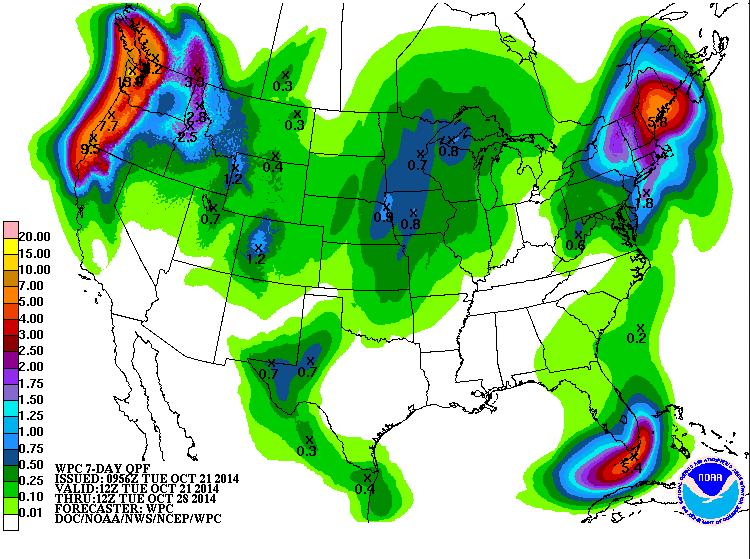
Northern California should see some precip in the next week according to forecasters. Here is the 7 day totals according to NOAA.

Screen Shot 2014-10-21 at 8.23.44 AM

As you can see heavy rain is expected in the extreme north part of the state while the Shasta area should get over half an inch.Light rain could reach as far south as San Luis Obispo County by Saturday says PG&E forecaster John Lindsey,who has predicted an above average wet winter.

Meanwhile the just completed Southwest Monsoon season in Arizona and New Mexico could bring more water into the Colorado river system as the summer storms were active this year.

The Climas (University of Arizona) recap of the season that ended Sept 30 reported “much of Arizona and New Mexico receiving well above-average rainfall.” Indeed “Most of Arizona received well above-average monsoon rainfall—200 to 400 percent of average—and many  areas in the state registered 150 percent of their seasonal total or higher.”

“ New Mexico saw a similarly strong, if not stronger, monsoon, with most areas of the state receiving more than 200 percent of their seasonal average and large swaths of southern New Mexico recording between 300 and 400 percent of their seasonal average.”

The upshot – the Bureau of Reclamation Lower Colorado Water Supply Report for October 20 says Lake Powell’s inflow that was at 97% of normal April-July jumped to 125% inflow in September and is expected to reach 146% of normal in October.

Will the strong Monsoon season mean a stronger El Nino than expected? Opinions vary.

The US Climate Prediction Center has been forecasting the likelihood of  a weak El Nino winter event that raises the chance of rain in parts of California. The forecast shows the likelihood of above average rain in the southern part of the state.

But as you can see from the above map storms continue to knock at the door on the northern end of the state, a more typical pattern. The issue has been whether these storms are strong enough to reach down to the state’s extensive hydrological infrastructure starting in Shasta as well as the snowpack in the Sierra starting around Tahoe south.

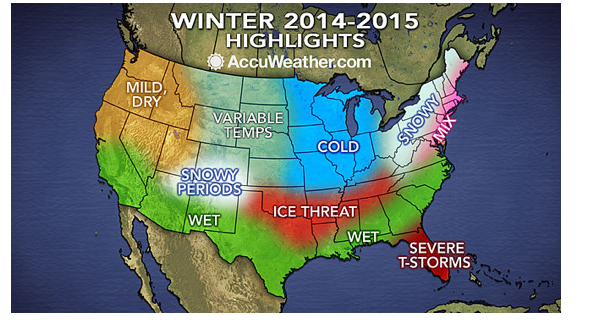
Tahoe snow watcher Bryan Allegretto in an Oct 19 posting suggests much of the state will get wet in November and offers this map of the Winter forecast by Accuweather.

Screen Shot 2014-10-21 at 9.00.28 AM

Ag forecaster Alan Fox paints a mixed picture.

“For northern and central California, along with the northern Sierra Nevadas, expect warmer than normal conditions and near normal rainfall in December. This will be followed by some good strengthening of the sub-tropical westerlies in January. The bottom line is that Sierra Nevada snow fall will be below normal at least through January.”

Millennials Tip The Glass

California wine leaders adapting to drought and consumer shifts, surveys find

September 22, 2014

bottle on its side and wine in glassesAs the baby boomers ‘pass the glass’ to the millennial generation, there will be trade-offs in consumption. (Thinkstock photo)

California wine will hold its own in the global market despite shifts in consumer demographics, scarce water, and competition from imported wines, craft beers and cocktails, according to wine industry leaders surveyed by the University of California, Davis.

Findings from the tandem surveys of wine executives and industry professionals will be presented at 8:30 a.m. Tuesday, Sept. 23, during the Wine Industry Financial Symposium at the Napa Valley Marriott in Napa, California.

“Wine industry leaders are keenly aware that this is a time of great change for California wineries and related business,” said Robert Smiley, professor and dean emeritus of the UC Davis Graduate School of Management.

“As the baby boomers ‘pass the glass’ to the millennial generation, there will be trade-offs in consumption, but the industry professionals surveyed indicate that they are prepared to meet these and other challenges by adjusting their brand composition, adapting new technologies and becoming more efficient in their use of water,” he said.

Survey of wine executives

Smiley gathered the opinions and projections from the heads of 26 wineries for this 13th annual wine executives survey. About 60 percent of those wineries are located in the Napa or Sonoma valleys, while most of the others are in the Central Coast and North Coast regions, and in California’s northern interior, Central Valley and Sierra foothills. One winery is in Washington.

Wine consumption by baby boomers is declining and will continue to do so as that group ages, but consumption by the millennial generation is expected to steadily increase, the wine executives reported.

“We find that the millennials are fabulous,” said one respondent. “They’re adopting wine at a faster pace, and they’re a different type of consumer than we’ve seen in the past.  How to reach millennials, how to engage them and build brand loyalty with them is … more complicated than with the boomers.”

Millennials are bringing a new interest in craft beer and cocktails, survey participants said. Many respondents suggested that the wine industry must pay close attention to those two competitive trends in the beverage business but seemed confident that the wine industry would eventually benefit from them.

“I’m thinking craft beer actually expands the market for us and offers an opportunity for millennial exploration and entry into the market, which then will progress up to wine,” said one wine executive.

International wine competition

Competition in the domestic wine market from imported international wines will increase, most respondents said. The industry should plan accordingly by increasing promotional efforts through local trade organizations, paying greater attention to wine quality and value, and better communicating those benefits to consumers to maintain brand loyalty, they said.

Climate change and water

Climate change and water scarcity were also on the wine executives’ minds, many of them listing these among the industry’s top issues over the next five to 10 years.

They said that they are already implementing a number of strategies including using imaging technology to minimize vineyard water use, recycling winery water for use in vineyard irrigation, and changing winery equipment and procedures to use water more efficiently.

One survey respondent advised keeping an eye on innovative water recycling systems at the teaching and research winery in UC Davis’ Department of Viticulture and Enology. The campus winery is designed to capture and reuse 90 percent of the winery’s processing water, eventually using that water as many as 10 times.

Survey of wine professionals

Smiley’s survey of California wine professionals, now in its 23rd year, probed the opinions of 122 wine industry leaders. Most of the respondents to that survey represent wine companies; others are from operations including wineries, grape-growing and wine-distribution firms, and financial institutions.

Respondents reported that the rebounding economy will have the greatest positive influence on California wine sales during the next three years, followed by increased direct sales to consumers, a larger consumer base and a trend toward high-end wine sales.

Most of these professionals agreed that their business plans are placing a greater emphasis on direct sales to consumers, raising wine prices and investing in technology. Social media is increasingly playing an important role in their businesses, with Facebook and Twitter seen as most valuable.

Over the next three years the strongest white varietals will be chardonnay followed by sauvignon blanc and pinot grigio, and the strongest red varietals will be cabernet sauvignon, pinot noir and red blends, they predict. Wines in the $14- to $20-per-bottle range will show the strongest sales.


Northern California To Get Wet This Week

September 22,2014
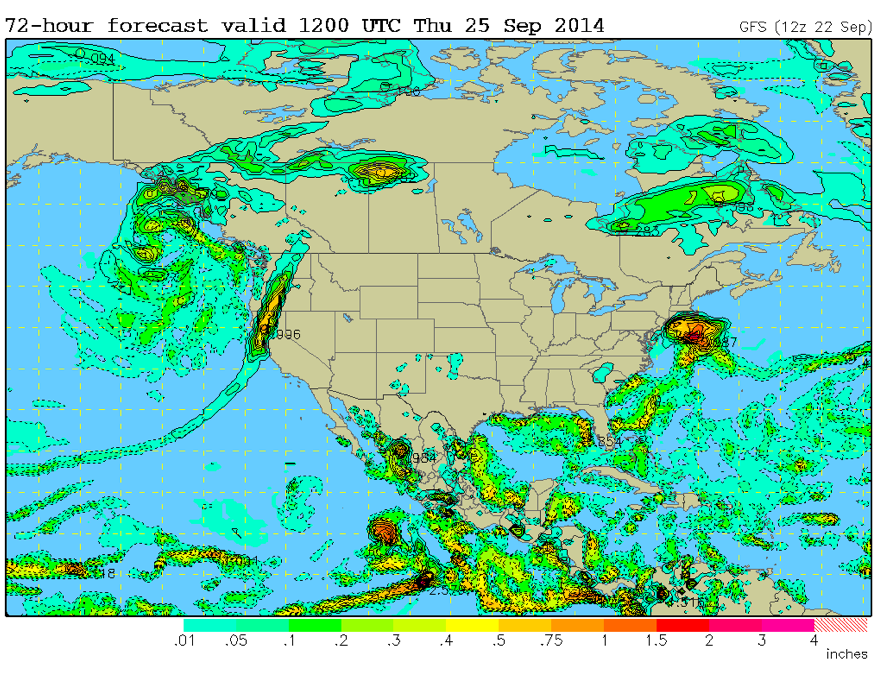
Northern California  is likely to get the first significant pulse of rain this Thursday as a storm out of the Northwest makes its way into the state dropping rain as far south as Monterey and bringing the first snow to the Sierra.

Screen Shot 2014-09-22 at 12.12.00 PM
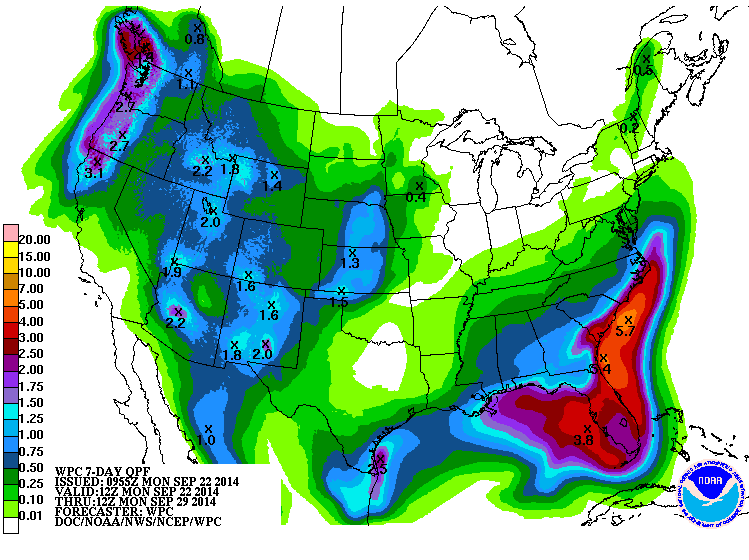
Rain totals September 22 through September 29 could  reach 3 inches in the far northern part of the Golden State. (See map)

Screen Shot 2014-09-22 at 12.09.26 PM

Visalia Dumps Great Lakes Airlines

Seaport Airlines Will Fly Daily

SeaPort 2014-09-15 at 5.37.04 PMto Oakland & Burbank For $59

September 18,2014

The Visalia City Council this week decided to wave goodbye to Great Lakes Airlines and welcome SeaPort Airlines to serve Visalia through the federal Essential Air Service (ESA). The vote was 3 to 2 to go with Seaport rather than quit the ESA program altogether and qualify to receive $2.9 million for airport use. According to a city staff report that ‘take the money’ option was second best, saying it” would provide substantial benefit to the airport, but having reliable air service provides a greater benefit to the community.” All agreed Visalia has had enough of Great Lakes Airlines who have served the city for several years.”They ended up being unreliable and chased away business with their frequent cancellations” says city council member Warren Gubler who sat on a city subcommittee to recommend to the council which of five airline proposals to accept. The subcommittee had recommended Portland-based SeaPort who will fly daily routes to Oakland and Burbank if the Department of Transportation (DOT) approves the city’s recommendation as expected. Service is likely to start toward the end of this year. SeaPort will fly the 9 passenger Cessna Caravan. The Caravan is a non-pressurized, single engine aircraft. While this aircraft effectively has the same number of seats as the Great Lakes Beechcraft 1900, it is a non-pressurized, single engine aircraft and some travelers may have an aversion to flying on those aircraft notes the city staff report. “I think people will get used to them” suggests Gubler adding “this is the last best hope for the ESA in Visalia.”  City airport manager Mario Cifuentes says SeaPort has agreed to ”do the marketing necessary put people in the seats.” DOT has stated that they intend, going forward, to enforce compliance with the EAS statute that prohibits the Department from subsidizing service to communities receiving per passenger subsidy amounts exceeding $200. As proposed, all communities receiving subsidies under the EAS program would have until September 20, 2015, based on data from October 1, 2014, through September 30, 2015, to ensure compliance with the $200 subsidy cap or face termination of subsidy eligibility. Accordingly, Visalia has just over a year of eligibility remaining if we don’t select an air carrier that can deliver reliable service and board enough passengers to keep the per passenger subsidy below $200 says the report. Visalians would rather fly to LAX and the report notes that – but the service to date has been bad through Great Lakes who has been having pilot shortage issues across their service areas. ”The vast majority of our passengers have a history of flying on United Airlines and their code share partners. Almost 90% of our regular passengers continue on to other airports by connecting in LAX. Unfortunately, given the subsidy amounts requested in the proposals this go around, we have to look more favorably on carriers that can carry the most passengers to the connecting airport if we’re to remain under the $200 per passenger subsidy cap. For instance, given the projected passenger totals included in the proposal from Great Lakes and their requested subsidy amount, we will exceed the $200 per passenger subsidy on an annual basis. Since the submital of their proposal, Great Lakes has promised to add a 19 passenger aircraft (to replace the current 9 seat configuration) back to the service pattern, but the subcommittee has no guarantee as to when or if that will happen. Unless they are willing to provide a third daily departure, the Subcommittee cannot recommend that Council support a proposal that is projected to exceed the cap.”

SeaPort Offers $59 Fare

SeaPort does not have landing rights at LAX. But Gubler points to the fact that both Burbank and Oakland have good connections including international flights out of Oakland.  Also, SeaPort Airlines announced a few weeks ago 4 nonstop flights between Burbank and San Diego International Airport (SAN) beginning on October 1, 2014. The proposal for Visalia is for a mix of daily one-stop and nonstop flights to Burbank-San Diego and Merced-Oakland. Fares would start at $59 per one way trip to Burbank and Oakland.  SeaPort is proposing a total of 24 departures per week, 12 to BUR and 12 to OAK; resulting in 216 available seats per week. Gubler says unlike the other proposals, with SeaPort ”whatever happens with Merced does not affect us” with the DOT ending ESA for Merced this summer. Merced has appealed the decision. If the Visalia council had decided to exit the ESA program, the city could use some of the money from DOT to subsidize a charter ground transit service to connect to Fresno and Bakersfield airports suggested council member Greg Collins who with Steve Nelsen was on the losing side of the 3 to 2 vote. In the past four years the subsidized flights from Visalia have attracted from 8 to 11 daily passengers.

Weather Watch: Northern California To Get First Fall Sprinkles

Southern Arizona/New Mexico To Get Pounded

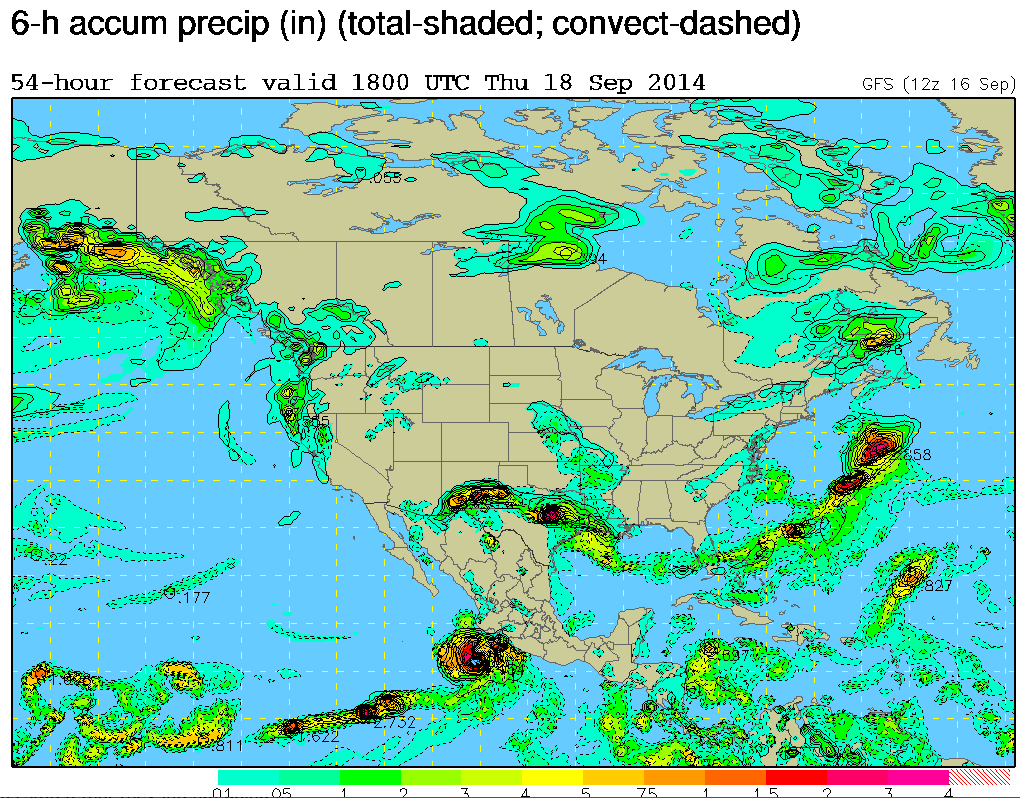
Screen Shot 2014-09-16 at 12.40.22 PMWeather notables this week as the first fall pattern weather front comes into northern California this Thursday (see map). PGE forecaster John Lindsey says a few sprinkles could fall as far south as Monterey. Not much – but a start.

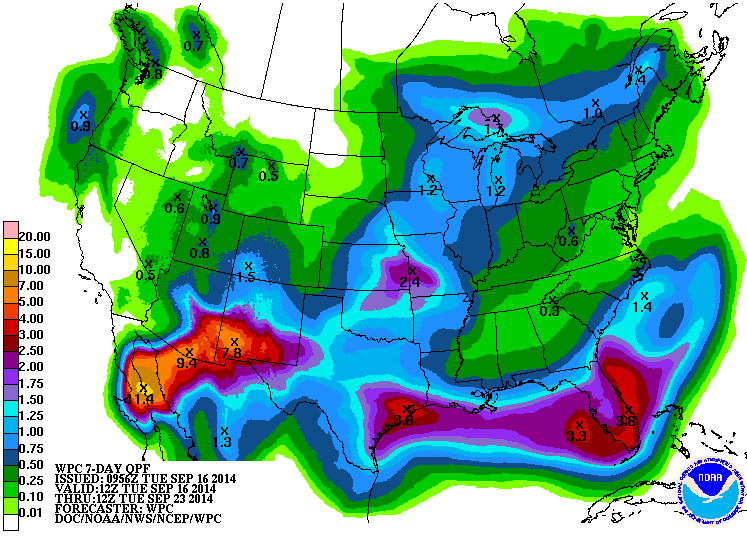
Meanwhile the US southwest in southern Arizona and New Mexico are likely to be pounded with hard rain spilling over from Hurricane Odile over the next week with as much as 9 inches falling in some places according to this NOAA map of rain accumulation over 7 days.

7 day rain accumulation forecast. Man the lifeboats!