California New Vehicle Market To Top 1.8 Million Units in 2014

November 20,2014 –

Screen Shot 2014-11-20 at 7.55.32 AMThe California new vehicle market has recovered from the depths of the recession in 2009 says the statewide New Car Dealers Assn. By year-end, new vehicle registrations are predicted to reach 1.84 million units, an impressive 77 percent increase from the recessionary low point of 1.04 million in 2009.
And the market is likely to move higher in 2015 as well, with registrations potentially exceeding 1.9 million units. That would make it likely the state would see double the car sales in 2016 compared to 2009.

Pent up demand resulting from the economic downturn, very low interest rates, an improving economy, and impressive new products have provided the long term boost to new vehicle sales.

Among the top 15 selling brands, Jeep, Lexus, Mazda, Subaru, and Nissan had the biggest percentage increases in the first nine months of this year. New registrations for each of the five brands increased by more than 16 percent.

Honda Accord is the best  selling car in the state in 2014.

Year to date sales of all vehicles are up 8.5%.

Violent Crimes Fall In 2013

November 13,2014 –

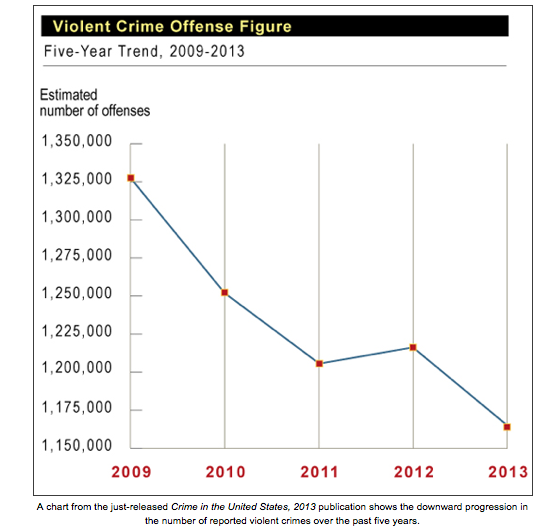
The FBI released Crime in the United States, 2013 today, which shows that the estimated number of violent crimes in 2013 decreased 4.4 percent when compared with 2012 figures, and the estimated number of property crimes decreased 4.1 percent. There were an estimated 1,163,146 violent crimes reported to law enforcement last year, along with an estimated 8,632,512 property crimes.

Screen Shot 2014-11-13 at 6.15.31 AM

The crime statistics report, issued by the Bureau’s Uniform Crime Reporting (UCR) Program, contains voluntarily submitted data from 18,415 city, county, state, tribal, campus, and federal law enforcement agencies on specific crimes brought to their attention. They include the violent crimes of murder, rape, robbery, and aggravated assault, and the property crimes of burglary, larceny-theft, motor vehicle theft, and arson.

Local Numbers

In Middle California Visalia’s violent crime fell from 269 in 2012 to 247 in 2013 while Fresno violent crimes also dropped from 1398 in 2012 to 1317 in 2013 while Santa Maria numbers went up from 314 in 2012 to 333 in 2013.

Shasta Water Picture Better Than Last Year

November 13,2014-

California’s keystone reservoir – Shasta in northern California got only 2.5 inches of precipitation last water year until February when it finally started coming down. Still, the reservoir that feeds the entire state CVP system – took in only 35.5 inches the entire water year.

Now the gauge has restarted as of September 30 and so far as of today we stand at 6 inches in the bucket, not great,but better than 2.5 in.

Wet weather is slated for the north part of the state over the next 10 days with the Redding 10-day forecast showing rain in five of those days going into Thanksgiving.

Screen Shot 2014-11-13 at 11.55.28 AM

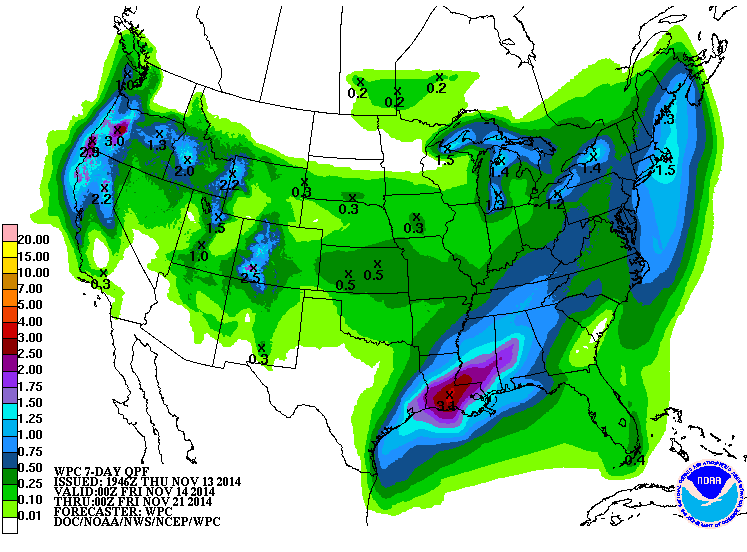
Here is a NOAA map showing some 2.2 inches expected around Shasta in the next week and down to the Tahoe area. Central Coast gets wet too.

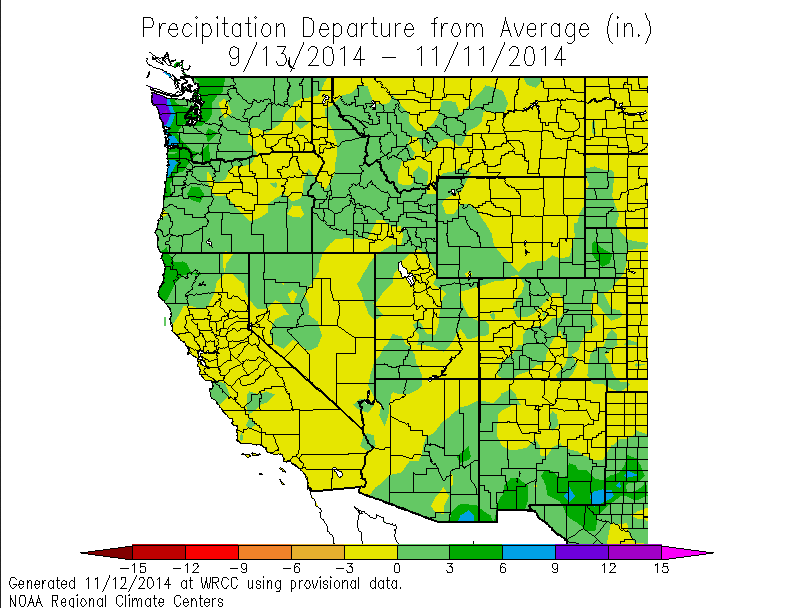
Here is a second map showing how Northern California has been the wet spot this water-year so far.

Screen Shot 2014-11-13 at 12.01.32 PM

California: Less For Gas / More Rain Coming

November 10,2014

Pump Prices Plummet

Gas prices keep dropping in California – down to $2.79 a gallon at a number of stations in the Sacramento and Lodi area ($2.77 at one)  and down to $2.85 in the Porterville area this Monday.Visalia’s Costco is $2.85. In SLO County Nipomo’s Vons station is down to$3.03. Statewide the average price is now $3.21 a decline of over 41 cents in the past month says Gas Buddy. Oil prices dropped today on world markets with WTI down to $77.31 a barrel. The drop in gas prices may help strapped consumers spend more this Holiday season suggest several reports

Getting Wet?

Screen Shot 2014-11-10 at 11.54.27 AMSecond half of the month could be wet suggest several sources.PG&E forecaster John Lindsey said today “a cold front is forecast to drop southward through the Bay Area by late Wednesday, then slide down to Big Sur early Thursday morning.This cold front may be just strong enough produce a few light rain showers in San Luis Obispo County by late Thursday morning.Given the mild nature of the system, snow levels are expected to remain above 6,000 feet with 3 to 5 inches of new snow possible across the northern and central Sierra.”

NWS Hanford says RAINFALL IS EXPECTED TO BE LESS THAN 0.10 OF AN INCH ACROSS THE SIERRA FOOTHILLS AND EVEN LESS INTO THE VALLEY. YOSEMITE QPF LOOKS TO BE AROUND 0.15 OF AN INCH BASED ON CURRENT FORECAST NUMBERS. DURATION LOOKS TO BE LESS  THAN 12 HRS AS THIS IS A FAST MOVING SYSTEM.
Lindsey is more upbeat on later storms.
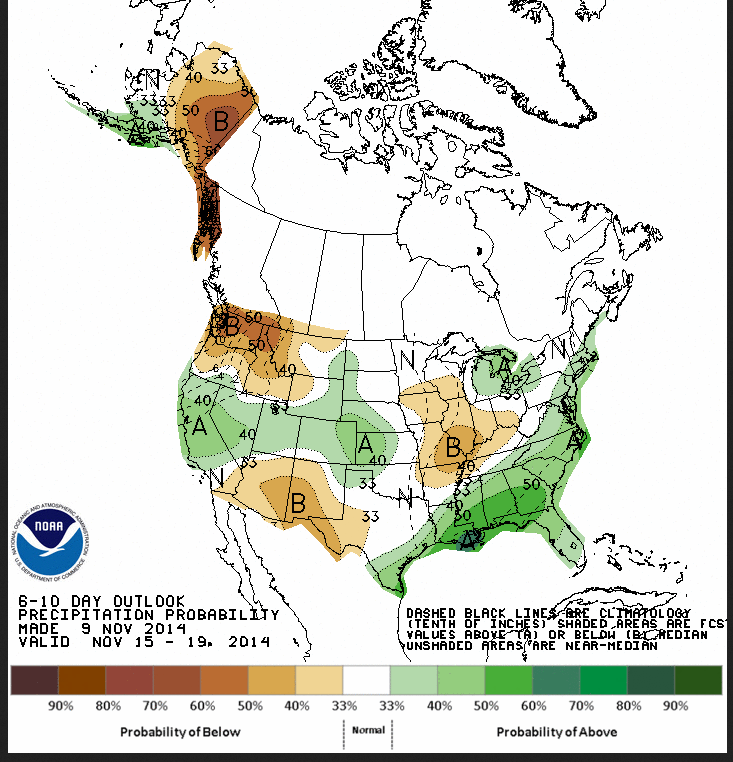
“The long-range models are suggesting a wet-weather pattern for  San Luis Obispo County for the middle and latter part of next week (Nov. 18 through 21).” NOAA is also predicting a chance for wet weather in this map from the 15th to the 19th.

10-Year Visa For Chinese Business Travelers To US

November 10,2014 –
Screen Shot 2014-11-10 at 12.35.51 PMStudents,visitors and business investors can all visit the US and California more easily Wednesday when the US and China will inaugurate more generous visa stays. President Obama announced a new plan  to extend Chinese student visas to five years and business and tourist visas to 10 years – a move that should  boost jobs in the United States. Visas now are granted for one year. The president was in China today.
In a statement the White House said that “this arrangement will improve trade, investment, and business ties by facilitating travel and offering easier access to both economies.  Extended validity visas for students and exchange visitors will boost the bonds between our two peoples and facilitate travel for outstanding students from around the world who attend U.S. institutions of higher education.  As a result of this arrangement, the United States hopes to welcome a growing share of eligible Chinese travelers, inject billions in the U.S. economy and create enough demand to support hundreds of thousands of additional U.S. jobs.  Travelers will continue to be subject to all the same legal and security reviews that currently apply to visa applicants.”
Welcoming a Growing Share of Chinese Travelers.
China is the fastest-growing outbound tourism market in the world, and in 2013, 1.8 million Chinese travelers visited the United States, contributing $21.1 billion to the U.S. economy and supporting more than 109,000 American jobs.
Chinese travelers consistently rank the United States as their most-desired travel destination, yet less than 2 percent of total Chinese travelers come to the United States.
Chinese travelers cite ease of visa policies as the second most important factor in deciding where to travel, behind only cost.
A competitive visa policy will help us meet projections that suggest as many as 7.3 million Chinese travelers will come to the United States by 2021, contributing nearly $85 billion a year to the economy and supporting up to 440,000 U.S. jobs.

Benefit To California

California could be the first to feel a new wave of visitation.The state is already is the top U.S. destination for Chinese visitors, who spent a projected $2.2 billion in California in 2013. Chinese visitors spend about $2,500 per trip to California, far more than travelers from any other market say the golden state’s tourism association
California enjoys 280 nonstop flights per month from China. Total seat capacity reached a record 1.2 million annually in 2013.
Meanwhile investment by the Chinese in business and real estate here is surging. A recent report adds some perspective.
“California, with its long history with China, the most sizable Chinese American population in the country, and more inward investment deals from China than any other state, is in a position to lead the nation in attracting Chinese investment in the decade to come. The Golden State has the potential to attract between $10 billion and $60 billion of Chinese direct investment by 2020.”
This summer an LA Times article said “Tourism from China into Los Angeles nearly quadrupled last year to 570,000 visitors, up from 158,000 in 2009, according to a new report from the Los Angeles County Economic Development Corp. The LAEDC thinks the county could see as many as 2 million Chinese tourists annually by 2020.
A few years ago, China wasn’t among the 10 largest sources of overseas travelers into the Southland; now it’s the top generator. Nearly half of all Chinese journeying to the U.S. stop in California; nearly three-quarters of those come to Los Angeles.”
A number of Chinese come to stay a while and invest here buying hotels, homes and businesses.
In the San Joaquin Valley Chinese investors are in escrow  to buy a Lindsay  food processing plant  and talks are underway with  the California High Speed Rail Authority about both investment and contracting to construct the bullet train.
Last month newspapers reported” One of China’s top train manufacturers may show on Wednesday that it wants a piece of California’s planned US $68 billion high-speed railway project.
Wednesday is the deadline for companies or groups to submit an expression of interest for a contract to supply up to 95 trains, and China CNR Corp, its unit Tangshan Railway and US-based SunGroup USA, will be among those submitting an expression of interest, Reuters reported on Tuesday.”
Last year 20 business leaders from the Shanghai region to the City of Fresno to meet with City officials to learn about the many food and water related business and investment opportunities that the Fresno region has to offer.

California Exports Grow Despite Sluggish Global Economies

Drought Hurting Ag Exports
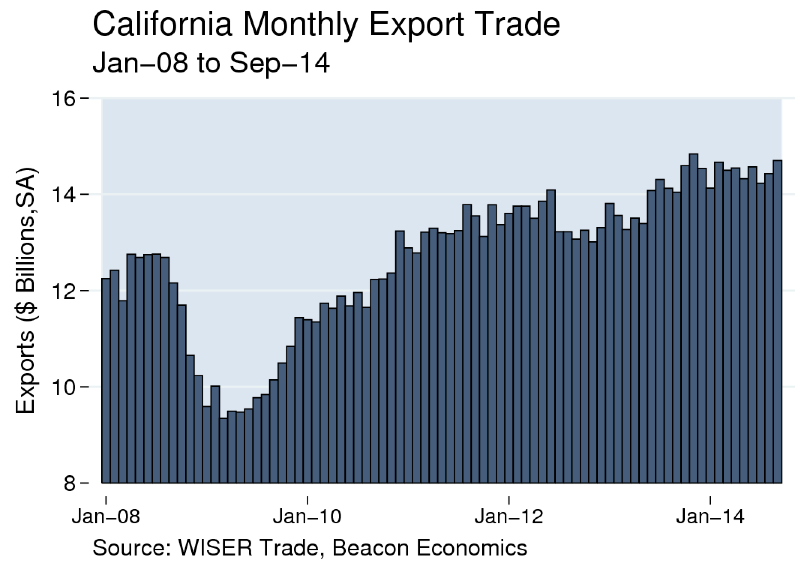
Screen shot 2012-06-15 at 12.12.22 PMNovember 4, 2014 – Despite increasingly adverse economic circumstances and geopolitical turmoil abroad, California’s exporters again posted strong growth numbers in September, according to a Beacon Economics’ analysis of foreign trade data released this morning by the U.S. Commerce Department. The state’s merchandise export trade in September totaled $14.44 billion, up 4.6% from the $13.81 billion in exports recorded in September 2013.
The Exports of manufactured goods rose by 5.1% to $9.5 billion. Exports of non-manufactured goods (chiefly agricultural produce and raw materials) barely budged, however, increasing by only 0.1% from last September. Re-exports meanwhile jumped by 6.7%.
California’s showing in September exceeded the overall 3.9% increase in the value of shipments that month by U.S. exporters.
“September was a very mixed bag for California exporters. Aerospace shipments were especially robust in September, but exports of farm produce and processed food items continued to sag,” said Jock O’Connell, Beacon Economics’ International Trade Advisor. “With each passing month, we are seeing mounting evidence of the adverse impact the drought is having on California’s multi-billion dollar agricultural export trade.”
A Closer Look At The Numbers
As always, Beacon Economics cautions against reading too much into month-to-month fluctuations in state export statistics, especially when focusing on specific commodities or destinations. Significant variations may occur as the result of unusual developments or exceptional one-off trades and may not be indicative of underlying trends.
For that reason, Beacon Economics compares the latest three months for which data are available (i.e., July-September) with the corresponding period one year earlier.
California’s merchandise exports during the latest July-September period totaled $42.84 billion, a nominal increase of 2.1% over the $41.96 billion recorded during last year’s third quarter. The state accounted for 10.7% of total U.S. merchandise exports over the latest quarter.
California’s export trade is highly diversified, with eleven different major categories of goods each accounting for at least $1 billion in exports during the past quarter.
Performance, however, was highly variable, with six categories showing declines in exports from the same period last year. Topping the export list in this year’s July-September period was Computer & Electronic Products (up 3.4% to $11.03 billion); Transportation Equipment (up 6.7% to $4.93 billion); Miscellaneous Manufactured Commodities (a catchall category of merchandise ranging from medical equipment to sporting goods), was down 5.6% to $3.43 billion in exports.
Exports of agricultural produce declined by 6.2% in the latest quarter from one year ago, while exports of processed food products dropped by 4.1%. Exports of Petroleum and Coal Products, which had been increasing briskly over the past three years, saw a 20.5% decline in the latest quarter.
Strong growth was recorded for Chemicals (13.5%) and Electrical Equipment (38.5%).
Screen Shot 2014-11-05 at 10.19.13 AMMexico remained the single largest destination for California exports during the latest three-month period, with the value of exports advancing by 3.8% to $6.42 billion. Exports to Canada fell by 3.7% to $4.69 billion, while shipments to China sagged by 2.0% to $4.03 billion. Japan (down 5.6% to $2.91 billion) and Hong Kong (up 15.2% to $2.21 billion) rounded out California’s ‘Top Five’ export destinations in the July-September period.
Regionally, California’s exports to the Asia Pacific region (including Australia and New Zealand) rose by 2.2% to $16.54 billion. Exports to the European Union edged ahead by 1.2% to $6.98 billion. California exports to Latin America and the Caribbean (excluding Mexico) jumped by 7.5% to $2.74 billion. The state’s exports to Sub-Saharan Africa amounted to only $194.7 million, down 15.3% from the same quarter last year.
By mode of transportation, 44.9% of California’s $42.84 billion merchandise export trade in the most recent three-month period was shipped by air, with Los Angeles International and San Francisco International Airports accounting for the vast majority of the state’s airborne trade. Seaports handled 30.1% of the state’s export trade, while the remaining 25.0% of the state’s exports of goods traveled overland by truck or rail to Canada and Mexico.
Year-to-date, California’s merchandise export trade ($128.99 billion) represented a 4.9% gain over the first nine months of last year. California therefore remains on a path to achieve its best export year ever.
California Exports: The Near Term Outlook
There is little doubt that U.S. export numbers have been disappointing recently, but they are still up from last year—growing at about a 3.8% nominal rate over the past quarter (relative to 2013). To put this in perspective, the average growth rate over the past two decades has been slightly more than 6.5%. Much of this is due to slow growth in the world economy. Ongoing fiscal issues in Europe, slowing growth in China, and a slump in the broader developing world are all to blame.
Looking ahead, Beacon Economics does not believe the global situation is as dire as some commentators have suggested. “Most numbers indicate the trends are disappointing, but stable, with little sign of continued slowing,” said Christopher Thornberg, Founding Partner of Beacon Economics. “Add new efforts by the European Central Bank and the Bank of Japan to stimulate those respective economies, and things may well start to improve soon.” Stronger growth numbers in the United States have also led to a second issue: The Fed is starting to ‘zig’ on interest rate policy even as these other central banks are zagging. Thus, the dollar has suddenly appreciated by 5.5% against a broad mix of other currencies, which will have some effect on future export growth.
Still the dollar is weaker than it was at anytime between 1997 and 2007, and given cost cutting measures put in place over the last few years, U.S. exporters remain very competitive. Beacon Economics expects ongoing growth, even if at a modest pace. Moreover, weakness in the global economy has caused commodity prices to fall, not the least of which, oil is at $80 per barrel. This will serve to offset any negative impacts of the exchange rate appreciation. These issues should not pose much of a threat to the United States overall or to California.
But there may well be another rapidly emerging threat to California exporters: the risk of a shut-down of West Coast seaports. The International Longshore and Warehouse Union has been working without a contract since July 1, and, while negotiations between the union and the Pacific Maritime Association (representing the steamship lines and terminal operators at the ports) had been proceeding amicably, there are now signs of sharpening discord between the two parties, raising the potential for either a strike by the union or a lock-out by the terminal operators at ports up and down the West Coast.
Nonetheless, barring a prolonged disruption of operations at the state’s seaports, Beacon Economics remains confident that California’s merchandise export trade will continue to expand at a modest pace over the coming months.

How’s Biz? Confidence In Economy At Multi-Year High / New Orders, Employment and Production Growing

November 4,2014

Screen shot 2013-01-19 at 11.41.42 AMEconomic activity in the US manufacturing sector expanded in October for the 17th consecutive month, and the overall economy grew for the 65th consecutive month, say the nation’s supply executives in the latest Manufacturing ISM® Report On Business®.

Meanwhile two other reports suggests we are enjoying the lowest  budget deficit since 2008 and highest level of consumer confidence in 15 months.

The ISM report for October PMI® registered 59 percent, an increase of 2.4 percentage points from September’s reading of 56.6 percent, indicating continued expansion in manufacturing. The New Orders Index registered 65.8 percent, an increase of 5.8 percentage points from the 60 percent reading in September, indicating growth in new orders for the 17th consecutive month. The Production Index registered 64.8 percent, 0.2 percentage point above the September reading of 64.6 percent. The Employment Index grew for the 16th consecutive month, registering 55.5 percent, an increase of 0.9 percentage point above the September reading of 54.6 percent. Inventories of raw materials registered 52.5 percent, an increase of 1 percentage point from the September reading of 51.5 percent, indicating growth in inventories for the third consecutive month. Comments from the panel generally cite positive business conditions, with growth in demand and production volumes.”
Of the 18 manufacturing industries, 16 are reporting growth in October in the following order: Plastics & Rubber Products; Textile Mills; Fabricated Metal Products; Miscellaneous Manufacturing; Primary Metals; Electrical Equipment, Appliances & Components; Nonmetallic Mineral Products; Food, Beverage & Tobacco Products; Chemical Products; Apparel, Leather & Allied Products; Printing & Related Support Activities; Transportation Equipment; Furniture & Related Products; Paper Products; Machinery; and Computer & Electronic Products. The only industry reporting contraction in October is Petroleum & Coal Products.

WHAT RESPONDENTS ARE SAYING …
“Holiday orders are exceeding seasonal forecasts. Customers are demanding additional quantities above prior orders. Fuel costs and other positive signals appear to be creating demand above normal.” (Food, Beverage & Tobacco Products)
“Weakness in commodity prices very positive on our business.” (Fabricated Metal Products)
“We continue to see strong demand across multiple sectors.” (Transportation Equipment)
“Business steady and strong.” (Furniture & Related Products)
“Another strong month in terms of business growth.” (Computer & Electronic Products)
“Most business segments are seeing an upward trend in orders — mostly from existing customers, but also some new customers. Transportation continues to be a major issue.” (Chemical Products)
“Conditions are still basically flat.” (Printing & Related Support Activities)
“Production is oversupplying demand, and prices have softened.” (Wood Products)
“Outer body material changes in the auto industry means new equipment and manufacturing growth.” (Machinery)
“Business conditions are good; sales and production volumes are generally increasing.” (Miscellaneous Manufacturing)

Lower Deficit
Also this week good economic growth has helped push the U.S. budget deficit down to the lowest level since 2008, marking the sharpest turnaround in the government’s fiscal position in at least 46 years. The shortfall of $483.4 billion in the 12 months ended Sept. 30 was 2.8 percent of the nation’s gross domestic product of $17.2 trillion over the same period, according to data compiled by Bloomberg using Commerce Department figures. The figure peaked at 10.1 percent of GDP in December 2009 according to a Bloomberg report.

Gallup Report On Confidence
Also economic confidence among Americans, including, finally, upper income Americans, jumped in October to the highest point in 15 months, according to polling by Gallup Inc. It comes in the final stretch of a year with index readings that, although negative, approached seven-year highs and were remarkably stable. “After months of stagnant confidence, Americans may be becoming more positive in their views of the economy’s current state and future prospects,” Gallup says.With the stock market having ended last month on a positive note and gas prices continuing to drop, it is reasonable to expect the gains made in October to be sustained in November, it adds.Gallup’s U.S. Economic Confidence Index jumped to a monthly reading of -12 in October. This is the most positive score since the -12 of July 2013, although it is still lower than the record high of -7 in May 2013. The three-point increase from September is the largest monthly improvement seen this year so far.

The October reading is the third-highest monthly figure Gallup has found since it began tracking the Economic Confidence Index on a daily basis in 2008.


Central California Wet Weather Turning Hot & Dry

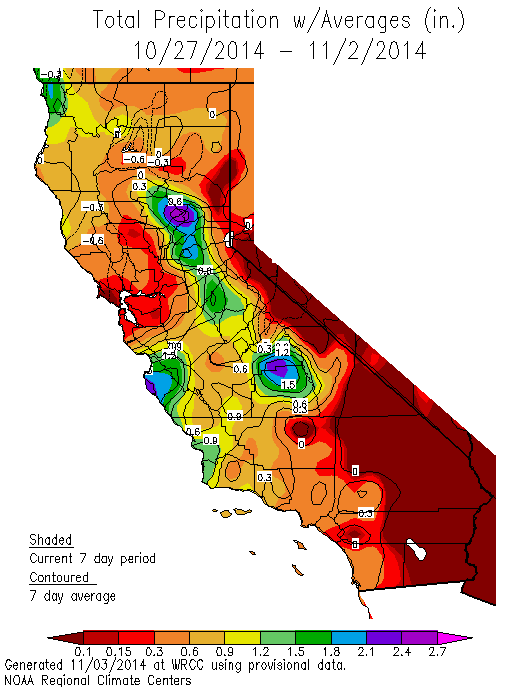
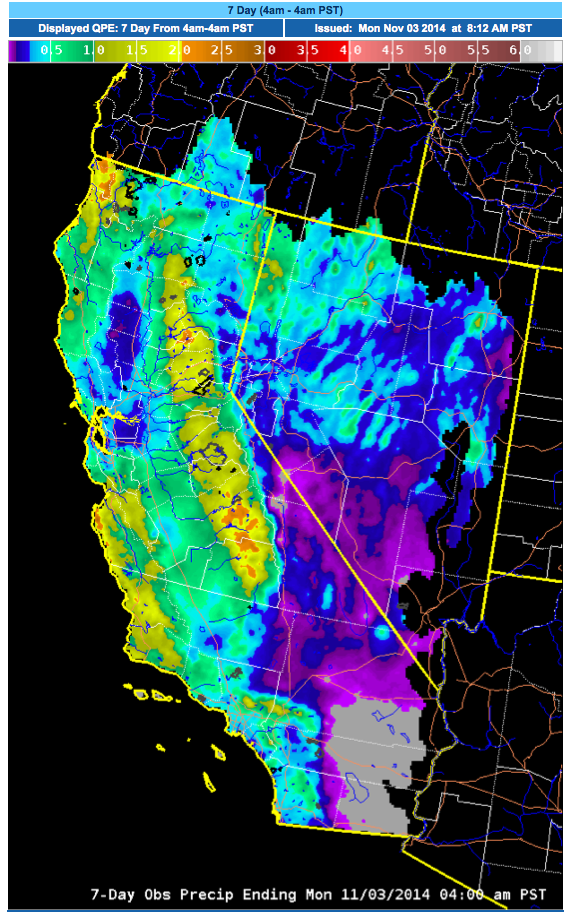
November 4,2014-  NOAA says last weekend’s storm targeted much of California with the mid-state in the bullseye. These two precipitation maps(below) tell the story with 2 inches of precip and above falling in the Tulare County mountains and the Central Coast getting the first significant rainfall in nearly 7 months. Giant Forest got over 2 inches of water and Yosemite high country got a foot of snow. Tioga Pass remains closed but is expected to reopen later this week.

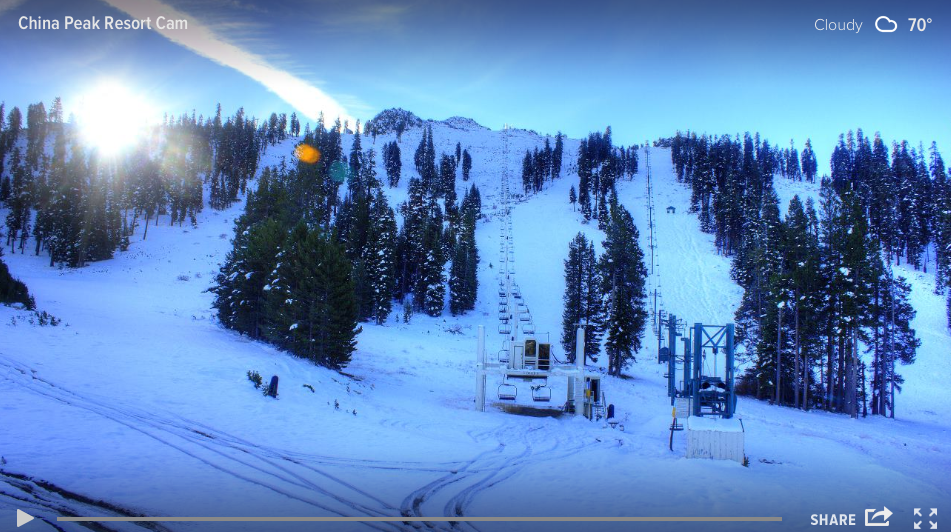
Screen Shot 2014-11-04 at 7.55.35 AMChina Peak ski resort above Fresno is celebrating this week with up to 15 inches of  snow on the mountain. But for how long? Today’s temps are in the 70s there.

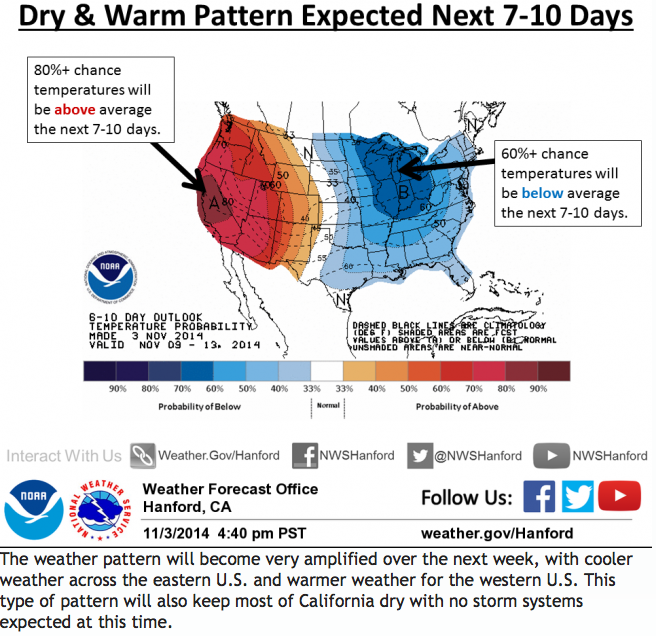
Screen Shot 2014-11-04 at 8.03.22 AMNWS Hanford says to expect hot and dry weather through the next 10 days as we await the next storm to come into the state.

Screen Shot 2014-11-04 at 7.52.07 AMScreen Shot 2014-11-03 at 8.39.27 AM

Taking The Pulse – What’sThe Latest?

October 31,2014

Storm Could Close Tioga Pass

Todays approaching storm is expected to dump between 4 and 8 inches of snow above 7,000 feet in the Central Sierra above Fresno. The east side of the Sierra could see up to 14 inches -good news for Mammoth Ski resort. “Snow may lead to the winter closure of Sonora and Tioga passes,” the National Weather Service predicted in a statement.

California Homeless Down 7 Percent

There were 113,952 persons sleeping in the cold on a single night earlier this year in California, according to the U.S. Housing and Urban Development Department’s annual assessment of the problem. That’s nearly 20 percent of the nation’s total.HUD says homeless planning agencies counted 578,424 persons homeless on the night of the count. California’s total represents an overall 7 percent  reduction since 2010.

HUD’s annual ‘point-in-time’ estimates seek to measure the scope of homelessness on a single night in January. Based on data reported by state and local planning agencies across the country, last January’s one-night estimate reveals a 33 percent drop in homelessness among veterans since 2010 and a 10.5 percent decline since last year. State and local communities throughout the U.S. also reported a 15 percent decline in the number of families with children experiencing homelessness since 2010, as well as a 53 percent reduction among these families who were found be to unsheltered.

Consumer Sentiment Highest Since 2007
From CNBC
U.S. consumer sentiment rose in October to its highest level since in more than seven years on growing optimism about the economy and more favorable personal financial expectations, a survey released on Friday showed.
The Thomson Reuters/University of Michigan’s final October reading on the overall index on consumer sentiment finished at 86.9, the highest level since July 2007, up from 84.6 at the end of September.
The late October reading was up slightly from its initial figure of 86.4, which was also the expected reading of economists polled by Reuters.
“The gains in confidence over the past three months point toward improved holiday spending by consumers,” survey director Richard Curtin said in a statement.
“Overall, five years after the start of the recovery, consumers have finally begun to adopt the expectations and behaviors that have driven past expansions.”

Truck Tonnage Up 4 Percent Vs 2013

ATA Truck Tonnage Index Unchanged in September


Arlington, Va. — American Trucking Associations’ advanced seasonally adjusted For-Hire Truck Tonnage Index was unchanged in September, following a gain of 1.6% the previous month. In September the index equaled 132.6 (2000=100), the same as in August and a record high.


Compared with September 2013, the SA index increased 3.7%, down from August’s 4.5% year-over-year gain. Year-to-date, compared with the same period last year, tonnage is up 3.2%.


The not seasonally adjusted index, which represents the change in tonnage actually hauled by the fleets before any seasonal adjustment, equaled 135.8 in September which was 1.7% above the previous month (133.5).


“September data was a mixed bag, with retail sales falling while factory output increased nicely,” said ATA Chief Economist Bob Costello. “As a result, I’m not too surprised that truck tonnage split both of those readings and remained unchanged.”


“During the third quarter, truck tonnage jumped 2.4% from the second quarter and surged 4% from the same period last year,” Costello said.  He also noted that the third quarter average was the highest on record.


Trucking serves as a barometer of the U.S. economy, representing 69.1% of tonnage carried by all modes of domestic freight transportation, including manufactured and retail goods. Trucks hauled 9.7 billion tons of freight in 2013. Motor carriers collected $681.7 billion, or 81.2% of total revenue earned by all transport modes.


ATA calculates the tonnage index based on surveys from its membership and has been doing so since the 1970s. This is a preliminary figure and subject to change in the final report issued around the 10th day of the month. The report includes month-to-month and year-over-year results, relevant economic comparisons, and key financial indicators.