“Most Affordable Homes” in California

March 4,2015-
The web news site Business Insider ran a story online this week naming the “most affordable small towns in America” in each state.
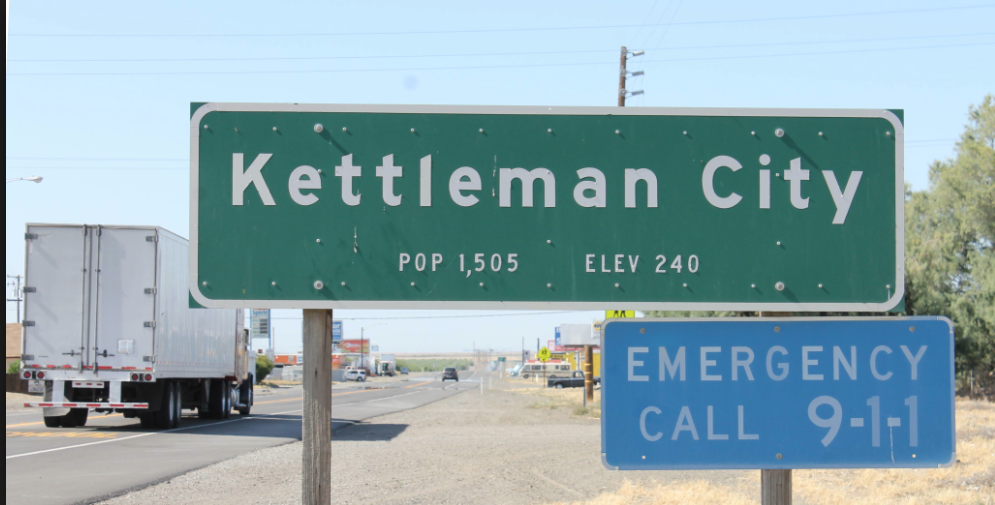
The winner in California is none other than our own Kettleman City in Kings County along I-5 where 85.9% of homes are “affordable” says the article.
The story describes the community this way.
“Halfway between Los Angeles and San Francisco lies Kettleman City, a farm town known for its proximity to oil hotspot Kettleman Hills. The community also sits close to the California Aqueduct and the controversial Kettleman Hills Hazardous Waste Facility.”
According to the January home sales report from the California Association of Realtors, Kings County’s median price for a home was $172,500, one of the lowest in the state. Homes in Kings County are one sixth the cost of homes in San Mateo County in the Bay Area where the median price for a home is $1,012,500, the highest in the state.


Screen Shot 2015-03-04 at 1.07.01 PM

Mokelumne River Salmon Defy Drought with Help from East Bay MUD and CDFW

Screen Shot 2015-02-28 at 7.17.10 AMFebruary 28,2015

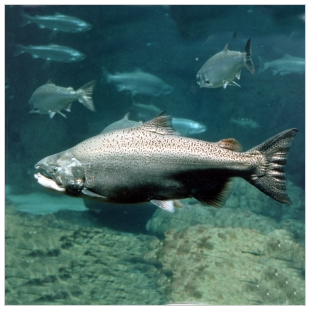
More than 12,000 Chinook salmon defied the drought last fall and returned to the Mokelumne River to spawn, creating the river’s fifth-largest run in 74 years, East Bay Municipal Utility District announced this week.
The successful fall run is attributed in large part to the Mokelumne River Fish Hatchery project, which is  a partnership between EBMUD and the California Department of Fish and Wildlife.  According to a press release from EBMUD, the 2014 salmon run marks the fourth consecutive year the number of Chinook salmon returning to the Mokelumne River has exceeded 12,000. This is nearly triple the river’s long-term annual average. Of the returning salmon, about one-fourth spawned in the river and the rest were collected at the fish hatchery.
“These positive results indicate that our efforts are successful and our partnerships are working,” said EBMUD manager of Fishery and Wildlife Jose D. Setka. “The Delta is already an unwelcoming place for juvenile salmon and the drought makes those conditions worse. Salmon need all the help they can get.”
The Mokelumne River is the source of water for 1.3 million people in the East Bay and is the site of Pardee and Camanche Reservoirs. To contend with dry conditions, EBMUD staff released reservoir water and pulsed it downstream to mimic storms. Even with limited amounts of water last year because of the drought, by modifying releases this way last spring, enough savings were achieved to pulse flows to attract adult salmon in the fall. Woodbridge Irrigation District, in Lodi, also on the Mokelumne River, changed its dam operations to deliver extra pulses.
To deal with warmer water temperatures, EBMUD biologists turned to Pardee Reservoir and drew cold water from the bottom of the reservoir, which  lowered the temperatures to less than 60 degrees in the lower Mokelumne River. The colder temperatures are better for salmon spawning.
The Delta is also home to salmon predators such as largemouth bass and striped bass. To bypass these salmon predators and the South Delta export pumps, another source of high mortality, staff trucked juvenile salmon from the hatchery and released them at Sherman Island, northeast of Antioch, with positive results.
EBMUDalso  is supporting a study which explores transporting juvenile salmon from the Mokelumne River by barge and releasing them in the San Francisco Bay. Barging may improve fish survival as they travel through the Delta and it also may help juvenile salmon learn the smell of the Mokelumne River through a process called imprinting, necessary for adult fish to re-trace their way to natal waters.
State and regional agencies met yesterday to review last year’s statewide salmon return results and develop forecasts for the 2015 season. EBMUD’s fishery program now is gearing up for what could be another dry, or worse, critically dry year. All eyes are set on helping the juvenile salmon produced this year survive and return to the Mokelumne River in two to three years.
The Department of Water Resources forecast, based on the April 1 snow survey, will determine how EBMUD and California Department of Fish and Wildlife manage the river and the hatchery later this year. The strategies are part of a 1998 agreement between EBMUD and federal and state agencies to promote healthier conditions and water flows in the Mokelumne River.

From ACWA

California Wines Fuel $1.49 Billion in U.S. Wine Exports in 2014

Screen Shot 2014-09-23 at 7.41.51 AMFeb 25, 2015

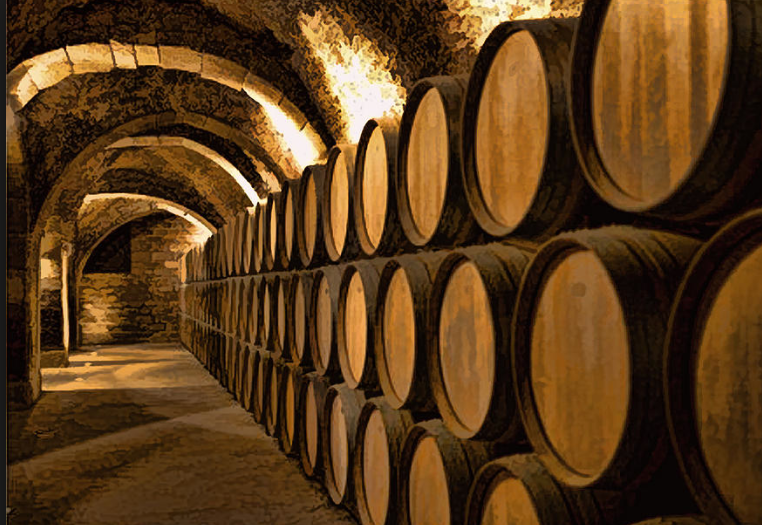
SAN FRANCISCO — U.S. wine exports, 90% from California, reached $1.49 billion in winery revenues in 2014, the second highest dollar value for U.S. wine exports and a 64% increase from five years ago. Challenged by a strong dollar and the West Coast port slowdown that began last July, U.S. wine exports were slightly down compared to the previous year while volume was up to 442.7 million liters or 49.2 million cases.

“With three back-to-back California vintages (2012, 2013 and 2014) heralded for their high quality and size, we have the ability to meet consumer demand for our wines both in the U.S. and abroad,” said Wine Institute President and CEO Robert P. (Bobby) Koch. “Despite our strong dollar and heavily subsidized foreign competition and their high tariffs, consumers worldwide are attracted to all things California—our iconic lifestyle, scenic landscapes, great wine and food, and emphasis on environmental stewardship.”

Of the top 10 export markets for California wines, the European Union’s 28-member countries were the largest accounting for $518 million; followed by Canada, $487 million; Japan, $88 million; China, $71 million; Hong Kong, $69 million; Mexico, $24 million; South Korea, $22.2 million; Nigeria, $21.9 million; Vietnam, $20 million; and Singapore, $16 million.

“Wine Institute’s global branding campaigns for California wine help develop markets in more than 25 countries with 15 representative offices around the world to provide market information and promotional assistance,” said Wine Institute Vice President International Marketing Linsey Gallagher. “We introduced several new tools this year including the translation of our consumer website discovercaliforniawines.com into eight languages, social media campaigns now live in 16 countries (Facebook, Twitter and Weibo and WeChat in China), an educational California Wines PowerPoint tool, and a strong partnership with Visit California to increase tourism to California wine regions. We organize California’s participation in international trade shows and trade missions to key export markets, host retail and on-premise tastings for trade, media and consumers worldwide and have an active schedule of California wine country visits by international media and wine buyers.”

“Wine Institute continues to work closely with Members of Congress and the Administration to remove trade barriers and provide a level playing field for our vintners around the world. First and foremost, Congress needs to approve Trade Promotion Authority (“fast track”) legislation so that the tariffs U.S. wines face in key Asia-Pacific and European markets can be eliminated in the Trans-Pacific Partnership and Transatlantic Trade & Investment Partnership free trade negotiations,” said Tom LaFaille, Wine Institute Vice President and International Trade Counsel.

Five of Wine Institute’s 15 Regional Trade Directors reported on key markets as follows:

Canada
“California wine sales experienced strong growth in all the major markets across Canada during 2014. Retail sales of U.S. wines now exceed a record six million cases and $1 billion dollars with the strongest increases in the provinces of Quebec and Alberta,” according to Rick Slomka, Wine Institute Trade Director for Canada. “Canadian consumers have confidence in the quality and value offered by California and our wines are successful in all price segments. In-store promotions in the major markets have created a solid base and strong momentum for California wines, which will be needed to offset the challenges of a stronger U.S. dollar.”

Continental Europe
“Exports to continental Europe were down slightly, mainly as a result of a weakening of the Euro in the fourth quarter. The 2015 year will also be challenging, with the markets adapting to the exchange rate of the stronger U.S. dollar,” said Paul Molleman, Wine Institute Trade Director for Continental Europe. “The 28-member European Union countries accounted for 35% share of total U.S. wine exports in 2014.”

United Kingdom
“The UK economy is now more robust than at any time in the last 10 years, but a series of above-inflation duty increases has taken its toll on the sales of wines at popular prices. However, consumer wine drinking behavior is changing to a less-but-better approach, and premium wines priced at $15 and over have increased by 30%. Premium California wine is well set for further growth here,” said Wine Institute United Kingdom Trade Director John McLaren.

Japan
“While California wine sales in Japan are brisk, supply from California has been a major challenge due to slow shipments from the state’s West Coast ports. Japanese import statistics confirm that U.S. wine exports to Japan in 2014 were bigger than a year ago for the period up to November but became negative in December. Resolution of the port issue should bring supply back in line with growing demand,” said Ken-ichi Hori, Japan Trade Director for Wine Institute.

“Once the Trans-Pacific Partnership free trade agreement is finalized, the import duty on U.S. wines will likely be minimized and help the entire California category increase in Japan. This is critical for the California wine industry, since our competitors from Chile and Australia have already established Free Trade Agreements with Japan, and thus have a duty advantage over California wines.”

China and Emerging Markets
“Asia’s emerging wine markets remained buoyant in 2014 despite the negative impact of China’s ongoing austerity campaign, resulting declines in the value of California wine exports to China and Hong Kong. However the long-term outlook for these key markets remains very promising and all of our other active Asian emerging markets saw value gains in 2014, led by Vietnam, up 55%, Singapore, up 33% and Taiwan, up 31%,” said Eric Pope, Wine Institute’s Regional Director, Emerging Markets. “Our markets in the Americas also showed resurgent growth, led by Brazil, up 44% and Mexico, up 14%. The value of California wine exports to Colombia, our newest Export Program market, grew 6%. Since 2011, the value of wine exports to this market has doubled.”

Since 1985, Wine Institute has served as the administrator of the Market Access Program, a cost-share export promotion program managed by the USDA’s Foreign Agricultural Service. More than 170 wineries participate in Wine Institute’s California Wine Export Program and export to 125 countries.

 

Gas Prices Up 40 Cents In California

February 18,2015-

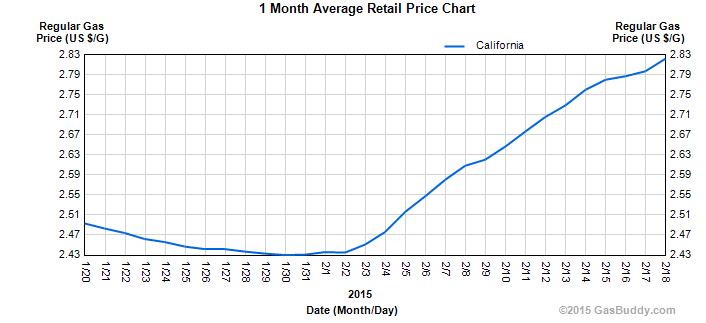
Screen Shot 2015-02-18 at 1.30.10 PMGas prices in California are up around 40 cents in a month says Gas Buddy. The increase comes despite the fact oil prices are about the same as they were a month  ago with WTI just above $50 today. The average price in the state is $2.82 a gallon.Several refinery issues as well as the switchover to warm weather fuels may be playing a part,

Kings County ‘New Town’ Quay Valley Is Back

February18,2015-

Screen Shot 2015-02-18 at 1.25.12 PMMothballed since 2008 the ambitious project to build a 12,000 acre new town in southwest Kings County is making a comeback this month.
When we last heard, Quay Valley property owners had won a lawsuit against McCarthy Family Farms for breach of contract involving the sale of the water rights and against developer John Vidovich and Sandridge Partners for intentional interference of two contracts involving water for the Quay Valley Ranch project. That was about one year ago when a Kings County jury had unanimously awarded a $128.6 million verdict in favor of GROW and Kings County Ventures.
Meanwhile Grow Holdings -proponent of Quay Valley – has filed a preliminary application to build a solar farm on the property, a plan that has not moved forward.
However this month Grow Holdings applicant Quay Hays did file a plan to move forward on the new town itself, located along I-5, with a zone change application and other requests. More info to follow soon.

Wait Till Spring Till Winter Comes?

February 18,2015-

Although February started out promising it turned into a duster rain wise. High pressure remains in control looks like through the rest of the month. Both Central Sierra ski resorts closed due to lack of snow or cold weather to make it and farmers fretted we will have the 4th year of the California drought.
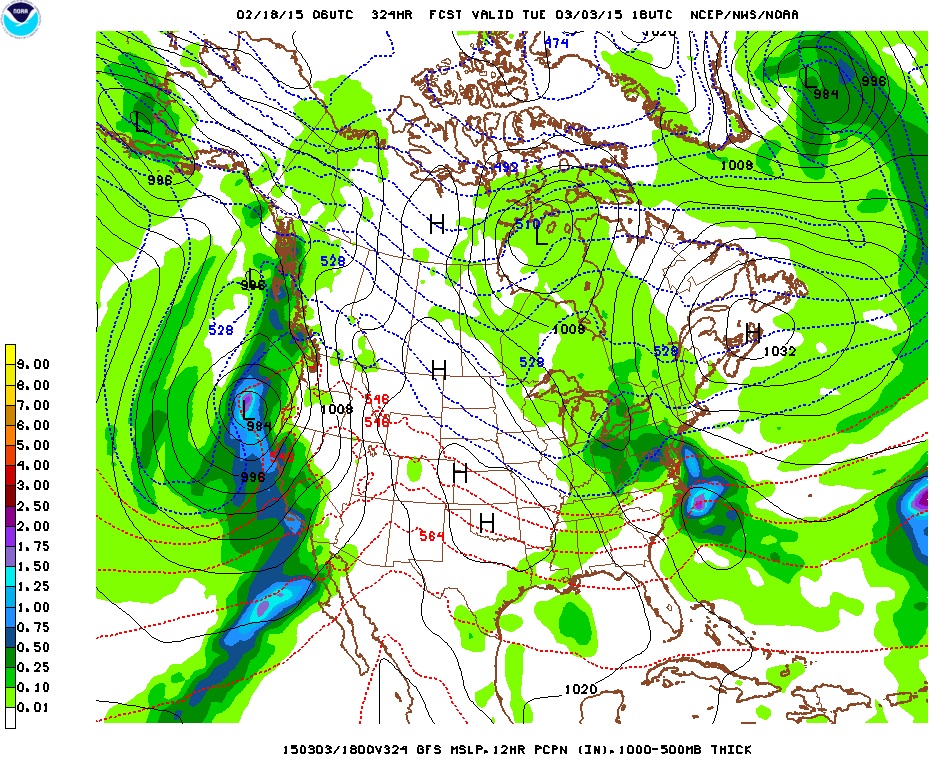
But hope springs eternal as major weather models are suggesting it will get wet in many parts of California including mid-state starting around February 28 and lasting at least a week with multiple cold storms coming in. Here is the GFS long range map for March 3 showing an atmospheric river effect from the south as well.  Still, two weeks out you can’t count on it but it does look like an encouraging pattern just in time for Spring.

Watch the long rang patterns yourself – click on the GFS models at this site –  http://www.cnrfc.noaa.gov/weather_models.php

- click to enlarge- early March wet pattern
– click to enlarge-
early March wet pattern

News Nuggets: Shasta / Gas / Eggs

February 9,2015

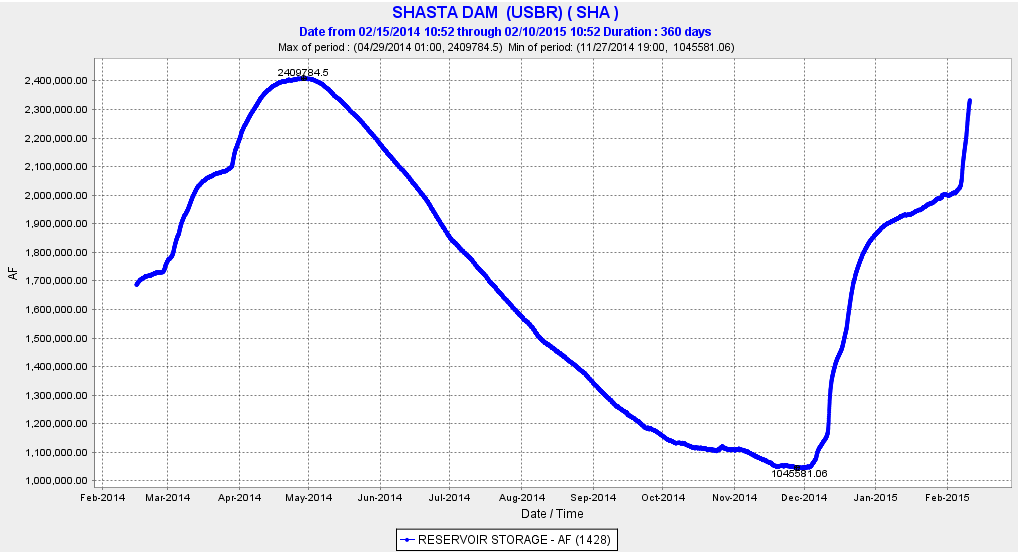
Storm To Bring Shasta Storage To 2.4 Million AF  – Same As All Last Year

This past week series of storms has helped fill Shasta Reservoir to last year’s high level  mark of 2.4 million af projected to reach that level by February 11. The Atmospheric River storms over a 5-day period in December and again this past week are to be credited with the rapid rise. The storms helped raise the Northern California Precipitation Index to a 102% of average as of today says the state. The warm storms dropped near 11 inches of rain that largely flowed into the lake since little fell as snow.Meanwhile the Bureau of Reclamation reduced outflows from the lake to protect against flooding downstream.

Click to enlarge - Key reservoir rises rapidly after storms in December and this past few days.
Click to enlarge –
Key reservoir rises rapidly after storms in December and this past few days.

 $750  Average Savings At The Pump

The federal EIA says this week that “the national average pump price is expected to stay below $3 a gallon during 2015.”
“Gradually rising crude oil prices will push the average U.S. gasoline price to $2.13 a gallon this quarter and to $2.33 a gallon for 2015 as a whole.”
“Despite the recent end to 17 straight weeks of declining gasoline prices, the average U.S. household is  forecast to save $750 in gasoline costs this year compared with 2014.”

California Eggs Price Take A Dive

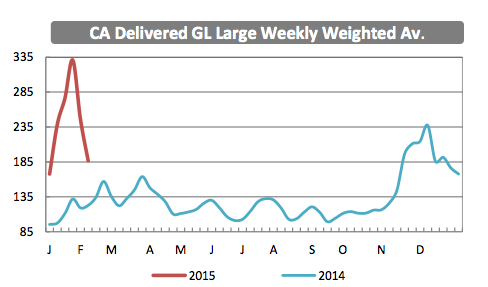
USDA Market News says wholesale California eggs fell 95cents per dozen for the jumbo size compared to a week earlier. Jumbos averaged $2.40. Those same eggs delivered to the grocery store averaged $3.27 and the store marks them up from there. Shoppers  in New York are paying $2.69  for extra large eggs. Some California grocery stores were selling a dozen eggs for $6 a few weeks ago  but the price is in the $4 range now but more for organic and range free.
The below USDA chart for large size eggs shows California delivered prices falling $1.50 a dozen in recent weeks – about 40 cents higher than year ago. Egg industry sources expected this drop after Prop 2 went into effect January 1 sending prices sky high.


Screen Shot 2015-02-10 at 10.52.55 AM

How Wet Will It Get?

February 4,2015

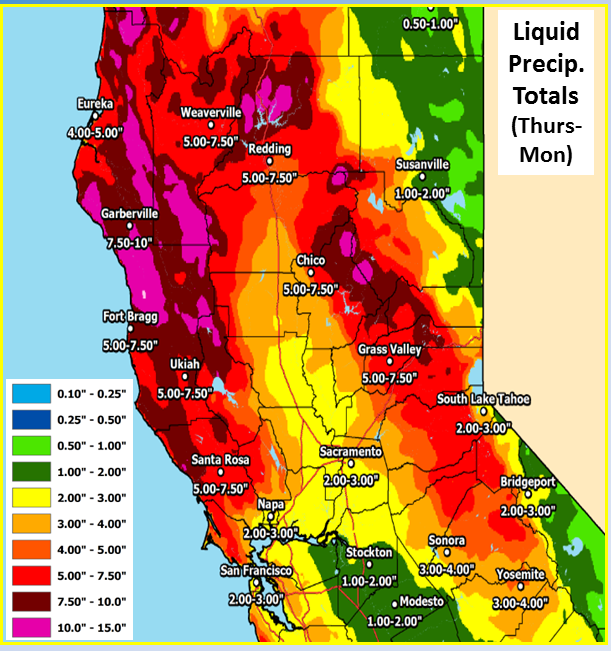
What the NWS calls a ‘very wet storm system will be moving through Northern California starting Thursday afternoon across the northwestern portions of the state, then shifting southeastward Friday into Saturday.”

The heaviest rains (and greatest potential for local flooding) are expected generally from I-80 northward, though all of NorCal will receive a good soaking.

Perhaps pumping up the volume of water is the fact this is an extremely warm storm with .sea surface temperatures immediately offshore of California extremely elevated–and are locally more than 3-4 F above average for this time of year. These near-record temperatures could provide some extra moisture to the incoming storm systems, as occurred during the December storm sequence in NorCal.” says one forecaster.

Storm should soak Central California by Saturday.

Note the pink around Lake Shasta that indicates 10-15 inches of rain over 4 days.

Click to enlarge
Click to enlarge


Californians Achieve Strong Water Conservation Gains in December

February 3,2015

from ACWA

Californians cut back on water use by 22% in December as compared with the same period last year, clocking the largest water conservation gains since state officials began tracking the data last summer,  according to data released today by the State Water Resources Control Board.

The sharp climb in water conservation marks the first time the state has attained Gov. Jerry Brown’s goal of a 20% reduction in water use. Brown called on Californians to cut water use last January when he declared a drought state of emergency.

While the strong conservation data was welcome news, state officials cautioned that some of the reduction in water use may be the result of rain storms in December, which likely reduced the need for outdoor water use. Officials added that January was one of the driest months on record in California and residents should still limit outdoor watering as the state grapples with exceptionally dry conditions.

“Today’s announcement is welcome news that demonstrates the importance of outdoor water savings,” said State Board Chair Felicia Marcus said in a written statement. “We have just gone through the driest January on record and it appears we are entering a fourth year of drought, which is awful to contemplate but we must.  Conservation is still the smartest and most cost effective way to deal with this difficult drought.”

The 22% water savings is the largest savings achieved since the state began tracking water production data seven months ago. In month-over-month savings, Californians as a whole saved 9.9% in November, 6.9% in October, 10.2% in September and 11.5% in August.

One Foot Of Rain Predicted

February 2,2015

Atmospheric River Event For Northern California Includes North Bay Area

SLO Could Get Wet

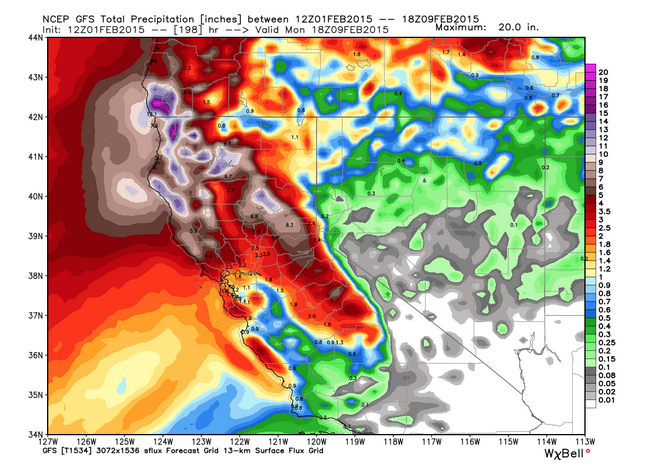
After receiving zero rainfall in the month of January the Bay Area is bracing for an atmospheric river event starting Thursday of this week. The SF NWS is “FORECASTING RAINFALL TOTALS OF NEARLY A FOOT IN THE NORTH BAY FROM THURSDAY THROUGH SUNDAY.”

Some weather models show the storm will reach as far south as Tulare County and SLO County with forecaster John Lindsey predicting wet weather Friday,Saturday and Sunday for SLO.


One model shows wet weather coming as far south as SLO click to enlarge
One model shows wet weather coming as far south as SLO
click to enlarge