Cheap gas for California: So far in the fourth quarter, California gasoline is the dog that hasn’t barked. Once predicted to command $1-$2/gal above CME RBOB, Los Angeles gasoline is trading for 6cts/gal UNDER January RBOB futures. Supportive of some $3.25/gal or lower pump prices. Oil Analyst Tom Kloza
The avian flu is devastating marine mammal populations. A new survey finds that nearly half of breeding females in the world’s largest population of southern elephant seals were killed by the virus.NPR notes that concerns about bird flu mostly focus on infected livestock and humans, but it’s also reached marine mammals in some of the world’s most remote areas. Of course elephant seals use the beaches of the Central Coast for birthing and mating.
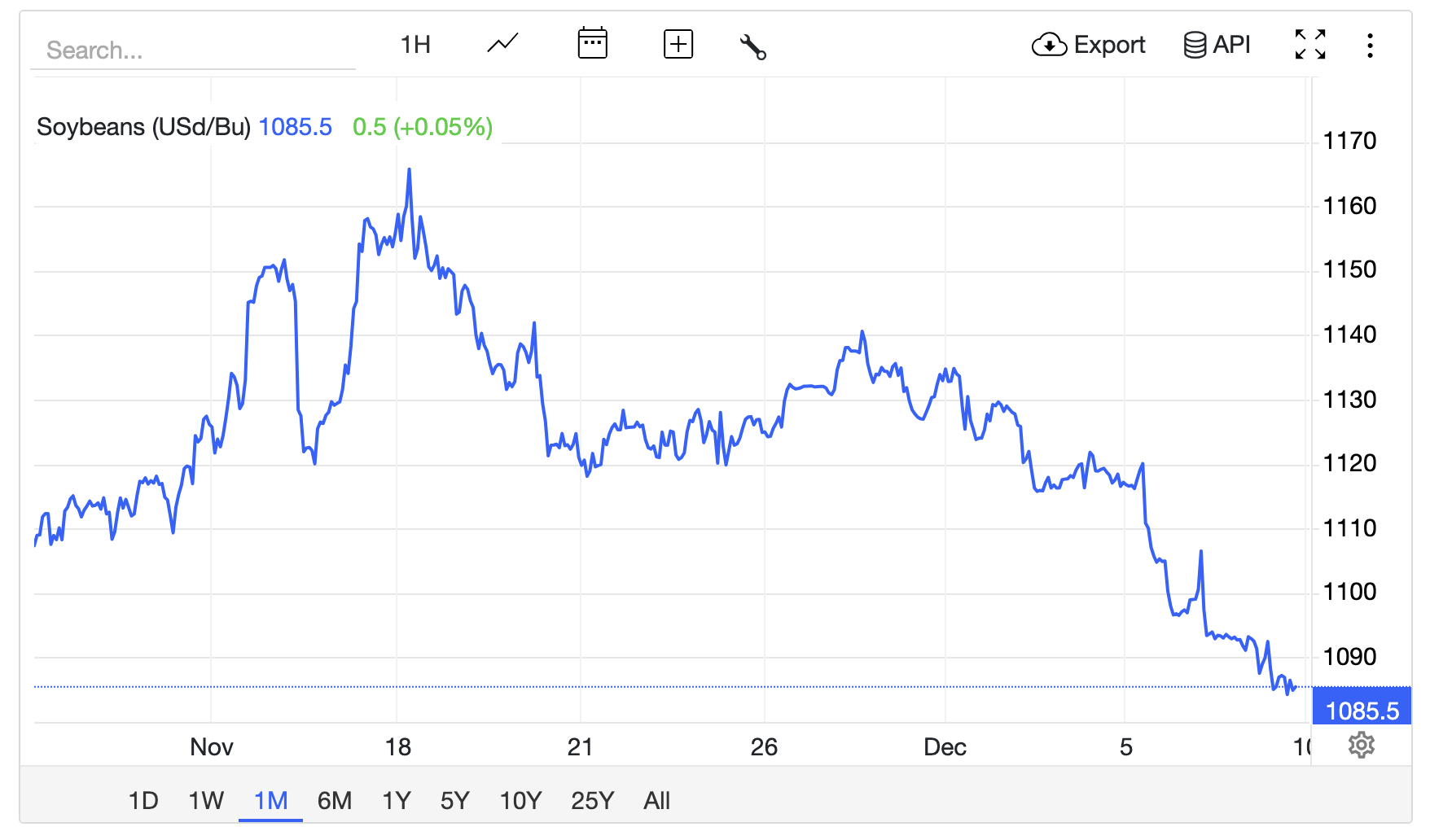
China is not buying our soybeans as fast as Mr. Trump had promised. So far they have purchased only 3,000,000 tons of a promised 12,000,000 tons by the end of this year. Now a Trump aide suggests that they won’t be buying the promised amount until “the end of the growing season.”Instead of doing sales, Trump is now offering a $11 million subsidy to help prop up the farm economy. Soybean futures have dropped nearly a dollar since mid February.
Closures:LA appliance store closes – blame tariffs?
Howard’s Appliance store closes 17 store LA chain. The appliance retailer is a 100% employee-owned company who suddenly closed this month said to have been impacted by tariffs.New tariffs imposed in mid-2025 on imported steel, aluminum, and finished appliances (like washing machines, refrigerators, and ovens) raised prices by an estimated 5-10% for consumers. Also Howard Miller clock and furniture company is closing permanently after 100 years selling off its inventory through early 2026 according to reports. The shutdown is attributed to tough economic factors like a struggling housing market, inflation, and tariffs, impacting their ability to remain sustainable. They are holding a going-out-of-business sale for their final products. Brazil-based JBS owned Swift Beef Co in Riverside CA is closing their plant laying off 372 workers according to a state WARN report. Another worn report filed this week says Palo Verde Hospital in Blythe California will close laying off 62 employees. The report says the closure is permanent.
Hot Rolled Steel fell to $904.03 daily but is up 6.73% in the past month and up 31.21% compared to the same time last year.HRS is used in Structural framing (I-beams, channels) for buildings and bridges, railroad tracks, vehicle frames, and heavy equipment and sheet metal, tubing, and parts requiring significant shaping.
U.S. coffee prices have hit record highs, with ground coffee prices up over 40% year-over-year in some instances.
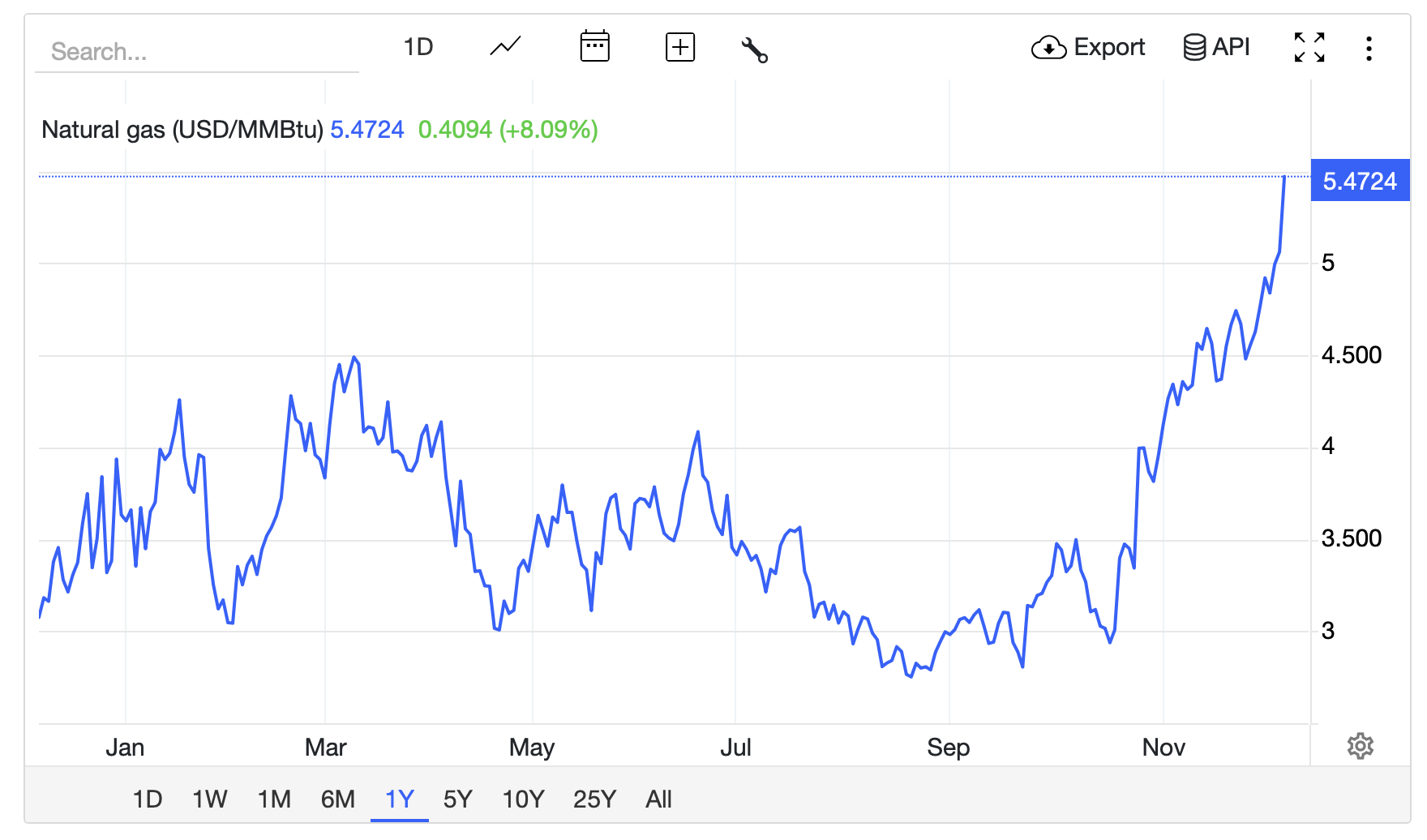
US natural gas futures were above the $5/MMBtu mark, hovering at three-year highs and soaring 70% since the lows from mid-October and up 78% since January amid a backdrop of soaring export demand and an expected cold winter.Natural gas prices affect electricity prices and is used to generates about 40% of US electricity.
Live Cattle rose to 226.20 USd/Lbs on December 5, 2025, up 2.14% from the previous day. Over the past month, Live Cattle’s price has risen 3.39%, and is up 20.82% compared to the same time last year.
Fertilizer Price Index is at a current level of 140.52, up from 139.55 last month and up from 119.72 one year ago.That ‘s up 17.37% from a year earlier
Spud farmers join many other ag commodities suffering from overproduction, high expenses
see related story in ag section
Farmers naturally pivot toward bountiful production if they have a choice. They tend to make too much of their product.But that can lead to oversupply. And low prices.
This month Idaho potato farmers are in this same leaky boat.
Idaho newspaper The Power County Press says that the state’s farmers net income fell 30% over the past two years according to USDA. “Farm input costs like fertilizer and seed hit record highs in 2024. Potato prices dropped from $6.54 to $4.40 per 100 pounds year over year. Revenue from hay, hops, barley, and wheat also declined sharply statewide.”
The North American Potato Grower Return Index “shows that Idaho farmers this year are receiving an average of $1.97 for each 100 pounds of potatoes they produce, after transportation and other expenses are factored in. That’s compared to $7.19 in 2024.” The article says the break-even point for Idaho potato farmers right now is about $9 per 100 pounds of potatoes they produce, said NAPM owner Ben Eborn- much less than what it costs to grow them.
Idaho now joins the club- the hurt club seen in the vast Midwest farm fields, among tractor dealers across the US and here in the orchards and vineyards of California. The Golden State has seen this play out in its top crops from almonds to grapes, cotton to walnuts where the supply has exceeded demand resulting in low prices and red ink Now our farms are reducing their acreage in search of profitability.
The best example of this is grapes – the second highest grossing crops grown in California. We produce 99% of the table grapes in the US. Also the state is the number one producer of wine in the United States and it is around Fresno where most raisins come from.
For years California growers expanded their acreage peaking in 2018/19 with about 925,000 acres planted including 635,000 acres of wine grapes. Since then farmers started pulling their vines due to low returns especially in wine grapes. As of this fall all grapes (table/raisin/wine) plantings are down to 710,000 acres – a decline of 215,000 acres from the peak. Wine grape farmers have been urged by industry leaders led by Allied Grape Growers to continue to pull acreage to right size the crop to meet reduce demand, now impacted by the inscrutable habits of a new generation that no longer favors wine (what’s wrong with the guys) and actually wants to reduce all alcohol.For 2026, Allied is urging farmers pull 50,000 more wine grape acres to about 500,000 which would be down 135,000 acres from 2019.
“There’s no doubt you should pull them out” urges a message by the industry group.But last year, Allied says grape growers reduced their acreage by only 20,000 acres as a result of new plantings that offset some of the total pulled. Farmers suffered when about 300,000 tons of California wine grapes went un-harvested in 2024 made worse by the fact that some wineries chose to import foreign concentrate instead of buying local product. Added to the misery in the Central Valley, both the raisin farmers and cherry growers had a lousy year.
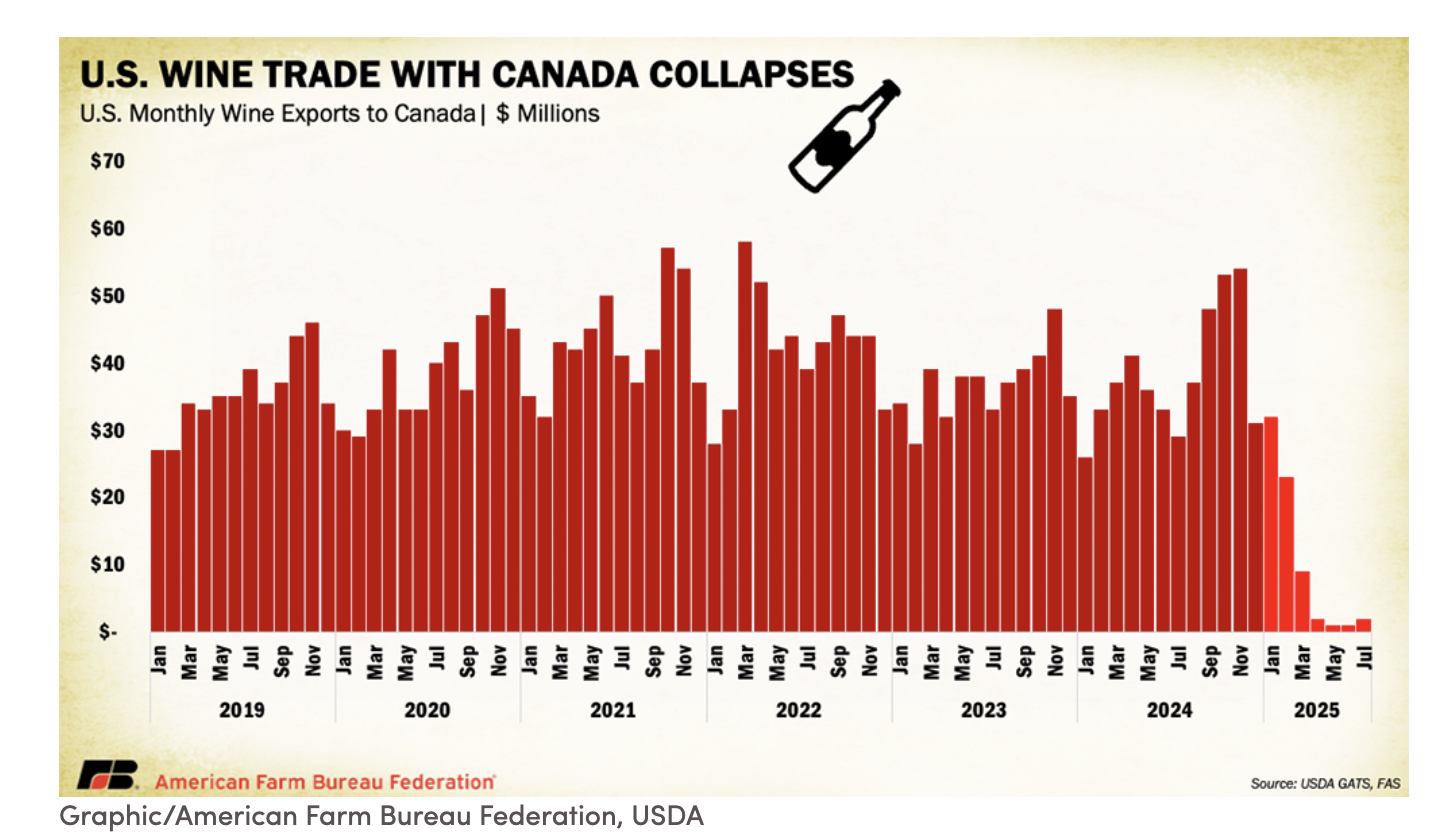
We haven’t even touched on the impact of President Trump’s tariffs on the wine industry, but the effect has been severe, particularly from the loss of a large export customer like Canada that has imposed a retaliatory tariff on liquor from the US.
Sometimes you feel like a nut
A similar trend has shaped the almond industry with farmers increasing their acreage year after year until the past few. In the year 2000 California had some 585,000 planted acres growing to 680,000 acres of almonds in 2005, 825,000 in 2020 and 1.6 million acres in 2020, the peak. Since then, the acreage has declined for four years in a row down to about 1.5 million acres currently. The new permanent plantings replaced annual field crop acreage like cotton and now require a dedicated water supply despite the huge variation in rainfall in California from the year to year. A field survey by Land IQ reports that around 51,805 acres of almond orchards will be removed at the end of this crop year adding to the nearly 67,000 acres removed during the 2023–24 period, based on Land IQ’s November 2024 estimate. These removals contribute to a broader trend of declining total and non-bearing acreage across the state over the past three years.The industry depends on exports that have been become embroiled in the trade war conflict.
The Farm Bureau reports the almond industry has been under financial stress. From 2019 to 2023, the average almond price declined to $1.81 per pound, down from $3.05 per pound during 2014–2018. Meanwhile, cost and return studies from the University of California show operating expenses increased roughly 40% between 2019 and 2024, while gross returns fell 36%, pushing net returns into negative territory. In the Sacramento Valley, net returns above total costs shifted from a modest $205 per acre gain in 2019 to a $4,280 per acre loss by 2024, leaving many operations unable to service debt or absorb high irrigation and input costs. During this period, an estimated 66,000 acres of almond orchards—about 5% of total growing area—were removed, as prolonged negative returns forced growers to idle or tear out orchards rather than continue producing at a loss.
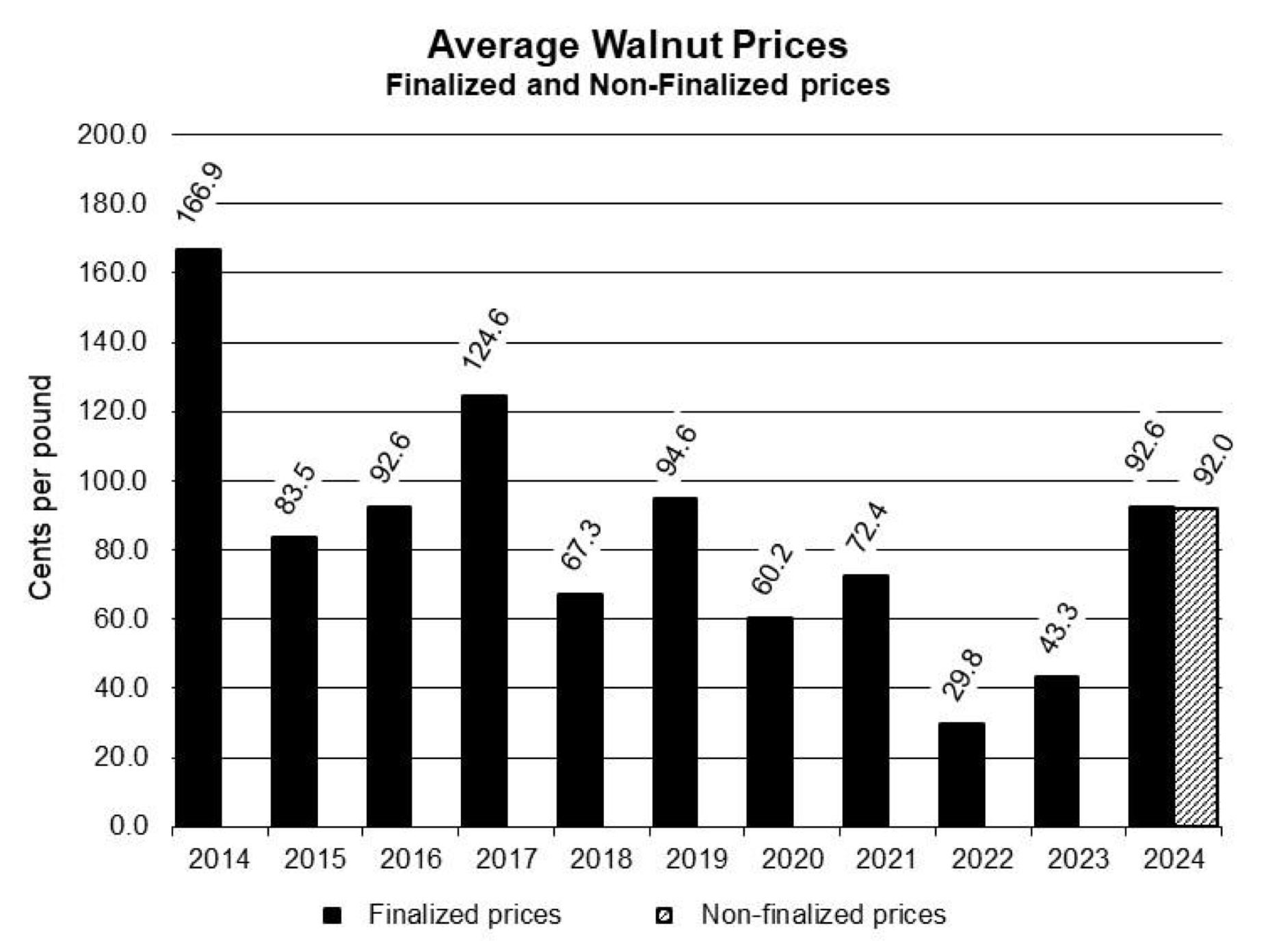
Another crop that has seen reduce acreage due to low prices are walnuts. Walnut farmers in 2022 receive just $.30 per pound for their crop rising to $.43 in 2023 and rising to $.92 in 2024. That’s still far lower than walnut prices a few years back. Farmers have reduced walnut acreage from about 441,000 acres in 2021 to about 370,000 acres today – a decline of 70,000 acres. The industry expects that they will be profitable although the export market continues to be a problem with India imposing a tariff of 30% on walnuts and in China, where the tariff is 60%.
Adding it up – between grapes, almonds and walnuts – farmers have reduced their excess plantings by 400,000 acres.With few other options available – what do you farm?
Adding it up – between grapes, almonds and walnuts – farmers have reduced their excess plantings by 400,000 acres.
Still another California crop under pressure or worse is cotton, According to the Farm Bureau,Roger Isom, CEO of the California Cotton Ginners and Growers Association, said cotton farmers face one of the worst markets in memory. In terms of acres planted and low demand, he said 2025 will be the second or third worst year on record since the CCGGA was founded in 1920.
“We (California) produce 90% of the nation’s pima cotton, and prices are stagnant,” Isom said. “Upland cotton is at 85 to 90 cents a pound right now. That’s the same darn price as when I started 30 years ago. It’s tough out there for our farmers.” Isom said the stagnant-at-best cotton market has also hurt the revenue streams of businesses that support farmers, such as trucking companies and cotton gins. For example, Fresno County was the top cotton-producing county in the United States 20 years ago and had 26 gins in operation to handle the harvest. Now, he said, Fresno County is not even in the top 150 cotton-producing counties and has just one gin.
“Ten thousand jobs just went away,” Isom said.
Meanwhile the states top crop -milk- is also under pressure in late 2025 suffering a huge decline in price based on oversupply- more cows- nationwide. Class 111 milk prices were $21 per cwt in January but now are around $16.90. Class IV milk was $20.70 in January but it dropped to $13.67 in December. Most of the milk marketed is in this class. Farmers have added more milk cows to their herd creating what is being called a “gush “of supply according to a recent market bulletin.California milk supply was up 6.9% in October.
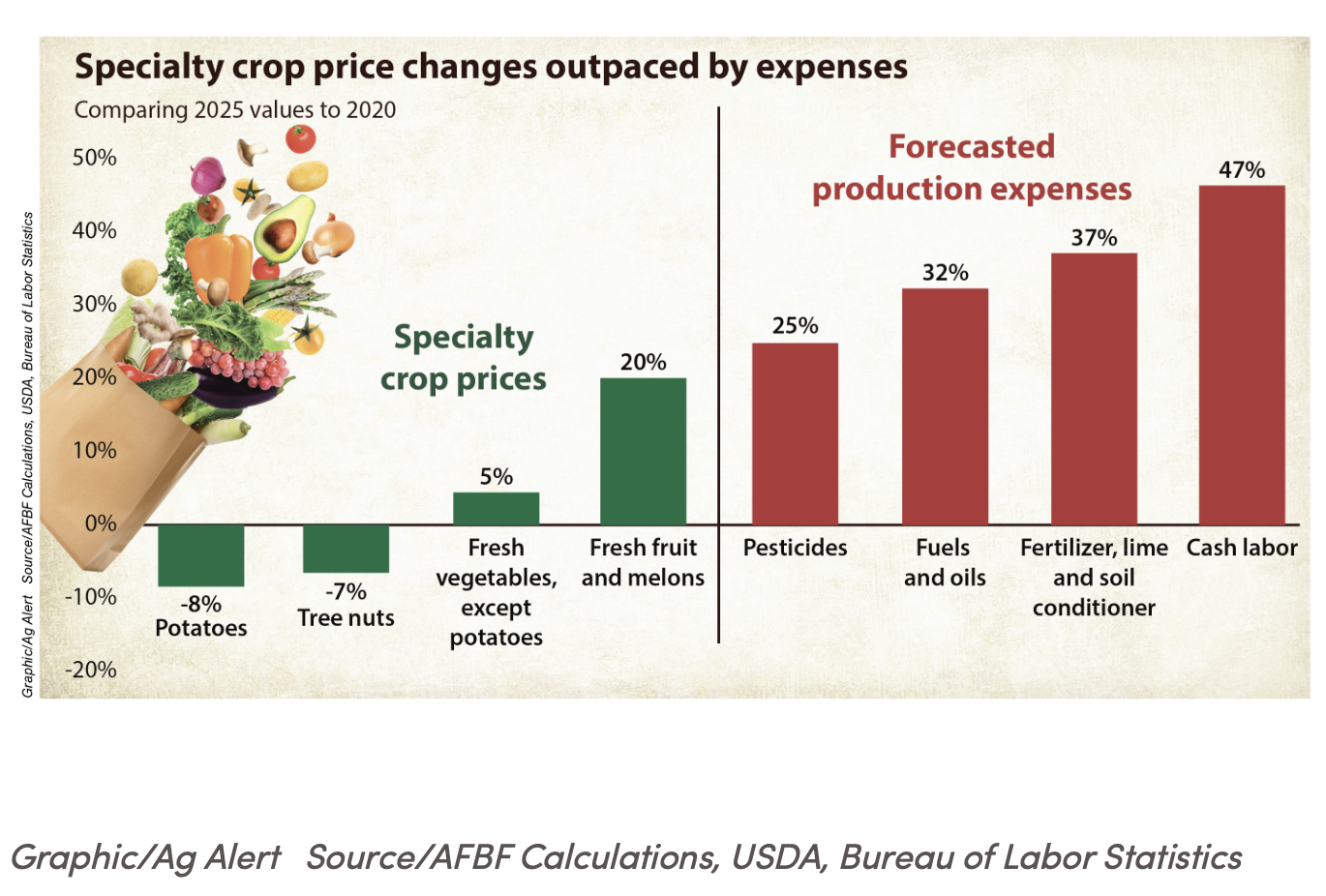
This week Ag Alert pointed to the low price for tree nuts but higher expenses for labor, fertilizer and pesticides. They added that potato prices are down as well.
Back on potatoes, the oversupply is impacted by other factors like increased harvest yields that can help boost supply without more acres allowing a grower to meet a contract on fewer acres.But the state’s farmers did over plant back in 2023 adding out 12% more acres. Now there is an oversupply.
Better yields tuned out well in processing tomatoes in California where the acreage has dropped from 300,000 acres in 1975 to 200,000 acres in 2025. But production has increased from about 7,000,000 tons to 11,000,000 tons in 2024. This is due to the fact that yield per acre has doubled even as water use has declined with the implementation of drip irrigation that has increased productivity. Farmers can make some money but only if they have a contract. Oversupply in this industry has still impacted a number of processors that have gone out of business in Central Valley in the past several years like Del Monte.
California Farm Bureau points out another factor- change in consumer preference that has affected the wine industry and now the craft beer business. And as everybody knows the in the potato industry more than half the spuds are these days frozen for fresh fries. Hey, did you know that none other than Thomas Jefferson was first to serve french fires in America offering them to guests at the White House.
An arson fire gutted the popular Downtown Visalia eatery Alejandra’s Mexican Restaurant in May 2022 shocking the owners and their large staff as well as the community.
Long wait
Now 42 months later, a long wait indeed, owner Roque Salinas says they will finally reopen as of Monday November 17 after the rebuilding of the family-owned restaurant known for its authentic Mexican cuisine including award-winning margaritas and their home-made salsa and chips.
Roque says the long wait came as the project was buried in technical issues that were finally resolved.Never give up hope.
Located just down the block from the Fox Theater at 314 W Main Street in Visalia the fire started in a dumpster behind the theater gutting businesses to the north including Alejandra’s Mexican Restaurant, Jimmy Johns Pizza, and Decor To Adore Visalia ca.
Owners Roque and Socorro Salinas launched their business in March 1993, in a small space in the strip center at Willis and Murray streets. Roque cooked and Socorro waited on tables. They moved to the current much larger 100-plus seat eatery in February 1996 as the city’s Downtown renaissance took off. Fans from all over Tulare and Kings Counties flocked here to savor the unique flavors dished up.The restaurant is named for Roque’s daughter.
Known for authentic Mexican food, specialties include pork dishes, fajitas, burritos, enchiladas, and chile verde.The remodeled place also features a full bar and patio dining.
Amazingly,” the whole kitchen staff is back and some of the front faces will be familiar” says Roque.
After American farmers biggest soybean customer did not buy beans this year they saw a glimmer of hope when President Trump met with the Chinese leaders a few weeks ago to try to work out a trade agreement.The situation is dire among Midwest soybean farmers considering that China purchased 54% of US grown soybeans last year for $13.2 billion but until now has purchased $0 US soybeans in 2025.Last month American Soybean Association President Caleb Ragland told Congress that “US agriculture is facing significant challenges. Commodity prices are down nearly 50%, and farm production costs continue to skyrocket. For soybean farmers, the loss of our largest export market due to trade retaliation by China has made financial problems even worse. High production cost and market losses mean soybean farmers are expected to face a loss of around $109 an acre for this year’s crop.”
So it was good news that after the meeting, the White House said China would purchase at least 12 million metric tons of U.S. soybeans in the last two months of 2025 and at least 25 million tons in each of the next three years. So far this year the US soybean industry has lost the Chinese market to competitors like Brazil and Argentina who despite the talks are cheaper than US-grown beans due to China’s retaliatory tariffs against Trump. Despite the positive signals, US soybeans still face a 13% tariff, compared with just 3% for Brazilian and Argentine supplies, limiting US price competitiveness, say reports.
Hopes fade with lack of sales
Fast forward to now- November 14 and news reports say USDA data “cast serious doubts about whether China will really buy millions of bushels of American soybeans like the Trump administration touted last month after a high-stakes meeting between President Donald Trump and Chinese leader Xi Jinping.The USDA report released after the government reopened showed only two Chinese purchases of American soybeans since the summit in South Korea that totaled 332,000 metric tons. That’s well short of the 12 million metric tons that Agriculture Secretary Brooke Rollins said China agreed to purchase by January and nowhere near the 25 million metric tons she said they would buy in each of the next three years.”
Reuters reported that “China is grappling with a glut of soybeans after months of record imports, curbing prospects for U.S. exports despite a recent trade truce that Washington said includes a pledge by Beijing to resume heavy purchases.”
Another report says “We don’t expect any demand from China to return to the U.S. market with this change,” said one trader at an international trading company. “Brazil is cheaper than the United States and even non-Chinese buyers are taking Brazilian cargoes.”CoBank’s Tanner Ehmke, lead economist for grains and oilseed, said there isn’t much incentive for China to buy from America right now because they have plenty of soybeans on hand that they have bought from Brazil and other South American countries this year, and the remaining tariffs ensure that U.S. soybeans remain more expensive than Brazilian beans.“We are still not even close to what has been advertised from the U.S. in terms of what the agreement would have been,” Ehmke said.Beijing has yet to confirm any detailed soybean purchase agreement but only that the two sides have reached “consensus” on expanding trade in farm products. Ehmke said that even if China did promise to buy American soybeans it may have only agreed to buy them if the price was attractive.”
All this uncertainty particularly impacts the Midwest and South where the soybean farms are clustered, arguably Trump country. Some 271 thousand U.S. farms raise soybeans. California produces many crops but no soybeans. Instead we import trainloads of both soybeans and corn for both animal feed and biodiesel blending into our diesel fuel.The big livestock industry and motorists here who use corn ethanol are customers.(California blends of ethanol will now go to 15% from 10%).
U.S. soybean futures recently reached their highest level since June 2024 on hopes for Chinese buying but the futures price has dropped this past week as hopes fade for relief and sales. The impact: One of the most important ag industries is joining other US commodities – a victim of the ongoing Trump trade war.
ProAg reports this week after the trade deal that “China’s state trader, COFCO, recently signed contracts worth over $10 billion to buy nearly 20 million tons of Brazilian soybeans and related products from major global traders, with no mention of U.S. goods. While some U.S. purchases have occurred as goodwill gestures, Beijing’s primary focus remains on Brazil.”
Meanwhile,China looks to be more self-sufficient and has built up its own soybean production, adding 9 million acres and increasing production by 8.6 million metric tons since 2015, according to the University of Arkansas System Division of Agriculture.
US farmers are looking at the calendar to plan their strategy for 2026 but lack of progress on sales to their biggest customer offers nothing but worry as their bins fill with this year’s harvest completed in October.
Soybean farmers had optimistically reasoned that China needs US soybeans for high-protein feed to sustain its massive hog population, which represents almost 60% of the global sow herd, and feed their large population hungry for protein. “Simply put, China needs soy, and the United States soy industry has depended on access to this market for decades.”
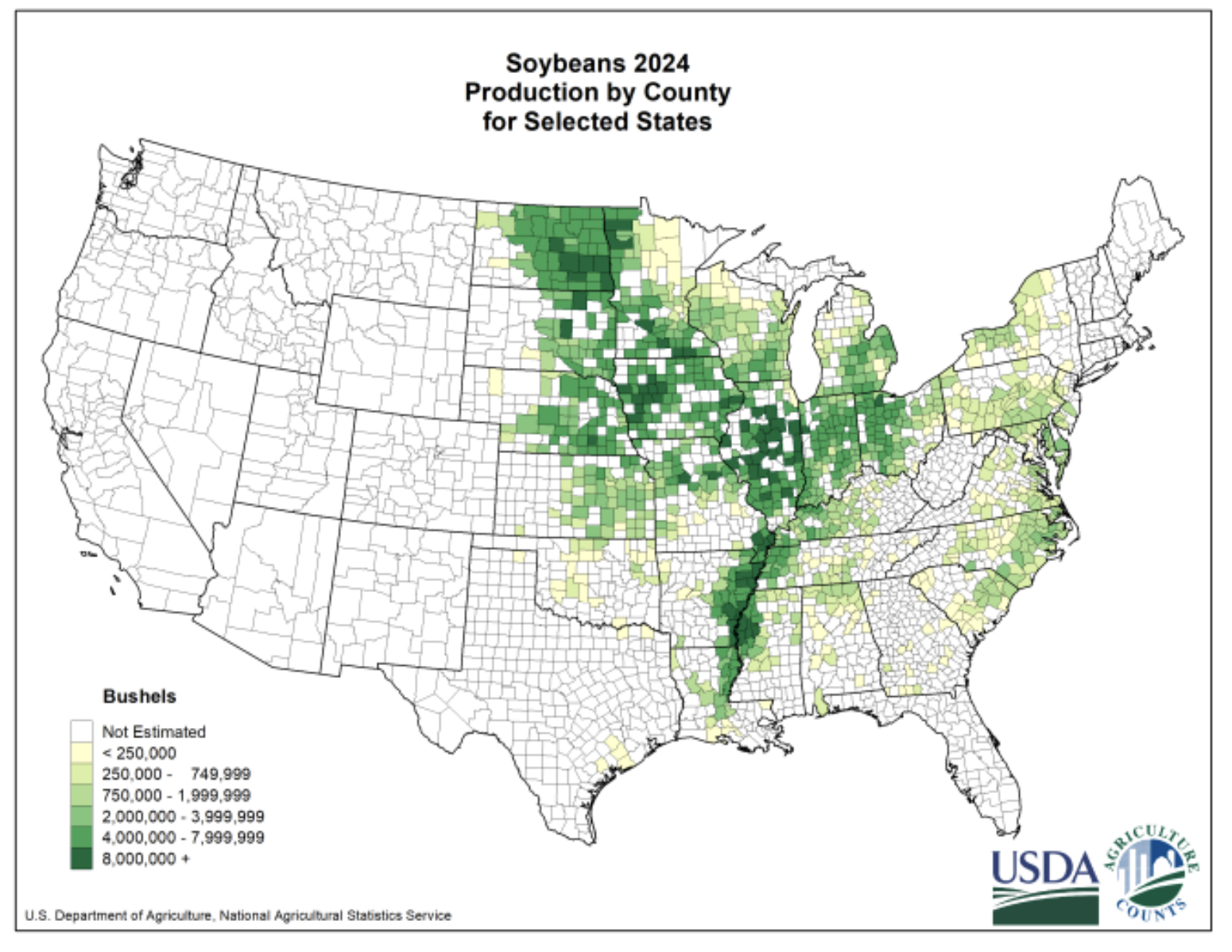
The bulk of Midwest soybeans where 80 percent of U.S. soybean acreage is concentrated – are exported to China, Canada and Mexico.
But China imported 71% of its soybeans from Brazil as of 2024, compared to 2% in the late ‘90s, according to the United States Department of Agriculture.Soybeans are a top food export for the U.S. making up 14% of the nation’s agricultural exports according to the U.S. Department of Agriculture. In 2024, China bought $12.5 billion of the $24.5 billion of soybeans the U.S. exported globally — more than 50% of U.S exports of the crop.
USDA report released
This past week USDA appeared to face reality in their long-awaited crop report. The agency trimmed its forecast for soybean exports in the 2025-26 crop year. USDA estimated there would be a 50-million-bushel reduction in 2025-26 U.S. exports, to 1.635 billion bushels, down 13% from 2024-25 – a 13-year low.
USDA also estimated that the 2024-25 Brazilian soybean crop was up 1.5% to a record 171.5 million metric tons or 6.3 billion bushels. In 2025-26, USDA expects Brazil’s crop to expand another 2% to 175 million tons.
With or without promised China sales, the US soybean industry must face the fact it needs new markets.The Center for Strategic and International Studies , a bipartisan, nonprofit policy research organization says “Even if China fulfills the reported purchase commitments, U.S. soybean exports to China in 2025 would reach only 18.2 million metric tons. This would constitute a 32 percent decline since 2024—when annual exports reached 26.8 million metric tons—and would make 2025 the worst year for U.S. soybean sales to China since 2018.
In the past five years, China’s share of U.S. soybean exports has remained roughly unchanged at about 53 percent. Unless the U.S. soybean industry diversifies into other markets, it will remain exposed to coercive Chinese economic statecraft in the future.”
The trade dispute with China has led to a surplus of soybeans that fill silos, forcing farmers to store their crops rather than sell at a loss, notes Bloomberg
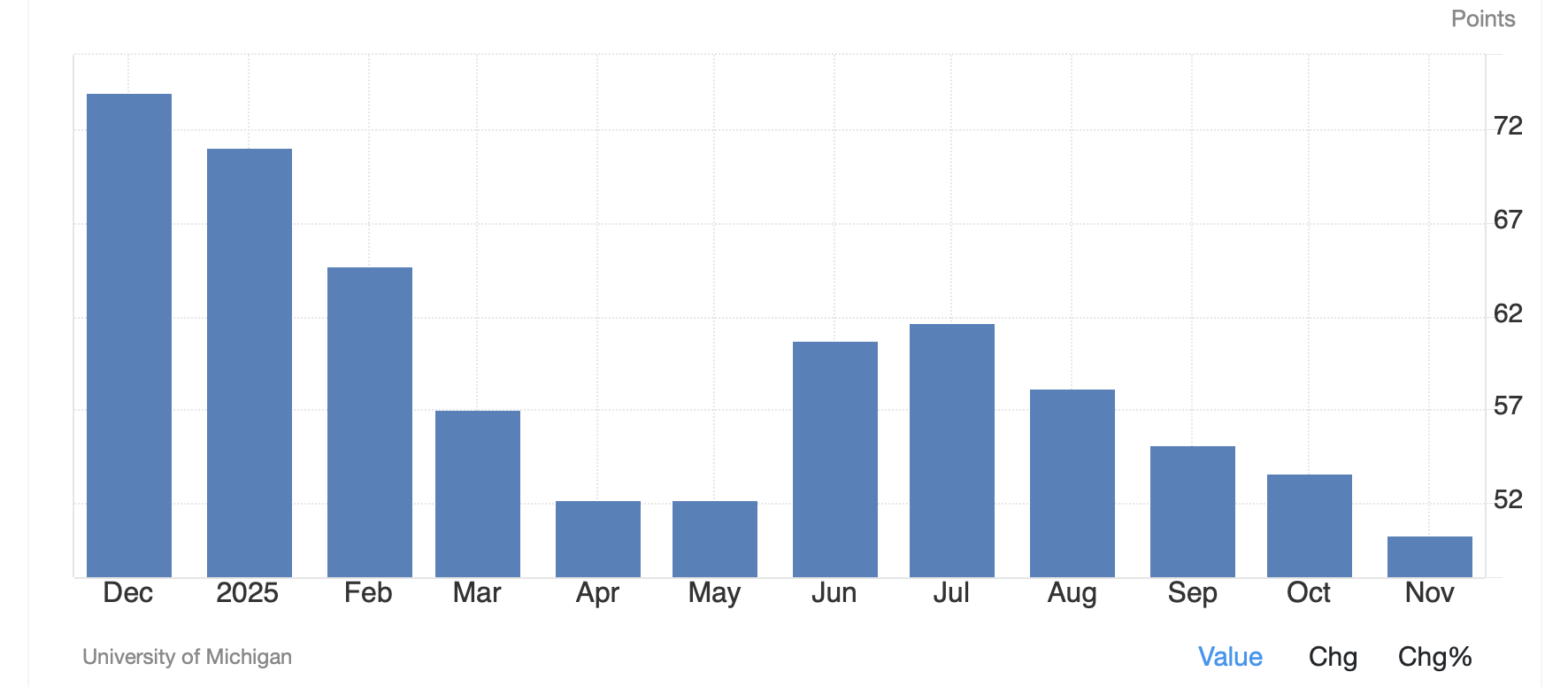
The University of Michigan’s consumer sentiment index fell to 50.3 in November, down from 53.6 in October and below expectations of 53.2, a preliminary estimate showed. The reading marked the second-lowest on record, just above the June 2022 low, as Americans grew increasingly concerned about the potential economic fallout from the longest US government shutdown in history. The Current Economic Conditions Index fell to an all-time low of 52.3, driven by a 17% drop in assessments of current personal finances, while the Consumer Expectations Index slipped to a six-month low of 49.0, reflecting an 11% decline in year-ahead business expectations. Sentiment weakened broadly across age, income, and political groups, with one exception: households in the top third of stock ownership reported an 11% rise in confidence, supported by stock market strength. Inflation expectations were mixed: year-ahead inflation inched up to 4.7% from 4.6%, while long-term expectations eased to 3.6% from 3.9%. source: University of Michigan
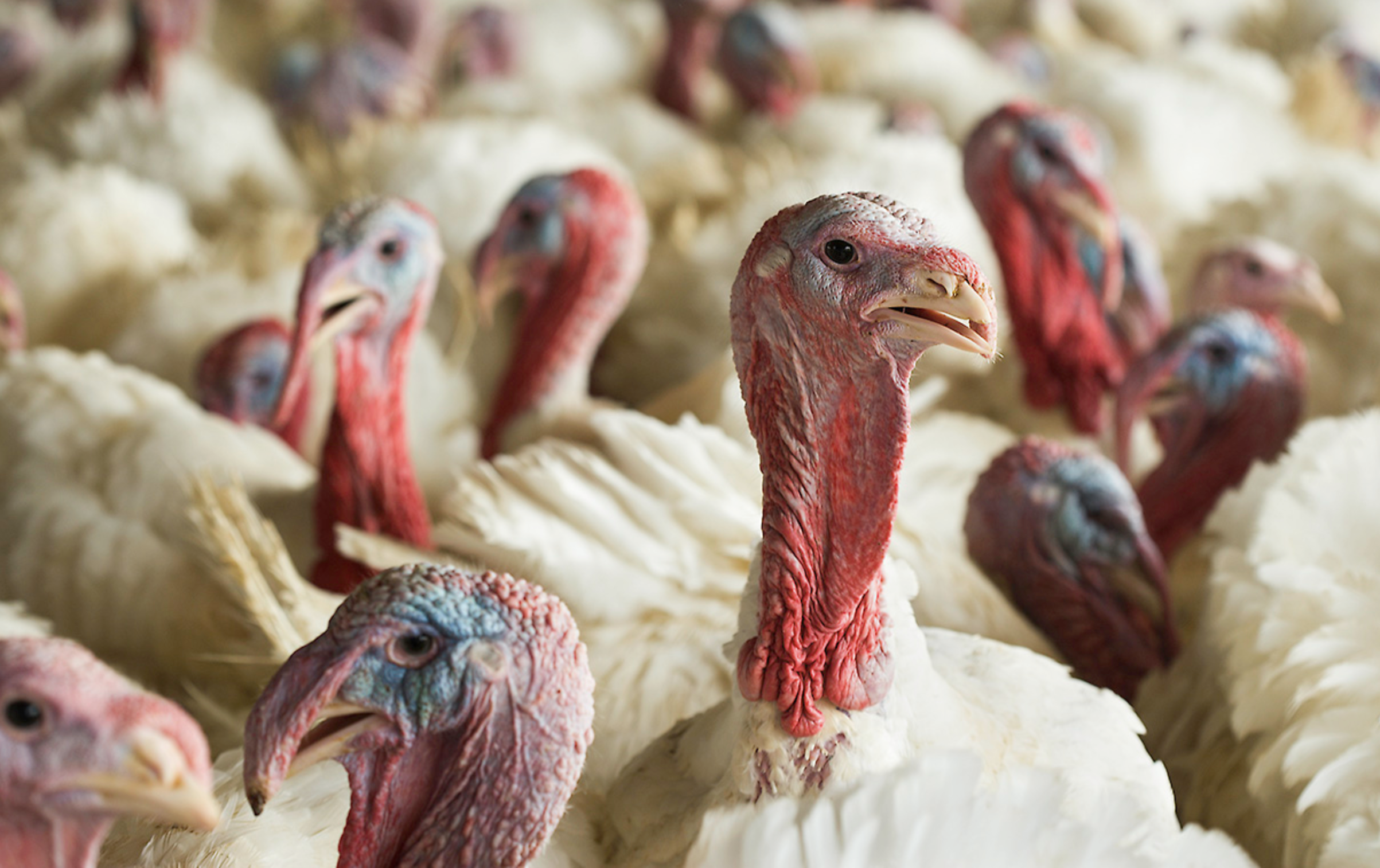
Good luck finding a California turkey this year. Poultry Federation president Bill Mattos tells the Farm Bureau that in the past year California lost top producer Foster Farms who left the turkey business and Sanger-based Pitman Farms moving most of their turkey operations to Utah after avian influenza devastated the state poultry industry last year.
The state’s turkey flock dropped from 6 million birds to just 2 million, says Mattos. California once housed 33 million turkeys.
And bird flu is on the march again this year, notes Mattos. Just this month two California poultry flocks have been hit in recent days in Sonoma County.Also California Department of Fish and Wildlife have confirmed two cases of avian flu in infected Canada geese at Cameron Park Lake in El Dorado County This is time of year for the annual bird migration.
As for California turkeys this year Mattos suggests consumers can probably find a specialty turkey particularly organic in your supermarket, but most consumers will be buying an out of state bird this year.
If you aren’t eating turkey you’re having to dig deeper to afford ground beef. Dollar sales of retail ground beef grew by double digits in August up 13% year over year to $1.7 billion according to consumer tracking firm Circana. Consumers might complain, but dairy folk aren’t since beef sales are an important contributor to their incomes.
California home sales are up for a change. After five consecutive months of year-over-year declines, September home sales activity climbed 5 percent from the 264,240 homes sold in August and rose 6.6 percent from a year ago, when 260,340 homes were sold, says the California Association of Realtors. September marked the 36th straight month in which the seasonally adjusted sales rate remained below the 300,000 benchmark.
At the county level, 40 of the 53 counties tracked by C.A.R. recorded year-over-year sales gains in September, with more than half (25) of those counties achieving double-digit growth. Kings County (46.3 percent) led the way with the highest sales growth from the last year, followed by Calaveras (42 percent) and Santa Cruz (37.9 percent). Tulare County reported a 23% increase in sales.
LAX passenger traffic was down 6.4% in September as both domestic and international arrivals declined.Air cargo also fell by 6% and is down 9% year to date.
Los Angeles port activity was down in September with both Long Beach and the Port of LA reporting declines in cargo volume compared to the same months last year.
“As we’ve reported for the last few months, imports continued to outweigh American exports by a four-to-one ratio. This data reflects the real impact that ongoing trade negotiations are having on our agriculture sector,” Port of Los Angeles Executive Director Gene Seroka said.
“As trade policy unfolds, we can only predict more unpredictability,” Seroka said in a statement. “When sweeping changes were first announced, importers abruptly stopped their orders from China. When those policies were softened and deadlines extended, cargo volume picked up again. The supply chain has been on a roller coaster all year and that ride continues he says.
Softening consumer demand and rising prices driven by shifting trade policies led to a decline in cargo containers moved through the Port of Long Beach in September.
Dockworkers and terminal operators moved 797,537 twenty-foot equivalent units (TEUs) of cargo containers last month, down 3.9% from September 2024. Imports decreased 6.9% to 388,084 TEUs and exports declined 3.6% to 85,081 TEUs. Empty containers moving through the Port inched up by 161 containers to 324,372 TEUs.
“Tariffs are impacting how consumers and business owners make financial decisions and purchases,” said Port of Long Beach CEO Mario Cordero.
Tulare Lake farmers lose round in court over groundwater pumping: Courthouse news reports that the State Water Resources Control Board can regulate groundwater usage by farmers in Kings County, after the state’s appellate court threw out a preliminary injunction and overruled a demurrer.
The pair of rulings means that farmers in the county will have to start metering and reporting how much water they draw from the ground, and pay the state fees of $300 per well and $20 per acre-foot of water used.
A spokesperson for the State Water Resources Control Board applauded the ruling, saying in a written statement that it would “allow the board to resume the important work of achieving sustainable groundwater management in the Tulare Lake subbasin while trial court proceedings continue.”
Dusty Ference, the executive director of the Kings County Farm Bureau, a nonprofit advocacy group representing farmers in the area that sued the state agency, said the group remains optimistic.
“The appellate court left standing our central arguments, including that the state overstepped its Sustainable Groundwater Management Act authority and imposed requirements without following proper process,” Ference said in a statement. “We look forward to having those claims fully heard in the trial court.”
The Farm Bureau did notch one important consolation win. The State Board had asked the court, if the injunction was thrown out, to order the Farm Bureau to pay $7 million in lost fees. The judge rejected that argument, writing that the State Board did not need those funds to proceed with its groundwater program.
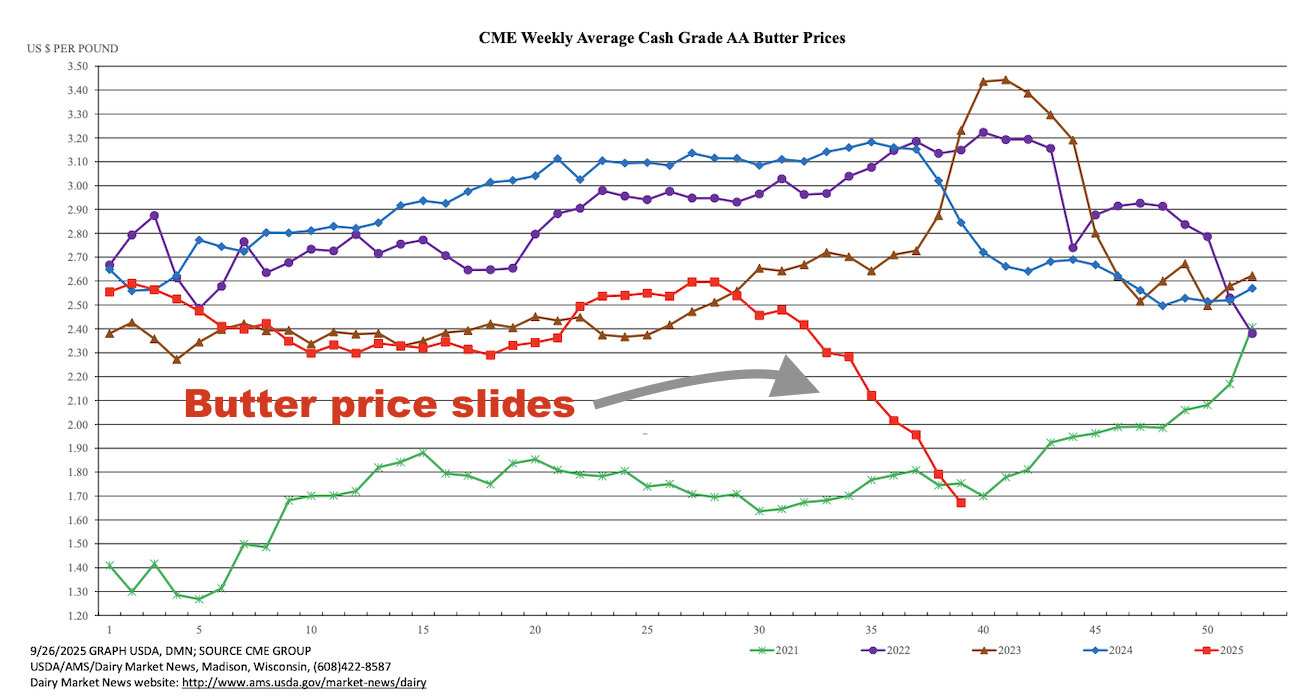
Butter prices started heading south in July this year (red on chart)
Butter prices have dropped to a multi-year low – around $1.80 a pound in September – well below the $2 historical threshold.The Daily Dairy Report notes that the $2.00-per-pound butter price compares to the annual CME butter price average of $2.8645 per pound in 2024, $2.5938 per pound in 2023, and $2.8596 per pound in 2022.
By the way, a recent government report says in 2024 farmers received 57 percent of what consumers paid for butter. Consumers typically pay around double what the farmer gets.
More cows
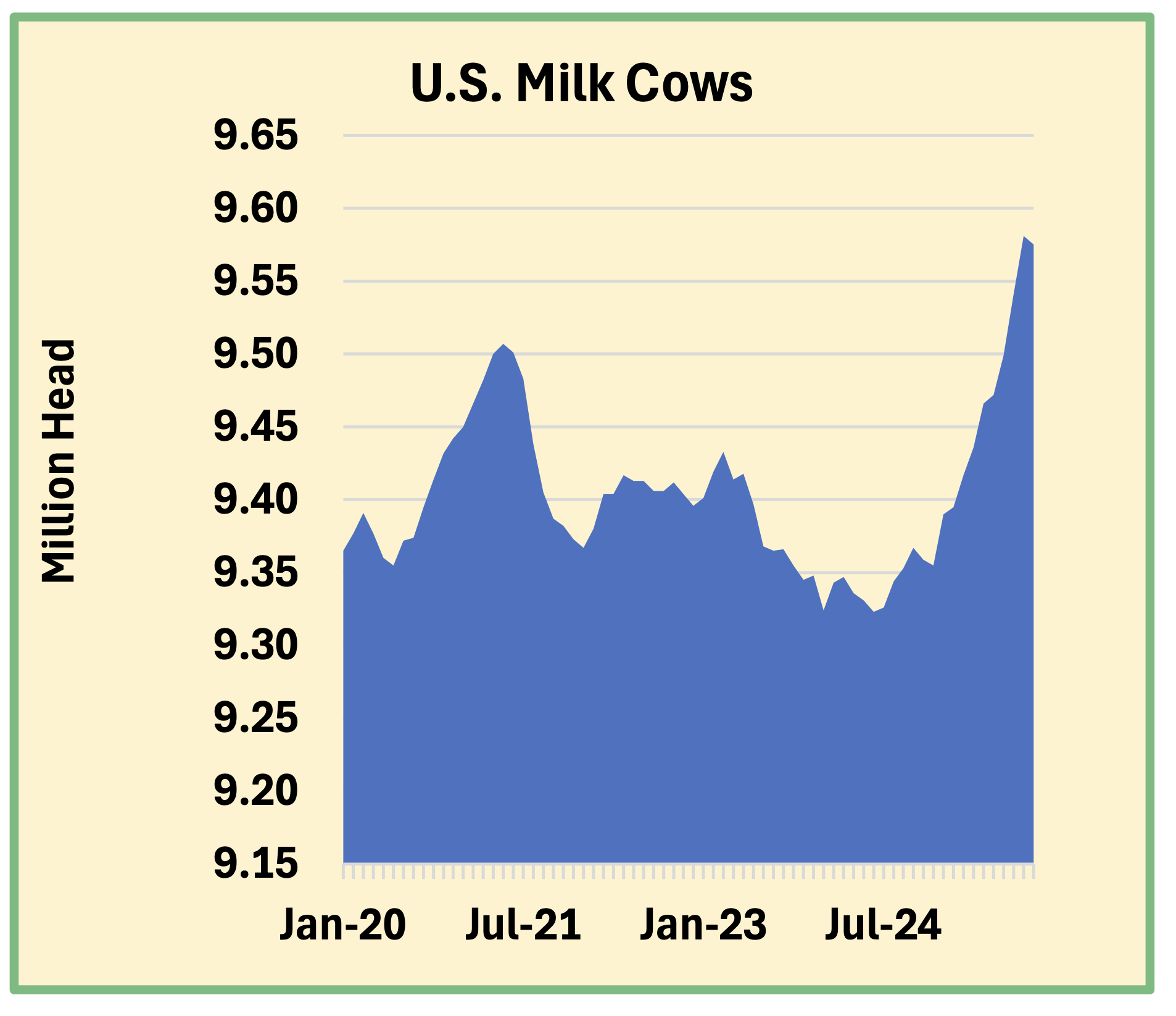
This last week’s Milk Producers Council newsletter writes that”Milk is absolutely gushing out of the U.S. dairy industry. Milk production reached 19.52 billion pounds in August, up 3.2% from a year ago. USDA revised its estimate of July milk output and cow numbers upward significantly. The agency now reports that dairy producers added 35,000 cows in July and another 10,000 head in August. That put the August milk-cow herd at 9.52 million head, larger thanat any time since late 1993 and up 176,000 head from a year ago.
The output is helping to reduce this fall’s milk checks for farmers. “Record-setting component levels continue to supercharge the growth in milk output. With 3.2% more milk, U.S. cows made 5% more butterfat.”
It’s not just butter but most milk-based products that are heading south.” The October Class III (think cheese) contract slumped 38ȼ to $16.80 per cwt., with similar losses and prices into early 2026. October Class IV (butter- powder) futures plummeted 60ȼ to $14.75. When October milk checks arrive in about six weeks, dairy producers who are exposed to the Class IV markets are sure to be disappointed.”
Dairy profitability depends on an average milk price at least in the high teens. In Kings County the average price in the annual crop report for milk was $26 per cwt in 2022,$19.30 in 2023,$19.10 in 2021 and $18.60 in 2020 (think Covid).
USDA has weighed in predicting the average price of milk will be about $1 lower in 2026 than this year.
Cattle Prices Set Record Highs
USDA says the August price for slaughter steers in the 5-area marketing region set a new monthly average record at $243.14 per hundredweight (cwt), which was $6 higher than July and almost $54 above August last year. In early September, weekly cattle and wholesale prices softened from the daily highs set in late August but remain historically elevated. As a result, the third-quarter price forecast for slaughter steers is raised by $2 to $240.00 per cwt and the fourth quarter is raised $4 to $244.00 per cwt. With that price strength being carried into 2026, the forecast for the annual price is raised $5 to $248.50.
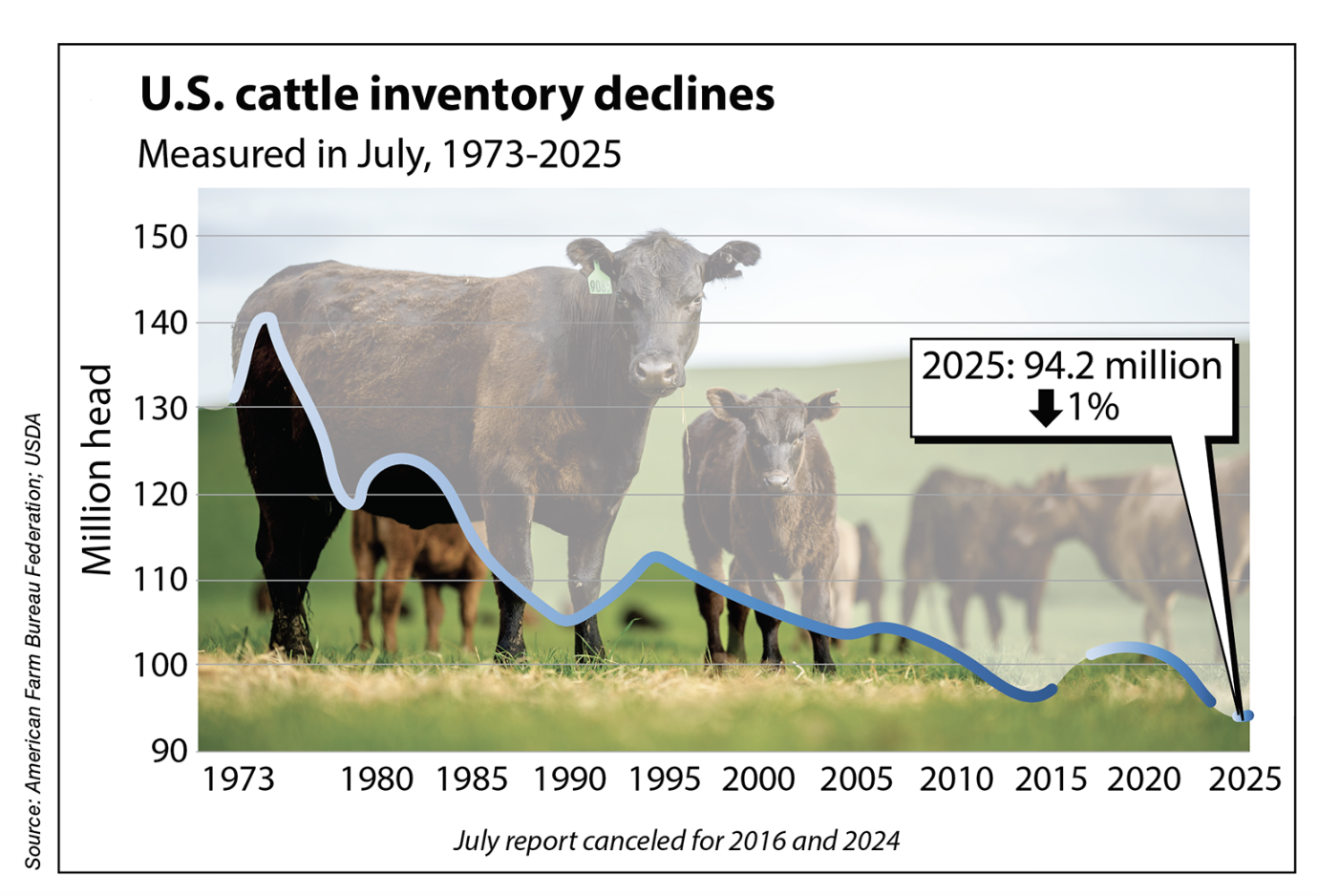
Cattle prices are at record highs due to a low national cattle inventory after years of drought. Meanwhile there is strong consumer demand for beef and higher production costs. This summer shoppers are paying $6.25 per pound for ground beef.
Beef Exports down
USDA reports that U.S. beef exports in July totaled 211 million pounds, 19 percent lower than a year ago largely due to current trade disputes. Monthly exports to the top six markets were lower year over year except for South Korea, which were up 15 percent year over year. Exports to China were down 94 percent while exports to Taiwan were nearly 26 percent lower year over year. Exports to Mexico were 17 percent lower than July 2024.
Several reports are detailing an increase in beef prices for American consumers this year driven by a shrinking supply in the nation’s cattle herd.
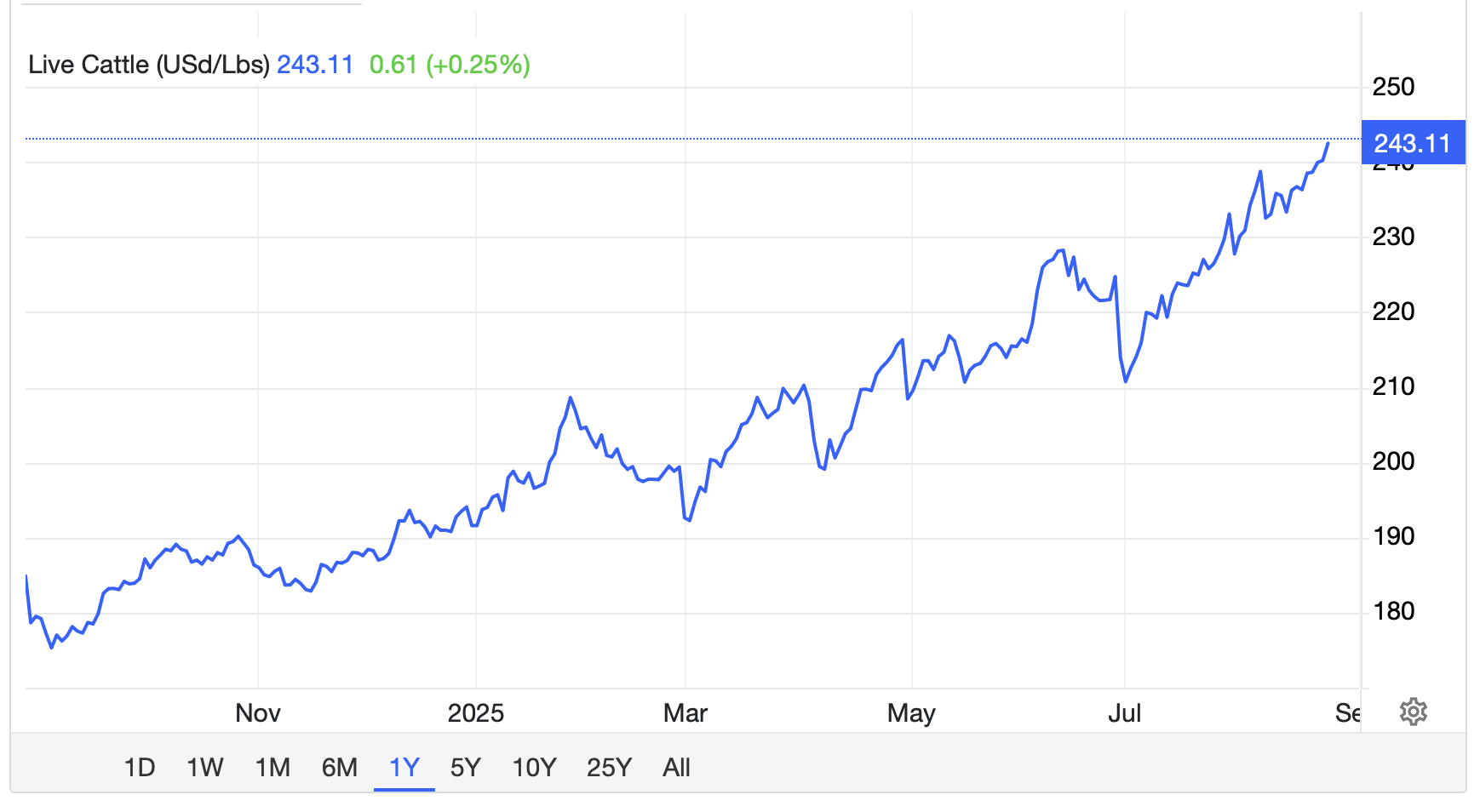
Here is a futures price chart for beef thanks to Trading Economics showing prices up about 25% in one year.
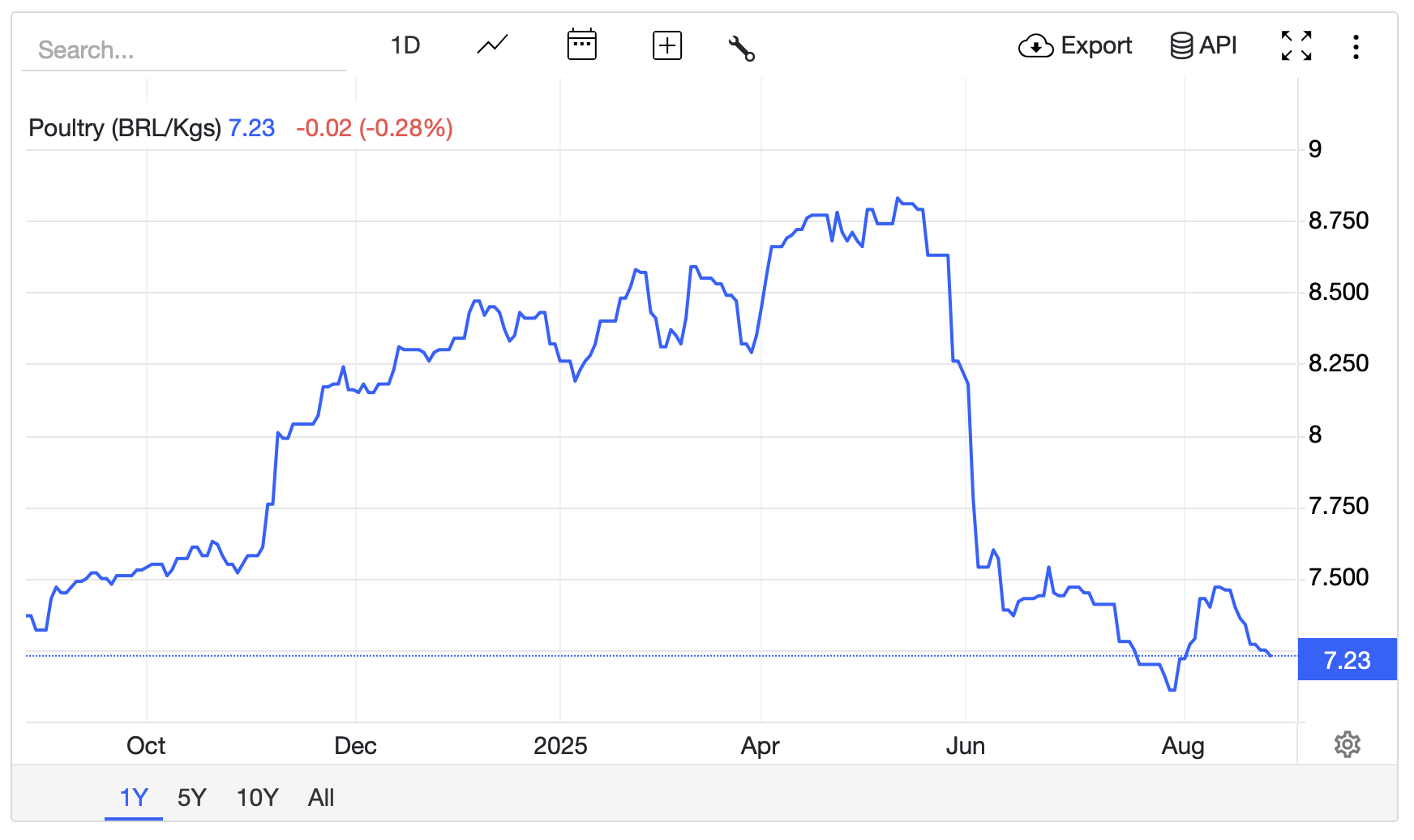
Given the high price for beef. more shoppers are likely to turn to chicken for their protein choice. Here is a contrasting one year chart for poultry prices, showing an actual decline over the past year.
Imported fish and shellfish account for 85 percent of seafood consumed here and now tariffs will hit our biggest import partners and you – in the wallet.The US imported $25 billion worth of seafood in 2024, led by Canada, 14 percent of imports; Chile,13 percent; India, 10 percent, and Indonesia and Vietnam, 8 percent each.Then there is China. We imported 769 million pounds of seafood from China in 2024.Chinese seafood now faces a 55% overall tariff rate in the U.S.
Two large seafood exporters to the U.S. market are India and Vietnam. India’s shrimp industry gets half its revenue from the US with countervailing and anti-dumping duties already imposed and a 25% tariff in place. Vietnam now faces tariffs of 15-20%.
Canada now has a 25% tariff. The United States imported 153 million pounds of farmed Atlantic salmon from Canada in 2024. The US is Canada’s largest export market for these products. In 2019, Canada’s fish and seafood exports to the US were valued at $4.56 billion, representing 61% of Canada’s total fish and seafood exports. Lobster, crab, and salmon are the top three species exported from Canada to the US.
The Indonesian shrimp industry, facing a 19% US tariff, could see a drop of 30% this year with the livelihood of one million workers impacted, say reports. The country is now scrambling to sell shrimp to China with a delegation visiting that country.
Brazil now faces high 50% US tariffs having exported 55% of its fish products to the U.S. The price of Brazil’s imported coffee and orange juice will also be impacted. Brazil produces 37% of the world’s coffee and 75% of all exported OJ.
Not everyone will be complaining about tariffs on foreign shrimp with the shrimp boats off the Gulf Coast hoping they can make a comeback like Forrest Gump did in the movie. One news article says Savannah restaurants serve foreign shrimp rather than shrimp caught off their own coast. Foreign shrimp can sell for $5 a pound but wild caught Georgia shrimp can cost more than $15 a pound.
Fresh shrimp is still one of the most popular seafoods in the US – the most consumed seafood at 4.6 pounds per person.
For restaurants shrimp deals are long gone. Last fall the CEO at Red Lobster quipped ‘I know how to do math’ announcing their “Endless Shrimp” deal is not coming back.
SeafoodSource says “U.S. consumers paid more for seafood – and food overall – at retail stores in July, according to new data but the increases didn’t dent fresh sales volumes. Fresh seafood prices increased 1.5 percent year over year at U.S. retail in the month, according to Lakeland, Florida, U.S.A.-based 210 Analytics, which analyzes data from market research firm Circana.
Within the category, fresh crab had the largest price increase, jumping 10.6 percent compared to the same month in 2024. Fresh shrimp rose 4 percent, and fresh finfish prices increased 0.5 percent.
Fresh salmon prices rose by 1.4 percent year over year and remain “substantially higher” than frozen salmon, according to 210 Analytics Principal Anne-Marie Roerink.
Sales by value of fresh seafood jumped 3.6 percent in July to USD 687 million (EUR 588 million). Sales by volume, despite the inflation, still grew 2.1 percent. “
California salmon fishermen got some limited goods news coming this September with plans to reopen ocean waters off California to recreational salmon fishing for the first time since 2022. That’s good news since if you want salmon, you may have to catch it yourself!
However, the recommendation from the Pacific Fishery Management Council includes keeping California’s commercial salmon fisheries closed for the third year in a row in an attempt to rebuild populations.
Canada and Norway send fresh salmon here but now face tariffs.Norway has a 15% tariff and Canada 25%.Canada’s fish and seafood exports totaled $7.6 billion in 2023, with about $5 billion worth going to the United States.
Salmon lovers who want US-supplied fresh product may now have to depend on Alaska. But it’s been tough going for this industry.
Last fall NOAA reported that the Alaska seafood industry “suffered an $1.8 billion loss (2022-2023). The Alaska fishing industry saw a 50 percent decline in profitability (2021-2023).
The Alaska seafood industry is a major contributor to the U.S. seafood sector,” said Robert Foy, director of the Alaska Fisheries Science Center. “The social and economic ramifications of Alaska’s losses have reverberated down the West Coast and across the country.
This has resulted in more than 38,000 job losses nationwide and a $4.3 billion loss in total U.S. output (the total dollar value of all goods and services produced). The most affected states (including Alaska, Washington, Oregon, and California) saw a combined loss of $191 million in state and local tax revenues.”