Called Amazon Fresh and Go grocery stores, more than 20 located mostly in S California urban areas will close permanently, says the company this week. These are all their stores in the state.
Some of the Fresh and Go stores will be converted into Whole Foods locations, says the company. Amazon said this week it plans to open more than 100 new Whole Foods Market stores over the next few years.
WARN notices have been posted announcing the pending closures showing store locations as follows.All sores would close April 28 says the WARN notice.
Cerritos: 11340 South St, Cerritos Citrus Heights: 5425 Sunrise Blvd, Citrus Heights Corona: 3941 Bedford Canyon Rd, Corona Encino: 16325 Ventura Blvd, Encino Elk Grove: 7530 Elk Grove Blvd, Elk Grove Fontana: 16188 South Highland Drive, Fontana Fountain Valley: 18100 Brookhurst St, Fountain Valley Fullerton: 1100 S Harbor Blvd, Fullerton Huntington Beach: 6911 Warner Ave, Huntington Beach Irvine: 13672 Jamboree Rd, Irvine Ladera Heights: 6855 S La Cienega Blvd, Los Angeles Long Beach: 6235 E Spring St, Long Beach Moorpark: 742 Los Angeles Ave, Moorpark Murrieta: 40485 Murrieta Hot Springs Rd, Murrieta North Hollywood: 5101 Lankershim Blvd, North Hollywood Northridge: 19340 Rinaldi St Pasadena: 3425 E Colorado Blvd Poway: 14837 Pomerado Rd. Roseville: 6780 Stanford Ranch Road, Roseville, Torrance : 21035 Hawthorne Blvd. Woodland Hills: 6245 Topanga Canyon Blvd, Woodland Hills Upland: 235 E Foothill Blvd, Upland
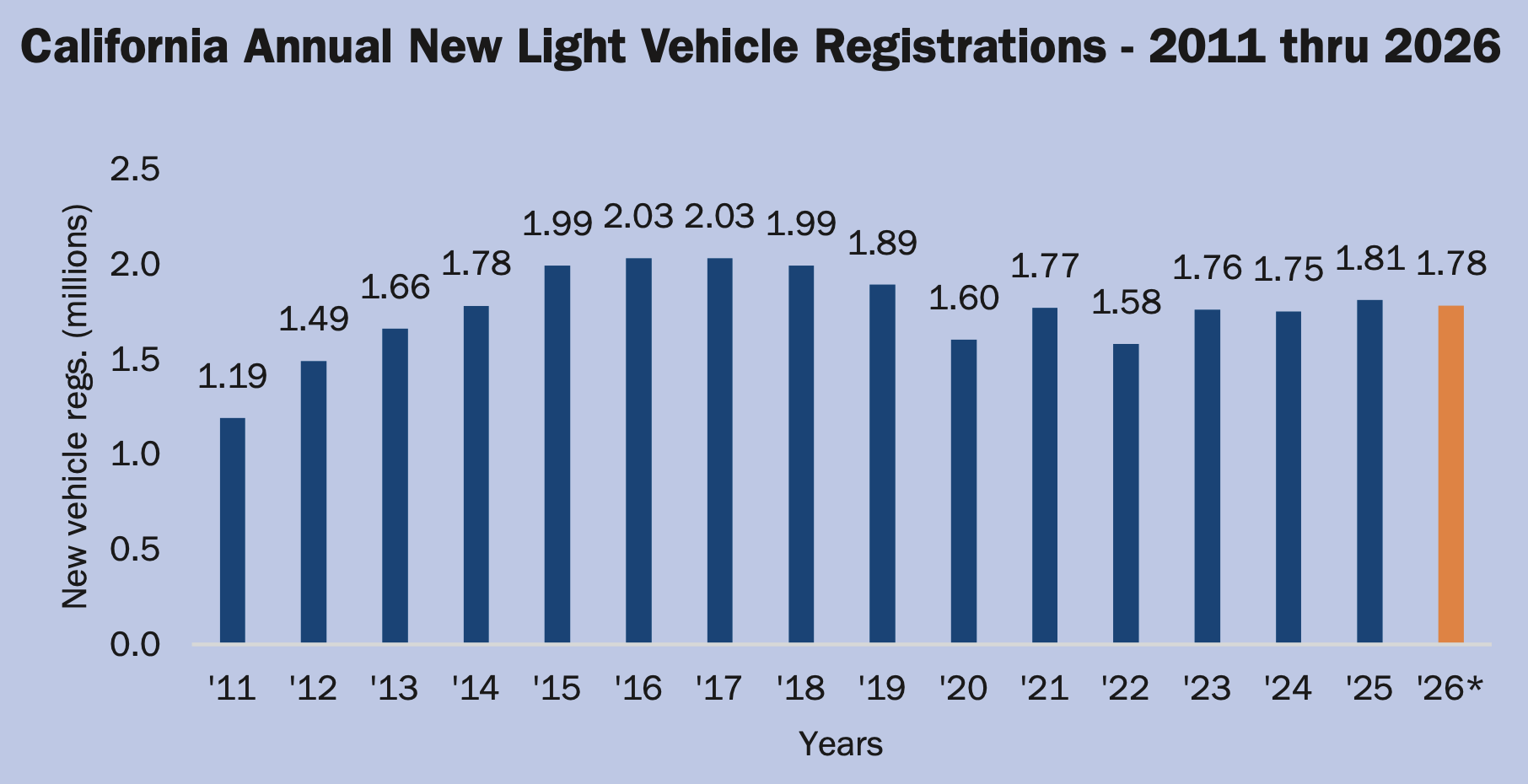
California new light vehicle registrations increased 3.3 percent from 2024 to 2025, slightly below the 4.2 percent improvement in the nation, says the annual report from the California New Car Dealers Association. As expected, the market declined in the fourth quarter, with registrations falling 1.9 percent versus the year earlier. Likewise in 2026 California new vehicle registrations are predicted to decline slightly, predicts the report.
Sticker shock
Transaction prices nearing $50,000 are making new vehicle purchases a stretch for many consumers.
Additionally, tariffs will almost certainly lead to rising vehicle prices, the labor market is weakening, and household incomes are barely keeping pace with inflation, says the report.
However, the news isn’t entirely bleak. The average age of vehicles on the road is at a record high, partly due to postponed purchases since the pandemic. This resulting pent-up demand, coupled with the prospects of lower interest rates, should limit any potential decline in sales in 2026.
New vehicle registrations this year are predicted to slip below 1.8 million units and fall 1.5 percent from 2025.
ZEV sales declined sharply at the end of 2025.
New registrations of zero emission vehicles headed lower during the last few months of 2025 due to the expiration of federal government tax credits. ZEV share of the new vehicle market was 22.2 percent during the first ten months of 2025 and declined to just 12.8 percent in November and December.California’s share of total U.S. ZEV registrations in 2025 was 28.5 percent. Hybrid registrations increased 36 percent last year, and market share reached 19.4 percent, up more than ten percentage points versus points three years earlier.
Notably, hybrid sales slightly outpaced ZEV sales in Q4 alone, capturing 20.4 percent of the market, reflecting sustained consumer interest in lower-emission options that do not require installation of charging infrastructure or major lifestyle changes.
Gas-powered vehicles remained the single largest segment of the market, accounting for more than half of all new vehicle registrations in 2025 (54 percent).
Model Rankings
California’s year-end model rankings underscore continued demand for both affordable and established, high-volume vehicles across passenger car and light truck segments.
The Toyota Camry remained the top-selling passenger car in California, widening its lead in 2025, posting 62,324 registrations and capturing 50.0 percent of the midsize and large car segment. The Honda Accord followed with 30,455 registrations (24.4 percent). In the small car segment, the Honda Civic led the market with 53,085 registrations, representing 30.4 percent of sales.
Among light trucks, the Tesla Model Y remained California’s top-selling model overall with 110,120 registrations, accounting for 8.2 percent of total light truck share. The Toyota RAV4 followed with 65,604 registrations while the Honda CR-V recorded 52,311 registrations.
Pickup demand remained strong. The Toyota Tacoma led compact and midsize pickups with 45,258 registrations (51.3 percent in that segment), while the Ford F-Series topped the full-size pickup segment with 39,502 registrations, followed by the Chevrolet Silverado at 33,634 registrations.
Toyota finished 2025 as California’s top-selling brand, with 17.8 percent market share, further widening its lead over competitors. Honda closed the year in second place, capturing 10.8 percent of the market.
Tesla sales drop
By contrast, Tesla registrations declined 11.4 percent in 2025 with market share dropping from 11.6 percent in 2024 to 9.9 percent in 2025 as it slipped to third place in the state. This extends a two-year downward trend for Tesla despite the temporary boost from federal incentives.
California’s EDD reports that jobs in key sectors like construction and manufacturing are down in the Central Valley in November, reflecting what is also a nationwide trend.
Kings County
Case in point is the latest employment report for Kings County for the month of November. The jobless rate in the county was 8.8%, some 6.1% higher than a year earlier. There were 900 fewer people working in the non-farm sector, but 500 more jobs were seen in agriculture from November to November. The biggest decline in non-farm jobs year over year was in manufacturing with the loss of 400 jobs. Healthcare jobs climbed 400 year over the same time.
Fresno
Meanwhile in Fresno County, the jobless rate was also up from 7.8% in November 2024 to 8.1% in November 2025.
Among the biggest sectors to lose jobs were in construction – down 700 people and manufacturing with a drop of 300 jobs.
Business services were down 700 jobs and transportation and warehouse jobs fell by 900. State government jobs declined by 900 as did federal jobs by the same number.
The big winner in Fresno County were healthcare jobs up a whopping 5700 jobs year over year.
Kern jobs
In Kern County the jobless rate fell year over year from 8% to 7.8%. But again the losses were seen in the same sectors.
Construction jobs were down 5% year over year and manufacturing jobs dropped by 2.3% in the county. Other significant drops were seen in department store jobs, down 4.2% in the past year. Again the sector that was positive was healthcare where jobs were up 6% in the year in Kern county.
Tulare jobs
In Tulare County the jobless rate declined year over year from 10.2% to 10% while the number of non-farm jobs were up by 400 in the past year. But it was the same sectors that showed weakness with construction jobs down 500 and manufacturing jobs down 400 – similar to other counties. Tulare County saw healthcare jobs jump by 1100 year-over-year.
Nationwide numbers
Economists have noted similar trends across the country with manufacturing soft and building activity down, hurting construction jobs.
Manufacturing drops 10 months in a row
Weakness is seen in the latest ISM manufacturing report for the nation that came out last week. The report says economic activity in the manufacturing sector contracted in December for the 10th consecutive month, following a two-month expansion preceded by 26 straight months of contraction.
American manufacturers shed about 8000 jobs in December, adds the Wall St Journal.
New residential construction in the U.S. saw a steep drop in the month of October, according to a report released by the Commerce Department on Friday.
Another report from the Census Bureau says housing starts in the United States fell by 4.6% from the previous month to a seasonally adjusted annualized rate of 1.246 million units, the lowest since the Covid pandemic triggered a plunge in starts in the second quarter of 2020. The decline was marked for housing with five or more units (-25.9% to 347,000), offsetting the increase for single-unit houses (5.4% to 874,000). Among different regions, housing starts fell sharply in the US West- down 21%. Beacon Economics employment analysis for the state says “while growth remains positive in California, employment levels are down 120,900 over the past year, a 0.8% decline, without the gains in Health Care.
California’s labor supply is growing slowly, expanding by just 43,200 from September to November. Since February 2020, the state’s labor force has grown by just 277,500 workers, a 1.4% increase. This trails the nation’s 4.3% growth over the same period. California’s chronic housing shortage continues to be the greatest constraint to labor supply growth.The recent ICE raids do not appear to be having a significant impact on California’s labor force, however the state’s chronic housing shortage continues to limit its ability to gro
CV Regional Center will backfill County-owned space
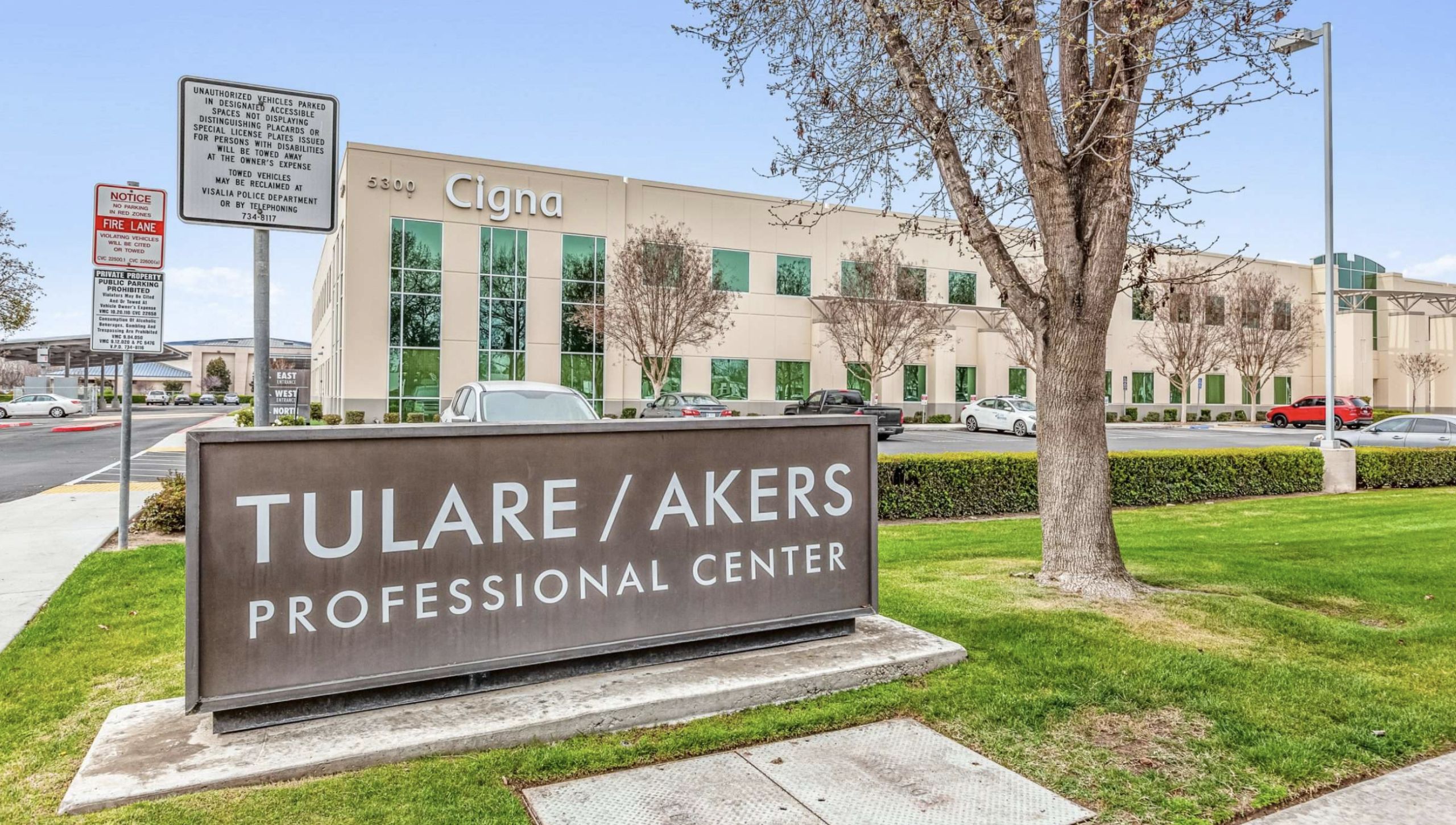
As of the new year, insurance giant Cigna has terminated any leased premises for their office complex in Visalia. That big building is now owned by the County of Tulare. The company has whittled down their square footage in the 180,000 square-foot Class A complex over the years. In 2001 Cigna still leased 96,103 ft.² but reduced that roughly in half to 49,503 ft.², a lease that was set to expire in May 20,2026.Now under a new agreement, Cigna will vacate the building by the end of this month, ending a saga of a company that was once of the largest employers in Visalia with some 1400 workers operating a call center
Cigna was why the building was constructed in 2001. The County purchased the property in 2015. Over the years Cigna transitioned employees to work remotely lessening the need for a large office presence.It is not known if many Cigna employees still work for the company from home in Visalia.
The good news is the county has an agreement with the Central Valley Regional Center to backfill space being vacated. This past year the county also leased some space to Kaweah Health.
Once known as the “Cigna building” the property at 5300 W Tulare Ave (along Akers) in Visalia, is now called the Tulare/Akers Professional Center (TAPC).
The matter was heard this week by the county Board of Supervisors. A staff report says that on September 30, 2025, the County and Cigna entered into a Third Amendment toreduce Cigna’s leased premises, retroactive to September 1, 2025, by 17,210 sq ft from 44,637 sq ft to 27,427 sq ft.
Bringing the negotiations up to date, the staff report says the proposed Fourth Amendment would mutually terminate the Original Lease,including all amendments, and any remaining payments due by Cigna to the County,retroactive to December 31, 2025.
Visalia building permits for all of 2025 seem to reflect a strong economy in the city as we go into the new year. The numbers have just been published.
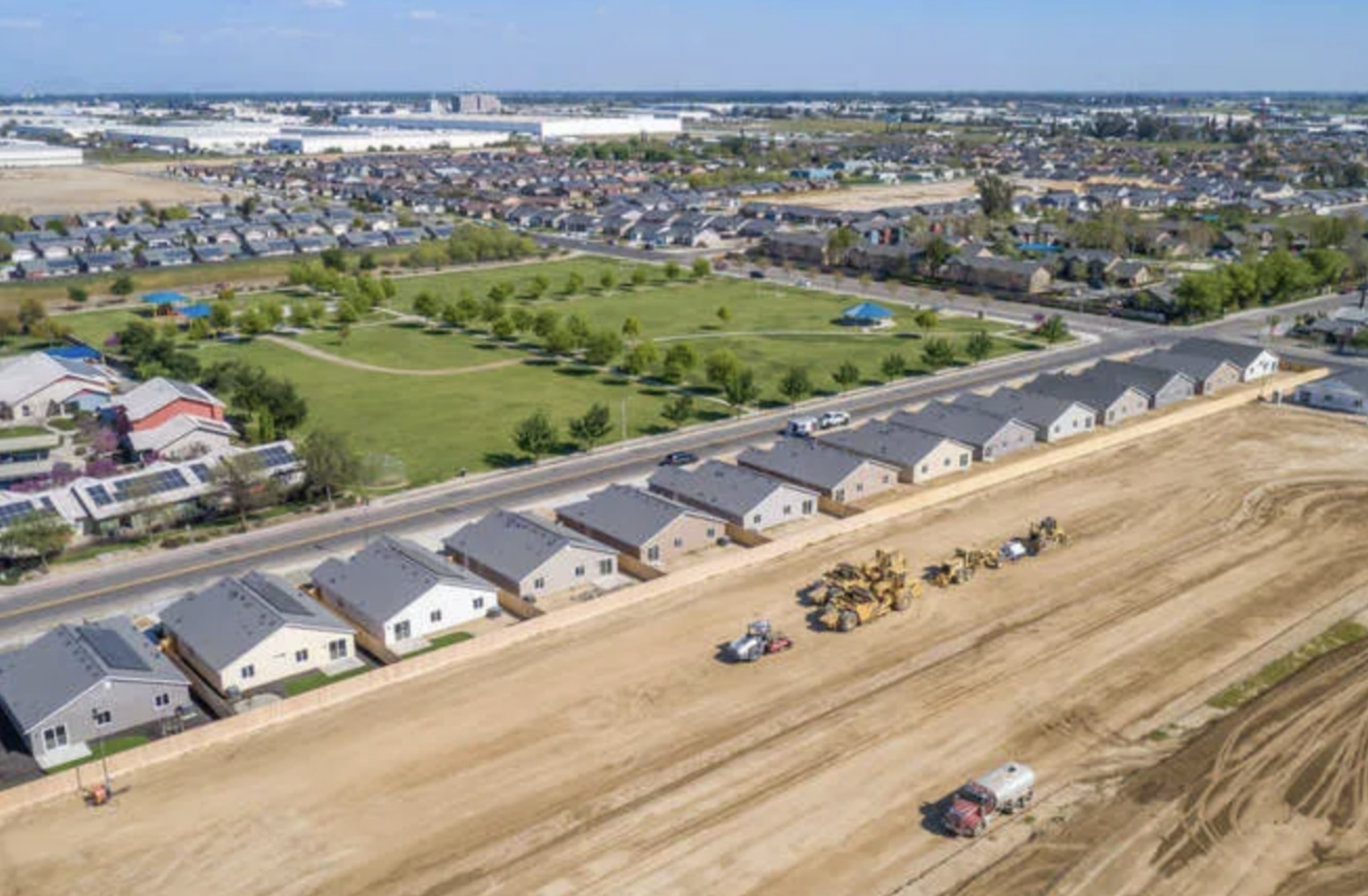
The total value of all building permits hit $525 million compared to $343 million in 2024. New home permits numbered 562 compared to 270 the year before. By contrast, multifamily permits were down at 142 compared to 327 permits in 2024.
More than 1.1 million square feet of new single-family homes were permitted in Visalia last year with an average dwelling cost of $363,600 ,up from $326,349 in 2024.Compared to most cities in the state, the average cost to buy a new home here is attractive.
Visalians spent more $40 million fixing up their existing homes last year.
If new home construction was humming, so were permits for commercial alterations as businesses set a record pace fixing up their stores and buildings. They spent $108 million on projects last year,up 140% from the year before.
New commercial permits added up to $151 million in 2025 compared to just $63 million in 2024 but down from 2023 when new commercial permits added up to $191 million, boosted by industrial park construction.
Construction in the Visalia Industrial Park slowed last year compared to the record pace in 2020 to 2023 when total square footage all over the city hit over 3 million sf each year. In 2025 it added up to 2 million sf compared to just 1.1milliion sf in 2024.
The strong pace will likely benefit the city’s 2026 revenue stream that counts on performance in residential and commercial activity for sales and property tax monies.
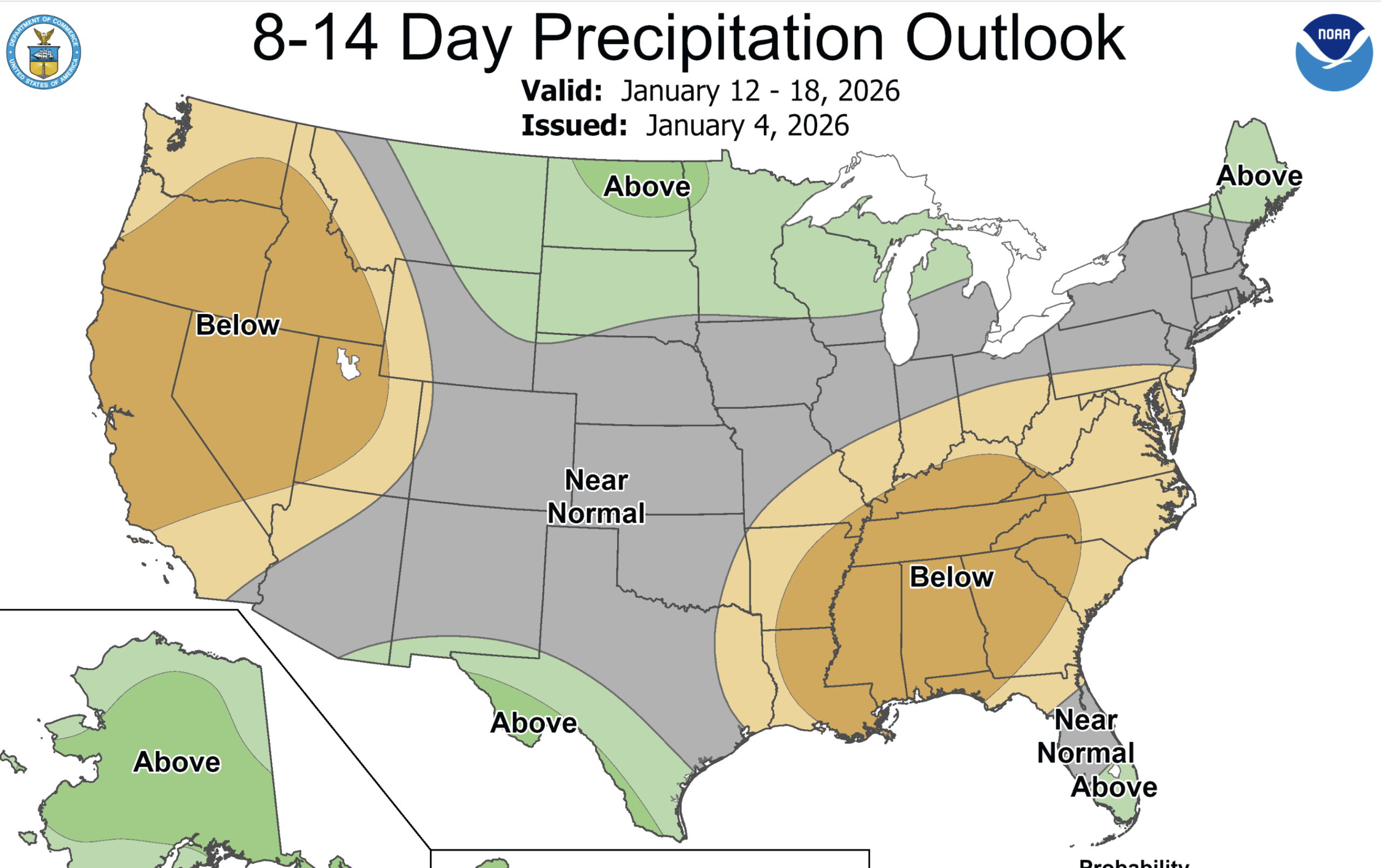
Like a switch being turned on and off, the AR led wet weather and waves of storms coming in from the Pacific that most of California saw over the holidays will feel the return for at least 10 days of “the blob” – high pressure off the coast and warm and sunny blue skies across the Golden State but likely fog in the SJ Valley. Here is the Climate Prediction Center January 4 forecast for 12th -18, 2026.
Multiple atmospheric rivers resulted in above-normal precipitation and flooding across California and the Pacific Northwest during mid to late December. 14-day precipitation, from December 18-31, averaged more than 200 percent of normal throughout California with southern parts of the state receiving more than 4 times their normal amount of precipitation during this two-week time period.
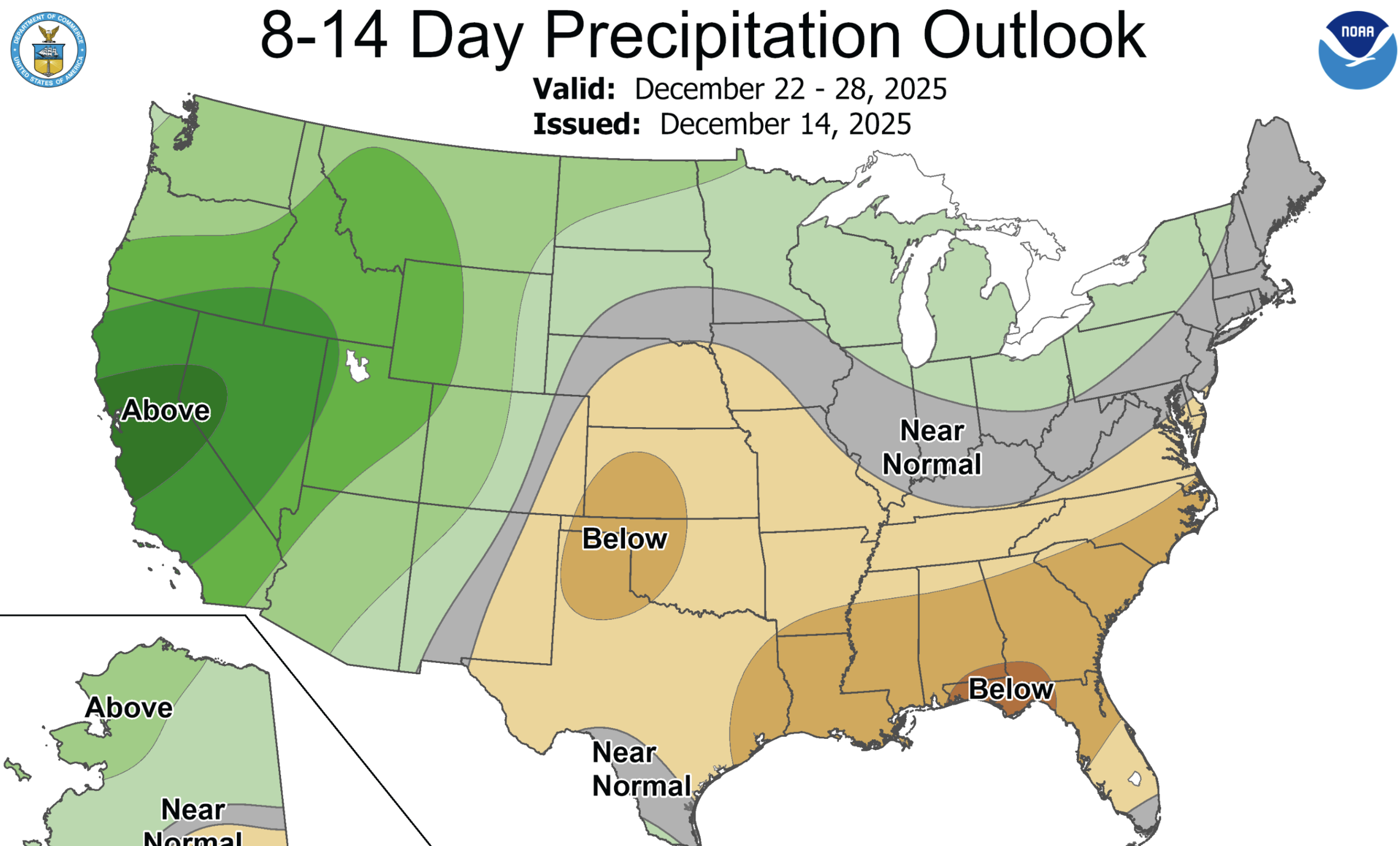
Contrast the latest map with what was predicted a few weeks ago
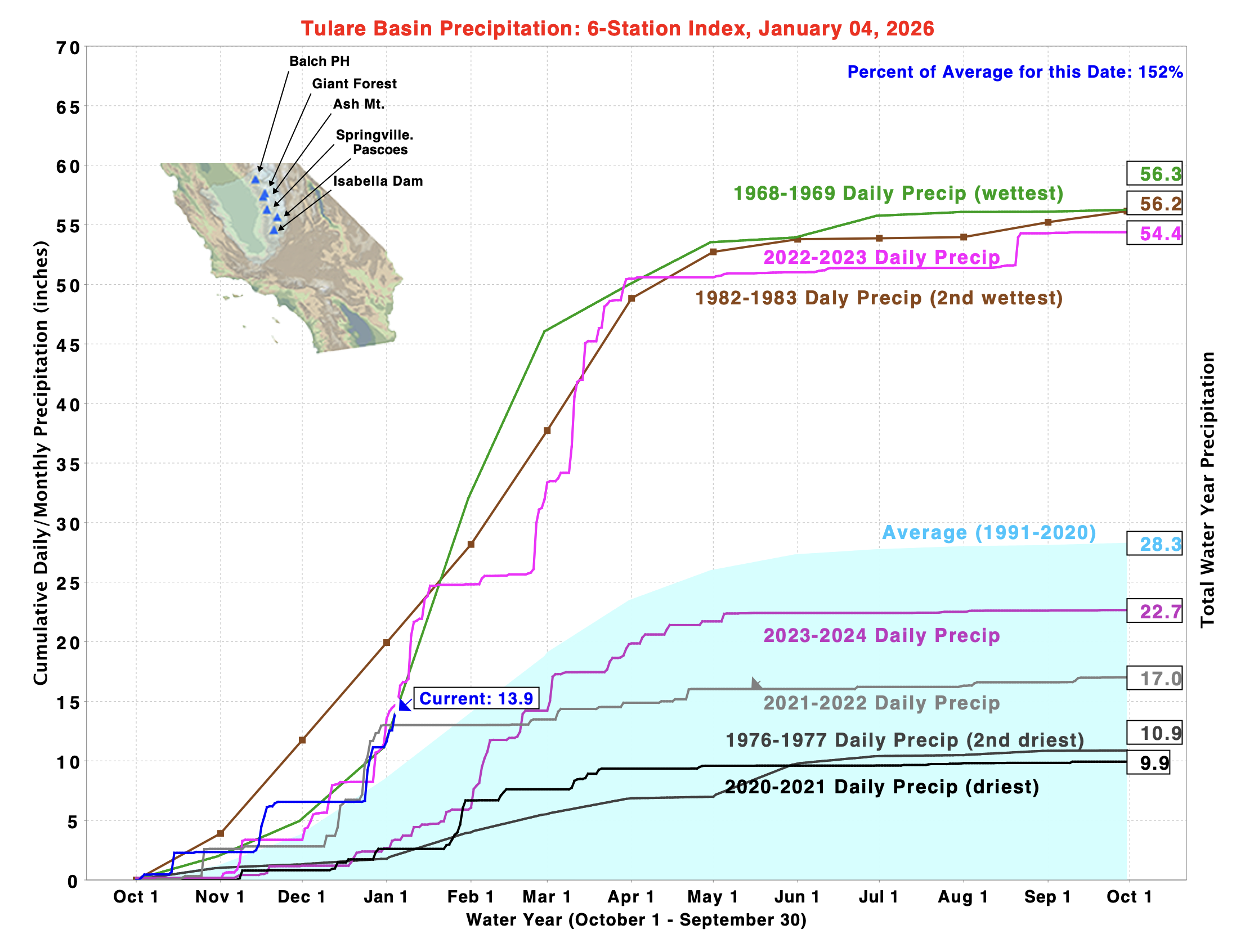
Precipitation is above average across the state, including in the San Joaquin and Tulare Basin stations – both about 150% of average for this time of year.
On the coast Lake Nacimento has received 7.25 inches of rain so far this water year compared to 2.29 inches this time last year. The lake is the water supply for San Luis Obispo and other towns. In our hometown of Los Osos we have received 12 inches of rain so far, 2/3 the average amount of 18 inches for the year.
The state’s most important reservoirs are doing well with Shasta storage at 128% of average and Oroville at 141%.
The 12,000sf space formerly occupied by Forever 21 at the Visalia Mall is slated to be re-tenanted to a kids’ amusement center- a colorful children’s play land in the new year. Plans were filed this week with the City of Visalia.
The large space is located next to JC Penny’s .Mall officials were out of town this week and could not comment.
Called Candeeland Wonderpark, the company calls itself a” vibrant indoor play center where kids explore a real-life Willy Wonka adventure through imaginative, active play.
The company says it has some 15 locations mainly in Southern California that are open or “coming soon” including the new Visalia store and another Valley store at Valley Plaza in Bakersfield.
Chinese state-backed money is remaking the hemisphere’s ports —from Santos to Chancay — reshaping grain routes to Asia and squeezing U.S. farmers as tariffs deepen the split with Washington For decades, U.S. soybeans fed China’s growing demand, binding the two economies together.
The share of U.S. soybeans going to China has at times been more than 60% by value, making China America’s most important agricultural customer.
Two main corridors carry U.S. soybeans to China: Pacific Northwest shipments take a direct trans-Pacific track, while Gulf exports move through the Panama Canal to ports in southern China. Since 2013, China has been investing in infrastructure projects around the world. In Latin America, the Asian giant has invested in more than 23 seaports, building a logistics network to support its growing trade with the region.
These seaport investments range from multi-billion-dollar deep-water terminals to smaller upgrades that improve rail links, storage capacity, and ship turnaround times.
The partnership between the US and China began to crumble in 2018, when tariffs during President Trump’s first term triggered a sharp drop in U.S. soybean sales to China.
Brazil quickly filled the gap and has remained China’s top soybean supplier ever since.
“What are the signs that China’s here to stay [in Latin America]? Really, the infrastructure,” said Henry Ziemer, an associate fellow with the Americas program at the Center for Strategic and International Studies (CSIS), a U.S. nonprofit policy research organization that reports 23 ports across Latin America have some degree of Chinese investment.
“Ports, railways, roads, bridges, metro lines, energy, power plants are probably the best signs that China has a long-term commitment … These are long-term projects.”
Daniel Munch, an economist with the American Farm Bureau Federation, said that when a country gains control over ports that make trade faster, cheaper and more reliable, such as the Port of Chancay, trade flows tend to “lock in.” Reversing that trend, he warned, would require the United States to narrow its efficiency gap, noting that none of its container ports rank among the world’s top 50.
“It could entrench patterns,” Munch said.
This is bad news for American farmers, particularly soybean growers.
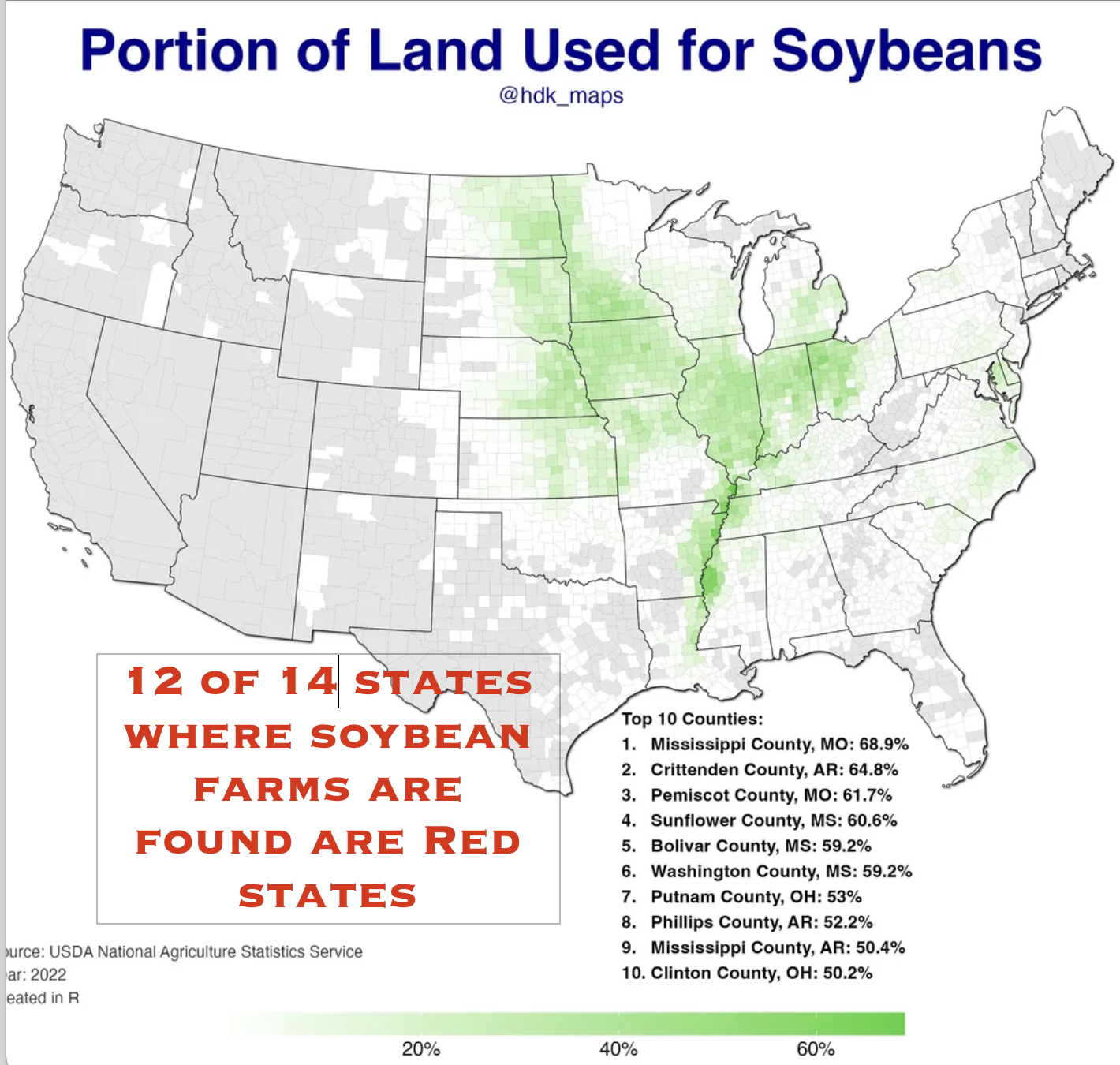
Soybeans are a cornerstone of American agriculture, particularly in the Midwest. Nationwide, more than 270,000 farms grow the crop, according to the latest Census of Agriculture. In Illinois, nearly half of all farms depend on soybean production, and in Iowa and Minnesota, about four in 10 do.
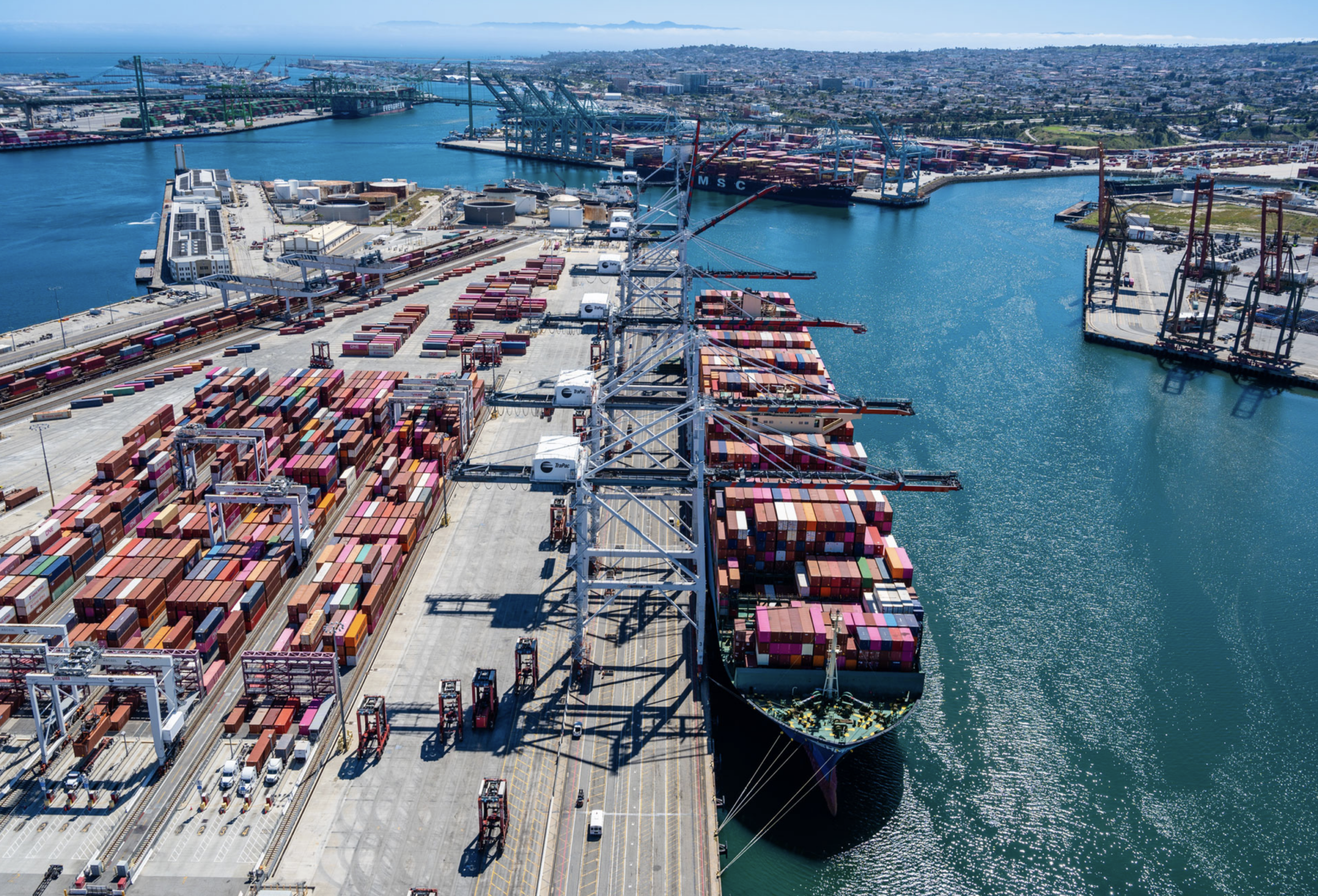
Much 0f the crop[ is shipped down the Mississippi but the Port ofLA has counted soybeans as the top ag commodity shipped from there .
“Exports in general have been very soft and we attributed it to the retaliatory tariffs that have been put in place by China,” said Gene Seroka, executive director of the Port of Los Angeles. “Our single biggest export sector is agriculture … of that, soybeans are the number one export commodity.”
Are you thinking about draining your silverware drawer you got from grandma? Here is a practical question. What are you going to eat with?
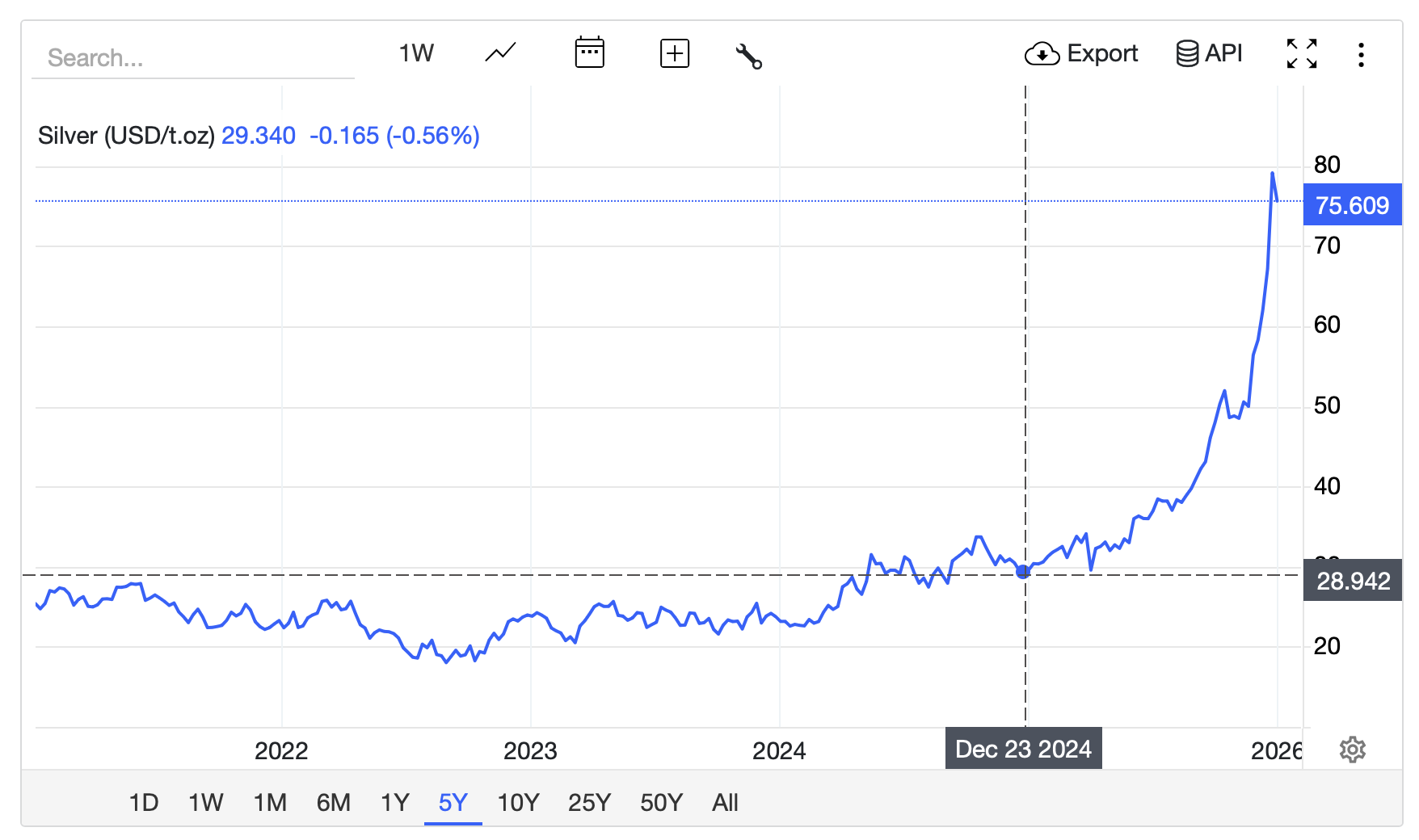
Silver prices have more than doubled in 2025, reaching levels over $75 an ounce, up from $28 a year ago. That is a 161% increase.The. uptick in demand for the metal is based on a combination of factors. Supply Deficits: Global demand has outpaced new supply for several years. Industrial Demand: The expansion of green technologies like solar energy has dramatically increased industrial consumption. Think about data center expansion demand! Investor Demand: Investors are increasingly turning to precious metals as a hedge against global economic uncertainties and persistent inflation fears. In this context, the rapid rise in silver is not just a cause of inflation itself but analysts suggest is rather a market signal that investors believe inflation will persist or worsen, potentially leading to hyperinflation in the coming years.
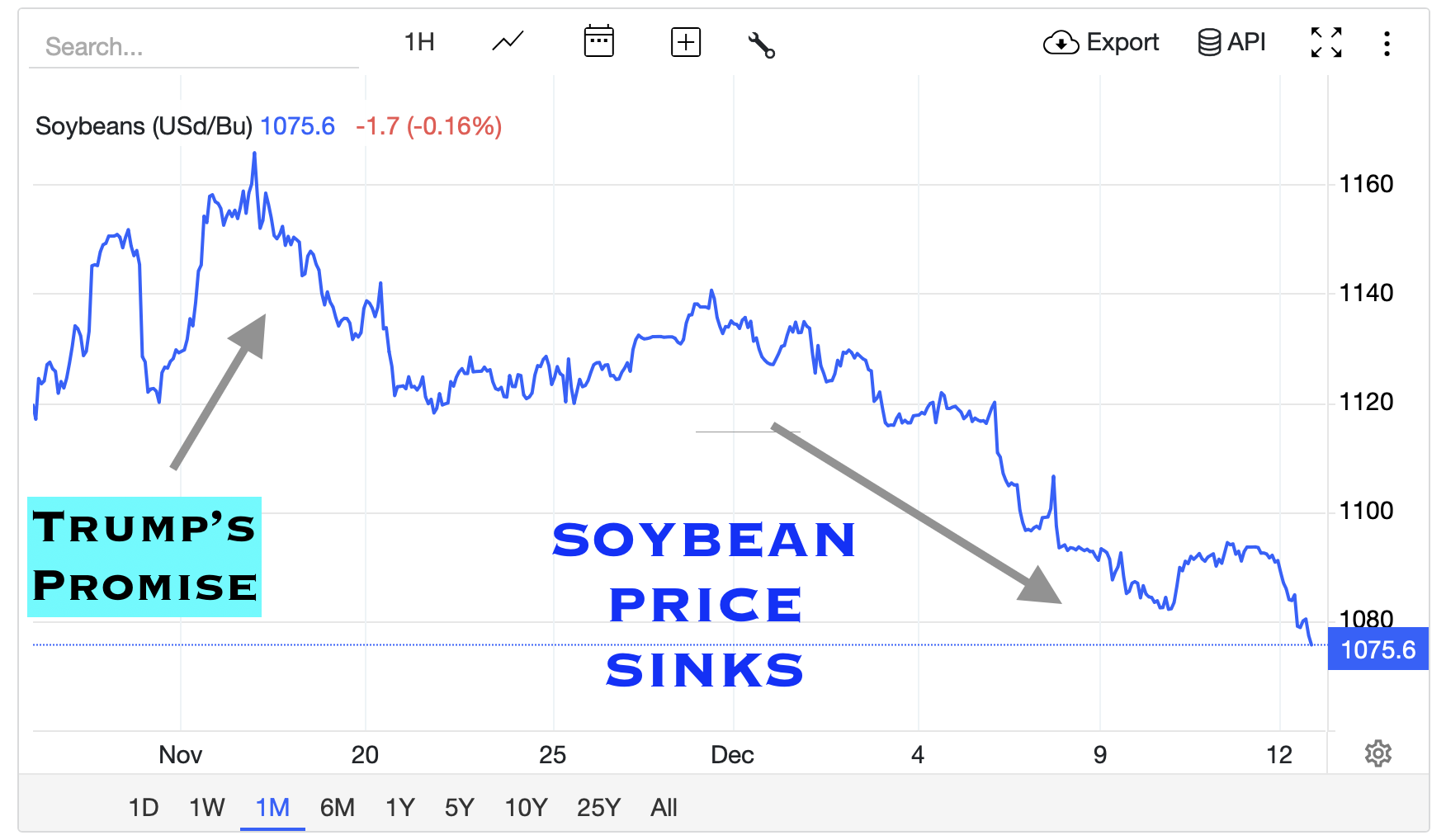
One Ag report notes that farmers “are growing more skeptical of the Trump administration’s promises that China will buy U.S. soybeans. Indeed, administration officials now suggest that China will buy 12 million metric tons of U.S. soybeans – about half of their typical annual total – by the end of the 2025-26 crop year next August rather than by January” as he had promised.
CNBC reports that a fact sheet issued by the White House says the deadline for the purchases, pursuant to China’s recent trade agreement with President Trump, is the end of December.Now it’s August.
Soybeans are the largest agricultural export in the U.S. The legume covers more than 81 million acres — or 10% — of all U.S. farmland, the U.S. Department of Agriculture reported in September, and more than 40% of the nation’s soybeans are exported to other countries.
Now a Bloomberg news report says Brazil’s record soy harvest could flood global markets and crush prices. Brazilian growers brace for potential oversupply as 2026 harvest projections hit record highs, threatening to destabilize international commodity markets, it states. Brazil is now China’s biggest soy supplier.
The bad news for soy farmers may have political impact in coming elections as 12 of the 14 states where soybean farms dominate the ag landscape have favored Mr Trump and are solid Red states.
American Soybean Farmers have posted this notice on their website this month.
Rising input costs for farmers has been an issue the Trump administration has made a policy priority as it advances through its first year – and with good reason. Soybean producers are staring down the barrel of a third year of negative market returns.
Soybean growers find themselves in a precarious position as the 2025 harvest season wraps up. When harvest began in September 2025, November futures prices were between 25% – 30% lower than at the same point in 2022. The lower revenue levels limit the amount of liquid assets farmers have available to pay off 2025 expenses this fall.
It’s not just the revenue side of the income statement where soybean farmers are being squeezed. Farmers are facing elevated prices for land, machinery, seeds, pesticides and fertilizers. According to USDA, farm production expenses are expected to reach $467.4 billion for 2025 – a $12 billion increase over 2024.
According to annual soybean cost of production reports published by USDA’s Economic Research Service (ERS), land (28%), machinery and repairs (28%), seeds (12%), pesticides (7%), and fertilizers (7%) are the most critical inputs for soybean production and account for 83% of a soybean operation’s annual expenses per planted acre.