Weather Watch: Skiing By Thanksgiving?

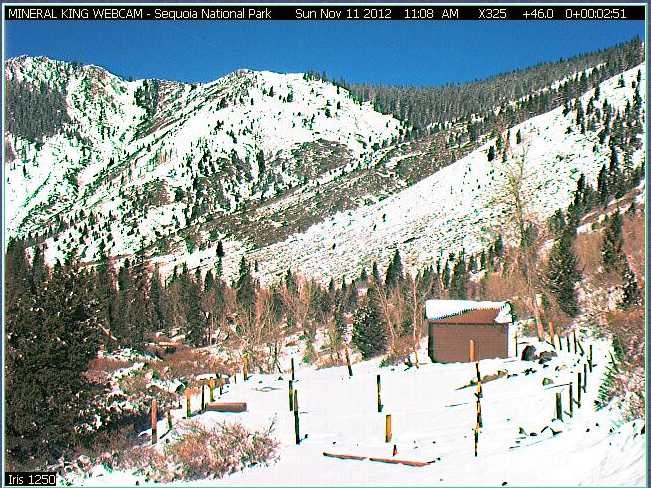
Mineral King Valley this past weekend

The winter storm door appears to have opened nearing mid-month in California with the 10 day forecast for Redding near Lake Shasta(the base of our hydraulic empire) showing likely rain for 7 of the 10 days coming up. Further south things are less optimistic with the best chances for rain coming next weekend (Nov 18/19).

On the Central Coast PG&E forecaster John Lindsey says today to expect some showers Thursday and Friday but that that “longer range charts and models are advertising a significant low-pressure system with increasing southerly winds and rain on Sunday into next Monday.”

NWS Hanford talks about the two systems as well saying snow levels in the Sierra on Thursday will remain at 8k ft with mountain areas receiving a quarter to half an inch of precip.
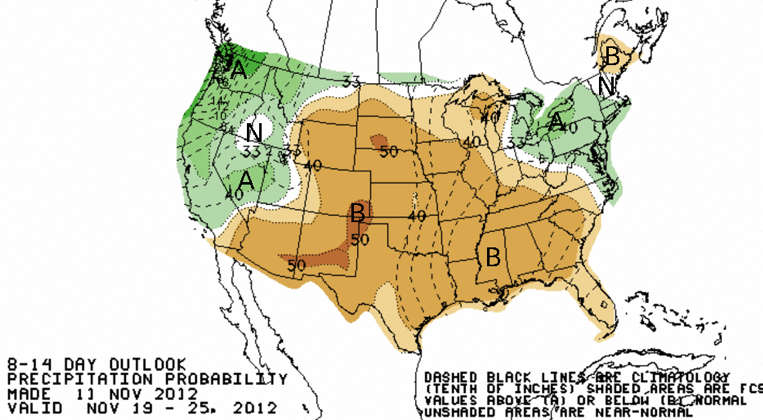
8 to10 day forecast

Some Ski Resorts Open

Several  California ski resorts are already open and more expect to open in the next week, always good news this time of year.

Mammoth Mountain along Hwy 395 is open and Boreal in Tahoe is now operating as are Bear Mountain, Snow Summit and Mountain High resorts in southern California that opened today in honor of Veterans Day. Tahoe’s Squaw Valley and Northstar expect to open on the 16th.

In the Central Sierra a snowstorm turned Shaver Lake into a ‘winter wonderland’ this weekend. At nearby China Peak “We are into some real good snow making conditions right now so that’s going to help and hopefully some more storms in the horizon,” Paul Gray of China Peak Resort told the Fresno ABC station.

The China Peak website suggests a Thanksgiving opening is more likely.”10-12 inches of new snow this week, and very cold temps for snowmaking give optimism for an early opening! Unless we receive significant snow this week (week of 11/12) the only thing we might open on November 17-18 would be one of our beginner moving carpets, so we’d have something in the base area only for beginners and those who want to get started on their skiing or snowboarding life with our Learn-to-Ski & Ride packages!

If we don’t see lots of snow this coming week, but we get some snow and continued snowmaking opportunities we’ll look to hopefully open Chair 6, mid way up the mountain, serving one low intermediate run (Sundown Ridge) by Friday, November 23, so stay tuned!”
Further south our picture from this weekend snow shows a dusting of snow in Mineral King Valley from their webcam with Big Meadows cross country ski area getting 3.6 in of precip so far this water season and over 2 inches this month.Further south, Quaking Aspen has over 3 inches so far this season and received 0.40 inches on November 11 alone.
It’s a start to hopefully a better water year,not just for skiers but all water users.
Weak El Nino?
Forecasters have saying that chances for a wetter winter in California have been scaled back after an early EL Nino weather pattern call this summer boosted hopes coming from the NOAA”s Climate Prediction Center. “While the tropical ocean and atmosphere may resemble a weak El Niño at times, it is now considered less likely that a fully coupled El Niño will develop,” NOAA experts wrote in a Nov. 8 update. “Therefore, the previous El Niño Watch has been discontinued as the chance of El Niño has decreased. While the development of El Niño, or even La Niña, cannot be ruled out during the next few months, ENSO-neutral is now favored through the Northern Hemisphere winter 2012-13.”
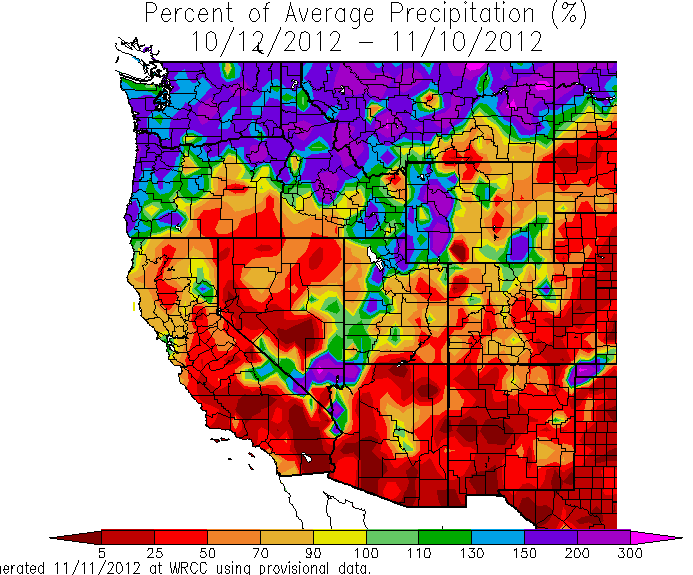
winter so far. Low precip in southern California but lots in Pacific Northwest

So far this season it is the Pacific Northwest that is seeing above average rainfall,an El Nino pattern.

Shrinking Snowpack?
Longer term,climate change is likely to alter the volume and timing of the runoff in California says new report released this week.
Stanford University researchers say climate change will shrink mountain snow pack but speed early runoff in more years according to their model,CMIP5.
“One clear result is that western North America shows the most rapid and largest response to the continued emissions of greenhouse gases when it comes to early snowmelt and spring runoff,”researcher Noah Diffenbaugh told the Chronicle this week.”The result, he and his colleagues say, will be less runoff water for irrigation during the season when California’s high-value crops need it most for growing, and also more early.”
The study concludes“We find that the CMIP5 global climate model ensemble exhibits an imminent shift towards low snow years in the Northern Hemisphere, with areas of western North America, northeastern Europe and the Greater Himalaya showing the strongest emergence during the near-term decades and at 2 °C global warming. The occurrence of extremely low snow years becomes widespread by the late twenty-first century, as do the occurrences of extremely high early-season snowmelt and runoff (implying increasing flood risk), and extremely low late-season snowmelt and runoff (implying increasing water stress). Our results suggest that many snow-dependent regions of the Northern Hemisphere are likely to experience increasing stress from low snow years within the next three decades, and from extreme changes in snow-dominated water resources if global warming exceeds 2 °C above the pre-industrial baseline.”

Guess you better save up that precious water and lower your footprint.

Business Briefs / State & Valley

Sales Up Statewide

The State Board of Equalization collected $1.86 billion in general fund sales and use tax revenue last month, surpassing the state’s $1.74 billion budget estimate.
“This is good news for the State of California,” said SBE member  George Runner. “Let’s hope that stronger tax revenues are a reflection of a recovering economy rather than merely the result of higher prices.”
Runner noted that October’s revenues came from sales taking place prior to the gas price spike of early October. Retailers must file returns monthly, quarterly or annually depending on the size of their business.
According to Runner, the state’s year-to-date general fund sales and use tax revenues are now meeting projections. From July 1 through October 31, the state received $6.5 billion in revenue, narrowly exceeding the state’s budget projection.

Energy News
– New York’s ConED Buying Another Solar Farms in Tulare County. Consolidated Edison Development has completed another purchase of a Tulare County solar-power project – the  20MW White River project in western Tulare county. The company already purchased two other nearby projects bringing the total to nearly 100MW.
– Solar power facilities may qualify for a partial exemption on sales tax says the state Board of Equalization this week even if if the power generated goes to the grid.

Water

-The City of Visalia is considering trading recycled effluent to the Tulare Irrigation District in exchange for Sierra run-off surface water from a canal. The surface water would replenish groundwater that feeds Visalia’s wells. The city is processing a environmental document.

-Tulare Lindsay Strathmore Irrigation District is connecting the rural colony of Tonyville tot he City of Lindsay’s water system according to an environmental notice. Tonyvile is an impoverished community of few blocks northeast of Lindsay.

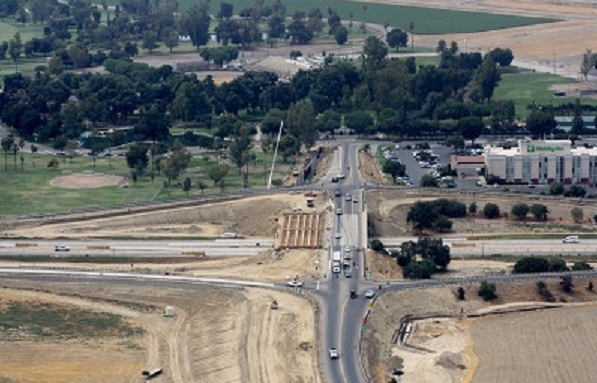
Plaza interchange in Visalia under construction

Lindsay uses surface water from the Friant Kern canal as its key water supply with much of the surrounding ag land high in nitrates.

Roads

-Visalia’s Plaza Ramp Closure Moved to Nov. 27 . Significant progress on the Plaza Drive Interchange Project continues, although the closure of the eastbound on-ramp to State Highway 198 has been moved to Tuesday, Nov. 27. The delay avoids the busy Thanksgiving holiday and forecasted inclement weather conditions. The temporary traffic signal at the 3-way-stop at the Hurley/Shirk intersection was completed today in anticipation of the closure and will help with traffic flow during this time frame.

California’s Export Trade Continues To Slip

November 8, 2012 – LOS ANGELES, CALIFORNIA – Despite improving economic conditions here in California, worldwide fall-out from Europe’s economic straits and a decelerating pace of growth in Asia took their toll on California’s export trade in September, according to an analysis by Beacon Economics of foreign trade data released this morning by the U.S. Commerce Department.

The value of goods shipped abroad by California businesses in September totaled $12.87 billion, a nominal decline of 4.5% from the $13.47 billion recorded in September 2011. (Adjusting for inflation and seasonal variations, the fall-off was also 4.5%.)

California’s exports of manufactured goods totaled $8.42 billion, down 1.9% from the $8.58 billion recorded last September. Non-manufactured exports (chiefly raw materials and agricultural products) fell by 9.6% from $1.67 billion to $ 1.51 billion, while re-exports shrank 9% from $3.23 billion to $2.94 billion.

A nearly 20% year-over-year drop in exports of industrial machinery (including computers) in September was partially offset by strong gains in shipments of medical equipment and aerospace components. Exports of fruits and nuts were up 7.6%.

Manufacturing’s share of California’s merchandise export trade now accounts for about 65%, down from 71% in 2008 and from 78% at the height of the dot com boom in 2000.

Shipments to the Pacific Rim countries of Asia were down by 5.1% in September, including a 4.5% drop in shipments to China.

On the other hand, trade was up with Canada, Taiwan, Singapore, Brazil, and the United Kingdom. Ironically, despite the continent’s travails, California exporters did eke out a 1.8% increase in shipments to the European Union in September.

This suggests that Europe’s troubles are not the primary cause of slowing export growth, and because the European Central Bank recently stepped up to backstop Europe’s major banks, the worst of the European crisis is likely behind us. Today, the European Union accounts for 16.6% of California’s exports, down from 19.9% in pre-recession 2008.

Despite the decline in trade in September, California’s exporters continue to exceed the inflation-adjusted pace they set in 2008, the peak pre-recession year for the state’s merchandise export trade. “Whether that will remain true through the year’s final quarter is exceedingly uncertain,” said Jock O’Connell, Beacon Economics’ International Trade Adviser. Still, initial indications of nationwide export activity shows that trade could have an upward influence on the revised 3rd quarter GDP figures when they are released.

While many had hoped that California’s export trade would resume the rate of growth experienced during 2009 and 2010 and stimulate the state’s economic recovery, creating large numbers of jobs, those accelerated growth rates were due in part to a rebound from the large contraction in exports during the Great Recession and were unlikely to persist at such high levels. Part of the reason growth in exports has slowed is due to global economic concerns, but the slowdown can also be attributed to ‘catching up’.

Among other risks, O’Connell pointed to the unknowns accompanying China’s current change in political leadership. “Even as the transition process unfolds in Beijing over the next few days, the economic policies that Xi Jinping will pursue are far from scrutable,” O’Connell said.

Beacon Economics’ analysis also notes a new forecast from the European Commission that expects gross domestic product to shrink 0.3% for the European Union. Growth in 2013 is expected to be a less than inspiring 0.4%. Those figures represent a significant downgrade of the Commission’s expectations.

This week also brought reports that business and consumer confidence in Europe in October fell to their lowest levels in three years, while unemployment rates moved higher. Still, this shows that the majority of risks in the U.S. economy have shifted from internal issues to external concerns, which stands in stark contrast to the economic woes during the downturn.

Nearly 28% of California’s export trade is with Mexico and Canada, two nations whose economic fates are intrinsically linked to the U.S. economy (which continues to move forward in terms of employment and GDP growth).

Banco de Mexico Governor Agustin Carstens said on Wednesday that the Mexican central bank expects growth of between 3.5% and 4.0% in 2012 and in the 3% to 4% range in 2013, although he warned that Mexico’s economy would suffer if U.S. lawmakers fail to turn back from the “fiscal cliff” – an estimated $600 billion in tax increases and spending cuts set to occur in January.

That warning was echoed in Canada, California’s second largest export market, where Canadian Finance Minister Jim Flaherty and Bank of Canada Governor Mark Carney both pledged on Wednesday to take action to support the economy if a shock from the U.S. threatened to plunge the country’s economy into recession.

The view at Beacon Economics continues to be that policymakers will reach a compromise before things are allowed to come to a head—especially now that the U.S. Presidential election is behind us. It is also important to remember that going one day over the “fiscal cliff” will not bring about a sharp, or any, decrease in economic activity – it would have to continue for a longer period. It is doubtful that our re-elected leaders in Washington will squabble for months and allow the nation to dip back into recession it.

Left Coast: How California Counties Voted For President

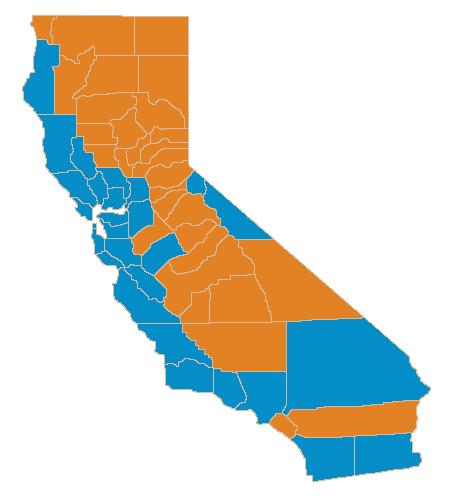
Blue:Obama, Orange: Romney

If Ohio was mostly a Red State on the map -watching election returns this week, it was those northern counties that hugged Lake Erie that turned it Blue for Mr Obama this year.What is it about water?

The California map tells the story. Coast counties in the Golden State voted in favor of President Obama this time around while inland counties mostly voted for Romney. As of this writing, Obama is ahead by about 2 million votes in the state.

In the S2S reading area (using unofficial results) despite a GOP majority, San Luis Obispo County went for Obama 47,893 to 46,598 – mighty close. In Fresno County the vote was 80,859  to 75,313 in favor of Romney even with a Democratic majority.Fresno had just a 39% turnout compared to 52% statewide average.

In Kern County it was 99,840 to 64,690 votes for Mr Romney with a  a 41% to 35% GOP registration advantage. In Kings County with a 45% to 35% GOP advantage, Romney won 17,184 to 12,282. In Tulare County with a 44% to 34% GOP majority, Romney won 58% to 40%.

In the north Valley, Sacramento along with Yolo as well as San Bernardino in the Southland were inland counties that bucked the Red State trend of most of the Central Valley, favoring Obama. The biggest surprise in the Valley – Merced County went blue 52% to 46%.The county has a 43% to 34% Demo majority.

With Passage of Proposition 30, California State University to Roll Back Tuition

System avoids $250 million additional cut, but funding still down $1 billion

(November 7, 2012) – The California State University will avoid a $250 million mid-year budget cut after voters’ approval of Proposition 30, and will start the process of rescinding the $249 per semester tuition fee increase already in place. With the passage of Proposition 30, CSU’s budget will essentially remain flat for the remainder of this fiscal year, but state funding is still approximately $1 billion less than several years ago. 

”We are hopeful that the passage of Proposition 30 will be the beginning of the state’s reinvestment in higher education,” said CSU Chancellor Charles B. Reed. “The long term benefits of additional revenue can only be realized if higher education is once again a priority. The state needs to start making up for the devastating budget cuts of the past several years, and focus on higher education as a driver of California’s economic future.”

The CSU Board of Trustees had previously approved a contingency plan to rescind a $249 per semester tuition fee increase that took effect for the fall 2012 term. Annual tuition fees for full-time undergraduate students will now revert back to $5,472 – the same rate as in the 2011-2012 academic year. Students will either be credited, refunded or receive a reconfigured financial aid package to account for the revised tuition fee rates. 

Campus enrollments will also remain constant for fall 2013. The system had held applications from new students pending the outcome of Proposition 30, which has a direct impact on funded enrollment targets. Campuses will immediately begin to review applications for new student admissions for the fall.

California Gas Prices Down 75c Since October 9

The average price of gas in California has dropped this week to $3.94 a gallon,down 75 cents from the high reached only a few weeks ago according to Gas Buddy.

In the S2S reading area  there are 7 stations in Visalia below $3.80,Fresno there are around 50 stations selling regular below $3.70  and one at $3.59. In  San Luis Obispo’s less competitive market only Costco is below $4 today at $3.89.

Statewide, the lowest price is $3.39 a gallon in the Bay Area.
Gas prices have fallen across the US from $3.89 average in mid September to $3.51 today.

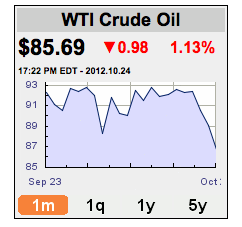
In the past month the price of crude has plunged even as California refiner margins that had skyrocketed to $1.22 a gallon in early October have dropped to 55 cents as of October 29 according to the California Energy Commission.Meanwhile, WTI crude oil has dropped in price from $101 a barrel in mid September to around $85 a barrel today.

Pacific Albacore Carry Barely Detectable Fingerprints Of Fukushima Disaster


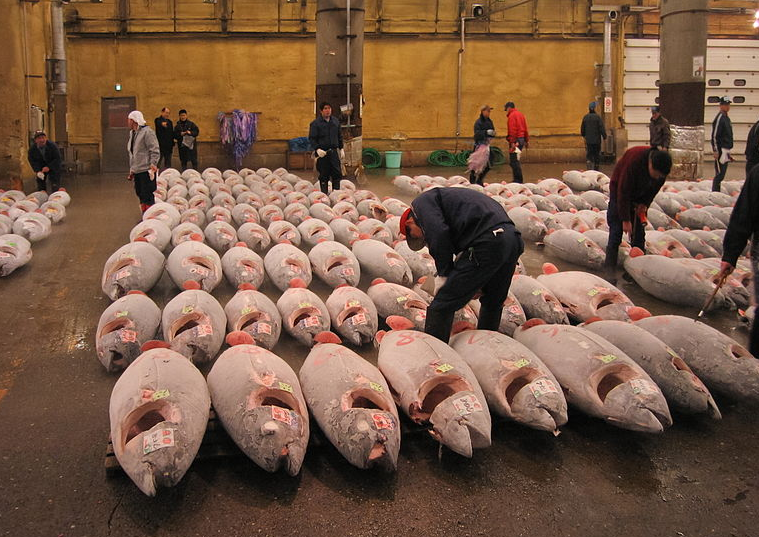
CORVALLIS, Ore. – Samples of albacore tuna caught off the West Coast of the United States show minute traces of radiation that can be traced to the Fukushima reactor disaster, according to an interdisciplinary team of scientists from Oregon State University and the National Oceanic and Atmospheric Administration.

The radiation levels in fish analyzed to date are far below anything that would pose a risk to humans who consume the fish, the research team emphasized. The findings are preliminary; additional fish remain to be tested.

But the findings could reveal new information about where Pacific albacore travel during their migratory lives – and how what happens in one part of the ocean can affect the food web thousands of miles away.

The team has collected and tested fish caught off the U.S. West Coast both before and after the devastating March 2011 Japanese tsunami and subsequent release of radioactive material into the ocean by the Fukushima Daiichi nuclear reactor.

“We’re still processing new fish, but so far the radiation we’re detecting is far below the level of   concern for human safety,” said Delvan Neville, a graduate researcher with OSU’s Radiation Health Physics program and a co-investigator on the project.

People are constantly exposed to radiation from the natural environment, Neville pointed out. “To increase their normal annual dosage of radiation by just 1 percent, a person would have to eat more than 4,000 pounds of the highest (radiation) level albacore we’ve seen.”

Neville will present the team’s preliminary findings on Oct. 27 at the Heceta Head Coastal Conference in Florence. Richard Brodeur, the NOAA Northwest Fisheries Science Center biologist who serves as lead investigator on the project, reported the same findings to the recent annual meeting of  PICES, the North Pacific Marine Science Organization, in Japan. The researchers also plan scientific journal articles.

The OSU team’s findings are consistent with those of California researchers who announced in May that they had found traces of Fukushima-linked radionuclides in bluefin tuna caught off the California coast. The bluefin news came as a surprise to the scientific and regulatory community. Shortly after the March 2011 Japanese tsunami and reactor disaster, the U.S. Environmental Protection Agency, Food and Drug Administration and NOAA jointly expressed “high confidence” in the safety of U.S. seafood products, suggesting it was unlikely that migratory fish such as tuna would be contaminated to “significantly elevated radiation levels.”

Relying on agency statements, fisheries organizations such as the Oregon Albacore Commission predicted that 2-to-5-year-old albacore, a mainstay of the U.S. troll and pole fishery, would be unaffected because their migration patterns do not take them through the waters where the radiation leak occurred.

But scientists differ on the details of albacore migration and behavior. Some suggest that not all albacore follow the same migration routes between western Pacific waters and feeding grounds off the U.S. West Coast. Some believe North Pacific albacore may even comprise two separate sub-stocks with different migratory paths.

That’s one of the questions Jason Phillips, then a graduate fisheries researcher in OSU’s College of Earth, Ocean, and Atmospheric Sciences, was investigating with support from Oregon Sea Grant, when the 2011 disaster struck Japan. He wondered whether the radiation released by the Fukushima nuclear plant could be used as a “natural tag” to help unravel some of the questions about fish migration. He put together a pilot study, but soon found he needed more fish samples – and access to additional equipment for detecting and measuring extremely low levels of radiation.

Brodeur, the NOAA biologist overseeing Phillips’ research, introduced him to Neville, a graduate student in OSU’s Radiation Health Physics program who was looking for Ph.D. research topics – and who had access to the specialized instruments needed to analyze the albacore samples for the type of radionuclides released by the Japanese reactor. He also obtained a modest NOAA grant to support the research.

The researchers first identified two Fukushima-linked isotopes – Cesium-137 (Cs-137) and Cesium-134 (Cs-134) – this July, in samples of fish caught and frozen in 2011.

This particular combination of radioactive isotopes is produced by fission in nuclear reactors, and less commonly, nuclear weapons. Cs-134, in particular, is considered key to the Fukushima nuclear “fingerprint” because it decays very rapidly, with a half-life of just more than two years. While Cs-137, which persists for decades in the environment, could come from other possible sources, scientists say, the Cs-134 could only have come from the Fukushima reactors.

But the team needed more evidence to support the radioactivity findings. Phillips spent this summer collecting more fish at sea, off Oregon and Washington, as well as from scientists, fishermen and other sources along the West Coast. Neville ran more tests, validating his methods against freeze-dried fish standards tested by dozens of labs – and got the same results. They also shared fish samples with the Washington state Office of Radiation Protection, where radiation health physicist Lynn Albin is analyzing them as an additional check.

As more fish were tested, the results were consistent with the initial findings: No Cs-134 in fish caught before the disaster, but traces of the isotope in a significant number of fish caught since.

“This is what we’ve seen after testing about 70 pounds of tuna,” Neville said. “When you’ve run one or two samples, you can’t really say much about the population you’re testing yet. When you’ve run five or six, you could make some guesses. When you’re up to, at this time, 18 samples and everything has fallen fairly neatly into two groups of results, you can start to make some predictions about that population.

“What we can say is that we have detected Cs-134 in fish thousands of miles from where that Cs-134 came from, and over a year since it was released,” Neville added. “It’s very interesting scientifically, and it can tell us more about tuna migration and what happens to radioactive releases, but it’s nowhere near enough to be concerned about food safety.”

Jason Phillips, whose fisheries research launched the investigation, says it will take more work to unravel the mysteries of albacore migration.

“We are finding evidence that the albacore caught in Oregon and Washington in the summer have spent the winter in different locations in the North Pacific,” he said. “But other researchers have been trying to figure out how albacore migrate for decades. We need to increase the number of fish and locations we test before we can start getting at the bigger questions.”

About Oregon Sea Grant: For more news about science, marine education and related activities on the Oregon coast, subscribe to “Breaking Waves,” the Oregon Sea Grant news blog, at: http://blogs.oregonstate.edu/breakingwaves/.

Media Contact

Pat Kight,
541-737-2011

Source

Delvan Neville, 480-907-8629

Jason Phillips, 541-231-5021

Richard Brodeur, 541-867-0336

jason-phillips

Jason Phillips


Researcher Delvan Neville labels containers of albacore tuna

Delvan Neville

News and Research Communications
Oregon State University
416 Kerr Administration Bldg.
Corvallis, Oregon 97331
541-737-4611
Contact us

Copyright © 2012
Oregon State University
Disclaimer

Web Com

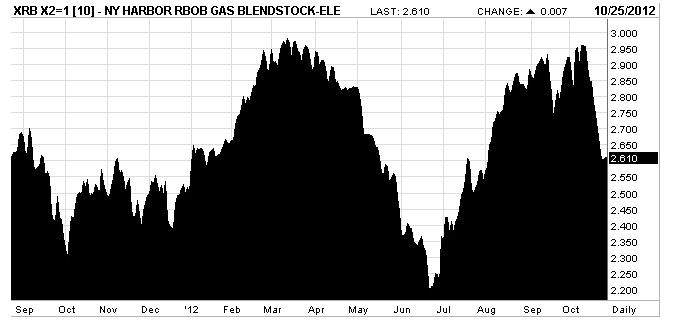
Wholesale Gasoline Prices Drop 90 Cents In 3 weeks

oil prices have dropped in the past 9 days

Wholesale CRBOB gasoline have now dropped around 90 cents from the beginning of October to today, a bit over three weeks later.The gasoline blend is used in California.The drop comes on the heels of a 50 jump in prices at the pump that shocked California motorists early this month virtually overnight. Some stations sold gas for $5 a gallon. Only days later there are predictions of well below $4 gas on average in coming days as volatility in the market appears to be the new norm

Online website Gas Buddy says the average California gasoline price at the pump has now fallen nearly 40 cents since October 8,in little over two weeks, accelerating down in recent days to $4.29.The website says several gas stations in the state have dropped their retail price to as low as $3.39.

Around our S2S reading area the price at the pimp in Visalia has dropped a dime in the past day at the Visalia Costco from $3.99 to 3.89 today.

In Fresno several stations are selling regular for $3.85. In San Luis Obispo, the price at the Costco gas station is  $3.94 down from $4.14 yesterday and $4.49 a week ago.

NY gasoline futures, volatility the new norm. 35 cent drop since mid October

With the wholesale drop of 90 cents through today look for lower  retail prices still.November gasoline futures were 35 cents lower than about 9 days ago today on the CME.

Nationally gas prices are dropping fast as well ,down nearly 20 cents in the past month says AAA.Some have pointed to the role gasoline prices play in the presidential election. ”Romney stands to gain if a small percentage of uncommitted voters in swing states decide to place blame for rising gasoline prices on Obama ”says one report.

Now they are heading the other way.

“Oil industry analysts reported significant drops in the wholesale market …which, if they hold, should bring prices well below $4 a gallon in Southern California,” said Auto Club spokesperson Jeffrey Spring. “The only question is how quickly that will happen.”

The latest California Energy Commission Fuels Watch report says refineries pumped out 4.4% more gas the week of 10/19 than on 10/12 and that volume is 11.9% higher than a year ago.Refinery gasoline stock is up 18.7% from the week earlier when refinery snafus cut production helping to send prices sky high.

Downward pressure on oil price may be helping to accelerate the price drop along with end of summer driving season.WTI crude is down to $85 a barrel today compared to $100 a barrel in mid-September.

Demand is down as motorists on U.S. roads drove less for the ninth-straight month in July when retail gasoline prices peaked at more than $4 per gallon, the government reported recently.

Biz Briefs: Gas,Avos & Lumber

California gas prices are down 17 cents since they spiked up more than 50 cents early this month says Gas Buddy.A few Fresno stations are selling regular for $3.99 this week ( the lowest in the state) while the state average is $4.50. says the online service.

In California and across the U.S. refinery problems and tight supplies in some locations caused gasoline prices to surge earlier this month to the highest prices since the spring. “But the switch to a less expensive winter grade of gasoline, weak refinery demand and increase of supplies in certain areas caused gasoline prices to start coming down. An unexpected increase in U.S. gasoline supplies in the past week could cause pump prices to fall even further “says an AP report.Gas demand is down from a year ago and supplies rose last week says the US Energy Information Service.
In California the state energy commission reports margins for sale of gasoline by week. In two weeks the refining margin of the cost to make gasoline rose from 57 cents to $1.22 as of October 8, even as the price the refiner paid for crude fell.
Cheaper avocados, good for those Holiday parties are here with more coming although the trend may hurt California growers prices.That’s because  this fall’s Mexican avocado crop is double what it was last year. California production is winding down until next spring.

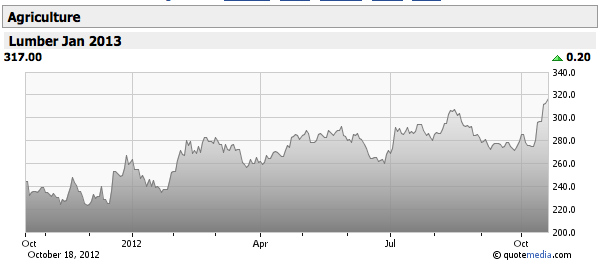
Despite the conventional wisdom that suggests lower prices are good for the economy , the rebound in the housing market this fall is lifting lumber prices – good if your are selling lumber or if you just want to see the economy thrive. Rising home values and more sales  added to predictions of a strong upcoming remodeling season by Harvard University this week suggests  the home improvement market(as well as appliance and furniture sales)  should fare well in coming months. After being in the $200 range for almost two years – lumber futures now stand at $320 – rising from $280 in October. Higher lumber prices will stimulate more production and investment, good for jobs.

STATE NEW CAR SALES JUMP 34%

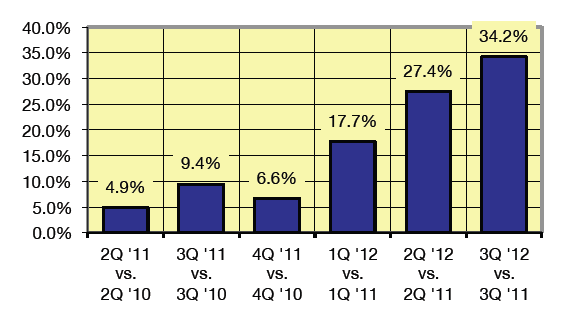
Sales increases by quarter according to the CNCDA

The new vehicle market in California continued to recover during the summer of 2012, with new registrations increasing a significant
34.2 percent in the Third Quarter versus a year earlier. It was the 14th consecutive year-over-year quarterly increase says the California New Car Dealers Association.
Primary reasons for the big increase include: release of pent up demand, easing credit conditions, strong trade in values, and improving supplies of top-selling models from Japanese manufacturers. The annual increase from 2011 to 2012 is now projected to approach 23%.

Other key trends in the state market:
• Chrysler was the brand with the largest percentage increase
during the first nine months of this year- Up 109%.
• Korean, Japanese, European, and Detroit Three brand registrations
each increased by more than 19 percent.
• Passenger car share increased 1.9 share points. SUVs were
down 1.8 points.
• The State market was up 26.3 percent in the first nine months of
2012, higher than the 14.5 percent increase in the Nation.

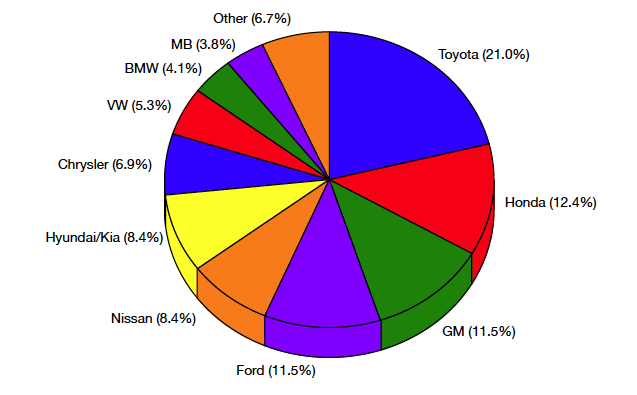
In California Toyota retained top market share at 21% followed by Honda,GM and Ford.

In full size truck sales the Ford F Series retains top market share at 33.7%. The Prius remains top selling car followed closely by Honda Civic.

The recovery in car sales in the state means sales of 1.58 million light vehicles this year compared to 1.17 million units in 2010 and 1.29 million last year.