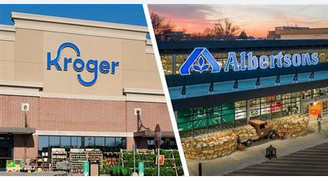
The Western Growers, California Fresh Fruit Association and Colorado Food and Vegetable Growers Association are actively opposing the proposed merger of Albertson’s and Kroger. The transaction would collectively represent 16 percent of the U. S. grocery market, second to Walmart at 21 percent.
According to the produce associations, Kroger has previously demonstrated predatory buying practices, including:
•Demanding 90-day credit, requiring waivers from the Perishable Agricultural Commodities Act that requires 30-day payment. This demand issued in 2018 was subsequently rescinded following intervention by the USDA.
•Kroger bills shippers for private label packaging.
•Suppliers cannot dispute rejections based on quality or discrepancies in quantity.
•Kroger and other large chains import fruit and produce from other nations with lower cost structures to the detriment of domestic producers who are required to conform to minimum wage rates and other legal restrictions.
Based on the unsatisfactory trade conditions imposed by Kroger, many producers and growers have opted to supply Albertson’s, an option that would disappear in a merger.
In a letter addressed to the Anti-Trust Division, of the Department of Justice and the Federal Trade Commission, Dave Puglia, President and CEO of Western Growers, stated, “The Kroger-Albertson’s merger is anticompetitive and will harm the fresh produce industry, farm workers and farm communities, consumers and threaten national security.” He added, “Eliminating major competitors from the marketplace never leads to reduced prices for the consumer. Rather, food costs – already under pressure by high inflation – will only go up if this mega-merger is permitted to proceed.”
Barn door shutting on area egg ranch while another opens
-January 19,2023-
2015 broadcast discusses challenges to small Bakersfield egg producer
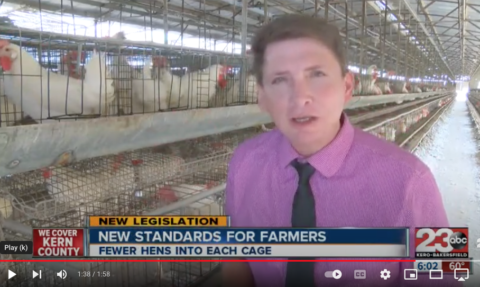
Another ‘mom and pop’ egg ranch will close their barn doors in the Valley. Even with eggs in short supply nationwide and prices climbing to new heights, it has not been enough to keep a 100-year-old egg farm from going out of business.
John Lewis Jr., president of Farmer John Egg Farm in Bakersfield, confirmed that the family operation will close its doors by the end of the month. The move comes as commercial poultry farms across the country have been pummeled by avian influenza, which has led to bird losses topping 57 million and shoppers facing sticker shock on eggs.
But Lewis said the family isn’t calling it quits because of impacts from avian influenza. He said they’re pulling out because they can’t afford the cost of going cage-free, now required by state law. Retrofitting the farm, he said, would cost $4 million to $5 million, and “we didn’t have the money.”
At 75, Lewis has been in the egg business for 50 years and would “still rather be a farmer…rather be out there in the chicken coop.” The farm once maintained 300,000 egg layers but stopped production last year when Proposition 12, the cage-free mandate, went into effect. Its facilities have since sat idle as the farm changed its business from producing eggs to strictly selling eggs from other farms.
As Mr Lewis advised, to stay in the egg business in California you need to be well capitalized and size matters.
Just in the past few weeks a new big egg co-op was launched called ProEgg. The new egg farmer cooperative in the western United States intends to bring sustainability and supply chain stability to its customers through its eight independent shell egg production members. ProEgg, a farmer cooperative formed under the Capper-Volstead Act, will serve 13 states, and is committed to providing retail and foodservice shell egg customers with collaborative solutions that will help stabilize the shell egg supply in this period of high egg demand.
The eight companies that are members of the cooperative are recognized leaders in egg production. They include Cal-Maine Foods, Inc.; Central Valley Eggs, LLC; Colorado Egg, LLC; Hickman’s Egg Ranch, Inc.; Oakdell Egg Farms, Inc.; Opal Foods LLC; Ritewood, Inc.; and Willamette Egg Farms, LLC. Central Valley Eggs is in Kern County.
Ric Herrera, ProEgg’s CEO, will be overseeing sales and customer relations for the farmers. He anticipates that, by reducing supply shortages, consumers will also see a price reduction.
“I see this model being key to the sustainability of egg producers in this country,” he says. “There are a lot of smaller producers that don’t have the scale of operations to cope with a hit to their production, and a lot of them are facing a decision to leave the industry. It’s a scary, scary thought.”
One new member says his motivation for joining the co-op is that he’s particularly worried about future bird flu outbreaks.
Since the outbreak was detected in February 2022, it’s been deemed the deadliest year for outbreaks in U.S. history. More than 57 million birds in hundreds of commercial and backyard flocks have been affected by it—according to the U.S. Department of Agriculture data. The depopulations at commercial facilities have decreased the domestic egg supply by about 7.5 percent on average each month since the outbreak began.
Ag Alert contributed to this story
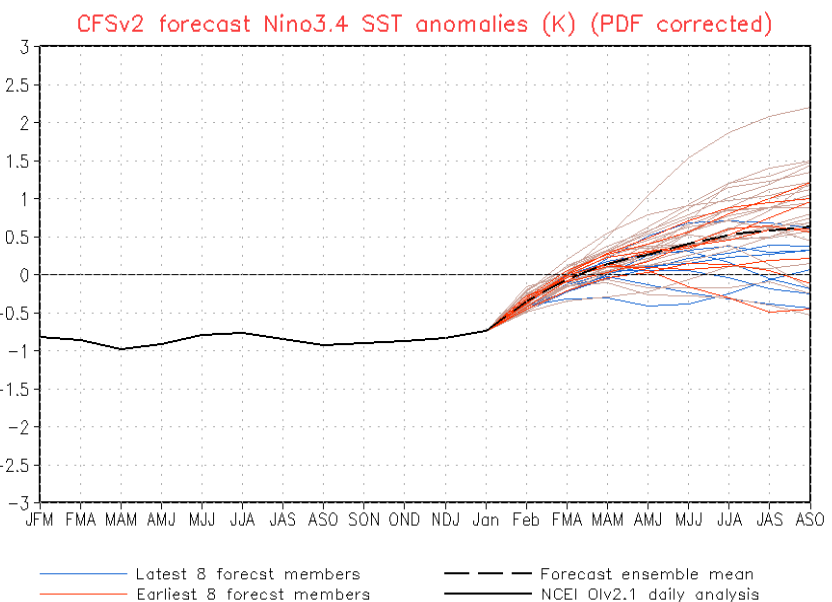
NOAA says we are transitioning to El Nino conditions
Californians might swear El Nino is already here after 9 atmospheric river storms swept into the state over the past few weeks. Indeed the sudden switch to extreme and stormy wetness appeared to have surprised forecasters who had been predicting another dry winter. But now NOAA has suggested warming eastern Pacific waters over the next few months means we are moving from La Nina to El Ninio conditions as the year goes on. The pattern could change next fall, not to a strong El Nino but a modest (0.5) level.
Visalia, Calif. – California Dairies, Inc. (CDI), the largest dairy farmer-owned cooperative in California, announced that it has agreed to acquire DairyAmerica, effective January 1, 2023.
DairyAmerica, a globally recognized supplier of quality and sustainable dairy ingredients, is a federated cooperative currently co-owned by CDI, Agri-Mark, Inc., and O-AT-KA Milk Products. As part of the acquisition, CDI will purchase the ownership rights currently held by Agri-Mark, Inc. and O-AT-KA Milk Products, making DairyAmerica a wholly owned subsidiary of CDI.
“This investment in DairyAmerica provides the opportunity for CDI to unlock significant synergies and represents another step towards improving efficiencies in providing world markets with high quality dairy ingredients,” said Brad Anderson, president and chief executive officer of California Dairies, Inc.
Under the new structure, DairyAmerica will continue to market milk powders produced by Agri-Mark, Inc. and O-AT-KA Milk Products. These marketing agreements will allow for the continued multi-origin and sustainable supply benefits currently enjoyed by DairyAmerica.
“We continue to support the Dairy America vision,” said William Schreiber, chief executive officer of O-AT-KA Milk Products.
“We are pleased to be a part of this transition and have seen the benefits of DairyAmerica’s transformation under its new leadership the past two years,” said David Lynn, interim chief executive officer at Agri-Mark, Inc.
DairyAmerica will remain under the leadership of Patti Smith, chief executive officer, and the DairyAmerica office will remain in Fresno, CA.
“As we continue to transform our business, this investment by CDI provides the framework to focus on our people and processes while strengthening our global competitiveness,” said Patti Smith, chief executive officer of DairyAmerica.
##
About
California Dairies, Inc., is the largest member-owned milk marketing and processing cooperative in California, producing approximately 40 percent of California’s milk. Co-owned by more than 300 dairy producers who ship nearly 17 billion pounds of Real California Milk annually, California Dairies, Inc. is the home of two leading and well-respected brands of butter – Challenge and Danish Creamery. California Dairies, Inc.’s quality dairy products are available in all 50 United States and more than 50 foreign countries.
For additional information on CDI, visit www.CaliforniaDairies.com.
DairyAmerica, Inc. is a federated marketing cooperative founded in 1995 and serves to market quality dairy products regionally, nationally, and international
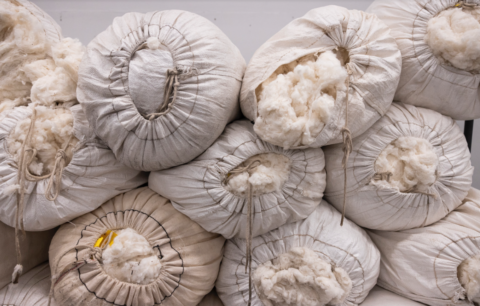
No longer the king, times have changed in the cotton business. California used to produce over 1.6 million acres of cotton – but today that is down to about 100,000 acres.
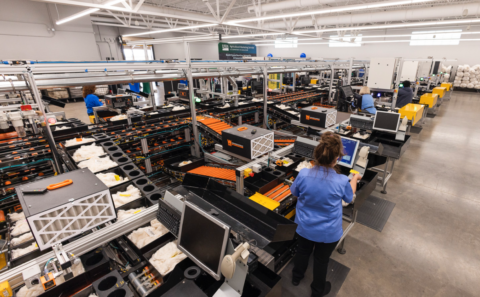
USDA Cotton sorting center in Texas
Those changes have affected the Valley Cotton Classing Office operated by USDA located in the Visalia Industrial Park.
Director of the center Greg Townsend says the Visalia office was opened in 1991 after consolidating operations in Fresno and Bakersfield in the heart of the SJ Valley cotton belt. The grower funded center sorts and grades samples from cotton bales coming out of gins up and down the state. As an unbiased government operation the work here provides both sellers and buyers with certainty over color, fiber length and other key characteristics that allow trusted valuation.
Back then “we were seeing some 2.5 million bales of cotton each year sourced from about 100 cotton gins around the Valley”says Townsend.
Cotton acreage in California peaked in the late 1980s when it reached over 1.6 million acres. It’s been mostly down since with 200,000 acres planted in 2010,179,000 in 2020 and in drought- plagued California in 2021, fell to 114,000 acres.
With the harvest coming in the fall, there is a three month period when sorting and measuring at the USDA center is the busiest. In 1993 that required 350 seasonal jobs at the center in Visalia according to a city report back then.
Several other firms in the industrial park hired workers in winter months as well like Jostens who employed 700 to help produce yearbooks during the time when farm work was slow. The operation was the top employer back then and the Visalia USDA center was number two
Fast forward to 2023 and Townsend says the USDA complex does some seasonal hiring but only needs 50 to add to the work of 6 full time employees.The job is much more automated today he notes with better technology requiring fewer hands to sort. Likewise at Jostens that went dark a few years ago as digital technology supplemented yearbook popularity.
Besides technology there is another major reason why times have changed at the local USDA center.
The industry has shrunk .
Today instead of being in charge of grading the cotton grown in the Valley, the Visalia center now sorts cotton from four states, California. Arizona, New Mexico and West Texas.
Instead of measuring the quality of 2.5 million bales grown in the Valley 30 years ago, the center is in charge of 800,000 bales, one third the volume, now grown across the 4-state American West.
”And the volume its getting smaller” says Townsend as the drought grips much for the cotton belt including places like Arizona.While Arizona looks to be on permanent decline, California cotton acreage bounces around based on water availability, he adds
A report says Arizona acres in upland cotton in 2022 are down 47 percent from 2021, but the yield on all 83,000 acres is projected to be higher by 5 pounds to the acre, according to the U.S. Department of Agriculture’s August Crop Production Report.
As for the San Joaquin Valley “Pima cotton is keeping the cotton industry alive” observes Townsend. The center grades both pima and upland varieties.Today there are 21 pima gins mostly in California and 30 upland gins in the multi-state service territory.
Reports say that in the 60s there were 299 gins in California but most now are empty or have been converted to other uses.A major cotton storage complex in Hanford is being used to store marijuana.
If the California cotton industry depends on the weather, there is good news at our doorstep this month.Last month Cotton Grower magazine reported “During a recent Cotton Incorporated Weekly Weather Update, Eric Snodgrass, Principal Atmospheric Scientist for Nutrien, says recent weather patterns may bring some good news for California.
“We’re going to see some major precipitation coming into parts of California in the near future,” he predicts. “But from now all the way through next year, it’s all about keeping an eye on soil moisture and what our drought situation looks like. La Niña is still here. It is in control and will stay in control likely through the start of the new year. I think it would be critical to be watching from about Dec. 15 to Jan. 15 to see if we can get rid of this.
“I don’t think the drought issues we’re encountering now are going to last into spring,” he adds. “As you look out until March, we start to see models hinting La Niña really beginning to fade and better moisture events for most of the country, including the Cotton Belt.”
Looking out the window, as of January 4th 2023, heavy rain is projected through the end of the month across the state and snowpack in the southern Sierra is 206% of average.
caption: USDA cotton classing office in Texas requires few empoyees
One attachment
• Scanned by Gmail
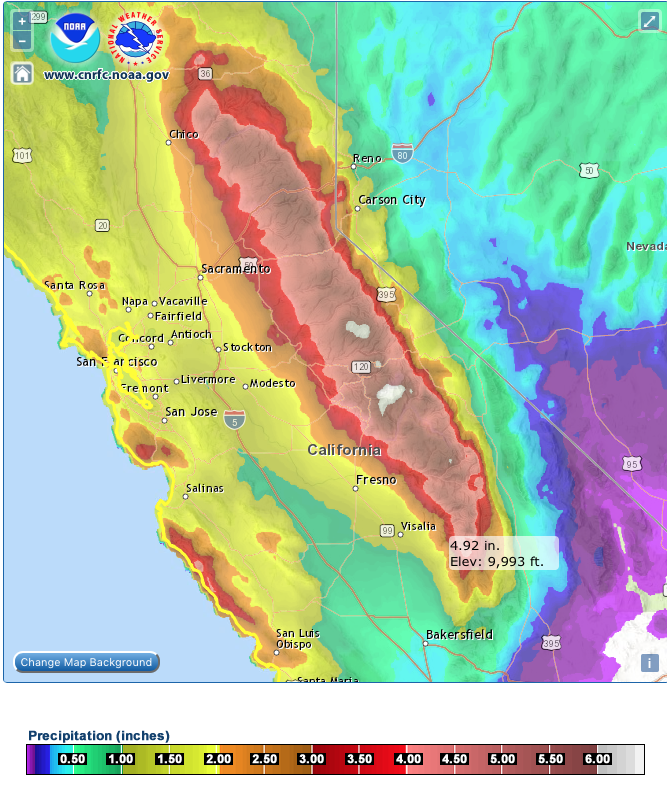
Here is the 6 day precipitation forecast for the Sierra showing near 5 inches expected, much of it falling as snow. Map shows area around Giant Forest getting 4.92 in.
-November 28,2022-
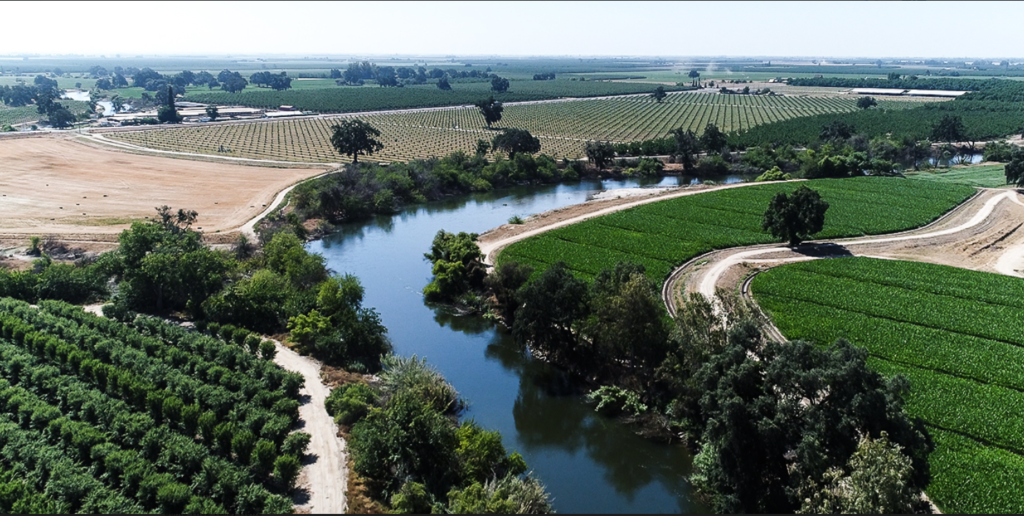
A Stanford study says the Kings River watershed, below Pine Flat Dam, is an ancient pathway for glacier-fed runoff and may be an ideal candidate location for recharge. The study found the underground pathway runs 15 miles onto the Valley floor and is high in sand, gravel and pebbles that can be mapped using technology that can identify the best place to recharge in wet years. That would help bolster the area’s sagging groundwater. A helicopter-based mapping effort was also done this year on the Kaweah watershed showing a similar profile of the alluvial fan near Visalia. Researchers call the ancient water pathways “paleo-channels”.The technology works by hanging a transmitter device below a helicopter which penetrates the ground with an electromagnetic field.The speed at which water can move through the paleo-channels can be much faster than other areas, said Graham Fogg, professor emeritus of hydrogeology at UC Davis, one of the authors of the new paper. Both the Kings and Kaweah watersheds feed farms and cities in Kings County to the west of the Sierra. Last chance for farm labor legislation
The lame duck session for the US Senate may be the last chance for grower back farm labor legislation, says farm activist Manuel Cunha of Nisei Farmers League.Proposed legislation already passed in 2021 in the House only needs Senate approval to become law. To pass it needs all the 50 Democrats voting this year and 10 Republicans, says Cunha who has long backed the idea.”We think we have 6 but need 60 votes” Also backing the legislation is the California Farm Bureau. Farm Bureau President Jamie Johansson recently joined farmers in urging the Senate to pass the Farm Workforce Modernization Act. “It is time to provide stability for our farmworkers, certainty for our farms and affordability for our grocery shelves”.
Hundreds of supporter from both ag and labor are in Washington rallying to support the proposal that would create a pathway to citizenship for the nation’s undocumented farmworkers.
For Republican senators, despite the conventional wisdom that every state is a farm state, a vote on immigration could create controversy at home given the activity at the border.
Ironically , the crackdown at the U.S. border has worsened the farm labor shortage. Still, some of the state’s most ardent Republicans — such as former Congressman Devin Nunes and Redding Rep. Doug LaMalfa — joined the Democrats to support the legislation when it passed the House last year.
The existing farm worker population with 90 percent of the state’s hired farm workers born in Mexico, includes over 770,000 who are settled in the US and 30,000 who work in California seasonally as H-2A workers.
Most of the settled Mexican-born farm workers were in their 20s and 30s when they arrived in the 1990s and early 2000s and are now in their 40s and 50s. Over half of settled Mexican-born farm workers are unauthorized, and most have US-born and -educated children who shun seasonal farm jobs, say Rural Migration News Thanks for lower gasoline prices
GasBuddy says at least nine Kings County gas stations are selling regular this week for under $4 including Yokut Gas and Costco selling at $3.89 a gallon – the lowest price of the year. It is good news as you fill up for the trip to grandma’s house this holiday. A plunge in world oil prices are helping to spur the decline with crude falling to almost $77 Wednesday Nov 23. AAA says the average King’s gas price has dropped 72 cents in the past month.
Election notes
Kings County voted against Prop 1, the Constitutional Right to Reproductive Freedom by 54 to 46% even though it passed statewide by 63%.
Kings county voted against Democrat Melissa Hurtado for state Senate by 5,000 votes. But Hurtado,who has worked hard to be the farmer’s friend regarding water, is in a close race with Republican David Shepard, behind by under 600 hundred votes districtwide. Hurtado’s strong base is Kern County.The race may yet change with thousands of ballots yet to be counted.
Speaking of close contests, Republican David Valadao has won a squeaker over Kern County-based Rudy Salas for the 22nd Congressional District with Salas now conceding. The vote tally was 51.7% to 48.3% districtwide while Valadao won in Kings County by 56.5%. GOP voters appeared to forgive Valadao for voting to impeach Trump .
Kings County’s turnout in this month’s election is 43% with just a handful of votes yet to be counted.
The 2021 raisin crop reached 93,120 tons at an average price of $1,696 per ton, says USDA. Harvey Singh, Chairman of the Raisin Bargaining Association (RBA) says he hopes growers can get $2000 a ton this year but prices won’t be finalized for a few weeks. The 500-farmer strong RBA represents about 25% of the raisin industry. Most of the nation’s raisins are grown famously within a 60-mile radius of Fresno.
Singh says this years’ crop was reduced by “terrible heat” that affected quality, in turn limiting their uses.Some rain also impacted the crop, he adds.Of course, the drought has continued to affect plantings as well, along with the high price of water
Acreage drops by half, tonnage down two-thirds
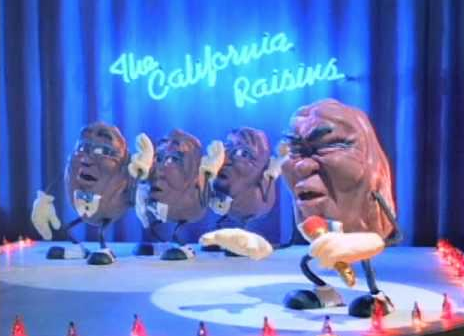
California raisins are not dancing any more as the size of the crop has shriveled to a third of what it was two decades ago.
The California raisin crop peaked in 2000 at 280,000 acres but now is less than half that. As of 2021 it was down to 138,000 acres and perhaps even less this year. Fresno County lost nearly 5000 acres from 2020 to 2021 with growers replanting with an alternate crop
The decline in acreage may be beneficial to the per-ton price growers who still have product as food processors use US-grown California raisins instead of product from Turkey or elsewhere. California tonnage was 3X today’s number just 2 decades ago.
Singh points out that people are not eating the amount of raisins that they used to.The primary user still is the bakery industry. Raisins in your morning cereal are made up of a mix of California and foreign raisins that are cheaper, he says.
Raisins may be less popular in part due to the explosion of more varieties of fruit available for Americans year-round including the rising tide of produce imports. Consumers have only so much room in their refrigerators or their stomachs and grocers have only so much room in their produce aisles.
Raisin production was once one of the most labor-intensive crop activities in North America, needing 40,000 to 50,000 workers for a typical six-week harvest, cutting bunches of green grapes, and laying them down to dry in the sun on paper trays. Newer varieties dry on-the-vine reducing labor requirements.
Olives are the pits too
The decrease in acreage and production in California reflects a similar but even more dramatic drop in another iconic California crop – olives. Olives are an alternative year production crop. This year USDA predicts we will produce just 20,000 tons -46,000 tons the year before. But twenty years ago in 2003 we harvested about 115,000 tons – that’s better than an 80% decline. This year bearing acres of table olives are just 12,000, says USDA compared to 36,000 acres twenty years ago -a drop of two thirds. Canneries that used to populate small towns in California like Lindsay are no more and one of the remaining family-owned canneries- Bell Carter near Walnut Creek recently sold out to a Spanish processor.
The state center of olive production used to be small farms in Tulare County with about 16,000 acres in 2003 – now half that in the latest 2021 county Crop Report.
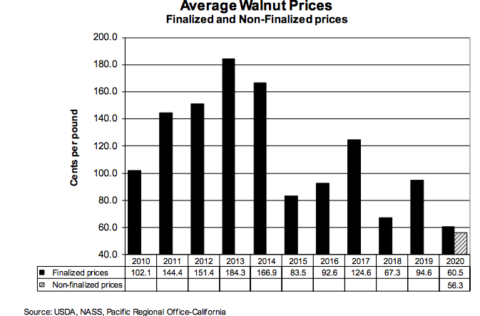
The Walnut Bargaining Association is recommending a minimum price recommendation that will return at least 65 cents per pound back to growers.
“Our organization is concerned that walnut prices will continue to fall without some minimum price being suggested,” said Jonathan Field, Executive Director of the Walnut Bargaining Association (WBA), a grower cooperative that exists to ensure walnut farmers receive fair prices.According to Field, current prices being offered by handlers will result in only 45 or 50 cents per pound going back to growers, which is substantially below break-even.
Walnuts were a $62 million crop in Kings Country in 2021. Prices have been trending lower in California for walnuts since 2013, says USDA.
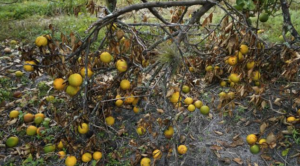
-October 20,2022- Agriculture losses in Florida from Hurricane Ian’s high winds and drenching rains could reach $1.56 billion, with citrus, cattle, vegetable and melon operations among the hardest hit, the University of Florida reported Tuesday in a preliminary estimate.
The school’s Institute of Food and Agricultural Sciences said there could be many impacts that are yet to emerge from flooded acreage and depend in part on whether some damaged crops can be replanted to salvage some of the winter vegetable growing season.
Citrus loss estimated to be $304 million
“There’s still a lot of uncertainty,” said Christa Court, an economist and director of economic analysis for the institute. “The effects can be very different in a single location.”
The estimated losses this year are for a high scenario of $1.56 billion and a low potential loss of about $787 million. That’s in an area of Florida where total agricultural production is valued at more than $8 billion on an annual basis, according to the report.
“It’s not completely devastating to the entire agriculture industry in the state,” Court said during an online news conference. “Some of the seasons were just getting started.”
Hurricane Ian swept ashore Sept. 28 in southwest Florida as a Category 4 storm with winds estimated at 155 mph (250 kph), then bisected the center of the state, where most agricultural production is located. About 5 million acres of farmland were affected by the storm, according to the UF report.
Before the storm, citrus production in Florida was already forecast to drop by a third compared with the year before, in part because of winter freezes and ongoing disease problems. Now, a primary source of orange juice for much of the nation will take another hit, with losses estimated at as much as $304.2 million.
And the harvest season for oranges, grapefruit, tangerines and similar fruit was just beginning.
“The impact on Florida’s affected commodities cannot be understated, especially the heartbreaking damage to Florida citrus, an industry already facing significant challenges,” state Agriculture Commissioner Nikki Fried said in a statement.
The University of Florida loss estimates do not take into account the impact on consumer prices, but the storm is likely to press prices upward and force orange juice producers to rely even more heavily on California and imported oranges from Latin America.
The estimated loss for vegetable and melon crops in Florida ranges from $208 million to $393 million. For horticultural crops — flowers, landscape plants, ornamental trees, sod grass — the loss could top $297 million. And for cattle and other animal production it’s as much as $221 million.
The greatest unknown is the effect flooding and heavy rains from Hurricane Ian will have over the long term. The university report indicates more than 20 inches (508 mm) of rain fell in places where the storm center passed, with 12 inches (304 mm) common outside that zone. Several rivers in farm regions set new flood stage records.
Some citrus trees weakened by the storm could die. Cattle that survived a flood could die from disease or injury and could have problems obtaining enough high-quality food in damaged pastures.
The complete damage picture in the flood areas, the report noted, “cannot be determined until fields dry out.”

 The Western Growers, California Fresh Fruit Association and Colorado Food and Vegetable Growers Association are actively opposing the proposed merger of Albertson’s and Kroger. The transaction would collectively represent 16 percent of the U. S. grocery market, second to Walmart at 21 percent.


 Today instead of being in charge of grading the cotton grown in the Valley, the Visalia center now sorts cotton from four states, California. Arizona, New Mexico and West Texas.

 Both the Kings and Kaweah watersheds feed farms and cities in Kings County to the west of the Sierra.
 California raisins are not dancing any more as the size of the crop has shriveled to a third of what it was two decades ago.
 The decrease in acreage and production in California reflects a similar but even more dramatic drop in another iconic California crop – olives. Olives are an alternative year production crop. This year USDA predicts we will produce just 20,000 tons -46,000 tons the year before. But twenty years ago in 2003 we harvested about 115,000 tons – that’s better than an 80% decline. This year bearing acres of table olives are just 12,000, says USDA compared to 36,000 acres twenty years ago -a drop of two thirds. Canneries that used to populate small towns in California like Lindsay are no more and one of the remaining family-owned canneries- Bell Carter near Walnut Creek recently sold out to a Spanish processor.

 The Walnut Bargaining Association is recommending a minimum price recommendation that will return at least 65 cents per pound back to growers.
 Agriculture losses in Florida from Hurricane Ian’s high winds and drenching rains could reach $1.56 billion, with citrus, cattle, vegetable and melon operations among the hardest hit, the University of Florida reported Tuesday in a preliminary estimate.