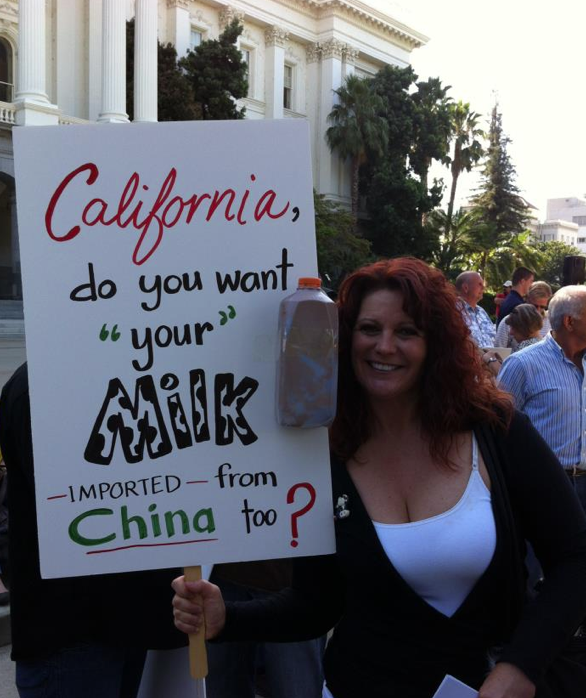
 Central Valley dairy operators are on the streets of Sacramento again this week demanding the state adjust the price they get for their milk from the state’s cheese makers who gobble up about half the supply.
One dairy tweeter says “Gov. Brown / Karen Ross: We’ll be at your office steps Oct. 18th @ 11:00 a.m. Bigger and Louder ! Your hands are stained with our industries Blood,Sweat,Tears and Generations of hard work to build California’s #1 Ag industry which you choose to destroy on YOUR inactions.
It’s in your stained hands to act. Give our industry a fair fight, we need our 4b milk price in parity with class 3 which is required by law.”
The state formula used to pay dairymen for their milk undervalues milk to the tune of $200,000 a month to the average dairy for the past 12 months argues Hanford dairyman Joaquin Contente who is speaking at this weeks rally
But CDFA ag secretary Karen Ross has already turned down petitions to adjust the formula as well as others to reconsider the May CDFA decision.CDFA has a tough balancing act to insure both the supply of milk and profit margins of the state’s huge cheese making industry remain healthy.
At the moment nobody could argue the dairy operators are a healthy bunch right now.
Empty Barns
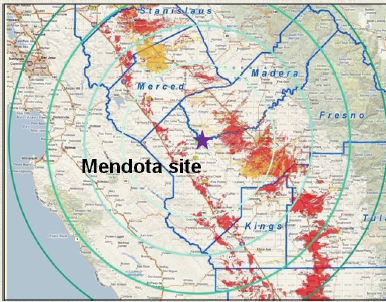
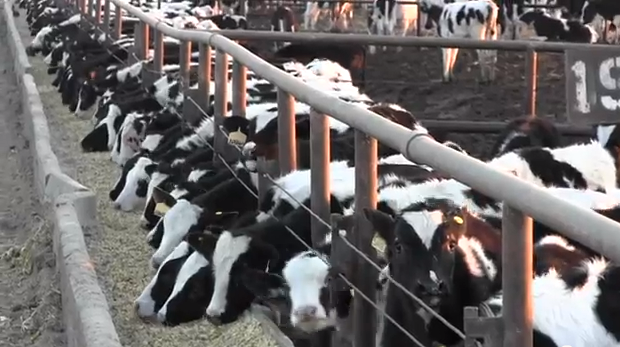
Western United Dairymen CEO Michel Marsh says 100 dairies may go out of business this year as low prices for milk earlier this year and record high prices for feed along with years of debt are making herd dispersal auctions and more empty barns commonplace. That’s happening right now around Kings and Tulare counties, the nations biggest dairy region.
In a fast moving story the region is producing of months less milk and there are worries there could be far less.
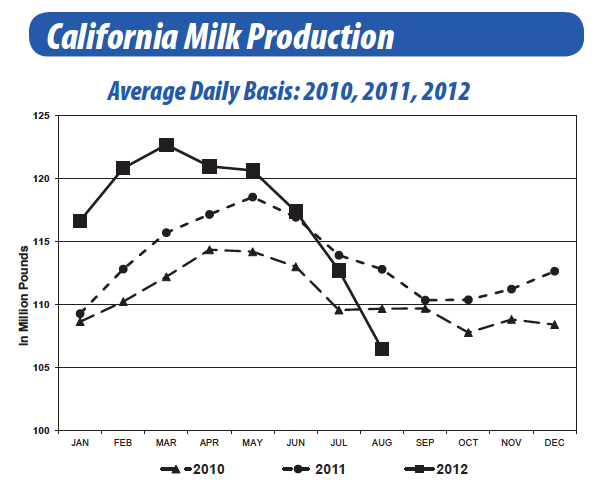
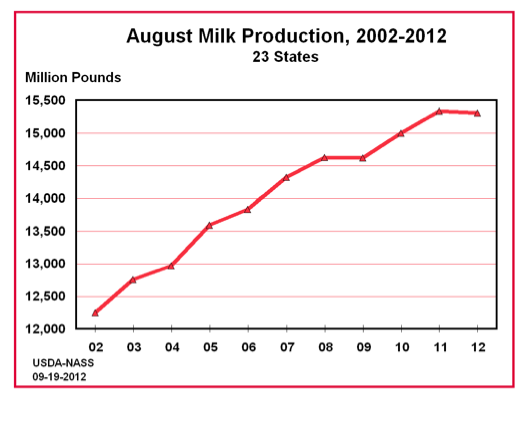
A recent CDFA report says in August Kings County milk production was down nearly 10 % compared to the same month a year before.Statewide we were down 5.8%.
Contente who ships milk to co-op Land O Lakes in Tulare says LOL is receiving about 6 to 7% less milk every day than a year ago due to cow liquidation – dairies being shut through bankruptcy or lender pressure. Another big co-op CDI is down millions of pounds as well, the two largest state players. CDFA reported a decline 29% in nonfat milk production in August, a huge product for the export market.
The decline in the local milk supply has a face to it as long time dairy operators throw in the towel including Tulare County dairyman Warren Hettinga who sold off his cows at his 4 locations this past month including all rolling stock and farm equipment.
Kings County’s John Camara with 75 year in the dairy business sold off his herd this week,October 16 at the Overland Sales yard in Hanford.
“Every time I turn around there is another neighbor dairy going out.” shrugs Contente.
While a state price adjustment won’t fix all the problems by a long shot, Contente says “we’ve been subsidizing the cheese business since the 1980s when the state order helped attract the big cheese plants that were built like Leprino in Lemoore.”
Another dairy blogger from Kings County, the Dairy Goddess, recently pointed to a September lawsuit against CDFA on the same issue.
“On September 4th a lawsuit was filed against the CDFA . We dairy farmers have asked three times for a fair price for our milk. Three times we have been denied. Secretary Ross is not following the law. The law is very clear, “the price announced by CDFA must be in reasonable alignment with prices paid for comparable milk produced and sold around the country”. This law has not been followed. California dairy farmers have continued to be paid $2.00 per hundred weight less for our milk than our neighboring states. That is 20 million dollars we have been robbed.”
Some Hope
Despite all the bluster, a lawsuit and administration bashing – behind the scenes there appears to be some serious discussions and maybe a realization of how bad it is out there.
In the past few weeks a high level meeting said to include Ross, a representative of Governor Brown and leadership from dairy producers has offered a glimmer of of hope says Western United Dairymen president Tom Barcellos of Porterville.”At least we are still talking” says Barcelleos whose industry group represents 60% of milk produced. “I think Ross became aware of some facts she did not know about”says another source.
One mega development in the past few weeks has been the bankruptcy filing of Fresno-based Zacky Farms who employs about 1000 workers but is, like the dairy industry, dependent on feed from the Midwest where drought has cut supply and raised the cost of feed to red ink levels. The collapse of a major player in California ag is sobering even as the number of dairy bankruptcies this summer has skyrocketed. Fresno bankruptcy attorney Riley Walter reported earlier this year.”This is just a bloodbath. In the past 18 months I have been worked on 58 dairy bankruptcies.”
Of course it’s not just formal bankruptcies you have to look at.Banks are feeling the pressure when strapped dairymen are not paying their bills and are calling some loans say industry leaders,forcing the liquidation of assets.
But rumors that a major dairy lender, Wells Fargo, has pulled the plug on the dairy industry are not true says Bill Hoover, Business Development Officer for Wells Fargo in Visalia.
“When a dairyman says Wells Fargo is getting out of the dairy business he may be referring to his own business, but not the business.”
“We still have a healthy dairy portfolio of over $1 billion dollars and much smaller portfolio that is not so healthy” adds Hoover.”For us it is definitely not going to be lights out on the dairy business.”
Hoover adds that they continue to work with some local dairymen who are downsizing but working to stay in the business while others are getting out, selling their land,often to farmers who want to plant trees.
Feed Issue
Asked why the California dairy industry doesn’t plant more of their own feed like Wisconsin instead of depending on a distant region for its feed supply both Contente and Barcellos point to the cost of land in the Valley and huge demand for more profitable crops.
“Where I am standing now, on field crop land I am surrounded by land that has been recently purchased and will be soon planted to to pistachios. It’s worth $15,000 an acre,far more than we can pay to grow more feed.”Ironically, a few decades ago it was dairies relocating from the LA Basin that pushed out cotton and field crop farmers.
Still some dairymen like Barcellos grow most of their own feed and with some experimentation other grains,canola and sorghum could help supplement the increased corn being grown in California (up 30% this year) where unlike the Midwest, the drought has not been so severe. Still comparison to Wisconsin have to admit because they are in a federal system they get about $2 per cwt more for their milk. That brings us back to Karen Ross.
All the trouble in the livestock industry whether dairy or poultry is putting the hurt on local feed vendors and other suppliers like Western Milling in Goshen who supplies both Zacky and area dairies.The bankruptcy filing by Zacky indicates some $6 million owed to Western Milling .”All these problems spill over to the vendors” says Hoover, and the banks obviously. Don’t forget the economy. Don’t forget those cheese makers.To quote a phrase”Got Milk?”
Maybe that’s what secretary Ross may be seeing – the unraveling of the states’ largest industry if some relief is not offered, at least for a while.