Ag News: Diamond Foods , Cows & Cotton

Can Cows Live Longer?

STOCKHOLM, Sweden. (Aug. 20, 2013) — Top international dairy scientists argue longer and healthier lifetime for cows. Typically a high production herd can turn over in 3 years requiring extra cost and effort to bring in new recruits.

For the first time ever, twelve of the leading dairy farming scientists and experts meet to discuss and elaborate on issues regarding cow comfort and best practices to increase lifetime productivity. In a conference hosted by DeLaval, at Hamra Farm outside Stockholm, Sweden, Aug. 28-29, this team will discuss-  How can I make my cows live longer, keep the culling rate down and maintain productivity at the same time?

“The high turnover rate of cows in intensive milk production is receiving increased attention around the globe. Apart from welfare consequences, too short a productive lifetime has a negative impact on farm profitability and sustainability. We believe that all actors in the dairy industry are responsible for making sustainable milk production possible. One of the aims of the conference is therefore to bring awareness and knowledge on how to improve the productive lifetime yield of cows,” said Tim Nicolaï, Vice President Aftermarket & Services at DeLaval International.

Diamond Foods Details Settlement In Financial Reporting Case

San Francisco based Diamond Foods has reached a proposed settlement in the case involving  alleged improper financial reporting made to growers in August 2010.The terms involve  a payment of of $11 million in cash and 4.45 million shares of common stock for a settlement fund paid to plaintiffs in a lawsuit.

California Field Crop Harvest Lower in 2013

USDA says the state’s 2013 corn crop is anticipated to be down 3% from 2012 with acreage down 6%.

The cotton crop is down as well with Upland variety expected to be down 29% and American Pima down 27%.The state total cotton acreage is expected  to fall to 278,000 acres from 365,000 acres in 2102 with the drought apparently having an effect as well as planting of more permanent crops.
Also forecasted to be down in 2013 is alfalfa hay in California  estimated to be 4% lower  this year.To make up for it  US hay harvest is forecasted to be up 15% but the lowest  level since 1955.

Ag Roundup: Fertilzer Tax, Parlier Winery Growing, Paramount Adding Greenhouse

Fertilizer Tax Coming?

AB 69,authored by Fresno’s Henry Perea,would impose a 1 percent tax on all fertilizer sales,dedicated to reduce the presence of nitrates in drinking water, with the authority to increase the tax up to 4 percent based on certain conditions beginning in 2016.The measure will be heard soon by two state Senate committees.
The talk is a fertilizer tax is might be used to pay for county by county monitoring of farm fertilizer use – similar to the monitoring of pesticide use  – a burden that could fall of county ag departments speculates Tulare County Ag Commissioner Marilyn Kinoshita.“We’re getting lots of invitations to fertilizer meetings.”

Raising Corn Yield

A Merced County field demonstration by Wilbur Ellis Co and BASF will offer their latest research on increasing the yield of corn grown in California. The company effort named Project Symphony is a three-year undertaking of corn trials on a dozen or so sites across the country with the goal of raising the current corn yield of 150 bushels to 300 bushels per acre. Scientists project that corn is biologically capable of yielding 500 bushels per acre.  Project Symphony Field Day takes place at Double Diamond Dairy 782 West Washington Road or the NW corner of Highway 59 and Washington Road, El Nido California on August 20.

Winegrape Harvest Starts Early

In California vineyards, the 2013 winegrape harvest has gotten off to an early start. Farmers throughout the state report their crops have been maturing at least a week ahead of a typical schedule. It’s still too early to tell whether the crop will challenge last year’s volume record. Grape growers say their crops look good, but that they worry about availability of water and about being able to hire enough people to pick their grapes once harvest peaks.

Paramount Citrus Adding 36,000sf Greenhouse In Visalia

Paramount Citrus is building a 36,000sf greenhouse at their rural Visalia facility on Rd 172. The large greenhouse valued at $1.5 million is being constructed by Conley’s Manufacturing. Paramount will grow their nursery stock inside in light of the growing citrus pest problem caused by the Asian Citrus Psyllid. Most nurseries who want to keep shipping are building screen houses.

Psyllids In Tulare County…. No News Is Good News

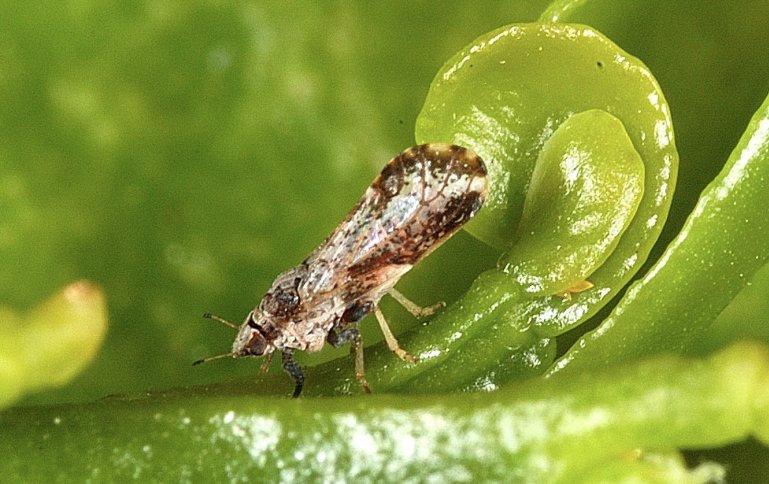
California officials have quarantined an area in the state’s citrus belt after the discovery of tiny pests capable of killing citrus trees.The California Department of Food and Agriculture announced July 31 that 178 square miles in Tulare County have been quarantined following the detection two weeks ago of six Asian citrus psyllids around Porterville.
Since then,a month after those finds,there have been no new detections say county ag commissioner Marilyn Kinoshita.”that’s good news” she says. Growers who who have to move their fruit out of the quarantine zone to a packing house  have  to pay an extra $4 a bin the remove the leaves.

O’Neill Vintners in Fresno County

Parlier Winery Adding New Tanks

O’Neill Vintners continue to grow its large Central Valley winery in Parlier with issuance of permits for several new tanks this summer. CEO Jeff O’Neill who founded the company in 2004 says they “built the facility from the ground up in 2007 and have been expanding since.”
“No one had built a new winery in the Central Valley in about about 25 years.”
Today, O’Neill Vintners has grown to become the 8th largest U.S. winery and has earned a reputation as one of the premier custom wine producers in California.
“We’ve about doubled our production since 2007,now 35 million gallons  and our employment has doubled as well to around 120 today” he says.
“We get our grapes from as far north as Lodi and as far west as the Central Coast” he says noting the winery’s strategic location in the middle.
O’Neill says this year’s grape crop is average size and good quality  adding that demand for wine is “robust” with an emphasis on reds.
O’Neill says their wines find their way into lots of famous brands.

Some contribution by CFB

Ag Updates: Raisins,Olives, Solar, Bank Of Sierra

click to enlarge

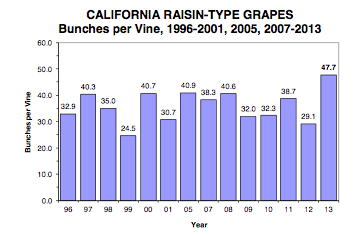
RAISIN-TYPE GRAPE PRODUCTION UP 25.5 PERCENT

The California raisin-type variety grape forecast is 2.40 million tons, up 25.5 percent from the 2012 final production according to USDA. Based on the objective measurement survey, bunches per vine totaled a record 47.7 compared to 29.1 in 2012. Acreage of bearing age is 200,000,which means a record high yield is expected. The 2013 California raisin-type grape crop is shaping up to be the largest crop since 2008. Weather conditions have been good for crop development, which is a few days ahead of normal. Mildew pressure was low, but mites were significant.

OLIVE CROP DOWN 4 PERCENT

USDA says the 2013 California canning olive crop forecast is 75,000 tons,down 4 percent from last year’s crop of 78,500 tons. Bearing acreage is estimated at 25,000 for a yield of 3.00 tons per acre.The California canning olive crop outlook was looking positive, but
the crop looks to be slightly lower than 2012. Weather conditions
during the bloom period were generally good. The crop is 1-2 weeks ahead of normal.

TULARE CO BASED SIERRA BANK CORP PROFIT UP 48%

For the second quarter of 2013, Porterville-based Sierra Bancorp reported a net income of $3.8 million, up 48%, from the second quarter of 2012. and its stock is up over 40% year to date.The bank holding company has 25 branches and 400 employees. Bank of Sierra has just under a 20% market share in the county for deposits, the top bank ahead of number two of Bank of America in the latest FDIC survey. The health of the bank is good proxy for the health of Tulare County. Its latest results are the highest since the fourth quarter of 2009  – just as the recession hit.

MORE AG FIRMS ADD SOLAR

A second Tulare County dairy has added solar to help power their production this month. Already Curti Farms of Tulare has a 719Kw system covering 85% of their power needs and now Woodville-area diary Fernandes Bros is adding a 1MW unit valued at $2.8 million that should handle 95% of the farm’s power requirements.
In Parlier ,SunWest Fruit Co. is expanding its Pickett Solar installation to around triple its original size.The Parlier, Calif.-based grower-shipper is adding a 2-megawatt project that will bring its total offset of electricity to 72%, SunWest Fruit president Martin Britz said in a news release.The addition to an existing system will bring its overall size to 2.9 megawatts, with 9,576 solar panels. That will offset about 3.9 million kilowatt hours annually, the equivalent of 490 homes.
Pickett Solar — a division of Fresno, Calif.-based Don Pickett & Associates — has done solar projects for clients including Fowler Packing Co., Cook Land Co., Mid Valley Packaging & Supply and the U.S. Department of Agriculture.
In Kingsburg, HMC Farms, is moving forward with Cenergy Power on a 10 acre solar photovoltaic farm. The large 2.2 megawatt (MW) solar system will span across 390,000 square feet of ground space and will enable HMC to significantly hedge against rising electric utility charges on two cold storage and packaging meters.  An additional 70 kilowatt (kW) solar carport will be added to supplant HMC’s energy use at the main office building on the property.

Some Key Farm Production Costs Head Lower

for California livestock and diary producers feed costs have been a huge burden

California farmers spent a little more to bring in the harvest in 2012 says a new USDA survey. But that increase was small – up 0.5 percent – below the cost of inflation. Now there is strong indication that the costs of key components including feed are heading lower in 2014.

The USDA report, released Aug 8, says feed costs
were up 7.2% – largely due to the Midwest Drought and high corn prices. Feed costs were a heavy burden for all of California’s livestock and diary industry.

But farmers also paid more for fuel – higher by 7.1% in 2012.

The survey shows that other costs were lower in 2012 – like interest rates paid out on loans – down 24% from to 2011.

Farm services were also lower including components like insurance and custom harvesting – down 2%.

Farmers might be surprised to know that in 2012 their labor costs were flat. Machinery was less – like tractors that fell 5.8%. Truck expenditures were down as well.

Fertilizer costs fell 6.8% likely based on continued low natural gas prices.Now there is indication these prices will move lower on 2014. A new University of Illinois report predicts fertilizer costs that averaged $200 per acre in 2012 could be in the $125 to $150 range for 2014.That is in part due the collapse of  a Russian cartel controlling potash prices. A Russian phosphate company – Uralkali exited a partnership agreement that controlled 43 percent of potash exports in late July.

Speaking of cartels, OPEC’s influence seems to be waning.

The US government is predicting lower petroleum prices for 2014 as well.Farmers are a big users of oil and particularly diesel fuel which was up 7.1% in 2012. On Aug 6 the US Energy Information Agency predicted diesel fuel that averaged $3.96 across the US in 2012 will fall to $3.92 in 2013 and $3.76 per gallon in 2014.

Looking on the feed side a big Midwest corn corp looks to dramatically reduce feed costs in 2014 with a 34% larger crop in store this fall. That could mean $4/5 corn compared to $7/8 a bushel last year, a huge break for livestock producers and dairy operators and likely all consumers food costs.Perhaps not celebrating will be the corn growers.

Milk Production Falls In Tulare/Kings During First Half of 2013…. But Gains Market Share

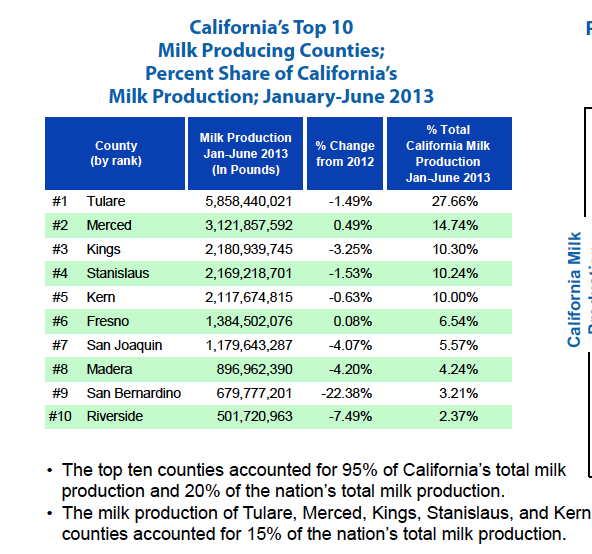
While milk production fell overall in both Tulare and Kings counties in the first half of 2013 the two neighboring counties added to their state market share for milk production.

The latest numbers are from CDFA’s Mid-Year statistics report.

Number one Tulare County produced 1.5% less milk in the first half of the year compared to the same period in 2012 according to CDFA (see chart). Kings County milk production also fell by a heftier 3.25%.
Kings is the state’s number three milk production county.

But aded together the two counties that share the Tulare Lake Basin pumped out 38% of the milk produced in California – up from a combined 37% in 2012. It was a combined 35% in 2005.

The higher comparative percent share comes as Southland counties milk production fell even more this year. San Bernardino County milk production was down over 22%. and Riverside was down 7.5% as the traditional LA region dairy industry continues to shrink.

Statewide milk production dropped -2.9%

Nut Boom & Grapes Propel Kern County Past Tulare To Number 2 In Crop Value In 2012

The 2012 gross value of all agricultural commodities produced in Kern County was $6,212,362, the county’s ag commissioner announced this week. This represents an increase (11%) from the revised 2011 crop value ($5,596,975,600).

The top five commodities for 2012 were Grapes, Almonds, Milk, Citrus and Pistachios, which make up more than $4 Billion (65%) of the total and with the top twenty commodities making up more than 92% of the total.

The $6.212 billion edges out Tulare County at $6.210 billion in 2012 with Fresno County still in the lead at $6.58 billion, all announced in the past few weeks.

Kern’s fruit and nut crops were up around $550 million in 2012 over 2011 while feed crop values fell as did milk.

Big plantings of nut crops are boosting values with pistachios totaling nearly 75,000 acres now. Also enjoying a boom are pomegranates with some 16,370 acres planted – 2000 of those acres just last year.

Central Coast Experiments With Blackberry Crop

Blackberry production area is continuing to expand along the coast of California driven in large part by growing consumption of all of the “minor” berry crops. Market demand for blueberries and raspberries has led the growing consumer demand over the past 10-15 years beyond traditional strawberry. Similarly, over the past 5-10 years, blackberries have also seen increased consumption fueled in large part by the availability of improved varieties.

New varieties with improved productivity, flavor, and post harvest attributes has led much of the growth in demand of blueberries and raspberries and those factors are now contributing to expanding demand for blackberries. Improved eating quality among newer blackberry varieties in particular has been important in expanding consumption.

In a word the berries are sweeter. Consumers are seeing some of the new fruit at SLO and SB farmers markets.

Most of the blackberry crop comes from Mexico but recent trials on the Central Coast over the past several seasons have revealed that of the traditional floricane fruiting blackberries, the Ouachita variety combines good fruit flavor with vigorous, thorn- free plants. Production on Ouachita in San Luis Obispo and Santa Barbara counties begins in mid June – just as Mexico is finishing shipments to the US. Some growers are successfully also growing other varieties such as Natchez, Apache, and Triple Crown for fresh markets but Ouachita is a thorn-less, reliable producer.

Article adapted from paper by Mark Gaskell, Specialty Crops Advisor, UC Cooperative Extension, Santa Barbara and San Luis Obispo Counties

Newly Found Asian Citrus Psyllids Prompt Quick Action In Tulare

After finding six Asian citrus psyllids (ACP) on three Tulare County yellow sticky traps last month, California scientists and officials are encouraging farmers to aggressively monitor and treat their orchards to prevent the sad fate befalling citrus farmers in Florida, where the pest and a serious disease it spreads are running rampant.

The July ACP find prompted the California Department of Food and Agriculture to quarantine 178 square miles in the Porterville area, placing severe restrictions on the movement of local citrus nursery stock and citrus fruit outside the area. It also prompted several hundred farmers and pest control advisers to gather July 30 at the International Agri-Center in Tulare for an update on the threat.

Like a scene from the film “Scared Straight,” Ken Keck, former executive director of the Florida Department of Citrus and now director of the California Citrus Research Board, admonished the California farmers to learn from the Sunshine State’s mistakes.

“I feel like the ex-con in front of a room of 17-year-olds,” Keck said. “All I can say is, ‘prevent, prevent, prevent.’”

Asian citrus psyllid is established in Southern California. Efforts in the southern part of the state are focused on managing the psyllids to reduce the likelihood they will find a tree infected with huanglongbing. Huanglongbing (HLB) is an incurable and fatal disease of citrus spread by ACP.

By working together and following science-based treatment strategies, UC Cooperative Extension specialist Beth Grafton-Cardwell believes farmers and CDFA can still eliminate ACP in the San Joaquin Valley, where the bulk of the state’s commercial citrus is grown.

At the Tulare meeting, Grafton-Cardwell explained the eradication strategy she developed by studying Asian citrus psyllid and huanglongbing disease management programs in Florida and Texas, another state where the pest is well established.

“We want to slow the spread of psyllid into new areas,” Grafton-Cardwell said. “We want to prevent psyllids from finding HLB infected trees.”

Although it is unlikely the pest and disease can be kept at bay indefinitely, Grafton-Cardwell said the battle will buy time for researchers to discover long-term approaches for maintaining California’s citrus industry in the presence of ACP and HLB.

Developing citrus varieties resistant to HLB through traditional breeding or genetic modification will take too long, she said. Scientists are considering such futuristic solutions as inserting HLB resistance into a mild form of the Tristeza virus and inoculating trees with the virus to fight HLB.

“Everyone is racing to come up with tactics to fight ACP and HLB,” she said. “I believe we will eventually be using multiple approaches, such as a repellent spray to keep ACP off the trees and perhaps breeding ACP that can’t transmit HLB and then flooding the population with these incapacitated psyllids.”

To fight ACP and HLB, growers and homeowners can access detailed information on the pest’s distribution, monitoring methods and treatment options on a new website created by Grafton-Cardwell with funding from UC Agriculture and Natural Resources.

For tap sampling, spray a plastic surface with
soapy water and tap branch over surfac

The website advises farmers and homeowners to regularly conduct visual surveys and tap sampling (see video on right) in their orchards. “Yellow sticky card traps are not very attractive to psyllids,” it says.

If psyllids are found, immediate action is required.

Adult psyllids should be placed in a container with 90% alcohol and reported to the county agricultural commissioner’s office so the insect can be tested for HLB. Immature stages of the pest should be left on the tree so the ag commissioner’s office can make an official regulatory collection.

An ACP find should also trigger rapid and wide treatment with the most effective pesticides po

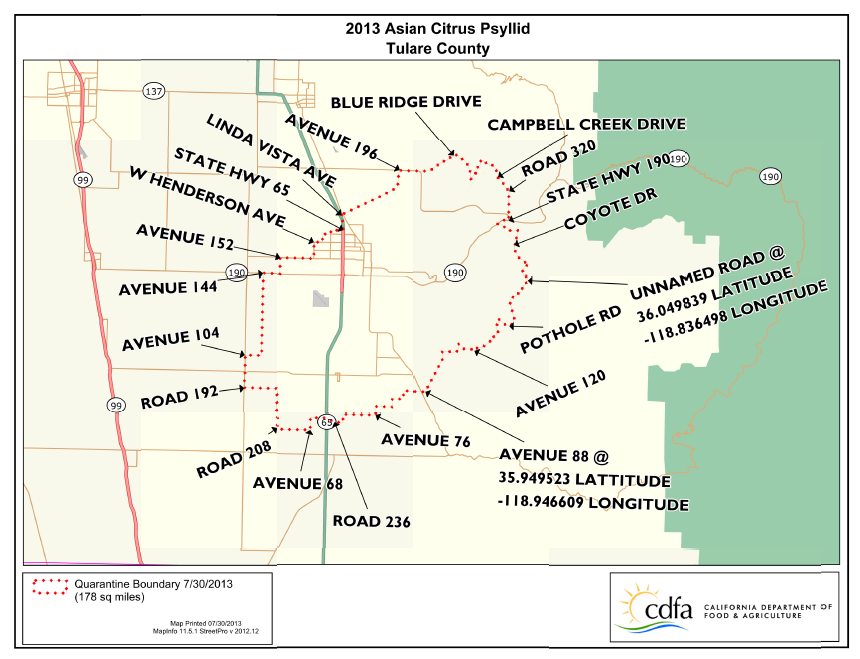
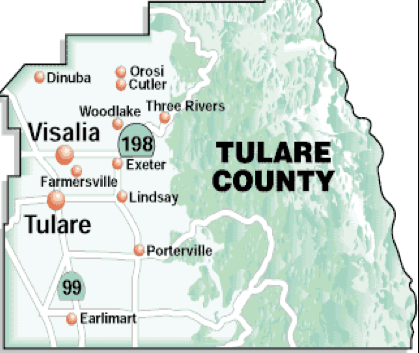
ASIAN CITRUS PSYLLID QUARANTINE IN TULARE COUNTY STRETCHES 178 MILES

CLICK TO ENLARGE

Santa Barbara County Now In Quarantine Too

SACRAMENTO, July 31, 2013 – A portion of Tulare County has been placed under quarantine for the Asian citrus psyllid (ACP) following the detection of psyllids at three locations in the Porterville area.
The quarantine zone measures 178 square miles, bordered on the north by an area near Blue Ridge Drive and Campbell Creek Drive; on the east by an area near State Highway 190 and Coyote Dr.; on the south by Avenue 68 near State Highway 65; and on the west by an area near Avenue 104 and Road 192. A link to a map may be found at: http://www.cdfa.ca.gov/plant/acp/maps/quarantine/3435ACP_Tulare_20130730.pdf
The quarantine prohibits the movement of host nursery stock out of the quarantine area and requires that all citrus fruit be cleaned of leaves and stems prior to moving out of the area. An exception may be made for nursery stock and budwood grown in USDA-approved structures designed to keep ACP out. Residents with backyard citrus trees in the quarantine area are asked to not remove fruit from the area.
In addition to Tulare County, ACP quarantines are now in place in Ventura, Santa Barbara, San Diego, Imperial, Orange, Los Angeles, San Bernardino and Riverside counties.  A total of more than 45-thousand square miles are under quarantine.
The ACP is of grave concern because it can carry the disease huanglongbing (HLB), also known as citrus greening. All citrus and closely related species are susceptible hosts for both the insect and the disease. There is no cure once a tree becomes infected. The diseased tree will decline in health until it dies. HLB has been detected just once in California – last year on a single residential property in Hacienda Heights, Los Angeles County.

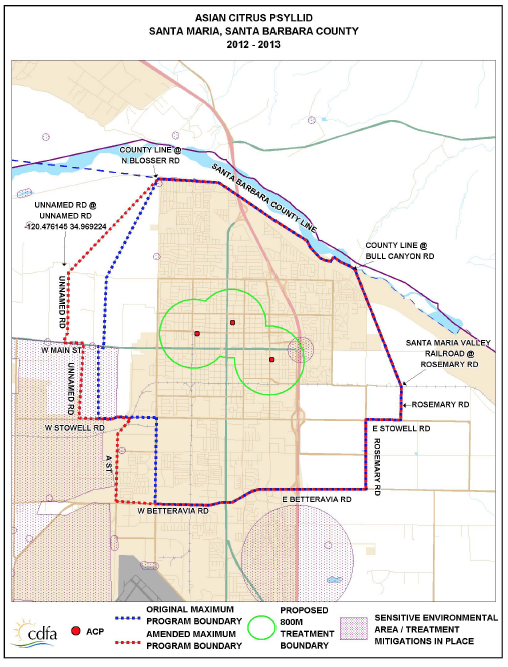
Quarantine near Santa Maria
Click to Enlarge

Residents in the area who think they may have seen the Asian citrus psyllid are urged to call CDFA’s Pest Hotline at 1-800-491-1899. For more information on the Asian citrus psyllid and huanglongbing disease please visit: http://www.cdfa.ca.gov/plant/acp/index.html

Tulare County Crops Valued At $6.2 Billion In 2012

Tulare County agriculture continued to fill the worlds dinner plates in 2012 with the annual crop value placed at $6.2 billion compared to $5.6 billion in 2011. The value of the county’s crop is right behind number one Fresno County who reported $6.6 billion in 2012 – down from $6.8 billion in 2011.

Grape led the way in 2012 in Fresno County valued at $1.1 billion and in Tulare County grapes were number two after milk – jumping  from $529 million in 2011 to $863 million in 2012 on nearly 5000 fewer acres! The biggest increase came in raisins where the crop value went from $1250 a ton in 2011 to $1900 a ton in 2012.

The biggest crop category in Tulare County was milk, as usual, at $1.8 billion down 12% from the year before.Meanwhile fruit and nuts enjoyed a 29%increase in value.

In the citrus category ( number three crop) acreage reached 118 thousand acres in 2012 with tangerine acreage about the same as Valencia acreage – around  17,000 acres. The value of the Valence crop in Tulare County in 2012 was $96 million compared to $140 million for the same acreage in tangerines.

Enjoying significant  bounces were the values of the pistachio crop,peaches,oranges,walnuts,almonds and olives.Timber sales were higher.

Tulare County grows 120 different commodities with 43 of those with a value of over $1 million. The crops are exported to 84 countries.