Peach Crop Down 8 Percent Says USDA On Warm Winter

July 2,2015

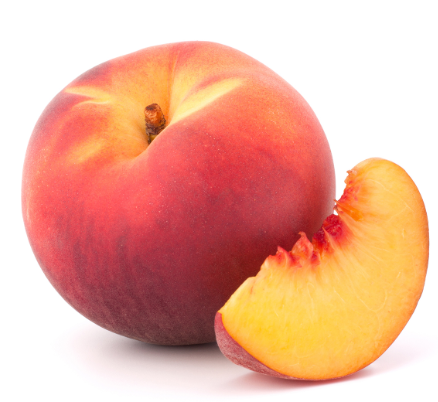
Screen Shot 2015-07-02 at 10.03.30 AMAs summer has arrived, the 2015 California peach harvest is underway. The initial USDA, National Agricultural Statistics Service (NASS) forecast for California’s 2015 peach crop was set at 566,000 tons, down 8 percent from last year and the smallest crop in over a decade. The freestone peach crop, destined mainly for the fresh market, is forecast at 260,000 tons, while clingstone peach production, used entirely for processing, is forecast at 306,000 tons. Both are down 8 percent from a year ago, at the lowest level in at least the past decade. Light supplies have put little upward pressure on fresh peach prices early this summer. In addition to increased supplies from South Carolina and Georgia, increased imports from Chile this winter have resulted in lower prices for off-season imported fruit, mitigating early-season price gains in California.

USDA’s NASS Pacific Regional Office forecast California’s 2015 dried plum (prune) crop at 100,000 tons, dried basis, down 4 percent from the previous year. Though higher than 2013’s 85,000-ton harvest, this year’s crop is 14 percent below the previous 5-year average—the fifth smallest crop since 2000. Statewide bearing acreage has steadily declined since 2000 and this year’s warm winter and early spring likely limited fruit size, causing average yields to decline. Because production is forecast to be slightly down in 2015, only a little increase in carry-in volume will keep this upcoming season’s overall domestic supplies relatively unchanged from 2014/15, likely preventing any major swing in the 2015/16 season-average price.
On June 24, NASS released its first forecast for the 2015 U.S. sweet cherry crop. The current forecast puts domestic production at 338,485 tons, down 11 percent from 2014 and 5 percent below the previous 5-year average, if realized. Smaller crops in the Pacific Northwest and in Michigan, the main producer in the eastern half of the country, are pulling down overall production. Despite the anticipated smaller crop this year, domestic shipments for the season through mid-June were running significantly above volume levels reported the same time last year, easing early prices for U.S. sweet cherries.
Warm weather this winter and spring accelerated the progress of melon crops in Arizona, California, and parts of the U.S. south. Domestic shipments for the season through mid-June were running ahead of last year’s.

June 29.2015

from California Weather Blog

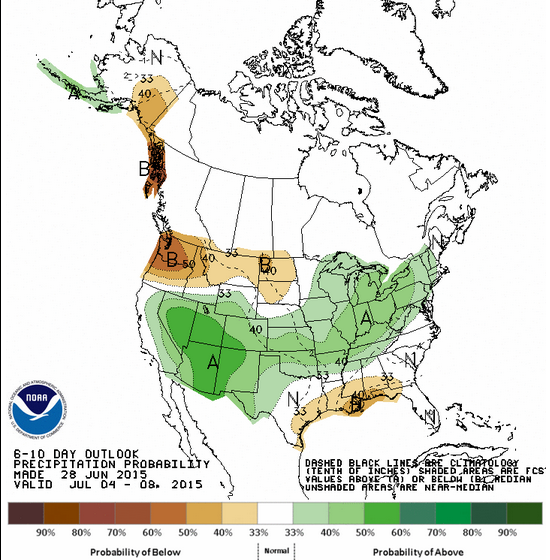
“Looking forward into July: long-range outlooks suggest the potential for a rather active pattern to persist for much of the summer in California and across much of the American Southwest. The CFS currently foresees far above-normal chances of precipitation along the CA coast during July, though it’s important to keep in mind that average precipitation this time of year is near zero, so even a small amount of rainfall would lead to far above-average totals in a relative sense.

Screen Shot 2015-06-29 at 7.38.02 AM
The CFS model is currently suggesting the potential for an usually active warm season pattern during July across California and the rest of the Southwest. (NOAA/CPC)
It’s not clear at the moment whether this unusual warm season precipitation signal is coming from an active monsoonal flow pattern (which we are currently experiencing) or from more tropical sources (in the form of remnant energy/moisture from the eastern Pacific Ocean). Hurricane season in the East Pacific has already gotten off to a record-breaking and hyperactive start–and this high degree of activity is expected to continue for the rest of the summer and fall as ocean surface temperatures remain exceptionally warm. It is worth noting that summer during which strong El Niño conditions are in place tend to feature at least a handful of interesting warm season weather events in California.
Micro El Niño update
A new, powerful westerly wind burst is currently underway in the far western tropical Pacific, and is expected to strengthen/shift eastward in the coming days. (SUNY Albany)
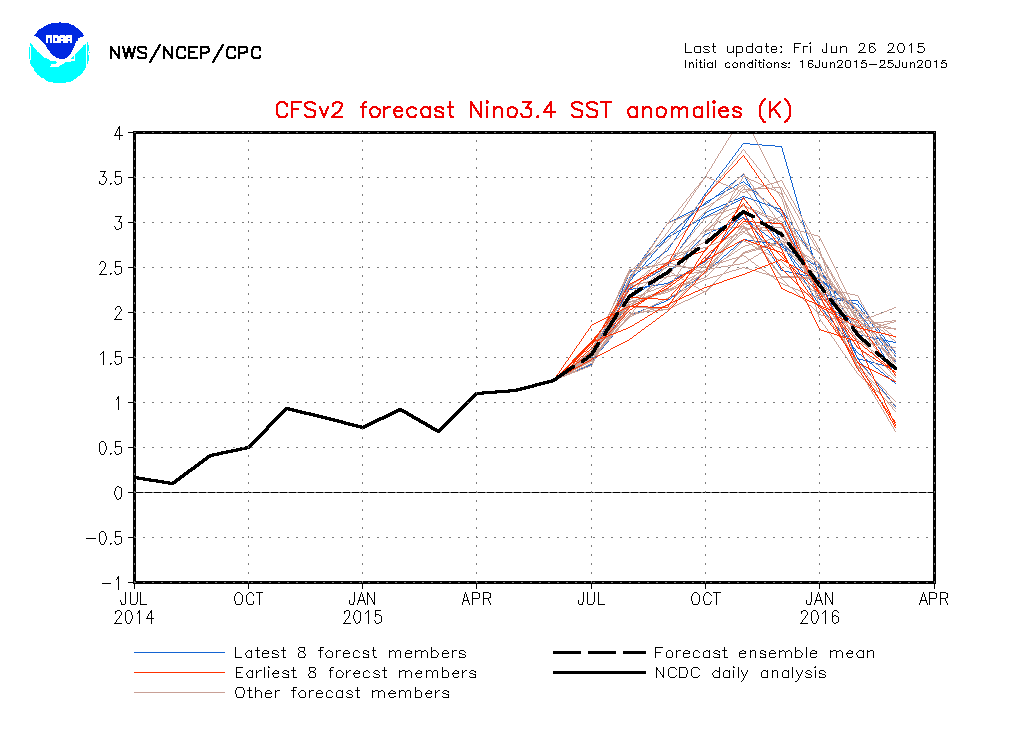
With each passing week, it seems more and more likely that the world will experience a strong El Niño event in 2015. We’re almost there already–observed conditions are right at the official threshold for declaring a “strong event.” All major dynamical models suggest further strengthening, and several of the best models are still suggesting the potential for quite a bit of additional strengthening.

Screen Shot 2015-06-28 at 2.54.06 PM
The latest runs of the CFS are continuing to call for the strongest El Niño event on record by the fall months–and this is starting to look more plausible as we have now mostly emerged from the so-called Spring Predictability Barrier. As of this writing, a new, powerful westerly wind burst was just beginning in the far West Pacific–a very strong sign that a third major Kelvin Wave may be on the way and that this El Niño event will continue to intensify for at least the next 3 months.”

Weather Blog – Monsoon Season Affecting California

June 29.2015

from California Weather Blog

“Looking forward into July: long-range outlooks suggest the potential for a rather active pattern to persist for much of the summer in California and across much of the American Southwest. The CFS currently foresees far above-normal chances of precipitation along the CA coast during July, though it’s important to keep in mind that average precipitation this time of year is near zero, so even a small amount of rainfall would lead to far above-average totals in a relative sense.

Screen Shot 2015-06-29 at 7.38.02 AM
The CFS model is currently suggesting the potential for an usually active warm season pattern during July across California and the rest of the Southwest. (NOAA/CPC)
It’s not clear at the moment whether this unusual warm season precipitation signal is coming from an active monsoonal flow pattern (which we are currently experiencing) or from more tropical sources (in the form of remnant energy/moisture from the eastern Pacific Ocean). Hurricane season in the East Pacific has already gotten off to a record-breaking and hyperactive start–and this high degree of activity is expected to continue for the rest of the summer and fall as ocean surface temperatures remain exceptionally warm. It is worth noting that summer during which strong El Niño conditions are in place tend to feature at least a handful of interesting warm season weather events in California.
Micro El Niño update
A new, powerful westerly wind burst is currently underway in the far western tropical Pacific, and is expected to strengthen/shift eastward in the coming days. (SUNY Albany)
With each passing week, it seems more and more likely that the world will experience a strong El Niño event in 2015. We’re almost there already–observed conditions are right at the official threshold for declaring a “strong event.” All major dynamical models suggest further strengthening, and several of the best models are still suggesting the potential for quite a bit of additional strengthening.

Screen Shot 2015-06-28 at 2.54.06 PMScreen Shot 2015-06-29 at 7.38.02 AM
The latest runs of the CFS are continuing to call for the strongest El Niño event on record by the fall months–and this is starting to look more plausible as we have now mostly emerged from the so-called Spring Predictability Barrier. As of this writing, a new, powerful westerly wind burst was just beginning in the far West Pacific–a very strong sign that a third major Kelvin Wave may be on the way and that this El Niño event will continue to intensify for at least the next 3 months.”

Ag Beat: Nut Shippments / Kings Crop Value Up 9%

Walnut Shipments In May Higher/Almonds Down

Walnut shipments for export are up nearly 18% so far this crop year compared to last year despite the high value of the US dollar. Domestic walnut shipments were down 2.3%. For the month, domestic  shipments were up 7% and exports up 15%.

Meanwhile almond shipments for export this crop year are down around 10% while domestic shipments are flat. Almond exports to China/Japan are down 12%. After rising all year the US dollar vs other currencies (US Dollar Index) is down since March, a bullish trend.

Kings County 2014 Crop Value Up 9 Percent

Screen Shot 2015-06-18 at 1.59.58 PMThe gross value of all agricultural crops and products produced during 2014 in Kings County was $2.47 billion – an increase of 9.0% from the 2013 value.

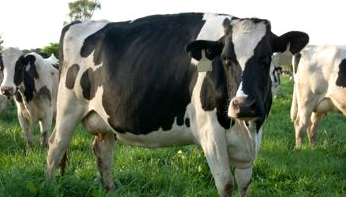
Livestock and Poultry Products had the largest increase in value at $195,563,000 (25.2%) due primarily to increases in milk prices. Milk per cwt was $21.90 in 2014 compared to $18.20 in 2013 Production rose from 42 million cwt to around 44 million. Milk continues to be the top commodity with a value of $9.7 billion in 2014.

Vegetable Crops increased 43% in value $66 million due primarily to higher processing tomato production and price. Fruit and Nut Crops increased 10.7% in value $55 million due to higher almond and pistachio acreage and prices. Apiary Products increased 8.7%. attributed an increase in the almond pollination price (per colony).
Field Crops had the largest decrease in value at $105,496,000 (17.8%) due primarily to less acreage as a result of the drought conditions. Livestock and Poultry decreased 2.8%

June El Niño update: Damn the torpedoes, full speed ahead

NOAA Blog Predicts Good Likelihood of Strong Event
June 11, 2015

Screen Shot 2015-06-15 at 7.41.11 AM
El Niño continues to pick up steam. NOAA CPC/IRI forecasters are now very confident that the event will continue through the fall (over 90% chance) and into the winter (~85% chance). Now that we’re emerging from the spring barrier, this month’s update provides a first guess of the potential strength of El Niño. It’s harder to predict the strength of the event than it is to predict its duration, so we are less confident about that, but forecasters currently favor a “strong” event for the fall/early winter. By “strong” we mean it’s expected that the three-month average sea surface temperature in the Niño3.4 region will peak at more than 1.5°C (2.7°F) above normal.
What’s happening right now?

During the month of May, we saw increases in a lot of the ENSO indicators. Sea surface temperature anomalies (the departure from average) were up all across the tropical Pacific, and the most recent Niño3.4 Index was 1.2°C. Both the lower-level and upper-level winds along the equator were substantially weaker than average last month, characteristic of El Niño’s weakened Walker Circulation. This feedback between the higher sea surface temperature anomalies and the atmosphere is critical to both perpetuating and strengthening an El Niño event, and to communicating the effects of El Niño to other areas of the globe.
Signs of another downwelling Kelvin wave have begun to appear in the upper levels of the equatorial Pacific. This reinforcing source of warmer-than-average waters follows the strong Kelvin wave that has been slowly moving east since February. The consistently warmer waters are reflective of the slower changes we’d expect to see when the ocean-atmosphere system has settled into an ENSO event, as opposed to the shorter-term changes that dominate the rest of the time.

What signs are suggesting a possible strong event?
The physical observations I described above are a source of confidence that this event is continuing to build. Also, most climate models are forecasting a continued increase in Niño3.4 sea surface temperature anomalies, and many forecast a peak in the early winter above 1.5°, some above 2.0°C.

Climate model forecasts for the Niño3.4 Index, from the North American Multi-Model Ensemble (NMME). Darker purple envelope shows the range of 65% of all model forecasts; lighter purple shows the range of 98% of all model forecasts. NOAA Climate.gov image by Fiona Martin from CPC data.

It’s important to remember, though, that we only have a handful of strong El Niño events in the historical record—seven since 1950. And only three of those saw Niño3.4 index values of 2.0°C or higher: 1972-73, 1997-98 and 1982-83)*. Imagine if we’d only had seven hurricanes in the history of record-keeping; it would make it much harder to understand and predict how a future hurricane could develop. So, while we’re confident that this El Niño event will continue, there’s still plenty of uncertainty about how it will evolve.
That said… what would a strong event mean?

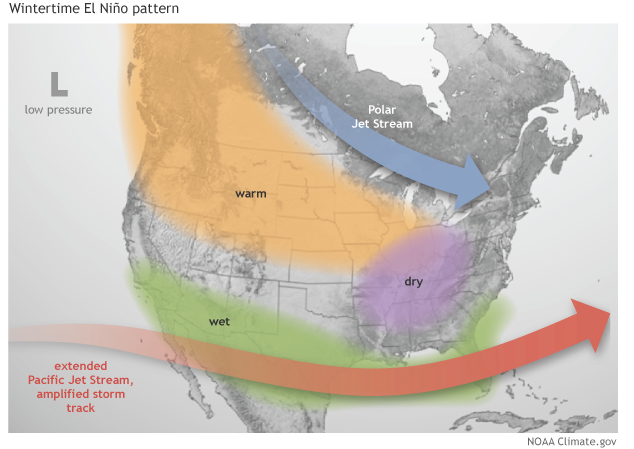
As Tony pointed out in our last post, ENSO impacts on North American weather and climate are most noticeable in the winter. This is largely because winter weather is governed more by large-scale processes (e.g. nor’easters) than summer weather, when local effects (e.g. isolated thunderstorms) tend to be more important. El Niño events affect the strength and position of the jet stream, and tilt the odds toward more rain than average along the West coast and in the Southeast during the winter.

El Niño loads the dice in favor of certain impacts, but it doesn’t guarantee them. However, stronger events tend to lead to more predictable effects. My brother asked me if he should repair the leaks in the roof of his campervan before he goes to Florida this winter… based on the ENSO forecast, I said yes. (I would probably have said yes anyway —who wants to stay in a drafty camper?— but that’s beside the point.)

Crop Watch – How You Like Those Peaches?

June 6,2015-
Processing Tomato Crop Up
Despite the drought in the Central Valley the state’s processing tomato crop is expected to be up this year by 2% to 14.3 million tons ,an all time record. The estimate is based on acreage of 295,000 acres, up 3,000 from last year. Fresno County remains the top county for contracted acres at 91,000,up from 90,000 last year. Kings County acreage has dropped to 27,000 acres from 31,000 in 2014.Merced and Madera acres are up up from last year. Yield per acre remains highest  in Kings County at 54 tons per acre, followed by Kern County.

2015 Cotton Acres at 160,000 – Lowest Ever
The drought certainly has helped whittle down the acreage of  California grown cotton.Last year some 210,00 acres were grown. This year the CDFA Pink Bolworm program estimate says farmers  planted   just 160,000 acres.
The number jibes with USDA estimates earlier this year of 45 thousand acres of Upland cotton in 2015, down 21 percent from the acreage seeded in 2014. In addition, growers were expecting to seed 110 thousand acres of American Pima cotton in 2015, down 29 percent from last year. Kings County remains king of cotton at some 51,000 acres planted.

Screen Shot 2015-06-06 at 11.29.50 AMMas Masumoto: Peaches Can be Grown with 30 to 50% Less Water
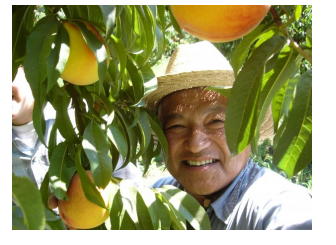
Selma fruit grower turned poet Mas Masumoto told the LA Times this week that some of his petite peaches can be grown with 30 to 50% less water resulting in smaller size but more intense flavor.”I realize all these years I’ve been pumping them with fertilizer and water to get them artificially big.”The result of less water – “they’re small this year but,good god,the flavor is great.It’s fantastic.It’s probably the most intense Ive ever had.”

Growers Pulled 30,00 Acres of Grapes This Winter
Allied Grape Growers in a recent presentation to growers estimates farmers pulled about  30,000 acres of vineyards this last winter, 20,000 acre of which were wine grapes.This is triple that recorded each of the past five years. Growers are likely to be planting alternative crops they say.

Egg Shortage Comes From Avian Flu
There is a nationwide egg shortage but this time – don’t blame Prop 2. Instead its due to Avian Flue with the loss of around 40 million hens in the Midwest.Prices for California eggs went up earlier this year due to new space rules for hens. But now prices are up all over with eggs sent to NY now being more expensive than those sold in California. The industry source Egg-Cite says “Wednesday May 27th in Moreno Valley, CA.  generic Large were priced at $3.20 per dozen with enriched specialty Large white at $3.99 per dozen for a national brand and $4.99 for store-brand USDA certified organic.” The flue has not made  a big hit in California but” was detected in a single chicken flock in Kings County and a turkey flock in Stanislaus County, for a total of 247,300 birds affected, USDA data show” says the LA Times.

High-density Planting Of Avocados Boosts Yield

June 3,2015-

from UC News

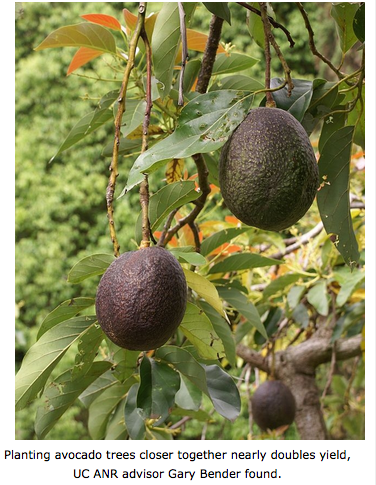
Planting avocado trees closer together nearly doubles yield, UC ANR advisor Gary Bender found.
The California avocado industry is getting much-needed hope from results of a UC Agriculture and Natural Resources (UC ANR) study on high-density planting, reported Lesley McClurg on Capital Public Radio. One farmer featured in her report said, because of the drought, he is paying $1,600 per acre-foot for water, an all-time high.

Screen Shot 2015-06-03 at 5.56.17 PM

Gary Bender, an advisor with UC ANR Cooperative Extension in San Diego County, believes that increasing per-acre yield will help farmers stay in business.
“We’ve been growing avocados wrong all these years and we’re finally starting to figure it out,” Bender said.
He planted trees 10 feet apart in a research trial, instead of the standard 20 feet spacing. Instead of letting the trees grow tall, the standard practice, he pruned them regularly to keep the trees short and fat.
The study was a huge success, yielding nearly 13,000 pounds of Haas avocados per acre, McClurg reported. Usually farms in the area yield between 6,000 to 7,000 pounds per acre.

Dinuba Produce Firm ‘Fruit Patch’ To Close

Plant Reportedly Sold

May29,2015-

Fruit patch plant 2015-05-27 at 10.50.42 AM
Embattled produce packing and marketing firm Fruit Patch will close according to a state Warn Notice published in the past few days. The  notice says the closure is permanent with the layoff of 132 employees by July 8. Dinuba city administrator Jayne Anderson confirms the city received the notice as well – commenting that ”it’s too bad we are losing a long time employer.” The company facility is located on Rd 48, a few miles from town.

Fruit Patch has been in the hands of two Wall Street private equity firms in the past decade – the latest being American Capital who bought the company from Marina Capital Partners in 2006 for $168 million.
A series of CEOs has run the Dinuba-based company that has had a record of shipping produce mostly from nearby farms to over 10,000 retail locations. Fruit Patch provides packing and marketing services to  growers of apricots,plums,nectarines,grapes,pomegranates,Asian pears and specialty citrus.They also offered grower financing.

The latest CEO at the company had been Jim Gallagher who was hired in 2012 by American Capital, after an earlier parade of top management had come and gone. According to an industry media story in 2011 “Since American Capital acquired Fruit Patch in 2006, the company has had three different presidents and four different people heading the sales organization.”
While no one from American Capital returned numerous phone calls – a person who answered the phone at the Dinuba headquarters said Mr. Gallagher “was no longer with the company.”
Another company source said as a result of the closure the sales office would also be shut down and that the Dinuba plant had been sold to another firm. He declined to name the firm.
If Fruit Patch’s recent history was a bit bumpy, so has the tree fruit  industry as a whole.
Fruit Patch,located in the heart of stone fruit country, had been well known as marketer for peaches,plums and nectarines, an industry  that has had several tough years. More recently there has been a significant removal of trees to try to right-size this small industry plagued with a perennial oversupply issue.
In Tulare County alone farmers had  boasted over 20,000 acres of plums that has now been reduce by half that acreage.Fresno County nectarine acres are down from 15,000 to around 11,000.
Ironically. sources say this year’s tree fruit crop “looks good” despite the drought, says produce company rep Steve Nelsen of Visalia. One shipper – Simonian Farms says fruit size is smaller but quality and demand is good. Industry expert Barry Bedwell, ‎President at California Fresh Fruit Association, says tree fruit farmers clustered in Tulare and Fresno counties typically have enough water this year, from wells. The Kings River has created ideal sandy soil in this region for growing the best stone fruit and wells are comparatively shallow.
Fruit Patch was started by farmer Leo Balakian in 1976 who continued to ship to Fruit Patch after it was sold.Recently the local grower has reduced acreage of tree fruit on his farms in favor of almonds.
Just who is buying the big,modern Fruit Patch cold storage,packing and processing facility is not clear. The facility is said to be state-of-the-art with some 20 cold storage rooms as well as a large ozone treatment center. In a 2011 story,a American Capital rep said “There have been $5 million invested in the plant in the last three years.”
The facility would likely be attractive to another large fruit packing firm   who would need a workforce to operate. So hopefully – some jobs will come back

Bako Packer Had Listeria Problem

Inspectors Find Listeria at Bidart Bros. Cooling and Packing House

Caramel apples were linked to 2014 Listeria outbreak

from Food Safety News

May 30,2015-

Inspector observations from the investigation into the role of Bidart Bros. in last year’s 12-state outbreak of Listeriosis involving commercially produced, prepackaged caramel apples found that the problem could well have originated in the California grower’s apple cooler and packing facility.

The observations are found on U.S. Food and Drug Administration (FDA) 483 forms completed after four on-site investigations were conducted at the company’s facility in Shafter, CA, from Dec. 23, 2014, to Jan. 6, 2015, along with a mostly public 16-page report.

The investigative team, including officials from FDA and the California Department of Public Health, took samples from food and non-food contact surfaces in packing and common cold storage areas and from outside storage bins. Positives for Listeria monocytogenes came back for seven areas, and six of those were from direct food contact surfaces.

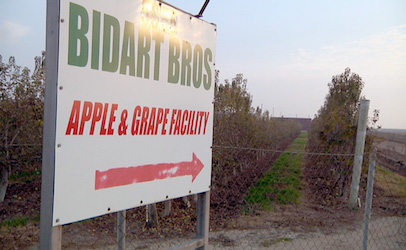
BidartBros_406x250Results of the on-site investigation last Jan. 6 caused Bidart Bros., one of northern California’s best known fruit-growing families, to voluntarily recall all the Granny Smith and Gala apples that were processed during 2014 through their cooler-packing facility.

Before that action, three distributors of caramel apples — Happy Apples, California Snack Foods Inc. and Merb’s Candies — had recalled caramel apples they produced in response to the Listeria outbreak.

That outbreak required the hospitalization of 34 of 35 people from 12 states who were sickened. Before the outbreak ended, seven of them were dead, and Listeriosis was blamed for the deaths of at least three of them.

Central Coast Cattle Industry Suffering Losses Due To Drought

May 29,2015-
from UC news service

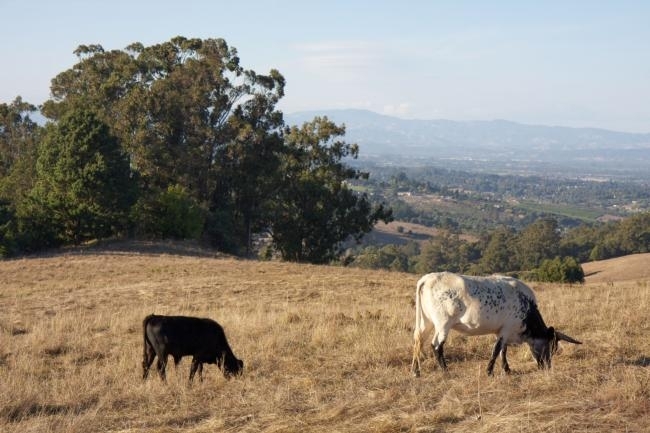
Since the late 1700s, grazing has been the best use for the rolling hills and valleys of California’s Central Coast, reported Louis Sahagun in the Los Angeles Times. However, because of the state’s four-year drought, three-quarters of the cattle in San Luis Obispo County have been sold or taken out of state. The sell-off brought in a record $129 million last year.

“We see clearly what a bust cycle looks like,” said Mark Battany, UC Agriculture and Natural Resources viticulture and soils advisor in SLO County. “Ranchers have no choice but to sell off their cows and rebuild the herd when the rain comes back.”

Sahagun reported that ranchers in the area have suffered severe drought for centuries.

“During a drought that ended in 1864, some ranchers drove their herds off cliffs and into the ocean below to stop their suffering,” the article said.

The current drought is leaving landowners few options. The county placed a two-year moratorium on new agriculture that depending on the aquifer, so rangeland can’t be converted to vineyards at the moment.

“Ranchers are getting hit hard from every direction,” said Royce Larsen, UC ANR natural resource watershed advisor in SLO County. “It’s a grim and desperate outlook.”