Sky-high butter prices on the commodity markets have raised eyebrows when they reached an all time high of $3.13 lb on the CME late last month. It’s not unusual for a run-up in butter prices as big buyers stock up for the Holiday baking and candy-making season. But this year strong domestic demand has helped take prices up even more than usual.After all,who wants to bake those Christmas cookies with margarine? It’s the one bright spot in the milk-making business who is suffering low prices overall this year. As of late October those high prices have eased with wholesale butter trading at a still strong $2.42 lb
Fresh & Easy Closure Will Affect Valley Locations including Reedley & Lemoore
Fresh and Easy grocery will shutter the remainder of its stores in California-some 97 locations in the next few weeks. The closures will affect Central Valley locations including Reedley, Lemoore and two in the Bakersfield area.
Citrus Research Board Hires Gary Schulz As President
Visalia-based Citrus Research Board (CRB) has hired Gary Schulz as President. Schulz joined the organization on September 14, 2015 to manage the overall affairs of the program and guide strategic direction.
Schulz joined CRB with a tremendous amount of experience. He served as President/General Manager of the Raisin Administrative Committee and as CEO of the California Raisin Marketing Board. Other experience includes 15 years as the General Manager of the International Agri-Center, Inc. and World Ag Expo in Tulare, CA as well as his own consulting business. Schulz obtained his Bachelor of Science degree from Washington State University, Pullman, WA.
“We are excited to have Gary on board,” said Etienne Rabe, outgoing Chairman of the Board. “My congratulations on his appointment and wishing him success in his new endeavor.”
Schulz is serving his presidency at the CRB office in Visalia, CA. He can be contacted at (559) 738-0246 or gary@citrusresearch.org.
Former GM At Friant,Ron Jacobsma Water Joins Contra Costa WD
Ron Jacobsma has joined Contra Costa water District as its assistant manager. California’s Contra Costa Water District delivers water to approximately 500,000 people in central and eastern Contra Costa County in Northern California. Jacobsma has been an active leader in California water for 26 years. Ron is a former Certified Public Accountant, worked for an international accounting firm and a mortgage banking entity before coming to California where he started as Controller for Friant, moved to Assistant General Manager, and became General Manager in 2003. Jacobsma has Bachelor of Science degrees in Accounting and Business Administration-Finance, and an Economics minor from Minnesota State University-Mankato.
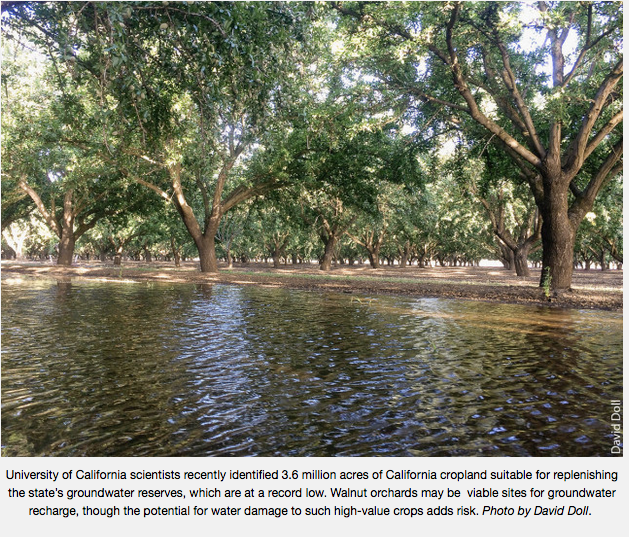
University of California scientists recently identified 3.6 million acres of California cropland suitable for replenishing the state’s groundwater reserves, which are at a record low. Walnut orchards may be viable sites for groundwater recharge, though the potential for water damage to such high-value crops adds risk.
By Philip Bachand, Helen Dahlke, William Horwath, Thomas Harter and Toby O’Geen
A much-anticipated “Godzilla” El Niño this winter may refill California’s drought-diminished reservoirs, but it won’t do much to restock the severely depleted aquifers we rely upon to get by during droughts.
The California Department of Water Resources (DWR) recently reported that groundwater levels across most of the state have dropped 50 feet below historical lows, with levels in many areas of the San Joaquin Valley more than 100 feet below previous record lows. Source: DWR
One reason for this is the sheer depth of California’s precipitation deficit – the deepest of any drought in 120 years of recordkeeping. The state has been drier than normal for 10 of the past 14 years.
The above-average amount of pumping during all those dry years has led to the deepest groundwater levels ever recorded in most areas of the state. In some areas water tables have plummeted by more than 100 feet. Unlike surface water reservoirs, aquifers do not refill with just one or two wet years, no matter how big the El Niño
A strong El Niño nonetheless presents a precious opportunity to replenish some of these vital underground reserves faster than would otherwise occur.
California’s vast acreage of irrigated farmland holds the key. Using the existing irrigation network, we can capture flood flows from our rivers onto suitable dormant or fallow agricultural fields, allowing the surplus water to infiltrate aquifers.
A team of University of California scientists has already identified 3.6 million farm acres with soils most conducive to groundwater recharge – those with high percolation rates. They developed an interactive map where growers can obtain site-specific information on the suitability of soils for on-farm recharge.
In other words, more than one-third of the state’s nearly 10 million acres of irrigated cropland could potentially be re-purposed as groundwater infiltration basins during winter and early spring – outside the usual growing season.
Likewise, the same infrastructure that conveys about 20 million acre-feet of water to irrigate California crops during the growing season could be used to divert high river flows onto fields in the off season, mimicking natural floodplains.
UC researchers recently developed a soil suitability index for groundwater recharge on cropland, based on such factors as (A) deep percolation, (B) root zone residence time and (C) chemical limitations. Source: UC Davis California Soil Resource Lab
During storms and flood-control releases, excess river water could be routed through irrigation canals onto farms, where the surplus would seep underground to replenish groundwater. This action could also mitigate downstream flood risks.
Farmers stand to benefit from this off-season arrangement. The infiltration of floodwaters would restore the drought-depleted soil moisture in crop root zones while accelerating recharge of regional aquifers. Greater availability of groundwater saves farmers the high expense of pumping deeper and drilling more wells.
Changes in groundwater storage in the Central Valley (dark blue) and its subregions, 1922-2009 . The largest depletions have occurred in the Tulare Lake Basin, which includes the southern Valley from Fresno to Bakersfield. Source: Thomas Harter/California Agriculture. (Adapted from Brush 2014)
Researchers with UC Davis and UC Agriculture and Natural Resources and their team of consultants are working to bring this new drought management and groundwater banking strategy into the mainstream. They have been test-flooding a number of vineyards, almond orchards and other cropland recently, looking at infiltration rates, plant physiology, groundwater quality and costs. So far, results look promising.
To take advantage of a strong El Niño this winter, farmers would need to determine how much floodwater they would want to divert and when they would want it. This would depend on the crop, soil preparation and planting dates, the soil moisture status and other agronomic considerations.
Dam operators and irrigation district managers also would need to make a number of strategic determinations, including:
The amount of investment needed for diverting and distributing flood flows into irrigation systems
Where that investment would reap the greatest benefits in groundwater and soil moisture replenishment
Whether to postpone wintertime maintenance of diversion and distribution systems to accommodate floodwater delivery
The type and level of incentives and outreach needed to gain landowner participation.
Jim Morris, a Siskiyou County rancher shown here, opened his alfalfa field last spring to UC researchers who are testing the groundwater recharge potential in various croplands around the state. “It was amazing to see how well the land absorbed the water and how quickly the water table rose,” Morris told UC Davis News. Photo by Steve Orloff.
Farmers and water managers should make preparations now to reap the most benefits of the predicted winter storms, including:
Identify fields and crops suitable for winter and early spring flooding
Minimize fall applications of fertilizers and pesticides to protect groundwater quality
Do your irrigation canal repairs and clearance this fall, before the storms
Clarify water rights as they pertain to capturing and applying large amounts of floodwater to cropland
To be sure, groundwater banking on farmland is several big steps away from becoming widespread. Several agronomic, policy and institutional questions remain to be investigated.
But flooding just 10 percent of the state’s irrigated cropland a few feet deep this winter would result in an additional 3 million acre-feet of groundwater. That’s half of the additional 6 million acre-feet of groundwater that California farmers are expected to pump this drought year to offset the drastic shortfall in surface water deliveries.
After four years of drought, a statewide effort by farmers, government agencies and water districts to capture flood flows to replenish our depleted groundwater is needed to seize what is expected to be rare opportunity – a monster El Niño.
Philip Bachand is an environmental engineering consultant in Davis. Helen Dahlke, William Horwath, Thomas Harter and Toby O’Geen are on the faculty at UC Davis’ Department of Land, Air and Water Resources.
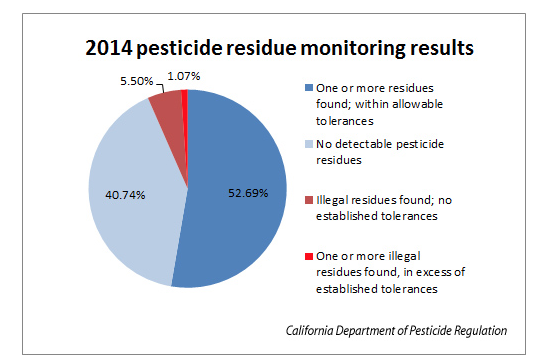
(Sacramento) – Tests on produce collected by the Department of Pesticide Regulation indicate the vast majority of fruits and vegetables available for sale in California meet stringent federal pesticide safety standards. During its 2014 survey, DPR found 96.4 percent of tested California-grown produce had little or no pesticide residues.
The findings are included in DPR’s newly released 2014 Pesticide Residues in Fresh Produce report.
“This report further confirms that California’s vigorous pesticide regulatory program creates a reliable marketplace where consumers can have faith in their fresh fruits and vegetables,” said Brian Leahy, DPR director. “The pesticide rules and oversight we have in this state are effective at protecting the produce that we enjoy eating.”
The report is based on year-round collection of about 3,500 different samples of produce, including those labelled as ’organic’, conducted by DPR scientists at grocery stores, farmers markets, food distribution centers, and other outlets throughout California.
The produce is tested using state of the art equipment for 300 types of pesticides operated by the California Department of Food and Agriculture (CDFA). The U.S. Environmental Protection Agency sets standards allowing each piece of fruit and/or vegetable to contain trace amounts of pesticide. The highest residue level that is allowed on that commodity is called a “tolerance”. It is a violation if a residue exceeds the tolerance for the specific fruit/vegetable, or if no tolerance has been established.
Highlights from the 2014 Pesticide Residues in Fresh Produce include:
93.43 percent of all produce samples (California grown and non-California grown) had pesticide residue levels that were legal i.e. at or below EPA tolerances.
Of those, 40.74 percent had no detectable residues at all, while 52.69 percent had residues detected within the legal level.
1.07 percent of the samples had pesticide residues in excess of the established tolerance level.
An additional 5.5 percent of the samples had illegal traces of pesticides that were not approved for that commodity.
Produce that most frequently tested positive for illegal pesticide residues in 2014 included Ginger from China; cactus pads, cactus pears, limes, papaya, summer squash, tomatillos, chili peppers and tomatoes from Mexico; and spinach and kale from the United States.
If DPR finds produce with illegal residues, it quickly works to remove it from the chain of distribution (to prevent it from reaching consumers) and also attempts to trace it to its source. The tainted lots are quarantined.
Businesses that violate California pesticide residue laws face loss of their product and also fines. In December 2014, DPR imposed a $21,000 fine against a California produce importer with a history of recurring pesticide residue violations, mostly on produce imported from Mexico. See press release on Repeat Pesticide Offenders. Click here for a video story of inspectors collecting samples and testing for pesticides.
DPR continues to find a small but significant number of cases of illegal residues on fresh produce from Mexico and other countries. To help address this, in 2014 DPR enforcement staff gave presentations about the DPR Pesticide Residue Monitoring Program to about 160 Mexican fruit and vegetable growers at workshops in Mexicali and Ensenada.
The 2014 pesticide residue monitoring data is posted at: http://www.cdpr.ca.gov/docs/enforce/residue/rsmonmnu.htm
This month Governor Jerry Brown signed SB 27 restricting the use of antibiotics in animals after reports of growing antibiotic resistance to infections in people. The bill makes it unlawful to give a drug to livestock to promote weight gain and gives CDFA power to monitor practices.It takes effect in January 2018. Brown hailed American poultry producers for their voluntary adoption of better practices.
Forecast Sees Fewer Apples On The Market
You may end up paying more for apples than you did a year ago. The U.S. Agriculture Department estimates apple production nationwide will be down 11 percent compared to last year. It estimates the California apple crop will be down 8 percent. California ranks fifth in the nation in apple production. In the top apple-growing state—Washington—production could be down 14 percent from last year’s record crop. Dairy Operators Face Lower Sales For Milk
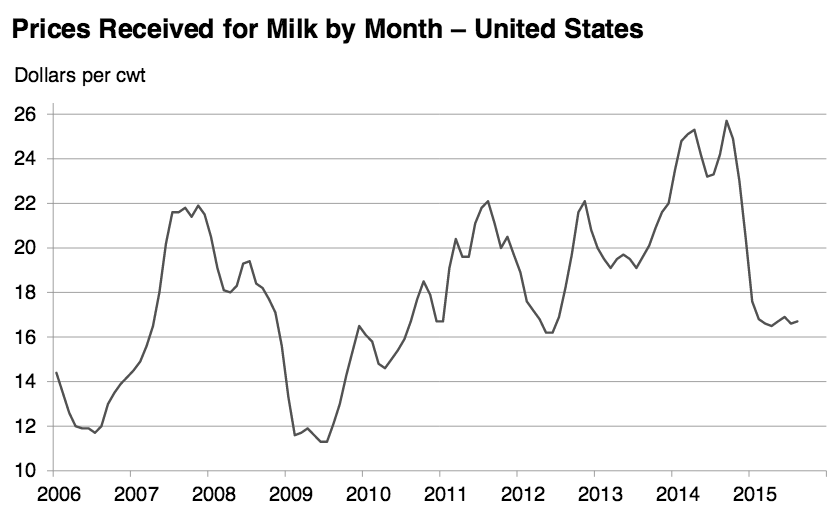
USDA chart show at least prices are not falling further.
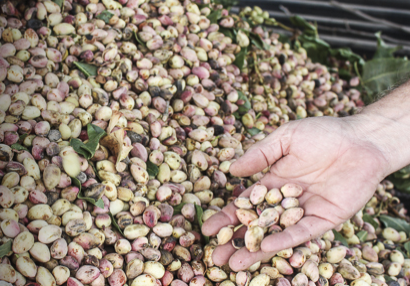
California pistachio harvest is in full swing but as nuts are shaken from the trees and collected, some growers report blanking, or shells that contain no nuts, contributing to a smaller-than-expected crop.
Jeff Gibbons of Setton Pistachio of Terra Bella puts it bluntly: “It’s the worst crop we’ve ever experienced.”
Gibbons, plant manager for the family-owned company that grows about 10,000 acres of pistachios and processes pistachios for itself and other growers, attributed the smaller crop to three factors.
“One: There wasn’t enough winter chill, so the trees did not receive enough rest,” he said. “Two: It was real warm during the bloom and this made pollination unviable, and three: There is the drought.”
Dealing with a fourth drought year, Gibbons said, Setton Pistachio suffered another year of a zero federal water allocation in areas such as Terra Bella, and that increased the purchase price for water—if any could be found. In addition, the warm winter and lack of fog meant pistachio trees didn’t gain the required 800 hours of exposure to temperatures colder than 45 degrees, needed to help set the crop.
“The last bad crop that we had due to lack of winter chill was in 2003, and the winter chill this year was significantly worse than it was in 2003,” Gibbons said.
Richard Matoian, executive director of American Pistachio Growers in Fresno, explained that with low chill hours, “the net effect for pistachios is the male and female trees do not bloom and do not receive the pollen at the same time; one blooms sooner than the other, and pollination does not occur.”
Matoian noted that last year’s crop was 520 million pounds. Pistachio trees generally have smaller crops in alternating years, and 2015 was expected to be an “off” year.
“We knew this year was going to be an off year. We had no idea it was going to be as off as it is,” Matoian said, noting that this year’s production could drop to 300 million pounds or less, a prospect he described as “very disappointing.”
He said the blanking problem has been “hit or miss,” depending on where trees are located, adding that in some of the worst cases, farmers reported blanking in 50 percent to 70 percent of the crop.
“Some growers had what they expected in an off-year crop, and then a field down the street only had a few hundred pounds per acre,” Matoian said.
During harvest, Setton Pistachio usually has about 200 truckloads a day coming to the plant and now because of the reduction in the crop size, Gibbons said, the plant expects only 100 truckloads a day. With capacity lower than usual, a second plant west of Terra Bella is not being used.
As a result of the small crop, Gibbons said Setton Pistachio—which typically sells half its nuts domestically and half to export—will divert more pistachios to the domestic market.
“We want to protect our domestic market,” Gibbons said. “Europe and China are our biggest export markets. Given the size of this year’s crop, there’s not a lot of the extra-large pistachios, and we usually ship those to China.”
Top export destinations for U.S. pistachios are Asia, Europe and the Middle East, but demand by China—the No. 1 market for U.S. pistachios, Matoian said—is slowing for a number of reasons.
“Part of it is the downturn in their economy, part of it is the strength of the dollar, but another part is our chief competitor, Iran, had its largest crop in 2014, so they supplied a large portion to the Chinese market,” Matoian said.
He also cited the West Coast port slowdown earlier this year, which came during peak shipping season for Chinese New Year. Because Chinese customers were having trouble getting pistachios from California, they sought nuts from Iran. That, Matoian said, “affects the immediate sale and future sales, because they may now establish a relationship with a (supplier) from another country, so we may lose that customer.”
Given the small pistachio crop , Gibbons said he believes growers should expect prices to reach an all-time high. Last year, the grower price was around $3.50 per in-shell pound. There will be no word on this year’s final price until more of the crop is harvested, Matoian said.
Ali Amin, president of Primex Farms, a company that grows nuts in Kern and Madera counties and operates a processing facility in Wasco, said the smaller crop and resulting higher prices could affect shippers’ ability to maintain foreign markets.
“Markets are going to be challenging and unknown,” Amin said. “We are setting new record prices and also with the devaluation of foreign currencies, specifically in Europe, it makes it even more expensive for them.”
For the domestic pistachio market, Matoian said demand appears to be steady, but has slowed a bit because customers are sensitive to price increases. Selling pistachios as a snack nut has always been the sector’s primary focus, but shelled nuts or kernels purchased for use as ingredients are gaining in popularity, he said.
“Kernel sales continue to increase. Whether it be crushed and made into energy bars, we are seeing more of it utilized as an ingredient,” Matoian said, adding that uses for salad toppers or baking have also increased.
Matoian said American Pistachio Growers intends to continue its marketing programs in the U.S. and around the globe, to accommodate anticipated production increases. Two seasons ago, Matoian predicted the pistachio crop would reach 1 billion pounds by 2020.
“We need to continue marketing our product because we need to prepare for the large crops that are coming,” Matoian said. “If the right conditions occur—cold wintertime temperatures, adequate water and normal growing conditions—we will be inching very close to a 1 billion-pound crop by 2020.”
But based on what happened this season, he said, that “could be further down the road than what we initially thought.”
September 15,2015- Exeter-based California Citrus Mutual (CCM) announced that the California Navel Orange Objective Measurement Report is anticipating 86 million 40 pound cartons of navels, or 3.4 billion pounds of Navel Oranges. 83 million of those cartons are expected to come out of the Central Valley of the state.
The 86 million cartons number is an 8.5% increase over last years volume at 76 million cartons.
The government survey this month estimates there are 2,000 acres fewer than last year according to the report that was compiled by the Agricultural Statistic Service. Fruit count per tree in District is higher – up 19% from last year at 412, and 18.5% higher than the 336 fruit average per tree over the last five years.
The average fruit measured 2.248 in diameter as of September 1st, CCM says, just above the 2.230 average over the last five seasons.
CCM says the NASS acreage estimates may be ”conservative” having themselves estimated that in the past two years growers have pulled 25,000 acre of citrus of all varieties including navels largely due to lack of water.
Offsetting pulled acres is nonbearing acreage that comes into production.Last estimate for navels had some 3300 acres of young trees not yet in production of which two thirds were in Tulare County.
The good news on crop size and set may be due to timely rainfall and good growing conditions after last spring’s petal fall.
The news that the crop looks good is in stark contrast to the gloom one hears over the drought particularly in Tulare County were little surface water has been available for irrigation for two years running.
CCM’s president Joel Nelsen says farmers suffered big time this year when the port strike kept local exports from reaching markets in the far east hurting returns.
On the plus side, the new sugar standard is expected to help early sales of fruit this holiday season as consumers enjoy their first taste of the season with sweeter fruit.
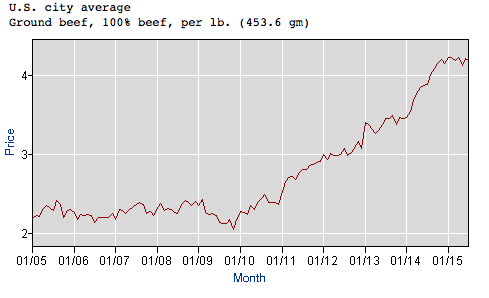
America can’t get enough hamburger meat as USDA reports beef prices are up on strong US demand.US producers can’t seem to supply all that US consumer demand as Australia is enjoying a banner year exporting beef to the US. Australian beef prices are up 40% this year.The US accounts for 25% of the world’s beef consumption.
The US Bureau of Labor Statistics says ground beef prices doubled from just over $2 lb in 2010 to $4.26 as of July 2015.The high price is some rare good news for dairymen who cull their herd to make hamburger.
In July 2013, ground chuck sold for $3.42 and it is $4.26 today, Meanwhile bacon over that same period has actually dropped in cost as pork prices have moderated since a virus hit the pig population. Pork ribs make an attractive alternative to that steak if price is an issue.
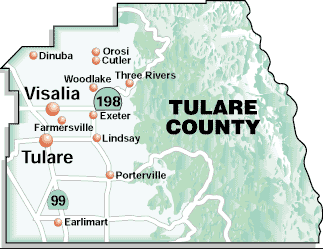
Fewer Dairies But More Milk A mention of drought and Tulare County dairies deserves a response. The article in Sept 9th EGG-Cite includes an excerpt from JAVMA, the veterinary publication. It says dairy farmers in Tulare County are exiting the business due to the drought and points to the fact there are just 281 dairies in the county compared to 343 some 10 years earlier.
A closer look however paints a different picture.
From 2004 to 2014 the value of the milk crop in Tulare County almost doubled from $1.3 billion to $2.5 billion in 2014. The number of cows is up from 442,000 to 484,000 according to CDFA and milk production climbed about 25% in that time. The county with fewer but larger dairies remains the number one milk production county in the US. Some smaller dairies here have quit in part because they need extra land to spread manure to comply with regulations.
Sure, things are tough but these dairy folk are a hardy lot.
California Fluid Milk Production Continues to Tank
Fluid milk produced in California continues to plunge, down nearly 5% in the first half half of 2015 says CDFA. California, like the rest of the nation, is drinking fewer glasses of milk than a decade ago as consumers trend toward other beverages.USDA says nationally the US drank less milk in 2014 than it did in 1975 when the US population was over 100 million fewer.
DESPITE DROUGHT- 2015 PROCESSING TOMATO PRODUCTION RECORD HIGH
Contracted production for California processing tomatoes is forecast at 14.5 million tons, averaging 49.5 tons per acre. The current forecasted production is 4% above the 2014 crop, and 1% above the May forecast.
Harvest started the first week of July in the Southern growing areas and is expected to run through mid-October. The 2015 crop year has had low disease and pest pressures and cooperative weather. As in 2014, the primary issue affecting yield has been availability of water. The ongoing, extreme drought in California has forced growers to fallow land and cut back on the acreage for many crops. However, despite the water concerns, the acreage devoted to processing tomatoes has increased from last year.
The projected harvested acreage of tomatoes is 293,000 acres, a 3% increase from 2014.
The shipping reports published by the Processing Tomato Advisory Board show that shipments through August 22, 2015 are running 8% above that of 2014.
Simplot Gets OK For GM Potato
The U.S. Department of Agriculture has approved a potato genetically engineered to resist the pathogen that caused the Irish potato famine and that still damages crops.
Food giant J.R. Simplot Co. says that the Russet Burbank variety can also be stored at colder temperatures longer to reduce food waste. Simplot earlier this year got FDA approval for its so called Innate potato said to reduce harmful chemicals when they make french fries that can cause cancer.
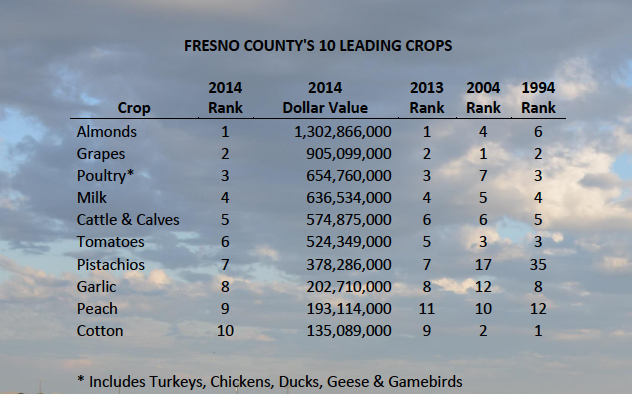
. The total gross production value of Fresno County agricultural commodities in 2014 was $ 7,039,861,000 says that county’s latest crop report.. This represents a 9.26 percent increase from the 2013 production value of $6,443,236,500.
Increases were seen in vegetable crops (0.47% = $5,599,000), fruit and nut crops (13.16%= $422,664,000), nursery products (46.89%= $20,022,000, livestock and poultry (31.48% = $301,144,000), livestock and poultry products (22.09% = $116,299,000, apiary (17.39% = $10,738,000), and industrial crops (107.05% = $3,795,500). For the first time ever the gross value of Fresno County agriculture exceeds seven billion dollars. Almonds remain the number one crop at a value of 1.3 billion dollars with grapes a close second at 905 million. Fresno comes in third in the nation like last year.
Tulare County retains its number one status with $8 billion in prodction followed by Kern at $7.5 billion.

 Sky-high butter prices on the commodity markets have raised eyebrows when they reached an all time high of $3.13 lb on the CME late last month. It’s not unusual for a run-up in butter prices as big buyers stock up for the Holiday baking and candy-making season. But this year strong domestic demand has helped take prices up even more than usual.After all,who wants to bake those Christmas cookies with margarine? It’s the one bright spot in the milk-making business who is suffering low prices overall this year. As of late October those high prices have eased with wholesale butter trading at a still strong $2.42 lb