China Takes Next Step to Approve Access for California Fresh Strawberries

April 9,2016

Screen Shot 2016-04-09 at 10.40.31 AMOfficials from the General Administration of Quality Supervision, Inspection and Quarantine (AQSIQ) in China have announced the initiation of the draft protocol for export of California fresh strawberries to China. The announcement is an important milestone in a long process that began with the special market access China granted for the 2008 Olympics, when the athletes requested strawberries.

“We are honored that the Chinese have allowed California to be the first location in the world to ship strawberries to China,” said Rick Tomlinson, president of the California Strawberry Commission.

The signing is progress toward the next step, when Chinese officials come to California for a final inspection in the spring. It is anticipated that shipments could begin in the summer. Access to the market is a good example of complementary trade to support the growing consumer demand for strawberries.  China has significant domestic strawberry production, but their season usually ends during the month of May; just as the Chinese season ends, California is reaching peak production.

Ag Beat: Rain Helps Oranges,Pixley Solar Project

Screen Shot 2016-03-18 at 12.17.22 PMRains Help Valencia Crop
The CDFA March 2015-16 Valencia orange forecast is 21 million cartons. The season has had adequate rainfall after several years of drought in many areas and measurements are indicating an average fruit size but the fruit set has been positively impacted.
Survey data indicated an average fruit set per tree of 696, a twenty eight percent increase from the previous year and well above the five-year average of 607.

Pixley Nut Farm Will Use Solar To Pump Irrigation Wells
Dixon-based Empire Farming also has orchards in Tulare County near Pixley. Now brothers Gary and Shindi Thiara are planning to irrigate their almonds here with the power of the sun. The company has invested more than $6.5 million in ground-mounted solar arrays that will pump well water enabling to just about say goodbye to their utility bill every month.”This should take care of more than 90% of our power needs” to pump water says Gary.
In the old days farmers and ranchers used those iconic windmills to power small water wells for cattle but today the technology can pump water on “very,very large systems” says a University of Arizona ag professor. Grants and rebates are available to help growers make the switch.

Californians are checking new growth on citrus for Asian citrus psyllid

March 16,2016-

Screen Shot 2016-03-16 at 12.06.55 PM

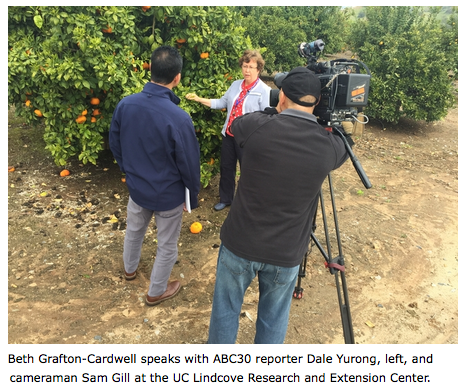
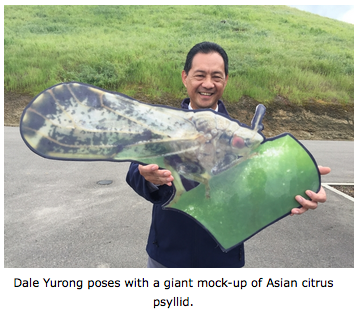
The Asian citrus psyllid is public enemy No. 1 at the UC Lindcove Research and Extension Center in Exeter, reported Dale Yurong on ABC30 Action News in Fresno. Yurong visited Lindcove to interview UC Cooperative Extension citrus entomology specialist Beth Grafton-Cardwell, who along with other UC ANR experts is calling on Californians to join the fight against the pest.
“Basically, you just look really closely (at new growth) with any kind of magnifying device you have to see if you can find any insects on there,” Grafton-Cardwell said.
If tiny yellow eggs, sesame seed-sized nymphs, or ACP adults are found, take action. Maps, treatment protocols and other information that detail what to do when ACP is present are available at http://ucanr.edu/acp.
Since ACP can spread the devastating citrus disease huanglongbing (HLB), controlling the insect population will buy time for researchers working around the world to find a way to grow healthy and delicious citrus fruit in the presence of HLB.
Yurong reported that the disease has been found in a dozen Southern California trees. Grafton-Cardwell figures Valley trees will ultimately get infected.

Screen Shot 2016-03-16 at 12.07.07 PM

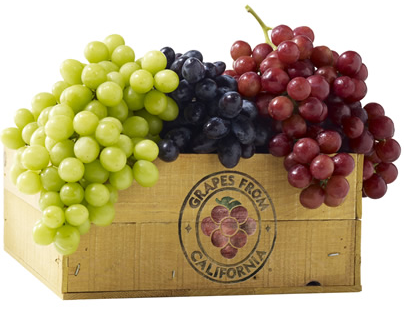
2015 Record Crop Value for California Table Grapes

Three Seasons in a Row Over 110 Million Boxes

Screen Shot 2016-03-15 at 1.51.35 PM

March 15,2016-
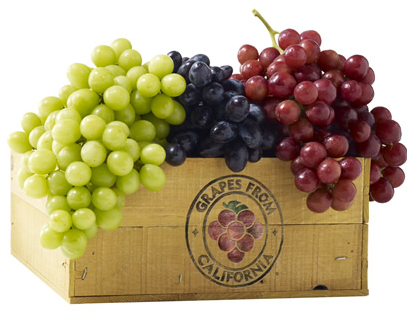
Fresno, CA – 110.5 million boxes (109.3 million 19‐pound box equivalents) of California
table grapes were shipped during the 2015 season, setting a new record crop value at
$1.83 billion, surpassing the previous record set in 2014 of $1.76 billion.

A majority of the crop is consumed in the U.S. In 2015, 34.7 percent of the total volume
was exported to over 50 countries around the world, with a total export volume of 37.9
million 19‐pound boxes valued at $737.8 million.
The top five volume export markets were Canada at 11.3 million 19‐pound boxes,
followed by Mexico at 5.7 million, China/Hong Kong at 3.5 million, the Philippines at 1.9
million and Taiwan at 1.8 million.
“Since the industry surpassed the 100 million box mark for the first time in its history in
2012, the total crop volume has seen three consecutive years over 110 million boxes,”
said Kathleen Nave, president of the California Table Grape Commission. The 2015
season total of 110.5 million boxes was the third largest crop volume in the industry’s
history, just below the 2014 total of 110.9 million. The largest crop was in 2013 at 117.4
million boxes.
Grapes from California are available from May through January. With the 2016 season
only about six weeks away, the commission is gearing up its global campaign for
California grapes.
“The commission campaign focuses on motivating the trade to promote, and consumers
to buy, more grapes from California more often,” said Nave.
###

California Wine Exports Set Record in 2015: Worldwide Demand Grows, Despite Strong Dollar

Feb 25, 2016

Screen Shot 2016-02-25 at 11.43.28 AMSAN FRANCISCO — U.S. wine exports, 90% from California, reached $1.61 billion in winery revenues in 2015, an all-time record and a 7.6% increase from 2014. Volume was up 4.1% from the previous year to 461 million liters or 51.2 million cases.

“California wines appeal to consumers across the globe who recognize the unique quality and excellent value of our wines. Consumers are also attracted to California’s trend-setting lifestyle, innovative cuisine, beautiful wine country destinations and emphasis on environmental responsibility—all of which are reflected in our wines,” said Robert P. (Bobby) Koch, Wine Institute President and CEO.

Of the top 10 export markets for California wines, the European Union’s 28-member countries were the largest, accounting for $622 million, followed by Canada, $461 million; Hong Kong, $97 million; Japan, $96 million; China, $56 million; Nigeria, $29 million; Mexico, $26 million; South Korea, $23 million; Switzerland, $21 million; and Singapore, $15 million.

“More than 170 California wineries participate in Wine Institute’s California Wine Export Program and export to 138 countries supported by 15 representative offices around the world which develop markets in 25 countries,” said Wine Institute Vice President International Marketing Linsey Gallagher. California wine exports have increased 91% by value in the last decade and we’re seeing a “premiumization” trend with dollar sales outpacing volume growth. This growth is occurring despite heavily-subsidized foreign competitors, high tariffs and strong dollar.”

“Removing obstacles to trade and ensuring that California wines have fair and equal access to international sales channels remain our top focus,” said Tom LaFaille, Wine Institute Vice President and International Trade Counsel. “Unfortunately, more and more countries and provinces are “modernizing” their laws to benefit only local wine producers. Wine Institute works closely with the U.S. government to continue to lead initiatives against discriminatory trade barriers which violate international agreements.”

Wine Institute’s Export Program offers many tools to support California Wines category building efforts around the world, including a consumer website discovercaliforniawines.com in eight languages, social media campaigns in 16 countries, an educational California Wines PowerPoint tool, educational and entertaining video assets, and a strong partnership with Visit California to increase tourism to California wine regions. The program organizes California’s participation in international trade shows and trade missions, hosts master classes and seminars as well as tastings for trade, media and consumers worldwide. Last year’s active schedule of California wine country visits brought in 150 international media and wine buyers from 15 countries.

Wine Institute’s six Regional Trade Directors in key export markets reported on 2015 exports:

Canada
“California wine sales continued to be strong in Canada last year despite unfavorable exchange rates. In 2015, U.S. wine sales surpassed wines from France and Italy for the first time to claim the largest share of import table wines in the Canadian market,” said Rick Slomka, Canadian Trade Director for the Wine Institute. “California wines have built a solid consumer base and enjoy substantial momentum in this market. California wineries have invested significantly to develop their business in Canada and anticipate continued growth, although at a slower pace.”

Continental Europe
“Despite a strong U.S. dollar and fierce competition from Old and New World wine countries, nearly all export markets in Continental Europe showed an increase. It is especially encouraging to see that our educational and promotional efforts in Germany, our largest market on the continent, are paying off with an increase of 32% in revenues,” said Paul Molleman, Wine Institute Trade Director for Continental Europe. “The 28-member European Union countries accounted for nearly 40% share of total U.S. wine exports in 2015.”

United Kingdom
“The United Kingdom has always been a receptive market for California wines, and a quarter of all U.S. wine exports by volume come to this country. Value increases are now out-stripping volume growth, with U.S. wine export value to the UK rising by 28% last year. The wine trade here has shifted emphasis to restaurants and casual dining, and a burgeoning independent retail sector, leading to increased interest in premium wines from the Golden State. California is better placed here than it has ever been before, and we expect further growth in 2016 and beyond,” said Wine Institute United Kingdom Trade Director John McLaren.

Japan
“California wine has been selling well in Japan but supply was a major challenge in the first quarter of 2015 due to the slowdown at the ports along the U.S. west coast. Japan’s California wine imports in January 2015 were down 40.5% by volume from the previous year, and the situation prevented Japanese importers from promoting our wines. After April 2015, the port issue was resolved and supply was back in line with growing demand,” said Ken-ichi Hori, Wine Institute Japan Trade Director.

“Once the Trans-Pacific Partnership free trade agreement goes into force, the import duty on U.S. wines will be completely abolished in eight years which will help the entire California category grow in Japan. This is critical for the California wine industry, since our competitors, Chile and Australia, already have free trade agreements with Japan, and benefit from a duty advantage over California wines.”

China
“With no reliable country-wide sales data, the 2015 numbers based on import/export data for China don’t tell the whole story on California wine performance, and, in fact, are misleading. Looking at consumption of California wines in the premium and super premium categories, the price range for most California wines, sales were up last year. The export decline was due to a drop in less expensive wines being imported following excessive importation in 2013-2014. Sales of higher-priced wines are quite healthy, while even lower-priced wines are selling through as depletions continue. The export data to Hong Kong shows a healthy 41% increase by value in exports, and we know that a portion of volume shipped to Hong Kong is destined for China. The market for California wines in China remains healthy and more consumer driven than in years past when gifting and group purchasing were significant drivers of sales,” said Christopher Beros, Wine Institute Trade Director for China.

Emerging Markets
“The strong dollar and difficult trading conditions affected California wine’s performance in emerging markets. However, the region produced clear success stories in 2015, such as Hong Kong, Mexico and South Korea where export value grew 41%, 7% and 5% respectively,” said Eric Pope, Wine Institute Regional Director for Emerging Markets.

Sunkist Weathers Slowdown In Citrus Exports

February 25,2016-

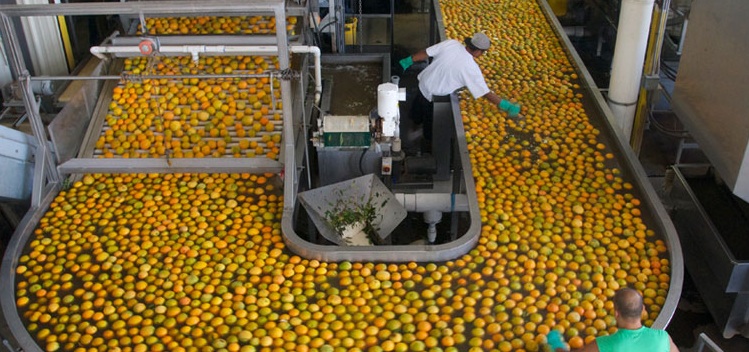
orange packer 2016-02-25 at 8.01.47 AMCitrus farmers including Sunkist members had a phenomenal year in 2014. So it is not a big surprise that 2015 did not repeat as was reported by Sunkist Growers in its annual report released in recent days. The cooperative held its annual meeting February 17 in Valencia announcing its 6th straight billion dollar revenue year despite a drop in both domestic and export citrus sales.

Total revenues reached $1.15 billion in 2015 after a record $1.23 billion in 2014 .The big hit was in export sales that declined to $242 million from $305 million the year before – about a 20% drop-off. Domestic sales fell to $712 million from $739 million in 2014.

A closer look at the numbers show domestic carton sales of navels was up 11% while prices dropped 15%.  On the export front navel carton volume was down 11% and FOBs also declined 13%.

Sunkist farmers received an average of $20.47 per carton of navels on exports in 2014.But that dropped to $17.78 FOB in 2015.Domestics FOBs were $15.64 in 2015 – the reason why exports are so attractive.

Sales of cartons of valencies fell 23% in 2015 while tangerine carton sales were up 4% – but FOBs declined 14%.

A big drop in exports in 2015 was the result of compounding negative factors including the port strike in early 2015 followed by a ban by China impacting all citrus shipments from Tulare County that lasted for six months. The ban was due to a find of brown fungus in some shipments.

Tulare County accounts for about half of all citrus exports in the state and is the home to many top Sunkist growers and leaders.

Despite the tougher timers there was some good news to report.For the first time in Sunkist’s history, the organization has issued grower payments of over a billion dollars for the second consecutive year.

“Sunkist has made many advancements to keep the cooperative well-positioned in the current business environment and last year’s results demonstrate the positive impact of those improvements,” Sunkist President and Chief Executive Officer Russell Hanlin said in a statement.

Notable changes in the past few years include the implementation of the cooperative’s grower distribution program.

“We made our third distribution to growers in 2015, and are committed to increasing these distributions annually,” Hanlin added. “This program was accomplished through an effective cost-containment plan and revenues from our for-profit businesses.”

Sunkist’s juice processing joint venture with Ventura Coastal (in Tipton) has yielded positive results for the organization. Now in its fourth year, the business partnership continues to generate improved by-product earnings, more timely payments and greatly contributes to grower distributions. Sunkist’s robust licensing program and global sourcing business is also advancing. With 49 licensees in total, the Sunkist brand is used to market approximately 700 products in 77 countries.

“All of these businesses continue to contribute to positive revenue streams and also help strategically position Sunkist for future growth,” said Hanlin.

Looking ahead Sunkist’s report says “No season is without its challenges, and the enduring drought, anticipated storms from the upcoming El Niño, and serious pest and disease risks are formidable threats to our industry in this upcoming year and beyond. In coordination with government and industry groups, Sunkist’s Board and management remain dedicated to finding solutions to overcome these issues and continue our legacy as the leading brand for California and Arizona fresh citrus.”

New Chair From Strathmore

As his term as chairman of Sunkist’s board of directors comes to a close, the contributions of Mark Gillette, president of Sunkist-affiliated Gillette Citrus Inc. of Dinuba, CA, was recognized during the meeting. Gillette served as chairman for five consecutive terms, the maximum time allowed under Sunkist by-laws.

Gerald Denni, general manager of Golden Valley Citrus Inc. in Strathmore, CA, and co-owner of Mittman-Denni Citrus Management, was elected to his first term as chairman following the meeting.
“We are excited about the fact we have eight new members on the board -younger growers who are taking a leading roll” Denni says.

Asked about co-ops growing acreage of organic citrus Denni notes growing navel oranges organically is not an easy task.”Sunkist was one of the first to grow organic oranges” he says,adding that organic citrus is now found in a wide number of supermarkets, “not just at Whole Foods.” Denni’s Stathmore ranch has 750 acres of organic citrus.

Another significant event for the cooperative was Sunkist’s headquarters relocation to Valencia, CA, in 2014, which strengthened Sunkist’s financial position and also geographically centralized its business operations to the cooperative’s grower base.

“The positive changes and growth we have achieved in recent years have been accomplished with the leadership and dedication of Sunkist’s board of directors, chaired for the past five years by Mark Gillette,” Hanlin said. “His commitment and leadership has been instrumental to our organization, and we are thankful for his valuable contributions to Sunkist.”

Elected by the board to vice chairmanships for 2016-17 were Mark Gillette of Dinuba, CA (District 1), James Finch of Ojai, CA (District 2) and Nicholas Bozick of Mecca, CA (District 3).

The meeting welcomed this year’s incoming directors, including Norman Evans of Terra Bella, CA, Amy Fukutomi of Oxnard, CA, Jim Layes of Riverside, CA, Tony Lombardi of Terra Bella, CA, Randy Vogt of Visalia, CA, and Scott Wiley of Terra Bella, CA. Also joining the board were Steve Cutting of Manhattan Beach, CA, and Robert Grether of Somis, CA, who have previously served on the board.

Enduring members of the 2016-17 board include Craig Armstrong of Thermal, CA, Ron Arnott of Mentone, CA, Allen Camp of Ventura, CA, Donald Dames of Oxnard, CA, Burt Fugate of Santa Maria, CA, Curt Holmes of Fresno, CA, Gary Laux of Porterville, CA, Brad Leichtfuss of Fillmore, CA, Robert Linderman of Visalia, CA, Warren Lyall of Pauma Valley, CA, Samuel Mayhew of Oxnard, CA, Eric Meling of Ivanhoe, CA, Cecilia Perry of Yuma, AZ, Kevin Riddle of Orosi, CA, and Kevin Severns of Orange Cove, CA.

Sunkist also honored the service of outgoing Directors John Kalender of Woodlake, CA, Russell Katayama of Orosi, CA, John Matthiessen of Visalia, CA, Martin Mittman of Porterville, CA, Thomas Mazzetti of Riverside, CA, Richard Pidduck of Santa Paula, CA, and Randy Veeh of Visalia, CA.


Caption: Strathmore Sunkist packing house

Eastside Growers Fear Delta Bottleneck Despite Wet Year

February12,2016-
Friant Water Authority’s new CEO Jason Phillips is looking at both some good news and bad news for eastside farmers who depend on federal canal water.

Phillips who worked for the Bureau of Reclamation before becoming CEO at the fractured water contractors group in January says his discussions with the Bureau recently suggest that “it is almost a sure thing that Shasta reservoir (at 2.5million acre-feet today) will fill to over 4 million acre-feet this year” assuming El Nino continues.That would trigger a full 840,000 acre-feet for the Exchange Contractors delivered from north of the Delta.

That is important to South Valley farmers who must stand in line for water behind the Los Banos-area Exchange Contractors.”If they get their water out of Shasta they won’t make a call on Friant water “above Millerton, as they have for the past two years.

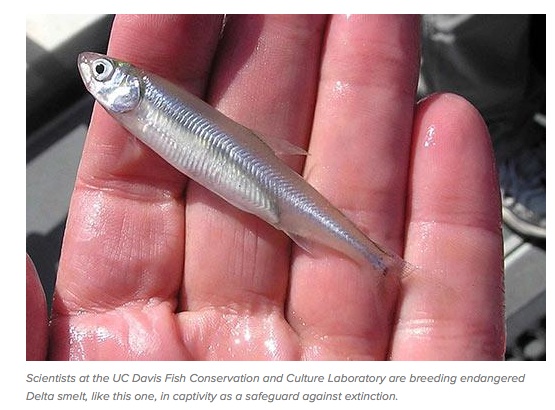
smelt 2016-02-12 at 11.09.28 AMWhile the Shasta prediction is good news – Phillips says the bad news is that the Bureau will have a tough time delivering all that water through the Delta this spring because of restrictions placed on them to save the endangered Delta smelt.

The Bureau has a limited number of smelt is can“take” at the Tracy pumps this water year – around 50 – so must be slow and cautious as it pumps water south. So far they say they have taken only one smelt. Restrictions will increase in March and April he says.

That will mean more water will head out to sea this wet year, a fact that galls many in the farm community.

The smelt are declining in the Delta, perhaps due to combination of factors that include the pumps,the drought and invasive fish that eat juvenile smelt.

The government may be ready to rescue the tiny fish as they have with salmon. If biologists fear the population is getting too low the U.C. Davis Fish Conservation and Culture Laboratory has a captive population of 10,000 smelt that could be released to keep the species going.

Meanwhile Phillips notes the Bureau “ must act in accordance with Fish & Wildlife “biological opinion” he states.

“If they can’t deliver all the water the Exchange Contractors are entitled to – they will take some from Friant’s supply on the upper San Joaquin, he fears.”We hope that it is a small amount but we don’t know yet””

Phillips says the yield on the San Joaquin looks to be the best in years figuring at least 1 million acre feet and perhaps up to 1.5 million acre-feet. The average yield is 1.7 mil acre-feet.

Of course for the past two years eastside farmers from Fresno,Tulare and Kern Counties have seen no Friant Kern Canal water and have had to depend on trades and groundwater.

“It looks like we will have a pretty healthy Class 1 supply this year” says Phillips optimistically.

Friant will get its first look at an initial allocation from the Bureau around March 1, figures Phillips. A hot and dry 10 days in February may be followed later this month by several promising storms.

Under strain over lack of water and controversy over the way forward- the Lindsay-based Friant contractors organization broke into three groups this past year but continue to share dependency on water from the big canal that courses down the eastern edge of the Valley irrigating more than a million acres.

California Grape Crush Down 7 Percent in 2015

February 11,2016-

Screen Shot 2016-02-11 at 7.45.45 AMThe 2015 crush totaled 3,862,385 tons, down 7 percent from the 2014 crush of 4,144,534 tons. Red wine varieties accounted for the largest share of all grapes crushed, at 2,037,083 tons, down 5 percent from 2014. The 2015 white wine variety crush totaled 1,662,159 tons, down 5 percent from 2014. Tons crushed of raisin type varieties totaled 92,432, down 41 percent from 2014, and tons crushed of table type varieties totaled 70,711, down 25 percent from 2014.
The Grape Crush Report includes the total number of tons crushed for concentrate production. In determining grape tonnage crushed for concentrate production, each processor was required to report the estimated equivalent tons of grapes crushed for grape concentrate. For the 2015 season, this total was 434,612 tons, 11 percent of the 2015 grape crush total. This report provides only the aggregate figure for grapes crushed for concentrate production and does not include information by district, type, or variety.
The 2015 average price of all varieties was $667.31, down 10 percent from 2014. Average prices for the 2015 crop by type were as follows: red wine grapes, $783.58, down 12 percent from 2014; white wine grapes, $538.67, down 10 percent from 2014; raisin grapes, $247.52, up 6 percent; and table grapes, $252.63, up 8 percent

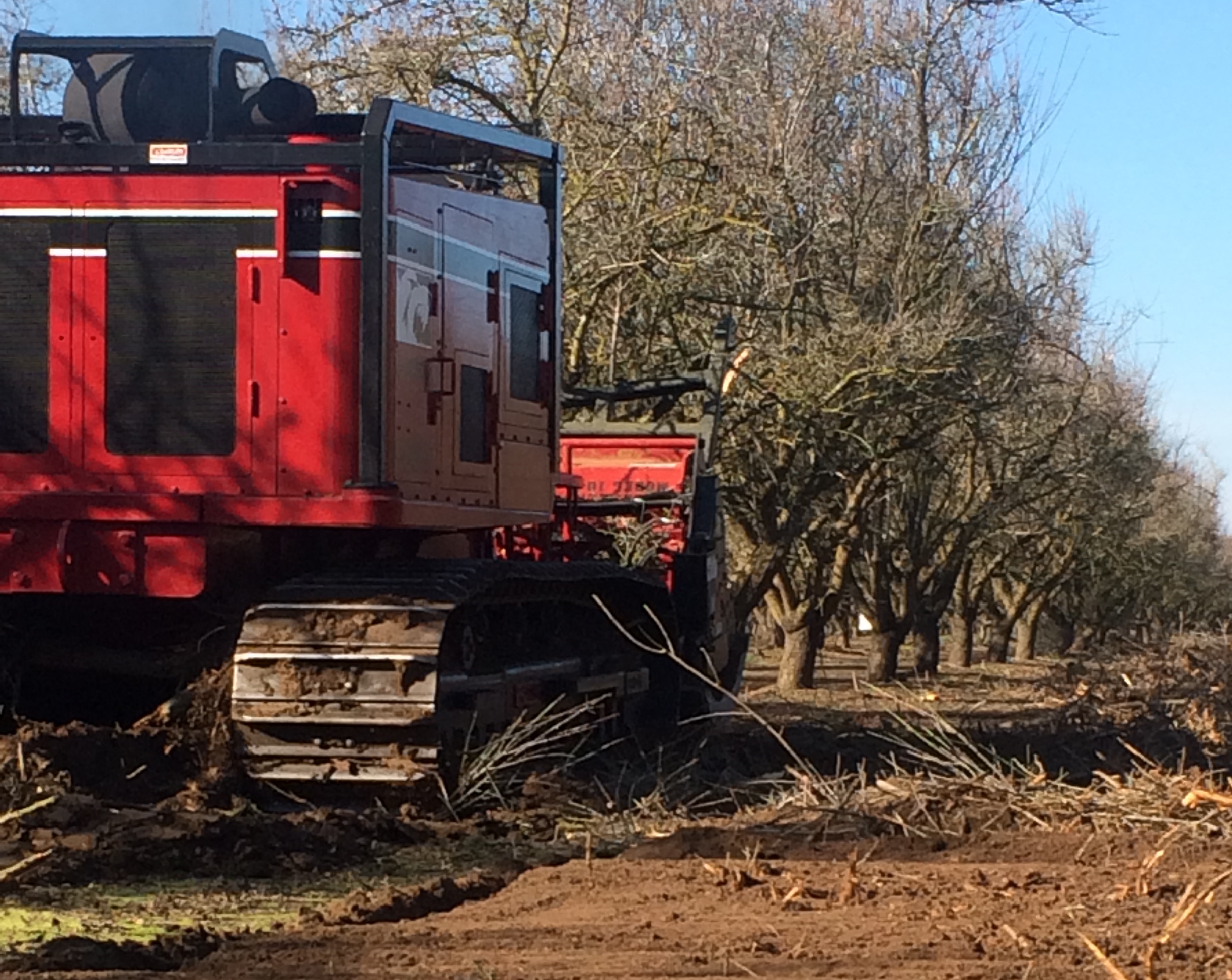
UCCE to show whole almond trees being ground up and incorporated into soil on Feb. 16


February 4,2016-
The IronWolf 700B removes almond trees measuring 15 to 25 inches in diameter east of Chowchilla.

When an orchard is removed for replanting, the trees are usually uprooted, chipped and hauled to a biomass plant. However, burning the wood in a cogeneration plant removes carbon from the orchard and biomass plants are becoming fewer and farther from farms.

One alternative is grinding up the trees and incorporating the wood into the soil in the orchard. UC Agriculture and Natural Resources (UC ANR) scientists have been studying the effects of incorporating the wood chips into the soil since 2008.

“A lot of growers feared if we added that much carbon to the soil, the microbes breaking down the organic matter would tie up nitrogen and the trees would be stunted,” said Brent Holtz, UC ANR Cooperative Extension advisor. “But the research results suggest that the trees will do just as well or better in the presence of the additional organic matter.”

For the 2008 study, an IronWolf machine was used to grind up whole stone fruit trees and bury the organic matter in the soil in some plots. For comparison, the researchers burned trees and spread the ashes in the soil of other plots. Holtz compared the nutrient availability in the soil and health of trees planted in the research plots.

In a new study, Holtz hopes to compare the effects of using the IronWolf to recycle an almond orchard to using a large tub grinder, which leaves much finer particles of wood.

Holtz invites growers and other interested people to watch the IronWolf 700B, a newer version of the machine used in 2008, grind up almond trees in Chowchilla on Feb. 16 at 10 a.m.

“There has been increased interest in the project because of the closure of many of the biomass plants statewide. They used to take the debris of removed orchards,” said Holtz. “The purpose of this demonstration is to see if this method of orchard removal will be competitive with the tub grinding process, and become an economically viable alternative that improves soil organic matter and fertility.”

WHO: UC ANR Cooperative Extension advisors, growers, IronWolf equipment representatives.

WHAT: Watch a 100,000-pound machine push, grind and incorporate whole almond trees into the soil.

WHEN:  10 a.m., Tuesday, Feb. 16, 2016

WHERE: AgriLand Farming, 20875 Avenue24, Chowchilla, CA 93610

Ag Beat: Citrus Exports / Pistachios / New Town

February 3,2016-

Citrus Exports Down Under
Tulare County is the number-one ag export county in the state but is having trouble with Australia shipping our citrus down under.That’s because we have a problem with a tiny critter – bean thrips – who bore into the navel of the orange. The county ag commissioner Marilyn Kinoshita wants to treat the oranges with another chemical besides methyl bromide but Australia is balking.Expect some negotiations in coming weeks.

Record Year For Pistachios?
Pistachio growers gathered in Visalia recently to look forward at the 2016 crop year. Bob Klein,Manager of the California Pistachio Research Board is estimating a potential record crop of 700 million pounds,given the improvement this winter in chill hours and the fact that it is a “on-year” for this alternate bearing crop. The production record stands now at 550 mil/lbs. By contrast 2015 was a “disastrous crop year” says Klein with just 270 mil/lbs harvested.Plaguing farmers was a high incidence of blanks – empty shell nuts likely caused by too few chill hours. Even this year we don’t have the number of chill hours we would like to see”he adds. Another blow in 2015 was the issue of ‘bushy top’ pistachio trees – some 25,000 acres planted in the Central Valley that had to be pulled.

Screen Shot 2016-02-03 at 8.14.41 AMFriant Ag Contractors Ready To Give Water To Fresno ‘New Town’
Negotiations that were held a decade ago will mean three Friant ag districts will give up future water they would use for farming to provide  water to Millerton New Town in Fresno County, a proposed city of 10,000.
Indeed the districts offering long term water include Lower Tule ID and Terra Bella ID, each of who saw virtually no water delivered to their farmers for the past two years. Tulare ID manager Dan Vink acknowledged the agreement, entered into many years back, dates from “another era” but says that water amounts are small and would basically “backstop” Arvin Edison who would be giving up water before the other 2 Tulare districts would have to. Payments to the district would allow the Tulare districts “other options” defends Vink.
Still it is a strange turn of events for drought-plagued farmers to be giving up CVP water for a Fresno urban development project.