Tulare County Gets Deputy Ag Commissioner

Jonathan Bixler Appointed Tulare County Deputy Agricultural Commissioner.

Former San Mateo County Agricultural Biologist/Specialist IV, Jonathan Bixler, has been appointed to the position of Deputy Agricultural Commissioner by Tulare’s Agricultural Commissioner/Sealer, Marilyn Kinoshita. Jonathan was raised on a Jersey dairy near Tulare and was active in 4-H and FFA. He attended California State University, Santa Cruz with a degree in molecular biology and started his career with Sunkist Growers Inc.

As the Deputy Ag Commissioner in charge of our Standardization and Exclusion Division, Jonathan will oversee fruit and vegetable inspection, quarantine compliance, phytosanitary (export) inspection, insect detection, vertebrate pest control, crop statistics, and the glassy-winged sharpshooter control program. “Our office has always enjoyed strong support from growers and local agricultural groups who have come to know and appreciate the quality of our work,” Kinoshita stated. “We congratulate Jonathan and are confident that he will continue to serve our industry and the public with dedication and the highest level of professional competency.” Jonathan lives in Tulare.

Valley & Kings Cotton Acreage Climbs In 2016 /More

November 4,2016-Screen Shot 2014-08-13 at 11.10.17 AM

Valley & Kings Cotton Acreage Climbs In 2016

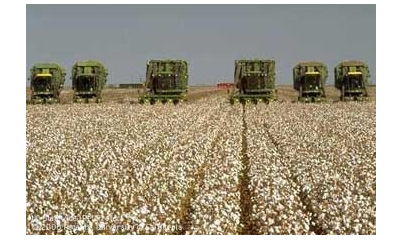
The state Pink Bollworm agency has announced that in the San Joaquin Valley the total mapped acreage of all types of cotton planted in 2016 was 209,860 acres. That compares to 154,827 acres last year. That reverses the long spiral downward in cotton plantings here.
This years totals by county are 48,280 acres in Fresno County, 23,760 acres in Kern County, 83,350 acres in Kings County, 625 acres in Madera County, 40,035 acres in Merced County, 190 acres in San Joaquin County, and 13,620 acres in Tulare County.
Kings County cotton acreage this year is up to 83,359 acres –  from just under 70,000 acres. That compares to around 75,000 acres in 2014, 103,000 acres in 2013, 133,000 in 2011 and just about fence-row-to-fence-row at 287,000 acres planted back in 1979. Tulare cotton acres last year were just 9860.
The total mapped acreage for Pima cotton in the San Joaquin Valley in 2016 was 154,255 acres compared to 115,785 acres in 2015. This year by county Pima acreage is 40,795 acres in Fresno County, 20,205 acres in Kern County, 75,270 acres in Kings County, 10 acres in Madera County, 14,805 acres in Merced County, 2,980 acres in Tulare County, and 190 acres in San Joaquin County

Local Producers Get USDA Help

USDA has recently announced grants to local companies to expand their farm based production to more customers.  The U.S. Department of Agriculture announced a total of $45 million in Value-Added Producer Grants Thursday, going to 325 projects across the U.S. Among the recipients is Barbara and Tony Martin, Dairy Goddess of Lemoore who will receive $49,000 to provide working capital to expand sales of bottled, non-homogenized/vat pasteurized whole chocolate milk, fromage blanc cheese and curds. Funds will be used for marketing, website development, attendance at the San Francisco Fancy Food Show and signage.
Also, Top O’ The Morn Farms, a family owned dairy in Tulare, received a $250,000 grant to help expand their farm fresh milk products which are sold in recyclable glass bottles into new markets in Southern California. The dairy originally received a VAPG grant in 2009 to study the feasibility of a home delivery service for their milk, which they launched with help from another VAPG award in 2011. In addition to their home delivery service, Top O’ The Morn Farms also offers their products at several local grocery stores, farmers markets and restaurants.  Their expansion has not only helped develop new revenue opportunities for the dairy, but has also helped create jobs in the community.

Hearing On New Pesticide Rule.

Kings County BOS as well as the local farm bureau are opposing a Department of Pesticide Regulation (DPR) proposed rule to require notification to schools and child care centers when aerial pesticides are used near a school site. In a 2010 state public health study – Agricultural Pesticide Use Near Public Schools in CaliforniaCalifornia – they found Tulare County had the highest percentage of schools with any pesticides applied within ¼ mile (63.4%), and Fresno County had the most schools (131). In Kings County 71% of schools had no pesticide used within a 1/4 mile while 29%, or 18 schools did. The study found that fumigants pose the greatest problem due to drift. But farmer advocates say rules are already in place to protect school kids. Now several hearings will take place including on Wednesday, November 16, 2016 at 6:00 p.m in Tulare at Tulare Veterans Memorial Building 1771 E. Tulare Avenue. Officials of the California Department of Pesticide Regulation announced the proposed rule that would prohibit growers from applying pesticides into the air within a quarter-mile of schools and child daycare centers. The new rule is subject to a public hearing and comment period. State officials said, if approved, the rule would take effect by September 2017.

Hanford Got 0.64 inches of Rain in October – Wet Elsewhere

Hanford got 0.64 inches of rain in October compared to 0.41 average for the month. That’s nothing like what northern California got with Shasta Dam receiving over 13 inches and the index for northern California nearly 400% of average, good news for our state water supply. The precipitation index for the Tulare Basin Sierra stations is a positive 137% of average. The next big system to hit our area could be around November 13-18.

State Water Board Proposes Increased Water Flows for Fish on San Joaquin River and Tributaries

September 16,2016-

from ACWA

screen-shot-2016-09-16-at-6-42-38-amThe State Water Resources Control Board September 15 released a draft proposal for the San Joaquin River that would require a significant increase in unimpaired flows for fish species.
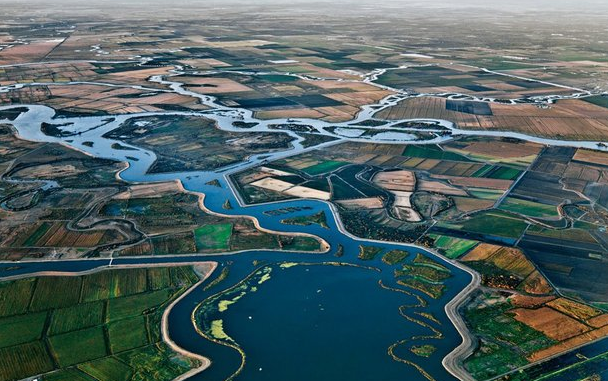
The proposal, which is part of the first phase of an update to the Bay-Delta Plan, would increase unimpaired flows from the current 20% to a range of 30% to 50%. It also includes proposed new salinity requirements for the southern Delta.
Felicia Marcus, chair of the State Water Board, said during a press call Thursday that the draft proposal is “about balancing competing interests to share the rivers with others and with nature”
“The current standards are out of date and fish populations have plummeted,” said Marcus. “The fish in the rivers need far more water left in the river to have a chance at survival.”
She added that stakeholders are invited to propose alternatives and modifications to the proposal, and that she encourages “people to come together to find the right balance.”
The increase in unimpaired flows to fish would severely impact water users that rely on the San Joaquin River and its tributaries, with many predicting Thursday that it would deeply cut into water supplies in the future.
A joint statement issued by a broad coalition of local government, water suppliers and others said the proposal, if implemented, “shuts down any hope of economic growth in this multi-county region”  by cutting water supply.
“This water grab by the state of California, without mitigation or due analysis of impacts, will be vigorously opposed by this coalition,” the statement read.
The documents released Thursday are known as Phase 1 of the Bay Delta Plan update and an accompanying Substitute Environmental Document (SED) that analyzes the impacts, benefits, and costs of the proposed revisions.
The draft proposal updates water quality requirements for salinity in the southern Delta and water flows in major tributaries to the San Joaquin River (the Stanislaus, Tuolumne, and Merced Rivers), which drain into the southern Delta.
The State Water Board stated in a press release that the proposed salinity requirements reflect updated scientific information about salt levels that “reasonably protect farming in the southern Delta.”
“The new flow requirements for the San Joaquin River’s major tributaries recognize the vital role upstream water flows provide for habitat and migratory signals for native fish species,” the release read. “In summary, the draft proposes increasing flows for fish and wildlife and adjusts the salinity requirements to a slightly higher level to reflect updated scientific knowledge.”
According to the press release, the proposal lays out water quality protections to ensure that various water uses – drinking, irrigation, fisheries – are protected. In establishing the objectives, the State Water Board said it “must consider all beneficial uses of water in determining how to reasonably protect any particular use, and must balance those interests.”
Comments on the draft SED are due on Nov. 15 of this year. A public hearing will be held over three days beginning on Nov. 2 in Sacramento, continuing Nov. 4 in the Modesto area, and concluding Nov. 10 in Sacramento. The State Water Board will then hold an additional public meeting to consider the proposed Bay‐Delta Plan amendments in early 2017.
The State Water Board is in the midst of a four-phase process of developing and implementing updates to the Bay-Delta Plan and flow objectives for priority tributaries to the Delta to protect beneficial uses in the Bay-Delta Watershed. This phase (Phase I) proposes amendments to the Bay-Delta Plan involving the Lower San Joaquin River flow objectives and southern Delta salinity objectives.
In a separate process, referred to as Phase II, the State Water Board is reviewing and considering updates to other elements of the Bay-Delta Plan, including Delta outflows, Sacramento and tributary inflows (other than the San Joaquin River inflows), Suisun Marsh salinity, Delta Cross Channel Gate closure, export limits, and reverse flows in Old and Middle River. In Phase III, the State Water Board will implement changes to the Bay-Delta Plan from Phases I and II through water right actions. Phase IV focuses on the development and implementation of flows in the Sacramento River watershed to address tributary-specific public trust needs, with consideration for other beneficial uses of water, and will be integrated with the Phase II effort. A draft scientific basis report for the Phase II proceeding will be issued in the next few weeks with proposed amendments to the plan to come next year.
Information on the draft SED and Phase 1 of the Bay-Delta Water Quality Plan update is here. A high level fact sheet is here.  A high level 8-page summary of the Bay Delta Update Phase One executive summary is here.

Farmworker Overtime Bill Passes

August 29,2016

Screen Shot 2016-08-28 at 7.19.00 AMHailed by farmworker advocates and decried by farmers, Assembly Bill 1066 passed on a 44-32 vote Monday August 29. The bill that would expanding overtime pay for farmworkers will now move to the Governor’s desk where its fate is not yet clear. Under the measure ag workers would receive time and one half after 8 hours of work – increased from the current state law that kicks-in after 10 hours. The UFW, who lobbied hard for the bill, has maintained that its about time time farmworkers in California get what “nearly all other American workers have received since the 1930s.” But critics like Geoffrey VandenHeuvel charge the decision “advances the war on California agriculture.” He says Ag will seek to replace workers with machines.

Pistachios & Almonds Look Good For Fall

Screen Shot 2014-08-08 at 11.31.03 AMAugust 21,2016-

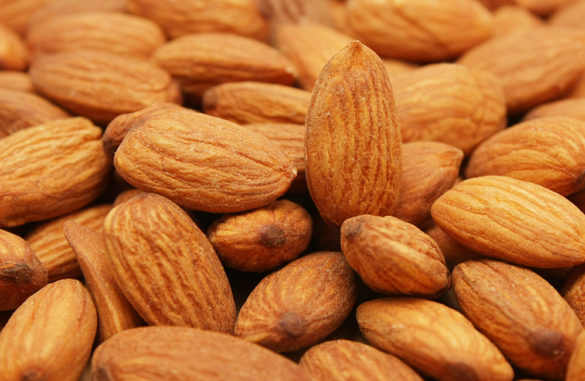
This fall’s pistachio and almond crops look both good and big, in comparison with last year. California’s pistachio production fell last year because of “blanking” caused by the drought and a lack of winter chilling hours. In Kings County where the crop grows on over 20,000 acres, production last year fell by half on a per-acre basis. Still it was a $86 million crop. The almond crop in 2015 was also down in the county, grown on some 21,000 acres here.

In 2016-2017 prospects look good for record almond crop even though prices have dropped from a year ago.USDA estimates California will have a 2.05 billion pound crop – up nearly 8 percent from last year and larger than the record 2.03 billion-pound crop of 2011.

According to the California Farm Bureau “After almond prices fell by nearly half last year, growers and others in the business say the market is now stabilizing and almond sales have picked up. Reduced prices, in turn, have helped to revive demand for almonds, with record shipments in the last three months, said Richard Waycott, president and CEO of the Almond Board of California.”
As for pistachios, Bob Klein,Manager of the Fresno-based  Administrative Committee For Pistachios says this year is a “on-year” for this alternate-bearing tree and estimates of the crop size”keep growing.”

“Earlier the estimates for the state’s crop was around 650 to 750 million pounds and recently that has grown to over 900 million pounds.People are optimistic about both the size of the crop and prospects for marketing it.”

Klein adds the number of blanks are down this year and chill hours were up.The lower prices should mean more buying around the world he adds.Last year, the California crop totaled only 275 million pounds.

Central Valley Ag Beat: When Cows Fly,Mandarins Shine

August15,2016-

When cows fly-13 at 7.12.36 AMDairy Operators Fight Methane Regulation

California dairy farmers are fighting against a bill  pushed by the Air Resource Board that could further regulate methane emissions from their cows arguing they have already  reduced their carbon “hoofprint” by 63%. They says regulation of flatulence is unrealistic. The” flatulence police need to to be reigned in.” they say. The bill could live or die by August 31.

Big Corn Crop Good News For Livestock Farmers

The USDA is now forecasting corn production will reach a record 15.2 billion bushels, up 613 from the July projection.According to the first survey-based corn yield forecast, at 175.1 bushels per acre, the number is up 7.1 bushels from August’s trend-based projection and above the record 171 bushels in 2014-’15. The USDA’s Crop Production report indicates that nearly all Corn Belt states, except Minnesota and South Dakota, are forecast to have yields above last year.

Milk Prices Recover

Milk commodity prices are up this month led by cheddar cheese at $1.88 for barrels,highest since late 2014.With this year’s feed cost down,milk checks are up for a change. California’s  big world competitor New Zealand’s dairy farmers, have cut their herd size as have we-so there is the prospect of less milk sloshing around world markets.

Water Woes Hurt Fresno Crop Values

Less westside water hurt Fresno County’s crop value in 2015, down from $7 billion in 2014 to $6.6 billion – some 6.5%. The lack of surface water was reflected in the value of field crops last year – down 42%. Cotton decreased in total value over 47 million dollars – down 35 percent from last year as acres decreased by over 7,000 acres and the price received for Pima lint decreased by over 22 percent. Harvested acres of dry beans decreased by over 70 percent resulting in a $1,930,000 decrease in overall value. Alfalfa hay was down over 21 million dollars with decreases in both the acres harvested as well as the price received. Besides field crops there was a huge drop in milk receipts in 2015 with the value dropping 31.3%. Walnuts also took a big fall based on the decline in nut prices falling from over $40 million in2014 to $23.4 million. Almonds remain the county’s top crop.


Mandarin Plantings Near 60,000 Acres

Central Valley growers continue to favor to Mandarin varieties of citrus as statewide plantings grew to nearly 60,000 acres. A new USDA report says Tulare County still leads the state  with 20,500 acres followed closely by Kern County. A look at new plantings of trees – non bearing acres – finds Kern County with 3941 acres and Tulare County with 3651 acres of new mandarin variety trees.The most popular variety is Tango with 3000 acres. Growers in Tulare County are also planting plenty of lemons with 1436 acres of new trees – the largest non-bearing acreage in the state.Tulare County leads the state in new plantings of navel oranges. We have some 68,000 acres in the county – half the state’s total.


Mandarins Fetching High Price

Mandarin citrus (tangerines) are fetching higher per unit prices year- over- year. According to the 2015 Fresno County Crop Report mandarins were worth $166,000 per ton in 2015 compared to $121,000 a ton in 2014. Meanwhile production per acre improved in 2015 as well at 13.6 tons per acre vs 9.9 tons per acre in 2014.The upshot was that Fresno ‘s mandarin farmers income almost tripled from $72 million in 2014 to $196.5 million. Strathmore citrus farmer Gerald Denni says “people are taking notice.It is definitely impacting the navel orange market.” USDA says tangerine production in the state is expected to be up 19% in 2016.

Walnut Price Stay Down

Central Valley walnut farmers continue to suffer low prices compared to 2 years ago – down by around half says local farmer Sam Sciacca. The price has dropped form around $2 lb –  two years ago to under $1 today and  a little better for the upcoming crop.He says the drought has stressed trees and yields have fallen.

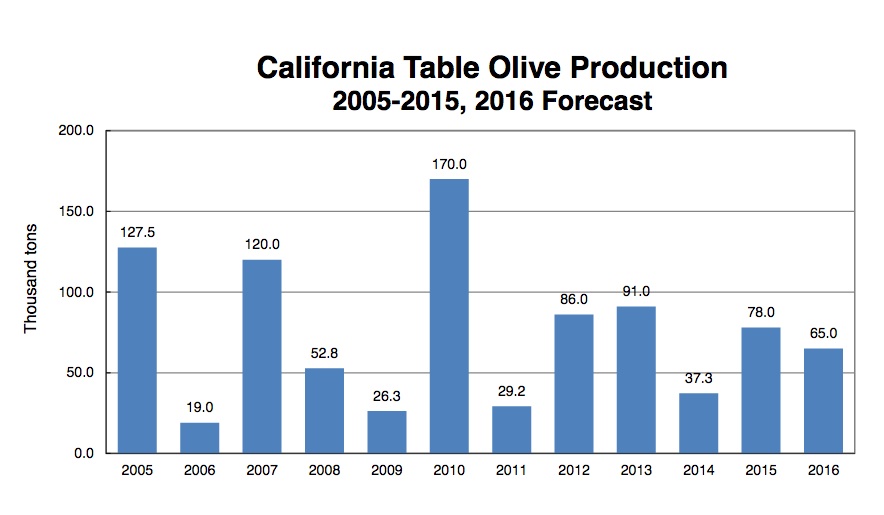
olives USDA  at 8.00.40 AMSmaller Olive Crop Predicted

California’s 2016 olive crop looks to be 17 percent smaller than last years crop of 78 thousand tons. Olives are  alternate bearing pushing yield up and down each year  But its been below 100 thousand tons since 2010.

San Luis Reservior 08-12 at 8.51.29 AMSan Luis Reservoir Water Level Rises

Westside farmers are suffering from a lack of surface water again as water levels in San Luis Reservoir have declined to a record low 10%.The government has cut back on pumping water south to help fish. That has dried  up water in the reservoir near Los Banos.But in the past few weeks the gauge is climbing as pumping has increased and expectation is that lake will fill into early winter.

Water Woes Hurt Fresno Crop Values

August 10,2016-

Screen Shot 2015-12-18 at 10.14.40 AMLess westside water hurt Fresno County’s crop value in 2015, down from $7 billion in 2014 to $6.6 billion – some 6.5%. The lack of surface water was reflected in the value of field crops last year – down 42%. Cotton decreased in total value over 47 million dollars – down 35 percent from last year as acres decreased by over 7,000 acres and the price received for Pima lint decreased by over 22 percent. Harvested acres of dry beans decreased by over 70 percent resulting in a $1,930,000 decrease in overall value. Alfalfa hay was down over 21 million dollars with decreases in both the acres harvested as well as the price received. Besides field crops there was a huge drop in milk receipts in 2015 with the value dropping 31.3%. Walnuts also took a big fall based on the decline in nut prices falling from over $40 million in2014 to $23.4 million. Almonds remain the county’s top crop.

Kings County News : Tomato Yield / More

Tomato Yield Jump – You Can Thank Drip Irrigation & Genetics

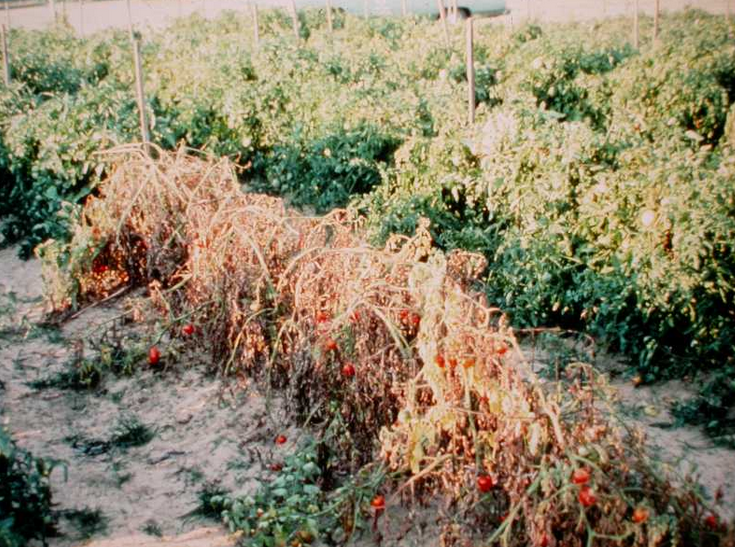
wilt in cherry tomotoes

It’s no secret that the westside of Kings County is water short.Yet this is one of the most productive processing tomato growing regions in the state or world with some of the highest yields per acre. You are probably not surprised to learn that most of the region’s growers use buried drip irrigation to deliver what water we have. But UC Vegetable Advisor Tom Turini, based at the Five Points station, says using this technology not only saves water but contributes to the high yields seen here. “It is not only more efficient way to deliver water but useful to provide a measured amount of fertilizer or pesticides just when it needs it” he says. That is a key reason why yields are higher in the drier Fresno/Kings/Kern areas vs wetter Northern California tomato fields.

Turini says local tomato farmers are only now experiencing a new pest problem that has moved south recently – fusarium wilt,a soil borne pathogen that can do major economic damage to a to field of processing tomatoes.But through the UC system and working with private firms and farmers new varieties resistant to the pest have been developed and planted experimentally around the area this year.”The plots look good but we are awaiting results on yield and quality of the fruit.” Besides drip irrigation the other secret weapon to increase yields has been genetics – using traditional plant breeding methods rather than GMOs says Turini. In the past decades tomato yields per acre have nearly tripled in California using these new management tools. Turini says” there is still room to grow, going forward.” Industry figures show yields of well under 20 tons per acre in the late 1960s compared to an average of 55 tons per acre in Kings County last year. California accounts for over 90 percent of U.S. production and approximately 35 percent of world production.

Heat Is On – Protect What You Got

Hot enough for you? Those 106 degree days are affecting all of us including our plants, our animals and our kids. Local tomato grower Brad Johns says he doesn’t use sunscreen when he heads to beach but his fields got a good dose of sun protection recently applied with a spray-rig, a whitewash of clay material that protects the tomatoes from the sear of the sun. Kings dairyman Joaquin Contente says all area livestock owners “pretty much have 100% shade for their animals.And they need it. So do children. This month two new structures will provide much needed shade for two playgrounds at Avenal Rice Park, the town’s busiest park. Through a partnership between the City of Avenal and Self-Help Enterprises, the organization secured a $25,000 Wonderful Community Grant for the shade structures. Many of the town’s farmworkers are employed by the company‘s pistachio operations. During the hottest months of the year playground equipment has been too hot for use previously.

USDA May Help Local Farmers

Last month USDA announced it would provide $300 million in cost-share assistance payments to cotton producers through the new Cotton Ginning Cost-Share program, in order to expand and maintain the domestic marketing of cotton. Through the Cotton Ginning Cost-Share program, eligible producers can receive a one-time cost share payment, which is based on a producer’s 2015 cotton acres reported to FSA. Sign-up for the program began in June and runs through Aug. 5, 2016 at the producer’s local FSA office. Payments will started this month. USDA says “Since 2011, cotton fiber markets have experienced dramatic changes. As a result of low cotton prices and global oversupply, cotton producers are facing economic uncertainty that has led to many producers having lost equity and having been forced to liquidate equipment and land to satisfy loans.” The program has a $40,000 per producer payment limit.

Now some dairy farmers are asking USDA for a similar program. A July 14 letter sent to USDA secretary Vilsack and backed by local congressman Jim Costa says ”Our dairy farmers have been hit extremely hard by low farm milk prices that have resulted in sharply reduced incomes, which is placing our nation’s dairy industry in an extremely vulnerable position.” The letter says “We have seen farm milk prices drop forty percent since 2014…” Comparing today’s tough times with 2009 the letter adds” During the 2009 dairy collapse, we saw far too many families have to sell off their cows and close the doors for good. Through the support of USDA, we can hopefully prevent many farms from needing to make that same difficult decision today and we hope your work to support our dairy farmers will be regionally balanced.” California Dairy Campaign farmer Joaquin Contente says he backs the one-time payment idea adding that the drought has been an extra burden for local dairy farmers who are having to dig deeper wells to survive and stay in business. Contente acknowledges that not all his neighbors agree – some not wanting to take government money.

Water: Some Help For Eastside & Westside Farmers

July 23,2016-

Screen Shot 2016-07-20 at 2.54.11 PMLocal farmers are not happy campers when it comes to federal water policy. Despite a wet year in Northern California westside farmers have been promised only a 5% allocation.However they would be plenty more unhappy if the Bureau had not taken action this week to shore up San Luis Reservoir, where these farmers store surface water from Northern California.
In a coordinated water exchange the federal Bureau of Reclamation announced an increase in allocation to the Friant districts from 65% to 75% of Class 1 water on Monday, a total of 100,000 acre-feet. In a key trade, Friant contractors also helped backfill San Luis reservoir, the main water supply for some Kings County farms. Some Fresno,Kings,Tulare and Kern districts also benefit from the boost in Friant’s water supply.
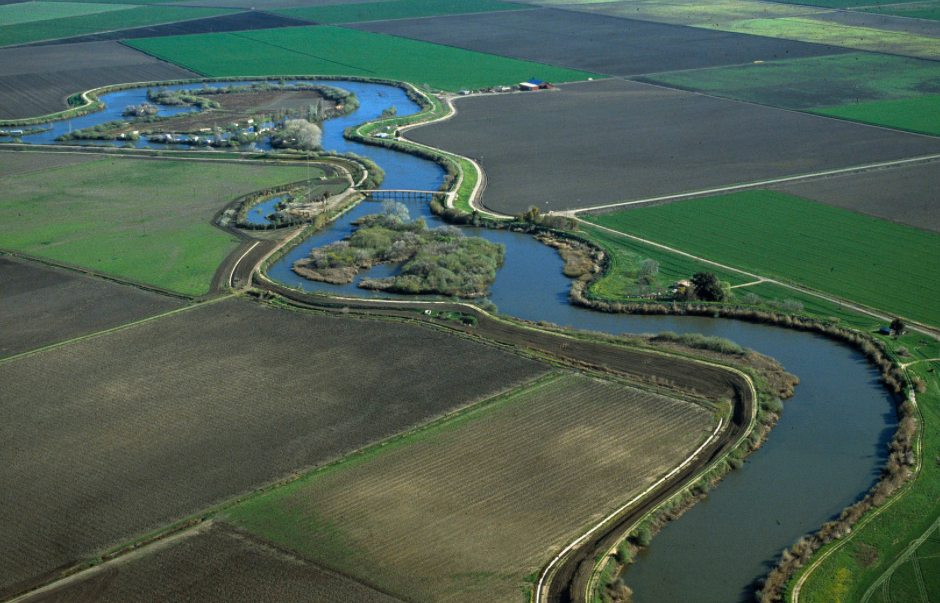
The agreement means another 50,000 acre-feet for a dwindling San Luis Reservoir near Los Banos where the lake level has been plunging due to less water making its way though the delta. “Westside growers were days away from losing their 5% allocation since the Bureau found itself short on water it could tap for operations ” says Dan Vink, a Friant contractor from Porterville.
The Bureau’s chief made this announcement.
“I am pleased to be able to increase the Friant Class 1 allocation in conjunction with an agreement that helps shore up South-of-Delta operation. We understand the frustration many of our contractors on the west side San Joaquin Valley continue to experience,” said a relieved Reclamation Mid-Pacific Regional Director David Murillo. “I appreciate our contractors’ willingness to continue to work together to develop creative solutions to the many challenges we collectively face in this difficult year.”

“The Bureau was projecting that it would move 200,000 acre-ft of water through the delta and into San Luis in June but they moved only 60,000 af.”

Jason Phillips CEO of Friant Water Authority explains just how difficult. “The Bureau was projecting that it would move 200,000 acre-ft of water through the delta and into San Luis in June but they moved only 60,000 af.” He says Friant helped by agreeing to allow the Kern County Water Agency to take water off the Friant Kern Canal in exchange for water that water district had stored in San Luis. Phillips notes that farmers have been counting on the 5% having already planted crops that will depend on it.
Because of the pecking order Friant’s supply had to be finalized before any westside districts. Friant had been trying to convince the Bureau there was more water available for the Friant districts on the upper San Joaquin River, at least another 100,000 af that had not been allocated. This week the Bureau acknowledged the supply was there. This made other trades possible.
Vink believes the Bureau is caught up in competing interests of two federal fish agencies who have a major say on water supply coming down the Sacramento River.”One wants Shasta Lake water held back this summer to help provide cold water for winter-run salmon.The other wants water released to help the delta smelt. It’s clearly a broken system.”
This year’s northern California supply is better than it has been in years with Shasta supply at 131% of average while San Luis Reservoir is down to just 13% of capacity – far below where it has been this time in recent years.
Because of the reduced flows coming south the Delta Mendota WD in recent weeks has sued the Bureau.They argue that in spite of the pumping restrictions, fish populations continue to decline sharply.The farm group wants a new look at the issue. Meanwhile, the Bureau’s Mr Murillo appears to be in the middle vowing to locals to keep that 5% allocation if possible. Murillo visited Kings County farmers in May as a guest of Kings supervisors Richard Valle and Craig Pedersen.

2015 California Wine Sales in U.S. Hit $31.9 Billion Retail Value

Jul 8, 2016

Screen Shot 2016-07-17 at 7.26.51 AMSAN FRANCISCO — California wine shipments to the U.S. reached an estimated retail value of $31.9 billion in 2015. The state shipped an all-time high of 229 million cases to the U.S. in 2015.

California wine sales to all markets, both domestic and international, were 276 million cases in 2015, a record high.

“California wines continue to attract global recognition for their outstanding quality and value,” said Robert P. (Bobby) Koch, Wine Institute President and CEO. “Consumers are comfortable with wine, and well informed about it, which is translating to growing interest in California’s regions, American Viticultural Areas, sustainable winegrowing practices and how wine complements their lifestyles.”

“The premium wine segment $10 and above is continuing its long-term growth trend,” said Jon Moramarco, founder and managing partner of BW166, who, along with Wine Communications Group, recently purchased The Gomberg-Fredrikson Report. Wine Institute has used this report as the authoritative resource for statistics and analysis for many decades. “The premium segment accounts for about a quarter of the shipments but half of the revenues. These sales offset the shrinking volume of value-priced wines $9 and under.”

Stats at a Glance

  • Estimated retail value of 2015 California wine sales in the U.S. was $31.9 billion
  • The state shipped an all-time high of 229 million cases to the U.S. in 2015
  • Total California wine sales to U.S. and to exports was a record 276 million cases
  • The U.S. has been the world’s largest wine market since 2010

Wine Institute has reported on the value of consumer expenditures on wine for two decades using volume data, scan pricing and other spending estimates. BW166 has reset the baseline for these figures using revised methodology and new sources of information from the U.S. Census Dept. and U.S. Commerce Dept.

Moramarco pointed out several developments in the U.S. marketplace last year. The lower 2015 winegrape crop has helped drive the premium wine emphasis. The U.S. consumer base is changing—millennials are reaching legal drinking age and now make up about a third of consumers over 21 years of age, with wineries tailoring their wines and marketing to appeal to this younger group seeking new and more upscale offerings. Competition was fierce with a strong dollar paving the way for foreign wines crowding U.S. distribution channels, which continue to consolidate. More than 160,000 wine labels are approved annually by TTB for sale in the U.S. Smaller wineries seeking distribution looked to direct-to-consumer (DTC) shipping, which will be legal in 44 states (when Pennsylvania’s DTC law comes into effect Aug. 7) and the District of Columbia.

Because of the move to higher value wines, dollar sales grew significantly faster than case sales in 2015, according to Nielsen, a global provider of information and insights into consumer preferences and purchases. In U.S. food stores, total wine volume sales grew 2% while total revenues increased 6%, compared to the previous year.

“The number of U.S. supermarkets selling wine is increasing, hitting about 30,000 last year, an increase of over 1,700 stores compared to 2011,” said Danny Brager, Senior Vice President of Nielsen’s Beverage Alcohol Practice Area. “No longer confined to specialty shops and liquor marts, many grocery stores are offering a cornucopia of wines to be part of a growing category. Both consumers and retailers are reaping the benefits.”

According to Nielsen, in measured U.S. food stores, the most popular table wine types by volume were Chardonnay (21% share), Cabernet Sauvignon (14%), Red Blends/Sweet Reds (10%), Pinot Grigio/Gris (9%), Merlot (8%), followed by Pinot Noir (5.5%), Moscato (5%), Sauvignon Blanc (5%) and White Zinfandel (4%). Sauvignon Blanc accounted for the strongest volume gains followed by Red Blends, and then Pinot Noir, Pinot Grigio/Gris and Cabernet Sauvignon.

The U.S. Wine Market
Wine shipments to the U.S. from all production sources—California, other states and foreign producers—grew to 384 million cases, up 2% from 2014, with an estimated retail value of $55.8 billion. The U.S. has been the largest wine consuming nation in the world since 2010. California’s 229 million cases shipped within the U.S. in 2015 represent a 60% share of the U.S. wine market.

Sparkling Wine and Champagne
Shipments of sparkling wine and champagne to the U.S. reached 21.7 million cases in 2015, up 9% over the previous year. The category appears to be growing at a healthy rate since the U.S. started emerging from the 2008 recession.

U.S. Wine Exports
U.S. wine exports, 90 percent from California, reached a record $1.61 billion in winery revenues in 2015. Volume shipments were 461 million liters or 51.2 million cases. The European Union was the top destination for U.S. wine exports, accounting for $622 million; followed by Canada, $461 million; Hong Kong, $97 million; Japan, $96 million; China, $56 million; Nigeria, $29 million; Mexico, $26 million; South Korea, $23 million.

# # #
 

CALIFORNIA WINE SHIPMENTS1
(In millions of 9-liter cases)

Year California Wine Shipments to All Markets in the U.S. and Abroad California Wine Shipments to the U.S. Market Estimated Retail Value of CA Wine to U.S.2
2015 275.7 229.0 $31.9 billion
2014 268.6 226.5 $30.3 billion
2013 259.1 215.4 $29.1 billion
2012 249.5 207.2 $29.0 billion
2011 260.0 215.3 $28.5 billion
2010 243.5 201.2 $28.5 billion
2009 246.3 205.9 $27.6 billion
2008 245.2 201.6 $26.1 billion
2007 236.4 195.3 $24.8 billion
2006 228.7 190.0 $24.4 billion
2005 224.0 185.5 $23.0 billion
2004 219.0 179.7 $22.2 billion
2003 206.8 174.7 $20.8 billion
2002 194.4 167.8 $21.5 billion
2001 188.9 162.8 $20.0 billion
2000 187.5 164.9 $17.2 billion
1999 186.4 167.0 $14.3 billion
1998 181.9 161.9 $12.6 billion

Sources: Wine Institute and BW166/Gomberg-Fredrikson Report. Preliminary. History revised.
1Includes table, champagne/sparkling, dessert, vermouth, other special natural, sake and others. Excludes cider.
2Estimated retail value includes markups by wholesalers, retailers and restaurateurs.


WINE SALES IN THE U.S. — in millions of 9-liter cases
(Wine shipments from California, other states
and foreign producers entering U.S. distribution)

Year Table Wine1 Dessert Wine2 Sparkling Wine/ Champagne Total Wine Total Retail Value3
2015 327.7 34.5 21.7 383.9 $55.8 billion
2014 324.0 32.7 19.7 376.4 $53.1 billion
2013 323.5 30.9 18.4 372.8 $51.3 billion
2012 319.4 29.9 17.6 366.9 $50.8 billion
2011 306.2 31.5 17.2 354.9 $48.6 billion
2010 292.1 28.8 15.4 336.3 $46.5 billion
2009 295.3 26.6 13.9 335.8 $45.2 billion
2008 279.7 27.4 13.5 320.6 $45.0 billion
2007 276.9 26.3 13.9 317.1 $43.5 billion
2006 266.0 27.4 13.6 304.3 $41.5 billion
2005 255.4 22.5 13.1 290.9 $38.5 billion
2004 245.3 20.3 13.2 278.8 $36.2 billion
2003 237.0 17.6 12.0 266.6 $34.0 billion
2002 222.5 15.9 11.5 250.0 $33.0 billion
2001 215.4 14.3 11.4 241.4 $29.7 billion
2000 213.2 13.9 11.8 238.9 $26.3 billion
1999 199.8 13.0 15.6 228.4 $22.9 billion
1998 196.0 13.0 12.2 221.2 $20.1 billion

Sources: Wine Institute, Department of Commerce, Estimates by BW166/Gomberg, Fredrikson & Associates. Preliminary. History revised. Excludes exports. Excludes cider as of 2011 going forward.
1Includes all still wines not over 14 percent alcohol.
2Includes all still wines over 14 percent alcohol and sake.
3Estimated retail value includes markups by wholesalers, retailers and restaurateurs.


Journalists requiring further information should contact the Wine Institute Communications Dept.