Reclamation Releases 100 Percent Water Supply Allocation for Central Valley Project Contractors South-of-Delta

Westlands Gets Relief

April 12,2016-
Top of Shasta at 5.39.04 PMThe Bureau of Reclamation yesterday announced an update to the 2017 water supply allocation for all Central Valley Project contractors South-of-Delta to 100 percent of their contract supply for the first time since 2006.
“Following the California Department of Water Resources exceptional March 30 snow survey results, Reclamation is pleased to announce this increase to a 100 percent allocation for our South-of-Delta water contractors,” said Acting Regional Director Pablo Arroyave. “However, as Governor Brown reminded us last week when lifting California’s drought state of emergency, the next drought could be around the corner. It is crucial that we remain vigilant in conserving our precious water resources.”
On Feb. 28 and March 22, 2017, Reclamation announced a 100 percent allocation for all CVP contractors with the exception of agricultural water service contractors South-of Delta (contractors in the Delta Division, San Felipe Division, and the San Luis Unit), who were initially allocated 65 percent of their contract supply, and Municipal and Industrial (M&I) contractors South-of-Delta, who were initially allocated 90 percent of their contract supply.
On March 30, 2017, DWR reported an average statewide snow water equivalent in the Sierra Nevada of 45.8 inches, or 164 percent of the historical average for March 30 (27.9 inches). As a result of the water availability south of the Delta and the amount of snowpack in the central and southern Sierra Nevada, Reclamation is able to make this significant water supply allocation increase.
Reclamation is announcing the following updated allocations:
South-of-Delta Contractors
• M&I water service contractors South-of-Delta are allocated 100 percent of their contract supply.
• Agricultural water service contractors South-of-Delta are allocated 100 percent of their contract supply.
Given the magnitude of this allocation, the amount of water carried over from last year, and the overall availability of surface water, Reclamation strongly encourages the use of surface supplies instead of ground water wherever possible through the remainder of the 2017 water year. In order to promote effective use of supplies in San Luis Reservoir this year and efficiency for next year’s operations, Reclamation will limit the overall amount of water to be carried over to the 2018 contract year to 150,000 acre-feet. Reclamation will continue to work with contractors regarding a strategy for water carried over from the 2016 water year and plans to effectively carry over water for the 2018 contract year.

Short On Workers? Robots To The Rescue

March22,2016-

Robots Head Off To Work At A Nursery
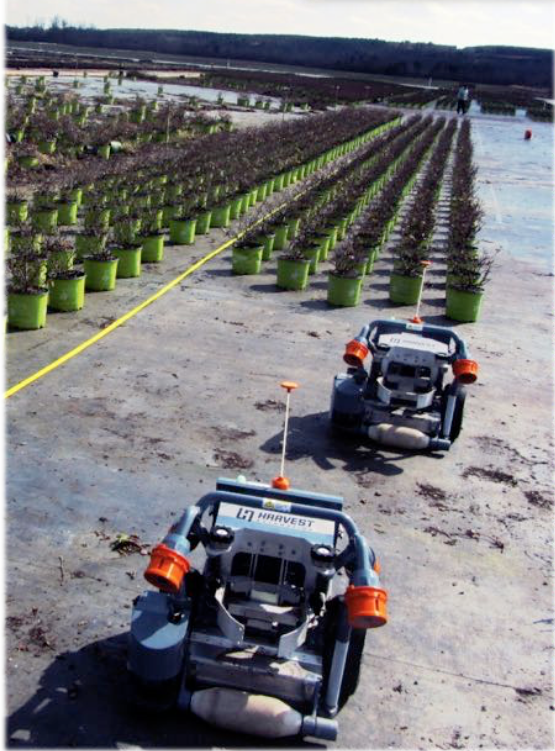
Screen Shot 2017-03-22 at 8.08.10 AMWith heightened concerned over labor availability – some Central Valley farmers are talking about tapping robotics to harvest their crops or to streamline part of their operations. A conference held in San Diego late last year addressed how fast robotics may be coming to a farm near you. The event was called RoboUniverse and it featured panels that included reps from Western Growers,Driscoll’s and Tanimura and Antle and some locals.

According to one published report from tech news watcher Robohub, Hanford dairyman Dino Giacomazzi described how the focus of his long-term plans for sustainability was finding enough labor to milk the cows next week. “Our workforce is either 25 years old or 65 years old. There is no in between right now and that is a problem. The 25-year-old farm hands either don’t like the work or find better work and are gone after payday. I have living animals who need the engagement from good people.”

Brian Antle of T&A described the lengths they are going to meet labor challenges. They built a 600-unit housing facility in Spreckels, California, this year to house temporary agricultural workers with H2A visas. T&A has also invested several millions of dollars in Spanish robotics startup Plant Tape to help it commercialize its automated field planting technology.

Antle said that it was no longer an option to sit on the sidelines and wait for machinery builders to deliver solutions. “We are all losing opportunities to sell quality products because the lettuce is picked late or we are too short staffed to meet our goals. If we cannot get more people, we must find machines; it is not that we have been sitting idle.”

Curtis Garner formerly of tomato producer The Morning Star Company said they have been very aggressively investing in agtech with a focus on automation, business intelligence, and logistics. “People want food and we have to deliver it without passing costs on.”

“We purposefully moved away from crops that require a lot of labor,” said Stuart Woolf, president and CEO of Woolf Farming & Processing, a Central Valley family farming group. “We now focus on tomatoes, almonds and other crops that can be mechanically harvested.”

Local farmer Harold McClarty, president of HMC Farms,offered the following. “We won’t find a technology that picks fruit the way we do. I have yet to find a robot with an effective, dexterous arm. Instead we are developing certain things that we can use in the packing houses. There are lots of modifications that can be made in the packing houses; they’re a much better and easier place to innovate.”

A report by the robotic intelligence firm Tractica forecasts that shipments of agricultural robots will increase significantly in the years ahead, rising from 32,000 units in 2016 to 594,000 units annually in 2024, by which time the market is expected to reach $74.1 billion in annual revenue.

The conference watched a presentation of a new robotics strawberry harvester. Organizers say that soon consumers will be buying their first autonomously-harvested tomatoes and robotically-tended celery.

With Low Milk Prices Vilsack Heads To Mexico

Key milk commodity prices are in the dumpster as of late March affecting the milk checks of local dairymen. While butter is a bright spot, cheese barrels are down around $1.36 compared to $1.61 in December and NFDM milk powder is hovering at 80 cents a pound down from $1 as of January 1. U.S. milk powder exports to Mexico in January totaled 41.9 million pounds, down 4.6% from big volumes of a year ago.

To stabilize trade concerns in Mexico, former US ag secretary Tom Vilsack. who now heads up the US Dairy Export Council, traveled south of the border in recent days to reassure our number one dairy customer. Jim Mulhern, President and CEO of the National Milk Producers Federation, and Michael Dykes, president and CEO of the International Dairy Foods Association, joined Vilsack at the meeting.

Vilsack agued the dairy industries in both countries “ have benefitted from NAFTA. Since 1994, Mexican milk production has increased by 58% which has helped meet the ever increasing demand of Mexican consumers and visitors to Mexico while at the same time continuing to provide market opportunities for American producers as well.”

Small Processing Tomato Crop

USDA is predicting California tomato processors will contract for just 11.6 million tons in 2017, the lowest since 2006. Tonnage in 2015 was 15 million. Acreage will drop to 235,000 acres in the Valley, the lowest since 1988. That is 10% less than forecasted last August. The drop is due to worldwide surplus of product. Tomato growers are being offered a base price $63 per ton compared too $72.50 last year and $80 in 2015.
High Speed Update: April Bonds Depend On March 22 Court Face-Off

Sacramento Superior Court has set at new date of March 22 to hear arguments over Prop1A and high speed rail. The tentative date is according to a spokesperson for the CHSRA. Plaintiffs attorney Stuart Flashman, who represents Kings County, has been promising he will head to court to seek a TRO – restraining order – to halt plans to spend state bond money on the project. But so far the dates have come and gone. This week could be the expected face-off with the recent announcement by the rail authority to sell $1.4 billion in bonds in the week of April 17. “These are the same litigants who tied things up in the courts for the last five or so years,” says CHSRA spokeswoman Annie Parker. “With their only results being the courts agreeing that we were following the law and the cost to taxpayers of their delay tactics.”

Dollar General Store In Armona

Armona is getting a Dollar General store with a 7500sf building under construction at 10821 14th Ave in the Downtown.

Horse Racing On Westside

On April 13 the Fresno County Planning Commission will hear a request to approve a horse racing venue some 13 miles west of Firebaugh. The quarter horse racing facility would feature concession stand and mobil vendors with plans to hold 26 events yearly with 600 guests each.The project is going through the CUP process due to a Fresno county code enforcement action. Applicants are Francisco and Romelia Nunez.


Locals Support New Federal Dairy Plan

March 8,2017-
Screen Shot 2016-05-15 at 7.56.25 AMWednesday a public hearing was held in Clovis over a proposal by USDA to change California’s milk pricing to federal jurisdiction. Support for the idea has been building in the Valley, the state’s dairy hub.

USDA’s recommended decision was released two years after three dairy cooperatives — California Dairies, Inc., Dairy Farmers of America and Land O’Lakes — petitioned the agency to hold a public hearing to establish a federal order for California.

Regulated minimum prices in a California federal order, especially for milk used in cheese manufacturing, are “likely to be higher” than what handlers would pay under the California state order says USDA. However, pooling regulations under the proposed California federal order would allow handlers to elect not to pool milk used in manufacturing.

Local Congressman David Valadao says “As California’s largest agriculture industry, dairy production contributes greatly to the economy of our state as well as the regional economy of the Central Valley. Under the current pricing system, dairies throughout the state have closed down, resulting in lost revenue and jobs.”

Local dairymen seem to agree.

California Dairy Campaign President Joe Augusto said “California dairy farmers have been substantially underpaid compared to dairy farmers in the federal milk marketing order system for far too many years. The California federal milk marketing order pro- posal put forward by the state’s cooperatives will bring our prices in line with prices paid around the country and restore equity to dairy producer pricing in our state.”

Milk Producers Council President Sybrand Vander Dussen added “We are excited to see this process begin and stand side-by-side with our State’s cooperatives in strongly supporting this proposal. For far too long, California’s dairy families have struggled under a system that artificially discounts the value of the milk they produce, to the tune of more than $1.5 Billion in the past five years. We urge USDA to schedule this hearing as soon as possible and to implement this proposal that would restore a fair price for the milk our dairies produce.”

Local farmer and Western United Dairymen President Tom Barcellos says “We are pleased this detailed project has finally come to fruition. It confirms what we have known for a long time, pointing out the inequities in milk pricing that are detrimental to California producers. We will follow its progress moving forward and keep our members fully informed as the process evolves. We encourage producers to stay engaged so that we can maintain the integrity of the proposal.”

Barcellos says California dairy operators face higher costs costs but are paid less by “an average $1.50 per lb or more” than other jurisdictions in the US.

Sunkist Handles Challenges of Big Navel Crop, Tough Competition

March 8,2017-
Screen Shot 2017-03-08 at 1.40.41 PMSunkist Growers had a strong year in 2016 despite the challenges of a large navel orange crop, tough completion both foreign and domestic, as well as lower FOB prices.

The California farm cooperative “responded well, moving an additional 3.5 million cartons into the fresh market generating revenue to support over $1 billion in member payments for the third time in the company’s history ”said Chairman of Board Russ Hanlin.

At the the co-op’s annual meeting held February 22, Tulare County orange farmer Gerald Denni was re-elected as chairman of Sunkist’s Board of Directors during the meeting. “Working hand in hand with management, the board is pleased with the way we managed a very large crop in 2016, but we are now keenly focused on current industry challenges and building a stronger Sunkist for the future,” said Denni.

Founded in 1893, the Sunkist cooperative of family farms offers more than 40 fresh citrus varieties and remains a brand that has been trusted by customers and consumers for over a century, clearly the best known citrus brand.

Not all varieties did well in this atmosphere and the high volume year did not treat all growers the same says a Sunkist statement. “However, as is often the case with large crops, the distribution of revenue did not flow equally among our grower base. Strong portfolios with good sets, size and exportability did well, but without those attributes getting back a satisfactory return was challenging.”

FOBs were down 6 percent for both navels and Valencias.

The Cara Cara crop, like others, was also much larger than initially projected and posed similar challenges to move. However, “research has shown that this variety holds tremendous promise for repeat purchase after trial.

“Sunkist’s sales and marketing staff is working diligently to educate our trade customers, domestically and in export markets, about the opportunity Caras offer and how to promote this variety’s flavor and nutrition profile to capitalize on that opportunity. Demand continues to expand for blood oranges, as does our supply…”

Meanwhile competition in the “California easy-peel market continues to intensify, with heavy supplies in production posing challenges.”

Sunkist supply of easy-peel mandarins is around 2.5 million cartons , a fraction of the navel volume at 26 million cartons and some are concerned these tangerine varieties being marketed by big non-Sunkist rival growers are taking away market share from navels and Sunkist

Regards the Valencia crop 2016 tonnage was almost double that in 2015 – 96 thousand tons in 2016- almost as much as navels which totaled 103 thousand tons.

Regards lemons Mr Denni says US growers had a good year and are cheering the US Department of Agriculture statement banning the importation of fresh lemons from northwestern Argentina to the US for 60 days.

The latest update on this year’s oranges came recently from USDA. The 2016 – 2017 California Navel orange forecast is 44.0 million boxes, up 5 percent from the October forecast, and down 3 percent from last season’s crop. The 2016-2017 Navel orange harvest began in late October. The 2016 – 2017 Valencia orange forecast is 9.0 million boxes, up 6 percent the October forecast, and up 3 percent from last season’s crop.

Central Valley Project Offers Good News For Friant Users – Delayed News For Westside Farmers

March 1,2017

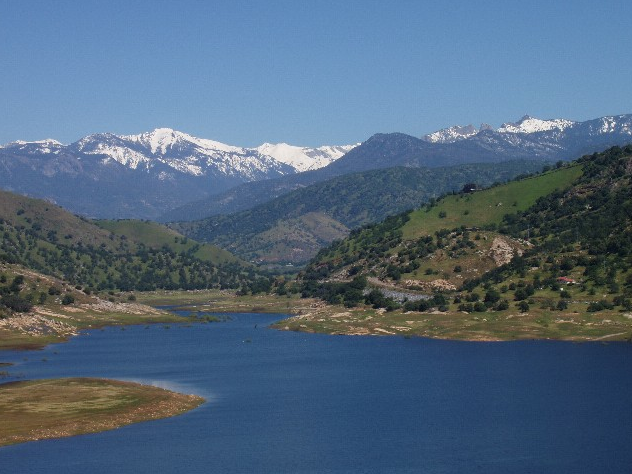
Lake Kaweah
Lake Kaweah

The Bureau of Reclamation announced February 28 the initial 2017 water supply allocation for Central Valley Project contractors in the Friant Division who will get 100% of Class 1.

“The 2017 water year has been an extreme year thus far, with precipitation throughout the Central Valley on track to be the highest in our historic records,” said Reclamation’s Acting Mid-Pacific Regional Director Pablo Arroyave.

Reclamation has notified the Sacramento River Settlement Contractors, San Joaquin River Exchange Contractors and Refuge Contractors they will get a full allocation.

Reclamation is targeting districts that receive water directly from Folsom, New Melones and Millerton reservoirs given the large snow pack and unusually high projected runoff this spring and summer.

Westside Farmers

The remaining water service contractors can expect an initial contract allocation amount in mid-to-late March. Specific to the South-of-Delta water service contractors, a substantial amount of CVP water is already in storage south of the Delta, and the Federal share of San Luis Reservoir will be full within the first week of March says the Bureau.

“ Given the extraordinary large snow pack and very high river flows this year, much of the water currently in storage in the Federal share of San Luis Reservoir will be available for delivery to CVP water service contractors this spring and summer. Reclamation currently estimates that at least 900 thousand acre-feet of water will be available for delivery to South-of-Delta water service contractors this year, and additional supplies will likely be available once seasonal operational forecasts are developed later in March.”

The 900 taf estimate represents the combined delivery of both 2017 CVP supplies and carryover supplies from last year. The exact amount of each type of supply is subject to hydrologic conditions this spring, and the overall allocation of water south of the Delta must be validated by the operational studies to be based on the March 1 snow surveys and runoff forecasts.

The California Department of Water Resources reports that as of Feb. 27, 2017, the statewide average snow water equivalent in the Sierra Nevada was 45 inches, as compared to 21 inches on Feb. 27, 2016. Precipitation is currently over 200 percent of the seasonal average to date for the Sierra Nevada for this point in the water year (beginning Oct. 1, 2016).

Friant contractors are also eligible for Class 2 flood water being evacuated from Millerton as well as Unreleased Restoration Flowsupply related to the San Joaquin River Restoration Program of 358,730 acre-feet are being made available in a block that needs to be scheduled and delivered by June 15 to avert flood management concerns.

Pine Flat Makes Room

Pine Flat Dam continues a 5600 cfs flood release this week as the Corp of Engineers makes room in the 1 million acre ft reservoir for Spring runoff. The high level peaked a few days ago, February 25 at about 781,000 af – now down to 775,550 af Wednesday with a dry pattern in store at the start of March the includes 70 degree days in the Valley.

Ag Beat: Tomatoes / Tree Fungus / Love That Eggnog

Tomato Growers Cut Plantings

Growers of processing tomatoes are expected to cut the tonnage of tomatoes they harvest by around 10 percent this year according to a USDA report. The volume may drop to 11.6 million tons in tons – the lowest amount since 2006. Acreage is expected to drop to 235,000 acres compared to 297,000 acres in 2015. There is a world-wide surplus of the product with California producing 95% of US supply and around one third the world’s volume. Kings County planted over 31,000 acres of processing tomatoes in 2015, one of the top production counties in the state.

Fungus Threatening Area Orchards

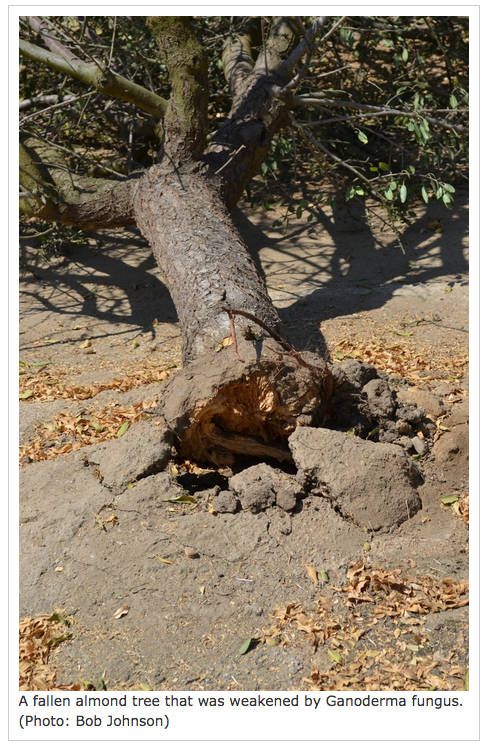
Screen Shot 2017-01-25 at 11.03.33 AMWhen an almond tree keels over in a mature orchard, it could be a sign of something ominous. UC scientists are tracking a fungal infection in San Joaquin Valley almond trees that can cost farmers hundreds of thousands of dollars in lost production.
The fungus Ganoderma grows in the living heartwood of almond, peach and other stone fruit trees. The only outward sign is development of rather large shelf-like mushrooms on the trunks called conks.
“Once you see conks on the tree, it is essentially dying from the inside out,” researcher Bob Johnson said. “The conks release trillions of spores which wind and water move through the orchard and to neighboring orchards. It’s next to impossible to stop the spread.”
A farmer in Hanford recently pulled out and destroyed every tree in his 120-acre orchard because of Ganoderma infection. “This was a 9- or 10-year-old orchard, just when the grower starts making money after investing in its establishment,” Johnson said. “Instead, his trees were just falling down right and left and he pulled out the orchard.”
In Fresno County another orchard is starting to lose trees. “In his orchard, every fifth tree has a massively sporulating conk,” Johnson said. “Growers see the conks, but they don’t realize they are the infectious part of Ganoderma fungi.”

Grocer Shutting Down In Coalinga

Save-A-Lot has announced that they are closing all of its Nevada and California locations in 13 towns including one in Coalinga and one in Taft in the San Joaquin Valley. The grocery store says they will close in a few weeks.

Kings County Jobless Rate 9.9 Percent

Kings County’s jobless rate was 9.9 percent in December. That’s up from 9.3 percent in November but down year over from 10.7 percent. Surprisingly, the county had 700 more farm jobs than a year ago while nonfarm jobs were down 200 from December 2015.

Love That Eggnog

Local dairy prices are on the rebound as consumers love those full-fat products. This holiday season there were record eggnog sales reported by processors as this full-fat beverage joined whole milk and butter’s increasing popularity.

A Mighty Wind

You thought the wind was blowing hard around your house during these past storms. Up at Tahoe’s ski resort Squaw Valley, a wind gust of 154 mph was recorded on a peak there Sunday.

Brown Announces Help For Central Valley Counties After Storms

Governor Edmund G. Brown Jr. this week issued two emergency proclamations to secure funding to help communities respond to and recover from severe winter storms that have caused flooding, mudslides, erosion, debris flow and damage to roads and highways. The emergency proclamations issued due to January and December storms includes Kings,Tulare,Kern and Fresno counties.It directs Caltrans to formally request immediate assistance through the Federal Highway Administration’s Emergency Relief Program. The proclamations also direct the Office of Emergency Services to provide assistance to local governments.

Tulare Lake Stirs

Flood Releases Help Kings Irrigation Districts Recharge

January 15,2017-

Screen Shot 2017-01-15 at 8.39.04 AMLast weekend’s warm rains were felt up to the 9500ft elevation and local rivers became torrents of runoff. The Kaweah River  flow climbed to 20,000cfs, below flood stage, but enough to get your attention. Watermaster on the Kaweah, Mark Larsen, says uncontrolled streams like Dry Creek,Deer Creek and White River added enough volume for water to reach their ancient destination – the old Tulare lakebed in Kings County.
“After all these years of drought, this good rainfall is a tremendous opportunity across the basin” says Larsen, the general manager of Kaweah Delta Water Conservation District (KDWCD).
Local Irrigation districts and farmers are buoyed this year by widespread precipitation volumes statewide so far this water year, enabling surplus water to reach even this  typically parched part of California.The state’s Northern California Precipitation Index is nearly 200% of average so far this water-year with our own San Joaquin Index not far behind as is the Tulare Basin Index.  Amazingly, all are on a pace of being the wettest year ever!
“We wish more of it would fall as snow but after so many years of drought we are not going to complain.”
Adding to the flows this winter is the fact that water is being released from both Lake Kaweah and Success Lake by the Army Corp in recent days to make room for more storms to come. Lake Success of course is mandated to keep its storage down to satisfy safety concerns.
But Lower Tule ID is gladly taking flood releases to replenish parched groundwater levels says manager Dan Vink – using new flexibility rules that allow more water exchanges.
And there is more.
Mark Larsen says Friant contractors like KDWCD and Tulare ID will be taking flood release water from Friant Dam coming down the Friant Kern Canal soon – perhaps in the 10,000 acre-feet range – to be imported and run down area channels eventually heading to Tulare Lake.
“We haven’t seen this much water to replenish the system since 2011” says Larsen. That includes the lakebed area, “the lower part of the river system that in all the drought years, has suffered the most.”he maintains.
Larsen claims that a more cooperative attitude from the federal Bureau of Reclamation that started earlier last year, has made a difference.
Now with prospects for more surplus stream and surface water being brought in from the Friant Kern, local reservoir releases and even northern California water “we are getting calls from Kings County irrigation districts who are pretty excited about getting more water.” reports Larsen.
Both Corcoran Irrigation District and Lakeside ID have made requests to KDWCD for more water” says Larsen, that will be put to good use now – either turning off the pumps to use now, for short term storage for spring irrigation or for long term groundwater storage.
It’s been a long while since Tulare Lake has made any kind of appearance. But this year she is stirring with the rest of January looking wet. Tulare Lake Basin is the name given to our part of the San Joaquin Valley from Fresno to the base of the the Tehachapis that drains four larger rivers – the Kings, Kaweah, Tule and Kern. In big runoff years like this one the dams built on each of the rivers just can’t contain the Sierra runoff and the old lakebed comes alive. Once the largest body of fresh water west of the Mississippi there were times this part of Kings County became beachfront property and you could not see across it.

Water Bill Could Speed Pumping South, Right Away

December 14,2016-

Screen Shot 2014-12-13 at 9.11.42 AMThe water picture looks brighter this week with the Congressional passage a few days ago of the bipartisan Water Infrastructure Improvement for the Nation Act (WIIN) on a strong 78 to 21 vote in the US Senate. Friant Water Authority CEO Jason Phillips say he anticipates President Obama will sign the compromise measure that offers assistance to Flint Michigan as well as relief for the Golden State.

Phillips point to some immediate benefits to drought stricken Central California.

“We believe this could mean additional pumped water from storms already in the  forecast” thanks to the so-called “short term provisions” in the bill to “maximize winter water pumping when there is no harm to fish.”

Farmers don’t need the water now, it’s planting time, but they, and their bankers, need some assurance it will be there next summer.

Local Congressman David Valadao,who backed the bill in the House, points to the need for immediate relief as well. “As we head into the winter rainy season, including these temporary provisions” in the water act to “strengthen California water infrastructure and increase water deliveries is both dire and extremely judicious. These provisions will not solve California’s water crisis, but they will provide interim relief, which my constituents desperately need.”

Phillips says federal officials will allow more pumped water south of the delta into San Luis Reservoir, a key off-stream storage facility for Westside farmers, the Exchange Contractors and cities in the Southland. Already, water storage in California is far better this year than last with San Luis Reservoir at 1 million acre-feet and climbing and Shasta at 3 million acre-feet.  The Northern California  Precipitation Index (22.9 in) is currently ahead of the wettest it has ever been for this time of the year with more big storms on tap for late this week.

The bill provides funding for long term projects but the buzz right now is over the immediate benefits for a more flexible pumping policy.

Senator Diane Feinstein says“The goal of the short-term provisions in the bill—which will sunset after five years—is to run California’s water system based on good science, not intuition. The provisions include daily monitoring of fish in turbid water, ending the winter storm payback requirement, requiring agencies to explain when they pump less than biological opinions allow, maximize water supplies consistent with law, a pilot project to see if the Delta Cross-Channel Gates can be opened for longer, extend the time period for voluntary water transfers, allow 1:1 transfer ratios in certain conditions and allow expedited reviews for projects to improve water quality.

Ending the winter storm “payback” requirement will allow agencies to capture additional water during winter storms. Agencies may increase pumping during winter storms so long as they do not violate the environmental protection mandate. Once storms end, agencies would no longer be required to “pay back” water already pumped unless there was an environmental reason to do so.
The measure also requires agencies explain why pumping occurs at lower levels than allowed by the biological opinions. The requirement is about transparency: agencies must provide reasons for why pumping was reduced.”


Record Nut Crops Challenge Industry

The harvests for all the big nut crops in Valley are bin-busters this fall – coming in at record levels this year including locally. In Kings County, almonds are our number 4 crop at $173.1 million with pistachios at number 6 –  $85.7 million and walnuts number 9 at $55.4 million. Together, they cover some 57,000 acres here. All this bounty – despite the 5 year drought.

Particularly jolting this year are numbers from the pistachio harvest indicating a 905 million pound crop – about triple last year. The record 905 million pounds estimate compares to 272 million pounds harvested in 2015 and 513 million pounds the year before. So the jump amounts to a quantum leap for this industry that must now gear up its marketing efforts to clear the bulging storage bins and plan how to handle larger crops as more trees come into production.

What about walnuts? One estimate for walnuts suggests the harvest this year could yield a total 673,000 tons –  some 12 percent larger than 2015’s record 603,000 ton crop.

As for almonds the USDA’s National Agricultural Statistics Service forecasts that California will have 900,000 acres of bearing almond trees that will produce 2.05 billion pounds of nuts this year, almost an 8% increase from last year. About two thirds are exported at a value that was $4.5 billion in 2014.

Almonds are the top ag export in the state with pistachios third and walnuts the number 5 crop that is exported. Exports are critical, but the rising value of the dollar and concerns over trade policy are weighing on the industry awash in nuts.

The prospect of bigger harvests to come is pushing the number two producer, Setton Pistachios, to hire more people and expand their facilities says plant manager Lee Cohen. Setton handles the crop from 4 million South Valley pistachio trees.
“With numbers like this we need to make plans to handle more product permanently.”

That includes hiring more people at their sprawling Terra Bella plant. “We are at 650 permanent employees now – the highest it has ever been.” They are building a new 60,000sf warehouse and adding a new pasteurization process.

As for marketing – the number one producer – Wonderful Pistachios – with farms in Kings County, is funding a $55 million “Get Crackin” media blitz that includes  the offer of lower prices for the popular nut. They say its their biggest campaign ever.

Long term the big harvests are “one more reason to automate” says Lee Cohen. The company looks to help their employees get more education for the more automated jobs of the future.


Water World – California Reservoir Storage Shows We’re Better Off

December 4,2016-

Key California reservoirs are storing more water this water-year than they were this time last year. Early winter storms have added what was a improved carryover from last year. The water-year started October 1.

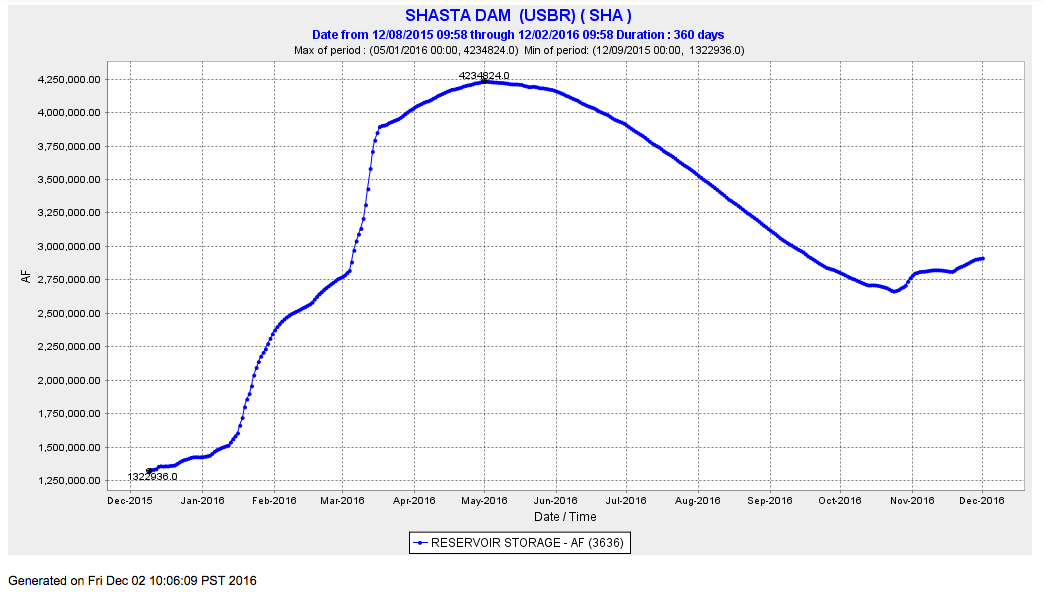
Starting at the top Shasta Reservoir as of December 2015 was at 1.32 million acre-feet. But as of December 4, 2016 the lake is at 2.92 million acre-feet and on a pace to reach 3 million AF by the New Year.

screen-shot-2016-12-02-at-10-06-29-amSo our water supply from the state’s most important reservoir is more than double last year.

The lake drains over 26,000 square miles and delivers on average around 17 million acre-feet of runoff down the Sacramento River each year.
Some runoff heads out to sea through the SF Bay holding back salt water from ruining the delta. The dam produces power too – rated at 625MW and set to generate 710MW next year.

screen-shot-2016-12-02-at-10-11-17-amFor the Westside of the Valley hardest hit by drought due to no natural river runoff – there is no more closely watched reservoir than San Luis Reservoir near Los Banos. The off-stream reservoir is a joint venture between the feds and state.

A year ago this Pacheco Pass lake had 360,000 acre-feet but now has some 918,000 acre-feet. This is still just 74% of average for the date but also the best yet for early December in the past four years of drought. The prediction is that San Luis may fill this water year, water that farms and cities can use this next summer.


Pine Flat
Pine Flat

How about Pine Flat above Fresno County? A year ago Pine Flat stood at 134,000 acre-feet. Today, a year later, the lake has 211,000AF. Rains this fall have not been so heavy in Central California as they have been in Northern California. Still, the water picture is brighter for cities and farms below.
How about those poor folks in Santa Barbara? How is Lake Cachuma doing this year. The lake is a puddle of its former self have held 57,000AF this time 2 years ago but just 14,800AF now, a little better than a month ago. It’s a good thing Santa Barbara will be using desal water to meet 30% of its supply starting next month.

Local Farm & Community Group Oppose Mass Deportation/ Plant Tea?/More

Fewer Raisins Planted

Those famous dancing raisins are fewer these days, pushed out by more lucrative crops in the Central Valley. In 2002, California raisins were grown on some 280,000 acres according to the National Agricultural Statistics Service. Today, that number is down to 165,000 acres – a 40 percent acreage decline. Kings raisin acreage has dropped from around 2700 acres in 2001 to about 2100 acres today. Tulare County has just 12,300 acres of raisins left as of 2015 compared to 33,000 acres in 2000.

Local Farm & Community Group Oppose Mass Deportatio
n

Screen Shot 2014-11-17 at 2.40.24 PMIn Fresno this week a farm and community based group is announcing a coalition of business and community leaders calling themselves the California Leadership for a New American Economy Organization. “The effort is one of a dozen statewide conservative coalitions calling for a responsible solution to the country’s broken immigration system that secures the border, grows the economy, and recognizes that America cannot and should not engage in mass deportations of millions of productive members of society.” says farmer and organizer Manuel Cunha   The membership includes
-Paul Wenger, President CA Farm Bureau
-Manuel Cunha Jr., President Nisei Farmers League
–George Radanovich, President CA Fresh Fruit Association
-Margaret Mims, Sheriff Fresno County
-Alan Autry, Former Mayor City of Fresno
-Rev. Gilbert Montelongo, Board Member National Hispanic Christian Leadership Council
-Mario Rodriguez, Chair Hispanic 100
–Victor Lopez, Mayor City of Orange Cove
CC Yin, Founder Asian Pacific Islander American Public Affairs

Tea Time For Central Valley Farmers?

screen-shot-2016-11-23-at-11-56-57-amFifty-five years ago, Thomas J. Lipton Inc.( think Lipton Tea) funded a tea study at the UC Kearney Agricultural Research and Extension Center in Parlier, which is  piquing the interest of scientists today. For 18 years, researchers pampered and coaxed 41 tea clones to determine whether tea plantations could be a lucrative alternative for San Joaquin Valley farmers.
Scientists of the time predicted a potential $25,000 economic value of future California tea plantings. Today, tea is a $3.8 billion business in the U.S. and UC Davis recently launched a Global Tea Initiative. Kearney submitted its yellowed research reports, correspondence and newspaper clippings about the long-ago tea research to the initiative’s collection of research, teaching and outreach spanning agriculture, social sciences, health, culture and economics of all things tea.
That got the attention of UC Davis chemistry professor Jacquelyn Gervay-Hague, who is studying microbes in the soil where tea is grown and their potential impact on the health attributes of tea. “I believe there is a microbial exchange that ends up in the cup,” she said.
When the Kearney tea research program was scrapped in 1981, a prescient researcher had a handful of the best tea clones planted in the landscape around buildings at Kearney, where they stand today as fall-blooming non-descript shrubs.
Hague, who with her students frequently travels overseas to sample soil on tea plantations, learned of the plants at Kearney and recognized the opportunity to conduct studies in California.
“It’s really remarkable,” she said.
Kearney director Jeff Dahlberg believes the renewed interest in the center’s tea, growing awareness about the healthful properties of tea, and increasing enthusiasm for artisanal tea and locally grown food could turn tea into a lucrative specialty crop for small-scale San Joaquin Valley farmers.
“This may be something like blueberries,” he said. “Twenty years ago, people thought they couldn’t be grown in California. But with research conducted here at Kearney, there is now a thriving blueberry industry in the San Joaquin Valley and on the coast.”

Linda Green