Valley Agricultural Leader Speaks out on DACA

Screen Shot 2014-11-17 at 2.40.24 PMFresno, CA — On September 5, 2017, Manuel Cunha, Jr., President of Nisei Farmers League announced that he was deeply disappointed in the termination of Deferred Action for Childhood Arrivals (DACA).

The President’s decision to end this program will affect 800,000 young people, which includes 225,000 Californians. These young people have only known the United States as their home. They have attended our local colleges, U C Merced, California State University Fresno, Community Colleges which includes Fresno City College in pursuit of improving our communities.

The parents of the Central Valley DACA recipients, who are mostly agricultural workers have relied on the promise of our elected officials that their children would be protected. They would be able to achieve the American Dream, which their parents sought for them when they brought them here.

There have been multiple pieces of legislation introduced by Congressional Members, all of which are inadequate in their current state. They leave out many individuals who are current DACA recipients.

I implore our elected officials and local leaders to work quickly and together, so the hard work of the DACA recipients is not in vain.

Falling Dollar Good News For Ag Exports / NAFTA

August 30,2017-

Screen Shot 2017-08-30 at 5.40.58 PMFalling Dollar Good News For Ag Exports

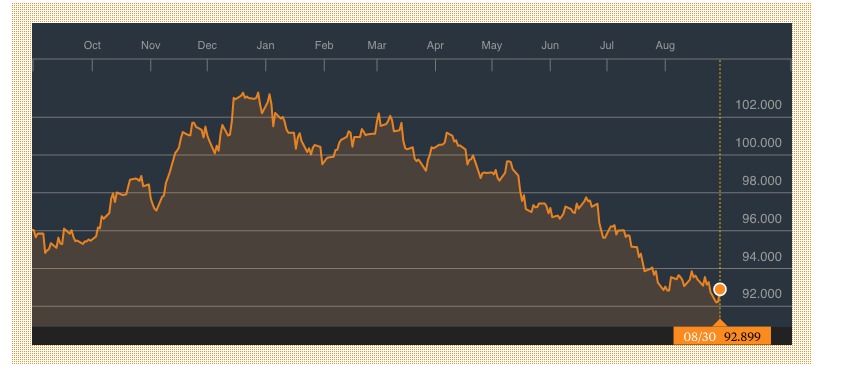
Local farmers are not complaining that the declining value of the US dollar vs other currencies.The US Dollar Index has dropped to 92 this week compared to 102 a year ago, making our products some 10% cheaper for foreign buyers using their currency. That’s a boost for our ag exports.

Farmers Worry About NAFTA

Speaking of  farm exports President Trump recently indicated he may throw out out the NAFTA trade deal but California and national farm groups says they oppose any wholesale dumping of the pact. Trump tweet this in recent days.”We are in the NAFTA (worst trade deal ever made) renegotiation process with Mexico & Canada.Both being very difficult, may have to terminate?”

When talks resume next month about renegotiating the North American Free Trade Agreement, farmers and ranchers will continue to press for policies that retain gains in agricultural trade among the U.S., Canada and Mexico. The California Farm Bureau says NAFTA has, on balance, been positive for California agriculture, although Mexican competition has hurt some crops. Canada is the No. 2 market for California farm exports, and Mexico ranks fifth.

Friant-Kern Canal Slows By 60 Percent, Subsidence To Blame

August 6,2017-

from NPR-

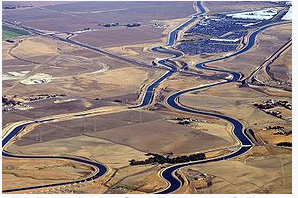
A section of the the Friant-Kern Canal in Tulare County is sinking so much that it’s lost about 60 percent of its flow.

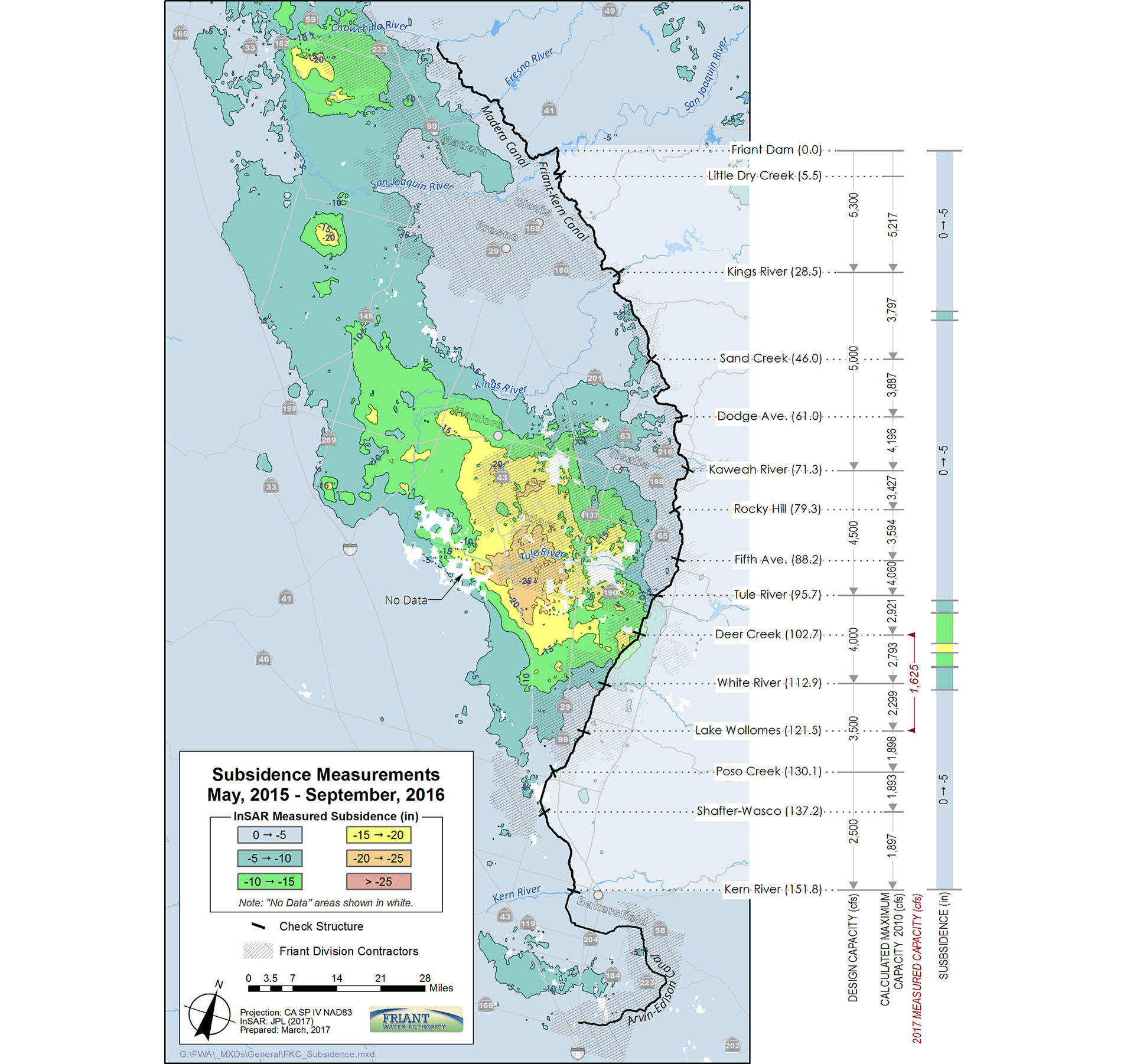
Doug DeFlitch with the Friant Water Authority says the canal that helps irrigate a million acres of farmland has sunk two to three feet in some places over about a 25 mile area. The original design capacity in the area is about 4,000 cubic feet per second and he says it’s dropped to 1,600 cfs.

“Underneath the bridge at Avenue 96 the water was impounding on the side of the bridge where historically it would be able to go underneath the bridge.” – Doug DeFlitch, Friant Water Authority

The 152-mile canal from Millerton Lake to Kern County was built in the 1940s. It also supplies water to places like Lindsey, Orange Cove and Terra Bella.

DeFlitch blames the subsidence on five years of drought, the over-pumping of groundwater and the geology of the region. As water is pumped out of the ground the clay the area is made up of collapses causing subsidence.

“One of the ways we discovered the subsidence was we were delivering some floods waters in January down the Friant-Kern Canal and underneath the bridge at Avenue 96 the water was impounding on the side of the bridge where historically it would be able to go underneath the bridge,” DeFlitch says.

Subsidence along the waterway is affecting how gravity forces water down the canal — it was designed with a slope of six inches per mile to ensure flow. He says his team has reduced the amount of water in the canal to make up for the difference.

He says the lack of flow is limiting groundwater recharge and access to water for farms and towns that draw from the canal. “Their capacity is limited, but some of the water districts have been able to mitigate those impacts by switching to their Kern River supplies or other local supplies,” DeFlitch says.

The sinking starts around the Tule River and only worsens as the water flows southward. He says the deepest sinking is near the community of Terra Bella.

CREDIT NASA JPL

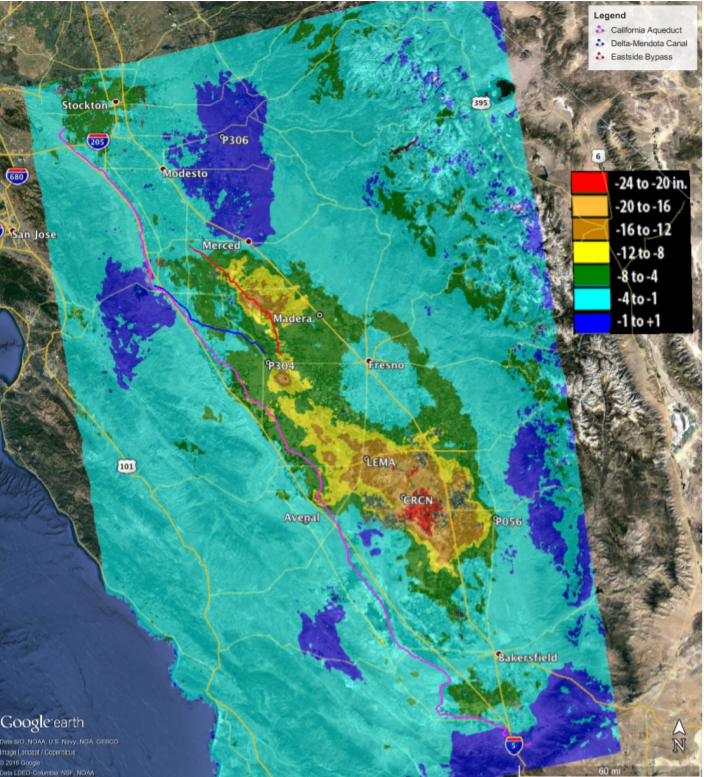
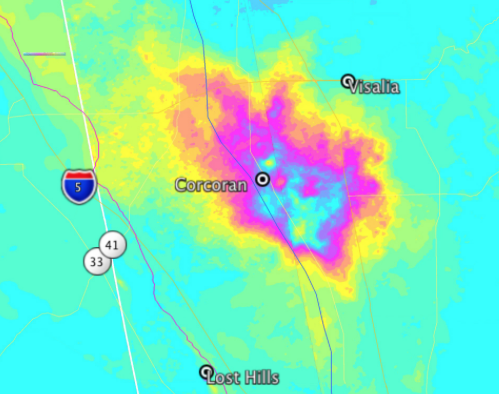
The problem mirrors subsidence detected in a 60 mile area around the town of Corcoran. That area has dropped by at least two feet according to a satellite mapping project by NASA from 2016.

“Subsidence by really no surprise is continuing there, but it’s actually got a lot faster during the drought period,” says Tom Farr with NASA’s Jet Propulsion Laboratory. “In those areas they’re just more susceptible. They have certain kinds of layers of fine grain material that are the type that compact and they pump too much.”

“This is going to be a big a big project and a big issue with all the potential critical challenges that farmers are facing right now.” – Doug DeFlitch, Friant Water Authority

To fix the flow problems DeFlitch says the entirety of the canal needs to be adjusted to make up for the subsidence, which will cost around $400 million. But because of the high price tag he says his team is focusing first on fixing the area most severely impacted. Even though only preliminary design work has been done, he says to raise the canal by three feet will cost tens of millions of dollars and about three to five years to complete.

“This is going to be a big project and a big issue with all the potential critical challenges that farmers are facing right now [groundwater over pumping rules, etc.],” DeFlitch says. “This is going to be an important one to get fixed.”

Similar repairs were made during a time of drought in the 1970’s. DeFlitch says in some places the banks were raised by six feet.

“After the 1977 drought the Bureau of Reclamation came in and did a capacity correction project — it cost millions of dollars,” DeFlitch says. “They installed several pumping plants for turnout in the area. They raised the canal linker, raised several bridges. They actually lifted the bridges up and changed the approaches to the bridges.”

DeFlitch says the plan to fix the problem may include erecting new bridges, building a pumping plant to increase the pressure of water flowing down the canal, raising banks or even re-routing the canal in some places. But he adds that all depends on funding.  He says the earliest anything will be done is sometime in 2019.

“There’s been a significant change in water supply use, crop patterns and demand patterns across the Valley since 1951,” says DeFlitch. “There’s a real need to look at the canal because of that.”

Well-Known Tulare County Orange Packer Quits

August 3,2107-

Lo Bue Bros Selling 3rd-Generation Family Operation

Korean-American Buyers Plan To Boost Exports

LoBue Bros are selling their Tulare County orange groves and packing operation in Lindsay as they exit the citrus business after more than 83 years.

President of the company Phil LoBue says the buyer is M Park Inc of Orange Cove, who is in escrow on the purchase, expected to close in September.

At a dinner for growers announcing the sale, the LoBues offered that they felt good selling their business to a fellow immigrant family, like their own which is based on their Sicilian heritage but in this case – a Korean family, father and son team, Alex and Daniel Kim. The Kims go by the M Park name from a previous business venture in Korea Town in LA – running a movie house.

Unlike most of the big players in the modern corporate citrus world, the family roots in the produce business, including in this case both the buyer and the seller – still hold strong.

Screen Shot 2017-08-02 at 4.19.11 PM

The Lobue operation owns just under 1000 acres of citrus and contracts with growers with a significant volume in addition. The family was lauded this week at the dinner/ meeting with growers and other attendees including the Kims, wishing them a relaxed well-deserved retirement.

The M Park team hope many of these contract growers will stay with the new packing operation and reports so far, appear to be positive on this, based on their reputation.

Caption: Lobue clan: L/R Fred,Joe,Phil,Robert

LoBue Bros filed a state WARN notice this month saying 98 existing employees of the company will be laid off in late September.

Daniel Kim, a Korean born,UC San Diego economics grad says he and his father are partners in their Orange Cove citrus operation that they bought and have been growing since 2008 – now managing their own 670 acres.

Daniel says ”the real value of the LoBue purchase is the volume” of all the contracted growers.

“We have the market in Korea but we need the volume” to do well, he says.

The father-son team have the familiarity and contacts, as well as market access in Korea and are exporting about 70% of their current crop to their native country, a much higher volume than most US growers who would love to sell that high percentage overseas.

LoBue History

Fred Lobue, the Chairman of the Board is now retired after growing up on a tractor on the family far, officially joining the company in 1962.

Current President Phil Lobue has run day to day operations since 1999. Phil is the son of co-founder Mario Lobue. Mario was the son of the pioneer founder – Phillip Lobue who came to the US from Sicily in 1914 and made a downpayment on a 40-acre orange grove near Lindsay in 1934, launching the dynasty.

With plans to retire in mind in the past year Phil Lobue says the family decided not to keep the groves because a “packing house  does not have the much value without the acreage to supply it.”

LoBue Bros sold their Exeter packing house earlier this year to Exeter-Ivanhoe Citrus Assn.

The M Park team apparently impressed growers attending the meeting as the Kims expressed optimism that navel oranges still have a bright future – particularly in the Pacific Rim export region.

The export market is the most important market for citrus agrees Phil Lobue. ”We expect exports could account for a steady 50% of  California sales going forward” says Lobue. That would be a good thing for the citrus industry, he adds.

California Navel Orange Future Bright ?

Daniel Kim explains that the idea that the era of navels is over is not accurate.”With farmers pulling 12,000 acres of navels in the past couple of years – mostly due to the drought- we think navels are coming back.”

The same thing happened with valencia oranges, says Kim – a  continued large reduction in trees until now – to the point “the market is pretty good” citing $200 a bin price this summer, for an example.

Kim say while US consumers are crazy for the new mandarin varieties – prospects in Asia are not as great in part because this fruit does not ship well. Also in Korea there is large mandarin tree fruit industry that is protected by the government.

Kim adds that Florida and Brazil’s problems also impact California.

The die-off of trees from citrus greening in those two major competitors, just gets worse and worse.

”In 5 or 6 year Florida’s citrus industry will be just about gone” he figures.

This year California’s citrus volume will overtake Florida for the first time ever.

Kim says the company plans to interview all new employees who are invited to apply for jobs at the Lindsay operation once the deal is finalized.


California Citrus Crop Tops Florida In 2017

July 17,2107-

Value Is Double That Of Sunshine State

California citrus production is now ahead of the Sunshine State of Florida, USDA figures show.

Florida has been hard-hit by deadly citrus greening disease for years now, taking its toll on the state’s sprawling orange groves.

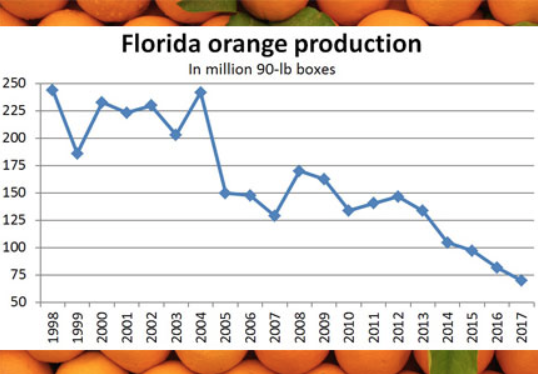
Today Florida citrus volume is half what it was decade ago and is down one third from 2014/15.

In their latest forecast released in July 2017, USDA says the 2016/2017 citrus crop is expected to total 95 million boxes from California while Florida’s a shrinking citrus crop, all varieties, will end up around 79 million cartons.

Screen Shot 2017-07-17 at 1.10.16 PMTen years ago Florida’s oranges come in at 147 million boxes. In 1998 it was around 250 million boxes.

Tonnage Tells The Tale

In 1998/99 Florida’s citrus tonnage was 10.8 million tons. California produced just 2.3 million tons that year.

Flash forward to 2014/15 Florida produced 5 mil/ tons while California came in at 3.7  mil/ tons. Last year the race was nearly a dead heat. In 2015/16 Florida edged out California 4.2 to 4 mil/tons.

When the tonnage is weighed later this year California should be some 10% ahead of Florida, based the USDA box estimate.

It is not just Florida’s orange trees that have suffered. Grapefruit production in Florida has tanked as well, from 27.2 million boxes in 2006 to 7.8 million boxes in 2016.

Consumption Down

Consumption of grapefruit has declined across the US says USDA as the fruit appears to have fallen out of favor.Per capita consumption has declined from 25 lbs in 1978 to just under 6 lbs in 2013.

Likewise for orange juice where sales are down 13% in the past four years, according to data from Nielsen.

Meanwhile, California’s non-Valencia production has surged past Florida while the Valencia crop in both states is down. California non-Valencia oranges in 2016/17 is forecast at 40 million boxes, down from 2015/16 at 47 million boxes while Florida’s non-Valencia crop has declined from just under 50 million boxes in 2014/15 to 35.7 million boxes expected this year.

Where California citrus production has surged is in the popular tangerine category that ten year ago were a minor 3.6 million box crop increasing to 18.7 million cartons by 2014/15 and 24 million boxes forecast this year.

Florida has a small and declining tangerine crop,1.6 million boxes.

The California tangerine crop seems to be climbing 10% a year, fed in-part by massive marketing of easy-peel varieties and new plantings gaining maturity.

Acres of tangerines are on the grow in California, now near 60,000 acres, half of what the navel orange acreage is in the state.Kern and Tulare County each have around 20,000 acres.

California has a big lead over Florida, not in acreage but in the value of the tangy fruit. In 2015/16 California citrus had a value of $2.1 billion compared to the Florida citrus crop valued at $1 billion. That is largely due the fact that most of the Florida crop goes to juice while most of the California crop is for fresh eating. In Florida there was 435,300 bearing acres in 2015/16 compared to 270,00 acres in California the same year.

That makes California citrus per acre more than 3X as valuable.

Florida Agriculture Commissioner Adam Putnam commented in the state’s press that the state needs to keep fighting citrus greening, which he equated to being “like a biblical plague” spreading across the state’s groves.

“The future of Florida citrus, and the tens of thousands of jobs it supports, is wholly dependent on the discovery of a silver bullet in the fight against greening,” Putnam said in a prepared statement. “Florida’s brightest minds are making progress toward a solution, but until then, we must continue to support our growers and provide them every tool available to combat this devastating disease.”

California citrus farmers are also fighting the spread of citrus greening – now found in southern California residential areas but yet to visit the commercial groves of the Central Valley.

The State Of California recently approved $10 million in state funding to fight the disease and the pest that spreads it. Authorized by Governor Brown, public monies will augment the nearly $25 million currently spent each year by the citrus industry. In addition to this $10 million, the committee will also receive $2.34 million in grant money from the federal side.

In San Diego County there is now new emphasis on removing abandoned citrus groves where the pest may multiple with little notice.


As Temps Climb… Cow Carcasses Pile Up

July 6,2017-

Screen Shot 2017-07-06 at 1.50.37 PMThree Central Valley counties have proclaimed a state of emergency as weeks of triple digit heat has resulted in significant livestock deaths. Local rendering plants can not keep up says a Tulare County proclamation heard by their Board of Supervisors July 6.

Kings County and Fresno County have similar proclamations extending a notice from late June.

Making things worse, a mechanical failure at Baker Commodities Kerman plant  has resulted in the back-up at their Hanford facility the would normally pick-up and accept dead animals.

The counties state of emergency proclamations cite health and groundwater contamination issues from decomposing cow carcasses.

At the Kerman plant the notice says 400 tons of livestock carcasses have accumulated.

The declaration sets in motion approval of alternative methods of disposal approved by CDFA and CAL-EPA until the emergency is over. Thousands of animals are expected to die despite owners best efforts to keep them cool.

The heatwave has been intense and prolonged. During the last 2 weeks of June 2017, Hanford’s NWS says 9 days were over 100F. So far in July most days were 100F or over. The 10-day forecast going forward, has little relief, with every day listed at 100F or above and temps reaching 107F this weekend.

A similar heat event occurred in 2006 casing high animal mortalities. Valley wide nearly $300 million in losses were reported due to the heat. In Kings County some 1,834 milk cows valued at $3.7 million died that summer.

Producers have the following options for disposing of carcasses:

1. Directly transport the carcasses to an alternative rendering facility or permitted landfill if one can be located which will accept them.

2. Temporarily store mortalities on their farm in composting piles for later transport to a permitted landfill.

3. Permanently bury mortalities on farm in an emergency landfill. This process requires a permit application, fees and paperwork with the Regional Water Quality Control Board.

Sinking Aqueduct Getting Help

June 21,2017-

Screen Shot 2017-06-21 at 5.49.12 PMThe California Department of Water Resources is busy this month starting emergency repairs on the all important California Aqueduct. The repairs are happening in Fresno and Kings counties where land subsidence, suspected to be caused by farm’s groundwater over pumping, has reduced the capacity of big 444-mile canal.

Department spokesperson Sheree Edwards says the agency is adding liners in low spots so the water does not overtop the rim and is looking to make the repairs “before the busy summer season” when irrigation demand is the highest. New concrete panels will be poured by contractors focusing on two “subsidence bowls” seen in studies done earlier this year

A February 8 JPL report includes sinking sections in Fresno and Kings County along the canal – a seven-mile area in Fresno County that has settled up to 20 inches. The JPL report shows that localized subsidence directly impacting the aqueduct is ongoing, with maximum subsidence of the structure reaching 25 inches near Avenal in Kings County where the aqueduct can carry only a reduced flow of 6,650 cubic feet per second — 20 percent less than its design capacity of 8,350 cubic feet per second.

The Aqueduct supplies almost 25 million Californians and waters nearly 1 million acres of farmland. Thousands of  private wells near state facilities could be contributing to subsidence, state officials suggest. Now it’s costing millions to fix it – at least repair it, temporarily.

Milk Production In Central Valley Continues To Drop In 2017

June 21,2017-

Screen Shot 2017-06-09 at 6.59.21 AMMilk producers in the Central Valley reduced their output during the first four months of 2017, as did the whole state according to CDFA statistics.

Statewide, milk production on a year-to-date basis (through April), was 13.1 billion pounds, down from 13.5 billion pounds for the same four-month period in 2016 ,about a 3% decline.

In Tulare and Kings Counties, milk output is down as well with Kings County dairy operations this year though April producing 1.419 billion pounds, down from 1.470 billion pounds for the same period in 2016, about a 4 percent drop.

In Tulare County, the numbers show a decline from 3.779 billion pounds during the first 4 months of 2016 to 3.708 billion pounds  during the same period in 2017, a 2% drop.

For the whole year of 2016, Tulare County milk production was 11.04 billion pounds according to CDFA. That is down from 2015 when dairymen in the county produced 11.2 billion pounds.

For all of 2014, Tulare reached 11.5 billion pounds – a record year. But it has been downhill since.So there is a trend line and it appears to be down. If Tulare continues this year’s trend at a 2% decline, we could end up at 11 billion pounds, still the biggest production county in the USA and the most important industry in these parts.

In Kings County the top year was also 2014 at 4.42 billion pounds, compared to 4.27 billion pounds in 2016. If the 2017 trend continues in the county – we may be lower than that.

Kings County dairyman Joaquin Contente says he is “not surprised” by the numbers.”I look around and can’t see 20 to 25 of my dairy neighbors that used to be here”. Contente says instead, many of these medium to small operations are replaced by nut farms.

“The difference is the low milk margins.” Meanwhile,” nut margins stay high, raising the price of land beyond what milk margins can sustain.”As long as nut prices stay and milk is where it is – we will see the same trend.”

Contente reports “another one of my neighbors was sold off this week.” The Manuel Costa dairy was auctioned off by A&M Livestock Tuesday.

Ag Briefs; HLB / Lake Kaweah Filling / More

New Case Of HLB Found

The dreaded citrus disease Huanglongbing (HLB) was confirmed in a single citrus tree in the city of La Habra in Orange County on April 11. This new find by CDFA will result in a new HLB quarantine area, which will link the existing quarantines into a contiguous zone spanning portions of Los Angeles and Orange counties.
Additionally, two samples of Asian citrus psyllids in Anaheim tested positive for carrying the bacteria that causes HLB. On April 8, intensive survey resulted in the detection of another diseased tree in the HLB core area of San Gabriel; another two positive trees in San Gabriel were confirmed April 11. The total number of diseased citrus trees detected in California is now at 53.
The detection of HLB in a La Habra citrus tree is alarming, as are the samples of Asian citrus psyllids from Anaheim that were found to be carrying the bacteria that causes HLB. So far, it is contained to urban pockets of Southern California. Not a single commercial citrus tree has been lost to the disease. Florida is left with a fraction of production after battling HLB for more than a decade.
No Rain In Next 2 Weeks

Weather models are backing off any hint the center of the state will get wet in the next two weeks through first week of May. That could be it for the rainiest winter in years.

Kaweah Lake Filling Fast

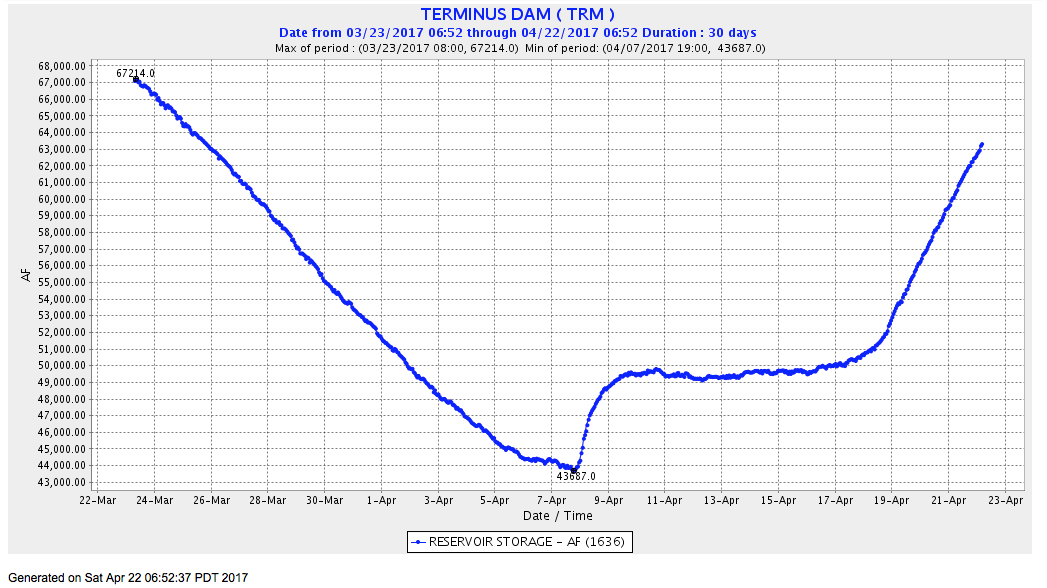
click to enlarge
click to enlarge

Terminus Reservoir will fill up from here-on after the first week of April to reach its capacity- 185,000af, this summer for a great irrigation and recreation season. Watermaster Mark Larsen says the Corps stopped flood releases recently, confident they can handle the snowmelt that is coming. April to July runoff is expected to be 186% of average at 520,000 acre feet.

Sultana Gets Greenhouse Fabric Supplier

Green-Tek, Inc is setting up a manufacturing and sales facility of greenhouse components, on a 3.79-acre parcel in the AE-20 (Exclusive Agricultural 20 acre minimum) Zone near Sultana.The company offers best in-class polycarbonate sheeting, hightech UV stabilized greenhouse film, light filtering shade nets, fans, fertilizer injectors. Green-Tek, Inc. says they are a leading converter, fabricator and master distributor of greenhouse coverings and components, thermal glazing and plastic pallets.
The company has facilities in Wisconsin and in the Visalia Industrial Park.

Woodlake To Get Ag Chem Company

Buttonwillow Warehouse, a chain of ag chemical and supply stores will open a location with a yard on S Acacia in Woodlake soon, near the Dryvit manufacturing plant. Starting as a grain elevator and warehouse, the Buttonwillow Warehouse Company diversified into distributing fertilizers and crop protection products in the early 1970’s. The closest store now is in Goshen.

Western Auto Plans New Store in Woodlake

Auto parts store Western Auto will build a new store on the north side of Valencia near the Dollar General in Woodlake later this year. The company is going through the permitting process with city.

Valley Tech Ag Lab Services To Expand

Tulare’s Valley Tech Ag Services plans to more than double its facility size on Fulton near South K St. The company is seeking city approval to build a 2-story, 7959sf building. A 4407sf building will remain on site. The firm has 13 employees.

Smaller Avocado Crop

The California Avocado Commission estimates farmers will ship 200 million pounds of fruit this season—only about half of what they sold the previous year, in part due to the cyclical nature of avocado production. Farmers say this year’s wetter winter and other signs point to a larger crop in 2018.

New Groundwater Basin Near Pixley Could Help Recharge

April 19,2017-

Screen Shot 2017-04-19 at 6.49.56 AM

NASA map shows sinking land

One of the areas in the Central Valley hard hit by ground subsidence will gain some help soon with a major recharge project in the Pixley area. A NASA sartidelte map shows the Pixley area near Corcoran, impacted by sinking lands due to farm water pumping in dry years.
The San Joaquin River Restoration Program has released for public review a Draft Environmental Assessment/Initial Study for a new groundwater recharge banking project in Tulare County.
The proposed project includes constructing an 800-acre groundwater recharge basin, installing a 4.5 mile pipeline connecting the new recharge basin to the Friant-Kern Canal and installing 16 groundwater recovery wells within the Pixley Irrigation District. These actions would allow the Pixley and Delano-Earlimart Irrigation districts to expand groundwater recharge efforts and improve groundwater levels. The proposed project also would contribute to the San Joaquin River Restoration Program goal of reducing or avoiding adverse water supply impacts to Friant Division long-term contractor