Visalia wholesale nursery laying off 278

November 7,2017

The 2018 spring season will be the last for a well-known Visalia wholesale grower. After nearly 75 years of supplying trees and shrubs for the horticulture industry, the L.E. Cooke Co is closing its bare root nursery division its owner announced recently.

Company president Ron Ludekens and CEO and general manager David H. Cox recently published a blog post offering some of the details.

“The end of an era is coming… the L.E. Cooke Co Bare Root Nursery Division will cease operations after the 2018 spring shipping season.” says the blog.

Screen Shot 2017-12-07 at 7.21.18 AM

The closure is confirmed by a state required WARN notice published on the web November 27. The notice says some 278 workers will permanently lose their jobs by mid-January.

L.E. Cooke Co is a wholesale nursery specializing in growing deciduous trees and shrubs with over 1250 acres in production. As a wholesale only nursery, the do not sell directly to the public but product is sold throughout the U.S. and Canada in leading nurseries and gardens center.

In their blog Ludekens and Cox cited various factors in the decision to shut down including the recession, the drought, uncertain market factors as well as regulation.

Not mentioned is the fact that Ron Ludekens father,Bob is now in his late 80s, a time of retirement for even the hardest working farmer. Bob was part-time with the L.E. Cooke Co. in 1946, bought into the business in 1959, became manager in 1962 and became owner of the company in 1965.

But the blog describes macro issues, not personal.

As for the drought “Not only did (Brown’s) new water use limitations hurt our sales in our largest markets of the West, but we spent over a million dollars in lowering wells, drilling new wells and tying them together. The bank we work with has been wonderful and if we felt we could work off the new debt over time with profits, we would have done it.”

The Visalia wholesale nursery supplies independent retail nurseries that in recent years have been shutting their own doors at a good clip.

“The Independent Nursery market keeps shrinking. Not many years ago, we had over 1700 active nurseries buying from us. Today, the number of active accounts has dropped to under 500 and declining almost weekly.

10-15 years ago over 70% of our volume was going direct to retail markets. The year-to-year stability in orders was nice – even when recessions came and went. Today over 60% of our volume is going to wholesale growers. There are huge fluctuations in demand from year to year. Now we grow large numbers of trees for 2 and 3 years and then shred them into mulch for a total loss at the end of harvest simply because the wholesalers have swings in inventory or found the items elsewhere for a few pennies a tree cheaper.”

Then there is state regulation that comes in for criticism.

“California is not friendly to businesses. Especially ones like ours that are labor intensive. 60-65% of our cost is labor. We have always tried to pay our year round employees as best we could afford even while competing in a nationwide market. California minimum starting wages will be $11.00 January 1 and will rise to $15 per hour over the next few years. Approximately half of our labor cost comes during harvest and shipping season and 60% of that labor are temporaries that earn minimum wage. The escalating minimum wage also puts upward pressure on wages for all our other year round employees. This is competing against labor in other grower nursery states at $7.25 an hour (less than half the cost of our future minimum wage) and Worker’s Compensation is only a suggestion in some states, or not fully mandated as it is in California.”

Ron Ludekens adds the last straw was California’s decision to change overtime rules for the state this year.

The closure will be particularly hard on L.E Cooke’s long time employees.

“Clearly we weep for our employees. Many have been with us for 20, 30 and even 40 years. The office and sales staff feels more like a family than employees and they treat each other that way. When we advised them last fall (2016) of the tough decisions made, they continued to stick with us all the way to the end. There are no words that can take away the pain felt for the disruptions of their lives this event is causing. Most have said, “I expected to go through to retirement with L.E. Cooke.” That said, we have great people that would be an asset to other companies and letters of recommendation are being written.”


Kings River: Dry start to water year – 32% of average

December 7,2017

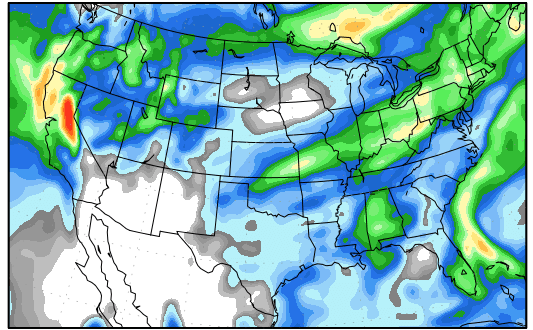
Its been day and night comparing rainfall between north and southern California through the first week of December. 

While northern California stands at 112% of average for this date, the Tulare Basin is only 39% of average.The beleaguered City of Ventura stands at just 1.5% of average rain for this date says NWS.

High pressure across the state this month is blocking any storm system in the Pacific from coming in at least until Dec 22. 

Kings River
Kings River

Steve Haugen, watermaster on the Kings River, says Pine Flat Dam has received only 1.07 inches of precipitation so far compared to an average of 3.31 inches or 32% of average.

Just published this week, new research by scientists at Lawrence Livermore and UC Davis are connecting the loss of Arctic sea ice to precipitation-inducing winter storms being steered away from California by a persistent atmospheric ridging system in the North Pacific. The study in the publication Nature says on average over a 20-year period, there would be a 10–15% decrease in California’s rainfall, similar to the extended drought we experienced from 2012-2016. It is sobering to think that the loss of ice is related to  high-pressure and bone dry conditions we are seeing this week, to disastrous results for the poor people of southern California.

Back in our area, Haugen is not panicking knowing ”one good storm could take the Kings number to average.” 

Further, the storage carryover this year in our Central Sierra reservoirs is about 400,000af due to the wet year we had in 2017.That compares to just 50,000af carryover the year before.

Then there is the groundwater banked in the valley-based Kings watershed from January through September 2017. Haugen estimates that could add up to an additional one million acre-feet available to us!


TULARE COUNTY PROCLAIMS COMMITMENT TO COMBAT CITRUS DISEASE

November 15,2017

Some 750 ACP Finds This Year

Screen Shot 2017-03-09 at 7.14.16 AMThe Tulare County Board of Supervisors approved a proclamation demonstrating the County’s commitment to fight and prevent the Asian Citrus Psyllid (ACP) and Huanglongbing (HLB), the disease it transmits.
The Board approved the proclamation at their fifth and final evening meeting for the 2017 year which was held on Tuesday, November 14th at the Porterville City Council Chambers. Tom Tucker, Assistant Agricultural Commissioner/Sealer gave a presentation on the worst disease known to the citrus industry, HLB also known as Citrus greening disease.
Tucker stressed the important roll the citrus industry plays in the County and why the disease with no known cure poses a threat to the local economy. Tulare County is the number one citrus growing county in California with 75 packing sheds and processing facilities. The annual production value of citrus in Tulare County is $1.3 Billion according to the 2016 Annual Tulare County Crop and Livestock Report.
To date, there have been more than 750 ACP finds in Tulare County alone posing a bigger threat to citrus acreage totaling more than 132,000 in the County.  The only method to control spread is removal of infected trees. The proclamation reaffirms the authorization already provided under the California Food and Ag Code given to the Agricultural Commissioner to order the removal of trees, if necessary, to destroy or control the pest.
“The impact to commercial groves and the economy of Tulare County could be devastating if we do not raise awareness,” stated fifth generation Tulare County citrus farmer and District One Supervisor Kuyler Crocker, who led the effort to create the abatement program. “This is the first step. I will work with our neighboring counties to establish similar programs, as Tulare County has done.”
The initiative received support from various members of the community as well as citrus and faming groups including California Citrus Mutual, Citrus Research Board, California Citrus Threat, Tulare County Farm Bureau and others.
“The action taken by the Board of Supervisors Tuesday night is very gratifying;” states California Citrus Mutual President Joel Nelsen. “The battle against Huanglongbing is being waged on many fronts in all U.S. citrus production areas. The Tulare County Board recognizes the partnership that exists between industry and local government. This appreciation for the family farmer in our County and the potential economic impact is indeed gratifying.”
Along with committing to the fight against the disease, the Board also passed a resolution allowing the Office of County Counsel to represent the County in all proceedings relating to the protection of citrus trees and abatement of neglected or abandoned plants or crops.  A budget adjustment was approved in the amount of $250,000 to cover the costs of infected tree removal expenses for Fiscal Year 2017/2018.

Ag Beat: Milk Powder Price Down / Raisins Up

Milk Powder Prices Fall

Screen Shot 2017-11-08 at 2.14.55 PMCentral Valley dairies produce tons of milk powder for export. But this month prices are down for nonfat dry milk with spot prices down to 72 cents per pound, the lowest value in 18 months say market analysts.One of our biggest destinations is Mexico but both Europe and Canada are grabbing some of the U.S.
marketshare south of the border. U.S. NDM exports in September dropped to 88.7 million pounds, down 19.5% from a year ago and the lowest monthly volume since February 2015.

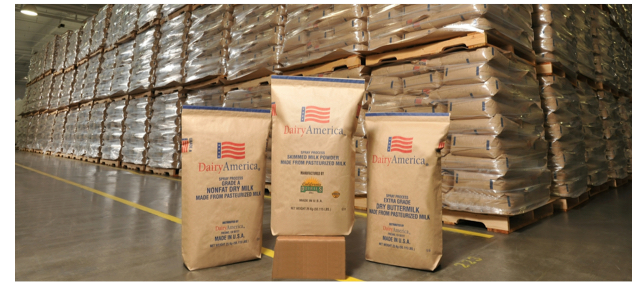
Visalia-based California Dairies manufactures 724 million pounds  of milk powder or 42 percent of the milk powder produced in the United States marketed by Dairy America (pictured).

Raisin Farmers Cheer Better Price

Last month the Raisin Bargaining Association and the Central Valley’s major packers agreed to a 2017 price of $1,800 per ton for natural seedless raisins.That is up from $1100 per ton they got in 2016. Helping to boost prices is what appears to be a low yield for this years crop, down about a third.

Union Pacific Eastbound Trains Now 5 Days A Week

November 8,2107-

Screen Shot 2017-11-08 at 2.03.51 PMUnion Pacific announced earlier this year it had acquired most of the RailEx business including the terminal in Delano that has 225,000 sq. ft. of refrigerated space. The firm transports fruits, vegetables and other temperature-sensitive cargo across the United States. Now UP has announced the refrigerated trains departure eastbound to New York will increase to five a week, Tuesday through Saturday beginning November 1. The rail company formerly shipped three days a week from Delano. With refrigerated truck loads costing more – UP expects to be competitive with this increase.”Loads have doubled since the announcement” says Delano UP market rep Lee Brown.

Brown points to rising freight rates by rival trucks this year and says it will get worse in coming weeks with the December 18 mandate that all commercial interstate vehicles install electronic logging devices to ensure compliance with hours-of-service laws.

Kern County Ag Tops Tulare for #1 Bragging Rights

September 20,2017-

Cattle & Field Crop Values Fall Big Time In Tulare County

Screen Shot 2017-09-20 at 12.49.46 PMThe 2016 Tulare County Crop Report, released this week, shows a drop of almost 9% from 2015 to $6.37 billion, well below Kern County at $7.18 billion.

That means Tulare County falls to second place in bragging rights for top ag county.Fresno County is number 3. So, what happened?

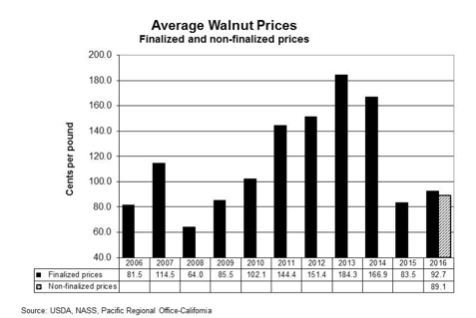
Milk dropped by $72 million, field crops were down by $300 million while grapes, peaches and walnuts all dropped, based on lower per ton price.

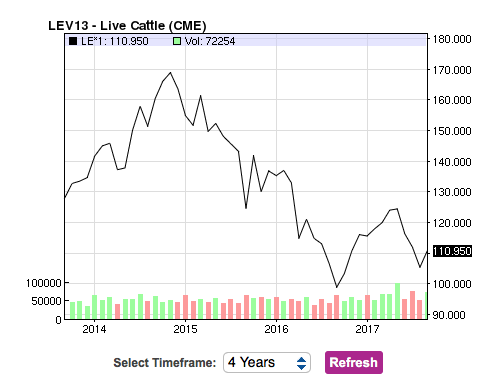
The big blow came with the one-third decline in cattle prices with the total value in this category falling nearly $300 million.

Screen Shot 2017-09-20 at 1.16.00 PMCattle prices in Tulare County fell from nearly $1500 per head in 2015 to about $1000 per head in 2016, a victim of declining beef prices that continue to flex at the low end in 2017 (see chart).

Oranges beat out cattle for number two crop in the county behind milk. Meanwhile pistachios and tangerines showed nice growth.

Milk prices fell to an average of $14.90 per cwt from $15.30 in 2015. The volume of milk produced fell by nearly 2%

Meanwhile other commodities fell as well. Tulare County’s pomegranates declined in value from $40 million in 2015 to just $7.5 million.

In Kern County cherry yields were up 250 percent. But the big factor is nuts. Kern is where they grow 40 percent of the state’s pistachio crop (up $500 million) and 20 percent of the US almond crop.

Valley Fall Orange Crop Down On Small Set

September 14,2017-

Screen Shot 2017-03-09 at 7.14.16 AMWe should see a smaller California navel orange crop this winter – with USDA saying – expect a decline to 68 million cartons, down from 80 million to 90 million cartons average in the past few years. The smaller crop comes as fruit-set down this year along with acreage to 115,000 acres, down 5000 from last year.

NASS survey data indicates a fruit set per tree of 273, below the five-year average of 348. The average September 1 diameter was 2.341 inches, above the five-year average of 2.240 inches.Tulare County, the number one navel organ producer has a set this year of just 266 oranges per tree, down from 380 per tree last year. Fresno County trees fell to 174 fruit per tree, down from nearly 300 per tree .Kern County remains the highest count at 384 per tree ,down from 474 last year.

The smaller California crop comes as Florida orange groves suffered significant fruit loss in the recent hurricane.One estimate says Hurricane Irma caused losses of 50 to 70 percent of Florida’s citrus crop in portions of South Florida, according to the Florida Fruit & Vegetable Association.