China Could Hit Back on Local Ag Products

March 20,2018-

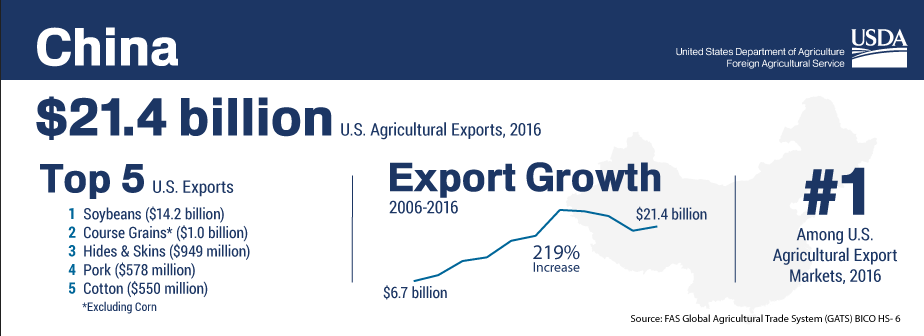
How might China respond if President Trump follows through on a promise to impose $60 billion in annual tariffs on China late this week?

Screen Shot 2018-03-20 at 8.35.21 AM“I believe that China would stick to trade responses by raising tariffs on select U.S. products that would hurt U.S. exporters, particularly in [the] agriculture sector,” Wendy Cutler, vice president at the Asia Society Policy Institute and former acting deputy U.S. trade representative, said in a statement to CNBC.

Even Mr Trump’s ag secretary has weighed in. U.S. agricultural exports could be at risk in any retaliation over tariffs implemented by the White House, U.S. Secretary of Agriculture Sonny Perdue said this week.

California ag commodities could be front and center including key products from Tulare County. China/Hong Kong is the top export destination for Tulare farm products with 7.1 million cartons. A full 20% of export shipments of Kings County ag products go to China/Hong Kong every year.Likewise for Kern County where China/Hong Kong is by far the top export partner. California sends over 30% of its cotton and beef to the region, 10% of almonds, walnuts and milk products and 21% of pistachios.

Ag Beat : Milk Price / Fish & Farming

February 7,2018-

Despite pleas CDFA turns down request for higher milk prices

Screen Shot 2017-06-09 at 6.59.21 AMOn February 2 the California Department of Food and Agriculture denied a request for a hearing to consider a temporary increase on all classes of milk. The CDFA reasoned that the state’s dairy famers are determining if they will join federal order or not.But the decision could be many months away.

Meanwhile Kings County milk production keeps shrinking, down 2.7% for 2017, and prices are poor. Meanwhile another local dairy is selling out.This month the Matt Evangelho dairy in Hanford will disperse their cows at auction and put the land up for sale.

Fish & rice farming?

A UC Davis study is evaluating the introduction of fish in rice fields with a goal of reducing methane emissions from rice production. The study is being carried out near Marysville.  Samples that were taken from flooded rice fields over the past two months verify an abundance of zooplankton, a significant source of protein for fish. The practice could potentially reduce methane emissions from rice by 90 percent.

California olive growers win duties on Spanish olives

January 25,2018-
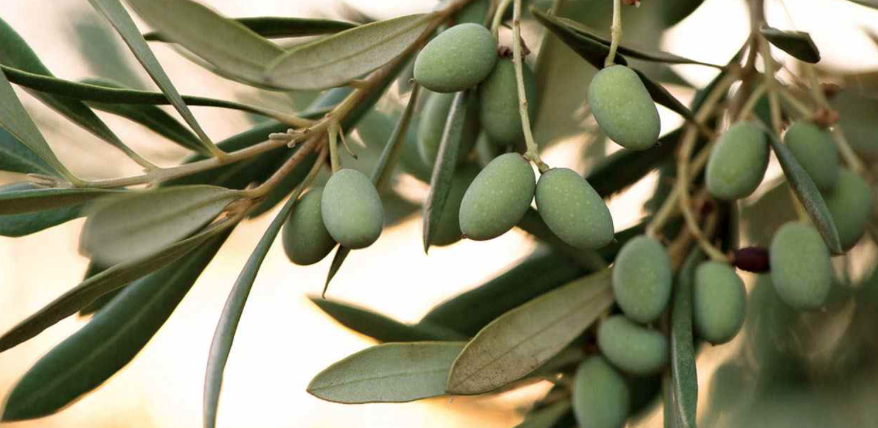
Screen Shot 2018-01-25 at 9.23.30 AMCalifornia based  Bell-Carter Foods and Musco Family Olives got the US Commerce Department to slap tariffs on ripe Spanish olive farmers this week, in a preliminary ruling.

In what is becoming a trend the Trump administration appears to be ready to take action even though this may cause an escalation in trade disputes.  This week tariffs were announced on Chinese solar panels as well as Korean washing machines.

Some fear this could be the start of a trade war retaliation by countries affected by these targeted US tariffs.

In this case the two large family-owed growers were the petitioners in a long running dispute.California growers say the Spanish olive industry dumps their olives at less than fair value propped up by subsidies, hurting San Joaquin Valley farmers.

Although the ruling wont be final until June the US is imposing duties of up to 20% on Spanish olives imported into the US. For now that will mean only a cash deposit.

Spain imported about $71 million worth of olives last year.The rulings will be subject to review by the International Trade Commission.

Olives are a $40 million crop in Tulare County and $160 million statewide. Farmers harvest about 36,000 acres.

CDI Closing Los Banos Plant /more

California Dairies closing Los Banos milk plant

Screen Shot 2018-01-17 at 6.31.41 AMCalifornians continue to drink less milk and now the industry is contracting. Visalia-based California Dairies Inc says it will close their Los Banos milk plant in March resulting in the layoff of 63 workers.

CEO Andrei Mikhalevsky says “Unfortunately, the declining volume of milk in California is affecting the entire dairy industry, and CDI is not immune.”

“These reduced milk volumes, combined with the high cost of operating our Los Banos facility, are the sole drivers behind the decision.”

The Los Banos plant produces fluid milk, milk powders, cheese and condensed products. The milk powder market is oversupplied and prices  this winter are near 2009 lows.

Regards fluid milk, California a continues to drink less –  with  sales down 3.3% through 2017 mid-year according to CDFA.

The co-op will longer make cream cheese products as a result.

Raisin variety cuts labor costs

Harvesting raisins is likely the most labor intensive crop in the Valley and farmers are busy looking for ways to cut costs. At a recent San Joaquin Valley Grape Symposium in Easton  farmers heard a UC expert talk about Sunpreme raisins.

“The vines can be pruned by machine and then the dried raisins can be harvested by machine,” said Matthew Fidelibus, Extension Specialist with the Department of Viticulture and Enology at UC Davis.

Traditional dried-on-vine varieties require workers to cut the stems above clusters of grapes to initiate the drying process before being mechanically harvested.  Sunpreme raisins are different in that the variety “dries naturally after ripening, so the fruit just ripen and then they start drying, so there’s no cutting needed,” Fidelibus stated.

Along with examining the performance of Sunpreme raisins using different rootstocks, Fidelibus has been evaluating the most effective trellising technique at the UC Kearney Agricultural Research and Extension Center.  Fidelibus and his team have been looking at “optimizing the trellises for machines to make sure that we can take the best advantage of the opportunities that this new variety offers in terms of being able to machine prune and machine harvest.

Central Valley Project water meetings set

The Bureau of Reclamation has added an additional meeting and postponed a meeting to give the public more time and more opportunities to provide comments as it prepares an environmental impact statement for Revisions to the Coordinated Long-term Operation of the Central Valley Project and State Water Project, and Related Facilities.

Three public meetings have now been scheduled to gather comments that will be used to develop alternatives to the proposed action. A meeting scheduled for Jan. 16, 2018, in Los Banos has been postponed a week to give the public more time to prepare and attend the meeting.

The new meeting schedule is as follows: Tuesday, Jan. 23, from 2-4 p.m. at the Stanford Room, 650 Capitol Mall, Sacramento.  Wednesday, Jan. 24, from 6-8 p.m. at Los Banos Community Center, 645 7th St, Los Banos.A third meeting will be in Chico.

Arrest Made in $1.5 Million Tulare County Cattle Theft

From Agnet West

DAIRY & LIVESTOCK, INDUSTRY

On January 4 law enforcement announced that a cattle theft suspect has finally been arrested and is now awaiting a hearing in Tulare County.

Sheriff Mike Boudreaux reported that 36-year-old Justin Tyler Greer of Exeter has been arrested, having been accused of stealing hundreds of head of cattle.  “This case can only be described as a 21st century, modern-day cattle rustling case,” said Boudreaux.Cattle Theft

There have been seven victims spanning California, Colorado, and Wyoming, with losses totally $1.5 million.  So far, 900 head of cattle has been recovered.  “We believe, through our investigation, the potential of thousands of head of cattle have still yet to be located,” Boudreaux noted.

Officials are continuing to work on recovering the remaining heads of cattle that are still missing.  Sergeant Raider of the Agricultural Crimes Unit, who helped lead the investigation said, “it’s no longer the time when you can just go get someone’s cattle back out of a field, you know, you have to pour through thousands of pages of digital evidence.”

The fugitive task force apprehended Greer in Texas on December 27.  For many years, Greer was widely known in the Tulare County area as a respected cattleman who bought and sold cattle as a broker and also managed various herds of cattle. Greer is now facing 13 grand theft, embezzlement and fraud charges related to the cattle theft.  His bail is set at close to two million dollars.  A hearing on this case is scheduled for the morning of January 5.

“I want to reinforce to our agricultural partners in the communities of Tulare County that we will dedicate and put no limits on the resources of investigating agricultural crimes to our agricultural partners here in Tulare County,” said Boudreaux.

Milk products: what’s selling?

January 3,2018-

Screen Shot 2018-01-03 at 4.01.24 PMSome rare good news for milk producers, organic milk sales in California are up about 3% in 2017 through November reports the CDFA.

Nationally, stories are circulating that organic milk sales have lost their mojo.

“Organic milk sales have cooled as the very shoppers who drove demand for the specialty product not long ago move on to newer alternatives, leaving dairy sellers and producers grappling with oversupply.”

Fluid milk of all kinds has seen a steady decline in popularity in part because we are all eating less ready-to-eat cereal with its own drop of 3.3 percent per year.

But organic whole milk continues to grow in popularity in the Golden State with sales up about 10% in 2017 through November. That compares to conventional whole milk sales that are up a more modest 1%.All varieties of conventional milk suffered a decline of 3.5% while all categories of organic milk sales are up around 3%.

One category seeing higher milk sales is flavored milk – up over 3% this past year; Buttermilk is up over 3% and yogurt is the strongest player – up over 20% Not doing well are frozen milk products, down about 6% year-over-year.

Also down this year is butter with sales down around 5% this year. Cheese sales are about even with 2016 sales with cheddar cheese seeing a 5% rebound, mozzarella (about 60% of all cheese sales) reporting a 1% decline.The much smaller category of Hispanic cheese sales are up around 10% and whey protein is up by 5%.

CDFA says comparing the first half of 2017 to the first half of 2016, total cheese production in California increased 0.4 percent, yogurt production increased 28.2 percent, butter production decreased 6.9 percent, and nonfat dry milk production (for human consumption) decreased 6.3 percent. In addition, from January through June of 2017, total sales of Class 1 fluid milk products (including half-and- half ) in California decreased 3.3 percent, compared to the same period in 2016.

Coastal Crop Updates: Avocados / Strawberries

December 21,2017-

Big year for Mexican Avocados

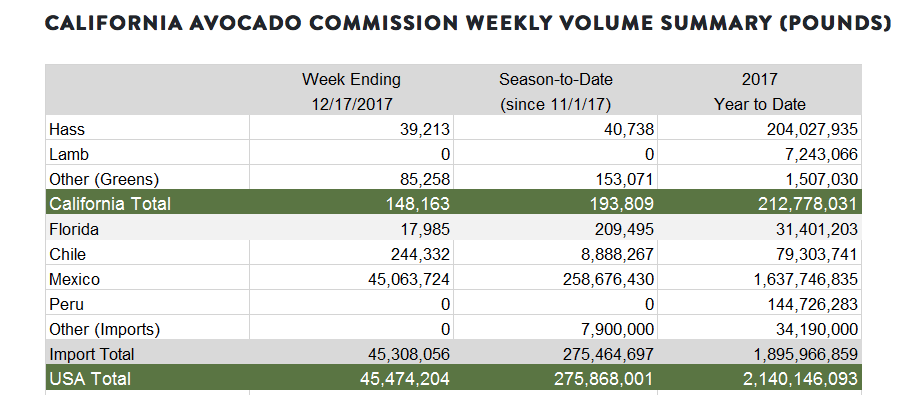
That guacamole you ate all year was mostly made from Mexican grown avocados. In 2017 California supplied just 10 percent of the total volume we consumed in the US according to the California Avocado Commission. Here are the numbers.(click to enlarge)

Screen Shot 2017-12-21 at 7.13.26 AM

California avocado production varies between 200 million lbs to 500 million pounds, a fraction of the Mexican crop size.

In recent years Mexico has been supplying the US with about 80% of the volume. The state of Michoacán is the world leader in avocado production and accounts for 80 percent of total Mexican avocado production.


California Strawberries Up About 6 Percent

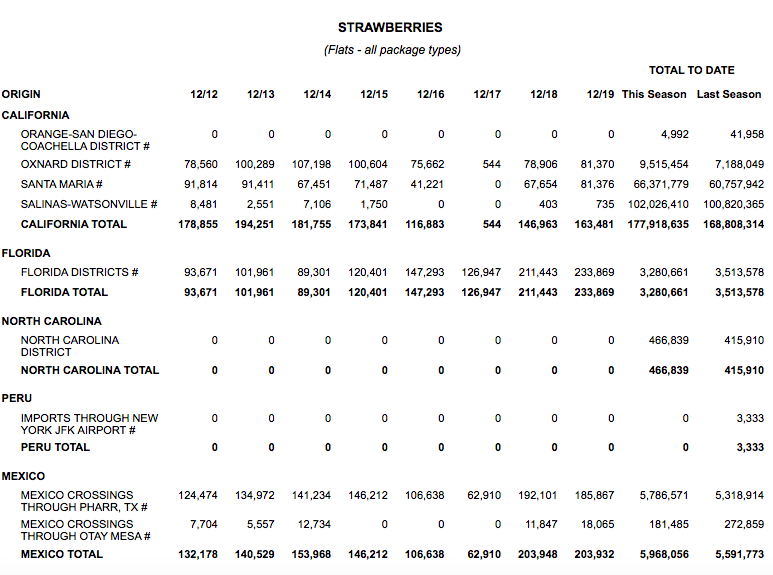
The California strawberry crop is up for 2017 around 6%. The  Santa Maria area volume is up even higher.Here are the industry stats.(click to enlarge)

Screen Shot 2017-12-21 at 10.03.36 AM


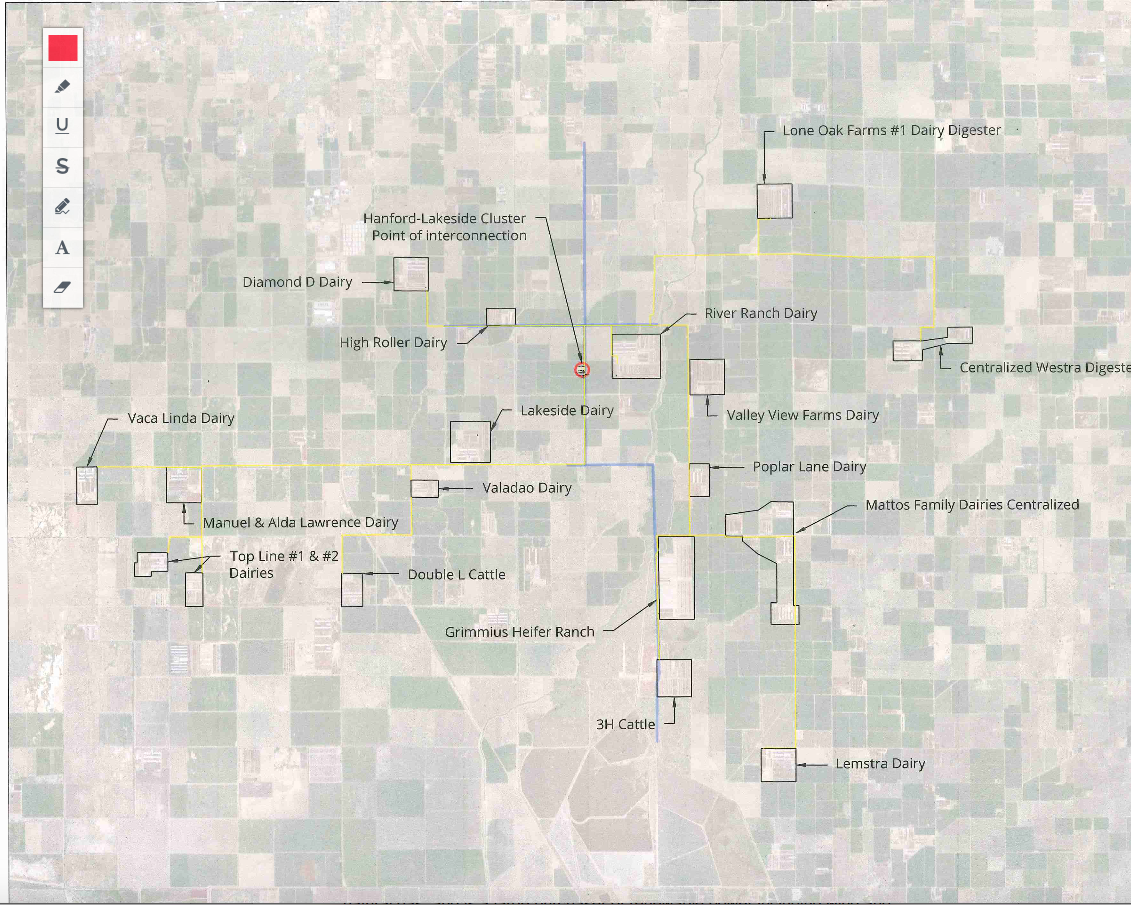
Kings County’s Lakeside biogas pipeline could link 18 dairies / Milk prices fall

December 20,2017

Covering around 35 miles, the new Lakeside Pipeline project would connect as many as 18 Kings County dairies ( a cluster of 8 to begin with) to a buried biogas pipeline and the SoCal Gas distribution system In an effort to cut methane emissions. If successful , the state incentives and restrictions could turn a pollution problem, particulates in our air, into a money maker for farmers, moving the gas out of the air shed and selling the biogas as a renewable transportation fuel.

The pipeline project near 7th Ave, is the subject of a new Kings County conditional use permit application. The pipeline would spread out like a spider web to dairies who have their own covered lagoons and digesters, then come together on a 3.3 acre site owned by Jacob and Nicole DeJong, where equipment would upgrade the gas to be injected into the SoCal Gas network.

November ground breaking in Pixley

Developing the pioneering project is Daryl Maas of Mass Energy Works of Redding who is also working with the Pixley biogas cluster of dairies connecting 8 to 10 of them with pipe being laid now to 2 of them. The project will be the first in the state to connect to SoCal Gas’s system, the utility has said.

Maas says while dairymen area skeptical bunch, more are seeing that “the technology works and the offers to buy are promising.”

Lakeside layout click to enlarge
Lakeside layout
click to enlarge

In a related development CDFA has announced it would fund an additional $61-$75 million in projects to help dairies install digesters to cut methane emissions with applications due January 26. A workshop will held in Tulare on January 4 from 1 to 3 PM at the Ag Commissioner’s office.CDFA has already funded $35 million in projects including digesters at three Kings County dairies, none part of the Lakeside cluster.

Milk prices slide – too much of a good thing?

CME milk prices are down again this week to $13.61 for February.They were up around $16 per cwt as recently as October. Especially hard hit is the non-fat dried milk (NFDM) spot prices now – down to 64.75 cents as of December 19. That is the lowest of the year. A huge portion of the nation’s NFDM supply comes through the big California dairy co-ops with many Kings County members, who feel the pain in their milk checks.

A year ago in January 2017, NFDM prices were above $1. Milk Producers Council recently told its members that the world is awash in milk, especially NFDM.  “Warehouses in the U.S. and Europe are bursting with powder, and driers are running hard for the holidays.” Demand is good for butter but when you make butter  – you have make more dried milk powder as well.

If there is just too much milk across the US there is some hope now that Wisconsin dairyman will not be using as much rBST to boost their milk supply in 2018 when close to 90 percent of the state’s milk will be rBST free.

For now the US milk supply continues to grow.USDA estimates milk production in the 23 major U.S. States increased 1.5% in October 2017, compared to October 2016. But not here. California milk production decreased 1.5% compared to October 2016 (with 13,000 less cows and 15 less pounds of milk per cow)

The growth hormone rBST, when injected into a cow, could cause a 10-25 percent increase in milk production says a UC Davis study. But it also tends to balloon the milk supply and arguably that lowers prices when demand is not there.

Consumers are pressing  processors to ban the stuff with California dairymen already pretty much there. In California all the big processors require the milk they receive be rBST free.

Florida Citrus to drop one third

December 14,2107

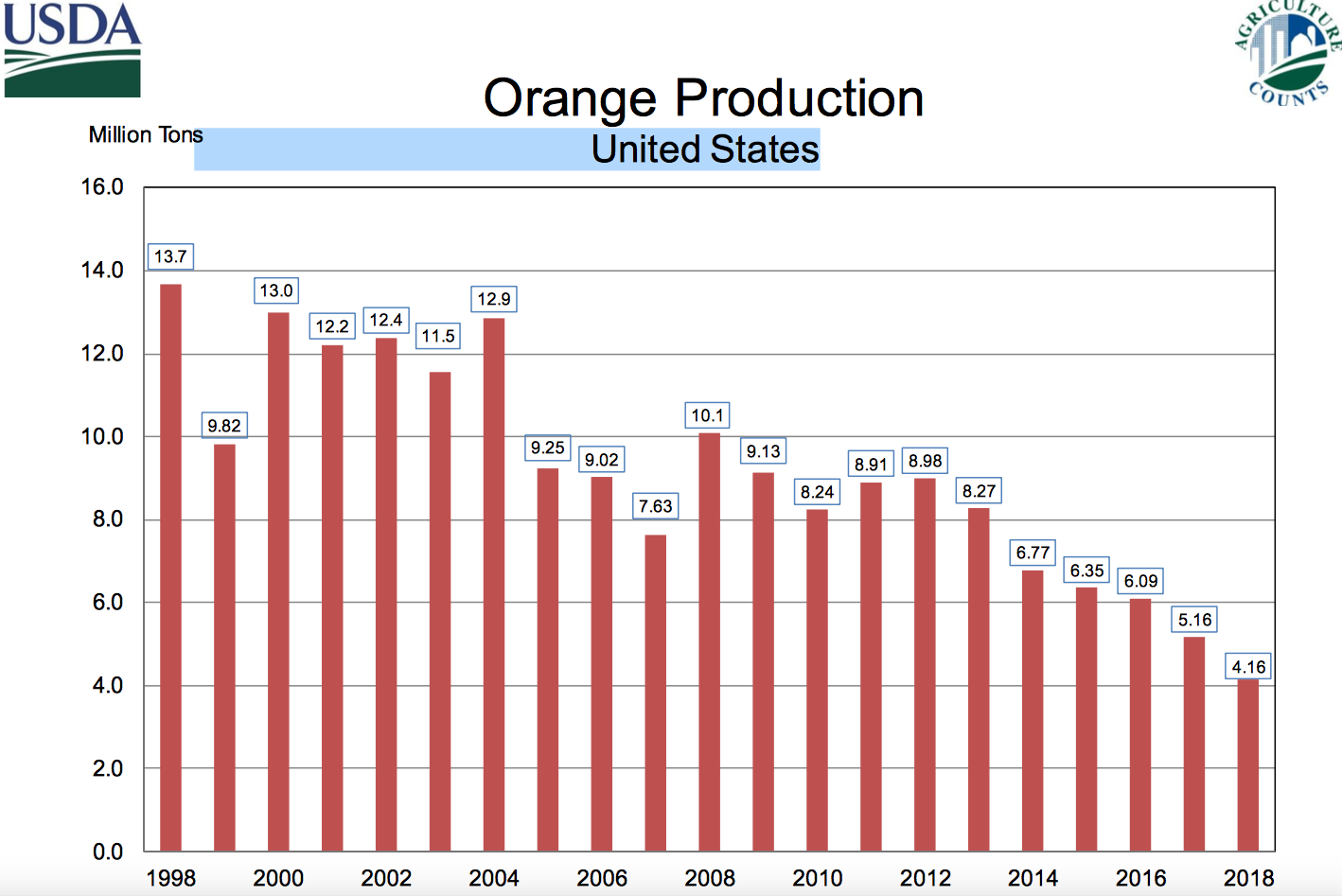
In a December 12 report USDA says the United States all orange forecast for the 2017-2018 season is 3.98 million tons, down 4 percent from last month and down 23 percent from the 2016-2017 final utilization.

The Florida all orange forecast, at 46.0 million boxes (2.07 million tons), is down 8 percent from last month and
down 33 percent from last season’s final utilization.

The latest estimate is about a third of  the crop size we saw cars the US in 1998 (see chart).

Screen Shot 2017-12-14 at 3.08.13 PM

Early, midseason, and Navel varieties in Florida are forecast at 19.0 million boxes (855,000 tons),
down 10 percent from last month and down 42 percent from last season’s final utilization. The Florida Valencia orange forecast, at 27.0 million boxes (1.22 million tons), is down 7 percent from last month and down 24 percent
from last season’s final utilization.

Both citrus greening disease and the recent hurricanes have devastated Florida citrus.

California citrus production this season is also expected to be down from 47 million boxes of non-Valencia oranges in 2015/16 to 39 million boxes in 16/17 to 35 million boxes in 17/18.

Water Commission meeting: Kings agencies slam one storage project and hail another

December 12,2017-
Screen Shot 2017-12-13 at 7.47.42 AMKings River water agencies, local leaders, Valley counties and area farmers all slammed Semitropic Water Storage District’s plan to divert Kings River water this week at a key hearing in front of the California Water Commission. An overwhelming majority of comment letters strongly opposed funding the project while the much larger Temperance Flat reservoir, competing for the same pot of money, got strong support.

The Commission is considering funding requests from advocates for 12 water projects including Temperance Flat ,Sites (requesting $1.66 billion), and from Kern-based Semitropic for their proposed reservoir near Kettleman City.

Altogether, the Commission is expected to allot $2.7 billion for new water storage projects. In August 2017, 12 applicants submitted projects for the Commission’s evaluation for their eligibility and the level of public benefits provided. By June 2018, the Commission will determine the maximum funding for which each water storage project is eligible and then make a final Commission award.

This week all projects were heard at a Sacramento meeting.

So far the Semitropic’s proposal to receive $452 million from the Commission ( total cost $603 million) appears to be wildly unpopular with Kings agencies with all but a few of the 52 letters regards the Semitropic project – against it.

Letters of opposition came from Kings County,Tulare County, Fresno County, Kings River Conservation District, Kings River Water Association, Kings Basin Water Authority, Kings County Farm Bureau, Tulare Lake WSD, Consolidated ID, Alta ID,Corcoran ID,Fresno ID, Assemblyman Jim Patterson, Fresno Mayor Lee Brand and Andy Vidak to name a few.

Favoring the project are Assembly member Rudy Salas, Senator Ben Hueso, Rep Jim Costa, State Building and Construction Trades and the applicant, to name most.

Proponents says the new Tulare Lake facilities (Kettleman Reservoir) and Aqueduct Tie-in would offer Kings River flood flow capture, reducing potential flood damage in the area and offering ecosystem benefits.

Opponents make the argument that the Kings River is already “fully appropriated” and any export of Kings River water would harm the already overdrafted water basin.

Meanwhile of the 100 per so letters commenting on the $1.33 billion requested for the Temperance Flat project, only a few were against it including the Sierra Club, arguing the application was late.The total cost of TF is $2.66 billion.

But virtually all Kings River-based agencies are saluting the idea of a larger dam in the upper San Joaquin watershed.

The letter from the Kings River Water Association urging funding for Temperance Flat says “Those of us in the central San Joaquin Valley recognize our region needs to develop additional surface water storage in order to capture much more Sierra Nevada runoff generated during above average water years. Water now lost because of flood releases represents the San Joaquin Valley’s only realistic means of complying with requirements of the Sustainable Groundwater Management Act. Effectiveness of groundwater storage and water banking rely directly upon the adequacy of a system’s abilities to capture and store high flows of water created by heavy rain events and above average snowfall melt discharge while such discharges are occurring.”

The Kings River Water Association adds that there are numerous “disadvantaged communities” in the region that Temperance Flat would help and that the Semitropic reservoir would harm.

The Kings River service area includes 51 disadvantaged communities with a population of 646,236 says their letter.

Further the letter says the Semitropic plan would would hurt efforts to advance groundwater sustainability since it would allow exports of Kings River flood water to Kern County from the Kettleman reservoir.