Another Valadao dairy to be auctioned off

June 18,2018-
Screen Shot 2018-06-18 at 1.50.20 PMRep. David Valadao, R-California was in the news recently when he confirmed to news reporters that his family was no longer operating their dairy near Tulare.
Rabobank seized the property being owed more than $8 million in loans.
“Like so many family dairy farms across the country, burdensome government regulations made it impossible for the operation to remain open,” Valadao said in a statement provided to CNN. “While this has been an especially difficult experience, I remain hopeful that sharing my story will help those going through similar situations. This is exactly why I ran for Congress — to give agriculture communities across the nation a voice in Washington.”

Ag lender Rabobank sued the Valadao brothers’ Triple V Dairy farm in November and as of this March took control of the farm.

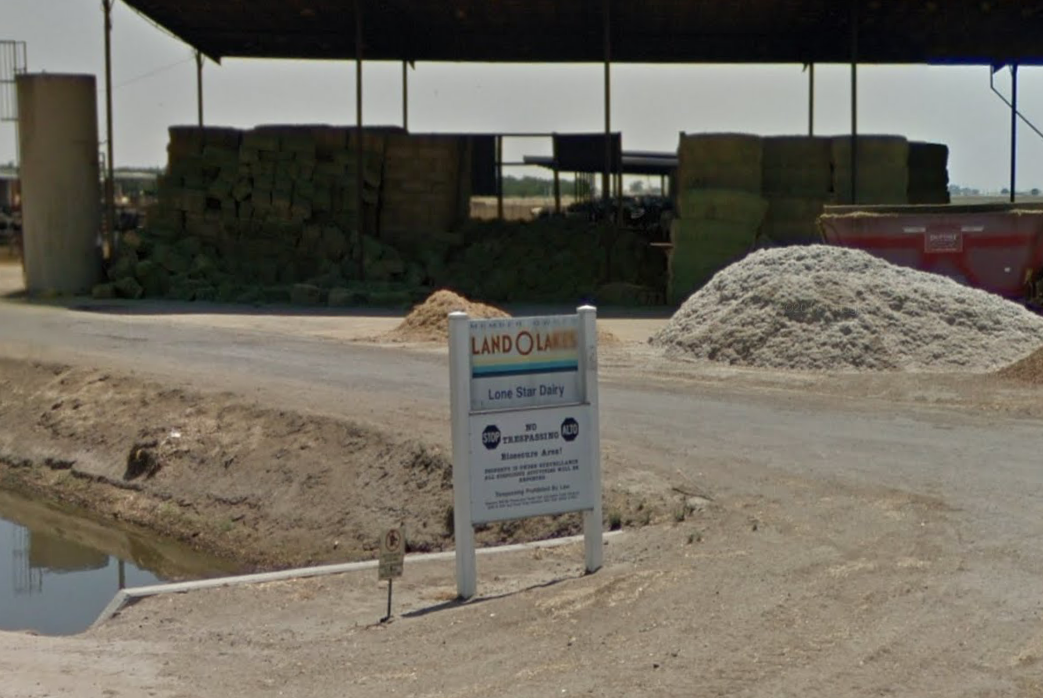
Now another dairy owned individually by David’s brother Eddie Valadao, the Lone Star Dairy near Hanford, is facing a bank forced auction/dispersal scheduled for June 22.

The sale through AM Livestock auction lists 2600 Holstein cows as well as the equipment at the farm, with proceeds to Rabobank.

California dairies haves been facing years of low milk prices and high operation costs.

Toxic Trap: Groundwater Overpumping Boosts Arsenic in California Aquifer

A study by researchers from Stanford University found that subsidence is not the only consequence of overpumping of groundwater – deadly water quality problems could also result.

WRITTEN BYTara Lohan
The Russell Avenue bridge, over the Delta Mendota Canal in Firebaugh, California, has subsided until there’s almost no space between the bottom of the bridge decking and the canal water surface. Overpumping of groundwater has caused subsidence in the San Joaquin Valley and a new study says that it is also causing increased concentrations of arsenic in the aquifer.Florence Low/California Department of Water Resources

IN CALIFORNIA’S AGRICULTURAL heartland, the San Joaquin Valley, excessive pumping of groundwater has resulted in subsidence, damaging crucial infrastructure, including roads, bridges and water conveyance. A study last year from NASA’s Jet Propulsion Laboratory in Pasadena, California, found overpumping of groundwater since the 1920s had caused parts of the San Joaquin Valley to sink as much as 28ft.

But groundwater overpumping may have another serious side effect, according to a study published June 5 in the journal Nature Communications. Researchers found that recent groundwater pumping caused an increase in the concentrations of arsenic in the aquifer. Arsenic has been linked to many kinds of cancer and can also cause stomach pain, paralysis and blindness. The scientists focused on the Tulare Basin, which stretches across the San Joaquin Valley from Fresno to just south of Bakersfield and is home to about 4 million people and a large agricultural economy.

“There is a huge societal impact behind this study, because not only is overpumping depleting our groundwater, it’s also contaminating it,” said Ryan Smith, coauthor of the study and a doctoral student in geophysics at Stanford University. “A lot of the groundwater pumping is being done by the agricultural industry, but the people that are being most strongly affected by it are those who are living in this area and need groundwater for their drinking water.”

The link between overpumping and arsenic concentrations in California is tied to the region’s geology. The Tulare Basin already has naturally occurring arsenic that originated in the rocks of the Sierra Nevada and coastal ranges and were deposited over millions of years in the valley by rivers. Some of this arsenic has ended up in groundwater, contaminating drinking water, and some of it is trapped in clay layers underground.

Under regular groundwater pumping conditions, the arsenic in the clay remains suspended, but when too much water is pumped, it becomes mobile, increasing the arsenic in the aquifer.

“When people pump a lot of groundwater it drops the pressure in the aquifers a lot and when the pressure is really low that pulls the water out of the clays, when normally it wouldn’t come out of the clays,” explained Smith. “You’re overstressing the groundwater system and that causes water to be drawn out of the clays and the water in the clays tend to have higher arsenic concentrations so you’re essentially bringing arsenic out of the clays into the groundwater system in the aquifer.”

At the same time, when the water is pulled out, the clay compacts and causes subsidence of the land surface.

California Department of Water Resources senior engineer Glenn Moeller visits the site of a water well being installed in Porterville, Calif. (Florence Low/California Department of Water Resources)

“So therefore when you see subsidence, you have arsenic in the water,” said Rosemary Knight, study coauthor and a professor of geophysics at Stanford. “The link to both being through the clays.”

The study focused only on the Tulare Basin and the potential for the same mechanism to be active in other areas would depend on both existing arsenic sources and clay layers, said Smith.

A similar correlation has only ever been reported once before. A 2013 study by Stanford researchers found that excessive pumping of groundwater had increased arsenic in aquifers in southern Vietnam.

Modeling in the Tulare Basin study was done with an algorithm that used public well data on arsenic levels, and to measure subsidence the researchers tapped Interferometric Synthetic Aperture Radar (InSAR) data, which has been deployed for years to understand changes in groundwater levels. InSAR uses information from satellites that measure tiny changes in the elevation of the Earth’s surface.

“I think what’s most exciting [about this study] is this new way of using the remote sensing InSAR data,” said Knight. “We’ve always thought of subsidence in terms of water quantity issues, and this is the first study that is clearly showing that we can be using this remote sensing data as what I call an early warning system for water quality issues.”

The study concluded that, “Land subsidence due to overpumping increases the probability that groundwater is contaminated beyond the [World Health Organization] drinking water standard by a factor of two to three for the San Joaquin Valley.” The World Health Organization standard is 10 micrograms/liter (or 10 parts per billion), which is the same as California’s health standard.

The good news is that an increase in arsenic concentrations in groundwater doesn’t have to be permanent. “We need to stop pumping as much groundwater and we need to avoid overstressing the aquifer system,” said Smith. “Our study also indicates that if we can reduce pumping than the arsenic levels can return to safer levels within about 10–20 years or so.”

The bad news, however, is that groundwater is the main source of drinking water for about 1 million people in the study area. Many of them reside in small, low-income communities with limited resources for treating contaminated water sources. And others may be even worse off, including thousands of people that rely on essentially unregulated private wells there.

“The areas that are most at risk here are people who are using private domestic wells because they are not checking them for groundwater quality regularly and there is not a lot they can do if the arsenic levels exceed the safe standards and there are a number of those communities in this study area in the Tulare Basin,” said Smith.

Also of concern may also be crops irrigated with the water, he added.

Implementation of California’s 2014 Sustainable Groundwater Management Act (SGMA) aims to curb overpumping, especially in the San Joaquin Valley, but new agencies governing groundwater have two decades before sustainability goals need to be achieved.

SGMA, however, provides an important framework for Californians to think about how to achieve the sustainable management of groundwater, said Knight. “I’m a real advocate of data-supported science and policy,” she said. “This is could be used as a guide to be thinking about how much pumping is reasonable, how much pumping is sustainable. I’m hopeful that these kinds of data can promote more sustainable groundwater management.”

Three Ways to Protect Your Interests as a Groundwater User in California

As California works to implement its Sustainable Groundwater Management Act, water rights attorney Sean Hood explains why it’s important to engage actively in the process.

WRITTEN BYSean Hood PUBLISHED ON READ TIMEApprox. 3 minutes
Glen Gordon, engineering geologist with the California Department of Water Resources, measures the water depth at specific agricultural wells in Colusa County on March 17, 2016.Kelly M. Grow / California Department of Water Resources

CALIFORNIA’S SUSTAINABLE GROUNDWATER Management Act (SGMA) requires each local Groundwater Sustainability Agency to develop and implement a Groundwater Sustainability Plan for its basin and the first plans for critically overdrafted basins are due to be completed by January 31, 2020. Each plan must be designed to achieve safe yield within 20 years.

This new regime of groundwater management is a monumental change in California water law. Overlying land owners have long enjoyed the right to extract groundwater for beneficial use on their land, and the agricultural, municipal, mining and industrial sectors rely heavily on groundwater resources to meet their water needs. It is difficult to fathom the collective investment that California businesses have made in reliance on the right to make beneficial use of groundwater.

In response to SGMA’s passage, public and private stakeholders have scurried to identify new water sources to augment existing supplies. However, the Department of Water Resources’ recently issued Water Available for Replenishment report seems to confirm longstanding conventional wisdom: There is no water supply panacea for solving California’s groundwater management crisis.

California is not the first Western state to grapple with groundwater overdraft, and there are lessons to be learned from previous experiences. In Arizona, the interest groups that were effectively represented in the negotiations resulting in the new groundwater regulations fared much better than the groups that waited for the process to unfold. Some water users enjoyed widespread protection of existing groundwater uses, while others were cut off from valuable supplies that would have supported significant economic growth.

Accordingly, the next 18 months are critical for stakeholders in California. Each Groundwater Sustainability Agency is evaluating an assortment of potential measures to reduce groundwater uses in its basin, including “regulating, limiting, or suspending extractions from individual groundwater wells.” That’s right – the Groundwater Sustainability Agency in your basin has the statutory authority to turn off your pumps.

SGMA provides little in the way of substantive protections for groundwater users. However, procedurally, SGMA requires each Groundwater Sustainability Agency to consider the interests of all groundwater users in the basin, and diligent stakeholders who make certain that their interests are considered are likely to find themselves in a much better place on January 31, 2020 than those who sit on the sidelines and wait for the dust to settle.

Proactive engagement in the process is the name of the game. Here are three things to make sure to do:

  1. Every concerned stakeholder should request to be added to the Groundwater Sustainability Agency’s notification list. This gets you invited to the party.
  2. You must show up to the party – repeatedly and consistently. Getting on the mailing list does you little good unless you actively engage in the plan preparation process. This includes participating in meetings, and providing thoughtful, substantive input on proposals and drafts.

Participation in this way serves multiple important purposes. First, it is critical that your Groundwater Sustainability Agency representatives get to know you. You want them to have a sense for your water uses and the businesses they support. They need to understand what is at stake for you and your business.

You also want your Groundwater Sustainability Agency to understand clearly that you are in this for the long haul, and that you will do whatever is reasonably necessary to protect your water uses and your business. In this regard, it is wise to assemble an interdisciplinary team capable of addressing the various legal, scientific and business issues that influence a plan’s contents. As we’ve experienced in Arizona, choosing the right expertise is critical. For instance, teaming with an experienced water litigator will enable you to navigate the complicated water law issues, while also harmonizing your plan development activities with litigation strategy.

  1. Document your interests as a water user. Each stakeholder should create a comprehensive written record reflecting the information that the Groundwater Sustainability Agency is required to consider, and do it in a way that is likely to have a positive influence on plan development.

This written record also supports a legal challenge if your concerns are not adequately considered. This is important, because the measures that will be required to achieve sustainable yield are likely to involve unacceptable levels of future economic risk for many stakeholders, and it therefore seems inevitable that many Groundwater Sustainability Plans will be litigated. A stakeholder who helped to create the written record of the plan development process will be in a much better position, whether that stakeholder ultimately seeks to defeat the Groundwater Sustainability Plan, or defend the plan against others who may fare worse under its measures.

While neither curtailment nor litigation can be avoided across the board, some stakeholders will avoid adverse outcomes through successful participation in the plan development process. The opportunities to protect your water use are much greater today than they will be in 18 months. Now is the time to actively engage in the process.

The views expressed in this article belong to the author and do not necessarily reflect the editorial policy of Water Deeply.

Clean Streams Key to Aiding Recovery of Endangered Frogs in California

Some content here

× DISMISS

We have updated our Privacy Policy with a few important changes specific to General Data Protection Regulations (GDPR) and our use of cookies. If you continue to use this site, you consent to our use of cookies. Read our full Privacy Policy here.

Become a Contributor.

Have a story idea? Interested in adding your voice to our growing community?

LEARN MORE

Trade disputes bring uncertainty for farm exports

From California Farm Bureau

Issue Date: June 13, 2018
By Ching Lee

Large export containers of California rice are loaded onto a freighter at the Port of Sacramento. The European Union plans new tariffs on rice, part of an ongoing trade dispute with the U.S.
Photo/Port of Sacramento

In April, China responded to U.S. tariffs on steel and aluminum imports by placing new tariffs on U.S. goods, including fruit, nuts and wine. Earlier this month, the European Union, Canada and Mexico—initially exempt from the U.S. tariffs—followed suit by announcing plans to enact their own tariffs on a wide range of U.S. exports, including some agricultural products.

More than $3 billion worth of U.S. goods face new EU tariffs starting July 1. Among the farm products on the list are rice, corn, dried kidney beans, cranberries, orange juice, peanut butter, bourbon whiskey and tobacco products, all of which face 25 percent tariffs.

The EU is the largest export market for California farm products. Rice shipments there totaled $35 million in 2016, or about 5 percent of the state’s total rice exports. California also shipped $7.9 million in dry beans, though it’s unclear how much, if any, were kidney beans.

Mexico’s tariff list, released last week, includes farm products such as cheese, pork, apples, potato products, cranberries and orange juice, with duties ranging from 15 to 25 percent. Mexico initially said grapes and blueberries would also be subject to tariffs, but those products are not on the current list.

Dairy products represent California’s No. 1 agricultural export to Mexico, valued at $421 million in 2016 , according to the California Department of Food and Agriculture. Of the U.S. cheese shipped to Mexico in 2016, about one-third came from the Golden State, according to the California Milk Advisory Board. None of the other products on the Mexican tariff list appears among the top 32 California farm exports to Mexico, with the exception of potatoes, valued at $5.7 million in 2016.

Marco Albarran Arozarena, the CEO of Imalinx, which promotes California milk and dairy products in Mexico for the advisory board, said a partial tariff of 10 percent for U.S. cheese entering Mexico took effect the day the tariff list was announced. The full tariff of 20 or 25 percent—depending on the type of cheese—will be applied starting July 5. Prior to last week, U.S. dairy products entered duty-free, as part of the North American Free Trade Agreement.

Albarran Arozarena said he expects buyers will stock up on U.S. cheese before the full tariff takes effect.

“It’ll be 10 percent more expensive, but switching the supply chain and running out of stock would affect them more,” he said.

At the same time, Mexican importers will be looking for alternative suppliers, mainly domestic, though Albarran Arozarena said it would be difficult for Mexico to immediately produce enough product to make up the shortfall. Imposition of the full tariff would reduce Mexico’s inventory, driving up prices for its consumers, and that might affect sales, he said.

“I think we’re going to lose some buyers,” Albarran Arozarena said. “We’ll have to go back and recover them, and it may take us longer to do so.”

David Ahlem, CEO and president of Hilmar Cheese Co., which exports cheese and other dairy products to Mexico, said his company is monitoring trade negotiations.

“We would like to see the successful negotiation of a modernized NAFTA that would preclude the need for tariffs on Mexico and Canada,” he said.

Canada’s new tariffs, due to take effect July 1, would include 10 percent duties on farm products including yogurt, ketchup and other tomato sauces, prepared bovine meat and meals, cucumbers, strawberry jam, nut purees and pastes, berry and other fruit purees, orange juice and maple syrup.

Processed tomatoes represent the state’s No. 2 farm export to Canada, worth $295 million in 2016. Trudi Hughes, government affairs director for the California League of Food Processors, said she doesn’t know how much of those tomato exports leave in the form of ketchup and sauces, but noted the ongoing trade dispute has created “quite a lot of havoc” for the state’s food manufacturers. In addition to the retaliatory tariffs, which would make their products more expensive, the U.S. metal tariffs have added cost on the cans used in food manufacturing.

“We only make half of the tinplate steel that we need to make our cans in the United States, so we rely on Canada, Korea and Europe to supply the rest,” she said. “Obviously, that’s a problem now.”

Meanwhile, exporters affected by the Chinese tariffs, which have been in effect for more than two months, said importers remain hesitant to do business.

At the Blue Diamond Growers almond cooperative, Warren Cohen, vice president of sales for the global ingredients division, said buyers aren’t ready to make purchasing decisions and are waiting for “visible, concrete agreements” before entering into contracts.

“Reports the tariffs may be lifted as China commits to increasing imports of U.S. ag products are also delaying buyers’ purchasing decisions,” he said.

China is the state’s No. 2 export market for almonds, and Cohen said the country shows potential growth exceeding 10 percent annually.

“If the new tariffs remain in place, we will no longer see an increase in shipments to China and more almonds will need to be exported to other markets,” he said.

Jim Zion, managing partner of Meridian Growers in Fresno County, which ships pistachios, almonds, walnuts and pecans, said Chinese importers are “being extremely cautious and not buying much, because they’re not sure if this is going to be long term or if we’re going to get a resolution on this trade dispute and get back to normal business.”

Zion said he hopes U.S. trade conflicts with China will clear up soon, but worries about what the mid- and long-term effect may be if current tariffs stay in place through harvest. Though he’s talking to buyers in other markets, he said there’s concern the trade disputes will widen.

As someone who’s trying to develop new markets in China, Joe Lange, manager of export sales for LangeTwins Family Winery and Vineyards in San Joaquin County, called the U.S.-China trade friction “bad timing” for his business. He recently returned from a wine expo in Hong Kong, where he said buyers were taking a wait-and-see approach or asked for discounts because of the tariffs.

“We were hopeful we were going to come away with new relationships in China, but things are a little bit challenging at the moment,” he said. “I don’t think it’s absolutely stopping all relationships, but it represents a hurdle in front of new business that we have identified as a great market.”

(Ching Lee is an assistant editor of Ag Alert. She may be contacted at clee@cfbf.com.)

Mexico buys pork elsewhere

from Politico

June 12,2018-

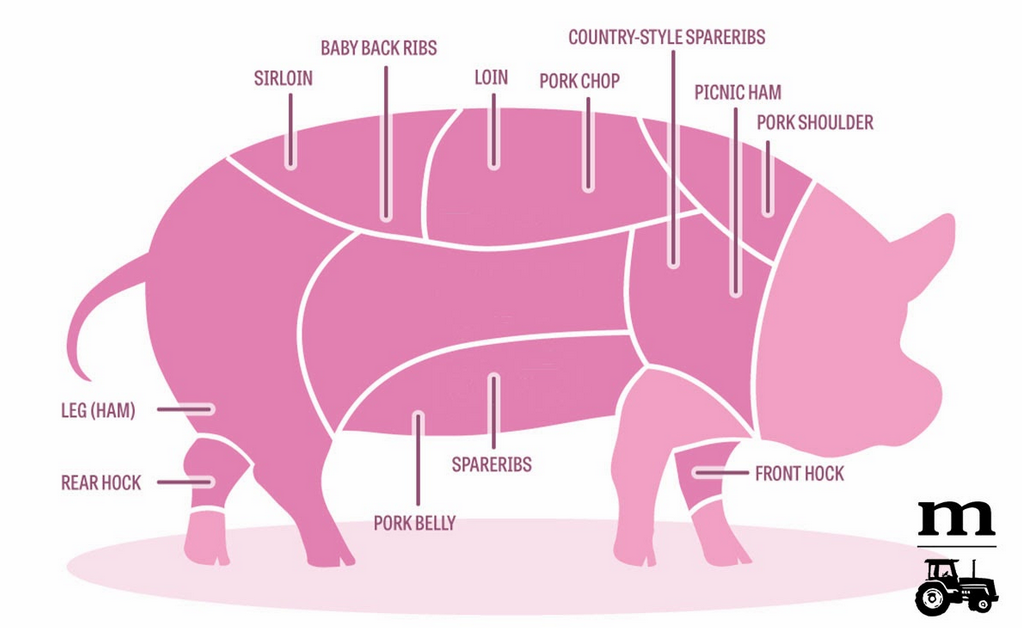
Screen Shot 2018-06-12 at 3.06.02 PMMexico moved on Friday to bring in tariff-free imports of pig meat from the European Union and Latin America, to offset an expected decline in U.S. pork shipments amid rising trade tensions. Mexico slapped 20 percent tariffs on U.S. pork shoulders and legs, starting July 5, in response to President Donald Trump’s duties on Mexican steel and aluminum exports.

Mexico will allow 350,000 tons of pig meat from all countries to ensure that its consumers do not face shortages, the Mexican Economy Ministry confirmed. Rogelio Garza, Mexico’s industry and commerce undersecretary, said Friday that the quota is expected to be quickly filled by the EU and Latin America.

“The import quota on pork meat published by [Mexico’s Economy Ministry] was already assigned in full to food processors that met the requirements. These companies have signaled that they will import from countries in the European Union and Latin America,” Garza posted on Twitter.

Not a complete loss for U.S. pork: U.S. pork producers will be able to vie for Mexican sales under the quota, Reuters reported. But producers are still expected to see a sharp loss in sales after sending 25 percent of all their pork shipments to Mexico last year.

EU welcomes pork sales: “If Mr. Trump does not want to do business, the EU is ready and willing to do business,” EU Agriculture Commissioner Phil Hogan said, according to POLITICO Europe.

The bigger picture: The move comes after Mexico upgraded its free trade agreement with the EU in April. The new pact eliminated tariffs on various Mexican agricultural products, including orange juice, honey, fruits and vegetables.

Almond crop: Yield down but crop is up

Screen Shot 2018-05-10 at 11.56.57 AMUSDA says it forecasts that California’s almond crop will climb this year even though yields are down due to a freeze earlier this year.

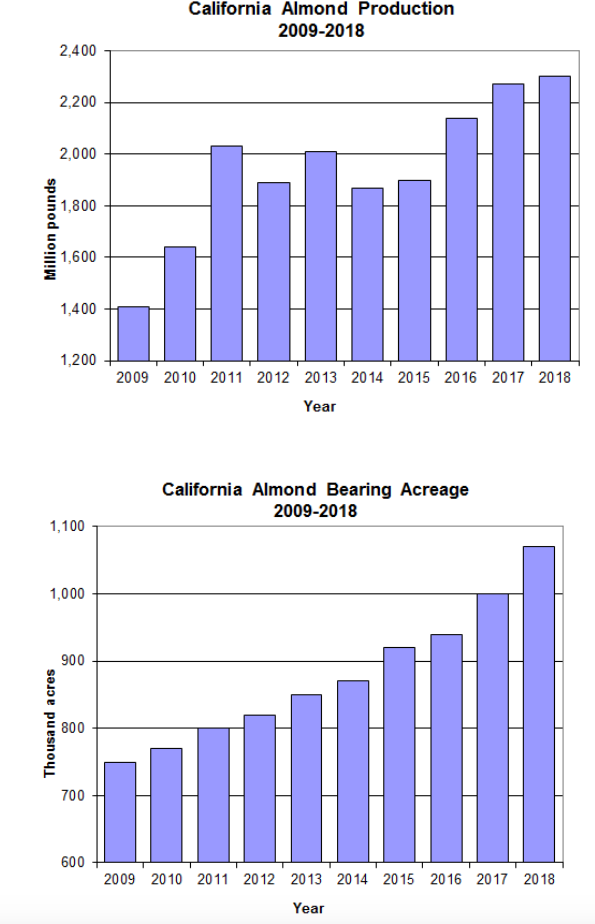
The initial subjective forecast for the 2018 California almond production is 2.30 billion pounds. Forecasted production is 1.3 percent above last year’s production of 2.27 billion pounds.

Forecasted bearing acreage for 2018 is 1,070,000, up by around 7%. Forecasted yield is 2,150 pounds per acre, down 5.3 percent from the 2017 yield of 2,270 pounds per acre.

The subjective production forecast is based on a telephone survey conducted from April 18 to May 4 from a sample of almond growers.

The 2018 California almond bloom began a few days earlier than normal. The bloom period was extended, due to cold temperatures, and lasted a few weeks. Frosts during bloom hit orchards hard, especially on the east side of the valley. Younger trees were impacted more severely than older trees. Weather during the spring was variable, leading many growers to be unsure about their 2018 crop. As temperatures warmed up in May, nuts were sizing well says a report this week.

Ag Beat

May 5,2018-

California cherry crop down

The harvest of sweet cherries is happening this week, the first stone fruit of the season. For 2018 it looks like a down year with crop estimates as low as 4.5 million cartons – half of what was harvested last year.
Reports cite lack of chili hours and freeze damage in the Central Valley.
One local ranch is specializing in highly valued organic cherries.The Packer newspaper reports that “Flavor Tree Fruit Co. offers substantial volume of Californias organic cherries, said Maurice Cameron, sales manager for Flavor Tree Fruit Co., Hanford, Calif.
There is not a lot of organic cherries in California, but we are significant portion of them,he said.

Rabobank: demographics key factor in labor shortage

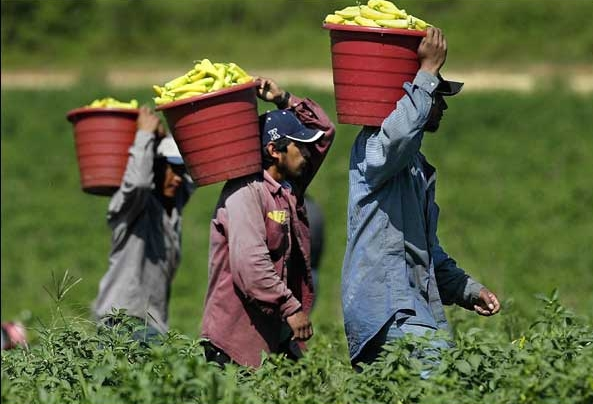
Screen Shot 2018-05-05 at 4.00.49 PMFewer Mexican workers including those in California are helping to tighten the labor market but demographics in Mexico may have more to do with the problem than has been realized.
A Rabobank study found that the annual growth rate of Mexican youth has been slowing from 1990 to 2018 from about 700,000 to 200,000. By 2030 the number of youth from 15 to 35 will be 100,000 less than today. Rabobank’s Roland Fumasi from Fresno told the Packer newspaper “When I talk to growers in Mexico, the biggest supply side challenge is labor, he said. If labor is a challenge in Mexico, imagine what that means further north.”

California almond acres up 7 percent

California’s 2017 almond acreage is estimated at 1,330,000 acres, up 7 percent from the 2016 acreage of 1,240,000 acceding to an annual  report. Of the total acreage for 2017, 1,000,000 acres were bearing and 330,000 acres were non-bearing. Preliminary bearing acreage for 2018 was estimated at 1,070,000 acres.
Nonpareil continued to be the leading variety, followed by Monterey, Butte, Carmel, and Padre.
Kern, Fresno, Stanislaus, Merced and Madera were the leading counties. These five counties had 73 percent of the total bearing acreage.

Water bond makes ballot

Citrus Mutual reports that “The Secretary of State has determined that the California Water Bond has submitted enough valid signatures to officially qualify for the November 2018 Ballot. The Water Bond needed 365,880 signatures to qualify. This bond authorizes $8.877 billion in state general obligation bonds for various infrastructure projects with about $2.24 billion directly benefiting agriculture. These projects include $855 million for improved water conveyance, which would repair the subsidence issues with the Friant-Kern Canal.

Port of Oakland fruit, veggie cargo up 36 percent in four years

April 26,2018-

More gains likely as buildout to handle temp-controlled products goes on

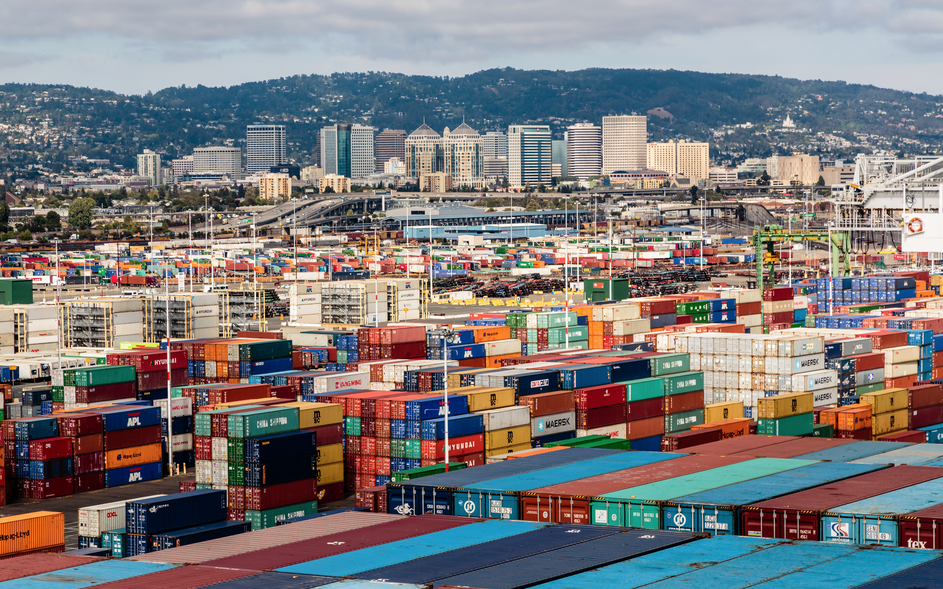
Screen Shot 2018-04-26 at 6.26.09 AMOakland, Calif. –  Port of Oakland containerized fresh fruit and vegetable shipments have jumped 36 percent since 2013, according to data released today.  The Port said further gains are likely as it adds capacity to handle temperature-controlled cargo.

About $6.1 billion worth of containerized fruit and veggie shipments moved through Oakland in 2017, the Port said. The volume equaled 135,000 20-foot containers.  The Port’s volume was less than 80,000 containers just four years ago.

“This is high-value cargo that has to be handled carefully and shipped promptly,” said Port of Oakland Maritime Director John Driscoll.  “Growth in our volume would indicate that we’re doing the job effectively.”

Exports accounted for 103,000 containers of Oakland’s 2017 fresh fruit and vegetable cargo volume.  That was a 44 percent increase from four years ago.  Fruit and vegetable imports jumped 16 percent.

The Port said oranges and grapes were among top exports.  Japan, South Korea and Hong Kong were leading export markets.

The data is watched closely because Oakland is considered one of the country’s most important agricultural gateways.  The reasons:

  • Oakland is adjacent to major growing regions in the Central, Napa and Salinas valleys.
  • Producers export through Oakland because it’s the last U.S. destination before outbound vessels head to Asia.  That means their cargo isn’t delayed at intermediate stops.

The Pacific Merchant Shipping Association said that Oakland shipped 42.3 percent of America’s 2017 fruit and nut exports to China.  It handled 93 percent of wine exports.

The Port said it expects fruit and vegetable shipments to grow because it’s improving the ability to handle temperature-controlled cargo.  Refrigerated export containers are now being delivered principally at night to Oakland’s largest marine terminal.  That speeds up handling and wait-time for sensitive cargo by avoiding busier dayside operations.  Oakland’s second-largest terminal is adding hundreds of electrical plug-in spaces for refrigerated containers this summer.  That means it can safely store more perishable cargo until the containers are loaded on vessels.

Exports make up half of the Port of Oakland’s total cargo volume.  Farm goods account for 40-to-50 percent of the Port’s total exports.

Kings River water supply brightens

April 25,2018-

Storms add increased supply

Kings River Water Association is forecasting an 80 to 85% water supply based on the past three weeks of storms says general manager Steve Haugen.”The warm weather is speeding up inflow into Pine Flat “ notes Haugen and “we are seeing releases for irrigation.” The forecast is up from 65% just a few weeks ago.

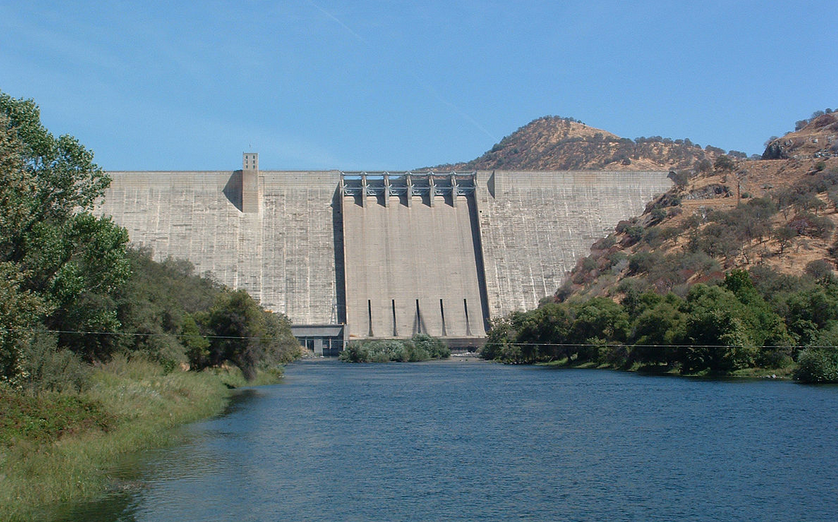
Screen Shot 2018-04-25 at 6.36.10 AM“We think Pine Flat will fill or very close to it.” Pine Flat reservoir has a capacity of 1 million acre-feet. and it has some 853,000 af at this writing.Wet weather in the mountains is still expected into the end of the month, up to 10 inches in the upper terrain of the central Sierra. But for the season, looks like the Valley storms are over.

Meanwhile wet weather in northern California has prompted the State Water Project to increase supplies to 30 percent of customers’ requests, up from the previous 20 percent. The federal Central Valley Project earlier announced it would raise allocations to 40 percent for agricultural customers south of the delta, and provide full supplies for northern customers. Friant Water Users will get 100% of their Class 1 allocation.

Kings water group cheers low score, zero dollars for Tulare Lake Storage project

The Kings River Water Association representing opponents of the proposal by Kern County-based Semitropic Water Storage District to export floodwater from the Kings River basin for the benefit of private landholders outside the area, this week praised the California Water Commission for its further analysis of the purported benefits of Semitropic’s proposal. After a thorough review of Semitropic’s appeal of the commission staff’s initial evaluation, the proposal has been deemed eligible for no public funds through the state’s Water Storage Investment Program.

The project’s score is the lowest among all projects reviewed upon appeal, thet say. Last December, more than 40 local governments, elected officials, water districts and small business leaders stated their opposition before the water commission.
The commission is set to release their final decision in June also affecting the more popular storage project – Temperance Flat.

Farm Bureau to highlight tariff impacts

Farmers for Free Trade and the California Farm Bureau Federation will host a news conference featuring California farmers and the secretary of the California Department of Food and Agriculture, Karen Ross, to highlight the negative impact of new tariffs on California exports.
During the course of the past three months, escalating trade tensions have resulted in new or threatened tariffs from China on American agricultural exports. Of particular concern to California farmers are roughly $3 billion in new Chinese tariffs that were put into place on April 2. Those tariffs are retaliation for U.S. tariffs on imports of steel and aluminum from China. The $3 billion in Chinese tariffs affect many products grown in California, including grapes, wine, almonds, walnuts, pistachios and oranges.
The event will be on Thursday April 26, at 11:30 a.m. at LangeTwins Family Winery and Vineyards,1525 East Johanna Road, Acampo.

CFB contributed to this item


Water Picture Brightens With March / April Storms

April 15,2018-

Friant contractors get 100% of Class 1 supply but canal stands at 50% capacity

Kaweah watershed at 51% of average

Friant contractors got some good news earlier this month. They will receive 100% of their Class 1 water supply this summer due to the late March and April storms this spring.

Screen Shot 2018-04-13 at 6.35.39 AM

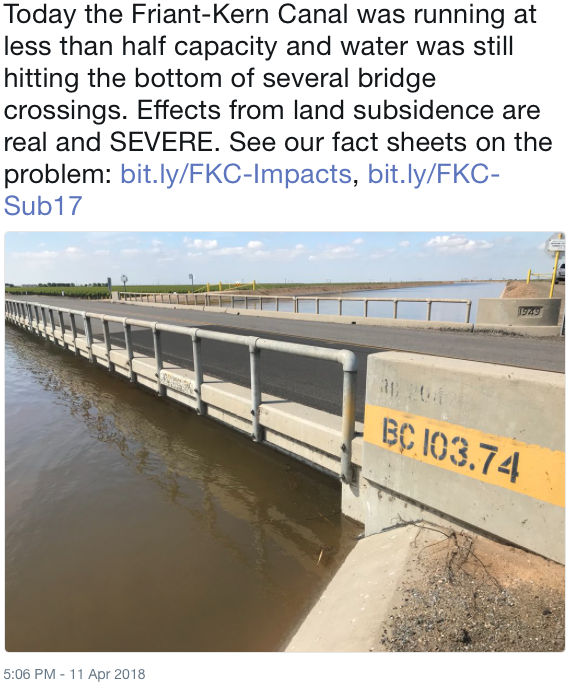
Friant Kern Canal is running at 50% capacity this month as water level nears a bridge in Tulare County in this April 11 photo.

April is the traditional end of significant storms to drop their load in the Sierra enabling farmers to take stock of their upcoming supply they can count on for the hot summer months to come.

For now some reservoirs like Millerton have too much in storage enabling contractors to get extra flood water delivered to their canals at bargain prices.

The San Joaquin River Restoration program made 38,000 acre feet of unreleased restoration flows available to Class 2 contractors this month,

Contractors depended on precipitation in the upper San Joaquin River watershed above Fresno, to irrigate a million acres of cropland along the eastern edge of the Valley – watered by the 152-mile Friant Kern Canal.

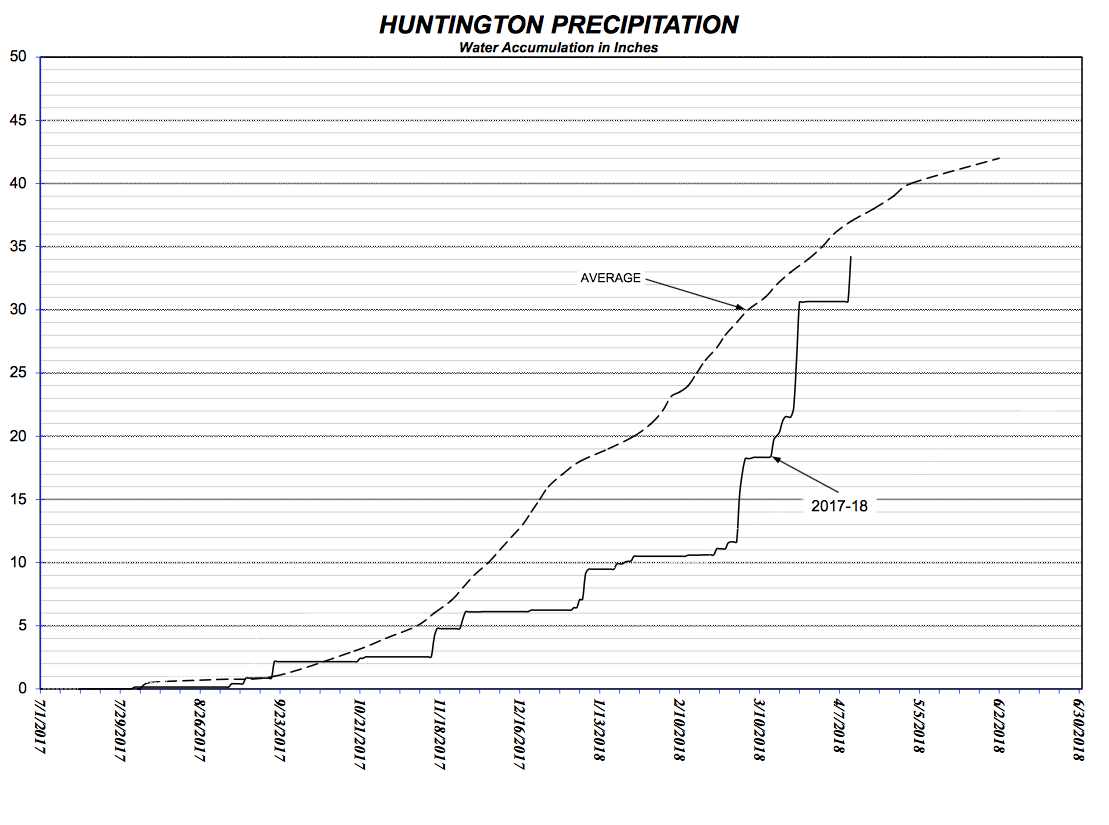
Through early March eastside farmers water supply outlook looked grim with Huntington Lake having received only 11 inches of precip as of early March. But by April 12 Huntington had seen 35 inches for the water year (see chart).

Screen Shot 2018-04-13 at 6.50.14 AM

But Friant contractors, particularly south of Tulare, face a problem this year as ground subsidence, due to drought years over pumping, has effectively constrained the volume of water that can be moved into southern Tulare and Kern counties by half or more.

In some locations the key canal’s capacity has dropped to 1,750 cubic feet per second, down from its intended capacity of 4,000 cfs.

The upshot is that when a farmer really needs that water – it may not be there.

But help may be one the way.

The Water Supply and Water Quality Bond Act of 2018 to be voted on electorate in November, includes improvements to the Friant Kern Canal and other Friant water interconnections to the tune $750 million. It intends to restore lost capacity, pays for groundwater recharge programs, water conservation and possibly new water conveyance in the Friant area.

Kaweah Watershed News

Over on the Kaweah River watershed the picture is not as bright as to the north but lots better than it looked in early March says watermaster Mark Larsen.

“Back a few weeks ago it looked a duster” says Larsen. But now the outlook has improved to about a 51% of average water supply expected this water-year.

Larsen says Kaweah Lake should at least 75% full in coming weeks and may fill to capacity depending on when famers downstream need their irrigation water, likely in mid to late May he says.

That will be good news for recreational users of the lake in coming months.

Larsen says Kaweah Delta Water Conservation District is running surplus Friant water down the basin’s channels to replenish the groundwater right now, made available due to Millerton’s lack of capacity.

In other water news, Larsen and all Valley water agencies are taking note of an April 10 vote by the board of the Metropolitan Water District of Southern California to fund two-thirds of the cost to build both tunnels proposed by Governor Brown – known as
the California Water Fix. Larsen says the importance for our area is that improvements in the Delta will help both supplies and flexibility of exchanges in the San Joaquin Valley.

Trade war already affecting local ag prices

April 4,2018-

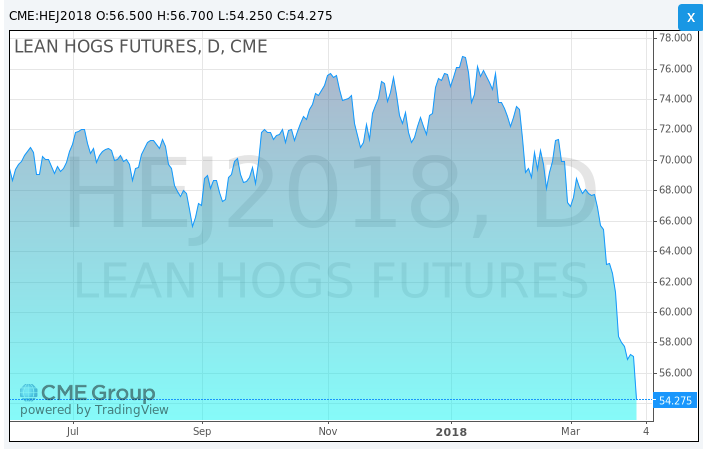
Screen Shot 2018-04-04 at 2.23.14 PMDon’t tell hog farmers there is no trade war. Pork futures are down 30% since the first of the year when President Trump has been talking about tariffs on Chinese steel, now in affect.

China responded last week announcing an increase in the tariff rate on eight imported U.S. products, including pork, by 25 percent and a 15 percent tariff on 120 imported U.S. commodities like fruit and nuts grown in California.

This week China ratcheted up what is turning into a real trade war with new 25% duties on soybeans, beef, corn, wheat and sorghum among other farm and non-farm products. Despite pleas by an administration official that the impact amounts to “small potatoes”  regards the US economy, the market has not been happy with news.

Exports of ag products have a huge effect on farm product acorss the US and right here in Kings County.

click to enlarge
click to enlarge

The Chinese market alone purchased about $1.1 billion in U.S. pork last year, according to the U.S. Meat Export Federation.

Lower hog prices are  affecting beef prices (now also targeted by China) seeing a price drop as well. At the CME, cattle prices have been down around 12% from January, before this Wednesday’s second round of bad trade news.

One Iowa hog farmer was quoted on NPR radio recently saying that fear of tariffs alone are affecting the entire economy. “And when farmers are not making money either raising grains or livestock, they don’t go and buy new machinery. And the people that build the machinery – they don’t go out and buy a new car.”

It is not just the Midwest that is feeling the pain.

Some 20% of ag export shipments from Kings County were purchased by China or Hong Kong as of 2016 according to the Ag Commissioner.

That includes walnuts, pistachios, almonds ,cherries, pomegranates and grapes -, all big ag products grown in Kings County. It also includes citrus, peaches and raisins – and wine

The ag press reports this week that China is one of the fastest growing wine markets in the world and will soon be second only to the U.S. in value, according to the Wine Institute, which said China’s proposed tariffs on U.S. wine “could have a significant negative impact on the future growth of wine exports to China.” 

The Wall Street Journal  quoted a California wine maker \ on the affect of the tariff on the end user – the Chinese consumer. ”An extra 15 percent charge would be brutal. “No one wants to overpay,” Mr. Honig said. “If all they’re looking at is two different bottles side by side, and we are competing with Australia and Chile, that’s a big competitive disadvantage.”

Richard Matoian of Fresno who heads up the American Pistachio Growers – echos that sentimet.

“No farmer wants to see a tariff imposed on their product” Matoian says, adding that 55% of US pistachio exports, mostly grown in California, go to China. The farm-gate value stands at $300 million annually he estimates.

“We go head to head with Iran for pistachio sales and this action makes us less competitive.”

Pistachios were the number-four crop in Kings County in 2016, bringing in more than $178 million.Top local crops also affected include beef (number 2 crop) almonds (number 5) as well as peaches and grapes.

One of the biggest Central Valley commodities affected is citrus and here too, the industry is concerned. Joel Nelsen of Exeter represents Citrus Mutual – worried that shippments are being affected now.

Family farmers in our industry will suffer from the economic fallout unless we can find alternative markets for California’s navel and Valencia oranges and lemons.”

Some California citrus is already on ships bound for China and arriving on docks  If the Chinese importers  down want the oranges exporters must scramble to find another Asian destination for the perishable products before they rot.

“We still have about 35 percent of the (orange) crop on the trees” awaiting harvest, Nelson said, and the lemon harvest will begin in the coming weeks.

Another group, the Agriculture Transportation Coalition said in a statement that new tariffs will make U.S. products more expensive and cause Chinese buyers to look to other suppliers.

“To say that this will disrupt the U.S. agriculture and forest products export shipping supply chain is a gross understatement,” the group said. “And the threat of more retaliation by China looms large, as additional U.S. measures against China exports to the U.S. (to combat China’s intellectual property violations) are still to be announced.”

Fruit and nut exporters have voiced concern over a trade war’s effects on their ability to export to China, which has increasingly become a popular market for U.S. agricultural products.

China is the third largest market for U.S. cherries with the season beginning in the Central Valley in a matter of weeks.

With news that soybeans from the Midwest are now part of ‘tit for tat’ trade dispute, Bloomberg reported April 4” while about a third of U.S. production goes to the Asian country annually, China last year bought more of the oilseed from Brazil. “This will obviously benefit Brazilian exporters,” said Warren Patterson, a commodity strategist at Dutch bank ING Groep NV. “They will be licking their lips right now.”

Soybeans on the Chicago Board of Trade dropped as much as 5.3 percent, while wheat and corn futures also slid.

Short term interest rates on the rise