Publicly traded Vegalab, Inc. (OTCQB: VEGL) has purchaseda major fruit package facility in Lindsay, the Suntreat plant with 260,000sf of space as of November 15.Already in operation the new owner is packing citrus and employing around 50. The company has been onthe grow in the Valleyrecently purchasing a facility in Merced and one in Visalia, the M&G Packing plant in October
Headquartered in Florida before coming to California this year the company has been in operation in Nevada.
David Selakovic, CEO of Vegalab, said, “With the current capacity at our existing Vegalab Produce facility unable to meet the demand from our domestic and international buyers for premium quality, and premium priced citrus, management has been systematically evaluating packing facilities to add to our portfolio. The Lindsay, California facility is major acquisition in an ideal location. Being in California’s San Joaquin Valley citrus belt, where Vegalab recently acquired the Merced Tuttle Cross Dock and Warehouse, the property is centrally positioned in one of the best fruit growing ecosystems in the United States. While touring the plant, we recognized how well-designed it is to seamlessly combine highly efficient fruit processing with the ability to rapidly ship product to our domestic and international customers. We intend to continue to build out our infrastructure and integrate our properties while efficiently increasing the Company’s annual sales.”
Vegalab, Inc. is the exclusive distributor in North and South America of a line of all-natural, biologically derived pesticides, fertilizers, and specialty agricultural products. Vegalab’s pesticides are highly effective against targeted organisms, non-toxic to beneficial organisms, and safe for the environment.The Company operates in two segments of the food industry. The Agronomy Business involves the manufacture and distribution of all-natural crop protection, crop health, and soil enhancement products; the Packing Business involves the operation of citrus packing facilities.
Wearing chest-high waders, biologist Sean McCain tries to tiptoe to the edge of a marsh in California’s Central Valley. A biologist with the state Department of Fish and Wildlife, McCain squints as he searches the shoreline.
“I don’t think they know we’re here yet,” he whispers. Then, excitedly, he points. “Is that one right there? I think we’re looking at one right there.”
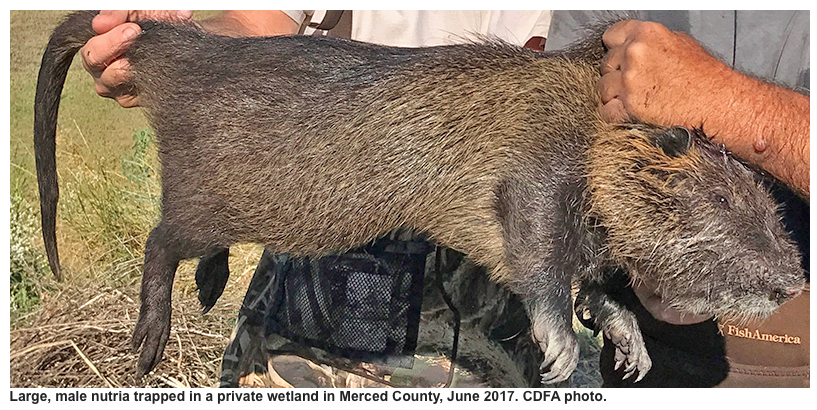
What he sees is a 20-pound rodent that looks like a cross between a rat and a beaver, with a scaly tail, webbed feet, and big orange bucked teeth. It’s a nutria and it’s poking its head out of a dark cave of tule reeds.
McCain’s first saw a family of nutria here two weeks ago, and since then he’s returned to this spot almost every day to check on them.
Nutria can eat up to 25 percent of their body weight in one day. They munch on the roots of green duckweeds, cattails, and tule reeds. If they clear cut an entire marsh like this one, they put all the birds and frogs and other species that depend on it at risk. “I’ve been watching the vegetation recede away from the middle of the pond,” McCain says.
They can also tear up crops and levees, damaging the state’s water infrastructure, and threatening farms.
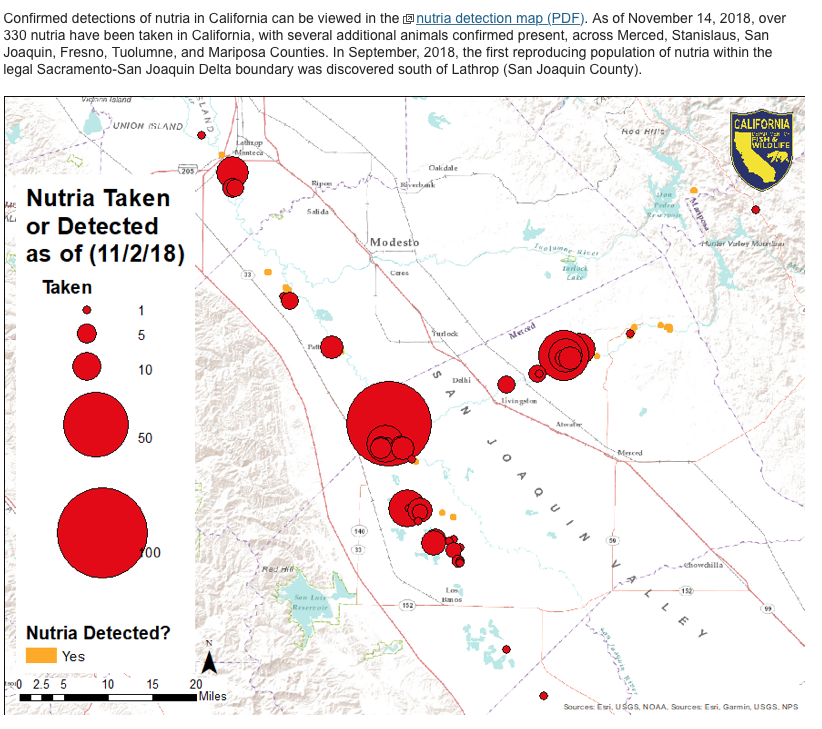
California is trying to eradicate nutria, an invasive rodent that is damaging irrigation ditches and farms.
Nutria aren’t native to California, or the United States. Fur farmers brought the South American rodent to Southern California in the late 1800s as an attempt to make an affordable mink alternative. After multiple attempts, the nutria fur business never took off, but the rodents went feral. California’s Department of Food and Agriculture determined they were eradicated in the 1970s.
Despite a glum picture painted by the dairy trade media, California milk producers are pumping out more milk The state’s milk production jumped 3.2% in October says USDA as Bessy was more productive. So why the long faces? – red ink says the latest downbeat report from the California Milk Producers Council released Friday.
“Dairy producers are dejected, and it’s easy to see why. December Class III milk settled today at $13.98/cwt., a new low for the contract. You can’t make milk for $14, especially with lower premiums and greater hauling deductions than in the past. There are wait lists to move cows to the slaughterhouse and the sales yard. USDA reports that the dairy producers received an average of $1,230 per head for replacement heifers sold in August through October, the lowest value in 20 years.”
Reports say dairy farmers, hit by retaliatory charges, are selling their family businesses.
Retaliatory tariffs by China and Mexico could lower dairy exports by $2.7 billion and depress dairy farmers’ revenues by $16.6 billion over the next several years unless they are rolled back. Moreover, U.S. economic output tied to the dairy industry would fall by more than $8 billion and 8,200 U.S. jobs would be imperiled through 2023.
Those findings are according to a study commissioned by the U.S. Dairy Export Council and conducted by Informa Agribusiness Consulting that estimated the economic impact of ongoing trade disputes on the U.S. dairy industry. The study only examined current tariffs, meaning the damage would worsen if other proposed duties take hold. This weekend’s news that there is a truce in the trade war with China doesn’t affect the duties still in place that are hurting US dairy farms.
Tulare County milk production continues to climb
Tulare County, the nation’s top dairy county, has 24 fewer dairies in 2018 vs 2015 according to state figures. Total number of dairies here are 258 as of January 2018 down from 282 in 2015. There are some 5000 fewer cows as well.
Still Tulare County leads the nation in dairy production. It amounts to 27% of California milk volume- up from 23% in 1999. But is it on the wane as news reports appear to imply?
Milk produced in Tulare County was down 1.3% in 2017 vs 2016. But in the first six months of 2018 Tulare’s milk production reversed the trend and climbed 1.1 percent says CDFA compared to the same period in2017. In September 2018 milk volume climbed at 3% .
As of November 1 California dairies now sell their product through the federal order, a move they expect will offer a bump-up in price, perhaps 40 to 60 cents higher for cheese milk, where much of the milk goes.As of October the state’s milk volume and cow numbers are both up as Golden State dairymen gear up to make more milk under the new system.
On the downside of things tariffs on product heading to Mexico and China are still in place. While we continue to sell more non-fat dry milk to Mexico – up 26 percent, year-to-date – cheese exports to Mexico are down 21 percent.
The Trump administration has not lifted the steel and aluminum tariffs on Mexico so Mexico will not eliminate the 25 percent tariffs on U.S. cheese. That hasn’t changed despite a new trade agreement among North America’s three nations that was announced at the end of September.
Domestically, fluid milk consumption continues to decline with Calif Class 1 sales for all beverage milks down 8% from a year earlier. Organic milk is no better, maybe worse, down 15% in September year-over-year. What’s up- cheese, particularly mozzarella with sales in Sept up 9%. Monterey cheese and Hispanic cheese are also up this year.
Pork’s Trade War Price Tag: $1.5 Bil
The National Pork Producers Council (NPPC) called for an end to a trade dispute that has cost U.S. pork producers an estimated $1.5 billion this year, according to Iowa State University Economist Dermot Hayes.
“We are very pleased with the new trade agreement with Mexico and Canada, one that preserves zero-tariff pork trade in North America for the long term,” said NPPC President Jim Heimerl, a pork producer from Johnstown, Ohio. “But, it’s imperative that we remove U.S. tariffs on Mexican metal imports so that retaliatory tariffs of 20 percent against U.S. pork are lifted.”
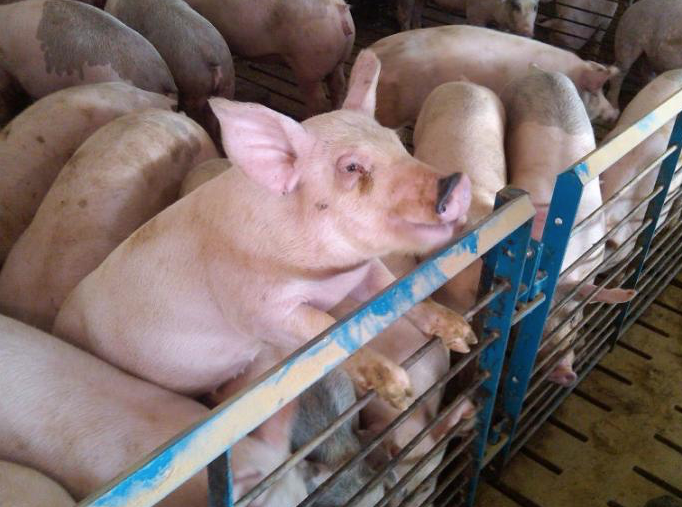
Dr. Hayes estimates that live hog values this year have been reduced by $12 per animal due to retaliatory tariffs imposed by Mexico against U.S. pork in June. The loss estimate of $1.5 billion is based on an expected total harvest of 125 million hogs in 2018. These tariffs, along with China’s retaliatory tariffs, have turned what promised to be a profitable year into a year of losses for export-dependent U.S. pork producers. Dr. Hayes estimates U.S. pork producer losses of $ 1 billion, or $8 per animal, from the ongoing trade dispute with China.
Mexico and China represent approximately 40 percent of total U.S. pork exports.
Cotton Prospects Down
Those 25% Chinese tariffs on U.S. cotton imports are making their mark on 2018/19 cotton exports. Despite exceptional commitments of 8.2m bales to begin the 2018/19 season, the pace of U.S. exports has slowed considerably vs. previous years. Chinese cancellations have occurred in the past five consecutive weeks. With weaker cash prices, mill forward purchases are likely to take a backseat in the short term – ultimately returning as demand confidence is reinstated says a Rabobank forecast. Southeast Asian demand to remain robust, but softer Chinese demand will keep export sales sluggish.
Zacky Farms, the family-owned turkey processor based in Fresno is closing their doors. Their website said recently “It comes with great sorrow that Zacky Farms has announced that it will be winding down its operations. Zacky has struggled in the current state of the industry and it has been impossible for it to continue profitably.” The company says they will close as of January 19,2019. The business was founded by the Zacky family in 1928.
Today only 84 year old Lillian Zacky remains to run the show.
Now an auction firm employed by the lender will sell off the equipment, rolling stock and the trade name. GemCap Lending will hold a secured party public sale to the highest and best bidder for cash November 15, 2018 at 9:00 a.m. Pacific Standard Time on the telephone.
Meanwhile the company has sent a letter to the Fresno EDD that of the 475 Valley jobs being lost, 323 are in the Fresno area. Zacky has also closed the Stockton plant that employed 152. Employees on ranches around Fresno including one in Kings County, are also being laid off. Just what the reasons for the closure are could be multiple. Some wonder if the expected passage of Prop 12 this month expected to raise the cost of bird operations in California may have been factor.
Others suggest there was no succession in this family operation once Lillian Zacky steps down.
Then there is those low turkey prices that may be key as well. Like so many Valley crops, like milk, a surplus of product has led to depressed prices and red ink.
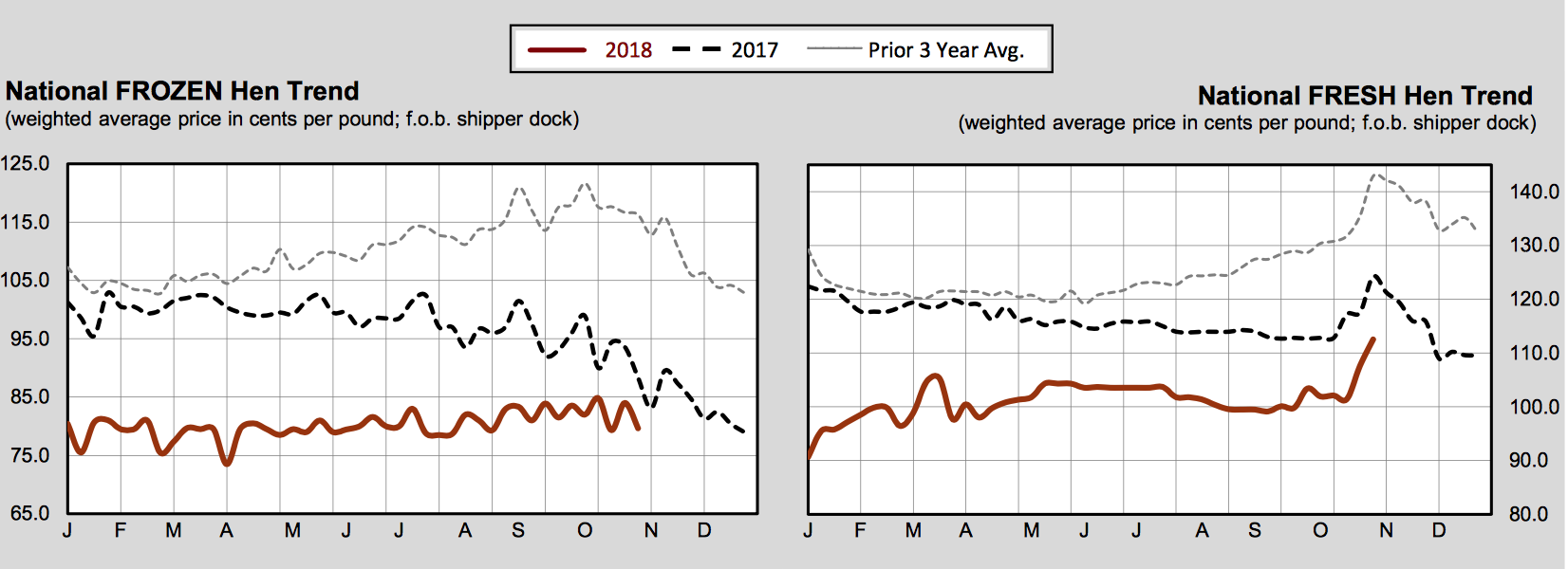
USDA says both frozen and fresh turkey prices remain well below the US three-year average in 2018 (see chart). Fresh turkey at $1 lb compares to $1.30 to $1.40 lb in past years. This info is as of November 2,2018.
But California Poultry Federation president Bill Mattos says other California turkey processor he has talked to are “doing well.” State growers and processor produce just 30% of the turkey we eat in California with the entire crop sold off by Thanksgiving.
The coming of Thanksgiving could be perhaps the key time factor Zacky used to decide when to pull the plug on their operation at this time.
Back in October 9, 2012 Bloomberg News Service announced Zacky Farms LLC, a Fresno, California-based poultry producer, filed for chapter 11 bankruptcy with plans to reorganize after removing partner, Richard Zacky. Zacky Farms came out of the bankruptcy in 2014 and owned entirely by Lillian Zacky, Robert Zacky’s widow.
David Pitman and Lillian Zacky right
Then last month Zacky Farms LLC announced that they will be winding down operations and shutting down the Fresno, California location. Lillian Zacky, CEO of Zacky Farms LLC, had stated in an email to employees at the Fresno, California location, “After four generations and an enormous effort to keep the company in sync with the fast pace of changing times, we no longer are able to keep up with business as usual. We have put our best foot forward but as we struggled in the current state of the industry conditions, it has been impossible for us to continue profitably”.
Having gone through bankruptcy before – tight margins again this year may have tipped the scales on the timing of this decision.
Association With Nitrogen-Fixing Bacteria Allows the Corn to Thrive Without Fertilizer
October 31,2018-
click to enlarge
A multidisciplinary team from the University of California, Davis, the University of Wisconsin–Madison, and Mars, Incorporated have found that an indigenous variety of corn can “fix nitrogen” from the atmosphere, instead of requiring synthetic fertilizers. The team’s findings were published today (Aug. 7) in the journal PLOS Biology.
If this trait can be bred into conventional varieties of corn, it could reduce the need for added fertilizer and increase yields in regions with poor soil. Corn that fixes nitrogen could also help farmers in developing countries that may not have access to fertilizer.
“This research has been 40 years in the making and is a significant breakthrough in our attempts to find a more sustainable way of growing corn, one of the world’s key crops,” said co-author Howard-Yana Shapiro, chief agricultural officer at Mars, Incorporated.
Nitrogen is an essential nutrient for plants. While nitrogen makes up 78 percent of the atmosphere, only legume crops were known to have the ability to use it through their association with bacteria. For cereal crops like corn, farmers must rely primarily on nitrogen fertilizers. The discovery
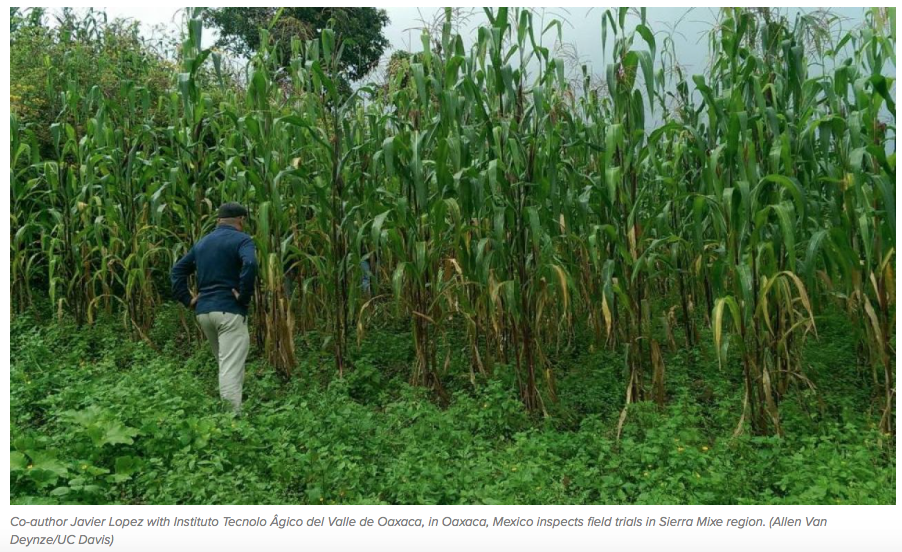
Researchers spent years searching for isolated indigenous varieties of corn, or landraces, where corn first originated in Mexico. It was thought that such varieties might associate with nitrogen-fixing bacteria. In the 1980s, Shapiro observed such corn being grown in nitrogen-deficient soil in the Sierra Mixe region near Oaxaca. It was not until the 2000s that new technologies developed to allow them to intensely study this nitrogen-fixing process.
“It has been difficult to identify such a landrace and demonstrate that this nitrogen-fixing association actually contributes to nitrogen nutrition of the plant,” said co-author Alan Bennett, distinguished professor of plant sciences in the College of Agricultural and Environmental Sciences at UC Davis. “Our interdisciplinary research team has been working on this for nearly a decade.”
Sugar-rich mucilage, a gel-like substance, found in an indigenous corn from the Sierra Mixe region supports the nitrogen fixation process by providing a home for nitrogen-fixing microbes. (Mars, Incorporated) How it works
The study found that one corn variety grown in the Sierra Mixe region obtains 28-82 percent of its nitrogen from the atmosphere. To do this, the corn grows a series of aerial roots. During certain times of the year, these roots secrete a gel-like substance, or mucilage. The mucilage provides the low-oxygen and sugar-rich environment required to attract bacteria that can transform nitrogen from the air into a form the corn can use.
“Our research has demonstrated that the mucilage found in this Sierra Mixe corn forms a key component of its nitrogen fixation,” said co-author Jean-Michel Ané, professor of Agronomy and Bacteriology in the College of Agricultural and Life Sciences at UW–Madison. “We have shown this through growth of the plant both in Mexico and Wisconsin.”
Hope for sustainable agriculture
Researchers are a long way from developing a similar nitrogen-fixing trait for commercial corn, but this is a first step to guide further research on that application. The discovery could lead to a reduction of fertilizer use for corn, one of the world’s major cereal crops. It takes 1-2 percent of the total global energy supply to produce fertilizer. The energy-intensive process is also responsible for 1-2 percent of global greenhouse gas emissions.
“Corn yields in developing countries are one-tenth of those found in the U.S., due both to variety development and access to affordable nitrogen fertilizer,” said co-author Allen Van Deynze, director of research at the UC Davis Seed Biotechnology Center. “This discovery opens the door to significantly improving the genetic potential and food security for these countries.”
“As one of the world’s largest food businesses, Mars is committed to reducing the environmental strain caused by farming,” Shapiro added. “We embarked on this uncommon collaboration decades ago to drive forward a discovery that has the potential to create a lasting and positive impact on sustainable agriculture.”
The municipal authority and community in the isolated village in the Sierra Mixe region were an integral part of this research project. Biological materials were accessed and utilized under an Access and Benefit Sharing (ABS) Agreement with the community and with permission from the Mexican government. An internationally recognized certificate of compliance under the Nagoya Protocol on Access and Benefit Sharing has been issued for such activities.
This ABS Agreement is designed to ensure the equitable sharing of benefits arising out of the utilization of genetic resources, contributing to the conservation and sustainable use of biodiversity.
This research was facilitated through the tremendous cooperation of SEMARNAT and SAGARPA, two agencies of the Mexican government responsible for implementation of the access and benefit-sharing provisions of the Nagoya Protocol.
Other authors include Pablo Zamora, Cristobal Heitmann, Alison Berry, Donald Gibson, Kevin Schwartz, Srijak Bhatnagar, Guillaume Jospin, Aaron Darling, Jonathan Eisen, Richard Jeanotte, and Bart Weimer of UC Davis; Javier Lopez, Instituto Tecnologico del Valle de Oaxaca, Oaxaca, Mexico; Pierre-Marc Delaux, Dhileephumar Jayaraman, Shanmugam Rajasekar, Danielle Graham, and Junko Maeda of UW–Madison.
This paper is dedicated to co-author Cristobal Heitmann, whose energy and enthusiasm were a major catalyst in this research. He died while the manuscript was under review, and his research for the paper was part of his M.S. thesis. Read more about Cris and the scholarship in his name.
“Don’t Hold Your breath” says Valley ag trade group
October 29,2018-
California’s most important citrus sales period is just starting for the holidays. But the outlook for better prices is clouded by the lingering trade war with our key export partners.
Tops on the list is China.This past week the trade group California Citrus Mutual weighed on prospects for any breakthrough in the 8 month face off. Here is what they told growers recently. The upshot is that they fear the “red ink” will continue to flow.
UPDATE:
“China has quietly closed a perceived loophole in trade onto the mainland by cracking down on almonds transshipped via Vietnam. This was being done to avoid the horrendous tariffs imposed. While California citrus has rarely transshipped from Vietnam, the Hong Kong distribution channel could be affected if the objective is to make the tariffs as a whole as effective as possible.
CNN photo of Joel Nelsen
Regarding possible elimination and an agreement between the two nations; don’t hold your breath.
The Chinese are seeking a long, drawn-out bureaucratic review via the World Trade Organization (WTO) as to the legality of U.S. actions on Chinese products. In November there is a major national trade session scheduled with the nation’s two leaders scheduling some “sidebar” time. U.S. interests continue to focus on U.S. companies being forced to give up technology, being forced to accept partnerships, and being forced to compete against subsidized Chinese companies. We wouldn’t anticipate any breakthrough just yet.”
CCM says that in 2017, the amount of California citrus exported to China was 7.868 million cartons of oranges and lemons. The previous season the number was higher. When the trade dispute broke, the citrus industry exported 13,333 metric tons in May of last years crop, compared to 27,072 metric tons in May of 2016, down be more than half.
Peak Export Month
December through May is historically the peak export months into China with major arrivals occurring in December after being loaded in November. “Finding a new home for that much tonnage or selling it for less to offset the 50% tariffs are not outcomes that generate the net revenue per acre for the grower” says CCM memo.
The value of the fruit is approximately $250 million.
Tulare County farmer Guy Wollenman told CNN a few days ago that trade war was hurting their long time family farm near Lindsay. The Wollenmans have grown citrus in California since 1919.
”We have two bad years with this trade war and I don’t know if we can weather that.” His brother Tom figures the tariffs are costing them $2000 an acre.
CCM’s president Joel Nelsen wonders when this trade dispute will be resolved suggesting right now that “supply exceeds demand” for our citrus and worries farmers “will end up with a red ink year.”
It does not help that in addition to the tariff squeeze the industry faces a larger crop but smaller in fruit size this year.
California citrus industry, already the number two crop in the Central Valley, affects other sectors of the economy in California. For example, California’s large food and beverage manufacturing industry is located in the state largely because California’s farms produce so much. That industry employs more than 234,000 people and generates $15.7 billion in employment earnings. This compares to farm employment of 241,000 and earnings of $15.9 billion Other industries are also dependent on agriculture, including those that provide agricultural inputs and that transport farm production and food products made from California farm production.
Recently a California economics analyst weighed in on the impact of the trade war.
“When President Trump imposed higher tariffs on imported steel and aluminum earlier this year, America’s trading partners retaliated with tariffs that disproportionately targeted agricultural exports, including California fruits, nuts, dairy products, and wines,” said Jock O’Connell, Beacon Economics’ International Trade Advisor. “So it comes as no surprise that our once vibrant agricultural export trade has suffered, while the state’s high-tech manufacturing sector continues to thrive.”
Likewise for other trade partners.Even with preliminary US trade agreement with Canada and Mexico, retaliatory tariffs are still in place over Trumps steel and aluminum tariffs.
The retaliatory tariffs imposed by Mexico and Canada against U.S. products in response to U.S. tariffs on imports of steel and aluminum from Mexico and Canada will remain in place. Secretary of Commerce Wilbur Ross tells Fox Business, “There are problems specific to steel and aluminum relating to our national defense, and at this point of time, those stay the same.”
US orange products remain affected by retaliatory tariffs not just from China but those imposed by Canada,Europe and Turkey. Mexico’s big impact includes the tax they continue to put on our other big crop – cheese. Mexico says it is up to Mr Trump to drop the steel tariffs before they will sign the new trade agreement. Dairy farmers are asking him to do just that.
NPPC warns farmers will take hit from auto import tariffs
U.S. tariffs on auto imports could affect Canada, Japan, Mexico, South Korea and at least four members of the European Union.
National Pork Producers Council | Sep 26, 2018
If the United States places tariffs on auto imports, it will be pork producers and other farmers who will likely face retaliation from some of American agriculture’s biggest trading partners, warned the National Pork Producers Council in comments submitted today to the Senate Committee on Finance.
NPPC reiterated its opposition to U.S. tariffs imposed to date — Section 232 duties on steel and aluminum imports and tariffs on imported goods from China related to that country’s theft of U.S. intellectual property and forced transfers of U.S. technology — and to any new tariffs.
“American agriculture generally and U.S. pork producers specifically have borne the brunt of trade retaliation from some of our top trading partners,” says NPPC President Jim Heimerl, a pork producer from Johnstown, Ohio. “We can’t afford to take another hit. If we do, a lot of farmers could go out of business, and consumers will pay a lot more for food.”
According to an estimate from Iowa State University economists, an initial 25% Chinese tariff on U.S. pork was the main cause of hog futures dropping by $18 per pig from March through May, or $2 billion industrywide on an annualized basis. In June, Mexico imposed a 10% tariff on U.S. pork, and in July, it increased the duty to 20%, and China imposed another 25% tariff. (Mexico is the U.S. pork industry’s No. 2 export market; China is No. 3.)
U.S. tariffs on auto imports could affect Canada, Japan, Mexico, South Korea and at least four members of the European Union — Germany, Italy, Sweden and the United Kingdom — as well as countries that supply parts to those nations. All are customers for U.S. pork. Canada, Japan, Mexico and South Korea are four of the U.S. pork industry’s top five export markets.
In 2010 Tangerines were a $115 million crop on fifteen thousand acres, compared to $616 million for all orange varieties, on 95 thousand acres planted in Tulare County, the state’s number one citrus producing county.
By 2017 the just released Tulare County Crop Report says Tangerines (also known as Mandarines) have climbed to the number five crop in the county valued at $463 million on 26,000 acres.
Meanwhile Tulare County’s Navel oranges are grown on 79,500 acres and the Valencia variety is grown on 15,000 acres, not much different from 2010. For 2017 the per ton value is $651 for Navels, and $680 per ton for Valencias. By comparison Tangerines are now valued at nearly three times that number -$1740 per ton.
In 2017 the staple of Tulare County’s citrus industry, the Navel orange crop, was valued $589 million. Now those tangy tangerines are within shouting distance wth a value $463 million.
Send in the Mandarines
Despite the growth in value here the US is bit player when it comes to Tangerine production.
USDA estimates that global production of Mandarins for 2017/18 is forecast flat at 30 million tons, with US production just 758,000 tons. It’s China that is offsetting declines elsewhere in the world such as the European Union and the United States. Fresh consumption and exports led by China and Turkey, are also flat.
U.S. production is estimated to drop 19 percent to 758,000 tons due to unfavorable weather says the agency. China’s production is forecast up 3 percent to a record 21.2 million tons due to favorable weather. As the largest producer, China represents over 70 percent of global production and consumption and over one-fifth of global exports.
Production in the European Union is expected to fall 10 percent to 3.1 million tons due to unfavorable weather in Spain. Morocco production is nearly double what we grow in the US.
US citrus production has been hurt by pest and weather problems in Florida.The USDA set the total 2017-18 Florida citrus crop value at nearly $551.2 million, down from a revised estimate of $927 million for the state’s 2016-17 citrus crop. A year ago, the agency estimated the 2016-17 crop at $780.7 million.Both hurricanes and citrus greening have reduced the crop even as juice consumption continues to plummet.
Unlike Florida most of California citrus goes to the fresh market.Unlike Navels most Tangerines go to the domestic market where they have been in recent years been branded with names like Delites, Cuties, Pixies, on the newer easy-peel, low or no
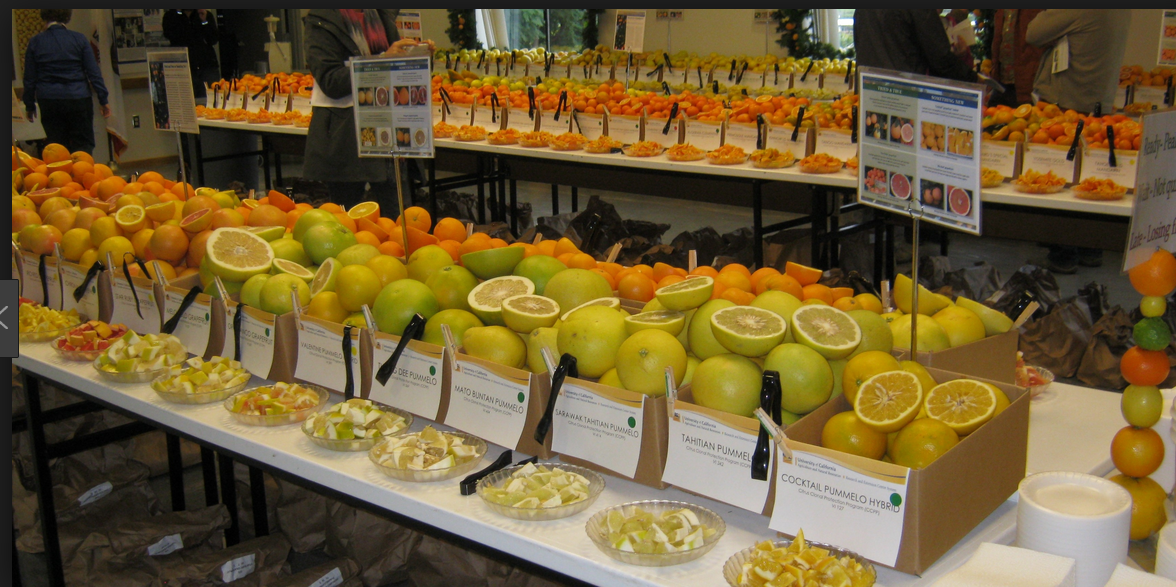
citrus tasting event in Tulare County
seed varieties that have been developed by USDA and UC researchers in collaboration with the industry.
Some growers expect Valley Tangerine production to eclipse Navels in coming years.That has already happened in Kern County where Tangerines reached at value of $394 million in 2017 vs $340 million for Navel oranges. Kern was again the number-one ag producing county last year narrowly edging out Tulare and Fresno counties.
Besides Tangerines 2017 also saw a big jump in value for Valley lemons. Tulare acreage of lemons was 8,900 acres ,up from 7100 acres in 2016 with the crop valued at $171 million compared to $118 million in 2016.
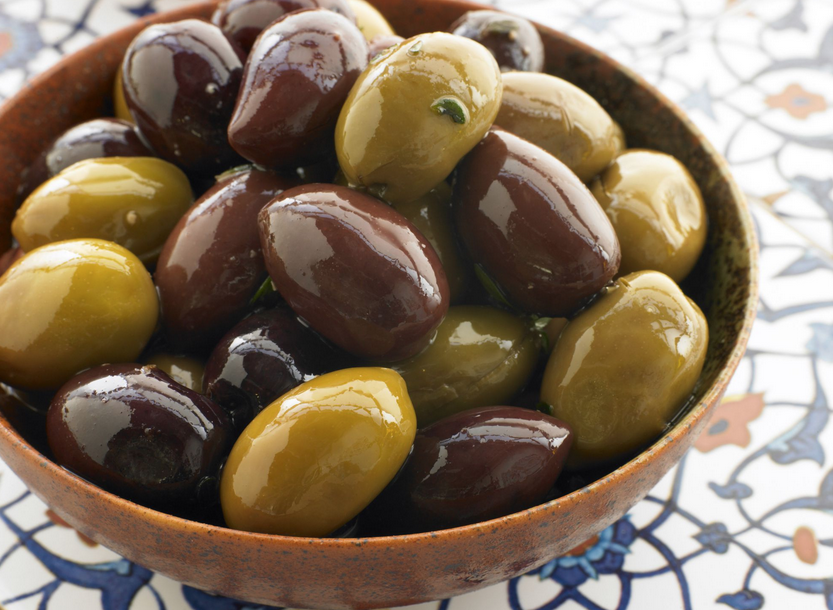
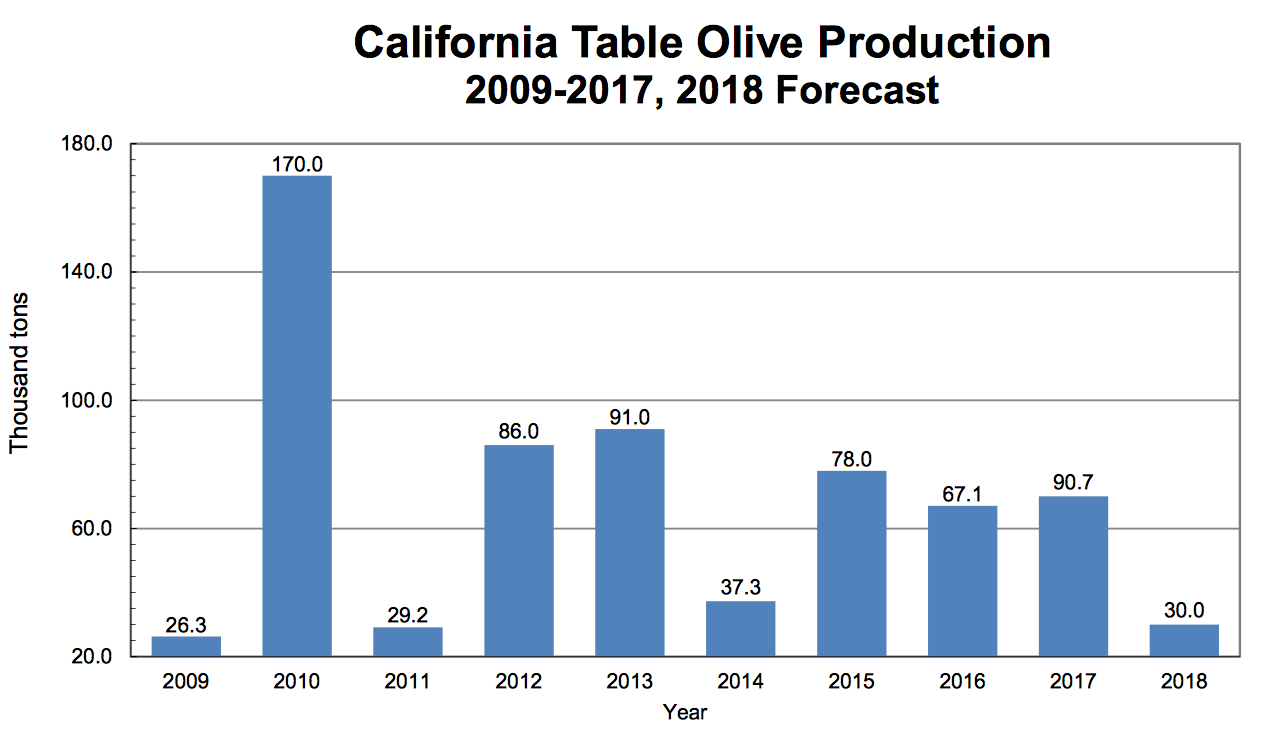
The 2018 California table olive forecast is 30,000 tons, down 67 percent from last year’s crop of 90,700 tons, according to a survey conducted by the USDA, National Agricultural Statistics Service, Pacific Regional Office. Bearing acreage is estimated at 16,000, which results in a yield of 1.88 tons per acre.
The Manzanillo production forecast is 28,000 tons, Sevillano production forecast is 1,500 tons, and other varieties are expected to total 500 tons.
A freeze in late February damaged developing buds and negatively impacted production, especially in
the Sacramento Valley. The bloom was normal in the San Joaquin Valley. Variable crop yields and labor shortages continue to impact growers. Harvest is expected to start early, in mid-September.
Commitments to export almonds for the 2017/18 crop are down 21% says the Almond Board.For the month of July exports of almonds totaled 83.8 mil pounds compared to 96.4 mil pounds in July 2017, a 13% decline.
European shipments were down from 52 million pounds in July 2017 to 40 mil pounds in July 2018.China/HongKong shipments fell from 7.3 million pounds last year to $4.7 mil pounds this July, affected by the escalating trade war.
President Trump has said he will impose an additional 25 percent tariffs on $16 billion worth of Chinese imports starting Aug. 23 with China again expected to retaliate.
California is expecting a big crop of almonds this fall but growers are worried about demand based on trade tensions and tariffs.
Reports from elsewhere…..
Roundup & Cancer Ruling Stands
— California decision to list glyphosate stands: The California Supreme Court on Friday declined to hear Monsanto’s appeal to remove glyphosate from the state’s list of chemicals that cause cancer or birth defects. That refusal keeps in place a lower appellate decision that the listing under Proposition 65 is proper, which was made after the World Health Organization’s International Agency for Research on Cancer determined that glyphosate — which is found in Monsanto’s Roundup weedkiller — is probably carcinogenic to humans.
— Strong demand for equipment despite tariffs: Farmers are continuing to buy equipment despite worries about tariffs on U.S. farm products, Deere & Co. said Friday. Steel and aluminum prices have been pushed up by U.S. tariffs on imported metals, leaving Deere to raise prices to offset higher material costs, the Wall Street Journal reports.
Farm Bill Egg Amendment rejected
Senator Dianne Feinstein (D-Calif.) joined with 31 other senators to call on Senate Agriculture Committee leaders to reject the King amendment in the farm bill. The amendment, offered by Congressman Steve King (R-
Iowa), would force states to accept agriculture products that violate state and locals laws.
“If enacted, this amendment would undermine numerous state laws and infringe on the fundamental rights of states to establish regulations within their own borders,” the senators wrote. “We want to thank you for not including this provision in the Senate bill, and strongly encourage you to reject this provision in any form in the final conference report.”
Ag Bank Mergers Exacerbate the New Farm Crisis
Posted by Claire Kelloway in Commodities, Grains, Mergers & Acquisitions, Newsletter
“So many banks have consolidated that the local bank is not locally owned, it’s just a branch of another bank,” says Vern Jantzen, Vice President of the Nebraska Farmers Union. “In the old days there was a relationship there, the banker knew how this family was operating and he could figure out if this is a good risk or not, but all of that is gone.”
The ag credit landscape is made up of commercial banks, government-sponsored enterprises called the Farm Credit Service and Farmer Mac, and “loans of last resort” from the USDA Farm Service Agency. In 2016 the FCS held nearly 41 percent of all farm sector debt while commercial banks held 42 percent.
Both the FCS network and the commercial ag banking sector have become increasingly consolidated since the 1980s farm crisis. In 1983 the FCS included nearly 900 lending associations organized into 12 regional districts. Today there are only 80 associations housed within just 4 large FCS regional banks.
On the commercial side, the number of agricultural banks has shrunk nearly in half since 1979, from 4,365 to just 2,316. Rural community banks with less than $10 billion in assets still finance roughly three-fourths of all commercial farm loans, but they too are disappearing. The number of community banks has declined from roughly 16,000 in 1984 to just around 6,000 in 2014.

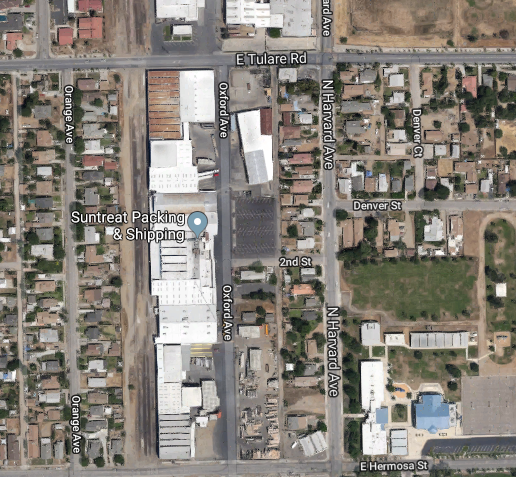 Publicly traded Vegalab, Inc. (OTCQB: VEGL) has purchased a major fruit package facility in Lindsay, the Suntreat plant with 260,000sf of space as of November 15. Already in operation the new owner is packing citrus and employing around 50. The company has been on the grow in the Valley recently purchasing a facility in Merced and one in Visalia, the M&G Packing plant in October