Ag beat: Tulare cotton acres at record low

-September 23,2020-

Navel orange forecast down 5%

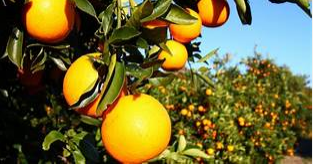
USDA reports the initial 2020-21 Navel orange forecast is 84.0 million cartons, down 5 percent from the previous year. In Tulare County, the number one orange producing county, the report estimates that average set at 332 oranges per tree compared to 339 last year with a slightly larger average diameter at 2.198 inches. The smaller crop and larger size is considered bullish for prices.

Tulare County cotton acres at record low

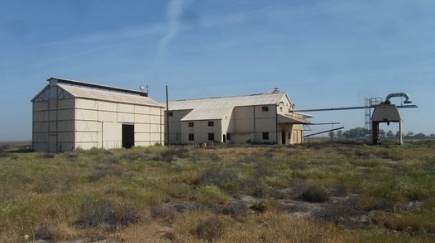
Abandon gin near Alpaugh2020-09-18 at 9.15.41 AMTulare County’s cotton acreage has dropped to 6695 acres this year – a record low .The numbers are reported. by the state Pink Bollworm program. Cotton acres in 2019 was 14,800. By contrast cotton acreage in1993 was near 145,000 acreage.  Scores of cotton gins in the county have shut their doors over the years and today only Mid-Valley Cotton is still ginning cotton in Tulare.

Valley farmer are asking for help from the government  this year due to depressed prices brought on by the tariff war with China and the pandemic.

Finger Limes immune to Citrus Greening

From LA Times

Citrus greening, also called huanglongbing or HLB, has upended the citrus-growing industry in Florida and put other American citrus producers, like those in California, on high alert. Now, 15 years after the disease first appeared in the United States, researchers at the University of California, Riverside have found a substance that might stop it.

Researchers’ best lead came from finger limes, an unusual citrus fruit that grows in Australia’s rainforests. The pickle-shaped fruits are full of caviar-like beads of juice, and the limes are immune to citrus greening. After finding the gene that grants the limes their immunity, the researchers used it to create the natural HLB-fighting protein. In controlled settings, spraying young trees with the protein killed the disease, Jeanette Marantos reports for the Los Angeles Times.

Tulare County crop value up 4% in 2019 at $7.5 billion

-September 22,2020-

Screen Shot 2020-09-22 at 7.32.42 AMTulare County crop production rose in value by 4% in 2019 reaching more than $7.5 billion. Milk continues to be the county’s top crop but lost 4.3% in value in 2019 vs 2018 based on a 11% decline in production in 2019 even though milk prices were higher than 2018.

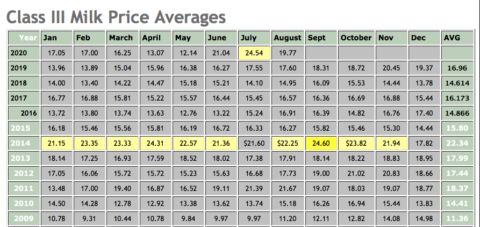
Milk prices per cwt in 2019 was $16.30 with a total value of $1.6 billion. That is a far cry from that record year of 2014 when the average milk price was nearly $23 per cwt and production of 115 billion pounds with a total value that year of $2.5 billion.

milk's wild ride
milk’s wild ride

The record for milk value was $8 billion in 2014, largely based on record milk prices that year.

If milk had a down year in 2019, fruit and nut crops were higher with acreage climbing from 415,000 to over 484,000.

Almond acreage climbed to 78,300 from 67,300 and pistachio plantings were slightly higher Pomegranates that suffered a ow price per ton in 2018 rose 3 fold per ton in prices in 2019.Walnut prices we’re lower as total value dropped to $149 million from $225 mil in 2018. Also down in 2019 was the crop value for cattle and calves with a lower price per head.

In the citrus category, navel orange production was up on a per acre basis even though the value per ton was down. The total value was up to $707 mil compared to $589 mil in 2018.Tangerines were higher on higher production.

While milk was the number one crop, oranges rose to number 2 and grapes fell from 2nd to 3rd. Cattle and tangerines followed.

Grape acres were 53,680 in 2019 – down from around 57,000 acres in 2016. Total value of grapes fell from $834 mil in 2018 to $802.5 mil.

Tulare County organic acreage continued to climb in 2019 to just under 13,000 acres compared to 7600 in 2014.

As for exports, the Republic of Korea was by far the county’s largest trade partner with shipment of 7.5 million cartons of produce.

Tulare’s World Ag Expo cancelled

September 14,2020

Screen Shot 2020-09-14 at 12.46.04 PMTulare, CA – For more than 52 years, World Ag Expo® has served agriculture by bringing buyers and sellers together to innovate, collaborate, and advance agriculture. In 2021, the show will not be held live for the first time in World Ag Expo® history.

“After working with the Tulare County Health Department and other officials, it has become evident that given health and safety restrictions from the State of California, holding a live, international event is not responsible in February,” said Jerry Sinift, International Agri-Center® CEO.

The International Agri-Center® Board of Director’s decision to cancel the 2021 World Ag Expo® was not taken lightly, and comes after months of research and evaluation of future trends and known constraints. The decision was finalized earlier than the initial November deadline to provide exhibitors, attendees, volunteers, concessionaires, contractors, and local businesses time to adjust their Tulare farm show plans.

The cancellation of World Ag Expo® comes as another negative effect of COVID-19 for the International Agri-Center®, exhibitors, non-profit food vendors, attendees, area hotels, restaurants, and other associated businesses.

Attendees are encouraged to follow World Ag Expo® social media channels and watch their email inboxes for more information on World Ag Expo® projects throughout 2020 and 2021. They can join the World Ag Expo® email list to stay up-to-date at http://bit.ly/WAEupdates.

World Ag Expo® staff will reach out to exhibitors concerning fees and more options for 2021 starting Wednesday, September 16.

The 2022 World Ag Expo® is scheduled for February 8-10 at the International Agri-Center® in Tulare, CA.

###

The International Agri-Center® is home to World Ag Expo® in Tulare, California. An estimated annual average of 100,000 individuals from 65 countries attend World Ag Expo® each year. The largest annual agricultural show of its kind, World Ag Expo® hosts more than 1,400 exhibitors displaying cutting-edge agricultural technology and equipment on 2.6 million square feet of exhibit space. Plan your visit at www.worldagexpo.org.

Nut Grower group backs ARO Pistachios

-August 26,2020-

Screen Shot 2020-08-26 at 5.45.52 PMIn a letter of support from America’s pistachio growers association the Fresno-based organization’s president Richard Matoian backed the expansion of a Tulare County nut grower being challenged by industry leader Wonderful Pistachios.

Wonderful lost the most recent round to stop construction of the ARO pistachio plant in Terra Bella this week as the Tulare County Board of Supervisors unanimously rejected Wonderful’s appeal.

Wonderful, owned by Stewart Resnick, has filed a lawsuit against the county hoping to convince a judge next week ( Sept 1) to put halt to the work on silo construction just as the harvest is beginning.Resnick has been a running battled with the Assemi family who now own the Terra Bella facility.

In their letter the American Pistachio Growers -a voluntary trade association representing over 850 member growers and member processors in the states of California, Arizona and New Mexico backed ARO’s expansion- now underway and approved by the county. Other growers penned letters of support this week as well.

Wonderful claims the county approved the expansion of the facility as a minor modification that the county says is common with ag projects noting the same language has been used to approve many Wonderful projects in Tulare County as well. Wonderful claims that the county has violated CEQA rules.

But the growers group points out the industry needs more processors in their letter.

“With the substantial increase in the number of acres planted to pistachios in California, and specifically in the San Joaquin Valley over the last 15 years, ever increasing hulling/drying and processing capacity is needed. As you may know, once pistachios are harvested, they must be hulled and dried within 24 hours, otherwise quality degradation occurs. So, the need for expansion of each and every existing pistachio processing facility on an on-going basis is imperative to keep up with the ever increasing crops that are being harvested. Without the expansion of the ARO Pistachios facility, this would put potentially 100’s of farmers at risk for the timely processing of their commodity. “

California produces 99 percent of the nation’s pistachios, and 97 percent of that the total bearing acres are located in the San Joaquin Valley. Pistachios are now the fifth largest commodity in California, and recently moved up to the third largest exported product from the State, in terms of value. Pistachio bearing acres have tripled from 2005 to 2020 (104,000 acres to 305,000 acres), and total production has risen from approximately 300 million pounds to nearly one billion pounds, projected for this year.

Tulare County is the third largest producer of pistachios in California. This increase in production IS the reason why each and every pistachio processing facility needs to undergo expansions of their facilities—to take care of and handle the ever increasing volumes.

20/21 -Another down year for Florida citrus

-August 14,2020-

news release

Screen Shot 2020-08-14 at 6.55.58 AMElizabeth Steger, president of Citrus Consulting International, has forecast Florida’s 2020-21 orange crop at 62 million boxes. That is 8.35 percent fewer oranges than the 67.65 million boxes the state produced last season. [See the final 2019-20 season forecast by the U.S. Department of Agriculture (USDA) here.]

Steger has been forecasting the size of Florida’s orange crop prior to the initial USDA forecast for many years. The first USDA forecast for the 2020-21 season is scheduled for Oct. 9.

“We are forecasting 27 million boxes for early-midseason (oranges), including 0.75 million boxes of navels, and 35 million boxes of Valencia,” Steger stated. Last season, Florida produced 29.65 million boxes of non-Valencia oranges and 38 million boxes of Valencias.

“The estimate of boxes per tree is as follows: Early-mids without the navels is 1.38, and Valencia (is) 1.17 boxes per tree,” Steger said.

“There are two significant issues this season, the reduction of fruit per tree in both varieties, which is the determinant factor for a lower crop,” Steger stated. “The other factor is the multi-bloom that can affect the final fruit size. The greening disease also affects the fruit size. This lower fruit per tree is probably related to the low cycle production which happened in Brazil this season.”

“The number of bearing trees has decreased by .53 percent,” Steger added. “The early-mids are down 2.73 percent and the Valencia is up .96 percent. The final crop will depend on how the drop and fruit size develop. Our estimate ranges between 59 and 65 million boxes.”

“This year will be remembered for the pandemic, disrupting everyone’s life,” Steger stated. “Our visit to the groves was limited this year, but we were able to see the multi-blooms throughout the groves.”

“The trendline in tree productivity is down,” Steger concluded. “It is imperative that the government creates incentives for growers to do massive new plantings in exchange for the old weak trees. We need a strong citrus industry to help the growers and the economy in our state.”

Source: Citrus Consulting International


off year for olives

Expect reduced harvest for olives

Screen Shot 2020-08-14 at 6.39.35 AM

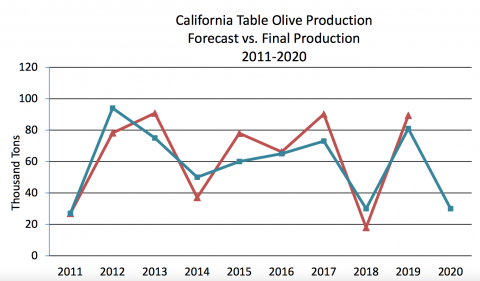
The 2020 California table olive forecast is 30,000 tons, down considerably from last year’s crop of 89,400 tons, according to a survey conducted by the USDA, National Agricultural Statistics Service, Pacific Regional Office. Bearing acreage is estimated at 15,500, which results in a yield of 1.94 tons per acre.

The Manzanillo production forecast is 25,500 tons, Sevillano production forecast is 4,000 tons, and other varieties are expected to total 500 tons.

High heat and winds during bloom caused a poor set for California table olives. Labor costs and marketing remains an issue for California olives growers, with many uncertain how much of their crop will be economical to harvest.

Olives are an alternate bearing crop generating wild swings in production year by year.

ADM plans Valley layoffs as nut plants close

-August 7,2020-
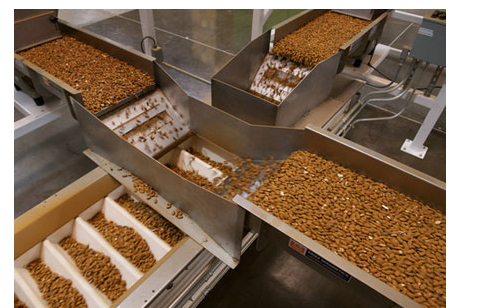
ADM nuts 2020-08-07 at 12.31.47 PMGlobal ag giant Archer-Daniels-Midland Company (ADM) will lay off 520 workers at several nut processing facilities in the Lodi and Modesto area confirms spokesperson Jackie Anderson.The Chicago-based trading company and food processor has some 270 plants worldwide and a number of processing plants in California.

The company filed required WARN notices this week posting that facilities in Lodi would permanently lay off 116 and in the Modesto area, some 404 employees would face permanent job loss as well, both some time in October.

Anderson says several nut plants will close.The company expanded their nut processing facilities in this area in 2015. In a news releases that year, ADM suggested consumer demand for healthy nuts drove their plan to expand.

“This acquisition helps ensure that we stay ahead of consumer demand trends, and continue to meet customer needs in a growing market.

The Modesto plant is capable of steam pasteurizing, roasting, dicing, slicing, milling and packaging. Like ADM’s plants in Lodi and Stockton, the facility can process a range of nuts, including almonds, cashews, Brazil nuts, pecans, pistachios, hazelnuts, walnuts and macadamias.”

But now the plan appears to exit this business in the Central Valley where almonds, walnuts and pistachios are heavyweights. However, this summer there is a glut of product, a huge almond crop, as COVID and the international trade war has hurt nut exports.The U.S. exports the most tree nuts but due to Chinese retaliatory tariffs and the virus demands way down as are prices.
This week The Almond Alliance of California has convinced the USDA to include almonds in their Section 32 food purchase program to the tune of $40 million.The Alliance notes
that “grower prices continue to drop and there is an anticipated 3-billion-pound crop for 2020 it is clear that the assistance of a USDA commodity purchase came at a critical time”.
Almond prices that were $3/lb year ago are half that today.Walnuts are a similar story.

One of ADM largest investment- ethanol products have been hurt by the same two factors and a number of their plants are idled in the Midwest.

ADM California plants to close

”We have informed colleagues of our plans to end tree nut processing at our facilities in Lodi and Modesto, California, in the coming months. We also plan to close our warehouse in Lockeford.”

“Our primary focus is the respect and care of our employees during this time; colleagues will have the opportunity to apply for other open roles at ADM, and regardless, we’ll be treating all of them with respect, according to our values. We’ll also be working with our customers to fulfill outstanding orders, and ensure a smooth transition.

It’s important to note that this decision is not related to the impacts of COVID-19. We regularly review our portfolio to ensure that the assets we hold are good fits. In this case, we reviewed several options, but in the end, we did not see a viable long-term path toward these facilities meeting our objectives.”

Ag beat

-July 26,2020-

Grocery shoppers gobble up dairy

When COVID hit full force in the middle of March, total grocery store sales shot up 61% with dairy sales up 59%, reports Larry Levin, executive VP of Market and Shopper Intelligence with IRI. Levin spoke at The Dairy Experience held virtually in mid July.

Post panic, from the end of March through most of June, dairy retail sales are still up 17% and up 22% for the year

Good year for California Avocados

Consumers like to buy them in a bag

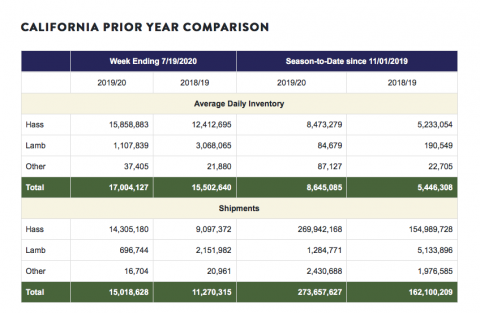
California avocado growers have a big crop to stretch out over the year. Shipments in 2020 may nearly double last year by December. 

Screen Shot 2020-07-25 at 7.30.14 AM

A industry report says “Rob Wedin of Calavo Growers Inc., Santa Paula, CA, said the avocado industry also is experiencing the same preference for bagged fruit that its colleagues in other sectors of the industry are noticing. While bagged avocados have been on an upward trend for the last few years, Wedin believes the fears generated by COVID-19 have accelerated the pace. He theorized that shoppers are less comfortable picking up bulk fruit handled by other shoppers. In addition, he said buying a bag of avocados that contains four to six pieces of fruit aligns with new shopping habits that see consumers going to the supermarket less often. A bag can  ll their avocado needs until the next time they venture out.”

California strawberry harvest up over last year

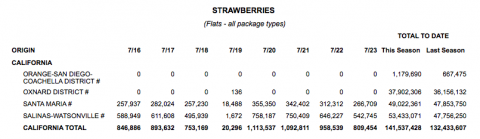
California strawberry growers are producing more fruit this year despite COVID 19.here are the latest numbers including the Sant Maria district.

Screen Shot 2020-07-25 at 7.22.16 AM


FARM BUREAU …”something is wrong when consumers are paying higher prices for meat and at the same time America’s farmers and ranchers are being paid less.”

Screen Shot 2020-07-26 at 7.29.20 AMThe USDA released a report on its investigation into disparities between prices paid to farmers and beef prices at grocery stores in the past few days. The following statement may be attributed to American Farm Bureau Federation President Zippy Duvall:

“We appreciate the USDA’s thorough examination of the beef markets. There’s little doubt that something is wrong when consumers are paying higher prices for meat and at the same time America’s farmers and ranchers are being paid less.

“We are pleased the USDA responded to our call for an investigation, but it’s important to note the scrutiny of the markets is not concluded. USDA indicates their examination continues and investigations by the Commodity Futures Trading Commission, as well as the Department of Justice, are ongoing.


UFW Decert’ election held at Foster Poultry Farms

The United Farm Workers replaced the International Association of Machinists and Aerospace Workers at the Foster Poultry Farms in Livingston in 2017. In July 2020, the NLRB held an election to determine if the 2,400 employees wanted to decertify the UFW.

The election is being conducted by United States mail. The mail ballots are mailed to employees employed in the appropriate collective-bargaining unit. At 5:00 p.m. on Wednesday, July 22, 2020, ballots were mailed to voters from the National Labor Relations Board. Results will be known in August,collected August 5.

ag beat: Goodbye to Odwalla / much more

-July 8,2020-

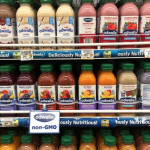
Screen Shot 2020-07-06 at 7.41.08 AMGoodbye to Odwalla! Odwalla, founded by hippies in Santa Cruz in 1980, the brand of smoothies  became all the rage as consumers looked for healthy juice beverages in the past decades. Coke bought the company after Odwalla had moved their production facility and several hundred jobs to tree-fruit- country in Dinuba.The company delivered product in some 230 refrigerated trucks. This month Coke announced it was shutting down Odwalla and the distribution network too.They had relocated from Dinuba a few years ago.Coke cited “a rapidly shifting marketplace.”

New USDA forecast confirms a big almond crop -up 18% from last year, the largest on record.The average nut set per tree is 5,645 – an increase of 21 percent compared to 2019.

Meanwhile export shipments of almonds, California’s leading agricultural export, were down 14.1% at 96.74 million pounds in May 2020. July prices are down to $1.49lb.

CoBank says dairy industry must adjust to COVID era as consumers stay home instead of eating at restaurants.The trend is affecting the variety of products available. The popular Wegman’s supermarket chain has cut its offerings from about 52,000 products to 30,000 products.Data from Nielsen shows that for the four weeks ending June 13, supermarkets carried nearly 7% fewer dairy items than the year prior.Some buyers are asking if suppliers can develop and provide extended shelf life alternatives. 

COVID is affecting the grape industry as well with an expected loss of sales adding up to at least $437 million this year. Allied Grape Growers say people they are “drinking at home, buying bottles for $10 rather than $40. It’s “flipped 180 degrees and everyone Is trying to readjust,” says president Jeff Bitter.An oversupply of grapes last year has caused growers to pull some vineyards.

Screen Shot 2020-07-08 at 7.41.27 AMMaine’s lobster industry isn’t happy either. A NY Times article quotes one lobsterman getting half the price per pound than he did a year ago.  President Trump recently remarked that the industry is”back, bigger and better than anyone ever thought possible,” the president said on Twitter. “Enjoy your ‘lobstering’ and fishing! Make lots of money!”Trump claims it was Obama that that “destroyed the lobster and fishing industry”. The trade war and COVID did a one two punch on the industry.

How are consumers getting their food? June online grocery sales jumped 9% compared with May, according to a survey from Brick Meets Click/Mercatus. With sales estimated at $7.2 billion in June, 45.6 million households used delivery and pickup services for their grocery needs, according to the survey. In August of last year, just 16 million households used the service.

UC Riverside discovers first effective treatment for citrus-destroying disease

New license agreement commercializes innovative, safe technology

JULES BERNSTEIN

July 7, 2020
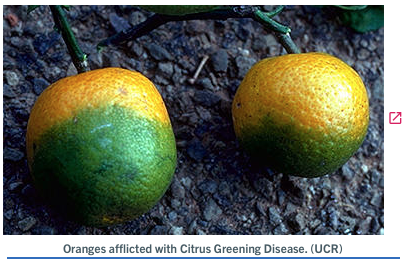
Screen Shot 2020-07-08 at 6.16.59 AMUC Riverside scientists have found the first substance capable of controlling Citrus Greening Disease, which has devastated citrus farms in Florida and also threatens California.

The new treatment effectively kills the bacterium causing the disease with a naturally occurring molecule found in wild citrus relatives. This molecule, an antimicrobial peptide, offers numerous advantages over the antibiotics currently used to treat the disease.

UCR geneticist Hailing Jin, who discovered the cure after a five-year search, explained that unlike antibiotic sprays, the peptide is stable even when used outdoors in high heat, easy to manufacture, and safe for humans.

“This peptide is found in the fruit of greening-tolerant Australian finger limes, which has been consumed for hundreds of years,” Jin said. “It is much safer to use this natural plant product on agricultural crops than other synthetic chemicals.”

Currently, some growers in Florida are spraying antibiotics and pesticides in an attempt to save trees from the CLas bacterium that causes citrus greening, also known as Huanglongbing or HLB.

The Asian citrus psyllid, pictured here, spreads the bacterium that causes Citrus Greening Disease. (Mike Lewis/UCR)

“Most antibiotics are temperature sensitive, so their effects are largely reduced when applied in the hot weather,” Jin said. “By contrast, this peptide is stable even when used in 130-degree heat.”

Jin found the peptide by examining plants such as the Australian finger lime known to possess natural tolerance for the bacteria that causes Citrus Greening Disease, and she isolated the genes that contribute to this innate immunity. One of these genes produces the peptide, which she then tested over the course of two years. Improvement was soon visible.

“You can see the bacteria drastically reduced, and the leaves appear healthy again only a few months after treatment,” Jin said.

Because the peptide only needs to be reapplied a few times per year, it is highly cost effective for growers. This peptide can also be developed into a vaccine-like solution to protect young healthy plants from infection, as it is able to induce the plant’s innate immunity to the bacteria.

Jin’s peptide can be applied by injection or foliage spray, and it moves systemically through plants and remains stable, which makes the effect of the treatment stronger.

The treatment will be further enhanced with proprietary injection technology made by Invaio Sciences. UC Riverside has entered into an exclusive, worldwide license agreement with Invaio, ensuring this new treatment goes exactly where it’s needed in plants.

“Invaio is enthusiastic to partner with UC Riverside and advance this innovative technology for combating the disease known as Citrus Greening or Huanglongbing,” said Invaio Chief Science Officer Gerardo Ramos. “The prospect of addressing this previously incurable and devastating crop disease, helping agricultural communities and improving the environmental impact of production is exciting and rewarding,” he said. “This is crop protection in harmony with nature.”

The need for an HLB cure is a global problem, but hits especially close to home as California produces 80 percent of all the fresh citrus in the United States, said Brian Suh, director of technology commercialization in UCR’s Office of Technology Partnerships, which helps bring university technology to market for the benefit of society through licenses, partnerships, and startup companies.

“This license to Invaio opens up the opportunity for a product to get to market faster,” Suh said. “Cutting edge research from UCR, like the peptide identified by Dr. Jin, has a tremendous amount of commercial potential and can transform the trajectory of real-world problems with these innovative solutions.”