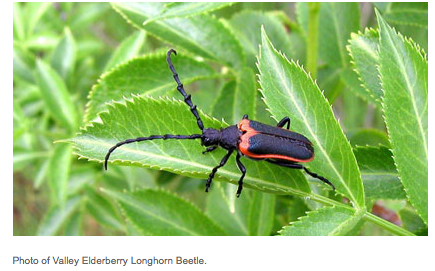
 The U.S. Fish and Wildlife Service has announced a proposed rule to remove the Valley Elderberry Longhorn Beetle from the list of threatened species.
The delisting will be important to landowners, flood control agencies, and irrigation districts as well as municipalities and other agencies throughout the Central Valley as they will no longer be required to seek prior authorization for the incidental take of the once rare beetle.
The beetle depends upon the valley elderberry bush that grows along streams, rivers, flood control channels and irrigation ditches particularly in the Central Valley. To insure the beetle survives these agencies must preserve the habitat for the beetle, the bush.
The federal notice said that at the listing in 1980, it was known from 10 occurrence records at 3 locations:Merced County, Sacramento County, and Yolo County. Currently, it is known from 201 occurrence records at 26 locations, including much of the San Joaquin and Sacramento Valleys from Shasta County in the northern Sacramento Valley to Kern County in the southern San Joaquin Valley. The listing as endangered came after loss of some 90% of the Valley’s original riparian habitat.
In 2010, the USFWS received a petition from the Pacific Legal Foundation requesting that the Service remove the
valley elderberry longhorn beetle, which is currently listed as a threatened species under the Act, from the Federal
List of Endangered and Threatened Wildlife. In 2011, USFWS published a 90- day finding on the petition, which
concluded that the petition contained substantial information that delisting the beetle may be warranted.
“Today’s announcement is good news for California’s economy, for property rights, and for honesty and integrity in environmental regulations,” said Pacific Legal Foundation attorney Damien Schiff, “The beetle isn’t endangered or threatened, so heavy-handed restrictions on landowners and businesses aren’t needed in order to help the beetle.”
Finding some elderberry bush in their way has cost development projects in the region both time and money to mitigate a take of the species if a bush had to be removed.
The Porterville Recorder noted last week that “As a way to mitigate projects in Porterville, the city in 2008 created a safe haven for the insect’s habitat — a mitigation site, which requires the maintenance and monitoring of 58 elderberry trees.
Over the past decade the city has spent an excess of $500,000 on the site along the Tule River off of Highway 190 just west Avenue 274.
City Manager John Lollis said any action to delist the bush would be welcomed by the city.”
The public comment period on the proposed rule is scheduled to close on December 3, 2012.
