
State funds mean more methane digesters & renewable energy pipelines
July 11,2018-
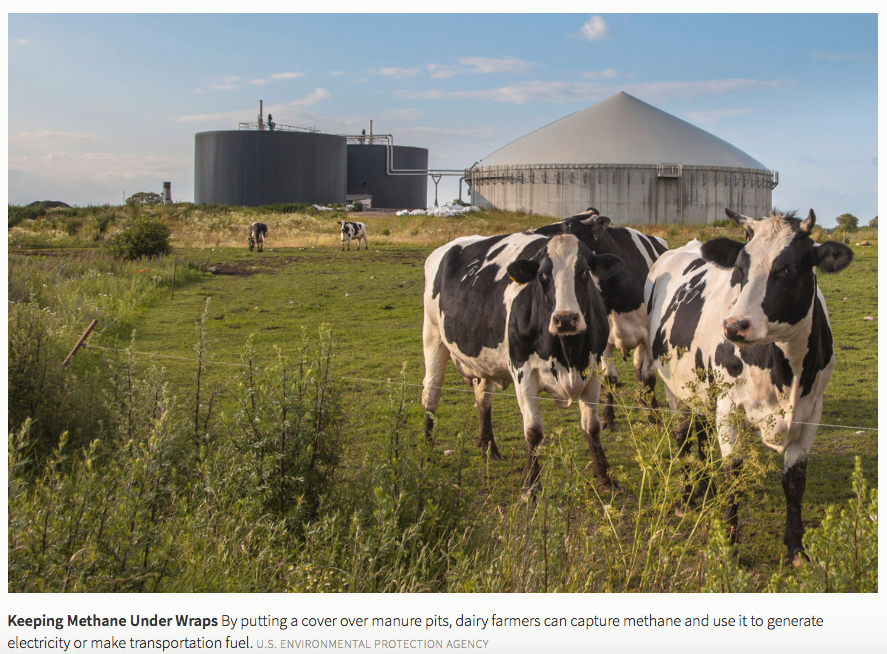
The California Department of Food and Agriculture (CDFA) has awarded $69.9 million in grant funding to 40 dairy digester projects across the state. Scooping up $49 million of that moola, some 28 of those dairies are local, located in Kings or Tulare Counties, scoring about 70% of the award funding. The results of a competitive process were announced July 6.
These projects, part of the Dairy Digester Research and Development Program (DDRDP), will reduce greenhouse gas emissions from manure on California dairy farms. Many of the state’s larger dairies are clustered in this two-county area.
Dairy manure produces methane when it decomposes. Methane is a powerful greenhouse gas that traps more than 80 times as much heat in the atmosphere as carbon dioxide. Dairy digesters help capture methane emissions, which can be used to produce electricity or natural gas.
Capturing the methane helps to reduce not only greenhouse gas emissions but air quality emissions such as VOCs and NH3 that contribute to secondary air pollutants like ozone and particulate matter. Those substances clog the summer air in a sort of gray haze.
Dairies and livestock are the largest sources of methane emissions in the San Joaquin Valley say scientists. Last year the state mandated that larger dairies reduce their methane emissions.
Putting biogas to good use
The strategy in using state funds to help dairies is to turn a problem into an opportunity for California operators who have been going through a tough time with low milk prices.
To make the strategy economical, increasingly the biogas is being sent from a covered digester at the dairy to a central receiving location by pipeline to be injected in the state’s utility natural gas pipeline where it can be used for transportation fuel among other uses.
Trucks including milk delivery tankers can use the renewable fuel to pick and up and deliver milk from the same dairies to the local processing plants.
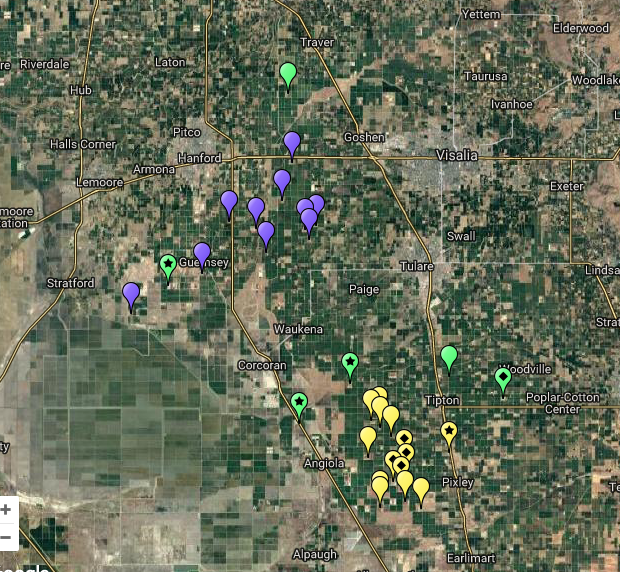
This works particularly well if the dairies can band together to connect to the same SoCalGas injection point.That’s the case with several of these of these clustered projects including several in Tulare County and one in Kings as well as elsewhere.
Already well underway is Calgren Dairy Fuels biogas cluster. This project ties together 14 new dairy digesters who will send all of the biogas to a central hub at Calgren Renewable Fuels in Pixley, an ethanol plant, where it can be used in a multitude of ways.
In April Calgren’s Lyle Schlyer accepted an award for the company from Biomass Magazine – The Groundbreaker of the Year Award. Calgren’s project will be first in the state to hook up renewable natural gas to the nat-gas grid.
In Kings County the Hanford-Lakeside pipeline cluster is covering a 35-mile radius with plans to connect as many as 18 Kings County dairies (a cluster of eight to begin with) to a buried biogas pipeline and the SoCal Gas distribution system in an effort to cut methane emissions.
Developing the pioneering project is Daryl Maas of Mass Energy Works of Redding. He is also working with the Pixley biogas cluster of dairies, connecting eight to 10 of them.
Maas has described his work this way.“I’m passionate about taking waste and making it into something useful,” Daryl says. “It’s just such a great picture of what humans are called to do. But it’s also a business venture. And I love hiring good people, who can go out and create value while providing for their families.”
Maas says the benefit of digesters include the opportunity for dairies to
• Sell electricity or renewable gas to the grid
•Reduce milk price dependence
•Offset electricity costs
•Sell carbon credits
•Local job creation
•Reduce odor from manure
•Contribute to a healthier environment
•Reduce greenhouse gases
•Increase nutrient efficiency
•One cow on your dairy = one car taken off the road
“Dairy operations in California continue to step up to ensure the agriculture sector contributes to climate change mitigation and adaptation. These collaborative efforts between the State, dairy operations and developers are making California a national and international leader in supporting on-farm methane reductions using climate-smart agriculture management approaches that also generate renewable energy,” said CDFA Secretary Karen Ross.
Financial assistance for the installation of dairy digesters comes from California Climate Investments, a statewide initiative that uses Cap-and-Trade program funds to support the state’s climate goals. CDFA and other state agencies are investing these proceeds in projects that reduce greenhouse gas emissions and provide additional benefits to California communities.
Millions in matching funds
Dairy digester grant recipients will provide an estimated $95.5 million in matching funds for the development of their projects.
_______