
June 26,2018-
Some farm goods already see canceled contracts and sales slowdown
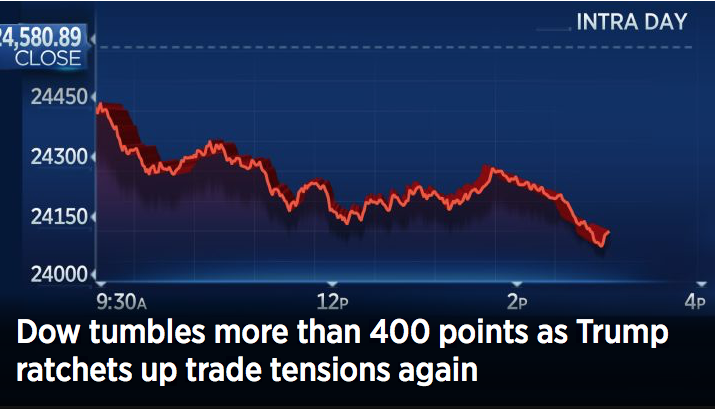
A ballooning trade dispute between the U.S. and its most important trading partners has California farm goods caught in the cross hairs. The jitters over President’s Trump’s policies have affected the larger economy as well this week as seen in that big drop on the Dow.
 Tariffs are being placed on key farm exports from California, some already in effect, piling up this week because Europe,China,Mexico, India and Canada, typically our best customers, are now threatening to increase the pain in coming days.
All are reacting to President Trump’s imposition of US tariffs over steel and aluminum imports.
The worry is that the tariff fight will hurt the US economy with the news that the retaliatory tariff by Europe on Harley Davidson motorcycles made in the US will result in the company moving some manufacturing out of the US. The unintended consequences of a trade war can be seen with this EU retaliatory tariff of 25 percent that will mean a motorbike shipped from the U.S to Europe would now face a tariff of 31 percent, up from 6 percent. That adds another $2,200 per motorcycle, hurting business.
This week President Trump criticized the Wisconsin motorcycle maker.
US farmers facing the same dilemma have limited options to pick up and move their trees and vines, or ship out their cows and pigs to avoid the new duties. Their products are in the ground and will soon be ready to harvest just as export markets are shrinking.
There seem little chance that this trade war can be called off before a July 5 deadline ratchets up the dispute to a full-blown conflict with higher tariffs yet.
Some say we have time. But in many cases it is clear that the escalating trade war has already impacted demand and prices for our farm goods being shipped out now.
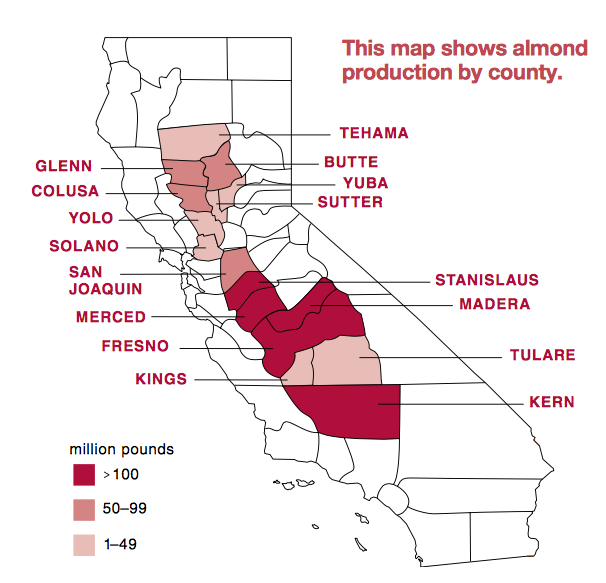
For example as a result of series of tit-for-tat tariff announcements, China is already buying less California-grown walnuts,almonds and pistachios.
Chinese customs began levying additional tariffs April 2, 2018.As of May 2018 exports of almonds to Hong Kong /China were off by about half compared to May 2017. In May pistachio shipments fell off as well from 6.7 million pounds in May 2017 to 4.9 million pounds in May 2018. As for walnuts we are seeing fewer of these nuts going to Hong Kong/China this market year along with India.
Beside nuts, pork producers too are suffering a drop in prices and shipments right now.
China is the third largest importer of U.S. pork, buying a little more than $1 billion worth of product in 2017. Mexico is number one. Mexico’s 10-percent tariff on pork in place now, will jump to 20 percent on July 5, and Mexico is talking to Europe to supply them instead.
What does this mean for hog prices? The USDA’s June 18 livestock, dairy and poultry outlook report expects hog prices to average 19 percent lower in the third quarter and 17 percent lower in the fourth quarter, compared to prices last year
Before all the trade war talk started farmers were already suffering.Net farm income was predicted to drop 6.7 percent to $59.5 billion this year says USDA.
Exports are key to key to keeping crops profitable. Exports make up 15 percent of the U.S. corn crop, 50 to 70 percent of the sorghum crop, 20 percent of pork and 70 percent of almonds, one our top crops in California. Altogether, 20 percent of all farm goods grown in the U.S. are exported.
Mexico, Canada and China are the three largest markets for U.S. agricultural exports accounting for more than 44 percent.
Many of our crops are already suffering the higher duties.
China implemented a 25 percent duty on most U.S. pork items on April 2, and a 15 percent tariff on a range of fruits and nuts, in response to U.S. tariffs on Chinese steel and aluminum products.Now a second round is pending, going into effect July 5 from several of the countries.
Pork now faces cumulative import duties of 71 percent, not including value added tax, according to a formula published on the website of China’s finance ministry. Cumulative duties on fruit amount to 50 percent.
“The additional tariff will put us out of business,” said Zhong Zheng, founder of China-based Heartland Brothers, which sells U.S.-produced Berkshire pork to Chinese supermarkets and restaurants.
Sour news for milk
Mexico is America’s single largest export dairy market, with $1.2 billion in sales last year, according to the U.S. Department of Agriculture. The U.S. Dairy Export Council estimates that the U.S. provides close to 75% of Mexico’s dairy products, which supports nearly 30,000 American jobs. Free trade under NAFTA is working well for both sides say supporters, including most in the US dairy business.
But all that is jeopardy including NAFTA.
Mexico, California’s top trading partner has already imposed a new 10% duty on US cheese and China now proposes a 25% tariff on our milk products starting July 5.
Market are already reacting. This past week milk prices recorded another drop.The weekly California Milk Producers newsletter describes what has happened now. “Cheddar barrels were once again the biggest loser. They plummeted 16.5ȼ to $1.285 per pound, and a whopping 88 loads changed hands. Barrels haven’t been this low since 2010.”
“Most U.S. dairy products face a tax of between 10% and 15% at the Chinese border. Buttermilk is charged a 20% levy, and whey powder is taxed at 6%. Beginning July 6, all U.S. dairy products will suffer a 25% surcharge en route to China.” The additional tariffs are additive to what US milk products already pay to China, essentially a tax that makes our products more expensive than than competitors.
Before now US grown products entered Mexico duty-free because of NAFTA.
China will now tariff milk powder. Among products listed are whole milk powder and skimmed milk powder, two products the U.S. has traditionally sent in large quantities to China, much of it sourced from SJ Valley milk.
“Our dairy farmers are already squeezed between the cost of feed and other farm inputs and stubbornly low global milk prices. Mexico purchases 25 percent of U.S. dairy exports, and it’s a market that we can’t afford to lose ”says Land O Lakes COO, Beth Ford.
Overall, China is the third-largest importer of California produce, after Europe and Canada. In 2016, the last year for which official data are available, the state exported to China some $530 million in pistachios, $518 million in almonds and $133 million in oranges and orange products.
Citrus exports already impacted
The trade blowup has added cost and hassle already impacting California citrus, Tulare County’s number-two crop behind milk.
“We started this year exporting our citrus to China with them imposing an 11% duty” says Joel Nelsen, president of Citrus Mutual.”Then in April they imposed an extra 15% duty, a move that resulted in a number of orders being canceled.”
“Then for a number of weeks port officials carried out some significant harassment of our fruit waiting on the docks, hurting the quality – before they backed off after 6 weeks” he says.
”Now the Chinese are ready to add another 25% tariff making our citrus cost 50% more and opening the door for competitors like Egypt and Spain.”
“If that 50% level holds, it will clearly dry up a lot of business for our growers” concludes Nelsen. He adds that “we begin marketing the fall crop in August.”
According to the Produce Marketing Association prior to additional tariffs, U.S. imported fruit prices averaged higher than Chinese produced fruit and other imports. Wholesale market price reports show U.S.-imported oranges currently priced more than double other imported varieties and higher than the domestic variety, and still U.S. fresh orange imports to China have increased consecutively in the last three years through 2017.
Now the Chinese consumer will face even higher prices.
Tree fruit worries
The Asia Fruit publication reports last week that “Major export categories in the US such as cherries, oranges, grapes, and apples are a few or the items on the April Chinese list”
“Following the announcement, US-based agricultural economist Des O’Rourke said the Washington apple industry (which is on course for its second largest crop on record in 2017/18 at a projected 135m 18kg cartons) could face lower domestic prices in the US while Chinese-grown apples would enjoy less competition in China.”
“Pacific Northwest cherries one market now face the impact of the tariff. Last year, China overtook Canada to become the leading export market for Northwest cherries, taking a record 2.98m cartons. With another record crop on its hands, the US-China trade conflict is a cause for concern for the cherry industry.”
“Imposition of both duties would cause Chinese purchases to fall sharply, he said, and air-freighted cargoes of cherries currently on their way to China would be canceled.”
July is huge month for Central Valley tree fruit ripening just when the higher Chinese tariff goes into effect.
“We just can’t be the punching bag,” said Marcy Martin, director of trade for the California Fresh Fruit Association. “We are not the primary object of this situation with tariffs. It’s aluminum, it’s steel, it’s national security or it’s trade issues. It’s not ag” the Bakersfield Californian newspaper recently reported.
“Martin, at the fresh fruit trade group, said the worry is that fruit scheduled to be shipped soon — peaches, plums, nectarine and apricots — will suffer the same fate as the California oranges that had to be sold at a discount because of the tariffs and inspection slowdown in China.”
Cotton prices wilt
Then there is cotton. Here too, Valley growers are already feeling the pain.The California Farm Bureau reports that California exported $88.5 million worth of cotton to China and Hong Kong in 2016. For the 2017-18 crop year, that value has jumped to about $185 million due to increased shipments. Because China is a “fairly large importer” of pima cotton, which represents the majority of California cotton acreage, Calcot’s Jarral Neeper said the tariff “could have an impact” on state cotton exports. “It could force prices lower here to make up for the difference of the 25 percent tariff,” he said.
The tariff, which goes into effect July 6, is already being felt in California. China imports about 40% of the pima we grow.
“For the crop year that runs through July 31, China has purchased 239,200 bales, or approximately 120 million pounds of the fiber, valued at around $200 million, Marc Lewkowitz, the president and chief executive of Supima, says.
Already, some 205,000 bales have been shipped, leaving a balance of about 34,000 bales for this year in addition to some 34,000 bales of forward contracted cotton sales for the next crop year. “These existing sales along with the entire new crop are at risk relative to the proposed Chinese tariffs,” he said.
California Apparel News reports “Roger Isom, president and chief executive of the California Cotton Ginners & Growers Association in Fresno, Calif., said his organization is hearing stories of China canceling contracts to purchase California cotton.
Cannon Michael, president and chief executive of Bowles Farming Company, which grows Supima and other cotton on land near Los Baños, Calif., said some speculators have pulled out of the market, which has put a damper on cotton prices.”
Other Crops
The Hill newspaper reports that “Exports are critical to agriculture and U.S. farmers face increasing competition for markets from a number of countries, such as Argentina, Ukraine and Russia.
For example, generally 15 percent of the U.S. corn crop, 50 to 70 percent of the sorghum crop, 20 percent of pork and 70 percent of almonds are exported. Overall, 20 percent of all farm commodities produced in the U.S. are exported.
Canada has responded to the U.S. tariffs with 10-percent tariffs on yogurt, ketchup, quiche, pizza, maple syrup, cucumbers and other products, most of which are processed food products.”
India too
The CFB reports that “At the same time, India said it has suspended trade concessions to the U.S. and plans to raise duties on 30 American products worth $241 billion. Agricultural products on that list include: almonds and walnuts, which face additional 20 percent tariffs; apples, with a 25 percent tariff; and chickpeas and lentils, with 10 percent tariffs. The additional duties — in retaliation for U.S. tariffs on steel and aluminum imports — were scheduled to take effect June 21.
India is the seventh-largest export destination for California agricultural products sayCDFA. India bought $489.9 million of our almonds in 2016.
Nuts & Wine
Pistachios are California’s biggest agricultural export to China, which bought $531 million worth of the nuts in 2016. Prior to the new tariffs, China had existing duties of 5 percent on raw pistachios and 10 percent on US roasted pistachios.
The additional 15 percent tariff “impacts our ability to compete with our competitors from Iran,” said pistachio trade group’s Richard Matoian. California and Iran over the years have traded the title of world’s top pistachio producer, he added.
Almonds are China’s second-biggest import from California farms. In 2016, China took 12 percent of California’s almond crop valued at $518 million.
The Chinese levy on U.S. almonds goes up from 10 percent to 25 percent, said Richard Waycott, president and chief executive of the Almond Board of California.
The April levy on wine increased the total tariff and tax paid on a bottle of U.S. wine imported into China from 48.2 percent to 67.7 percent.
The US, mostly California, exported $79 million worth of wine to China last year, according to the Wine Institute.
“This is a very sobering development for California agriculture, particularly since we’re so dependent on the export market to provide an outlet for the abundance of products that we produce,” said Joel Karlin, commodity manager and market analyst for Western Milling in Goshen.”
“Any chances of us exporting milk powders or cheese or any fraction of milk products to China have basically gone out the window,” Karlin said.
How will farmers respond to this raid on their pocketbooks?
More than twice as many jobs are exposed to Chinese tariffs in counties that voted for Trump in 2016 as in areas that backed Hillary Clinton, according to the Brookings Institution.
“A lot of people in the ag community were willing to give President Trump the benefit of the doubt,” said Brian Kuehl, executive director of Farmers for Free Trade. “The reason you are seeing people increase the pressure now is because the pressure is increasing on them. Now the impact is really starting to hit. It is not something you can just take lightly.”
His group, along with the U.S. Apple Association, ware running TV ads on attacking Trump’s tariffs in Pennsylvania and Michigan, apple-growing states that could play a role in which party controls Congress after the November elections.
Trump, a Republican, has said farmers will not become a casualty in any trade war, suggesting the administration will subsidize those hurt by tariffs. Citrus Mutual’s’ Nelsen says they are counting on some help for their growers.
Will farmers stick with Trump?
One Valley irrigation district manager expects some rumbles.”You are in the Central Valley, a Republican hotbed. Farmers here want to give Trump the benefit of the doubt. But if these guys start to feel it in their pocketbook – that sentiment will evaporate quickly.”
US ag secretary Sonny Perdue says”There is no denying that the disruption in trade relations with China is unsettling to many in agriculture, but if the president succeeds in changing China’s behavior, America’s farmers will reap the benefits.”
The Washington Post published a graphic on which parts of the nation are most affected by tariffs. They include Fresno County, Calif.; Parmer County, Texas; Scott County, Miss.; and Dooly County, Ga.
Cash flow swing
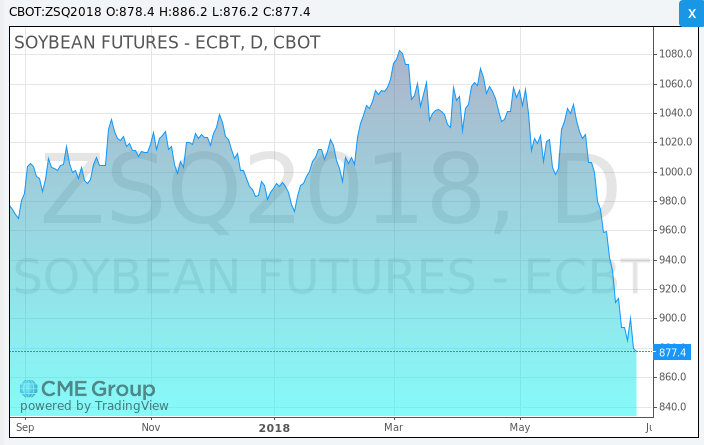 Corn and soybean farmers have seen their prices plunge as this trade war has set in.So How Much Damage Did Recent Price Movements Do to Projected Corn and Soybean Returns?
One economic study says After reaching contract highs toward the end of May, both new crop corn and soybean prices sank toward contract lows during the third week of June 2018. These price swings resulted in a large shift in the expected profitability of both crops. Agricultural Economic Insights calculates that in the last month a 2,700 acre farm would have experienced a $210,600 swing in cash flow.