
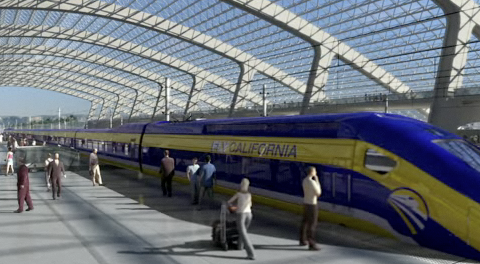
 A key state Senate vote last week made it clear – California High Speed Rail will likely be built starting next spring coming through the Central Valley whether farmers and GOP politicians oppose it or not.
After the Assembly gave their OK Thursday by a large margin, the Senate barely passed the modified SB 1029 “rail modernization” bill by a dramatic one vote majority Friday. The legislation, backed by Governor Jerry Brown, but opposed by all Republicans, authorizes spending $1.9 billion of voter-approved Prop 1A bonds and $3.3 billion in federal grants to begin construction of the proposed Central Valley high-speed rail line. The line will eventually connect the state with a new 220mph electrified passenger train system.
After the nail biter of a vote, Brown said “In 2008, California voters decided to create jobs and modernize our state’s rail transportation system with a major investment in high-speed rail and key local projects in Northern and Southern California. The Legislature took bold action today that gets Californians back to work and puts California out in front once again.”
Winning by one vote was deja vu all over again for Brown whose father won a key legislative battle by one vote to build an equally controversial public works program – the now hugely popular State Water Project.
The revised CHSR rail plan lowers the total cost from an anticipated $100 billion to $68 billion and in an effort to get support in the state legislature from major population centers offered to do $800 million in rail connections in the larger metro areas simultaneously as the first Central Valley segment is built.
“Our new plan makes major investments in regional and local rail systems throughout the state,” said CHSRA chair Dan Richard in a statement. “In the BART system, MUNI, Caltrain, Transbay Terminal, the ACE train in the Central Valley, Metrolink in Los Angeles, the Los Angeles to San Diego Amtrak service…all of these things will benefit from the investment program that high-speed rail is leading.”
Farmer Opposition
But farmer critics of the plan refuse to give up their battle to junk the train while others in the Central Valley are busy this week figuring out how to plan to connect to the new transportation system that will have stations in Fresno,Bakersfield and likely Hanford/Tulare County.Pending now, just where in the Central Valley will CHSRA decide to place a 1500 job heavy maintenance station and will Hanford /Tulare County get a station?
Just before the July 6 vote, the California Farm Bureau voted to oppose the project due to loss of farmland and impacts on rural communities in places like Kings County where opposition has been particularly strong.
“The high-speed rail system would change the landscape for generations across some of the most productive agricultural counties in the United States,” California Farm Bureau President Paul Wenger said. “We understand the need for transportation projects, but we should not needlessly sacrifice food production, family farmers and workers who depend on agricultural jobs.”
Wenger noted that the bond measure authorizing construction of the high-speed rail system stressed the goal to build the system along existing transportation corridors where practical. Instead, the proposed route for high-speed rail cuts through farms and ranches, requires numerous road closures and bisects canals and other water delivery systems.
“A rural road or a canal may look insignificant to a planner studying a map, but those roads and canals support farms, ranches and rural communities,” Wenger said. “The High-Speed Rail Authority has seen farmland as the path of least resistance. But farmers and ranchers are resisting. The authority needs to address the impacts that high-speed rail will force on rural communities.”
Two county Farm Bureaus—in Madera and Merced counties—are plaintiffs in a lawsuit challenging the environmental review of the Merced-to-Fresno route for the rail project. The Kings County Farm Bureau has joined county officials in expressing concerns about the impact on farmland along the proposed Fresno-to-Bakersfield route.
“In the past, California Farm Bureau has said we support the concept of high-speed rail as long as it conserves irreplaceable farmland, avoids premature conversion of farmland for urban sprawl, and complies with established environmental law. As of now, the proposed system does not meet any of those goals and we can’t support it until it does,” Wenger said.
Legal Battle Already Underway
Translation – get ready for a hard fought legal battle now that the funding has been authorized. Indeed it is already well underway.
As of last month three complaints have been filed in the Sacramento Superior Court that challenge the Merced to Fresno route section over inadequate environmental review. This would be the first leg of the bullet train’s construction. Plaintiffs include the City of Chowchilla and County of Madera. A ruling on the merits of the petitions is expected in early 2013, before the expected start of construction in the spring of 2013 say legal experts.
“We are going to protect our property,” said Frank Oliveira, a farmer and leader of the Central Valley group Citizens For California High-Speed Rail Accountability. “Somebody is coming into our area, and they are going to seize our property and say we don’t have a choice in the matter.” Oliveira told a reporter.
Both sides in this ideological battle are determined to fight this out. The law allows the taking of farmland to run a road or rail line and allows other negative impacts,noise ,dust etc, as long as those impacts are mitigated, reduced to the degree possible and compensated for.
The upshot is the California Environmental Quality Act(CEQA) under which the plaintiffs are and will be suing the CHSRA over does not pave the way to kill the project but simply delay it until whatever court recognized shortcomings of the plan are fixed.
Already, a court found last month a Kings County suit did not pass muster but offered a chance for them to amend the suit.
Rubio’s Role
On the other side of the coin Senator Michael Rubio (D- Shafter) who represents Kings County and who arguably cast the deciding vote last week has sought to mollify critics of the project. He released this statement.
“Earlier today, I voted in favor of funding the initial phase of the high speed rail project because it provides the Central Valley with critical transportation dollars and includes provisions that protect agriculture.
I laid out early on a set of two requirements that I expected the project to meet before I would consider supporting high speed rail funding. The project needed to:
1.) Exhibit greater accountability. The Governor replaced the CEO and Chairman of the Authority and language was adopted to increase reporting and accountability.
2.) Appoint an Agriculture Czar. The Authority will develop an agriculture industry committee—headed by an individual from the Central Valley—that includes California Department of Food and Agriculture Secretary Karen Ross.
The construction of the Central Valley segment will create about 100,000 year-long jobs in the Valley. Unemployment rates in Fresno, Kern, Kings and Tulare Counties are unacceptable and high speed rail guarantees jobs for the Central Valley.”
Rubio’s decision may not be a popular one in Kings County although the district includes friendlier landscape in Kern County as well.Rubio does not have run again until 2014.
What Route?
After the vote the debate over elements of the big project continues this week.The LA Times reported Monday that The French railway recommended that the state build the rail line along the Interstate 5 corridor and partner with it or another foreign firm to hold down costs in 2010.But the CHSRA rejected the idea.
One commenter offered”The whole point of HSR is to be a viable, practical alternative to air travel. If I’m traveling from L.A. to San Francisco, I want the quickest route and no detours to places like Fresno.”
Still, Valley supporters of the planned rail route through Fresno on the Valley’s east side want their millions of constituents to enjoy access and the benefits of a rail stop and not simply be a bystander to fast train service between LA and SF. As of now, the train on this route would take your from SF to LA in 2 hrs 40 minutes.
The CHSRA has also rejected the idea of running the train down Hwy 99,popular among farm critics and some cities on the eastside like Visalia and Hanford but they have rejected that route as too costly with strong opposition from Union Pacific Railroad.
Ready to build along the currently proposed route, CHSRA chair Dan Richard remains a true believer on a project he insists will attract private investment and help clean the air.
“Not only will California be the first state in the nation to build a high-speed rail system to connect our urban centers, we will also modernize and improve rail systems at the local and regional level. This plan will improve mobility for commuters and travelers alike, reduce emissions, and put thousands of people to work while enhancing our economic competitiveness,” said CHSRA chair Richard .